RAMSY Deconvolution: A Statistical Framework for Resolving Overlapping Peaks in Mass Spectrometry-Based Metabolomics
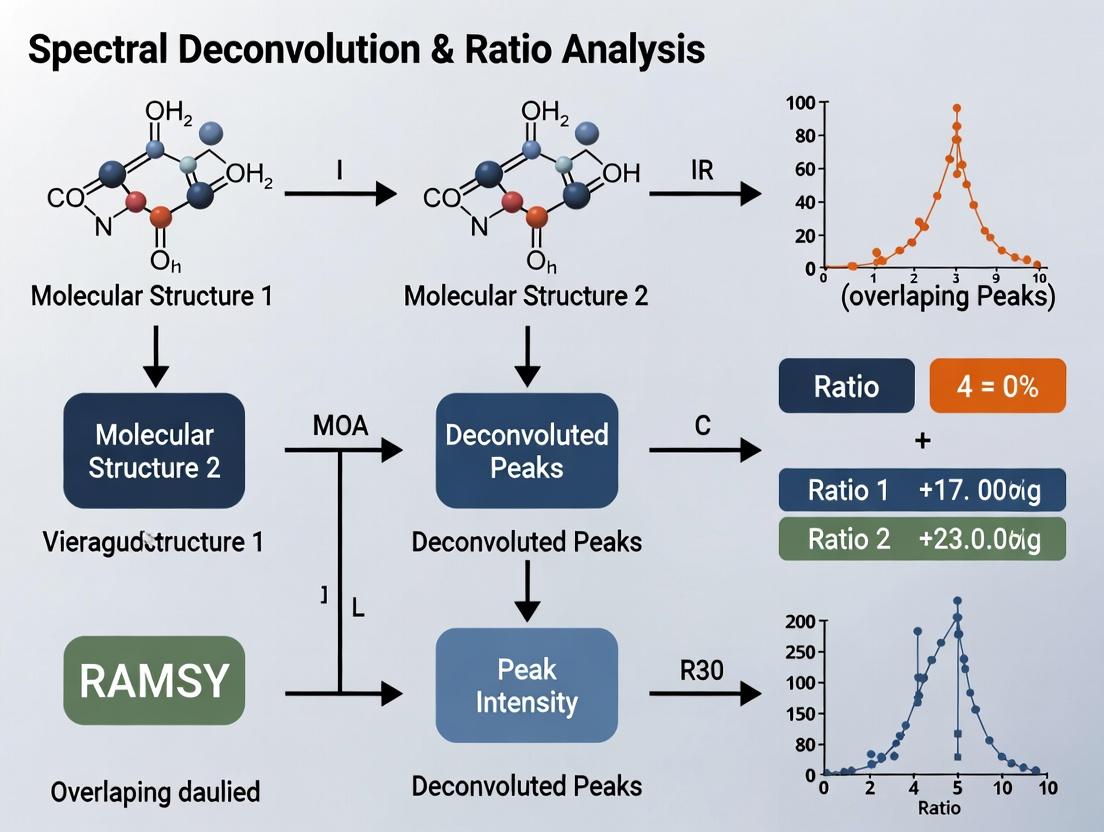
This article provides a comprehensive guide to Ratio Analysis of Mass Spectrometry (RAMSY), a powerful statistical deconvolution technique for improving compound identification in complex biological samples.
RAMSY Deconvolution: A Statistical Framework for Resolving Overlapping Peaks in Mass Spectrometry-Based Metabolomics
Abstract
This article provides a comprehensive guide to Ratio Analysis of Mass Spectrometry (RAMSY), a powerful statistical deconvolution technique for improving compound identification in complex biological samples. Aimed at researchers and drug development professionals, it covers the foundational theory of RAMSY, which exploits constant peak-intensity ratios within a metabolite's spectrum. The article details practical methodological workflows for GC-MS and LC-MS/MS data, strategies for troubleshooting and optimizing the analysis, and a comparative evaluation against other deconvolution methods. By synthesizing these aspects, the article demonstrates how RAMSY enhances the reliability of metabolomics studies and outlines its future potential in biomedical research.
Understanding RAMSY: The Core Principle of Ratio Analysis for Spectral Deconvolution
The Challenge of Overlapping Peaks in Complex Metabolomics Samples
Technical Support & Troubleshooting Center
This technical support center is designed within the context of ongoing thesis research on spectral deconvolution via Ratio Analysis of Mass Spectrometry (RAMSY) for resolving overlapping peaks. It provides researchers, scientists, and drug development professionals with targeted troubleshooting guides and FAQs to address common experimental challenges in complex metabolomics analyses [1] [2].
Troubleshooting Guide: Common Chromatographic and Deconvolution Issues
This guide addresses practical problems that compromise spectral clarity and deconvolution success.
Problem Category 1: Poor Chromatographic Peak Shape Poor peak shape (tailing, fronting, splitting) reduces resolution, making deconvolution more difficult [3].
- Issue: Peak Tailing
- Symptoms: Asymmetrical peaks with a prolonged trailing edge. Measured tailing factor (Tf) > 1.5 [3].
- Primary Causes & Fixes:
- Active Sites in Inlet/Column: Replace inlet liner or trim 10-20 cm from the column front [3].
- Poor Column Installation: Re-cut the column end squarely and re-install to the correct depth in the inlet [3].
- Chemical Interactions: For persistent tailing of specific analytes, consider derivative chemistry (e.g., methoximation and silylation for metabolites) [1].
- Issue: Peak Fronting
- Symptoms: Asymmetrical peaks with a leading edge. Indicates column overload [3].
- Primary Causes & Fixes:
- Issue: Peak Splitting
- Symptoms: A single peak exhibits two or more apices [3].
- Primary Causes & Fixes:
- Inlet/Column Issues: Check column cut and positioning (if all peaks split) [3].
- Splitless Injection Problems: Ensure the initial oven temperature is ~20°C below the solvent boiling point for effective cold trapping [3].
- Solvent/Stationary Phase Mismatch: Use a solvent compatible with the column chemistry (e.g., avoid hexane on a Wax column) [3].
Problem Category 2: Failure of Spectral Deconvolution When software fails to resolve co-eluting compounds, a systematic approach is needed.
- Issue: AMDIS Yields High False-Positive Rates or Misses Metabolites
- Symptom: Many incorrect library matches or low Match Factors (MF) [1].
- Investigation Protocol:
- Parameter Optimization: Do not use default settings. Employ a factorial design to optimize AMDIS parameters (component width, shape requirements, resolution) for your specific instrument and sample type [1].
- Apply Heuristic Filters: Use a Compound Detection Factor (CDF) or similar metric to filter results and reduce false positives [1].
- Supplement with RAMSY: For challenging overlapping peaks, apply RAMSY as a complementary "digital filter" to recover low-intensity ions from co-eluted compounds [1].
- Issue: RAMSY Cannot Deconvolute Fully Overlapping Peaks
- Symptom: Algorithm fails when two analytes have identical retention times.
- Investigation Protocol:
- Understand the Limitation: Thesis research confirms RAMSY's primary strength is in resolving partially overlapping peaks by leveraging ratio consistency across spectra. It may not separate perfectly co-eluting signals [4].
- Improve Chromatography First: The primary solution is to improve chromatographic resolution by modifying the temperature gradient, column type, or method duration.
- Explore Hybrid Approaches: Develop a workflow where RAMSY processes data pre- or post-AMDIS application, or integrate it with other chemometric tools in an R-based pipeline [4].
Problem Category 3: Mass Accuracy and Calibration Drift Inaccurate m/z measurement undermines all downstream identification.
- Issue: Mass Shift or Poor Accuracy in LC-MS or GC-MS
- Primary Causes & Fixes:
- Incorrect Calibration: Use a calibration solution appropriate for your mass range and analyte polarity. For highest accuracy, use internal calibrants that bracket your analyte m/z [5].
- Instrument Contamination: Regularly clean ion sources and mass analyzers. Contamination can cause shifting calibration and peak shape issues [5].
- Space Charge Effects (Ion Traps): Tune instrument methods to avoid over-filling the trap, which can shift m/z values [5].
- Primary Causes & Fixes:
Frequently Asked Questions (FAQs)
Q1: In my HPLC analysis, 2-3 key analyte peaks are overlapping. How can I improve separation? [6]
A: Resolution is governed by selectivity (difference in retention) and efficiency (peak width). systematically:
- Adjust Selectivity: Modify the mobile phase (pH, buffer strength, organic modifier), gradient steepness, or column temperature [6].
- Check Column Efficiency: If the column is old or damaged, efficiency drops. Compare to a reference chromatogram or a new column. Perform column cleaning or replacement [6].
- Verify Method Integrity: Ensure the correct method, eluent composition, and column are being used. Prepare fresh solvents and equilibrate the system thoroughly [6].
Q2: My deconvolution software (AMDIS) returns many potential compounds for one peak. How do I determine the correct one? [1] [2]
A: Use orthogonal filtering criteria:
- Retention Index (RI): Use a homologous series (e.g., FAMEs) to calculate a linear retention index for the unknown peak. Filter library matches by RI, which is more reproducible than absolute retention time [1].
- Match Factor (MF) & Heuristic Filters: Ignore matches with low MF. Apply a heuristic like the Compound Detection Factor (CDF = (Reverse Match Factor * RI Match Factor) / 100) to prioritize high-confidence identifications [1].
- Apply RAMSY: Use RAMSY to generate a "cleaner" spectrum for the target compound by suppressing ions from co-eluting interferents, then re-run the library search on the RAMSY output [2].
Q3: What are the main advantages of RAMSY over correlation-based methods like STOCSY? [2]
A: RAMSY operates on the principle of constant intensity ratios for fragments from the same metabolite across a chromatographic peak. Correlation methods (e.g., STOCSY) identify peaks from the same compound based on covariance across many samples. RAMSY is often more effective because:
- It requires only the spectra within a single chromatographic peak, not a large sample set.
- It is less susceptible to spurious correlations from biologically linked but distinct metabolites.
- It directly produces a simplified spectrum for easier library matching [2].
Q4: Can I use RAMSY with LC-MS/MS data, or is it only for GC-MS? [2]
A: The RAMSY algorithm is platform-agnostic. The foundational research demonstrates its successful application to both GC-MS (using EI fragmentation) and LC-MS/MS data [2]. The key requirement is multiple mass spectra (scanning MS1 or MS2) across the chromatographic peak of interest to calculate stable intensity ratios.
Experimental Protocols & Methodologies
Core Protocol: GC-MS Metabolomics with RAMSY-Assisted Deconvolution [1] [2]
This protocol is adapted from key research applying RAMSY to plant and plasma metabolomics.
1. Sample Preparation (Rat Plasma Example):
- Protein Precipitation: Mix 100 μL plasma with 200 μL methanol. Vortex, incubate at 4°C for 30 min, centrifuge (13,000 rpm, 10 min). Repeat extraction on pellet, combine supernatants [2].
- Drying: Evaporate combined supernatant to complete dryness under vacuum [2].
- Derivatization:
- Internal Standard: Add retention index markers (e.g., FAME mix or d27-myristic acid) prior to GC-MS analysis [1] [2].
2. GC-MS Analysis:
- System: Agilent 7890A GC / 5975C MSD [2].
- Column: DB-5MS or equivalent (30 m x 250 µm x 0.25 µm) [2].
- Injection: 1 μL, split mode (10:1) [2].
- Oven Program: Start at 60°C, ramp to 325°C [2].
- Ionization: Electron Impact (EI) at 70 eV [1].
3. Data Processing Workflow:
- Step 1 - AMDIS Deconvolution: Process raw data through AMDIS using optimized parameters (not defaults) determined via experimental design for your matrix [1].
- Step 2 - Initial Identification & Filtering: Match deconvoluted spectra against standard libraries (e.g., NIST, Fiehn). Apply CDF filter to reduce false positives [1].
- Step 3 - Targeted RAMSY on Problematic Peaks: For peaks with low MF or suspected co-elution, apply the RAMSY algorithm:
- Select a "driving peak" (m/z known or suspected to belong to the target compound).
- Calculate ratio matrix (D): Di,j = Xi,j / Xi,k where Xi is spectrum i, j is any m/z, and k is the driving peak [2].
- Compute RAMSY vector (R): Rj = mean(D,j) / std(D_,j). High R values indicate m/z belonging to the same compound as the driving peak [2].
- Step 4 - Re-identification: Use the RAMSY-purified spectrum for a second, more confident library search.
Performance Summary of Deconvolution Strategies
| Deconvolution Method | Principle | Key Strength | Key Limitation | Best For |
|---|---|---|---|---|
| AMDIS (Empirical) | Peak model fitting and spectral purity | Fast, automated, well-established [1] | High false-positive rate (~70-80%) with defaults; struggles with severe overlap [1] | Initial processing of complex data; requires parameter optimization [1] |
| RAMSY (Statistical) | Constant intensity ratios across a peak | Suppresses interfering ions from co-eluters; simplifies spectra [1] [2] | Less effective for perfectly co-eluting (RT-identical) compounds [4] | Resolving partially overlapping peaks; clarifying spectra for library matching [1] [2] |
| Hybrid (AMDIS+RAMSY) | Sequential empirical and statistical filtering | Reduces false positives; recovers metabolites missed by AMDIS alone [1] | More complex workflow; requires user input | Optimal dereplication in complex samples like plant extracts [1] |
The Scientist's Toolkit: Essential Research Reagents & Materials
| Item | Function & Importance in RAMSY/Deconvolution Research | Example/Supplier |
|---|---|---|
| Fiehn GC-MS Metabolomics Standards Kit | Provides fatty acid methyl ester (FAME) mix for Retention Index (RI) calibration, critical for orthogonal compound identification post-deconvolution [1] [2]. | Agilent Technologies [1] |
| Derivatization Reagents: MSTFA (+1% TMCS) | Trimethylsilylating agent. Increases volatility and thermal stability of metabolites for GC-MS. Essential for detecting sugars, acids, etc. [1] [2] | Sigma-Aldrich [1] |
| Derivatization Reagents: Methoxyamine hydrochloride | Performs methoximation. Protects carbonyl groups and reduces tautomerization, giving single, sharp peaks for sugars and ketones [1] [2]. | Sigma-Aldrich [1] |
| Deuterated Internal Standard (e.g., Myristic acid-d27) | Internal standard for retention time locking (RTL) and semi-quantification. Ensures run-to-run retention time stability [2]. | Provided in Fiehn Kit or Sigma-Aldrich [2] |
| NIST Mass Spectral Library | Primary reference database for identifying EI mass spectra generated after deconvolution (by AMDIS or RAMSY) [1] [2]. | National Institute of Standards and Technology |
| AMDIS Software | The industry-standard software for empirical deconvolution of GC-MS data. Serves as the foundational tool in the hybrid workflow [1]. | NIST (Free) |
| R/Python Environment with RAMSY Code | For implementing the custom RAMSY algorithm, building hybrid pipelines, and integrating with other omics data analysis tools [4]. | Open-source (R, Python) |
Visualization of Workflows and Concepts
RAMSY Algorithm Workflow for Spectral Simplification
Hybrid AMIDS-RAMSY Workflow for Complex Samples
RAMSY Technical Support Center
Troubleshooting Guides
Issue 1: Poor Deconvolution Accuracy in Complex Biological Matrices
- Problem: RAMSY analysis yields inconsistent or implausible ratios for target analytes in plasma/serum samples.
- Diagnosis: Likely caused by isobaric interferences or high background chemical noise overwhelming the isotopic pattern of the target peaks.
- Solution: Implement a more selective sample preparation (e.g., immunoaffinity depletion, specific solid-phase extraction) prior to LC-MS/MS analysis. Re-optimize the chromatographic separation to increase the retention time difference between the target and interfering species.
Issue 2: Excessive Noise in the Calculated Ratio Trace
- Problem: The extracted ratio trace over the chromatographic peak is noisy, hindering precise determination of the plateau region.
- Diagnosis: Insufficient signal-to-noise (S/N) ratio for the minor isotopic peak used in the ratio calculation. Could be due to low analyte abundance or instrument sensitivity.
- Solution: Increase the injection amount if possible. Optimize MS source parameters (e.g., ion spray voltage, source temperature) for the specific analyte. Consider using a higher resolution or more sensitive mass spectrometer to improve S/N for the isotopic peaks.
Issue 3: Calibration Drift Affecting Ratio Stability
- Problem: The measured ratio for a constant standard shows drift over the sequence run.
- Diagnosis: Gradual alteration in instrument response (e.g., source contamination, detector aging) differentially affecting the intensities of the two monitored m/z channels.
- Solution: Incorporate frequent, bracketing quality control (QC) standards of known ratio throughout the sequence. Perform regular source maintenance. Apply post-acquisition correction based on QC values if drift is consistent and linear.
Frequently Asked Questions (FAQs)
Q1: What is the fundamental difference between NMR's RANSY and MS's RAMSY? A1: RANSY (Ratio Analysis of NMR SpectroscopY) exploits scalar (J-) coupling networks in NMR to deconvolve overlapping signals. RAMSY (Ratio Analysis of Mass SpectromY) translates this core concept to mass spectrometry by utilizing the fixed, predictable isotopic coupling within a molecule's isotopic pattern to deconvolve overlapping ion chromatograms, without requiring MS/MS fragmentation.
Q2: When should I use RAMSY instead of traditional MS/MS quantification? A2: RAMSY is particularly advantageous when: 1) Analytes co-elute and produce interfering fragment ions in MS/MS (insufficient selectivity), 2) The molecule fragments poorly, yielding low MS/MS sensitivity, or 3) You need to perform "post-acquisition" deconvolution on data where a specific MS/MS transition was not originally targeted.
Q3: What are the minimum resolution and mass accuracy requirements for RAMSY? A3: RAMSY requires sufficient resolution to distinguish the isotopic peaks used in the ratio (e.g., M and M+1, or M and M+2). A resolution of 20,000-30,000 (FWHM) is typically adequate for small molecules (<1000 Da). High mass accuracy (<5 ppm) is crucial for correct peak assignment and integration.
Q4: How do I validate the accuracy of RAMSY deconvolution for my method? A4: Validate by analyzing: 1) Individual analyte standards to establish the "true" isotopic ratio, 2) Artificial mixtures of analytes at known ratios to assess deconvolution accuracy and linearity, and 3) Spiked matrix samples to determine precision, accuracy, and limit of quantification in the biological context.
Core Experimental Protocol: RAMSY Deconvolution for Co-eluting Analytes A and B
Principle: Exploit unique natural isotopic signatures (e.g., different [M]/[M+2] ratios due to Cl/Br atoms or 13C distribution) to mathematically resolve contributions from two co-eluting compounds to the summed ion chromatogram.
Materials: Pure standards of Analytes A and B; stable isotope-labeled internal standards (if available); appropriate LC-MS system (high-resolution preferred).
Procedure:
- System Calibration: Tune and calibrate the mass spectrometer for optimal resolution and mass accuracy.
- Individual Standard Analysis:
- Infuse/inject pure Analytes A and B separately.
- For each, acquire high-resolution full-scan or selected ion monitoring data.
- Determine the characteristic isotopic ratio (R): For each analyte, calculate its reference ratio
R_true = Intensity of Peak M / Intensity of Peak M+x(where M+x is a distinct, less abundant isotopic peak, e.g., M+2 for chlorine-containing compounds).
- Mixture Analysis:
- Prepare and inject samples containing mixtures of A and B.
- Extract ion chromatograms (XICs) for the m/z values corresponding to Peak M (common to both A and B) and Peak M+x (unique or distinct for each).
- RAMSY Calculation:
- At each time point (i) across the co-eluting peak, the observed intensities are sums:
I_M(i) = I_M,A(i) + I_M,B(i)I_M+x(i) = I_M+x,A(i) + I_M+x,B(i)
- Using the predetermined
R_true,AandR_true,B, set up a system of two equations to solve for the individual contributionsI_M,A(i)andI_M,B(i).
- At each time point (i) across the co-eluting peak, the observed intensities are sums:
- Deconvolution & Quantification:
- Solve the equations for each time point to generate deconvoluted chromatographic peaks for A and B.
- Integrate the deconvoluted peaks. Use a calibration curve (prepared with pure standards) or a stable isotope-labeled internal standard for absolute quantification.
Comparative Data: RAMSY vs. Traditional MS/MS
Table 1: Performance comparison for the quantification of two co-eluting pharmaceutical compounds in rat plasma.
| Parameter | Traditional SRM (MS/MS) | RAMSY (High-Resolution MS) | Notes |
|---|---|---|---|
| Selectivity | Moderate (Fragment ion interference) | High (Isotopic pattern deconvolution) | RAMSY effective where SRM channels overlapped. |
| Linear Range | 1-1000 ng/mL | 5-500 ng/mL | RAMSY slightly less sensitive due to reliance on minor isotopic peak. |
| Accuracy (% Bias) | -15.2 to +12.8% (at LLOQ) | -4.5 to +6.3% (at LLOQ) | RAMSY more accurate at low levels due to reduced background interference. |
| Precision (% RSD) | 8.5-14.1% | 3.8-7.9% | RAMSY demonstrates superior precision across the range. |
| Data Interrogation | Targeted only | Post-acquisition & Targeted | RAMSY ratios can be calculated post-run from full-scan data. |
Visualization of Workflows and Logic
Title: RAMSY Experimental Data Analysis Workflow
Title: Core Mathematical Logic of RAMSY Deconvolution
The Scientist's Toolkit: Key Research Reagent Solutions
Table 2: Essential Materials for RAMSY Method Development and Application
| Item | Function in RAMSY Analysis |
|---|---|
| High-Purity Analytic Standards | Required to determine the characteristic, reference isotopic ratio (R_true) for each pure compound under experimental conditions. |
| Stable Isotope-Labeled Internal Standards (SIL-IS) | Ideally labeled with 13C or 15N, providing a distinct isotopic signature not found in nature. Used for normalization to correct for ionization efficiency and matrix effects, improving accuracy. |
| High-Resolution Mass Spectrometer | Platform (e.g., Q-TOF, Orbitrap) capable of resolving closely spaced isotopic peaks and providing high mass accuracy for confident peak assignment. |
| Chromatography Columns | UPLC/HPLC columns providing high peak capacity to maximize separation and minimize the degree of overlap requiring deconvolution. |
| Deconvolution Software | Custom scripts (e.g., Python, R) or software with matrix algebra capabilities to implement the RAMSY calculation across the chromatographic peak. |
| Complex Matrix Simulants | Control matrices (e.g., stripped plasma, tissue homogenates) for preparing calibration standards and validating method selectivity and robustness. |
Technical Support Center: Spectral Deconvolution & RAMSY Analysis
This support center is designed for researchers applying Ratio Analysis of Mass Spectrometry (RAMSY) and related spectral deconvolution techniques within metabolomics and drug development. It addresses common practical challenges encountered when working with the core principle that, under consistent experimental conditions, the intensity ratios between mass fragments or spectral peaks from the same metabolite are constant [2].
Frequently Asked Questions (FAQs)
1. Q: What is the fundamental principle behind RAMSY, and why is it effective for deconvoluting overlapping peaks? A: RAMSY operates on the core theoretical principle of the constancy of intra-metabolite peak ratios. For a given metabolite, the intensity ratios between its different mass spectral fragments remain relatively constant across the chromatographic peak profile. In contrast, ratios between fragments from co-eluting, different metabolites will vary significantly. By calculating the quotient of the mean and standard deviation of these ratios across multiple scans, RAMSY statistically isolates peaks belonging to the same compound. This method effectively suppresses interfering signals from overlapping compounds, leading to cleaner spectra for identification [2].
2. Q: When should I use RAMSY over traditional correlation-based methods like STOCSY? A: RAMSY is generally preferred when your goal is to isolate all signals belonging to a single, specific metabolite from a complex background, particularly in mass spectrometry data. Correlation methods can produce complex networks of correlations between many metabolites, making it difficult to distinguish which correlations are meaningful for a single compound. RAMSY's ratio constancy principle provides a more direct and statistically robust filter for isolating a single metabolite's signature, often yielding better performance in reducing spectral interference [2].
3. Q: My deconvolution software (e.g., AMDIS) sometimes splits what I know is one compound into two components. How should I handle this? A: This is a common issue, often caused by peak tailing, low signal-to-noise ratios, or a fluctuating baseline [7]. Before processing:
- Adjust Deconvolution Parameters: Increase the "Component Width" setting to inform the algorithm that peaks may be wider. Conversely, if set too high, try decreasing it slightly [7].
- Exclude Noisy Ions: Identify and exclude high-background or common ions (e.g., m/z 60 in some GC-MS analyses) from being used as "model peaks" for deconvolution. This can stabilize the baseline and prevent erroneous splitting [7].
- Post-Processing Decision: If the problem persists, compare the areas of the split components. If they heavily overlap, simply adding areas may overestimate concentration. Often, selecting the component with the larger, more well-defined area provides the best estimate [7].
4. Q: Can the constancy of intra-metabolite ratios be applied outside of mass spectrometry? A: Yes, the underlying principle is universal for spectroscopic techniques. It was first formalized as Ratio Analysis of Nuclear Magnetic Resonance Spectroscopy (RANSY) for NMR data before being successfully extended to MS as RAMSY [2]. The concept is also relevant in other areas where signal separation is needed, such as in separating metabolite and macromolecule signals in short-echo-time magnetic resonance spectroscopic imaging (MRSI) [8].
5. Q: What are the critical experimental factors that could undermine the constancy of intra-metabolite ratios? A: The principle holds under a given set of experimental conditions. Key factors to control and standardize include:
- Ionization Stability: In MS, fluctuations in ionization efficiency can affect absolute intensities. The method relies on relative ratios, which are more stable, but severe instability is problematic.
- Chromatographic Consistency: Changes in retention time or peak shape during the compound's elution can distort ratios.
- Sample Matrix Effects: Co-eluting matrix components can cause ion suppression or enhancement, altering apparent ratios.
- Instrument Tuning and Calibration: Proper mass calibration and detector tuning are essential for reproducible fragment intensities.
Troubleshooting Guides
Issue 1: Poor or Unreliable Deconvolution Results
- Symptoms: Software fails to find known compounds, splits single peaks, or combines multiple metabolites into one component.
- Potential Causes & Solutions:
- Suboptimal Chromatography: This is the root cause of many deconvolution challenges. Review raw chromatograms for poor peak shape, excessive tailing, or co-elution. Solution: Optimize the separation method (e.g., gradient, column temperature) if possible.
- Incorrect Software Parameters: The deconvolution algorithm is misconfigured. Solution: Systematically adjust key parameters like "Component Width," "Sensitivity," and "Resolution" settings. Refer to the software manual for guidance [7].
- High Chemical Noise: A noisy baseline confuses the peak-finding algorithm. Solution: Use background subtraction features or exclude known noisy ions from the deconvolution model as described in the FAQs [7].
Issue 2: Inconsistent or Noisy Peak Ratios in RAMSY Analysis
- Symptoms: High standard deviations in calculated peak ratios, leading to weak or non-existent RAMSY signals.
- Potential Causes & Solutions:
- Low Signal-to-Noise Ratio (SNR): The analyte signal is too close to the noise floor. Solution: Increase sample concentration, use larger injection volumes, or employ signal averaging where possible.
- Incorrect Driving Peak Selection: The chosen driver peak is not specific to the target metabolite or is itself unstable. Solution: Re-inspect the spectrum and choose a different, abundant, and characteristic fragment ion as the driver.
- Sample Heterogeneity or Instability: The chemical composition of the sample is changing during the analysis window. Solution: Ensure sample preparation is consistent and the sample is chemically stable under the analysis conditions.
Issue 3: Failed Identification Despite Good RAMSY Spectra
- Symptoms: RAMSY produces a clean spectrum, but library matching fails or gives a low confidence score.
- Potential Causes & Solutions:
- Library Incompatibility: The experimental spectrum (e.g., from a different ionization energy or instrument type) does not match the library entries. Solution: Use a library built with comparable instrumentation and methods. For GC-MS, the NIST or Fiehn libraries are standards [2].
- Novel or Uncommon Compound: The metabolite is not in the reference library. Solution: Use the clean RAMSY spectrum to search for similar spectral patterns or proceed with structural elucidation via tandem MS or NMR.
- Insufficient Spectral Features: The deconvoluted spectrum has too few peaks for a confident match. Solution: This may be a limitation of the data; consider alternative ionization modes or derivatization techniques to generate more fragments.
Experimental Protocols & Data
Key Experimental Protocol: GC-MS Sample Preparation for Metabolomics (Based on RAMSY Development) This protocol outlines the derivatization steps used in the foundational RAMSY study for analyzing rat plasma [2].
- Protein Precipitation: Mix 100 μL of plasma with 200 μL of cold methanol. Vortex and incubate at 4°C for 30 minutes.
- Centrifugation: Centrifuge the mixture at 13,000 rpm for 10 minutes (4°C). Transfer the supernatant to a new tube.
- Second Extraction: Add another 200 μL of methanol to the pellet, vortex, centrifuge again, and combine the supernatants.
- Drying: Evaporate the combined supernatant to complete dryness using a vacuum concentrator.
- Internal Standard Addition: Reconstitute the dried sample with 5 μL of an internal standard (e.g., myristic acid-d27 from the Fiehn GC/MS kit) for retention time locking.
- Methoximation: Add 10 μL of methoxyamine hydrochloride in pyridine (20 mg/mL). Incubate at 30°C for 90 minutes.
- Silylation: Add 90 μL of N-methyl-N-trimethylsilyltrifluoroacetamide (MSTFA) with 1% chlorotrimethylsilane (TMCS). Incubate at 37°C for 30 minutes.
- Retention Index Marker: Add 2 μL of a fatty acid methyl ester (FAME) mixture (C8-C30).
- Analysis: Inject 1 μL into the GC-MS system. Use a DB-5MS column with helium carrier gas at 1.2 mL/min. Start oven temperature at 60°C [2].
Table 1: Performance Comparison: RAMSY vs. Correlation Method
| Metric | RAMSY Method | Typical Correlation Method | Notes |
|---|---|---|---|
| Primary Principle | Constancy of intra-metabolite peak ratios [2] | Statistical correlation between peak intensities [2] | |
| Output for a Single Driver Peak | A spectrum of peaks from the same compound [2] | A correlation map often including peaks from biochemically correlated but different compounds [2] | |
| Effect on Spectral Complexity | Reduces interference, simplifying the spectrum [2] | May reveal complex networks, adding interpretive complexity [2] | |
| Reported Performance | Generally better for isolating metabolite-specific signals [2] | Can be confounded by high correlation between different metabolites [2] | As reported in the original RAMSY publication [2] |
Table 2: Research Reagent Solutions Toolkit
| Reagent/Material | Function in Protocol | Example from RAMSY Study |
|---|---|---|
| Methanol | Protein precipitation and metabolite extraction. | Used to precipitate proteins from rat plasma [2]. |
| Derivatization Agent (e.g., MSTFA) | Converts polar, non-volatile metabolites into volatile, thermally stable derivatives suitable for GC-MS. | MSTFA +1% TMCS used for silylation [2]. |
| Methoxylamine Hydrochloride | Protects carbonyl groups (ketones, aldehydes) by forming methoximes, preventing multiple peaks. | Used in the oximation step [2]. |
| Internal Standard (Deuterated) | Accounts for variability in sample preparation, injection, and ionization. Used for retention time locking. | Myristic acid-d27 was added [2]. |
| Retention Index Markers (FAMEs) | Allows calculation of a retention index for each peak, adding a second identification parameter beyond mass. | A C8-C30 FAME mixture was added [2]. |
| DB-5MS Type Capillary Column | The standard stationary phase for separating a wide range of metabolites in GC-MS metabolomics. | An Agilent DB5-MS+10m Duraguard column was used [2]. |
Visualization of Concepts and Workflows
Key Advantages Over Traditional Correlation-Based Methods (e.g., STOCSY)
Technical Support & Troubleshooting Center
This technical support center addresses common challenges in spectral deconvolution for complex mixture analysis, framed within research on Ratio Analysis of Mass Spectrometry (RAMSY). The content is designed for researchers applying these advanced techniques in metabolomics and natural product discovery.
Frequently Asked Questions (FAQs)
Q1: When analyzing complex plant extracts with GC-MS, my traditional peak-picking software fails to resolve overlapping peaks, leading to missed metabolites. How can RAMSY improve this? A1: RAMSY specifically targets the deconvolution of severely co-eluted ions that conventional tools miss [9]. Unlike standard algorithms that may only use a few ions, RAMSY employs a full-spectrum approach, analyzing the ratio of intensities across all ions in a mass spectrum [10]. This allows it to recover low-intensity signals from within complex overlapping peaks, significantly reducing false negatives in dereplication workflows [9].
Q2: I use Statistical Total Correlation Spectroscopy (STOCSY) for NMR to identify correlated signals from the same molecule. What is the core conceptual advantage of a ratio-based method like RAMSY over correlation-based methods? A2: The core advantage is the fundamental difference in approach. STOCSY relies on calculating correlation coefficients of intensity variations across a series of spectra to establish relationships [11]. In contrast, RAMSY leverages the principle that for a single pure compound, the intensity ratio between any two ions in its mass spectrum is constant over time. It deconvolves mixtures by identifying these consistent ratio patterns, making it less susceptible to errors from non-linear detector responses or concentration variations that can confound correlation-based analyses.
Q3: In my direct infusion-MS experiments, chimeric MS/MS spectra from co-isolated isobars are a major problem. Can the principles behind RAMSY help? A3: Yes. While RAMSY itself is used for GC-MS, the underlying principle of deconvolving mixtures by analyzing intensity modulation is directly applicable. A related DI-MS² method shifts a narrow quadrupole isolation window stepwise, causing precursor and fragment ion intensities to modulate based on their m/z position [12]. Deconvolution algorithms can then separate chimeric spectra by these unique modulation patterns, a concept analogous to RAMSY's ratio analysis. Optimizing parameters like isolation window width and step size is critical for success [12].
Q4: What are the key experimental parameters I must optimize when implementing a RAMSY-based deconvolution protocol for the first time? A4: Successful implementation hinges on several factors:
- Chromatographic Separation: While RAMSY handles overlap, initial GC or LC separation should be optimized to minimize extreme co-elution.
- Mass Spectral Quality: High signal-to-noise ratio is crucial for accurate ratio calculations.
- Data Preprocessing: Proper baseline correction and smoothing are essential, as baseline artifacts can distort intensity ratios [13].
- Algorithm Configuration: Parameters defining the tolerance for ratio consistency must be set to balance sensitivity (finding true components) and selectivity (avoiding false positives from noise).
Q5: After deconvolution with RAMSY, how can I validate that the extracted component spectra are reliable and not mathematical artifacts? A5: Employ a multi-tiered validation strategy:
- Spectral Evaluation: Check the physical plausibility of the deconvoluted spectrum (e.g., expected isotopic patterns, logical fragment ions).
- Database Matching: Search the spectrum against mass spectral libraries (e.g., NIST). A high match factor supports validity [9].
- Cross-Platform Correlation: Compare the deconvolution result with findings from orthogonal techniques like NMR or LC-MS/MS.
- Reconstruction Check: Re-sum the deconvoluted component spectra and compare the synthetic total to the original raw data; a low residual indicates a good fit [11].
Comparative Technical Specifications
The table below summarizes key performance distinctions between RAMSY-enhanced deconvolution and traditional correlation-based approaches like STOCSY.
Table 1: Comparative Analysis of Deconvolution Methods
| Feature | RAMSY (Ratio-Based Deconvolution) | Traditional Methods (e.g., STOCSY, Simple Peak Picking) |
|---|---|---|
| Core Principle | Analyzes constant intensity ratios between ions across the full mass spectrum [10] [9]. | Relies on correlation of intensity changes across samples or time [11], or fitting peaks in single dimensions. |
| Primary Strength | Excellent for deconvolving severely overlapping peaks in a single chromatogram; recovers low-intensity co-eluted ions [9]. | Powerful for identifying co-varying signals across multiple samples (STOCSY), or for well-resolved peaks. |
| Data Requirement | Can work effectively with data from a single analysis of a complex mixture. | Often requires a set of related spectra (for correlation) or clearly defined peak boundaries. |
| Handling of Complexity | Robust in complex, unresolved chromatographic regions. | Struggles with highly complex overlaps where correlations break down. |
| Typical Use Case | Dereplication of complex natural product extracts via GC-MS [9]; resolving co-eluting compounds. | Identifying biomarkers in metabolomics studies; analyzing well-resolved spectral features. |
Detailed Experimental Protocols
Protocol 1: GC-MS-Based Dereplication Using RAMSY and AMDIS This protocol is adapted from a study on plant metabolite identification [9].
- Sample Preparation: Prepare plant extracts using standard solvent extraction. Derivatize aliquots (e.g., via methoximation and silylation) for GC-MS analysis.
- GC-MS Analysis: Inject samples using a standard GC-MS system. Use a suitable temperature gradient on a non-polar column (e.g., DB-5). Acquire mass spectra in full-scan mode (e.g., m/z 50-600).
- Initial Deconvolution with AMDIS: Process raw data with Automated Mass Spectral Deconvolution and Identification System (AMDIS) software. Use a factorial design to optimize AMDIS parameters (component width, resolution, sensitivity) for your specific instrument.
- Targeted RAMSY Deconvolution: Identify chromatographic regions where AMDIS results show poor deconvolution (low match factors, apparent peak impurities). Apply the RAMSY algorithm specifically to these regions to resolve the overlapping ions.
- Compound Identification: Combine the purified spectra from AMDIS and RAMSY. Search them against commercial mass spectral libraries (e.g., NIST) using linear retention indices as an additional filter for confidence [9].
Protocol 2: Parameter Optimization for DI-MS² Spectral Deconvolution This protocol, based on a study of chimeric spectra [12], outlines optimization for a related intensity-modulation method.
- Sample & Instrument: Prepare isobaric test mixtures. Use a high-resolution mass spectrometer (e.g., Q-Orbitrap or LIT-Orbitrap).
- Method Development: Create a direct infusion method with a stepped MS² acquisition. The quadrupole isolation window should move in small increments (e.g., 0.1 m/z) across the target m/z range [12].
- Critical Parameter Testing: Systematically vary and test the impact of:
- Isolation Window Width: Test widths from 0.4 to 2 m/z. Narrower windows improve selectivity but reduce sensitivity.
- Step Size: Test step sizes smaller than the isolation window. This determines the granularity of intensity modulation [12].
- Collision Energy: Optimize for informative fragmentation of your target compound class.
- Resolving Power: Balance between scan speed and the need to separate very close m/z fragments.
- Performance Assessment: Process data with the appropriate deconvolution algorithm. Assess success by the similarity score between deconvoluted spectra and reference pure spectra [12].
The Scientist's Toolkit: Essential Research Reagents & Materials
Table 2: Key Reagents and Software for Advanced Spectral Deconvolution Workflows
| Item | Function | Application Context |
|---|---|---|
| Derivatization Reagents (e.g., MSTFA, MOX) | Increases volatility and thermal stability of polar metabolites for GC-MS analysis. | Essential sample prep for GC-MS-based metabolomics and dereplication [9]. |
| Isobaric Test Mixtures | Compounds with very similar or identical nominal mass but different structure or exact mass. | Used as standards to validate and optimize deconvolution algorithm performance [12]. |
| AMDIS Software | Performs automated deconvolution of component spectra from GC-MS data. | The initial deconvolution step in a complementary workflow with RAMSY [9]. |
| NIST Mass Spectral Library | A comprehensive database of reference electron-ionization (EI) mass spectra. | Used for compound identification after successful deconvolution [9]. |
| MATLAB or Python with Chemometrics Toolboxes | Provides a flexible environment for implementing custom deconvolution algorithms (like RAMSY) and data analysis. | For researchers developing or customizing ratio-based or multivariate deconvolution methods. |
Workflow and Logic Visualization
The following diagrams illustrate the complementary workflow of a RAMSY-enhanced analysis and the logical comparison of deconvolution principles.
RAMSY-Enhanced Dereplication Workflow (92 characters)
Comparative Deconvolution Method Logic (77 characters)
Primary Applications in GC-MS and LC-MS/MS-Based Studies
Technical Support Center: Spectral Deconvolution & System Troubleshooting
This technical support center provides targeted guidance for researchers employing GC-MS and LC-MS/MS, with a specialized focus on overcoming challenges in metabolite identification and quantification within complex biological samples. The content is framed within advanced research on Ratio Analysis of Mass Spectrometry (RAMSY), a spectral deconvolution technique designed to resolve overlapping peaks and improve compound identification reliability [2].
Frequently Asked Questions (FAQs) & Troubleshooting Guides
Q1: My GC-MS baseline is high and noisy, with random peaks appearing even in blank runs. The problem worsens at higher oven temperatures. What is the cause and how can I fix it?
- Problem Diagnosis: This combination of symptoms—elevated baseline, increasing baseline drift with temperature, and random ghost peaks—strongly indicates column bleed and degradation [14]. The random peaks, often at masses associated with siloxanes (e.g., 73, 147, 221), are fragments from the degrading stationary phase shedding into the MS source [14].
- Primary Fixes:
- Check Carrier Gas Purity: Ensure the carrier gas line has a functional oxygen and moisture scrubber. Oxygen exposure at high temperatures rapidly degrades columns [14].
- Condition or Bake-Out the Column: Disconnect the column from the detector and condition it at its maximum allowable temperature for several hours. Increasing the column head pressure during the bake-out can help force contaminants out faster [14].
- Replace Consumables: Install a new injection port liner and septum, as these can also be sources of contamination and bleed [14].
- Column Replacement: If conditioning does not resolve the issue, the column is likely damaged and must be replaced [14].
Q2: In my LC-MS/MS analysis, I suspect co-elution of analytes is affecting my quantification. How can I confirm this and what are my options?
- Problem Diagnosis: Suspect co-elution if you observe peak asymmetry (tailing or fronting), inconsistent fragment ion ratios, or poor reproducibility of calibration curves for certain analytes.
- Investigation & Fixes:
- Check Resolution: Calculate the resolution (Rs) between the suspect peak pair. For reliable quantification with minimal error, especially with unequal peak sizes, aim for Rs ≥ 1.7-2.0 [15] [16].
- Optimize Chromatography First: Before applying mathematical fixes, adjust the LC method. This includes modifying the mobile phase gradient, changing the stationary phase (e.g., different ligand chemistry), using a longer or narrower-bore column, or adjusting the column temperature [15].
- Employ Spectral Deconvolution: For irremediable co-elution, apply techniques like RAMSY. RAMSY uses the constant intensity ratios of fragments from the same analyte across a chromatographic peak to statistically isolate its true spectrum from that of an interfering compound [2].
Q3: How can the RAMSY method specifically help when library matching of a GC-MS peak is unreliable due to interference?
- Solution: RAMSY improves deconvolution of overlapped spectra for more confident library searches.
- Protocol: If a peak at a given retention time yields a poor library match:
- Select a key fragment ion (driving peak) suspected to belong to your target analyte.
- Extract multiple mass spectra across the entire width of the chromatographic peak.
- For every mass channel (m/z) in every spectrum, calculate its intensity ratio relative to the driving peak.
- Compute the RAMSY value for each m/z: the mean ratio divided by the standard deviation of that ratio across all extracted spectra [2].
- The resulting RAMSY spectrum will amplify signals from fragments whose ratios to the driving peak are stable (indicating they come from the same compound), while suppressing signals from fragments with highly variable ratios (indicating background or a different co-eluting compound) [2].
- Submit this "cleaned" RAMSY spectrum for library matching. This often yields a significantly higher match factor for the correct metabolite.
Q4: My peaks are tailing badly, which I know affects integration and resolution. What are the common causes in GC and LC?
- GC-Specific Causes & Fixes:
- Active Sites in Inlet/Liner: Non-volatile residues or an inactive liner can cause adsorption/desorption effects. Fix: Replace or re-silylate the injection port liner [17].
- Column Contamination: Non-volatile matrix components accumulate at the column head. Fix: Trim 0.5-1 meter from the inlet side of the column or perform solvent rinses if allowed [17].
- LC-Specific Causes & Fixes:
- Secondary Interactions: Silanol interactions with basic compounds are a classic cause. Fix: Use a low-pH mobile phase to suppress silanols, add a competing base like triethylamine, or switch to a specialty column designed for basic compounds [16].
- Dead Volumes: Extra-column volume in tubing or fittings causes peak broadening and tailing. Fix: Ensure all connections are tight and use zero-dead-volume fittings [17].
Key Experimental Protocols for RAMSY-Based Research
Protocol 1: GC-MS Sample Preparation for Metabolomics (Based on Fiehn Method) [2] This protocol is foundational for generating data suitable for RAMSY analysis.
- Protein Precipitation: Add 200 µL of methanol to 100 µL of bio-fluid (e.g., plasma). Vortex, incubate at 4°C for 30 min, and centrifuge (13,000 rpm, 10 min).
- Supernatant Collection & Drying: Transfer supernatant. Re-extract pellet with 200 µL methanol, centrifuge, and combine supernatants. Dry completely in a vacuum concentrator.
- Derivatization:
- Oximation: Add 10 µL of methoxyamine hydrochloride in pyridine (20 mg/mL). Incubate at 30°C for 90 min.
- Silylation: Add 90 µL of N-Methyl-N-(trimethylsilyl)trifluoroacetamide (MSTFA) with 1% TMCS. Incubate at 37°C for 30 min.
- Internal Standard Addition: Add a retention index marker (e.g., FAMEs mix) prior to injection.
- GC-MS Analysis: Inject 1 µL in split mode (e.g., 10:1). Use a 30m DB5-MS-type column. Oven program: start at 60°C, ramp to 325°C [2].
Protocol 2: RAMSY Spectral Deconvolution Workflow [2]
- Data Extraction: From a chromatographic peak suspected of overlap, export a data matrix containing
nconsecutive mass spectra (scans). - Driving Peak Selection: Choose an m/z value (
k) that is a major, characteristic fragment of the target analyte. - Ratio Matrix Calculation: Create a ratio matrix
Dwhere each elementD(i,j)is the intensity of mass channeljin scanidivided by the intensity of the driving peakkin the same scan:D(i,j) = X(i,j) / X(i,k). - RAMSY Value Calculation: For each mass channel
j, calculate its RAMSY valueR(j)across allnscans:R(j) = Mean(D(:,j)) / Standard Deviation(D(:,j))A highR(j)indicates the fragment is highly correlated with the driving peak and likely originates from the same compound. - Interpretation: The vector
Ris the RAMSY spectrum. Peaks in this spectrum represent the deconvoluted mass spectrum of the target compound, with contributions from co-eluting compounds and noise significantly suppressed.
Data Presentation: Resolution and Quantification Accuracy
Table 1: Impact of Peak Resolution (Rs) on Quantification Accuracy for Equal and Unequal Peak Pairs [15]
| Resolution (Rs) | Visual Description | Area Overlap (Equal Peaks) | Error in Smaller Peak (10:1 Size Ratio)* |
|---|---|---|---|
| 1.0 | Peaks partially resolved; valleys at ~50% height. | ~2.3% of peak area overlaps. | ~-10% error (with vertical drop integration). |
| 1.5 | "Baseline resolution"; valleys touch the baseline. | ≤ 0.1% overlap. | Error typically < 1%, depending on integration. |
| 2.0 | Peaks fully separated. | No measurable overlap. | Negligible error. |
Note: * Error for the larger peak in the 10:1 pair is smaller (~+1% at Rs=1.0) [15]. Integration algorithm choice (e.g., vertical drop vs. tangent skim) significantly affects error for poorly resolved peaks [15].
Visualization of Methods and Relationships
Diagram 1: The RAMSY spectral deconvolution workflow.
Diagram 2: The relationship between peak resolution and analytical outcomes.
The Scientist's Toolkit: Essential Reagents & Materials
Table 2: Key Research Reagent Solutions for Spectral Deconvolution Studies
| Item | Primary Function | Application Note |
|---|---|---|
| DB-5MS (or equivalent) GC Column | Separation of semi-volatile metabolites. The standard 5% phenyl phase provides a good balance of efficiency and low bleed [14]. | Low bleed is critical for sensitive detection and to avoid background interference in RAMSY analysis. |
| MSTFA + 1% TMCS | Derivatization reagent for GC-MS. Silylates polar functional groups (-OH, -COOH, -NH2), making metabolites volatile and thermally stable. | Essential for metabolomics. TMCS acts as a catalyst. Must be handled under anhydrous conditions [2]. |
| Methoxyamine Hydrochloride (in Pyridine) | Protects carbonyl groups (aldehydes, ketones) by forming methoximes during derivatization, preventing multiple peak formation from sugars and similar compounds. | Used before silylation. Pyridine acts as the solvent and base [2]. |
| Retention Index Marker (e.g., C8-C30 FAME mix) | Provides a series of reference peaks at known retention times. Allows calculation of a retention index (RI) for each analyte, a stable identifier complementary to mass spectrum. | Improves metabolite identification confidence when used with RAMSY-deconvoluted spectra [2]. |
| High-Purity Solvents (LC-MS Grade) | Mobile phase for LC-MS. Minimal ion suppression and background. | Critical for maintaining ionization efficiency and detector sensitivity in LC-MS/MS experiments. |
| Stable Isotope-Labeled Internal Standards | Accounts for variability in sample preparation, injection, and ionization. Used for normalization in quantification. | Ideally, a unique labeled standard for each analyte. In practice, class-specific standards are often used. |
Practical Implementation: A Step-by-Step Guide to Applying RAMSY Analysis
Technical Support Center: RAMSY Spectral Deconvolution
Context: This support center is designed within the framework of advanced spectral deconvolution research, specifically focusing on the Ratio Analysis of Mass Spectrometry (RAMSY) method. RAMSY is a computational technique that improves compound identification in complex samples, such as those encountered in drug development and metabolomics, by statistically isolating the mass spectral peaks belonging to a single metabolite from within overlapping chromatographic peaks [2] [18].
Fundamentals of MS Data Preparation for Deconvolution
Why is preprocessing critical for RAMSY and other deconvolution methods? Raw mass spectrometry data contains technical noise, baseline drift, and misalignments that obscure true biological signals. Effective preprocessing transforms raw, complex data into a clean, reliable set of features (peaks) essential for accurate deconvolution [19] [20].
Key Preprocessing Steps:
- Noise Filtering & Baseline Correction: Removes high-frequency electronic noise and corrects low-frequency baseline drift caused by chemical noise or ion overloading. Common methods include Savitzky-Golay smoothing and wavelet denoising [19] [20].
- Peak Detection & Deisotoping: Identifies true ion signals from noise and groups isotopic peaks (e.g., from ¹²C and ¹³C) belonging to the same analyte, summarizing them by a monoisotopic mass. This reduces data complexity [19].
- Retention Time (RT) Alignment: Corrects for small shifts in chromatographic elution times across multiple runs, which is crucial for comparing peaks across samples [19].
- Normalization: Adjusts for systematic differences in total ion intensity between samples to enable valid quantitative comparisons [19] [21].
Table 1: Common Preprocessing Tools and Their Primary Functions
| Software/Tool | Primary Function | Typical Application |
|---|---|---|
| MSConvert (ProteoWizard) | Vendor format conversion to open formats (mzML, mzXML) [21]. | Data standardization for open-source tools. |
| MZmine 2 | Peak detection, filtering, alignment, and gap filling for metabolomics [19]. | LC-MS untargeted metabolomics. |
| MaxQuant | Integrated preprocessing, identification, and label-free quantitation for proteomics [19] [21]. | High-throughput LC-MS/MS proteomics. |
| MATLAB Bioinformatics Toolbox | Custom scripting for baseline correction, alignment, and peak finding (e.g., msbackadj, msalign) [20]. |
Flexible, algorithm-specific preprocessing. |
| MS-Deconv | Top-down spectral deconvolution of isotopic envelopes to monoisotopic masses [22]. | Top-down proteomics analysis. |
Core RAMSY Methodology and Driving Peak Selection
What is the principle behind RAMSY deconvolution? RAMSY operates on the principle that for a single compound eluting from a chromatography column, the intensity ratios between its different mass-to-charge (m/z) fragments remain constant across the chromatographic peak [2]. In contrast, ratios between fragments from different co-eluting compounds will vary. By calculating the quotient of the mean and standard deviation of these ratios across multiple spectra, RAMSY amplifies signals from the target compound and suppresses interfering signals [2] [18].
The Role of the Driving Peak: The driving peak is a critical, user-selected m/z signal that is believed to originate from the target compound. All other signals in the mass spectrum are ratioed against this driving peak. Its correct selection is paramount to the success of the deconvolution.
How do I select an optimal driving peak for RAMSY analysis?
- High Specificity: Choose an m/z fragment that is a known, characteristic ion of the suspected target metabolite. Consult standard spectral libraries (e.g., NIST, HMDB) for guidance [2].
- High Intensity: Prefer a strong, clear signal with a high signal-to-noise ratio (SNR). A weak driving peak will propagate error.
- Minimal Interference: Inspect the chromatogram at that m/z. The peak shape should be Gaussian-like, suggesting it is primarily from a single compound. Avoid m/z values with jagged or obviously overlapping peak shapes.
- Validation: If possible, use a pure standard to confirm the fragment's origin from the target compound.
Table 2: Performance Comparison of Deconvolution Methods
| Method | Key Principle | Best For | Limitations per Research |
|---|---|---|---|
| AMDIS (Automated Mass Spectral Deconvolution and Identification System) | Model-based; uses peak shape and spectral purity for deconvolution [4] [18]. | Well-resolved GC-MS peaks; high-throughput screening. | Can misinterpret near-complete overlapping peaks, leading to inaccurate spectra [4]. May yield high false-positive rates with default settings [18]. |
| RAMSY (Ratio Analysis of MS) | Statistical; uses constant intensity ratios within a chromatographic peak [2] [18]. | Partially overlapping peaks; isolating a target compound's spectrum from a known fragment. | Requires a well-chosen driving peak. Preliminary research indicates it may not fully deconvolve completely overlapping analytes from a single dataset [4]. |
| Combined AMDIS+RAMSY | Uses AMDIS for initial deconvolution, then applies RAMSY as a "digital filter" on challenging peaks [18]. | Complex, highly overlapping peaks in plant metabolomics & natural products. | More complex workflow; requires optimization of both AMDIS parameters and RAMSY application. |
Diagram 1: RAMSY Deconvolution Workflow
Step-by-Step Experimental Protocols
Protocol 1: GC-MS Sample Preparation for Metabolomics (as used in RAMSY studies) [2] [18]
- Function: To derivative non-volatile metabolites for analysis by Gas Chromatography-Mass Spectrometry (GC-MS).
- Materials: Methanol, internal standard (e.g., myristic acid-d27), O-methylhydroxylamine hydrochloride (in pyridine), N-methyl-N-trimethylsilyltrifluoroacetamide (MSTFA) with 1% TMCS, fatty acid methyl ester (FAME) mix for retention time indexing.
- Procedure:
- Protein Precipitation: Add 200 µL methanol to 100 µL of sample (e.g., plasma). Vortex, incubate at 4°C for 30 min, and centrifuge (13,000 rpm, 10 min). Transfer supernatant. Repeat extraction and combine supernatants. Dry in a vacuum concentrator.
- Methoximation: Add 10 µL of methoxyamine reagent (40 mg/mL in pyridine). Incubate at 30°C for 90 minutes to protect carbonyl groups.
- Silylation: Add 90 µL of MSTFA+1% TMCS. Incubate at 37°C for 30 minutes to derivative acidic protons.
- Retention Time Locking: Add 2 µL of FAME mixture and vortex.
- Analysis: Inject 1 µL into GC-MS with a 10:1 split ratio using a DB-5 type column.
Protocol 2: Executing RAMSY Deconvolution on a GC-MS Dataset
- Function: To isolate the mass spectrum of a target compound from a co-eluting interference.
- Preprocessing Prerequisite: Ensure data is preprocessed (baseline corrected, aligned).
- Procedure:
- Data Extraction: For the region of interest (ROI) around the co-eluting peak, extract the ion chromatograms (EICs) for all relevant m/z values and the full mass spectra across the peak apex.
- Driving Peak Selection: As per the guidelines above, select a candidate driving peak (m/z=k). Visually inspect its EIC for a Gaussian shape.
- Construct Ratio Matrix (D): For each spectrum i (across the elution profile) and each m/z point j, calculate the ratio ( D{i,j} = X{i,j} / X{i,k} ), where X is the intensity [2].
- Calculate RAMSY Vector (R): For each m/z point j, calculate the RAMSY value ( Rj ) as the quotient of the mean and standard deviation of column j in matrix D across all spectra i [2].
- Interpret Output: Plot the resulting R vector. Peaks with high R values correspond to m/z fragments that correlate strongly with the driving peak and thus belong to the same compound. Low R values indicate noise or interfering compounds.
Diagram 2: Essential MS Data Preprocessing Pipeline
Troubleshooting Guide & FAQs
Q1: I applied RAMSY, but the deconvoluted spectrum still shows obvious peaks from a known interferent. What went wrong? A: This is most likely due to poor driving peak selection. The chosen m/z may not be specific to your target compound. Re-examine your driving peak:
- Action 1: Check the extracted ion chromatogram (EIC) for your driving m/z. If the EIC is asymmetrical or has shoulders, the signal is impure.
- Action 2: Consult a mass spectral library for your suspected target. Choose a different, more specific fragment ion as the new driving peak.
- Action 3: As a test, run RAMSY using a driving peak you are certain belongs to the interferent. If this cleanly produces the interferent's spectrum, it confirms the problem is selectivity.
Q2: Can RAMSY deconvolve peaks that are perfectly co-eluting (i.e., have the same retention time)? A: Current research suggests limitations with fully overlapping peaks. A foundational study on RAMSY noted its utility for interfering compounds but did not explicitly demonstrate it for perfect co-elution [2]. A later thesis investigating RAMSY for GC-MS data concluded that while it properly isolates m/z for resolved compounds, it was not able to deconvolve partially or fully overlapping peaks from the dataset used in that study [4]. For such cases, a combined approach (like AMDIS+RAMSY) or acquiring additional orthogonal data (e.g., MS/MS with different collision energies) may be necessary.
Q3: During general spectral deconvolution (e.g., with other software), I get negative peaks. What causes this and how do I fix it? A: Negative peaks often arise from incorrect baseline definition [23].
- Action 1: Re-examine and adjust your baseline correction step. Ensure the baseline is accurately fit beneath the entire chromatographic peak, not cutting through it.
- Action 2: If using a peak fitting/deconvolution tool (like Origin's Peak Analyzer), check for an option to restrict peak direction. You can typically set parameters like area or amplitude to be greater than or equal to 0 to force positive peaks [23].
Q4: How do I choose between RAMSY and other deconvolution tools like AMDIS? A: The choice depends on your data and goal.
- Use AMDIS for a first-pass, automated deconvolution of an entire chromatogram where peaks are moderately resolved [18].
- Use RAMSY when you have a specific target compound in mind and a known characteristic fragment (driving peak), especially when dealing with a challenging region of overlap that AMDIS failed to resolve correctly [18].
- Use a Combined Approach for complex samples like plant extracts. Optimize AMDIS parameters first, then apply RAMSY as a targeted "digital filter" to problematic peaks to recover low-intensity ions and improve match scores [18].
Diagram 3: RAMSY Deconvolution Troubleshooting Decision Tree
The Scientist's Toolkit for RAMSY Experiments
Table 3: Essential Research Reagent Solutions for GC-MS RAMSY Studies
| Reagent / Material | Function in Protocol | Key Consideration |
|---|---|---|
| Methanol (Pre-cooled) | Protein precipitation and metabolite extraction [2]. | Use high-purity, pre-cool for better precipitation efficiency. |
| Deuterated Internal Standard (e.g., Myristic acid-d27) | Monitors and corrects for variability in derivatization efficiency and instrument response [2]. | Choose a compound not expected in your sample. |
| O-methylhydroxylamine hydrochloride (in pyridine) | Methoximation reagent. Protects keto- and aldehyde groups, preventing cyclization and improving chromatographic behavior [2] [18]. | Must be prepared fresh or stored anhydrous. |
| MSTFA with 1% TMCS | Silylation reagent. Derivatizes -OH, -COOH, -NH groups to volatile TMS ethers/esters [2] [18]. | TMCS acts as a catalyst. Reagent is moisture-sensitive. |
| FAME Mixture (C8-C30) | Retention Time Locking (RTL) standards. Creates a fixed reference frame for retention indices, aiding identification [18]. | Added after derivatization, immediately before injection. |
Table 4: Key Software Tools for RAMSY and Related Analysis
| Software | Category | Use-Case in RAMSY Workflow |
|---|---|---|
| AMDIS [18] | Deconvolution & Identification | Initial bulk deconvolution of GC-MS data; identifies regions requiring targeted RAMSY analysis. |
| MATLAB / R with custom scripts [2] [20] | Data Processing & Algorithm Execution | Implementing the RAMSY calculation, custom visualization, and integrated preprocessing. |
| MSroi [24] | Data Compression & ROI Selection | Compresses large MS datasets by extracting regions of interest, useful before detailed RAMSY analysis. |
| Origin / PeakFit [23] [25] | Peak Fitting & Analysis | Alternative model-based deconvolution; troubleshooting peak shapes and evaluating fit quality. |
| NIST / Fiehn Mass Spectral Libraries [2] [18] | Reference Databases | Critical for identifying candidate driving peaks and validating deconvoluted spectra. |
Technical Support Center: RAMSY Spectral Deconvolution
This technical support center provides targeted guidance for researchers employing Ratio Analysis of Mass Spectrometry (RAMSY) deconvolution within computational workflows for analyzing complex spectral data, such as overlapping peaks in metabolomics or drug discovery [18]. The following sections address common operational challenges, provide standard protocols, and list essential tools.
Troubleshooting Guides
Issue 1: High False-Positive Rates in Initial Spectral Deconvolution
- Problem: Initial deconvolution using standard software (e.g., AMDIS) yields an unacceptably high rate (e.g., 70-80%) of false metabolite assignments [18].
- Diagnosis: This typically occurs due to suboptimal deconvolution parameter settings and the empirical software's difficulty in fully resolving co-eluting, low-intensity ions in complex samples like plant extracts [18].
- Solution:
- Optimize Parameters First: Do not use default settings. Implement a factorial design of experiments to systematically determine the best deconvolution configuration (e.g., component width, resolution, sensitivity) for your specific instrument and sample type [18].
- Apply a Heuristic Filter: Develop and apply a compound detection factor (CDF) to the initial results. This statistical filter helps separate true signals from noise, significantly decreasing false-positive identifications [18].
- Employ RAMSY as a Complementary Tool: Use the RAMSY algorithm as a secondary, targeted deconvolution step. Apply it specifically to peaks exhibiting substantial overlap where the primary method failed, as it is designed to recover low-intensity, co-eluted ions by analyzing mass-to-charge (m/z) intensity ratios across spectra [18].
Issue 2: Inability to Resolve Specific Overlapping Peaks
- Problem: Certain chromatographic peaks remain unresolved, leading to missed or low-confidence metabolite identifications.
- Diagnosis: The co-elution is too severe for the primary deconvolution algorithm's peak model, often because the ions' profiles are not sufficiently distinct.
- Solution:
- Isolate the Problematic Retention Window: Export the raw data for the specific retention time range containing the overlapping peak.
- Calculate the Ratio Matrix: For the selected window, construct a matrix where rows are spectra (scans) and columns are m/z values. This represents the core data for RAMSY analysis [18].
- Perform RAMSY Deconvolution: Execute the RAMSY algorithm on this matrix. It identifies pure component spectra by seeking m/z pairs whose intensity ratios remain constant across multiple scans—a signature of a single compound. This "digital filter" approach can extract clean spectra for co-eluted compounds [18].
- Cross-Validate: Match the deconvoluted spectrum against your standard mass spectral library (e.g., NIST) for identification.
Issue 3: Inconsistent Results Across Sample Batches
- Problem: Deconvolution performance and metabolite recovery vary between different batches of samples.
- Diagnosis: Inconsistencies often stem from variations in sample preparation, derivatization efficiency, or slight instrument drift.
- Solution:
- Standardize Derivatization: Strictly control the two-step derivatization procedure (methoximation followed by silylation) for GC-MS samples. Ensure consistent reaction times, temperatures, and reagent volumes [18].
- Use Internal Standards: Include a reliable internal standard (e.g., trimethylsilylpropionic acid-d4, TSP) in every sample to monitor and correct for preparation inconsistencies [18].
- Employ Retention Index Markers: Use a homologous series (e.g., Fatty Acid Methyl Esters, FAME) in every run to calibrate retention indices. This provides an orthogonal identification parameter beyond mass spectra, improving confidence across batches [18].
- Re-optimize Parameters if Needed: Significant instrument maintenance or changes may require re-running a parameter optimization design.
Frequently Asked Questions (FAQs)
Q1: What is the fundamental principle behind the RAMSY deconvolution method? A1: RAMSY (Ratio Analysis of Mass Spectrometry) is a statistical deconvolution tool that identifies pure component spectra from mixtures by analyzing the ratios of ion intensities across successive scans [18]. Its core principle is that for a given pure compound, the ratio between the intensities of any two of its characteristic ions remains constant over the chromatographic peak. By detecting these constant ratios in overlapping peaks, RAMSY can digitally resolve the individual components.
Q2: When should I use RAMSY instead of, or in addition to, established tools like AMDIS? A2: AMDIS is an excellent first-pass tool for general deconvolution. RAMSY should be applied as a complementary, targeted method when AMDIS or similar software fails to fully resolve specific, severely overlapping peaks—particularly those containing low-abundance ions [18]. The combined workflow of optimized AMDIS followed by targeted RAMSY application on problem areas has been shown to provide improved metabolite recovery and identification confidence in complex samples [18].
Q3: What are the critical parameters to monitor for a stable GC-MS workflow supporting RAMSY analysis? A3:
- Chromatographic Resolution: Maintain column health and optimized methods to minimize peak overlap.
- Derivatization Completeness: Ensure consistent and complete methoximation and silylation reactions to avoid multiple derivatives for a single metabolite [18].
- Mass Spectrometer Tuning: Regular instrument tuning ensures consistent ionization and fragmentation patterns, which is crucial for ratio-based analysis and library matching.
- Retention Time Stability: Use retention index markers to compensate for minor retention time shifts [18].
Q4: How does the RAMSY workflow integrate into a broader computational pipeline for drug discovery or systems biology? A4: The RAMSY deconvolution workflow is a critical data refinement step within a larger computational pipeline. It ensures high-quality, compound-level data is fed into downstream analyses. For instance, in drug discovery, accurately deconvoluted metabolite profiles from cell assays can be used to calculate stimulus-response specificity scores or construct confusion maps to evaluate drug effects on signaling dynamics [26] [27]. In systems biology, clean spectral data is essential for building quantitative models of metabolic or signaling pathways [28].
Experimental Protocols & Data
Detailed Protocol: GC-MS Metabolomics Sample Preparation for RAMSY Analysis
This protocol is optimized for plant metabolite profiling and can be adapted for other biological samples [18].
Derivatization:
- Methoximation: Add 10 µL of 40 mg/mL O-methylhydroxylamine hydrochloride in pyridine to the dried sample extract. Incubate at 30°C for 90 minutes to protect carbonyl groups.
- Silylation: Add 90 µL of N-Methyl-N-(trimethylsilyl)trifluoroacetamide (MSTFA) with 1% chlorotrimethylsilane (TMCS). Incubate at 37°C for 30 minutes to derivative acidic protons into trimethylsilyl (TMS) ethers and esters.
Internal Standard & Retention Index Addition:
- Add 2.0 µL of a Fatty Acid Methyl Ester (FAME) mixture (C8-C30) to the derivatized sample. This provides reference peaks for calculating Kovats Retention Indices [18].
GC-MS Analysis:
- System: Agilent 7890A GC coupled to a 5975C MSD (or equivalent).
- Column: Rxi-5Sil MS capillary column (30 m × 0.25 mm i.d., 0.25 µm film thickness).
- Injection: 1 µL in splitless mode at 230°C.
- Oven Program: Hold at 70°C for 2 min, ramp to 325°C at 10°C/min, hold for 10 min.
- Carrier Gas: Helium at 1.0 mL/min constant flow.
- MS Settings: Electron Ionization (EI) at 70 eV; source temperature 250°C; acquisition in full-scan mode (m/z 50-600) [18].
Table 1: Core Parameters for RAMSY-Enhanced Deconvolution Workflow [18].
| Parameter Category | Specific Parameter | Recommended Setting / Note |
|---|---|---|
| AMDIS Optimization | Component Width | Determine via experimental design for your GC method |
| Resolution | Determine via experimental design for your GC method | |
| Sensitivity | Determine via experimental design for your GC method | |
| Heuristic Filter | Compound Detection Factor (CDF) | Apply post-AMDIS to reduce false positives |
| Retention Index | Reference Standard | C8-C30 FAME mixture |
| Calculation | Use Kovats method based on FAME retention times | |
| RAMSY Application | Target | Severely overlapping peaks missed by AMDIS |
| Input Data | Matrix of scan vs. m/z intensity for a retention window | |
| Output | Deconvoluted pure-component mass spectra |
Table 2: Typical Results from a Combined AMDIS-RAMSY Workflow [18].
| Performance Metric | AMDIS Alone | AMDIS + RAMSY | Improvement Note |
|---|---|---|---|
| False Positive Rate | High (70-80% reported) | Significantly Reduced | Due to CDF filter and targeted RAMSY validation |
| Recovery of Low-Intensity Co-eluted Ions | Low | High | RAMSY excels at extracting weak signals from overlap |
| Metabolite Identification Confidence | Moderate (based on MF score) | High | Adds orthogonal RI data and cleaner spectra |
Workflow Visualization
Diagram Title: Computational Workflow for Spectral Deconvolution with AMDIS and RAMSY
Diagram Title: Core Logic of RAMSY Ratio Matrix Calculation
The Scientist's Toolkit: Research Reagent Solutions
Table 3: Essential Reagents for GC-MS Metabolomics Sample Preparation Prior to RAMSY Analysis [18].
| Reagent / Material | Function / Purpose | Critical Notes |
|---|---|---|
| O-methylhydroxylamine hydrochloride | Methoximation reagent. Reacts with carbonyl groups (aldehydes, ketones) to form methoximes, preventing ring formation of sugars and stabilizing carbonyl compounds for analysis. | Prepare fresh in dry pyridine. Incomplete reaction leads to multiple derivatives for a single metabolite. |
| Pyridine (silylation grade) | Solvent for methoximation. Anhydrous, base catalyst for the derivatization reactions. | Must be anhydrous to prevent hydrolysis of silylation reagent. |
| N-methyl-N-trimethylsilyltrifluoroacetamide (MSTFA) with 1% TMCS | Silylation reagent. Replaces active hydrogens (e.g., in -OH, -COOH, -NH groups) with trimethylsilyl (TMS) groups, increasing volatility and thermal stability of metabolites. | TMCS (chlorotrimethylsilane) acts as a catalyst. Store under anhydrous conditions. |
| Fatty Acid Methyl Ester (FAME) Mixture (C8-C30) | Retention Index (RI) markers. Provides a series of known compounds eluting across the chromatographic run to calculate Kovats Retention Indices for metabolite identification. | An orthogonal identification parameter to mass spectrum matching, crucial for confidence [18]. |
| Trimethylsilylpropionic acid-d4 sodium salt (TSP-d4) | Internal standard. Deuterated compound used to monitor derivatization efficiency, instrument response, and for potential quantification. | Adds a quality control checkpoint for sample preparation consistency. |
| Rxi-5Sil MS Capillary Column | GC separation column. Low-bleed, non-polar column optimized for separating a wide range of volatile, derivatized metabolites. | Column health and conditioning are vital for reproducible retention times. |
This support center is designed for researchers applying spectral deconvolution techniques, particularly Ratio Analysis of Mass Spectrometry (RAMSY), to resolve overlapping metabolite peaks in complex GC-MS data from plant extracts [2]. The content is framed within ongoing thesis research focused on advancing deconvolution algorithms for overlapping peaks. Here, you will find targeted troubleshooting guides, detailed experimental protocols, and answers to frequently asked questions to support your work in metabolomics and natural product discovery [18].
Troubleshooting Guides
Common Data Quality Issues and Solutions
Problems with raw data quality can compromise all subsequent deconvolution steps. Below are frequent issues and their remedies.
| Problem Description | Probable Cause | Recommended Solution | Preventive Measures |
|---|---|---|---|
| Peak Tailing or Splitting [29] | Active silanol groups on inlet liner or column; poor column cut [29]. | Trim 10-50 cm from the inlet end of the column [29]. | Use deactivated inlet liners; ensure a clean, square column cut [29]. |
| Rising Baseline During Temperature Program [29] | Increasing column bleed; carrier gas flow changes in constant pressure mode [29]. | Operate in constant flow mode; properly condition column before use [29]. | Condition column at 10°C above method max temp for ≤30 min [29]. |
| Poor or Irreproducible Peak Shapes (Splitless Mode) [29] | Incorrect solvent polarity match; improper oven starting temperature [29]. | Ensure solvent polarity matches stationary phase; set initial oven temp 10-20°C below solvent boiling point [29]. | Optimize splitless/purge time to balance reproducibility and solvent peak width [29]. |
| Low-Intensity or Missing Peaks Post-Deconvolution | Metabolite concentration below detection limit; signal lost in noise [30]. | Use sensitive algorithms (e.g., ADAP-GC 3.0) [30]; increase sample concentration if feasible. | Employ instruments with higher sensitivity; optimize derivatization. |
| Persistent Co-elution After Deconvolution | Peaks are fully or nearly completely overlapping [4]. | Apply complementary techniques (e.g., RAMSY + AMDIS) [18]; consider orthogonal chromatography. | Optimize GC temperature gradient to maximize separation. |
RAMSY-Specific Algorithmic Challenges
Applying the RAMSY algorithm presents unique challenges. The following table addresses common implementation issues.
| Problem Description | Root Cause | Solution & Diagnostic Steps |
|---|---|---|
| RAMSY fails to separate fully overlapping peaks. | The algorithm relies on intensity ratio stability across the peak; fully co-eluting peaks have no region of pure signal for a single compound [4]. | Diagnostic: Check extracted ion chromatograms (EICs) for any point where one compound dominates. Solution: Acknowledge this limitation; use as a digital filter post-AMDIS [18]. |
| High noise or implausible fragments in deconvolved spectrum. | Selection of a driving peak (Xi,k) that is not unique to the target compound or is too low intensity [2]. | Diagnostic: Re-calculate RAMSY using a different, high-intensity, compound-specific driving peak. Solution: Manually inspect candidate driver peaks using pure standards or library spectra. |
| Low RAMSY values for true fragment ions. | Large standard deviation in intensity ratios due to background interference or low signal-to-noise [2]. | Diagnostic: Inspect the ratio matrix (D) for the problematic ions. Solution: Apply smoothing or background subtraction to raw spectra before RAMSY calculation. |
| Difficulty integrating RAMSY into automated pipeline. | Lack of automated peak selection and integration steps [4]. | Solution: Use or develop an R/Python wrapper that sequences peak picking, driver peak selection, RAMSY calculation, and integration [4]. |
Frequently Asked Questions (FAQs)
Q1: What is the fundamental principle behind the RAMSY deconvolution method? A1: RAMSY operates on the principle that for a given metabolite, the intensity ratios between its different mass fragments (m/z) remain constant across the chromatographic peak under consistent experimental conditions. By calculating the quotient of the mean and standard deviation of these ratios across multiple spectra, RAMSY statistically isolates fragments belonging to the same compound, suppressing signals from co-eluting interferents [2].
Q2: When should I use RAMSY instead of, or in conjunction with, traditional deconvolution software like AMDIS? A2: RAMSY is particularly useful as a complementary tool. Traditional software like AMDIS, which uses spectral contrast and peak shape, can struggle with severely overlapping peaks and may yield false identifications [18]. Research shows that applying RAMSY as a "digital filter" to results from an optimized AMDIS method can recover low-intensity ions and improve identification confidence for co-eluting compounds in plant extracts [18]. RAMSY alone may not resolve fully overlapping peaks [4].
Q3: What are the critical steps in sample preparation for GC-MS-based plant metabolomics to ensure successful deconvolution? A3: A robust two-step derivatization protocol is standard [2] [18]:
- Methoximation: Add 10 μL of methoxyamine hydrochloride in pyridine (40 mg/mL) to the dried extract. Incubate at 30°C for 90 minutes. This step protects carbonyl groups (aldehydes, ketones).
- Silylation: Add 90 μL of MSTFA (with 1% TMCS) to the sample. Incubate at 37°C for 30 minutes. This step trimethylsilylates acidic protons (e.g., in -OH, -COOH groups). Always add internal standards (e.g., fatty acid methyl esters, FAME) for retention index locking [2].
Q4: How do I select the optimal 'driving peak' for the RAMSY calculation? A4: The driving peak is a critical parameter. It should be a mass fragment (m/z) that is:
- Abundant: Has a high signal intensity.
- Characteristic: Preferably unique or highly specific to the target metabolite.
- Reliable: Present with a good signal-to-noise ratio across all spectra in the chromatographic peak window. Selection often requires prior knowledge from a standard library or manual inspection of the spectrum [2].
Q5: Can RAMSY be applied to data from LC-MS/MS platforms? A5: Yes. The original research presenting RAMSY demonstrated its application on both GC-MS and LC-MS/MS data, indicating its broad utility for mass spectrometry-based metabolomics where reproducible fragmentation patterns are generated [2].
Detailed Experimental Protocols
Protocol 1: Optimized GC-MS Analysis for Plant Metabolites
This protocol is adapted from the Fiehn method and used in RAMSY studies [2] [18].
- Instrumentation: Agilent 7890A GC coupled to a 5975C MSD (or equivalent).
- Column: DB-5 ms capillary column (30 m × 250 μm × 0.25 μm).
- Carrier Gas: Helium, constant flow mode at 1.2 mL/min.
- Injection: 1 μL, split mode (10:1 ratio).
- Temperature Program:
- Inlet: 260°C
- Oven: Start at 60°C, hold for 1 min; ramp at 10°C/min to 325°C; hold for 10 min.
- Transfer line: 260°C
- MS Parameters:
- Ion source: 230°C
- Quadrupole: 150°C
- Electron Ionization (EI): 70 eV
- Scan range: m/z 40-600
- Post-Run: Add retention indices using FAME standard data.
Protocol 2: Implementing the RAMSY Deconvolution Algorithm
Follow this step-by-step computational procedure [2].
- Data Segmentation: For a target chromatographic peak region, extract a small set (
n) of consecutive MS spectra (X). - Driving Peak Selection: Choose an index
kcorresponding to the m/z of the driving peak for the suspected compound. - Calculate Ratio Matrix (
D): For each spectrumiand each m/z pointj, compute the ratio ( D{i,j} = X{i,j} / X_{i,k} ). - Compute RAMSY Vector (
R): For each m/z pointj, calculate the RAMSY value as the quotient of the mean and standard deviation of its ratios across thenspectra: ( Rj = \frac{\text{mean}(D{:,j})}{\text{std}(D_{:,j})} ) - Interpret Output: High
Rvalues indicate m/z points whose intensity ratios to the driving peak are stable, identifying them as fragments of the same metabolite. LowRvalues (like noise) indicate unrelated fragments or interference.
Protocol 3: Combined AMDIS and RAMSY Workflow for Plant Extract Dereplication
This integrated protocol improves identification rates [18].
- Optimize AMDIS: Use a factorial design to optimize AMDIS deconvolution parameters (e.g., component width, sensitivity, shape requirements) for your specific instrument and sample type.
- Run AMDIS Deconvolution: Process your GC-MS data file with the optimized parameters to obtain initial identifications and pure spectra.
- Target Problematic Peaks: Identify peaks with low match factors (MF) or that are flagged as potentially mixed.
- Apply RAMSY: Use the chromatographic region of the problematic peak as input for the RAMSY algorithm.
- Filter and Validate: Use the RAMSY output to identify which ions belong to the target compound. Reconstruct a cleaner mass spectrum and search the library again for improved identification.
- Apply Compound Detection Factor (CDF): Use a heuristic factor (CDF) to the final results to decrease false-positive rates [18].
Workflow Visualization
Figure 1: RAMSY Deconvolution Workflow
Figure 2: Combined AMDIS-RAMSY Dereplication Strategy
The Scientist's Toolkit: Research Reagent Solutions
| Item | Function in Experiment | Key Consideration |
|---|---|---|
| Methoxyamine Hydrochloride | Derivatizing agent for carbonyl groups (aldehydes, ketones) in the methoximation step, preventing ring formation of sugars and improving chromatographic behavior [2] [18]. | Prepare fresh solution in anhydrous pyridine (e.g., 40 mg/mL) [18]. |
| N-Methyl-N-(trimethylsilyl)trifluoroacetamide (MSTFA) with 1% TMCS | Silylation reagent. Replaces active hydrogens in -OH, -COOH, -NH groups with trimethylsilyl (TMS) groups, increasing volatility and thermal stability for GC analysis [2]. | TMCS (chlorotrimethylsilane) acts as a catalyst. Store under anhydrous conditions. |
| Pyridine (Anhydrous) | Solvent for methoximation reaction. Also acts as a catalyst and acid scavenger during silylation [2]. | Must be anhydrous to prevent hydrolysis of silylation reagent. Use silylation-grade quality. |
| Fatty Acid Methyl Ester (FAME) Mix (C8-C30) | Internal standard mixture for Retention Time (Index) Locking (RTL). Allows correction of minor retention time shifts across runs, essential for reliable library matching [2] [18]. | Added to every sample after derivatization, immediately before GC-MS injection [2]. |
| Alkanes or Other RI Standards | Alternative to FAMEs for calculating Kovats Retention Indices (RI), an orthogonal identifier for compound confirmation [31]. | Used to calibrate the retention index scale for the specific GC method. |
| NIST/ Fiehn GC-MS Metabolomics Library | Reference spectral database. Essential for identifying deconvolved pure spectra by matching fragmentation patterns and retention indices [2] [18]. | The Fiehn library is retention-index enabled, providing higher confidence IDs [2]. |
Technical Support Center: Spectral Deconvolution in Metabolomics
This technical support center provides targeted troubleshooting guidance for researchers employing Liquid Chromatography-Tandem Mass Spectrometry (LC-MS/MS) in the analysis of complex human serum profiles. The content is framed within advanced research on Ratio Analysis of Mass Spectrometry (RAMSY) and other deconvolution strategies for resolving overlapping peaks, a critical challenge in untargeted metabolomics and lipidomics [1] [32].
Frequently Asked Questions (FAQs) and Troubleshooting
1. Q: My LC-MS data shows severely overlapping chromatographic peaks, leading to missed or misidentified metabolites. What advanced deconvolution strategies can I use beyond standard software? A: When traditional peak-picking algorithms fail, a hybrid deconvolution approach is recommended. Research demonstrates that coupling common tools like the Automated Mass Spectral Deconvolution and Identification System (AMDIS) with the Ratio Analysis of Mass Spectrometry (RAMSY) algorithm significantly improves results [1]. AMDIS uses empirical parameters for initial deconvolution but can yield false assignments. RAMSY acts as a complementary "digital filter," applying statistical ratio analysis to the intensities of ions within co-eluting peaks to recover low-intensity signals and correctly attribute them to individual compounds [1]. For LC-MS data, machine learning-based peak detection models that learn data features from extracted ion chromatograms (EICs) can also outperform fixed-parameter filters [33].
2. Q: How can I improve confidence in metabolite identification when database matches are ambiguous? A: Confidence is increased through orthogonal data and strategic analysis. First, use high-resolution accurate mass spectrometry (HRAM) systems like Orbitrap or Q-TOF to obtain precise molecular formulae [34]. Second, incorporate retention time (RT) or retention index matching using validated in-house libraries. Third, leverage the deconvolution power of RAMSY to obtain cleaner, component-specific mass spectra from overlapping peaks, leading to more reliable database search scores [1]. Finally, for critical findings, confirm identities using tandem MS/MS spectral matching against standard compounds or validated spectral libraries.
3. Q: I am not detecting low-abundance metabolites in human serum despite high instrument sensitivity. What steps should I check? A: Detection of low-abundance species is a multi-factorial challenge. Focus on sample preparation, chromatography, and data processing:
- Sample Preparation: Optimize protein precipitation and extraction protocols to maximize recovery of your metabolite class of interest while minimizing ion suppression.
- Chromatography: Improve separation to reduce background noise. Consider using longer gradients, different column chemistries (e.g., HILIC for polar compounds), or multidimensional LC (LC/LC) [34].
- Data Processing: Standard peak detection filters may discard low-intensity, broad peaks. Implement machine learning-based tools like
apLCMSthat use data-derived models to more sensitively distinguish true signal from noise, specifically improving detection for lower-intensity peaks [33].
4. Q: What is the practical difference between using an Orbitrap and a Q-TOF for my serum metabolomics study, especially for deconvolution? A: The core difference lies in resolving power and its impact on distinguishing isobaric ions. Orbitrap systems typically offer superior resolving power (up to 1,000,000 FWHM), providing exceptional mass accuracy (<1 ppm) which is crucial for separating compounds with nearly identical masses in complex mixtures [34]. Q-TOF analyzers provide slightly lower resolution (typically 30,000–60,000 FWHM) but often feature faster scan speeds [34]. For deconvolution of overlapping peaks, higher resolving power allows the mass spectrometer itself to differentiate ions that co-elute chromatographically, simplifying the subsequent computational deconvolution task. The choice may depend on whether your study prioritizes ultra-high confidence in identification (Orbitrap) or rapid acquisition across a wide dynamic range (Q-TOF).
5. Q: Can artificial intelligence (AI) be integrated into my LC-MS data analysis workflow for better peak detection and identification? A: Yes, AI and machine learning (ML) are transformative tools in analytical data processing. AI can streamline the analysis of complex datasets [35]. Specific to peak detection, supervised machine learning models (e.g., random forest, support vector machines) can be trained on data features from extracted ion chromatograms (EICs) that match known metabolites. This model can then score all EICs in a dataset, predicting their likelihood of being true peaks with greater adaptability than fixed-parameter filters [33]. This approach tailors the detection process to the specific characteristics of your instrument and run conditions.
Comparison of Key Analytical Techniques and Performance
The table below summarizes the core characteristics of relevant deconvolution methods and mass analyzers based on current research.
Table 1: Comparison of Deconvolution Methods and Mass Analyzer Performance
| Method / Instrument | Key Principle | Typical Performance / Advantage | Primary Limitation |
|---|---|---|---|
| AMDIS (Traditional) [1] | Empirical model-based deconvolution using peak shape and spectrum. | Widely used, integrated into many GC/LC-MS systems. | Can generate 70–80% false assignments if not carefully optimized; struggles with severe overlap. |
| RAMSY Deconvolution [1] | Statistical ratio analysis of ion intensities across co-eluting peaks. | Recovers low-intensity ions from overlaps; excellent complement to empirical methods. | Not a standalone identification tool; requires prior chromatographic separation. |
| Machine Learning Peak Detection [33] | Learns data features from known peaks to score all potential signals. | Adapts to data characteristics; superior for detecting low-intensity and irregular peaks. | Requires computational expertise; dependent on quality of training data. |
| Q-TOF Mass Analyzer [34] | Time-of-flight measurement following quadrupole filtration. | Resolving Power: ~30,000–60,000; Fast scan speeds; Good dynamic range. | Lower resolution may not separate all isobaric ions, complicating deconvolution. |
| Orbitrap Mass Analyzer [34] | Measures image current frequency of orbiting ions. | Resolving Power: Up to 1,000,000; Exceptional mass accuracy (<1 ppm). | Slower scan speeds compared to Q-TOF; Higher cost of instrumentation. |
Detailed Experimental Protocol: RAMSY-Based Deconvolution Workflow
The following protocol, adapted from a plant metabolomics study [1], outlines a systematic approach for applying RAMSY deconvolution to enhance metabolite identification in complex samples like human serum.
1. Sample Preparation & Derivatization (for GC-MS):
- Serum Processing: Precipitate proteins from human serum using cold methanol or acetonitrile (typically a 2:1 or 3:1 solvent-to-serum ratio). Centrifuge, collect supernatant, and dry under a gentle nitrogen stream.
- Chemical Derivatization (if using GC-MS): Reconstitute the dried extract in pyridine. First, perform methoximation by reacting with O-methylhydroxylamine hydrochloride (20 mg/mL, 90 min, 30°C) to protect carbonyl groups. Second, add MSTFA (N-methyl-N-trifluoroacetamide) with 1% TMCS (trimethylchlorosilane) and incubate (60 min, 37°C) to form trimethylsilyl (TMS) derivatives of polar functional groups [1].
- LC-MS Alternative: For LC-MS analysis, reconstitute the dried extract in a solvent compatible with your chromatographic method (e.g., water/acetonitrile).
2. Instrumental Analysis:
- GC-MS: Inject sample using a split/splitless injector. Use a non-polar capillary column (e.g., DB-5MS). Employ a temperature ramp (e.g., 60°C to 330°C). Operate the mass spectrometer in electron ionization (EI) mode at 70 eV [1].
- LC-MS/MS: Inject sample onto an appropriate column (e.g., C18 for lipids, HILIC for polar metabolites). Use a gradient elution with water and acetonitrile, both modified with 0.1% formic acid. Operate the mass spectrometer in data-dependent acquisition (DDA) mode, switching between full MS scans and MS/MS scans of the most intense ions.
3. Data Processing & RAMSY Deconvolution:
- Initial Deconvolution: Process the raw data file with standard deconvolution software (e.g., AMDIS for GC-MS, or vendor software for LC-MS). Export the resulting peak list and spectra.
- Identify Candidate Overlaps: Review the total ion chromatogram (TIC) and extracted ion chromatograms (EICs) for peaks with broad, asymmetrical, or "shouldering" shapes, indicating potential co-elution.
- Apply RAMSY Analysis: For each candidate overlapping peak cluster:
- Extract the full mass spectrum at multiple points across the peak (apex, leading edge, tailing edge).
- Calculate intensity ratios for key fragment ions or molecular ions across these time points.
- Statistically analyze these ratios. Ions whose ratios remain constant across the peak originate from the same compound. Ions with varying ratios belong to different, co-eluting compounds.
- Use this ratio analysis to "deconvolute" the combined spectrum into separate, component-specific mass spectra.
- Database Searching: Search the deconvoluted pure spectra against mass spectral libraries (e.g., NIST for GC-EI-MS, METLIN or HMDB for LC-MS/MS). The cleaner spectra from RAMSY will yield higher match factors and more confident identifications [1].
Visualization of Key Workflows
Diagram 1: RAMSY Complementary Deconvolution Workflow. This flowchart details the sequential steps for applying RAMSY ratio analysis to improve the deconvolution of co-eluting peaks [1].
Diagram 2: Machine Learning-Based Peak Detection Workflow. This diagram illustrates the process of using known metabolites to train a model that distinguishes true peaks from noise in untargeted HRMS data [33].
The Scientist's Toolkit: Essential Research Reagents & Materials
Table 2: Key Reagent Solutions and Materials for Serum Metabolomics
| Item | Function/Description | Application Note |
|---|---|---|
| MSTFA with 1% TMCS [1] | Derivatization reagent for silylation of -OH, -COOH, -NH groups in GC-MS analysis. | Critical for making polar metabolites volatile and thermally stable for GC-MS. Must be handled under anhydrous conditions. |
| O-Methylhydroxylamine hydrochloride [1] | Derivatization reagent for methoximation of carbonyl groups (aldehydes, ketones) in GC-MS. | Protects carbonyls and prevents cyclization of sugars; used prior to silylation. |
| Deuterated Internal Standards | Isotopically labeled analogs of target metabolites (e.g., d27-myristic acid) [1]. | Essential for correcting for analyte loss during sample preparation and matrix effects during MS ionization. |
| FAME Mixture (C8-C30) [1] | Fatty Acid Methyl Ester standards for retention index calibration in GC. | Allows for calculation of linear retention indices (LRIs), an orthogonal identification parameter independent of the MS. |
| Ultra-High Purity Solvents (MeCN, MeOH, Water) | Mobile phase and sample reconstitution components for LC-MS. | Minimizes background chemical noise and prevents ion source contamination. LC-MS grade or higher is required. |
| High-Resolution Mass Spectrometer (Orbitrap, Q-TOF) [34] | Instrument core providing accurate mass measurement and resolution of isobars. | High resolving power is a key enabling technology for analyzing complex serum samples. |
| Spectral Databases (NIST, METLIN, HMDB) [1] [33] | Reference libraries of mass spectra and metabolite information. | Required for metabolite identification. Match scores (from deconvoluted spectra) are a primary metric of confidence. |
In the context of spectral deconvolution ratio analysis (RAMSY) for overlapping peaks research, a synergistic pipeline combining the Automated Mass Spectral Deconvolution and Identification System (AMDIS) with RAMSY has been developed to significantly enhance dereplication accuracy in complex samples like plant extracts [1] [36]. This approach directly addresses the critical challenge of co-elution in GC-MS-based metabolomics, where overlapping peaks hinder the identification of individual metabolites [37].
- AMDIS is an established, widely-used software that performs deconvolution by separating co-eluting components and creating pure spectra for identification against standard libraries [38] [37]. However, its empirical parameters can lead to a high rate of false assignments or missed metabolites in cases of severe chromatographic overlap [1] [18].
- RAMSY (Ratio Analysis of Mass Spectrometry) is a complementary chemometric tool. It facilitates compound identification by statistically analyzing the intensity ratios of masses that form non-resolved chromatographic peaks across multiple samples, acting as a "digital filter" [1] [18].
The integrated workflow begins with an optimized AMDIS analysis, where parameters are fine-tuned using design of experiments. The output is then processed by RAMSY, which specifically targets poorly deconvoluted peaks to recover low-intensity, co-eluted ions and improve match factor scores [18]. This pipeline has proven effective for the dereplication of natural products from complex plant matrices [36].
Experimental Protocols & Workflow
The following protocol, derived from seminal research, details the steps for implementing the combined AMDIS-RAMSY dereplication pipeline [1] [18].
Sample Preparation & Data Acquisition:
- Extraction: Extract dried, ground plant material (e.g., 0.5 g) using pressurized solvent extraction (e.g., 60°C, 15 min, 60 mL ethanol) [18].
- Derivatization: Perform a two-step derivatization to make metabolites volatile for GC-MS:
- Methoximation: Add O-methylhydroxylamine hydrochloride in pyridine. Incubate at 30°C for 90 min.
- Silylation: Add MSTFA with 1% TMCS. Incubate at 37°C for 30 min.
- Add a retention index standard (e.g., FAME mix) to each sample [18].
- GC-TOF-MS Analysis: Analyze samples using GC-TOF-MS (e.g., Agilent 7890A/5975C). Use a non-polar column (e.g., DB-5ms). Apply a temperature gradient and use electron ionization (EI) at 70 eV [18].
Data Processing Pipeline:
- AMDIS Optimization: Before batch processing, use a factorial design of experiments to determine the optimal AMDIS deconvolution parameters (component width, adjacent peak subtraction, resolution, sensitivity) for your specific instrument and sample type. This is critical to minimize false positives [1].
- Heuristic Filtering: Apply a Compound Detection Factor (CDF) to the initial AMDIS results. The CDF is a heuristic score that weights the Match Factor (MF), reverse Match Factor (RMF), and probability to reduce false assignments. Set a threshold (e.g., CDF > 70) to select confident identifications [18].
- RAMSY Analysis: For peaks with low MF scores or missed identifications from AMDIS, apply the RAMSY algorithm.
- Input the raw data for the problematic retention time window across multiple related samples.
- RAMSY performs ratio analysis on mass intensities to deconvolute co-eluting signals and extract pure component spectra.
- Match the deconvoluted spectra against libraries (e.g., NIST) [1].
- Data Integration: Combine the high-confidence identifications from the filtered AMDIS output with the new identifications obtained from RAMSY to create a final, improved metabolite list.
Troubleshooting Guide
This section addresses common technical issues encountered during the setup and execution of the AMDIS-RAMSY pipeline.
Issue 1: High False Positive Rate in AMDIS Identifications
- Symptoms: A large percentage (70-80%) of AMDIS identifications are incorrect or unreliable [18].
- Solutions:
- Do Not Use Default Parameters Blindly: Avoid indiscriminate use of default settings [1].
- Optimize for Your System: Perform a factorial design of experiments (DoE) to calibrate key AMDIS parameters (component width, sensitivity, resolution) using a representative sample [18].
- Apply the CDF Filter: Implement and tune the Compound Detection Factor heuristic to automatically filter out low-probability matches [18].
Issue 2: AMDIS Fails to Detect or Deconvolute Co-eluting Peaks
- Symptoms: Visually apparent chromatographic peaks yield no identification or very low Match Factors (MF).
- Solutions:
- Adjust Deconvolution Window: Manually adjust the "Deconvolution Window" and "Adjacent Peak Subtraction" settings in AMDIS to better match the peak width and complexity of your chromatogram.
- Target with RAMSY: This is the core strength of the pipeline. Export the raw data for the problematic retention time segment and process it with the RAMSY algorithm to recover pure spectra from the overlap [1].
Issue 3: RAMSY Analysis Does Not Yield Improved Spectra
- Symptoms: RAMSY output does not show clear deconvolution or library matches are not improved.
- Solutions:
- Verify Input Data Quality: Ensure the input data for the selected retention window contains clear MS signal above the noise level.
- Check Sample Set: RAMSY requires multiple related samples (e.g., different biological replicates, dose responses) to perform ratio analysis. Using too few or unrelated samples will fail [18].
- Review m/z Selection: Confirm that the mass ions being analyzed by RAMSY are characteristic and change consistently across samples.
General Data Handling Issues:
- File Format/Data Integrity: Ensure all input files (raw GC-MS data, library files) are in the correct, software-supported formats. Corrupted or incorrectly converted files will cause processing failures [39].
- Memory Errors: Processing very large datasets or too many libraries simultaneously can exceed system memory. For AMDIS, try processing files in smaller batches. For other spectral tools, limiting the number of active library searches can prevent crashes [39].
Frequently Asked Questions (FAQs)
Q1: Why should I use RAMSY with AMDIS instead of AMDIS alone? A1: AMDIS relies heavily on empirical rules and peak shapes, which can fail when chromatographic overlap is severe, leading to missed metabolites or false IDs [1]. RAMSY uses a complementary statistical approach based on intensity ratios across samples, allowing it to deconvolute peaks that AMDIS cannot, thereby recovering more true positive identifications from complex data [18].
Q2: What are the minimum sample requirements for the RAMSY step? A2: RAMSY requires data from multiple related samples (typically biological or technical replicates) to perform its comparative ratio analysis. A single sample is insufficient. The method was demonstrated using sets of plant extracts from related species or tissues [18].
Q3: How is the Compound Detection Factor (CDF) calculated and used? A3: The CDF is a heuristic score developed to weight the standard AMDIS output metrics (Match Factor, reverse Match Factor, and probability). It consolidates them into a single, more reliable value to discriminate true from false identifications. A threshold (e.g., CDF > 70) is applied to filter the AMDIS results before RAMSY intervention [18].
Q4: Can this pipeline be used with LC-MS data? A4: The core principle is transferable. While the referenced research applies the pipeline to GC-TOF-MS data, the RAMSY algorithm itself has been described as applicable to high-resolution LC-MS data as well [1]. However, the initial deconvolution software would need to be adapted from AMDIS (designed for GC-EI-MS) to a tool suited for LC-MS data.
Q5: Where can I download the necessary software? A5:
- AMDIS: The official AMDIS software is available for download from the National Institute of Standards and Technology (NIST) website [38].
- RAMSY: The specific implementation of RAMSY used in the foundational research may require contact with the authors or specialized chemometric software packages that include ratio analysis modules.
- NIST Library: Commercial spectral libraries (e.g., NIST/EPA/NIH Mass Spectral Library) are required for identification and are available from distributors [40].
Performance Data & Validation
The performance gain from the synergistic AMDIS-RAMSY pipeline is quantifiable. The following table summarizes key improvements documented in foundational research on plant metabolomics [18].
Table 1: Performance Comparison of AMDIS vs. AMDIS-RAMSY Pipeline
| Metric | AMDIS Alone (After CDF Filter) | AMDIS + RAMSY Pipeline | Improvement |
|---|---|---|---|
| Total Metabolites Identified | Baseline (X) | Increased Count | ~20-30% more compounds recovered |
| False Positive Rate | High (70-80% possible) | Significantly Reduced | Major reduction via CDF & RAMSY validation |
| Match Factor (MF) forCo-eluted Peaks | Low (<70) or No ID | High (>80) | Enables confident ID of previously hidden metabolites |
| Key Outcome | Many missed metabolites,especially at low concentration | Comprehensive profile,better representation of sample |
The Scientist's Toolkit: Essential Research Reagents & Materials
Table 2: Key Reagents and Materials for the GC-MS Dereplication Protocol [1] [18]
| Item Name | Function/Purpose | Example/Details |
|---|---|---|
| Derivatization Reagents | Makes polar, non-volatile metabolites volatile and stable for GC-MS analysis. | MSTFA + 1% TMCS: Silylation agent for acidic protons. O-Methylhydroxylamine hydrochloride: Methoximation agent for carbonyl groups. |
| Retention Index Standard | Allows calculation of Linear Retention Indices (LRI) for more accurate identification orthogonal to mass spectrum. | FAME Mix (C8-C30): Fatty Acid Methyl Ester mixture added to each sample prior to injection [18]. |
| Mass Spectral Library | Reference database for identifying deconvoluted pure spectra. | NIST/EPA/NIH Mass Spectral Library: The industry standard for GC-EI-MS spectra [38] [40]. |
| Chromatography Column | Separates metabolites in the gas phase based on volatility and interaction. | DB-5ms (or equivalent): A (5%-phenyl)-methylpolysiloxane non-polar column commonly used for metabolomics. |
| Design of Experiments (DoE) Software | Essential for statistically optimizing AMDIS deconvolution parameters to minimize false IDs. | General statistical software (e.g., JMP, Minitab, R) capable of factorial design. |
Optimizing RAMSY Performance: Parameter Selection and Common Pitfalls
This technical support center addresses common challenges in spectral deconvolution using Ratio Analysis of Mass Spectrometry (RAMSY), a computational method designed to improve compound identification in complex mixtures by isolating peaks from the same metabolite based on their constant intensity ratios [2]. Within the broader thesis on RAMSY for overlapping peaks research, this guide provides targeted troubleshooting for researchers, scientists, and drug development professionals to optimize their experimental outcomes.
Troubleshooting Guide: Common RAMSY Analysis Issues
This section outlines frequent problems encountered during RAMSY analysis, their likely causes, and recommended solutions.
| Problem Symptom | Likely Cause | Recommended Solution | Key Principle |
|---|---|---|---|
| Poor deconvolution; RAMSY spectrum is noisy or contains many false peaks. | Suboptimal Driving Peak Selection (e.g., peak from a minor compound, overlapping peak). | Select a driving peak that is intense, unique to the target metabolite, and from the apex of its chromatographic peak [2]. Re-evaluate using a pure standard if available. | RAMSY efficacy depends on the constant ratio between the driving peak and all other peaks from the same compound [2]. |
| Inability to resolve two co-eluting compounds. | Severe chromatographic overlap and highly similar fragment ions, leading to correlated intensity changes. | Apply RAMSY iteratively with different driving peaks. Use orthogonal data (e.g., retention index, MS/MS library match) to confirm identifications [18]. | Peaks from different compounds generally yield large ratio standard deviations, but highly correlated metabolites can be an exception [2]. |
| Low RAMSY values for expected true peaks. | Poor Spectral Quality: Low signal-to-noise ratio (SNR) or inconsistent peak intensities across the chromatographic peak. | Optimize instrument parameters for sensitivity. Ensure consistent chromatographic peak shape. Apply smoothing or background subtraction before RAMSY calculation. | RAMSY calculation uses the standard deviation of ratios; noise introduces high variance, yielding low RAMSY values [2]. |
| Discrepancy between RAMSY and AMDIS or library identification. | Limitations in traditional deconvolution (AMDIS) or database matching for highly overlapping peaks. | Use RAMSY output as a "digital filter" for AMDIS results [18]. Prioritize peaks with high RAMSY values and cross-validate with retention index libraries [18]. | RAMSY statistically recovers peaks based on ratio consistency, independent of spectral library completeness [2] [18]. |
Frequently Asked Questions (FAQs)
Q1: What is the single most critical step in performing a successful RAMSY analysis? A1: The selection of a suitable driving peak. This peak must be a mass fragment that is (a) abundant, (b) characteristic of the target metabolite, and (c) derived from a chromatographic point where the target compound's contribution is maximal. An incorrect driving peak will lead to the statistical recovery of peaks from interfering compounds, resulting in a failed deconvolution [2].
Q2: How does RAMSY fundamentally differ from correlation-based methods like STOCSY? A2: While both methods aim to group related peaks, their principles differ. Correlation methods (e.g., STOCSY) identify peaks that co-vary in intensity across multiple samples. RAMSY operates on a fixed ratio principle within a single dataset (across the chromatographic peak), assuming that intensity ratios between fragments from the same metabolite are constant. This makes RAMSY particularly powerful for deconvoluting overlapping peaks from a single run, whereas STOCSY often requires a sample set and can struggle with highly correlated interferents [2].
Q3: My sample is very complex. Can RAMSY be used with LC-MS/MS data in addition to GC-MS? A3: Yes. The RAMSY algorithm is platform-agnostic. It has been successfully applied to both GC-MS and LC-MS/MS data [2]. For LC-MS/MS, the consistent ratio principle applies to fragment ions generated from a common precursor. The key requirement is a set of sequential spectra (a chromatographic peak) across which ratios can be calculated.
Q4: What are the minimum spectral quality requirements for RAMSY? A4: RAMSY requires spectra with a high signal-to-noise ratio (SNR) and consistent chromatographic peak profiles. Noisy data or unstable baselines cause large variations in calculated intensity ratios, leading to small RAMSY values (indistinguishable from noise) [2]. Pre-processing steps like smoothing, background subtraction, and ensuring proper chromatographic alignment are essential prerequisites.
Q5: How can I integrate RAMSY into my existing metabolomics workflow? A5: RAMSY is best used as a complementary tool. A proven workflow involves: First, perform standard deconvolution and library matching (e.g., using AMDIS for GC-MS). Then, for peaks with low match factors or suspected co-elution, apply RAMSY deconvolution. Use the high-RAMSY peaks to generate a "cleaned" spectrum for re-identification, significantly reducing false positives [18].
Detailed Experimental Protocols
This protocol is optimized for metabolomic profiling of biological fluids or plant extracts prior to RAMSY analysis.
Protein Precipitation/Metabolite Extraction:
- Add 200 µL of cold methanol to 100 µL of sample (e.g., plasma, serum).
- Vortex thoroughly and incubate at 4°C for 30 minutes.
- Centrifuge at 13,000 rpm for 10 minutes (4°C).
- Transfer supernatant to a new tube. Re-extract the pellet with another 200 µL methanol, centrifuge, and combine the supernatants.
- Dry the combined supernatant completely using a vacuum concentrator.
Methoximation (Protection of Carbonyl Groups):
- Add 10 µL of methoxyamine hydrochloride solution (40 mg/mL in pyridine) to the dried sample.
- Incubate at 30°C for 90 minutes with shaking.
Silylation (Derivatization of Active Protons):
- Add 90 µL of N-Methyl-N-(trimethylsilyl)trifluoroacetamide (MSTFA) with 1% chlorotrimethylsilane (TMCS).
- Incubate at 37°C for 30 minutes.
Internal Standard Addition:
- Add 2 µL of a Fatty Acid Methyl Ester (FAME) mixture (C8-C30) and 5 µL of an internal standard (e.g., myristic acid-d27) for Retention Time Locking (RTL).
- Vortex gently and transfer to a GC-MS vial for analysis.
This protocol describes the computational steps after data acquisition.
Data Pre-processing:
- Export the raw chromatogram and mass spectra for the region of interest.
- Perform baseline correction and smoothing if necessary.
- Define the chromatographic peak apex for the compound of interest.
Driving Peak Selection:
- Extract the mass spectrum at the chromatographic apex.
- Select an intense, characteristic fragment ion (m/z) of the target metabolite as the driving peak. Avoid ions common to background or known interferents.
RAMSY Calculation:
- For the set of spectra across the chromatographic peak, calculate the intensity ratio of every m/z channel relative to the driving peak for each spectrum (Equation 1: Di,j = Xi,j / X_i,k) [2].
- For each m/z channel, calculate the mean and standard deviation of its ratios across all spectra.
- Compute the RAMSY value for each m/z as the quotient of the mean ratio divided by its standard deviation (Equation 2) [2].
- The driving peak itself is assigned the highest RAMSY value.
Interpretation:
- Plot the RAMSY values against m/z to generate the RAMSY spectrum.
- High RAMSY peaks correspond to fragments from the same compound as the driving peak.
- Use this cleaned spectrum for library searching or further interpretation.
Visual Workflows and Diagrams
RAMSY Spectral Deconvolution Workflow
Key Factors Determining RAMSY Success or Failure
The Scientist's Toolkit: Essential Research Reagents & Materials
This table lists key materials used in the sample preparation protocol for RAMSY-based GC-MS analysis as detailed in the research [2] [18].
| Reagent / Material | Function in Protocol | Key Consideration for RAMSY |
|---|---|---|
| Methanol | Protein precipitation and metabolite extraction from biological samples (e.g., plasma, serum). | High-purity grade is essential to minimize chemical noise that can interfere with ratio consistency. |
| Methoxyamine Hydrochloride | Derivatizing agent for carbonyl groups (aldehydes, ketones) in the methoximation step. Prevents ring formation of sugars. | Complete derivatization is critical; incomplete reactions create multiple species for one metabolite, complicating ratio analysis. |
| N-Methyl-N-(trimethylsilyl)trifluoroacetamide (MSTFA) with 1% TMCS | Silylation reagent. Replaces active hydrogens (e.g., in -OH, -COOH, -NH groups) with trimethylsilyl groups, increasing volatility and thermal stability. | The most common derivatization method for GC-MS metabolomics. Consistency is vital for reproducible fragment ion ratios. |
| Fatty Acid Methyl Ester (FAME) Mixture (C8-C30) | Internal retention index standard. Added to the sample before injection. | Enables calculation of Kovats Retention Index (RI), providing orthogonal identification data to validate RAMSY results [18]. |
| Pyridine | Solvent for methoxyamine hydrochloride. Acts as a catalyst in the silylation reaction. | Must be anhydrous to prevent degradation of silylation reagent and ineffective derivatization. |
| DB5-MS+ or Similar Low-Polarity Capillary Column | GC stationary phase for separating derivatized metabolites. | Column choice dictates the elution order and degree of peak overlap, directly impacting the need for deconvolution. |
Ratio Analysis of Mass Spectrometry (RAMSY) is a chemometric tool developed to address persistent challenges in the deconvolution of overlapping peaks in complex chromatographic data, particularly in Gas Chromatography-Mass Spectrometry (GC-MS) metabolomics [4]. Within the broader thesis context of spectral deconvolution for overlapping peaks, RAMSY exploits the reproducibility of electron ionization (EI) mass spectra. It analyzes the similarity of m/z intensity ratios across a chromatographic peak to distinguish co-eluting compounds, offering a complementary approach to established algorithms like the Automated Mass Spectral Deconvolution and Identification System (AMDIS) [4] [18].
While AMDIS is a mainstay for GC-MS data processing, it can misinterpret near-complete or fully overlapping peaks, leading to inaccurate spectral isolation and compound identification [4]. RAMSY was introduced to mitigate these drawbacks. However, research indicates that its performance is context-dependent; preliminary studies found RAMSY could properly isolate m/z for resolved compounds but struggled to deconvolve partially or fully overlapping analytes, not outperforming AMDIS in all scenarios [4]. Interpreting the distribution and robustness of RAMSY output values—essentially the consistency of identified ratio patterns across samples or replicates—is therefore critical. Robust, tight distributions indicate reliable deconvolution, while broad or multimodal distributions may signal unresolved co-elution, background interference, or algorithmic limitations, directly impacting the validity of downstream biological or chemical conclusions in drug development and metabolomic research [18].
Technical Support Center: Troubleshooting RAMSY Analysis
This section addresses common experimental and data analysis challenges encountered when applying RAMSY deconvolution within spectral deconvolution workflows.
Frequently Asked Questions (FAQs)
Q1: What does a low or inconsistent RAMSY score indicate for a suspected co-eluting peak? A low or highly variable RAMSY score (reflecting poor correlation of m/z ratios across the peak profile) primarily suggests that the algorithm cannot reliably distinguish a consistent spectral pattern indicative of a single compound. This often occurs with severely overlapping peaks where the ionic profiles of multiple analytes are too intertwined for ratio analysis to separate, or when the signal-to-noise ratio is too low [4]. It warrants investigation into chromatographic separation conditions or the use of complementary deconvolution methods.
Q2: How can I improve RAMSY's performance for challenging peak overlaps? RAMSY should not be used in isolation for complex deconvolution. The most effective strategy is its integration within a hybrid workflow. Optimize AMDIS parameters first for initial peak picking and deconvolution, then apply RAMSY as a "digital filter" specifically to problematic, overlapping peak regions flagged by AMDIS. This combination leverages AMDIS's peak model and RAMSY's ratio consistency check to recover low-intensity ions and reduce false positives [18]. Furthermore, ensuring high-quality, reproducible chromatography and proper spectral alignment across samples is foundational.
Q3: Why might RAMSY fail to deconvolve peaks that are visually distinct in the total ion chromatogram (TIC)? The TIC is a summation of all ion abundances. Peaks may appear separated in the TIC but still contain co-eluting isobaric or low-abundance ions from different compounds that contribute to specific extracted ion chromatograms (EICs). RAMSY analyzes individual EICs. Failure here may indicate that the overlapping compounds share too many fragment ions, making their ratio profiles statistically inseparable. Employing high-resolution mass spectrometry (HRMS) to increase m/z specificity or applying multivariate deconvolution techniques like Multivariate Curve Resolution (MCR) may be necessary [41].
Q4: How should I handle background noise and baseline drift before RAMSY analysis? Effective pre-processing is non-negotiable. Baseline correction and noise reduction must be applied uniformly across all chromatograms in the dataset before deconvolution. Uneven baselines distort m/z intensity ratios across the peak, leading to erroneous RAMSY scores. Standard workflows include smoothing, baseline subtraction algorithms, and retention time alignment across samples to ensure ratio analysis is performed on consistent data [41].
Q5: What are the best practices for validating RAMSY-deconvoluted results? Validation requires orthogonal evidence. First, check the pure mass spectrum extracted by RAMSY against reference spectral libraries (e.g., NIST) for match factor (MF) scores. Second, use standard addition or analyze authentic chemical standards under identical conditions to confirm retention time and spectral fidelity. Third, employ a second deconvolution algorithm (like AMDIS or a model-based method) for comparison. Consistent results across multiple methods strengthen confidence [18]. Finally, in metabolomics, biological context—whether the identification makes sense within the studied pathway—is a key plausibility check.
Troubleshooting Guide: Common Issues and Solutions
Table 1: Common RAMSY Analysis Issues and Recommended Solutions
| Problem | Potential Cause | Diagnostic Step | Recommended Solution |
|---|---|---|---|
| Low RAMSY scores across many peaks | Poor chromatographic quality (broad peaks, high noise) | Inspect TIC for peak shape and baseline stability. | Optimize GC method (temperature gradient, column). Apply stringent baseline correction and smoothing [41]. |
| RAMSY fails on a specific severe overlap | Algorithmic limitation for complete co-elution | Check AMDIS result for the same region; compare pure spectra. | Use RAMSY in tandem with AMDIS [18]. Consider advanced methods like Functional PCA (FPCA) or model-based fitting (e.g., EMG) [41]. |
| Inconsistent compound identification across replicates | Retention time shift or spectral misalignment | Review aligned chromatograms post-processing. | Apply robust retention time alignment algorithms to all files in the batch before deconvolution [41]. |
| High false-positive identification rate | Overly permissive similarity thresholds | Manually review low-match spectra from library search. | Implement a heuristic filter (e.g., Compound Detection Factor) [18]. Raise the threshold for RAMSY correlation and library match scores. |
| Missing low-abundance metabolites | Signal below noise floor or ion suppression | Examine EIC for noisy, low-intensity signals. | Increase sample concentration if possible. Use selective ion monitoring (SIM) in MS acquisition. Employ RAMSY specifically on AMDIS-flagged regions to recover weak ions [18]. |
Core Experimental Protocols
Protocol: GC-MS Metabolomic Analysis with RAMSY Deconvolution
This protocol is adapted from dereplication studies in plant metabolomics [18].
1. Sample Preparation & Derivatization:
- Materials: See "The Scientist's Toolkit" (Section 5).
- Methoximation: Add 10 µL of methoxyamine hydrochloride in pyridine (40 mg/mL) to the dried extract. Incubate at 30°C for 90 min. This step protects carbonyl groups.
- Silylation: Add 90 µL of MSTFA with 1% TMCS. Incubate at 37°C for 30 min. This step derivatizes polar functional groups (e.g., -OH, -COOH) to volatile TMS ethers/esters.
- Internal Standard: Add 2.0 µL of a Fatty Acid Methyl Ester (FAME) mixture (C8-C30) for retention index calibration.
- Procedure: Vortex thoroughly and transfer to a GC vial.
2. GC-MS Data Acquisition:
- System: Agilent 7890A GC coupled to a 5975C MSD (or equivalent).
- GC Conditions: Injector 230°C; splitless mode. Column: e.g., DB-5MS (30m x 0.25mm, 0.25µm). Oven program: Start at 60°C (hold 1 min), ramp at 10°C/min to 325°C, hold 5 min.
- MS Conditions: Electron Ionization (EI) at 70 eV; ion source 230°C; quadrupole 150°C. Scan range: m/z 50-600. Solvent delay: ~5-7 min.
3. Data Processing & RAMSY Analysis Workflow: 1. Pre-processing: Convert data files (e.g., .D) to standard format (e.g., .mzML, .netCDF). 2. Baseline Correction & Alignment: Use software (e.g., MZmine, XCMS) for baseline subtraction, smoothing, and retention time alignment across all samples [41]. 3. Initial Deconvolution with AMDIS: Process files through AMDIS. Optimize parameters (component width, shape requirements, sensitivity) via a factorial design if possible. Export peak lists and pure spectra [18]. 4. Targeted RAMSY Application: Identify peaks with poor AMDIS match factors or areas suggesting co-elution. Apply the RAMSY algorithm to these specific retention time windows to re-analyze m/z ratio consistency. 5. Result Integration & Identification: Combine the validated spectra from RAMSY and AMDIS. Search consolidated spectra against standard EI libraries (NIST, GMD) using linear retention indices for confirmation [18].
Protocol: Assessing RAMSY Result Robustness via Value Distributions
This protocol is designed to evaluate the reliability of RAMSY outputs within a study.
1. Experimental Design:
- Analyze a minimum of 6-8 technical replicates of a quality control (QC) sample—a pooled mixture representing all samples in your batch.
- Ensure the QC is run at regular intervals (e.g., every 4-6 samples) throughout the analytical sequence.
2. Data Generation:
- Process the entire sequence, including QC replicates, through the hybrid AMDIS/RAMSY workflow described in Section 3.1.
3. Robustness Metric Calculation:
- For each compound identified by the workflow in the QC sample, extract the RAMSY correlation score (or similar algorithm output metric) from all replicate injections.
- Calculate: (i) The mean RAMSY score, (ii) The standard deviation (SD) or relative standard deviation (RSD%), and (iii) The distribution range (min-max).
4. Interpretation & Acceptance Criteria:
- Robust Result: A tight distribution with a high mean score (>0.8, scale-dependent) and low RSD% (<10-15%).
- Questionable Result: A broad distribution, low mean score, or bimodal distribution. This indicates the deconvolution is sensitive to minor run-to-run variations and is not robust. The identity of the compound in these peaks should be treated as tentative and require stronger orthogonal validation.
Visualizing Workflows and Relationships
Workflow: Hybrid AMDIS-RAMSY Deconvolution Strategy
The following diagram illustrates the integrated data processing pipeline for robust metabolite identification [4] [18].
Diagram Title: Workflow for Hybrid AMDIS-RAMSY Spectral Deconvolution
Troubleshooting Logic for Overlapping Peaks
This decision tree guides the systematic investigation and resolution of poor deconvolution outcomes [4] [41] [18].
Diagram Title: Troubleshooting Logic for Poor Peak Deconvolution
The Scientist's Toolkit
Table 2: Key Research Reagents for GC-MS Metabolomics with Derivatization [18]
| Reagent/Chemical | Function in Protocol | Key Property / Purpose |
|---|---|---|
| O-Methylhydroxylamine hydrochloride | Methoximation reagent | Protects keto and aldehyde groups by forming methoximes, preventing cyclic hemiacetal formation in sugars and stabilizing carbonyls for GC analysis. |
| N-Methyl-N-(trimethylsilyl)trifluoroacetamide (MSTFA) | Silylation agent | A volatile, powerful silyl donor that replaces active hydrogens in -OH, -COOH, -NH groups with a trimethylsilyl (TMS) group, increasing volatility and thermal stability. |
| Trimethylchlorosilane (TMCS) | Silylation catalyst (often 1% in MSTFA) | Acts as a catalyst to accelerate the silylation reaction, particularly for stubborn functional groups like tertiary alcohols and amines. |
| Pyridine (anhydrous) | Reaction solvent | A basic, anhydrous solvent used to dissolve the methoxyamine reagent and facilitate the methoximation reaction. It also helps scavenge HCl produced. |
| Fatty Acid Methyl Ester (FAME) Mix (C8-C30) | Retention Index Calibrant | A series of known compounds eluting across the chromatographic run. Used to calculate Linear Retention Indices (LRIs) for metabolites, providing a standardized, system-independent identifier for library matching. |
| Alkane Standard Mixtures | Alternative Retention Index Calibrant | Sometimes used instead of FAMEs to establish retention indices, especially in non-polar stationary phases. |
Handling High Noise and Low-Abundance Signals in Complex Matrices
Within analytical chemistry and metabolomics, a persistent and critical challenge is the confident identification and quantification of trace-level analytes embedded within complex biological or environmental matrices. As research, particularly in drug development, pushes towards detecting ever-smaller signals—such as low-abundance metabolites, drug degradants, or environmental contaminants—the interfering noise and signal overlap from the matrix become dominant factors limiting analysis [42]. This problem is central to advancing research in spectral deconvolution, where techniques like Ratio Analysis of Mass Spectrometry (RAMSY) are developed to resolve overlapping peaks and extract meaningful information from convoluted data streams [18].
The core issue is twofold: high technical noise obscures true signal, and low-abundance analytes produce signals comparable to this noise floor. In techniques like gas chromatography-mass spectrometry (GC-MS) or liquid chromatography-mass spectrometry (LC-MS), this manifests as poorly resolved chromatographic peaks, distorted mass spectra, and an increased rate of both false-positive and false-negative identifications [42]. The reliability of identification decreases significantly as analyte concentration approaches the method's limit of detection (LOD) [42]. Furthermore, in fields like natural product discovery or metabolomics, the goal of "dereplication"—the rapid identification of known compounds to avoid re-isolation—depends entirely on the ability to deconvolute these complex signals [18].
This technical support center is framed within the context of ongoing thesis research on spectral deconvolution and RAMSY methodology. It provides targeted troubleshooting guides and FAQs to address the specific, practical obstacles researchers face when handling high-noise, low-abundance signals in their experiments.
Technical Support Center
Troubleshooting Guides
Guide 1: Diagnosing and Resolving Overlapping Chromatographic Peaks in GC-MS/LS-MS
- Problem: Unresolved or poorly resolved peaks, leading to incorrect integration, spectral contamination, and failed compound identification.
- Diagnosis Steps:
- Inspect the Raw Chromatogram: Look for peak asymmetry (fronting or tailing), shoulders on peaks, and a baseline that does not return to zero between peaks.
- Check Mass Spectral Purity: Extract mass spectra at the upslope, apex, and downslope of a suspect peak. Significant changes in the fragment ion ratios indicate co-elution [42].
- Review Sample Preparation: Consider whether the complexity of the sample extract exceeds the chromatographic system's resolving power. Incomplete cleanup can lead to matrix-induced peak broadening.
- Solutions:
- Chromatographic Optimization: Adjust the temperature ramp (slower gradients improve resolution), change the stationary phase of the column, or use a longer column.
- Sample Cleanup: Implement additional or alternative extraction and purification steps (e.g., SPE, liquid-liquid partitioning) to reduce matrix complexity.
- Advanced Deconvolution: Apply mathematical deconvolution algorithms. Use Automated Mass Spectral Deconvolution and Identification System (AMDIS) software as a first pass. For persistent, complex overlap, employ RAMSY (Ratio Analysis of Mass Spectrometry) as a complementary tool. RAMSY analyzes the intensity ratios of ions across a peak to separate co-eluting components, which is particularly effective for recovering low-intensity ions from a dominant neighboring peak [18].
- High-Resolution MS: If available, switch to a high-resolution mass spectrometer. The increased mass accuracy helps distinguish ions from different compounds even if they co-elute chromatographically.
Guide 2: Managing Excessive Baseline Noise and Low Signal-to-Noise Ratios
- Problem: A noisy, unstable baseline obscures small peaks, making detection and integration of low-abundance analytes unreliable.
- Diagnosis Steps:
- Identify Noise Type: High-frequency "spiky" noise often originates from electrical sources. Low-frequency, wandering baselines can stem from column bleed, contaminant buildup, or solvent effects.
- Run System Blanks: Inject a pure solvent or matrix-free sample. Persistent noise indicates a system problem (contaminated inlet, column, or ion source).
- Check Instrument Tune and Calibration: A poorly tuned MS will have low ion transmission efficiency, reducing signal and amplifying the relative noise level.
- Quantify Signal-to-Noise (S/N): Calculate the S/N ratio for a known low-level standard. A value below 3:1 is generally considered at the limit of detection [43].
- Solutions:
- Instrument Maintenance: Clean or replace the GC inlet liner, trim the GC column, and thoroughly clean the MS ion source according to the manufacturer's schedule.
- Source Parameter Optimization: For ESI sources, optimize nebulizer gas, drying gas temperature, and capillary voltage. For EI sources, check filament condition and emission current.
- Data Processing Filters: Apply post-acquisition smoothing algorithms (e.g., Savitzky-Golay) cautiously, as over-smoothing can distort peak shape. For sequencing data, tools like noisyR can be applied to filter out random technical noise by assessing signal distribution consistency across replicates [43].
- Chemical Noise Reduction: Use high-purity solvents and reagents. Ensure sample preparation is performed in a clean environment to avoid background contamination from plastics, additives, or human contact.
Frequently Asked Questions (FAQs)
Q1: My target analyte is at a very low concentration, and its peak is barely visible above the noise. How can I improve its detection and be more confident it's really there? A: Focus on signal enrichment and confirmatory criteria. First, optimize sample preparation for maximum recovery of the target (e.g., use selective solid-phase extraction). Second, move from single-ion monitoring to multiple reaction monitoring (MRM) if using a tandem MS, as this drastically improves specificity and S/N. Third, employ Bayesian statistical frameworks to evaluate identification confidence. This involves combining the uncertainty from multiple independent lines of evidence (e.g., retention time match and abundance ratios of several fragment ions) to calculate a probability that the identification is correct. This approach helps estimate both true positive and false positive rates near the limit of detection [42].
Q2: I'm using AMDIS for GC-MS deconvolution, but I'm getting many false-positive identifications or missing real metabolites. What can I do? A: AMIDS performance is highly dependent on its parameter settings. A one-size-fits-all approach does not work for complex samples [18].
- Optimize Parameters Systematically: Use a factorial design of experiments to find the best AMDIS configuration (e.g., component width, shape requirements, sensitivity threshold) for your specific sample type and chromatographic conditions [18].
- Apply a Heuristic Filter: Develop or use a compound detection factor (CDF) to score AMDIS results based on spectral match quality and peak shape, filtering out low-probability matches [18].
- Implement a Complementary Method: For peaks with substantial overlap that AMDIS cannot resolve, use RAMSY deconvolution. RAMSY acts as a "digital filter" specifically for recovering the intensity patterns of low-abundance, co-eluted ions, improving the overall fidelity of your metabolite identification pipeline [18].
Q3: In my Raman spectroscopy of cells, I have many overlapping bands from different biomolecules. How can I resolve these to identify specific macromolecular contributions? A: Traditional methods like PCA can commingle signals. A novel approach combines peak fitting with trend clustering [44].
- Fit All Peaks: Use an algorithm to fit every spectrum in your hyperspectral dataset with individual peaks (e.g., Gaussian distributions), resolving overlapping bands into their underlying components [44].
- Cluster Amplitude Trends: Apply k-means clustering to the amplitude trends of all fitted peaks across the dataset. Peaks whose intensities change in a similar pattern across samples/conditions will group together [44].
- Reconstruct Component Spectra: For each cluster of peaks (representing a correlated component), reconstruct a representative spectrum from the fitted parameters. This yields "cleaner" spectra for individual macromolecular types (e.g., proteins, nucleic acids) that are less distorted by overlapping or uncorrelated noise [44].
Q4: What are the critical steps to prevent noise and artifacts when preparing samples for sequencing or similar sensitive analyses? A: Contamination and suboptimal template quality are primary culprits [45].
- Accurate Quantification: Double-check DNA/RNA concentration and purity (A260/A280 and A260/A230 ratios). Using too much or too little template is a common cause of failure [45].
- Thorough Purification: Ensure complete removal of inhibitors like salts, ethanol, EDTA, detergents, or phenol from your template. Even small amounts can inhibit enzymes in downstream reactions [45].
- Prevent Degradation: Avoid repeated freeze-thaw cycles of templates and primers. Minimize exposure to nucleases and, when gel-extracting, minimize UV light exposure time to prevent DNA nicking [45].
Featured Experimental Protocol: RAMSY-AMDIS Integrated Dereplication
This protocol details the integrated use of AMDIS and RAMSY deconvolution for identifying metabolites in complex plant extracts, as described in the dereplication of natural products [18].
1. Sample Preparation:
- Extraction: Dry and grind plant material. Perform accelerated solvent extraction (ASE) with ethanol at 60°C and 1500 psi for 15 minutes [18].
- Derivatization: (For GC-MS analysis) Protect carbonyl groups by methoximation with O-methylhydroxylamine hydrochloride in pyridine (30°C, 90 min). Subsequently, silylate acidic protons using N-methyl-N-trimethylsilyltrifluoroacetamide (MSTFA) with 1% chlorotrimethylsilane (TMCS) at 37°C for 30 min [18].
- Internal Standards: Add a series of fatty acid methyl esters (FAMEs) to the derivatized sample for retention index calibration [18].
2. GC-TOF-MS Analysis:
- System: Use a GC system coupled to a time-of-flight (TOF) mass spectrometer.
- Chromatography: Employ a non-polar capillary column (e.g., DB-5ms). Use a temperature program suitable for a wide boiling point range of metabolites (e.g., 60°C to 325°C).
- Ionization: Electron ionization (EI) at 70 eV.
- Acquisition: Acquire data in full-scan mode (e.g., m/z 50-600) to capture all fragment ions necessary for ratio analysis [18].
3. Data Processing & AMDIS Deconvolution:
- Optimization: Before batch processing, use a factorial design to determine the optimal AMDIS deconvolution parameters (Component Width, Adjacent Peak Subtraction, Resolution, Sensitivity) for your specific chromatographic conditions and sample type [18].
- Deconvolution and Identification: Process data files through AMDIS using the optimized method. Perform initial identification against standard mass spectral libraries (e.g., NIST, Fiehn, GMD) using both mass spectrum and retention index matching [18].
- Filtering: Apply a heuristic Compound Detection Factor (CDF) to the AMDIS results to reduce false-positive identifications [18].
4. RAMSY Deconvolution (Complementary Step):
- Target Selection: Identify chromatographic peaks where AMDIS results are poor (low match factor) or where visual inspection suggests severe overlap.
- Ratio Analysis: Apply the RAMSY algorithm to these problematic regions. RAMSY will analyze the intensity ratios of mass fragments across the peak profile.
- Component Resolution: RAMSY separates the contributions of co-eluting compounds based on their distinct ion ratio signatures, effectively recovering the pure mass spectrum of each component, including low-abundance ones [18].
- Re-identification: Submit the deconvoluted spectra from RAMSY for a second round of library searching.
5. Data Integration and Reporting:
- Merge the confident identifications from both the optimized AMDIS and the RAMSY complementary analysis.
- Report compounds with their respective match scores, retention indices, and the deconvolution method used.
Data Presentation
Table 1: Comparison of Spectral Deconvolution and Noise-Reduction Methods
| Method | Primary Principle | Best Suited For | Key Advantage | Key Limitation |
|---|---|---|---|---|
| AMDIS [18] | Empirical peak model fitting and spectral untangling. | General GC-MS deconvolution of moderately complex mixtures. | Widely available, integrates with major libraries. | Performance depends on parameter tuning; high false-positive rates if unoptimized. |
| RAMSY [18] | Ratio analysis of mass fragment intensities across a peak. | Resolving severely overlapping peaks, recovering low-abundance co-eluters. | Recovers signals buried under dominant peaks; acts as a digital filter. | Complementary use; requires prior chromatographic separation. |
| Bayesian Identification [42] | Statistical combination of retention time and ion ratio uncertainties. | Confirming trace analyte identity near detection limits. | Quantifies confidence (probability) in identification; estimates false-positive rate. | Requires modeling of noise and variance for each parameter. |
| noisyR [43] | Signal consistency assessment across replicates/samples. | Filtering technical noise from sequencing count matrices. | Data-driven, sample-specific noise threshold; improves cross-method consistency. | Primarily for sequencing data types (RNA-seq, etc.). |
| Peak-Fitting & Clustering [44] | Fitting peaks to all spectra, then clustering intensity trends. | Demixing hyperspectral data (e.g., Raman) with many overlapping bands. | Recovers component spectra without a pre-defined library; handles complex correlations. | Sensitive to initial peak fitting quality; requires choice of cluster number (k). |
Table 2: Typical Limits of Examination (LOE) for Pesticides in Foodstuffs via Bayesian GC-MS Identification [42] Data derived from QuEChERS extracts of high-water-content vegetables.
| Analyte | Estimated Limit of Examination (LOE) | Confidence Level at LOE |
|---|---|---|
| Chlorpyrifos-methyl | 0.14 mg kg⁻¹ | "Extremely strong" evidence of presence |
| Malathion | 0.23 mg kg⁻¹ | "Extremely strong" evidence of presence |
The Limit of Examination (LOE) is defined as the lowest quantity that produces "extremely strong" evidence of compound presence based on combined Bayesian probability [42].
The Scientist's Toolkit: Key Reagent Solutions
Table 3: Essential Reagents for GC-MS-Based Metabolomics & Dereplication
| Reagent/Solution | Function | Key Consideration |
|---|---|---|
| O-methylhydroxylamine hydrochloride (in pyridine) [18] | Methoximation: Protects ketone and aldehyde functional groups by converting them to methoximes, preventing cyclization and improving chromatographic behavior of sugars. | Critical for analyzing reducing sugars and carbonyl-containing metabolites. Reaction must be performed under anhydrous conditions. |
| N-methyl-N-trimethylsilyltrifluoroacetamide (MSTFA) with 1% TMCS [18] | Silylation: Replaces active hydrogens (e.g., in -OH, -COOH, -NH groups) with trimethylsilyl groups, making metabolites more volatile and thermally stable for GC analysis. | The most common silylation reagent. TMCS acts as a catalyst. Must be kept anhydrous. |
| Retention Index Marker Mix (e.g., FAME C8-C30) [18] | Chromatographic Calibration: Provides a series of known compounds eluting across the chromatographic run to calculate Linear Retention Indices (LRIs) for unknowns, adding an orthogonal identification point. | Essential for cross-laboratory reproducibility and for matching against LRI libraries. |
| QuEChERS Extraction Salts & Sorbents [42] | Sample Preparation: A standardized method (Quick, Easy, Cheap, Effective, Rugged, Safe) for extracting analytes from complex food/plant matrices while removing many interfering compounds. | Different sorbent blends (e.g., PSA, C18, GCB) are chosen based on matrix composition (e.g., pigment content, fatty acids). |
| High-Purity, LC-MS Grade Solvents | Mobile Phase & Reconstitution: Used for chromatography, sample reconstitution, and dilution. Minimizes chemical noise and ion suppression in the mass spectrometer source. | Contaminants in lower-grade solvents can cause significant background ions and elevated baselines. |
Visual Workflow and Pathway Diagrams
Diagram Title: Integrated RAMSY-AMDIS Workflow for Metabolite Identification
Diagram Title: Spectral Deconvolution via Ion Ratio Pattern Analysis
This technical support guide provides a framework for applying Response Surface Methodology (RSM)—a powerful collection of statistical and mathematical techniques for process optimization—to a critical challenge in analytical chemistry: optimizing parameters for spectral deconvolution using methods like RAMSY (RA tio M atrix for SY nthesis) [46] [47]. In drug development and research, accurately resolving overlapping spectral peaks (e.g., from NMR, MS, or chromatography) is paramount for identifying compounds, assessing purity, and quantifying components. RSM offers a systematic, model-based approach to efficiently find the optimal settings for deconvolution parameters (e.g., regularization factors, peak width constraints, baseline correction settings) that maximize accuracy and resolution while minimizing artifacts [48] [49].
Core RSM Concepts for Researchers
Response Surface Methodology (RSM) is a sequential experimental strategy used to develop, improve, and optimize processes where multiple input variables (factors) influence a performance measure (response) [46] [47]. Its primary goal is to efficiently navigate the experimental region to find factor settings that produce the optimal (maximum, minimum, or target) response [50] [51].
Key Models and Their Application in RAMSY
The methodology employs a hierarchy of empirical models, each suited to a different phase of the optimization journey [51].
| Model Type | Mathematical Form (Example for 2 factors) | Primary Use in RAMSY Optimization | Key Output |
|---|---|---|---|
| First-Order (Screening) | y = β₀ + β₁x₁ + β₂x₂ + ε |
Initial screening to identify which deconvolution parameters (e.g., λ, σ) have significant linear effects on response (e.g., residual norm). | Direction for steepest ascent/descent [50] [51]. |
| Second-Order (Quadratic) | y = β₀ + β₁x₁ + β₂x₂ + β₁₂x₁x₂ + β₁₁x₁² + β₂₂x₂² + ε |
Modeling curvature near the optimum to find precise optimal settings and understand interactions [48] [52]. | Stationary point (maximum, minimum, saddle). Prediction of optimal conditions [53]. |
Essential Experimental Designs
Choosing the right design is critical for efficient data collection. For RAMSY parameter optimization, common RSM designs include [46] [52] [54]:
| Design | Description | Runs for k=3 Factors | Best For in RAMSY Context |
|---|---|---|---|
| Central Composite (CCD) | A 2-level factorial (or fractional factorial) augmented with center points and axial (star) points [52] [54]. | 15-20 runs (based on α) | General-purpose, precise optimization. Allows estimation of pure error and lack-of-fit [53]. |
| Box-Behnken (BBD) | A spherical design based on incomplete 3-level factorial blocks; all points lie at a distance √2 from the center [48]. | 15 runs | When factors cannot be set at extreme (axial) levels simultaneously. Often more efficient than CCD [48]. |
| Three-Level Factorial | Full factorial with all factors at 3 levels. | 27 runs (3³) | Situations requiring detailed mapping across a wide region, but often inefficient for RSM [52]. |
Experimental Protocols for RAMSY Parameter Optimization
This protocol outlines a systematic RSM approach to optimize a RAMSY deconvolution for a mixture with two overlapping peaks.
Phase 1: Problem Definition and Screening
- Objective: Maximize the Peak Resolution Index (Rₛ), a quantitative measure of separation quality, while minimizing the Baseline Artifact Score (Bₐ).
- Factors (Preliminary): Identify potentially influential parameters from literature and software documentation. Typical candidates include:
- Regularization parameter (λ): Controls smoothness vs. fitting fidelity.
- Peak width constraint (σ): Defines the expected width of constituent peaks.
- Baseline correction stiffness (β).
- Screening Experiment: Use a two-level fractional factorial design (e.g., a Resolution IV design) to screen these 3-5 factors. The goal is to identify the 2-3 most significant factors affecting Rₛ and Bₐ for focused optimization [46] [49].
Phase 2: The Path of Steepest Ascent (Finding the Region)
- Initial First-Order Design: For the two most significant factors (e.g., λ and σ), conduct a 2² factorial design with 3-5 center point replicates. Use coded units (e.g., -1, 0, +1) [51].
- Analysis & Direction: Fit a first-order model to the primary response (e.g.,
Rₛ = β₀ + β₁λ + β₂σ). Perform ANOVA to check for lack of fit and curvature. If the model is adequate and curvature is not significant, calculate the path of steepest ascent. The direction is proportional to the regression coefficients (β₁, β₂) [50] [51]. - Ascent Experiments: Conduct experiments along this calculated path (e.g., moving λ and σ in proportional steps). Continue until the response Rₛ no longer improves [51].
Phase 3: Locating the Optimum with a Second-Order Design
- Design Selection: Once the response plateaus or curvature is detected, a second-order model is needed. Center a new Central Composite Design (CCD) or Box-Behnken Design (BBD) around the best conditions from Phase 2 [46] [52].
- Execution: Run all experiments in the design matrix. For each combination of λ and σ, process the synthetic or standard mixture spectrum using the RAMSY algorithm and record Rₛ and Bₐ [49].
- Model Fitting & Analysis:
- Fit the full second-order (quadratic) model for each response.
- Use ANOVA to assess model significance and lack of fit. Check R² (predicted) for predictive ability.
- Perform canonical analysis on the fitted surface to classify the stationary point (maximum, minimum, or saddle) [53].
- Optimization & Validation:
- For single response optimization, use the model to solve for the factor levels that maximize Rₛ.
- For dual responses (Rₛ and Bₐ), use a desirability function approach to find a compromise [50] [49].
- Crucially, run 3-5 confirmation experiments at the predicted optimum settings. Compare the observed results with model predictions to validate the optimization [46].
Diagram: Sequential RSM Workflow for RAMSY Parameter Optimization
Technical Support Center: Troubleshooting FAQs
Q1: My initial second-order model shows a significant "Lack of Fit" in the ANOVA. What does this mean, and what should I do next in my RAMSY optimization? A: A significant lack-of-fit (LOF) p-value (typically <0.05) indicates your quadratic model is insufficient to explain the relationship between your deconvolution parameters and the response [46]. This is a critical checkpoint.
- Investigate Residuals: Plot residuals vs. predicted values and vs. each factor. Patterns may suggest the need for a transformation of your response (e.g., log(Rₛ)) or a higher-order model [52].
- Check for Outliers: A single anomalous spectral deconvolution result can distort the model.
- Consider Interactions or Cubic Terms: The effect of a parameter like λ on resolution might involve complex interactions not captured. You may need to augment your design to explore a broader region or fit a more complex model [46].
- Verify Experimental Consistency: Ensure spectral data quality and RAMSY algorithm settings are consistent across all runs. LOF can stem from uncontrolled noise (e.g., varying baseline noise in spectra).
Q2: I need to optimize for two conflicting responses: maximizing peak resolution (Rₛ) and minimizing processing time (T). The optimal settings for each are different. How can RSM handle this? A: This is a classic multiple response optimization problem. RSM addresses it using the desirability function (D) approach [50] [49].
- Fit Individual Models: Develop separate RSM models for Rₛ and T.
- Define Desirability Functions: For each response, define a function (dᵢ) that maps the predicted value to a [0,1] scale, where 1 is most desirable. You can set goals: "maximize," "minimize," or "target."
- Calculate Overall Desirability: The overall objective is to maximize the geometric mean of the individual desirabilities:
D = (d₁ * d₂ * ... * dₙ)^{1/n}. - Find the Compromise: Use numerical optimization to find the factor settings (λ, σ) that maximize D. This provides the best compromise solution balancing resolution and speed [49].
Q3: During the steepest ascent phase, my response improved and then started getting worse. I moved back and ran a CCD, but the resulting model suggests a saddle point, not a maximum. What happened? A: Finding a saddle point (or minimax) is common in complex systems [53]. It indicates that while you found a region where the response improved along your ascent path, the true response surface is more complicated.
- Interpretation: The stationary point is not a pure optimum. The response increases as you change one factor but decreases as you change another.
- Next Steps:
- Analyze Contour Plots: Examine the contour plot of your fitted model. The saddle will appear as hyperbolic contours. It reveals ridge lines where good performance can be found [51].
- Ridge Analysis: Use statistical software to perform ridge analysis (or canonical analysis) to locate the path of maximum response along the ridge [46].
- Practical Optimum: Often, the goal is to find a set of robust operating conditions that yield good, stable performance, not just a theoretical peak. The model helps identify this region.
Q4: My process factor (e.g., a specific baseline correction method) is categorical, not continuous. Can I still use RSM for my RAMSY study? A: Yes, but it requires a modified approach. Standard RSM assumes continuous, quantitative factors [46].
- Combined Design: Incorporate the categorical factor (e.g., Baseline Method: A, B, C) into your design as an additional dimension.
- Modeling Strategy: Fit a separate response surface model for each level of the categorical factor. For example, you would have one quadratic model for λ and σ when using Method A, and another for Method B [49].
- Comparison: You can then compare the optimal performance and optimal settings predicted for each method. Overlaid contour plots are extremely useful for this visual comparison [49].
| Category | Item/Technique | Function in RSM for RAMSY | Notes & Recommendations |
|---|---|---|---|
| Software | Statistical Software (JMP, Minitab, Design-Expert, R) | Creates optimal experimental designs, fits complex RSM models, performs ANOVA, generates 3D surface/contour plots, and performs numerical optimization & desirability analysis [49] [53]. | Essential for modern RSM. R (rsm package) offers flexibility; commercial software offers guided workflows. |
| Software | Spectral Deconvolution Platform (e.g., with RAMSY) | Provides the environment to apply the parameter settings (λ, σ) from the experimental design and compute the responses (Rₛ, Bₐ). | Automation via scripting (e.g., Python, MATLAB) to batch-process design points is highly recommended. |
| Design Knowledge | Central Composite Design (CCD) | The most common RSM design for fitting quadratic models. Understand types (circumscribed, inscribed, face-centered) and the role of the alpha (α) value for rotatability [52] [54]. | A rotatable CCD ensures constant prediction variance at equal distances from the center, ideal for unbiased optimization [52] [54]. |
| Design Knowledge | Box-Behnken Design (BBD) | An efficient alternative to CCD when operating at the extreme axial points (α=±1) is difficult or impossible. Uses fewer runs for 3-5 factors [48]. | Useful when the experimental region is more naturally spherical than cubic. |
| Analytical Standards | Mixture with Known Composition | A critical material for validation. A sample with precisely known concentrations and partially overlapping peaks provides the "ground truth" to calculate accurate response metrics like Rₛ. | Necessary for developing and validating the optimization method before applying it to unknown samples. |
| Core Concept | Coded Variables (x) | Transforming natural factors (e.g., λ = 0.01 to 0.1) to a standard scale (e.g., -1, 0, +1). Removes units, improves model stability, and makes regression coefficients comparable [46] [51]. | Always perform design and initial modeling in coded units. Convert back to natural units for the final recommendation. |
| Core Concept | Lack-of-Fit Test & Pure Error | A key ANOVA test. Pure error is estimated from replicated points (like center points). Lack-of-fit measures whether the model form is adequate versus this pure error [46] [53]. | Always include replicated center points in your design to estimate pure error independently. |
Best Practices for Integrating RAMSY into a Standard Metabolomics Workflow
Technical Support Center
Welcome to the RAMSY Integration Technical Support Center. This resource is designed for researchers implementing Ratio Analysis of Mass Spectrometry (RAMSY) as a complementary deconvolution tool within GC-MS-based metabolomics workflows, particularly for the analysis of complex biological samples like plant or clinical extracts [1]. The following guides and FAQs address common challenges and provide evidence-based protocols to optimize your analyses.
Frequently Asked Questions (FAQs)
Q1: What is the primary advantage of using RAMSY alongside traditional deconvolution tools like AMDIS? RAMSY is a statistical deconvolution approach that leverages the reproducibility of electron ionization (EI) mass spectra. Its core strength is analyzing the ratios of mass-to-charge (m/z) peak intensities across a chromatographic peak to identify ions belonging to the same compound [4]. When used as a complementary "digital filter" for tools like the Automated Mass Spectral Deconvolution and Identification System (AMDIS), it can recover low-intensity, co-eluted ions that AMDIS may miss, thereby decreasing false-positive rates and improving the identification of metabolites in complex samples [1].
Q2: Can RAMSY deconvolve completely overlapping (co-eluting) GC-MS peaks? Current evidence suggests a key limitation. A dedicated thesis investigation found that while RAMSY can properly isolate m/z signals for well-resolved compounds, it was not able to successfully deconvolve partially or fully overlapping peaks [4]. This indicates that RAMSY is best applied to peaks with some degree of chromatographic separation, where ratio analysis can distinguish between co-eluting compounds, rather than to perfectly co-eluting analytes.
Q3: What are the essential steps for sample preparation prior to RAMSY-assisted GC-MS analysis? A robust, standardized preparation protocol is critical for generating high-quality data for any deconvolution. A proven method for plant metabolomics involves [1]:
- Extraction: Use pressurized liquid extraction (e.g., with an ASE system) with ethanol at 60°C and 1500 psi for 15 minutes using dried, ground plant material.
- Derivatization: Dry the extract and perform methoximation with O-methylhydroxylamine hydrochloride in pyridine, followed by silylation with MSTFA (N-methyl-N-trifluoroacetamide) with 1% TMCS. This step is crucial for volatilizing a wide range of metabolites for GC-MS analysis.
- Internal Standards: Include internal standards like fatty acid methyl esters (FAMEs) for retention index alignment or labeled compounds for quality control.
Q4: How do I structure my experiment to best utilize RAMSY? RAMSY benefits from a multi-step, integrated workflow. The most effective approach involves using AMDIS for initial deconvolution with optimized parameters, followed by the application of RAMSY's ratio analysis to challenging, overlapping regions of the chromatogram [1]. This hybrid method leverages the strengths of both tools.
Troubleshooting Guide
Issue 1: High False-Positive Identifications from Deconvolution
- Problem: The deconvolution process identifies many compounds that are not actually present.
- Solution: Implement a heuristic filter like the Compound Detection Factor (CDF), as described in the literature [1]. Do not rely on default deconvolution settings. For AMDIS, use a factorial design of experiments to optimize parameters (e.g., component width, resolution, sensitivity) for your specific instrument and sample type before applying RAMSY [1]. This step significantly reduces false assignments.
Issue 2: Poor or No Deconvolution of Severely Overlapping Peaks
- Problem: RAMSY fails to separate the mass spectra of two or more metabolites that co-elute completely.
- Solution: This is a known algorithmic limitation [4]. First, review your chromatography method to improve peak separation if possible. For irreducibly overlapping peaks, note that RAMSY may not provide a solution. Consider alternative strategies such as using orthogonal data (e.g., MS/MS or NMR) or applying different chemometric tools designed for full co-elution.
Issue 3: Low-Intensity Metabolites are Missing from Results
- Problem: The final metabolite list lacks known or expected low-abundance compounds.
- Solution: Apply RAMSY specifically as a secondary tool targeting peaks where AMDIS results appear weak or ambiguous (e.g., low match factor values) [1]. RAMSY's ratio analysis can help recover subtle ion signals belonging to low-abundance metabolites that are obscured by the background or larger neighboring peaks.
Issue 4: Inconsistent Results Across Multiple Samples or Batches
- Problem: Deconvolution performance varies widely from run to run.
- Solution: Ensure rigorous chromatographic alignment. Use retention index markers (like a FAME series) in every run to standardize retention times across samples [1]. Verify that all derivatization steps are performed consistently and completely, as inconsistencies here will directly impact the mass spectra ratios that RAMSY analyzes.
Performance Data & Experimental Protocols
The following table summarizes key performance characteristics of RAMSY integration based on published research [1] and validation studies [4].
Table 1: Performance Characteristics of RAMSY Integration
| Aspect | Performance & Outcome | Context & Notes |
|---|---|---|
| Deconvolution Capability | Effectively recovers low-intensity, co-eluted ions; complements AMDIS. | Does not fully deconvolute completely overlapping peaks [1] [4]. |
| Identification Improvement | Attests to improved dereplication in complex biological samples. | Used as a digital filter post-AMDIS optimization [1]. |
| False-Positive Rate | Heuristic filters (e.g., CDF) decrease false-positive rates from AMDIS. | Unoptimized AMDIS alone can yield 70-80% false assignments [1]. |
| Sample Applicability | Successfully applied to diverse plant families (Solanaceae, Chrysobalanaceae, Euphorbiaceae). | Suitable for complex extract types with large concentration ranges [1]. |
Detailed GC-MS Protocol with RAMSY Integration
This protocol is adapted from a validated method for plant metabolomics [1].
1. Sample Preparation:
- Derivatization: After drying, first add 50 µL of methoxyamine hydrochloride in pyridine (20 mg/mL). Incubate at 30°C for 90 minutes with shaking. Then, add 100 µL of MSTFA with 1% TMCS and incubate at 37°C for 30 minutes.
- Internal Standard: Add a retention index standard (e.g., C8-C30 FAME mix) prior to injection.
2. GC-MS Data Acquisition:
- Instrument: Use a standard GC-MS system with electron ionization (EI) at 70 eV.
- Column: Employ a non-polar or mid-polar capillary column (e.g., DB-5MS).
- Gradient: Run a suitable temperature gradient (e.g., 60°C to 330°C) to separate a broad metabolite range.
- Data Format: Export data in open, accessible formats (like netCDF or mzML) for downstream processing.
3. Data Processing Workflow:
- Step 1 - AMDIS Deconvolution: Process raw files through AMDIS. Critically, first optimize the AMDIS deconvolution parameters (component width, resolution, sensitivity) using a factorial experimental design tailored to your samples to minimize false positives [1].
- Step 2 - RAMSY Application: Apply the RAMSY algorithm to the chromatographic regions where AMDIS results are poor or where substantial peak overlap is observed. RAMSY will analyze the intensity ratios across m/z traces to help isolate pure component spectra.
- Step 3 - Compound Identification: Match the deconvoluted pure spectra from both AMDIS and RAMSY against standard mass spectral libraries (e.g., NIST, GMD, Fiehn RTL). Use linear retention indices as orthogonal confirmation.
- Step 4 - Validation: Apply a heuristic Compound Detection Factor (CDF) or similar metric to filter the final identifications and reduce false positives [1].
Workflow and Decision Visualization
RAMSY Integration Workflow
(Flowchart: RAMSY Integration into GC-MS Workflow)
Troubleshooting Decision Logic
(Flowchart: Deconvolution Problem-Solving Guide)
Experimental Design for Parameter Optimization
(Flowchart: AMDIS Parameter Optimization via DoE)
The Scientist's Toolkit: Essential Research Reagents & Software
Table 2: Key Reagents and Software for RAMSY-Integrated Metabolomics
| Item | Function / Purpose | Example / Note |
|---|---|---|
| Derivatization Reagents | Volatilize polar metabolites for GC-MS analysis. | MSTFA + 1% TMCS: Silylation agent. O-methylhydroxylamine HCl: Methoximation agent [1]. |
| Retention Index Standard | Align retention times across runs for reliable identification. | C8-C30 FAME Mix: Allows calculation of Linear Retention Indices (LRI) [1]. |
| Deconvolution Software | Perform initial spectral deconvolution and identification. | AMDIS: Must be optimized via Design of Experiments (DoE) [1]. |
| Statistical Deconvolution Tool | Apply ratio analysis to resolve co-eluting ions. | RAMSY Algorithm: Used as a complementary filter post-AMDIS [1] [4]. |
| Mass Spectral Library | Identify deconvoluted pure component spectra. | NIST, GMD, Fiehn RTL: Essential for metabolite identification [1]. |
| Chromatography Column | Separate complex metabolite mixtures. | DB-5MS type column: Standard for non-targeted metabolomics [1]. |
Benchmarking RAMSY: Validation Strategies and Comparative Analysis with Other Techniques
Technical Support Center: Spectral Deconvolution & RAMSY Analysis
This technical support center is designed for researchers employing Spectral Deconvolution Ratio Analysis (RAMSY) and related chemometric tools for the analysis of overlapping chromatographic peaks. The content is framed within a broader thesis on advancing dereplication strategies in complex mixtures, such as plant metabolomics and lipid mediator profiling [36] [18].
Frequently Asked Questions (FAQs)
Q1: What is RAMSY, and how does it differ from traditional deconvolution software like AMDIS? A1: Ratio Analysis of Mass Spectrometry (RAMSY) is a statistical deconvolution tool that identifies compounds by comparing MS peak intensities within non-resolved chromatographic peaks [18]. Unlike the Automated Mass Spectral Deconvolution and Identification System (AMDIS), which uses empirical parameters and peak shape models for deconvolution, RAMSY acts as a complementary "digital filter." It is particularly effective at recovering low-intensity, co-eluted ions that AMDIS may miss, thereby reducing false-positive identifications and improving the accuracy of metabolite discovery in complex samples like plant extracts [36] [18].
Q2: What are the key metrics for validating the success of a spectral deconvolution method? A2: Success is defined by several quantitative and qualitative metrics, grounded in analytical method validation principles [55]. Key metrics include:
- Accuracy & Precision: Measured via recovery studies of spiked analytes and repeatability (relative standard deviation, RSD). For lipid mediator analysis, inter-day precision RSD can range from 5% to 12%, with accuracy between 87% and 95% [56].
- Sensitivity: Defined by the lower limit of quantification (LLOQ). In targeted assays, LLOQ can be as low as 0.01 pg for standards in solvent [56].
- Specificity: The ability to distinguish and accurately measure the analyte amid interference from co-eluting compounds or matrix components [55]. This is the primary challenge RAMSY addresses.
- Peak Purity & Resolution: Assessed by the effectiveness of deconvolution in separating overlapping peaks, leading to pure mass spectra for library matching [41].
Q3: My deconvolution results contain many false positives. How can I improve specificity? A3: A high false-positive rate is a common limitation of empirical deconvolution. A proven strategy involves a two-step workflow:
- Optimize AMDIS Parameters: Use a factorial design of experiments to find the best configuration for your specific sample type and instrument, considering retention indices and mass spectral data [18].
- Apply RAMSY Post-Processing: Apply RAMSY as a complementary method to peaks exhibiting substantial overlap. This combination has been shown to decrease false-positive rates significantly by applying a heuristic factor (like a Compound Detection Factor) to the initial AMDIS results [36] [18].
Q4: How does signal-to-noise (S/N) calculation affect compound identification, and what is the best practice? A4: The method for calculating S/N has a more significant impact on identification than the choice of integration algorithm itself [56]. Different software approaches (US Pharmacopeia, relative noise, peak-to-peak, standard deviation) can yield varying results. For the most robust identification of low-abundance compounds (e.g., lipid mediators at picomolar levels), evidence suggests the relative noise approach is superior [56]. Consistently documenting and applying the same S/N calculation method across a study is critical for reproducibility.
Q5: What are the best practices for preparing complex biological samples for GC-MS deconvolution analysis? A5: For plant metabolomics, a standardized derivatization protocol is essential for reproducibility:
- Methoximation: Add O-methylhydroxylamine hydrochloride in pyridine to protect aldehydes and ketones; incubate at 30°C for 90 min.
- Silylation: Add N-methyl-N-trimethylsilyltrifluoroacetamide (MSTFA) with 1% TMCS to derivative acidic protons; incubate at 37°C for 30 min.
- Internal Standard Addition: Add a retention index standard (e.g., FAME mix) before GC-MS injection [18]. This process ensures consistent volatility and fragmentation patterns for reliable library matching and deconvolution.
Troubleshooting Guides
Issue 1: Ambiguous or Failed Deconvolution of Severely Overlapping Peaks
- Symptoms: Poor spectral purity, low match factor (MF) scores against libraries, inability to resolve individual components from a chromatographic "hump."
- Diagnosis: The chromatographic co-elution is too severe for the primary deconvolution algorithm (e.g., AMDIS) to resolve based on peak shape and model fitting alone [41].
- Solution: Implement a hybrid deconvolution strategy.
- Do not rely solely on one software. Export the raw or pre-processed data for the region of interest.
- Apply a complementary chemometric tool like RAMSY [18] or a Functional Principal Component Analysis (FPCA)-based method [41]. These methods excel at separating peaks based on variance across multiple samples or using ratio-based statistics rather than shape-fitting alone.
- Validate the deconvolution by checking if the resulting pure spectra yield sensible, high-confidence library hits.
Issue 2: Poor Recovery of Low-Abundance (Low-Intensity) Co-eluted Ions
- Symptoms: Minor compounds are consistently missing from identification lists, even when their pure spectrum is in the library.
- Diagnosis: The deconvolution algorithm's settings may be prioritizing major components and discarding low-intensity ions as noise.
- Solution:
- Adjust Sensitivity Thresholds: In your deconvolution software (e.g., AMDIS), lower the "minimum match factor" and "minimum signal-to-noise" settings cautiously for the analysis.
- Leverage RAMSY's Strength: RAMSY is specifically noted for recovering low-intensity, co-eluted ions [36]. Process the data through RAMSY with a focus on the target retention time window.
- Manually Inspect Extracted Ion Chromatograms (XICs): Extract ions characteristic of the missed compound. If a coherent peak is visible in the XIC but was not deconvoluted, it confirms the deconvolution failure and provides evidence for manual integration or parameter adjustment.
Issue 3: Inconsistent Compound Identification Across Replicate Runs
- Symptoms: The same analyte is identified in some replicates but not others, or match scores vary widely.
- Diagnosis: Likely causes are retention time shifts, matrix-induced ion suppression/enhancement, or inconsistent peak picking/integration [56].
- Solution:
- Retention Time Alignment: Apply robust alignment algorithms to all chromatograms before deconvolution and analysis. Using retention index markers (e.g., FAME) is crucial for GC-MS [18].
- Assess Matrix Effects: For LC-MS/MS, evaluate matrix effects by comparing the response of an analyte in solvent versus in a spiked surrogate matrix. Ion suppression in negative mode or enhancement in positive mode is common and must be corrected using appropriate internal standards [56].
- Standardize Integration: Use the same integration algorithm and S/N calculation method (preferably relative noise [56]) across all data sets. Document these parameters in your methods.
Issue 4: Interpreting Noisy or Complex Chromatograms Post-Deconvolution
- Symptoms: After deconvolution, chromatograms still show a messy baseline, "wobbly" peaks, or mis-spaced peak apexes, leading to uncertain basecalling (identifying the correct compound).
- Diagnosis: This is often a primary data quality issue, analogous to problems in DNA sequencing chromatograms [57]. Deconvolution cannot fix poor-quality raw data.
- Solution (Preventive & Corrective):
- Pre-Run: Ensure clean sample preparation to reduce background contaminants.
- Inspection: Learn to read chromatograms. Look for evenly spaced peaks with a flat baseline. Be wary of regions with high baseline noise, multi-colored peaks (indicating co-elution), or irregular peak spacing [57].
- Post-Acquisition: Apply mild smoothing filters before deconvolution. If noise persists, manually define integration baselines and peak boundaries for critical analytes. Recognize that data quality degrades at the ends of chromatographic runs, making identifications there less reliable [57].
Quantitative Metrics & Performance Data
The following table summarizes key performance metrics from validated methodologies relevant to deconvolution-based identification, illustrating benchmark values for accuracy, precision, and sensitivity.
Table 1: Performance Metrics for Targeted Quantification of Lipid Mediators (LC-MS/MS) [56]
| Validation Parameter | Result (in Solvent) | Result (in Surrogate Matrix) | Acceptance Criteria / Notes |
|---|---|---|---|
| Linearity (R²) | > 0.98 | > 0.98 | Across calibration range (e.g., 0.05-125 pg) |
| Lower Limit of Quantification (LLOQ) | 0.01 – 0.9 pg | 0.1 – 8.5 pg | Varies by specific mediator |
| Inter-day Precision (RSD) | 5% – 12% | Not Specified | At low, medium, high concentrations |
| Accuracy (Recovery) | 87% – 95% | Not Specified | At low, medium, high concentrations |
| Internal Standard Recovery | Not Applicable | 60% – 118% | In biological matrices (plasma, serum) |
Table 2: Common Chromatographic Peak Deconvolution Methods & Applications
| Method | Primary Principle | Typical Application | Key Advantage | Common Challenge |
|---|---|---|---|---|
| AMDIS [36] [18] | Model fitting (peak shape, spectra) | GC-MS data, general use | Widely available, integrated with libraries | High false-positive rates with default settings |
| RAMSY [36] [18] | Ratio analysis of MS intensities | GC-MS or LC-MS, overlapping peaks | Recovers low-abundance ions; complements AMDIS | Requires data export and separate processing |
| FPCA-Based [41] | Functional data analysis of variance | Large datasets (e.g., plant metabolomics) | Handles many samples; highlights variable compounds | Computationally intensive; complex implementation |
| EMG Model Fitting [41] | Exponentially Modified Gaussian fitting | HPLC-UV/Vis, clean peaks | Accurate for well-defined peak shapes | Poor performance with noisy data or severe overlap |
Detailed Experimental Protocols
Protocol 1: GC-MS-Based Plant Metabolite Dereplication Using AMDIS & RAMSY
Adapted from Carnevale Neto et al. (2016) for Solanaceae, Chrysobalanaceae, and Euphorbiaceae extracts [18].
1. Sample Preparation (Derivatization): a. Methoximation: Add 10 μL of 40 mg/mL O-methylhydroxylamine hydrochloride in pyridine to the dried extract. Vortex and incubate at 30°C for 90 minutes. b. Silylation: Add 90 μL of MSTFA with 1% TMCS. Vortex and incubate at 37°C for 30 minutes. c. Internal Standard: Add 2.0 μL of a Fatty Acid Methyl Ester (FAME) mixture (C8-C30) for retention index calibration.
2. GC-MS Analysis: a. Instrument: Agilent 7890A GC coupled to a 5975C MSD. b. Column: DB-5MS capillary column (30 m × 0.25 mm i.d., 0.25 μm film). c. Conditions: Injector 250°C, splitless mode. Oven: 60°C (1 min), ramp to 325°C at 10°C/min, hold 10 min. d. MS: Electron Impact (EI) at 70 eV, source 230°C, quad 150°C. Scan range: m/z 50-600.
3. Data Processing & Deconvolution Workflow: a. AMDIS Optimization: Use a factorial design to optimize AMDIS parameters (component width, shape requirements, sensitivity) for your specific sample set. b. Initial Deconvolution: Run AMDIS deconvolution with optimized settings against libraries (e.g., NIST, GMD). c. Apply Compound Detection Factor (CDF): Filter AMDIS results using a developed heuristic CDF to reduce false positives [18]. d. RAMSY Analysis: For regions with poor deconvolution (low MF) or suspected overlap, export data and apply the RAMSY algorithm as a complementary tool to recover additional ions and confirm identities.
Protocol 2: LC-MS/MS Method for Specialized Pro-Resolving Mediators (SPMs)
Adapted from a 2024 lipid mediator methodology study [56].
1. Sample Extraction (Solid Phase Extraction - SPE): a. Use C18 SPE columns for the most robust recovery of lipid mediators from biological fluids (plasma, serum). b. Condition column with methanol followed by water. c. Load acidified sample, wash with water, then hexane. d. Elute target mediators with methyl formate. Evaporate under nitrogen and reconstitute in methanol/water for injection.
2. LC-MS/MS Analysis: a. Instrument: Shimadzu LC-20AD HPLC coupled to a SCIEX QTrap 6500+. b. Column: Agilent Poroshell 120 EC-C18 (100 mm × 4.6 mm, 2.7 μm). c. Gradient: Binary gradient of methanol/water with 0.01% acetic acid, from 20:80 to 98:2 over 15-20 minutes. d. MS/MS: Multiple Reaction Monitoring (MRM) in negative ionization mode. Optimize declustering potential and collision energy for each mediator using synthetic standards.
3. Data Validation & Integration: a. Calibration: Use a 10-point standard curve (e.g., 0.05-125 pg) with deuterated internal standards. b. Integration: Use consistent settings. The study found the relative noise method for S/N calculation to be most robust [56]. c. Validation: Assess linearity (R² > 0.98), precision (RSD < 15%), and accuracy (85-115% recovery) per ICH guidelines [55].
Visualization of Workflows & Relationships
Diagram 1: This workflow details the sequential and decision-based process of using RAMSY as a complementary tool to AMDIS for improved identification confidence in complex samples [36] [18].
Diagram 2: This diagram categorizes the main approaches to solving peak overlap, highlighting computational deconvolution as an essential strategy when physical separation is insufficient [41].
The Scientist's Toolkit: Research Reagent Solutions
Table 3: Essential Materials for GC-MS Metabolomics & Spectral Deconvolution Studies
| Item | Function in Protocol | Key Note / Purpose |
|---|---|---|
| O-methylhydroxylamine hydrochloride | Derivatization agent (Methoximation). | Protects carbonyl groups (aldehydes/ketones) in metabolites, preventing cyclization and enabling volatility [18]. |
| MSTFA with 1% TMCS | Derivatization agent (Silylation). | Adds trimethylsilyl groups to acidic protons (-OH, -COOH, -NH), increasing volatility and thermal stability for GC-MS [18]. |
| FAME Mixture (C8-C30) | Retention Index Standard. | Provides internal retention time markers to convert absolute retention times to system-independent Linear Retention Indices (LRI) for reliable identification [18]. |
| Deuterated Internal Standards (e.g., d5-17R-RvD1) | Internal Standard for Quantification. | Corrects for sample loss during preparation and matrix-induced ion suppression/enhancement in LC-MS/MS, critical for accuracy [56]. |
| C18 Solid Phase Extraction (SPE) Columns | Sample Cleanup & Concentration. | Isolates target lipid mediators from complex biological matrices like plasma, removing interfering salts and proteins [56]. |
| Synthetic Analytic Standards | Method Development & Validation. | Essential for determining MS/MS parameters (MRM transitions), constructing calibration curves, and validating method accuracy/precision [56] [55]. |
This technical support center is designed within the context of advanced spectral deconvolution research, specifically addressing the Ratio Analysis of Mass Spectrometry (RAMSY) method. In fields like metabolomics and drug development, accurate identification of compounds in complex biological samples is paramount. A significant challenge arises from co-eluting and overlapping peaks in chromatographic data, which obscure individual compound signals and hinder reliable analysis [2] [41]. This resource provides a direct comparison of RAMSY against statistical correlation and other conventional integration methods, offering detailed protocols, troubleshooting guides, and FAQs to support researchers in implementing these techniques effectively for their experiments [2] [58].
Head-to-Head Technical Comparison
The following table summarizes the core characteristics, strengths, and limitations of RAMSY, statistical correlation methods, and conventional data integration approaches.
| Method | Core Principle | Key Strength | Primary Limitation | Typical Use Case in Spectral Analysis |
|---|---|---|---|---|
| RAMSY (Ratio Analysis) | Exploits the constant intensity ratio between fragments/peaks originating from the same compound across multiple spectra [2]. | Excellent at isolating peaks from a target metabolite amidst spectral interference; outperforms correlation in isolating metabolite-specific peaks [2]. | Requires a well-chosen "driving peak"; performance may decrease if the target compound's signal is extremely low. | Deconvolving overlapping GC-MS or LC-MS/MS peaks to identify unknown metabolites [2]. |
| Statistical Correlation (e.g., STOCSY) | Identifies peaks belonging to the same molecule based on high statistical correlation (e.g., Pearson) of their intensities across a sample set [2]. | Can discover interrelated signals without prior knowledge of specific ratios. | Can produce false positives from biologically correlated but distinct metabolites, complicating interpretation [2]. | Exploring covarying signals in NMR or MS datasets to hypothesize about shared metabolic pathways [2]. |
| Conventional Peak Deconvolution (e.g., FSD, EMG Fitting) | Uses mathematical models (Fourier transforms, Gaussian functions) to resolve overlapped peaks based on shape and width [59] [41]. | Does not require multiple samples; can be applied to a single chromatogram. Often simpler computationally [59]. | Assumes specific peak shapes; struggles with severely overlapping or asymmetric peaks and high noise [41]. | Resolving overlapping UV/Vis or chromatographic peaks for binary drug mixtures (e.g., dextromethorphan and bupropion) [59]. |
| Multi-Omics Integration (e.g., CCA, Matrix Factorization) | Integrates multiple data types (genomics, transcriptomics) by finding shared latent factors or maximizing covariance [60]. | Provides a holistic, systems-level view by identifying co-regulated features across molecular layers. | Generally not designed for low-level signal processing like peak deconvolution; focuses on higher-level feature integration [60]. | Identifying molecular subtypes or biomarkers by jointly analyzing matched genomic, proteomic, and metabolomic datasets [60]. |
Detailed Experimental Protocol: Implementing RAMSY for GC-MS Data
The following protocol is adapted from the seminal RAMSY work for analyzing complex biological samples like rat plasma [2].
1. Sample Preparation and Derivatization:
- Protein Precipitation: Mix 100 µL of biofluid (e.g., plasma, serum) with 200 µL of cold methanol. Vortex, incubate at 4°C for 30 min, and centrifuge at 13,000 rpm for 10 min. Transfer the supernatant.
- Repeat Extraction: Add another 200 µL of methanol to the pellet, vortex, centrifuge, and combine the supernatants. Dry the combined supernatant using a vacuum concentrator.
- Derivatization: First, add 10 µL of methoxyamine hydrochloride in pyridine (for oximation) and incubate at 30°C for 90 min. Then, add 90 µL of N-Methyl-N-(trimethylsilyl)trifluoroacetamide (MSTFA) with 1% TMCS and incubate at 37°C for 30 min to form trimethylsilyl derivatives.
- Internal Standard: Add a deuterated internal standard (e.g., myristic acid-d27) for retention time locking prior to derivatization.
2. GC-MS Data Acquisition:
- System: Use a system like an Agilent 7890A GC coupled to a 5975C MSD.
- Injection: Inject 1 µL of sample in split mode (e.g., 10:1 ratio).
- Column: Use a DB-5MS capillary column (30 m length, 0.25 mm diameter, 0.25 µm film thickness).
- Temperature Program: Start at 60°C, then ramp to 325°C.
- Carrier Gas: Use Helium at a constant flow of 1.2 mL/min.
- MS Detection: Use electron ionization (EI) at 70 eV and scan across a suitable m/z range (e.g., 50-600).
3. RAMSY Data Analysis Workflow:
- Step 1 - Data Compilation: Extract a set of mass spectra (
nspectra) from the chromatographic peak region of the compound of interest. - Step 2 - Driving Peak Selection: Choose an intense and characteristic ion (
k) from the target metabolite as the driving peak. - Step 3 - Ratio Matrix Calculation: For each spectrum
iand each data point (or peak)j, calculate the ratioD(i,j) = X(i,j) / X(i,k), whereXis the intensity [2]. - Step 4 - RAMSY Value Calculation: For each point
j, calculate the RAMSY valueR(j)as the quotient of the mean and standard deviation of the ratiosD(i,j)across allnspectra [2]. A highR(j)indicates a point whose intensity ratio to the driving peak is constant, identifying it as part of the same compound. - Step 5 - Interpretation: The resulting RAMSY spectrum highlights ions belonging to the target metabolite, simplifying comparison to reference spectral libraries.
1. Fourier Self-Deconvolution (FSD): FSD is a chemometric technique used to resolve overlapping spectral bands without prior separation. It combines deconvolution (which identifies the number and position of underlying peaks) with curve fitting [59]. A key application is the simultaneous quantification of drugs like dextromethorphan and bupropion in tablet formulations from their severely overlapping UV spectra, offering a simple, green, and accurate alternative to HPLC methods [59].
2. Computational Chromatographic Peak Deconvolution: For large datasets where chemical separation is incomplete, computational methods are essential. Two main approaches are:
- Clustering-Based Separation: Groups co-eluted peaks from different chromatograms based on the similarity of their shapes to separate underlying compounds [41].
- Functional Principal Component Analysis (FPCA): Models the chromatographic peak as a function and uses FPCA to detect sub-peaks with the greatest variability across samples, effectively separating co-eluted compounds and preserving biologically relevant differences between experimental groups [41].
3. Multi-Omics Data Integration Methods: These methods are designed for a higher level of analysis than raw peak deconvolution, integrating different types of omics data [60] [61].
- Correlation/Covariance-based (e.g., CCA, DIABLO): Find linear relationships between datasets. Sparse extensions are used for high-dimensional data to identify co-regulated features across omics layers [60].
- Matrix Factorization (e.g., JIVE, NMF): Decompose data matrices into lower-dimensional joint and individual components, useful for identifying shared molecular patterns across data types [60].
- Deep Generative Models (e.g., VAEs, VAE-GANs): Advanced tools like UNAGI use these models to integrate time-series single-cell data, learn disease progression dynamics, and even perform in silico drug perturbation screening [62].
Technical Support & Troubleshooting Guide
| Problem | Possible Cause | Solution | Recommended Method |
|---|---|---|---|
| Severely overlapping peaks in a single chromatogram | Co-elution of compounds with similar chromatographic properties [41]. | Apply mathematical peak deconvolution (e.g., FSD, EMG fitting) to the single run [59] [41]. | Conventional Deconvolution |
| Suspected spectral interference masking target peaks | Signal from a co-eluting compound obscures the fragment ions of your metabolite [2]. | Apply RAMSY analysis using a characteristic ion of your target as the driving peak to isolate its true fragment pattern [2]. | RAMSY |
| Need to discover covarying ions/metabolites without a target | Exploratory analysis to find statistically related signals in a new sample set. | Use statistical correlation spectroscopy (e.g., STOCSY) across all samples to generate a correlation map [2]. | Statistical Correlation |
| High false-positive correlations in STOCSY output | Biological correlation or similar concentration changes among different metabolites [2]. | Use the more specific RAMSY method to confirm if correlated peaks belong to the same molecule based on constant ratios. | RAMSY |
| Integrating multiple omics datasets (e.g., transcript + metabolite) | Need to find shared patterns across different molecular layers [60] [61]. | Use multi-omics integration frameworks (e.g., DIABLO, JIVE, or deep learning models) rather than spectral deconvolution tools. | Multi-Omics Integration |
Frequently Asked Questions (FAQs)
Q1: When should I choose RAMSY over standard correlation analysis (like STOCSY) for my MS data? Use RAMSY when your goal is to isolate the complete and accurate mass spectrum of a specific target compound from a complex or noisy chromatographic peak where interference is suspected. Its ratio-based principle provides higher specificity [2]. Use statistical correlation (STOCSY) when you are in an exploratory phase and want to discover all ions or metabolites that covary across a set of samples, which can generate hypotheses about metabolic relationships [2].
Q2: Can RAMSY be applied to LC-MS/MS data, or is it only for GC-MS? Yes, the RAMSY method is fundamentally applicable to any mass spectrometry data where multiple spectra of the same compound can be acquired. The original research demonstrated its utility on both GC-MS and LC-MS/MS data, proving its broad relevance for metabolomics [2].
Q3: How do I select a good "driving peak" for RAMSY analysis? The driving peak should be a characteristic and intense ion fragment that is confidently assigned to your target metabolite. It should ideally be unique to that compound within the analyzed window. Choosing a weak or non-specific ion will reduce the effectiveness of the RAMSY deconvolution [2].
Q4: My sample set is small. Can I still use RAMSY or correlation methods effectively?
RAMSY can work with a relatively small set of spectra (n) extracted from across a single chromatographic peak, as its calculation is based on the consistency of ratios within that peak [2]. For statistical correlation methods (like STOCSY), a larger sample set (n > ~20) is generally recommended to produce reliable and statistically significant correlation coefficients.
Q5: Are advanced deep learning models replacing methods like RAMSY for deconvolution? Not directly. Deep generative models (e.g., VAE-GANs) excel at integrating large, heterogeneous datasets (like multi-omics or single-cell data) and modeling complex dynamics for in silico prediction [62] [63]. RAMSY is a specialized, mathematically elegant solution for the specific low-level problem of spectral interference within a chromatographic peak [2]. They address different stages of the analytical workflow.
Visual Guide: Workflow and Decision Logic
Diagram 1: Method Selection Logic for Spectral Analysis (100 characters)
Diagram 2: RAMSY Calculation Core Workflow (88 characters)
The Scientist's Toolkit: Key Reagents & Materials for RAMSY Experiments
| Item | Specification / Description | Primary Function in Protocol |
|---|---|---|
| Methanol | LC-MS Grade | Protein precipitation and metabolite extraction from biofluids [2]. |
| Pyridine | Anhydrous, >99% | Solvent for methoxyamine hydrochloride during the oximation step [2]. |
| Methoxyamine Hydrochloride | >98% purity | Derivatization agent to protect carbonyl groups (oximation) [2]. |
| MSTFA + 1% TMCS | N-Methyl-N-(trimethylsilyl)-trifluoroacetamide with Chlorotrimethylsilane | Silylation agent for derivatization of polar functional groups for GC-MS analysis [2]. |
| Deuterated Internal Standard | e.g., Myristic acid-d27 | Internal standard for retention time locking and quantitative correction [2]. |
| GC-MS System | e.g., Agilent 7890A GC / 5975C MSD with electron ionization (EI) | Separation and detection of volatile, derivatized metabolites [2]. |
| Analytical Column | e.g., DB-5MS (30m x 250µm x 0.25µm) | High-resolution capillary column for separating complex metabolite mixtures [2]. |
| Data Analysis Software | MATLAB, R, or Python with custom scripts | Implementation of the RAMSY calculation algorithm [2]. |
Validation Using Known Standards and Spiked Samples
Ratio Analysis of Mass Spectrometry (RAMSY) is a computational method designed to improve compound identification in complex mass spectrometry (MS) data by deconvolving overlapping peaks. It operates on the principle that, under consistent experimental conditions, the intensity ratios between different mass fragments originating from the same metabolite remain relatively constant across multiple spectra within a chromatographic peak [2]. By calculating the quotient of the mean and standard deviation of these intensity ratios, RAMSY statistically isolates peaks belonging to the same compound, effectively reducing spectral interference from co-eluting substances [2].
Within the broader thesis on spectral deconvolution for overlapping peaks, the validation of the RAMSY algorithm and its outputs is paramount. Reliable identification and quantification are impossible without rigorous validation protocols. This technical support center details the core validation strategies—using known analytical standards and spiked biological samples—to troubleshoot common issues, ensure methodological fidelity, and generate reproducible, high-confidence results for researchers, scientists, and drug development professionals.
Frequently Asked Questions (FAQs)
Q1: Why is validation with known standards critical for RAMSY analysis? Validation with authentic chemical standards is the definitive method to confirm the identity of a metabolite tentatively identified by RAMSY. RAMSY statistically isolates a set of fragment ions predicted to belong to a single compound, but only comparison of retention time and fragmentation patterns with a pure standard can provide conclusive identification. This step verifies the algorithm's output and is essential before any biological interpretation [2].
Q2: What is the purpose of using spiked samples in method validation? Spiked samples are used to assess the accuracy and reliability of the entire analytical workflow, from sample preparation through RAMSY deconvolution to quantification. By adding a known amount of a standard compound to a biological matrix (e.g., plasma or serum), you can measure recovery rates. This tests whether the method can accurately quantify the analyte in a complex, realistic sample where matrix effects, ion suppression, and peak overlap occur [2].
Q3: My chromatogram shows severe peak overlap. How does Statistical Overlap Theory (SOT) explain this, and can RAMSY help? Statistical Overlap Theory (SOT) models that in a complex mixture, peaks are distributed randomly. A sobering prediction is that a chromatogram may contain isolated peaks for only about 18% of the components present; the rest are fused into overlapping multiplet peaks [64]. This is not necessarily a failure of the chromatography but a statistical reality for complex biological samples. RAMSY is specifically designed to address this issue by mathematically deconvolving these overlapped signals in the spectral (m/z) dimension, even when chromatographic resolution is incomplete [2].
Q4: What are the primary experimental factors that can cause peak overlapping despite careful work? Beyond the statistical inevitability described by SOT, practical factors include:
- Suboptimal Separation Parameters: Inappropriate chromatographic conditions (gradient, temperature, flow rate) [65].
- Instrument Issues: Column degradation or loss of detector performance [65].
- Sample-Dependent Effects: The presence of isomers or isoforms with very similar physico-chemical properties, or dynamic molecular conformations that broaden peaks [64].
Q5: How do I choose between different computational deconvolution methods like RAMSY, Fourier self-deconvolution, or Tikhonov regularization? The choice depends on your data and goal. RAMSY leverages the constant ratio principle in MS fragment ions and is ideal for GC-MS or LC-MS/MS data of small molecules [2]. Fourier self-deconvolution and Tikhonov regularization-based methods (like MTR-RL) are often used for vibrational spectroscopy (e.g., Raman, IR) to resolve overlapped bands and suppress noise [66]. Select a method whose underlying assumptions match your analytical technique and spectral characteristics.
Troubleshooting Guides
Issue 1: Poor Recovery Rates in Spike-and-Recovery Experiments
Problem: The calculated amount of a spiked standard analyte is consistently significantly lower or higher than the expected value. Diagnosis & Solutions:
| Possible Cause | Diagnostic Check | Corrective Action |
|---|---|---|
| Matrix Effects (Ion Suppression/Enhancement) | Compare the MS response of the standard in pure solvent vs. in the spiked matrix post-extraction. A difference indicates matrix effects. | 1. Improve sample clean-up/chromatographic separation. 2. Use a stable isotope-labeled internal standard (SIL-IS) for the analyte, which co-elutes and experiences identical matrix effects [2]. |
| Incomplete Extraction or Degradation | Check recovery at different stages (post-extraction spike vs. pre-extraction spike). Low pre-extraction recovery indicates loss during sample prep. | Optimize extraction protocol (e.g., solvent composition, pH, time). Add enzyme inhibitors or perform extraction under inert atmosphere if analyte is labile. |
| Error in Spike Concentration | Re-prepare the spiking solution from primary stock and verify its concentration independently (e.g., via UV-Vis). | Implement rigorous solution preparation and documentation protocols. Use calibrated pipettes and balances. |
Issue 2: RAMSY Fails to Deconvolve a Known Overlapping Peak
Problem: For a co-eluting peak pair confirmed by standards, the RAMSY output still shows a mixed spectrum or incorrectly assigns fragments. Diagnosis & Solutions:
| Possible Cause | Diagnostic Check | Corrective Action |
|---|---|---|
| Violation of Constant Ratio Principle | Inspect the extracted ion chromatograms (XICs) for key fragments. Their profiles across the peak should be identical. If ratios fluctuate wildly, the premise fails. | The compounds may be interacting or undergoing in-source fragmentation changes. Re-evaluate chromatography to increase spatial separation or adjust MS source conditions (e.g., temperature, voltage). |
| Poor Signal-to-Noise (S/N) Ratio | Examine the raw spectra in the region of overlap. High noise levels swamp the ratio calculation. | Increase sample concentration or MS injection volume. Use scan modes that improve S/N (e.g., SIM for quantification, though this limits discovery). |
| Incorrect Driving Peak Selection | The RAMSY calculation is initiated from a user-selected "driving peak" [2]. If this peak is itself impure or weak, results will be poor. | Select a driving peak that is intense, unique to the target compound (checked via standard), and has a stable profile across the chromatographic peak. |
Issue 3: High Variation in Replicate Analyses
Problem: Technical replicates of the same sample show unacceptable variability in peak ratios or RAMSY-derived quantities. Diagnosis & Solutions:
| Possible Cause | Diagnostic Check | Corrective Action |
|---|---|---|
| Inconsistent Sample Preparation | Review the sample prep workflow for manual steps prone to error (e.g., vortexing time, evaporation dryness). | Automate where possible (e.g., liquid handlers). Use detailed, step-by-step SOPs. Include internal standards early in the protocol to correct for preparation variability [2]. |
| Chromatographic Instability | Check alignment of retention times and peak shapes across replicates. Drift indicates instability. | Ensure the HPLC/G.C. system is properly equilibrated. Use retention time locking (RTL) methods if available [2]. Maintain the column consistently. |
| MS Source Contamination or Instability | Monitor the intensity of a background ion or system suitability standard over time. Gradual decline or spikes indicate issues. | Perform routine MS source cleaning and instrument calibration according to manufacturer schedules. |
Detailed Experimental Protocols
Protocol 1: Validation of RAMSY Identification Using Pure Standards
This protocol confirms the identity of a metabolite feature isolated by the RAMSY algorithm.
Materials: Purified chemical standard of the suspected analyte, appropriate solvent, analytical instrument (GC-MS or LC-MS/MS), data processing software with RAMSY capability. Procedure:
- Analyze the Standard: Inject the pure standard solution using the identical chromatographic and mass spectrometric method as your experimental samples.
- Acquire Reference Data: Record the retention time (RT) and the full mass spectrum (including fragmentation pattern if using MS/MS).
- Analyze the Sample: Process your biological sample data through the RAMSY algorithm. Select a driving peak for your compound of interest to generate the deconvolved RAMSY spectrum.
- Compare and Validate: Perform a three-way match:
- Retention Time: The RT of the RAMSY-isolated peak in the sample must match the RT of the standard within a pre-defined tolerance (e.g., ±0.1 min for LC, ±0.01 min for GC).
- Spectral Match: The deconvolved RAMSY spectrum from the sample should be highly similar to the reference spectrum of the standard. Use match factors (like NIST MF in GC-MS) or dot-product scoring in LC-MS/MS.
- Peak Ratios: The intensity ratios of key fragment ions in the RAMSY spectrum should align with those in the standard spectrum.
Protocol 2: Spike-and-Recovery Experiment for Quantitative Accuracy
This protocol assesses the accuracy of quantifying an analyte in a complex matrix after RAMSY deconvolution.
Materials: Blank matrix (e.g., control plasma/serum), analyte standard, stable isotope-labeled internal standard (SIL-IS), sample preparation materials. Procedure:
- Prepare Samples:
- Blank Matrix: Process the blank matrix normally.
- Pre-Extraction Spike (Low/Med/High): Spike the analyte standard at three different concentrations into aliquots of the blank matrix before the sample preparation/extraction steps. Process these.
- Post-Extraction Spike: Spike the analyte standard into a prepared sample of the blank matrix after the extraction step, just before injection. This controls for matrix effects.
- Solvent Standard: Prepare the same three concentrations of the standard in pure solvent.
- Add Internal Standard: Add a fixed amount of SIL-IS to all samples (blanks, spikes, and unknowns) at the very beginning of the sample preparation process.
- Analyze and Deconvolve: Run all samples on the MS. Apply RAMSY deconvolution to the target analyte peak in each sample.
- Calculate and Interpret:
- For each spiked sample, calculate the measured concentration based on the RAMSY-processed peak area ratio (analyte/SIL-IS) against the solvent standard calibration curve.
- Recovery (%) = (Measured Concentration in Spiked Matrix / Expected Spiked Concentration) * 100.
- Compare recovery for pre-extraction vs. post-extraction spikes. Pre-extraction recovery evaluates the entire method; post-extraction recovery isolates the MS ionization efficiency.
Core Methodologies and Data
The RAMSY Calculation Algorithm
The RAMSY method statistically isolates peaks from the same compound by exploiting constant intensity ratios. The workflow and calculation are as follows [2]:
RAMSY Algorithm Workflow for Spectral Deconvolution
Key Formula: For a selected driving peak k, the RAMSY value R for any other mass spectral point j is calculated across n spectra as [2]: R_j = Mean(D_j) / Standard Deviation(D_j), where D_i,j = X_i,j / X_i,k (the ratio of intensity at point j to intensity at driving peak k in spectrum i).
Statistical Overlap Theory (SOT) Reference Data
SOT provides a theoretical framework for understanding peak overlap, which RAMSY aims to solve. Key predictions include [64]:
| SOT Metric | Formula/Description | Typical Value for Complex Samples | Implication for Analysis |
|---|---|---|---|
| Peak Saturation (α) | α = m * (2σ * Rs) / tD | > 1 (Highly crowded) | Indicates severe overlap is statistically likely. |
| Visible Single-Component Peaks | p_singlets ≈ m * exp(-2α) | Only ~18% of components (m) [64] | Most components are fused into multiplet peaks, necessitating deconvolution. |
| Total Visible Peaks (p) | p ≈ m * exp(-α) | Only ~37% of components (m) [64] | The number of observed peaks significantly underestimates the true complexity. |
| Required Vacancy for 90% Isolation | - | 95% vacancy needed [64] | Achieving clean, isolated peaks for most components requires extremely high-resolution separation. |
The Scientist's Toolkit: Essential Reagents & Materials
| Item | Function in RAMSY/Validation | Example from Protocol | Key Consideration |
|---|---|---|---|
| Chemical Standards | Provides reference RT and spectra for definitive identification of RAMSY-isolated features. | Arginine, metabolites from Fiehn GC/MS Kit [2]. | Purity must be certified. Should be stored stably to prevent degradation. |
| Stable Isotope-Labeled Internal Standard (SIL-IS) | Corrects for variability in sample prep, matrix effects, and MS ionization efficiency; essential for accurate quantification. | Myristic acid-d27 [2]. | Should be added as early as possible in sample prep. Must be chemically identical to the analyte except for mass label. |
| Derivatization Reagents | For GC-MS analysis, modifies metabolites to be volatile and thermally stable. | Methoxyamine hydrochloride, MSTFA+1% TMCS [2]. | Reaction conditions (time, temperature) must be strictly controlled for reproducibility. |
| Retention Time Locking (RTL) Standards | Allows alignment of RT between runs and instruments by adjusting pressure, improving consistency for validation. | FAME mixture (C8-C30) [2]. | Must be run with every batch of samples to monitor and correct for RT drift. |
| Quality Control (QC) Pooled Sample | A homogenous pool of all study samples run repeatedly throughout the sequence to monitor instrument stability and data quality. | Pooled human serum or rat plasma [2]. | QC metrics (e.g., peak area, RT of key compounds) should show low variation (<20% RSD). |
Troubleshooting Logic Pathway
The following diagram provides a structured decision tree for diagnosing common validation failures in a RAMSY-based workflow.
Diagnostic Logic for RAMSY Validation Failures
In the field of analytical chemistry, particularly for complex tasks like the spectral deconvolution of overlapping peaks in GC-MS data using methods such as Ratio Analysis of Mass Spectrometry (RAMSY), the principles of machine learning (ML) are increasingly relevant [36]. Rigorous cross-validation is a fundamental ML technique used to evaluate how well a predictive model will perform on unseen data, preventing overfitting and providing a reliable measure of generalizability [67]. For researchers and drug development professionals employing RAMSY for metabolite identification, adopting these validation principles is not optional—it is critical for ensuring that their deconvolution algorithms and analytical workflows produce accurate, reproducible, and trustworthy results suitable for high-stakes discovery pipelines [18].
This technical support center addresses common pitfalls in spectral deconvolution experiments and provides guided solutions, framing them within the essential context of rigorous validation to enhance the robustness of your research.
Troubleshooting Guides & FAQs
FAQ 1: Why does my RAMSY-deconvoluted model perform well on my sample data but fail to identify metabolites in new samples?
Root Cause: Model Overfitting and Selection Bias This is a classic symptom of an overfit model or a validation method susceptible to selection bias. In machine learning, a model that is too complex or trained on insufficient data will memorize noise and specific patterns in the training set rather than learn generalizable rules [68]. In RAMSY analysis, this can occur if the deconvolution parameters are tuned to perfection for one specific chromatogram but do not hold for the natural variation found in biological replicates.
Solution: Implement K-Fold Cross-Validation Replace simple holdout validation with a more robust method. K-Fold Cross-Validation is a primary technique where the dataset is randomly partitioned into K equal-sized subsamples or "folds" [67]. A single fold is retained as the validation data, and the remaining K-1 folds are used as training data. This process is repeated K times, with each fold used exactly once as the validation set. The final performance metric is the average of the K results [68].
- Procedure for RAMSY Workflow:
- From your sample set (e.g., 50 plant extract runs), randomly divide the data into 5 or 10 folds (K=5 or K=10).
- For each fold i:
- Train/optimize your RAMSY deconvolution parameters (e.g., ratio thresholds, peak width) using all data NOT in fold i.
- Apply the trained model to deconvolve the data in fold i.
- Score the performance (e.g., using a metric like Match Factor against a known standard).
- Calculate the average Match Factor across all 5 or 10 iterations. This is your cross-validated performance score.
Table 1: Comparison of Model Validation Techniques
| Technique | Description | Key Advantage | Key Disadvantage | Best For |
|---|---|---|---|---|
| Holdout [67] | Single split into training/test sets (e.g., 80/20). | Simple and fast to compute. | Highly susceptible to selection bias based on a single, arbitrary split. | Preliminary, rapid testing on very large datasets. |
| K-Fold CV [67] [68] | Data split into K folds; model trained & tested K times. | Reduces variance of performance estimate; more reliable. | Increased computational cost (train K models). | The standard for most applications, including medium-sized spectral datasets. |
| Stratified K-Fold CV [67] | Ensures each fold preserves the percentage of sample classes. | Prevents skewed representation of rare metabolites in folds. | More complex implementation. | Imbalanced datasets where key metabolites are low-abundance. |
| Leave-P-Out CV [67] | Creates all possible training sets by leaving out P samples. | Extremely thorough, uses all data. | Computationally prohibitive for large P or datasets. | Very small sample sizes where maximizing data use is critical. |
FAQ 2: How can I reliably tune my AMDIS and RAMSY parameters without introducing analyst bias?
Root Cause: Ad-hoc, Non-Systematic Parameter Optimization Manually tweaking parameters (e.g., deconvolution width, component width in AMDIS, or similarity thresholds in RAMSY) until the output "looks good" for a single sample is a common but flawed practice [18]. This process injects subjective bias and almost guarantees overfitting.
Solution: Integrate Cross-Validation with Design of Experiments (DoE) The referenced research on RAMSY successfully used a factorial design of experiments to objectively determine the best AMDIS configuration for each sample type [18]. This systematic approach should be validated using cross-validation.
- Experimental Protocol:
- Define Parameters & Ranges: Identify key adjustable parameters in both AMDIS and your RAMSY script (e.g., 3-5 critical ones).
- Create DoE Matrix: Use a fractional factorial design to generate a set of parameter combinations to test. This efficiently explores the parameter space.
- Cross-Validate Each Combination: For each unique parameter set from the DoE, evaluate its performance using K-Fold Cross-Validation on a representative training dataset.
- Select Optimal Set: Choose the parameter combination that yields the highest cross-validated performance metric (e.g., average Match Factor or lowest false discovery rate).
- Final Locked Model Test: Apply this locked, optimized parameter set to a completely independent, hold-out test set that was never used during the DoE or cross-validation process. This provides the final, unbiased estimate of real-world performance.
FAQ 3: My deconvoluted peaks still show residual co-elution artifacts. How can I improve separation algorithmically?
Root Cause: Limitations of Individual Deconvolution Algorithms AMDIS, while popular, can struggle with severely overlapping peaks and may generate false assignments [4]. RAMSY was developed to address this by exploiting the reproducibility of mass-to-charge (m/z) intensity ratios across a peak [36]. However, neither method is universally perfect.
Solution: Hybrid Workflow with Complementary Validation As demonstrated in the literature, a synergistic combination of AMDIS and RAMSY outperforms either method alone [18]. The validation of this hybrid workflow is crucial.
- Hybrid Workflow Protocol:
- Primary Deconvolution with Optimized AMDIS: Run data through AMDIS using the parameters optimized via the DoE/Cross-Validation process above.
- Targeted RAMSY Refinement: For peaks flagged by AMDIS as low-confidence or with high overlap indices, apply the RAMSY algorithm as a secondary, complementary deconvolution tool [18].
- Cross-Validate the Entire Workflow: The entire sequence (AMDIS → RAMSY refinement) should be treated as a single "model." Use K-Fold Cross-Validation on this entire pipeline to ensure the hybrid approach generalizes well across your sample population.
- Recover Low-Intensity Ions: Note that a key benefit of RAMSY in this workflow is the recovery of low-intensity ions from co-eluted peaks, which can be crucial for identifying minor metabolites [36].
Cross-Validated RAMSY Hybrid Workflow
The Scientist's Toolkit: Research Reagent Solutions
Table 2: Essential Reagents & Materials for GC-MS Metabolomics & RAMSY Analysis
| Item | Function / Role | Key Consideration |
|---|---|---|
| O-methylhydroxylamine hydrochloride [18] | Methoximation reagent. Protects carbonyl groups (aldehydes/ketones) in metabolites, preventing ring formation and stabilizing sugars for GC analysis. | Critical for accurate profiling of sugar-rich plant extracts. Use high-purity, silylation-grade reagents. |
| N-Methyl-N-trimethylsilyltrifluoroacetamide (MSTFA) with 1% TMCS [18] | Silylation derivatizing agent. Replaces active hydrogens (e.g., in -OH, -COOH, -NH groups) with trimethylsilyl groups, increasing volatility and thermal stability. | The 1% Trimethylchlorosilane (TMCS) acts as a catalyst. Must be handled under anhydrous conditions. |
| Fatty Acid Methyl Ester (FAME) Mix [18] | Retention index standard. A series of FAMEs of known chain length (C8-C30) analyzed alongside samples to calculate Linear Retention Indices (LRIs) for metabolites. | Provides an orthogonal identification parameter (LRI) to mass spectra, essential for cross-validating compound ID. |
| Agilent Fiehn GC-MS Metabolomics RTL Library | Reference spectral database. A widely used, commercially available library of metabolite spectra and associated retention time information. | Often used as the primary reference for AMDIS identifications. Cross-reference with other libraries (e.g., NIST) is recommended. |
| R Scripting Environment | Data processing platform. The RAMSY algorithm and associated peak picking/integration tools are often implemented in R [4]. | Enables custom automation of the hybrid AMDIS/RAMSY workflow and the implementation of cross-validation routines. |
Based on the foundational RAMSY research [18], the core experimental protocol for GC-MS-based metabolomics is summarized below. Integrating cross-validation at the data analysis stage is imperative for the robustness of this protocol.
Sample Preparation (Derivatization):
- Methoximation: Add 10 µL of 40 mg/mL O-methylhydroxylamine hydrochloride in pyridine to dried extract. Incubate at 30°C for 90 min [18].
- Silylation: Add 90 µL of MSTFA + 1% TMCS. Incubate at 37°C for 30 min [18].
- Internal Standard Addition: Add 2.0 µL of a FAME mixture to serve as a retention index marker [18].
GC-MS Analysis:
Data Processing & Cross-Validated Analysis (The Critical Step):
- Optimization: Use a Design of Experiments (DoE) approach to find optimal AMDIS deconvolution parameters (e.g., component width, resolution) [18].
- Validation: Evaluate each parameter set from the DoE using K-Fold Cross-Validation on your training dataset.
- Hybrid Deconvolution: Apply optimized AMDIS to all data, then target low-confidence peaks with the RAMSY algorithm [36] [18].
- Final Assessment: Validate the performance of the entire, locked hybrid workflow on a completely independent test set that was not used during optimization or cross-validation.
Technical Support & Troubleshooting Hub
This section addresses common practical challenges in implementing RAMSY (Ratio Analysis for Multiple Spectral Yields) for spectral deconvolution, with solutions grounded in the principles of correlated quantum measurement sequences [69].
Q1: Our RAMSY analysis yields poor resolution for very low-frequency spectral components. Are we hitting a fundamental limitation? A: This is a known challenge, but not a fundamental limitation of the RAMSY approach. Traditional dynamical decoupling protocols struggle when the target signal's period exceeds the probe's decoherence time [69]. The issue likely lies in your measurement sequence. Switch to a time-tagged correlated Ramsey sequence. This method controls the initiation time of each measurement, allowing you to track signal amplitude and phase regardless of frequency. By correlating measurements in post-processing, you can reconstruct low-frequency spectra beyond the standard coherence limit, making RAMSY particularly effective in this regime [69].
Q2: We observe significant systematic errors (e.g., AC Stark shifts) in our high-precision RAMSY measurements of weak transitions. How can we suppress these? A: Systematic shifts like the AC Stark effect can be suppressed by leveraging the inherent properties of the Ramsey interrogation scheme itself. Research in precision spectroscopy shows that the Ramsey method naturally suppresses the AC Stark shift on transition frequencies [70]. Ensure your experimental setup uses two spatially separated, phase-coherent interaction regions. The interference pattern (Ramsey fringes) that forms is less susceptible to these light-shift effects compared to continuous excitation methods. For advanced applications, a Ramsey-comb spectroscopy approach using two amplified frequency comb pulses has been shown to cancel optical light-shift effects, improving frequency accuracy by up to thirty times [71].
Q3: How can we optimize the correlated Ramsey sequence for our specific experimental parameters (e.g., probe coherence time, noise floor)? A: Optimization requires a quantitative metric. Use the Fisher information to evaluate and optimize the performance of your correlated Ramsey sequence. This method allows you to model the sequence's sensitivity based on your specific experimental parameters—such as decoherence rates and signal strength—and adjust variables like inter-pulse timing to maximize information extraction. Studies have demonstrated that correlated Ramsey sequences optimized via Fisher information can rival or outperform state-of-the-art dynamical decoupling protocols for detecting specific signal bands [69].
Q4: The signals from our target molecules are overwhelmed by background noise. Can RAMSY help? A: Yes, RAMSY's post-processing correlation strength is key. The core advantage of the time-tagged correlated Ramsey method is its ability to correlate multiple measurements in post-processing. Even if the signal is buried in noise in individual measurement traces, the correlated analysis can statistically isolate the coherent signal of interest from random background noise. This makes it highly effective for nanoscale sensing, such as detecting weak nuclear magnetic resonance signals from molecular couplings [69].
The effectiveness of RAMSY-based deconvolution is governed by the relationship between target signal characteristics and the chosen measurement protocol. The following table summarizes its operational scope.
Table: Operational Scope and Efficacy of RAMSY-Based Deconvolution
| Signal Characteristic | RAMSY Efficacy | Recommended Protocol | Key Limitation / Advantage |
|---|---|---|---|
| Low-Frequency Signals (period > probe T₂) | Most Effective [69] | Time-tagged Correlated Ramsey Sequence | Advantage: Tracks amplitude/phase regardless of frequency; enables post-processing correlation [69]. |
| High-Frequency Signals | Effective | Standard Dynamical Decoupling (DD) | Limitation: Correlated Ramsey may offer no advantage over optimized DD for high-frequency regimes [69]. |
| Signal-to-Noise Ratio (SNR) | Highly Effective for Low SNR | Correlated Measurements with Post-Processing | Advantage: Correlation of multiple sequences extracts weak signals from noise [69]. |
| Systematic Shift Sensitivity (e.g., AC Stark) | Effective Suppression | Ramsey/ Ramsey-Comb Spectroscopy | Advantage: Fringe analysis suppresses light shifts [70]; comb pulses can cancel shifts [71]. |
| Broadband Spectral Reconstruction | Moderately Effective | Requires Multiple Sequenced Experiments | Limitation: Single sequence is optimized for a specific band; full spectrum requires scanning or multiplexing. |
Core Experimental Protocol: Correlated Ramsey Sequence for Low-Frequency Detection
This protocol is adapted from quantum sensing methodologies for detecting low-frequency signals [69], forming the basis for a powerful RAMSY deconvolution workflow.
1. Principle: The protocol uses a series of Ramsey measurements initiated at precisely controlled, tagged times. Unlike sequences requiring pulse spacing matched to the signal's half-period, this method records both amplitude and phase information continuously, allowing signals with periods longer than the probe's coherence time to be reconstructed via post-processing correlation [69].
2. Materials & Setup:
- Quantum Probe System: A qubit or sensor with a well-defined coherence time (T₂).
- Control & Readout Hardware: Capable of generating precise π/2 pulses and performing single-shot measurement.
- Time-Tagging Unit: High-precision clock to record the initiation time (
τ_i) of each measurement sequence. - Signal Source: The sample or system generating the low-frequency oscillating field to be detected.
3. Procedure:
1. Initialization: Prepare the quantum probe in its ground state.
2. First π/2 Pulse: Apply a π/2 pulse to create a coherent superposition state.
3. Free Evolution: Let the probe evolve under the influence of the target signal for a fixed time T. The phase accrued is φ(τ_i) = ∫_{τ_i}^{τ_i+T} γ * S(t) dt, where γ is sensitivity and S(t) is the signal.
4. Second π/2 Pulse & Readout: Apply a second π/2 pulse and measure the probe state (e.g., |0> or |1>). This outcome probabilistically depends on φ(τ_i).
5. Repetition & Tagging: Repeat steps 1-4 many times (index i), each time precisely recording the sequence initiation time τ_i.
6. Correlation Analysis: In post-processing, compute correlation functions between the measurement outcomes M(τ_i) as a function of the time differences |τ_i - τ_j|. The spectral content of the target signal S(t) can be reconstructed from these correlations.
Protocol for Precision Spectroscopy (Positronium/Muonium Model)
This protocol, based on proposed two-photon optical Ramsey–Doppler spectroscopy [70], illustrates a specialized application for exotic atoms and provides a template for high-precision deconvolution of spectral lines.
1. Principle: Atoms are excited via a two-photon transition using two spatially separated, phase-coherent laser pulses (Ramsey method). This reduces transit-time broadening and suppresses the AC Stark shift [70]. The atoms' velocity is reconstructed on a particle-by-particle basis to correct for the second-order Doppler shift, turning it from a systematic error into a means for frequency scanning [70].
2. Materials & Setup:
- Atom Source: A beam of positronium (from a positron beam on porous silica) or muonium [70].
- Laser System: A continuous-wave (CW) laser source (e.g., 486 nm for Ps 1S-2S). A folded Fabry-Perot enhancement cavity creates two high-power, phase-coherent interaction regions [70].
- State-Selective Detection: A pulsed laser for Rydberg excitation (e.g., 736 nm for Ps 2S-20P), followed by a field-ionization region and a position-sensitive microchannel plate (MCP) detector [70].
- Timing System: Precise timing electronics to record formation (
T_0) and detection (T_f) times and MCP position (x_f, y_f).
3. Procedure:
1. Atom Formation & Timing: Generate atoms (e.g., positrons hit silica target). Record the formation time T_0 and approximate origin coordinates [70].
2. Ramsey Interrogation: The atom cloud passes through two phase-coherent laser interaction regions, inducing a two-photon transition via the Ramsey method.
3. Velocity Reconstruction: After the interaction zones, a Rydberg excitation laser pulse is fired. Successfully excited atoms are field-ionized and detected on the position-sensitive MCP, recording (x_f, y_f, T_f) [70].
4. Doppler Correction & Analysis: For each atom, reconstruct its 3D velocity using (x_0, y_0, z_0, T_0) and (x_f, y_f, T_f). Calculate the second-order Doppler shift δν_2DS = -(v²/2c²)ν_0 for that atom [70].
5. Spectrum Construction: Plot the excitation probability against the atom-frame laser detuning, calculated by subtracting δν_2DS from the fixed laboratory laser frequency. This yields a high-resolution Ramsey fringe spectrum without scanning the laser [70].
Visualizing Workflows and Concepts
RAMSY Correlated Measurement Workflow
Diagram 1: Correlated Ramsey sequence workflow for RAMSY.
Precision Spectroscopy with Velocity Reconstruction
Diagram 2: High-precision spectroscopy workflow with velocity reconstruction.
The Scientist's Toolkit: Research Reagent Solutions
Table: Essential Research Reagents and Materials for RAMSY Experiments
| Item / Reagent | Function / Role in Experiment | Key Consideration for Effectiveness |
|---|---|---|
| Quantum Probe (e.g., NV center, trapped ion, superconducting qubit) | Senses the target field; its coherence time (T₂) sets a fundamental scale for the measurement. | Optimal Use: Match probe T₂ to expected signal timescales. For low frequencies, use probes where correlated sequences can exceed T₂ limit [69]. |
| Phase-Coherent Laser System (e.g., frequency-stabilized CW laser) | Creates the two interaction regions for Ramsey interrogation; phase stability is critical for fringe visibility. | Optimal Use: Employ enhancement cavities to boost power in interrogation zones [70]. Phase noise must be below target spectral resolution. |
| Porous Silica Target | Converts incident particle beams (positrons, muons) into the exotic atoms (positronium, muonium) for study. | Optimal Use: Key for forming a diffuse, low-energy cloud of atoms with minimal velocity broadening [70]. |
| Position-Sensitive Microchannel Plate (MCP) Detector | Detects single ions with high spatial and temporal resolution, enabling trajectory reconstruction. | Optimal Use: Essential for velocity reconstruction in Doppler-corrected spectroscopy; timing resolution dictates velocity uncertainty [70]. |
| Ultra-Stable Frequency Comb | Provides the precise optical ruler for absolute frequency measurements in advanced spectroscopy. | Optimal Use: Enables Ramsey-comb spectroscopy; using two amplified comb pulses can cancel systematic shifts [71]. |
| High-Speed Time-Tagging Electronics | Records precise initiation (τ_i) and detection (T_f) events for correlation analysis. |
Optimal Use: Jitter and dead time must be negligible compared to the signal periods of interest for accurate correlation [69]. |
Conclusion
RAMSY represents a significant advancement in computational mass spectrometry, offering a robust, ratio-based statistical framework to deconvolute overlapping spectral peaks and enhance metabolite identification. By moving beyond simple correlation, its foundational principle leverages the inherent stability of fragment ion ratios, providing clearer insights into complex biological mixtures like plant extracts and human serum. Successful application requires careful methodological execution and parameter optimization, but the payoff is a substantial reduction in identification ambiguity. Comparative analyses validate its utility, often showing performance superior to traditional methods. For the future, integrating RAMSY with advanced computational trends—such as machine learning for automated parameter tuning or AI-assisted data processing as seen in adjacent spectroscopic fields—holds great promise. This evolution will further solidify its role as an indispensable tool in the quest for comprehensive and reliable metabolomic profiling, directly impacting biomarker discovery, drug development, and systems biology research.
References
- 1. Dereplication of Natural Products Using GC-TOF Mass ... [https://pmc.ncbi.nlm.nih.gov/articles/PMC5044510/]
- 2. RAMSY: Ratio Analysis of Mass Spectrometry to Improve ... [https://pmc.ncbi.nlm.nih.gov/articles/PMC3867450/]
- 3. Troubleshooting GC peak shapes [https://www.elementlabsolutions.com/uk/chromatography-blog/post/gc-troubleshooting-peak-shapes]
- 4. Investigation of Deconvolution Approaches in GC-MS ... [https://scholarworks.calstate.edu/concern/theses/f1881p12j?locale=it]
- 5. Mass calibration options for accurate electrospray ... [https://www.sciencedirect.com/science/article/pii/S1387380621000993]
- 6. overlapping peak problem, help! [http://www.chromforum.org/viewtopic.php?t=17468]
- 7. Amdis: one peak, two components [http://www.chromforum.org/viewtopic.php?t=29001]
- 8. Separation of Metabolites and Macromolecules for Short-TE ... [https://pmc.ncbi.nlm.nih.gov/articles/PMC8049099/]
- 9. deconvolution analysis tool: Topics by ... [https://www.science.gov/topicpages/d/deconvolution+analysis+tool]
- 10. Full Spectrum Deconvolution (FSD) [https://cernobioscience.com/fsd/]
- 11. Global Spectral Deconvolution (GSD) [https://mestrelab.com/resources-by-product/resources-nmr/gsd.html]
- 12. Enhancing Chimeric Fragmentation Spectra Deconvolution ... [https://pmc.ncbi.nlm.nih.gov/articles/PMC12620602/]
- 13. How do you process overlapping peaks in a spectrum? [https://www.tutorchase.com/answers/ib/chemistry/how-do-you-process-overlapping-peaks-in-a-spectrum]
- 14. GC-MS Troubleshooting - Misc Peaks, High Baseline & Bleeding - Chromatography Forum [https://www.chromforum.org/viewtopic.php?t=33781]
- 15. When Peaks Collide | LCGC International [https://www.chromatographyonline.com/view/when-peaks-collide-1]
- 16. Back-to-Basics #6: Resolution [https://www.sepscience.com/back-to-basics-6-resolution-7217]
- 17. GC Troubleshooting - Common Problems & How to Fix Them [https://aimanalytical.com/common-gc-problems-and-solutions/]
- 18. Dereplication of Natural Products Using GC-TOF Mass ... [https://www.frontiersin.org/journals/molecular-biosciences/articles/10.3389/fmolb.2016.00059/full]
- 19. Preprocessing and Analysis of LC-MS-Based Proteomic Data [https://pmc.ncbi.nlm.nih.gov/articles/PMC4838194/]
- 20. Preprocessing Raw Mass Spectrometry Data - MATLAB & ... [https://www.mathworks.com/help/bioinfo/ug/preprocessing-raw-mass-spectrometry-data.html]
- 21. MS Proteomics Data Preprocessing: Overview & Tools [https://bigomics.ch/blog/how-to-process-raw-mass-spectrometry-data-top-tools-for-proteomics-data/]
- 22. MS-Deconv Manual [https://www.toppic.org/software/msdeconv/msdeconv_manual.html]
- 23. FAQ-964 Why there are negative peaks when I ... [https://www.originlab.com/doc/Quick-Help/deconvoluted-peaks-be-positive]
- 24. MSroi: A pre-processing tool for mass spectrometry-based ... [https://www.sciencedirect.com/science/article/pii/S0169743921001015]
- 25. Deconvolution of Thermal Analysis Data using Commonly ... [https://www.tainstruments.com/applications-notes/deconvolution-of-thermal-analysis-data-using-commonly-cited-mathematical-models/]
- 26. PLOS Computational Biology [https://journals.plos.org/ploscompbiol/article?id=10.1371/journal.pcbi.1013344]
- 27. A computational workflow for assessing drug effects on ... [https://pmc.ncbi.nlm.nih.gov/articles/PMC12370059/]
- 28. A new computational workflow to guide personalized drug ... [https://www.sciencedirect.com/science/article/pii/S1532046423002678]
- 29. Troubleshooting Real GC Problems | LCGC International [https://www.chromatographyonline.com/view/troubleshooting-real-gc-problems]
- 30. ADAP-GC 3.0: Improved Peak Detection and ... [https://pmc.ncbi.nlm.nih.gov/articles/PMC5544921/]
- 31. mini review article spectral deconvolution for gas ... [https://www.sciencedirect.com/science/article/pii/S2001037014600568]
- 32. Tips and tricks for LC–MS-based metabolomics and ... [https://www.sciencedirect.com/science/article/pii/S0165993624004230]
- 33. Improving peak detection in high-resolution LC/MS ... [https://pmc.ncbi.nlm.nih.gov/articles/PMC4184266/]
- 34. Comprehensive analytical approaches: The use of LC-MS ... [https://www.sciencedirect.com/science/article/abs/pii/S0026265X25021289]
- 35. Separation Science Companies Confront New ... [https://www.chromatographyonline.com/view/separation-science-companies-confront-new-uncertainties-in-2025]
- 36. Dereplication of Natural Products Using GC-TOF Mass ... [https://pubmed.ncbi.nlm.nih.gov/27747213/]
- 37. Spectral Deconvolution for Gas Chromatography Mass ... [https://pmc.ncbi.nlm.nih.gov/articles/PMC3962095/]
- 38. AMDIS Literature and Downloads [http://www.amdis.net/What_is_AMDIS/AMDIS_Literature_and_Downloads/amdis_literature_and_downloads.html]
- 39. Troubleshooting - GNPS Documentation - GitHub Pages [https://ccms-ucsd.github.io/GNPSDocumentation/troubleshooting/]
- 40. NIST MS Search Program [https://chemdata.nist.gov/mass-spc/ms-search/]
- 41. Separation of Chromatographic Co-Eluted Compounds by ... [https://pmc.ncbi.nlm.nih.gov/articles/PMC8065729/]
- 42. Evaluation of trace analyte identification in complex ... [https://www.sciencedirect.com/science/article/abs/pii/S0039914015305592]
- 43. noisyR: enhancing biological signal in sequencing ... [https://pmc.ncbi.nlm.nih.gov/articles/PMC8373073/]
- 44. Demixing and Analysis of Complex Biological Raman ... [https://pmc.ncbi.nlm.nih.gov/articles/PMC12426328/]
- 45. Eton Bioscience Inc. | Troubleshooting [https://www.etonbio.com/sequencing/troubleshooting.php]
- 46. Response Surface Methodology (RSM) in Design of ... [https://www.6sigma.us/six-sigma-in-focus/response-surface-methodology-rsm/]
- 47. Response surface methodology [https://en.wikipedia.org/wiki/Response_surface_methodology]
- 48. Response Surface Methodology - Overview & Applications [https://www.neuralconcept.com/post/response-surface-methodology-overview-applications]
- 49. Response Surface Methodology | Statistics Knowledge Portal [https://www.jmp.com/en/statistics-knowledge-portal/design-of-experiments/response-surface-methodology]
- 50. Response Surface Methods for Optimization [https://help.reliasoft.com/reference/experiment_design_and_analysis/doe/response_surface_methods_for_optimization.html]
- 51. Lesson 11: Response Surface Methods and Designs [https://online.stat.psu.edu/stat503/lesson/11]
- 52. 5.3.3.6. Response surface designs [https://www.itl.nist.gov/div898/handbook/pri/section3/pri336.htm]
- 53. All Topic Response Surface Methodology [https://www.theopeneducator.com/doe/Response-Surface-Methodology/All-Topic-Response-Surface-Methodology]
- 54. 2. Design Response Surface Methodology [https://www.theopeneducator.com/doe/Response-Surface-Methodology/Design-Response-Surface-Methodology]
- 55. Introduction to Analytical Method Development and ... [https://www.labmanager.com/introduction-to-analytical-method-development-and-validation-33922]
- 56. PMC - PubMed Central [https://pmc.ncbi.nlm.nih.gov/articles/PMC11450820/]
- 57. Interpretation of Sequencing Chromatograms - biology@unt.edu [https://biology.unt.edu/~jajohnson/Chromatogram_Interpretation]
- 58. Innovative applications and future perspectives of ... [https://www.frontiersin.org/journals/pharmacology/articles/10.3389/fphar.2025.1529468/full]
- 59. A fourier self-deconvolution approach [https://www.sciencedirect.com/science/article/pii/S2772577425000709]
- 60. A technical review of multi-omics data integration methods [https://pmc.ncbi.nlm.nih.gov/articles/PMC12315550/]
- 61. Computational approaches for network-based integrative ... [https://www.frontiersin.org/journals/molecular-biosciences/articles/10.3389/fmolb.2022.967205/full]
- 62. A deep generative model for deciphering cellular dynamics ... [https://www.nature.com/articles/s41551-025-01423-7]
- 63. Benchmarking deep learning methods for ... - Genome Biology [https://genomebiology.biomedcentral.com/articles/10.1186/s13059-025-03869-z]
- 64. The Simple Use of Statistical Overlap Theory in ... [https://www.chromatographyonline.com/view/simple-use-statistical-overlap-theory-chromatography]
- 65. What Could Cause Peak Overlapping in Results When ... [https://www.mtoz-biolabs.com/what-could-cause-peak-overlapping-in-results-when-contamination-is-unlikely-and-purification-was-carefully-performed.html]
- 66. Blind spectral deconvolution algorithm for Raman spectrum ... [https://opg.optica.org/abstract.cfm?uri=prj-2-6-168]
- 67. What Are the Cross Validation Techniques in Machine ... [https://multimatics.co.id/insight/nov/what-are-the-cross-validation-techniques-in-machine-learning]
- 68. Why and How to do Cross Validation for Machine Learning [https://medium.com/data-science/why-and-how-to-do-cross-validation-for-machine-learning-d5bd7e60c189]
- 69. Low frequency signal detection via correlated Ramsey ... [https://www.sciencedirect.com/science/article/pii/S1090780724000752]
- 70. Two-photon optical Ramsey–Doppler spectroscopy of ... [https://link.springer.com/article/10.1140/epjd/s10053-025-00960-9]
- 71. Ramsey-comb spectroscopy with intense ultrashort laser ... [https://www.nature.com/articles/nphys2807]