Overcoming the Trace Compound Challenge: Advanced Dereplication Strategies for Low-Abudance Natural Products in Drug Discovery
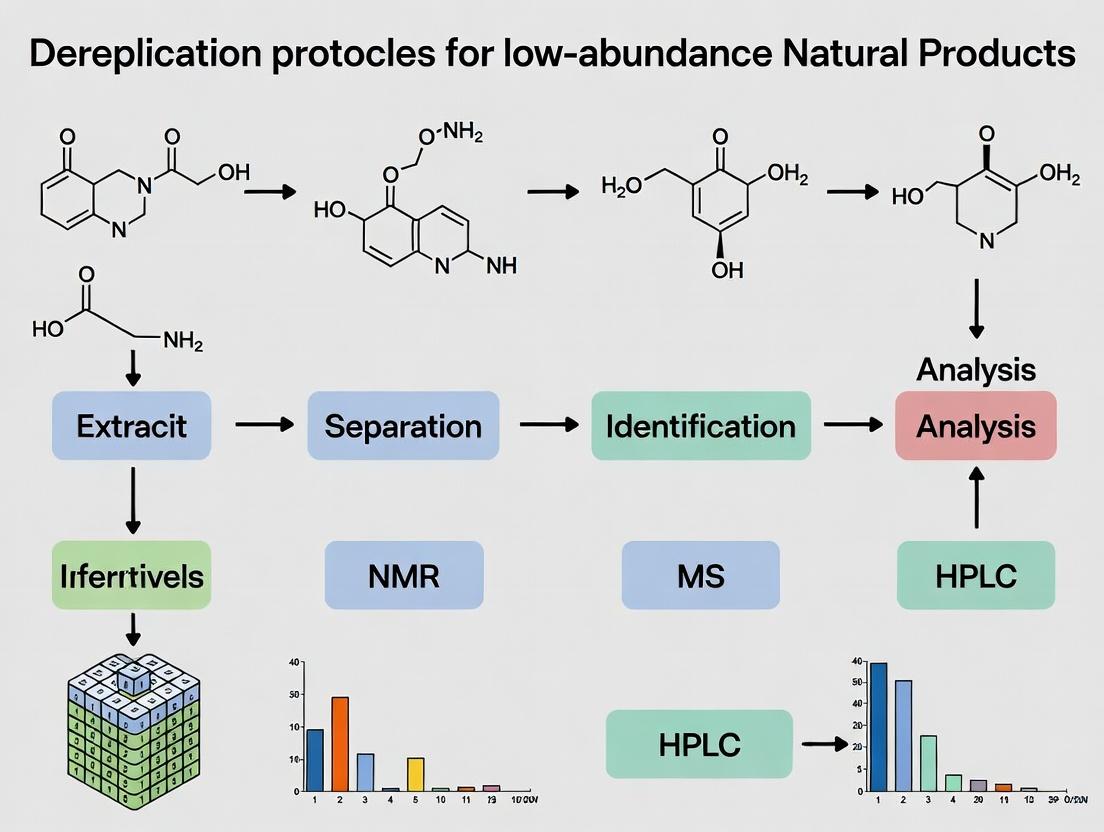
This article provides a comprehensive guide to dereplication protocols specifically designed for the identification of low-abundance natural products (NPs), a critical step in accelerating drug discovery.
Overcoming the Trace Compound Challenge: Advanced Dereplication Strategies for Low-Abudance Natural Products in Drug Discovery
Abstract
This article provides a comprehensive guide to dereplication protocols specifically designed for the identification of low-abundance natural products (NPs), a critical step in accelerating drug discovery. It details the fundamental principles of modern, MS-based dereplication, with a focus on molecular networking as a core strategy[citation:1]. The piece explores integrated methodological workflows that combine advanced cultivation, sophisticated mass spectrometry, and genomic analysis to detect and prioritize trace bioactive compounds[citation:2][citation:8]. It further addresses key troubleshooting challenges such as sensitivity limits and data scalability, highlighting solutions like AI-enhanced analysis and feature-based molecular networking[citation:3][citation:9]. Finally, the article evaluates validation frameworks, including orthogonal techniques like chemical genomics and multi-omic integration, which are essential for confirming novel discoveries and preventing the costly rediscovery of known entities[citation:2][citation:8].
The Critical Imperative: Why Low-Abundance Natural Products Demand Specialized Dereplication
A significant disparity exists between the vast biosynthetic potential encoded in microbial genomes and the relatively small number of characterized natural products (NPs). For example, the well-studied erythromycin producer Saccharopolyspora erythraea was found to possess at least 25 biosynthetic gene clusters (BGCs), yet only four classes of NPs were known from it after decades of research [1]. This "hidden" reservoir is largely due to BGCs that are transcriptionally silent or expressed at very low levels under standard laboratory conditions [1].
The process of dereplication—the early identification of known compounds to avoid costly re-isolation—is therefore critical. However, it becomes exceptionally challenging with low-abundance or "trace" bioactive compounds. Traditional activity-guided fractionation can easily miss these compounds, leading to repeated redisovery of common metabolites and wasted resources. The high cost is measured not only in financial terms but also in time, labor, and missed opportunities to discover truly novel therapeutics [1] [2].
Modern solutions integrate genomics, high-throughput metabolomics, and advanced bioinformatics. The evolution of high-throughput mass spectrometry (MS) now allows for the rapid acquisition and comparison of hundreds of metabolomic profiles, enabling researchers to sift through complex extracts and pinpoint novelty amidst a background of known compounds [1].
Technical Support & Troubleshooting Guide
This section addresses common operational challenges in dereplication and trace compound research.
FAQ 1: Our LC-MS dereplication efforts are overwhelmed by chemical noise and dominant metabolites, masking low-abundance targets. What strategies can improve detection?
- Problem: High-abundance compounds saturate detectors and obscure the MS and UV signals of trace bioactive constituents.
- Solution: Implement a multi-faceted prefractionation and data acquisition strategy.
- Employ Orthogonal Separation: Use two rounds of fractionation with different chemistries (e.g., reverse-phase followed by size-exclusion or ion-exchange chromatography) to reduce complexity per fraction.
- Leverage Advanced MS Techniques:
- Data-Dependent Acquisition (DDA) with Exclusion Lists: After an initial run, create an exclusion list for dominant ions to prevent their repeated selection, allowing the MS to trigger on lower-abundance ions.
- Data-Independent Acquisition (DIA): Acquires MS/MS data on all ions within sequential, wide mass windows, ensuring fragmentation data is collected for trace compounds, albeit with more complex data deconvolution.
- Utilize Bioinformatics Filters: Process data with tools that can subtract the background metabolome of the host or media. Align features across multiple sample treatments (e.g., from a HiTES screen) and prioritize ions that show significant intensity changes upon perturbation [1].
FAQ 2: When applying elicitation methods (OSMAC, HiTES), we see global metabolic changes but cannot link them to specific silent BGCs. How can we connect phenotype to genotype?
- Problem: Untargeted elicitation successfully alters the metabolome, but identifying which new metabolites originate from which silent BGC is non-trivial.
- Solution: Adopt an integrated genomics-metabolomics workflow.
- Generate a Genomic Blueprint: First, sequence the strain and use BGC prediction software (e.g., antiSMASH) to catalog all potential biosynthetic pathways [1].
- Correlate Expression with Production: Perform transcriptomics (RNA-seq) on elicited vs. control cultures. Identify BGCs that are significantly upregulated.
- Targeted Metabolite Prediction: Use the genomic data to predict the putative class (e.g., non-ribosomal peptide, polyketide) and key structural features of the metabolite from the activated BGC. This informs which MS adducts, fragments, or isotopic patterns to search for in the complex metabolomics data [1].
- Isolate with Guidance: This integrated hypothesis guides the isolation process, focusing purification efforts on fractions containing ions with the predicted properties.
FAQ 3: We have a pure trace compound with interesting bioactivity but cannot identify its protein target. Label-free methods like CETSA seem promising. How do we start, and what are the key pitfalls?
- Problem: Target deconvolution for trace, unmodified natural products is challenging. Label-free methods like the Cellular Thermal Shift Assay (CETSA) are attractive but require optimization [2].
- Solution: Follow a tiered CETSA experimental strategy.
- Start with a Validated System: Optimize protocols using a cell line and a compound with a known target (e.g., a kinase inhibitor) to establish robust melting curve protocols.
- Ensure Compound Integrity and Permeability: Confirm your trace compound remains stable under assay conditions and can enter cells. Use analytical LC-MS to check compound levels in lysates if needed.
- Avoid Common Pitfalls:
- Compound Solubility: Ensure your DMSO (or other solvent) concentration is consistent and ≤0.5% in final assay to avoid non-specific protein stabilization.
- Cell Lysis Efficiency: Incomplete lysis after heating is a major source of error. Use multiple freeze-thaw cycles in liquid nitrogen and a 37°C water bath [2].
- Protein Concentration: Keep lysate protein concentration consistent (e.g., 1-2 mg/mL) across samples for reproducible precipitation.
- Detection Method Choice: For unknown targets, you must use MS-CETSA (thermal proteome profiling). Western blot-based CETSA is only for validating hypothesized targets [2].
FAQ 4: Our metagenomic or microbiome-based discovery project struggles to assemble genomes or profile strains for low-abundance taxa of interest. How can we improve resolution?
- Problem: Shotgun metagenomic data often fails to recover sufficient sequence coverage for low-abundance microbial strains, hindering BGC discovery and strain tracking.
- Solution: Implement advanced binning and profiling algorithms designed for low-abundance scenarios.
- Utilize Time-Series Aware Algorithms: For longitudinal studies, tools like ChronoStrain use Bayesian models to probabilistically profile strain abundances over time, significantly improving the detection limit and accuracy for low-abundance strains compared to sample-by-sample methods [3].
- Apply Customized Filtering: Prior to assembly, filter reads against a customized database of marker sequences (e.g., virulence factors, BGC core genes) to enrich for reads from taxonomic or functional groups of interest [3].
- Leverage Hybrid Sequencing: Combine short-read (Illumina) and long-read (PacBio, Nanopore) data. Use the accurate short reads to correct long reads, which can then span repetitive regions in BGCs, enabling more complete assembly of genomes from complex communities.
Detailed Experimental Protocols
Protocol 1: High-Throughput Elicitor Screening (HiTES) for Activating Silent BGCs [1]
- Objective: To systematically test hundreds of chemical elicitors for their ability to activate the production of cryptic natural products from a microbial strain.
- Materials: Microbial strain, 384-well deep-well culture plates, library of small-molecule elicitors (e.g., FDA-approved drugs, natural product extracts), DMSO, appropriate liquid culture medium, UPLC-MS system.
- Procedure:
- Inoculate a master culture of the strain in medium to a standardized optical density (OD).
- Dispense consistent culture volumes into each well of a 384-well plate using an automated liquid handler.
- Pin-transfer or acoustically transfer nanoliter volumes of each compound from the library into assigned wells. Include DMSO-only control wells.
- Incubate plates under optimal growth conditions with agitation for a defined period (e.g., 3-7 days).
- Quench metabolism and extract metabolites directly in the deep-well plate by adding a solvent like ethyl acetate or methanol, followed by shaking.
- Centrifuge plates to separate organic and aqueous layers. Automatically transfer a portion of the organic extract to a new analysis plate.
- Analyze all extracts via UPLC-MS using a rapid, generic gradient method (e.g., 5-10 min run time).
- Data Analysis: Use metabolomics software (e.g., MZmine, XCMS) to align chromatograms, pick features (mass-retention time pairs), and integrate ion abundances. Normalize data and perform statistical analysis (e.g., ANOVA) to identify features significantly upregulated in specific elicitor-treated samples compared to DMSO controls. Prioritize unique features not found in controls.
Protocol 2: MS-CETSA (Thermal Proteome Profiling) for Target Identification [2]
- Objective: To identify cellular protein targets of a bioactive trace compound by detecting ligand-induced thermal stability shifts across the proteome.
- Materials: Relevant cell line, compound of interest, DMSO, PBS, liquid nitrogen, cell lysis buffer, centrifuge, filter plates, trypsin, LC-MS/MS system, TPP software package.
- Procedure:
- Treat cell cultures with compound (at several concentrations) or vehicle control (DMSO) for a predetermined time (e.g., 1 hour).
- Harvest cells and divide each treatment into 10 aliquots. Heat each aliquot at a different temperature (e.g., from 37°C to 67°C in 3°C increments) for 3 minutes.
- Snap-freeze all samples in liquid nitrogen, then thaw and lyse cells using repeated freeze-thaw cycles.
- Centrifuge to remove aggregated, denatured proteins. Collect the soluble protein fraction (supernatant).
- Digest the soluble proteins with trypsin to create peptides.
- Analyze peptides from all temperature points for each treatment by quantitative LC-MS/MS (using TMT or label-free quantification).
- Data Analysis: For each protein, plot the normalized amount of soluble protein remaining across the temperature gradient to generate a melting curve. Fit curves to determine the protein melting temperature (Tm). A significant positive shift in Tm (ΔTm) in compound-treated samples versus control indicates compound binding and thermal stabilization of that protein. A concentration-dependent Tm shift confirms target engagement.
Protocol 3: ChronoStrain Pipeline for Longitudinal Strain Profiling [3]
- Objective: To accurately profile the abundance dynamics of low-abundance bacterial strains in time-series metagenomic samples.
- Materials: Longitudinal shotgun metagenomic sequencing reads (FASTQ files), reference genome database, high-performance computing cluster.
- Procedure:
- Database Construction: Provide a set of marker sequence "seeds" (e.g., core genes, virulence factors). ChronoStrain aligns these to the reference genomes to build a custom marker database for the strains of interest [3].
- Read Filtering: Filter the raw metagenomic reads against the custom database to enrich for strain-relevant reads [3].
- Model Input: Prepare a metadata file with sample collection timepoints. Inputs are the filtered reads, the marker database, and the metadata [3].
- Bayesian Inference: Run the ChronoStrain model. It uses a time-aware Bayesian algorithm to estimate a probability distribution over abundance trajectories for each strain, explicitly modeling presence/absence uncertainty [3].
- Output Analysis: The primary outputs are: a) Probability of presence for each strain in each sample, and b) A probabilistic abundance trajectory over time for each strain. Analyze these to identify strain blooms, invasions, or disappearances.
The Scientist's Toolkit: Essential Research Reagent Solutions
Table 1: Key Reagents and Materials for Trace Bioactive Compound Research
| Item | Function / Application | Key Consideration for Trace Compounds |
|---|---|---|
| Natural Deep Eutectic Solvents (NADES) [4] | Green extraction solvents for bioactive compounds. | Can be tailored for selective extraction of specific compound classes, improving yield of trace metabolites from complex biomass. |
| HiTES Compound Library [1] | A curated collection of small molecules (e.g., drugs, bioactive agents) for high-throughput elicitor screening. | Diversity is key. Should include antibiotics, epigenetic modifiers, and signaling molecules to probe various bacterial stress responses. |
| Stable-Isotope Labeled Precursors (e.g., ¹³C-Glucose, ¹⁵N-Ammonia) | Used in isotope-guided metabolomics and pathway tracing. | Feeding studies can help link unstable trace metabolites to their BGCs by identifying characteristic isotope patterns in MS data. |
| CETSA-Compatible Lysis Buffer [2] | Buffer for cell lysis in thermal shift assays, free of detergents that interfere with protein precipitation. | Must maintain protein stability and compound-target interaction integrity during the heating and freeze-thaw steps. |
| Phase Separation Solvents (e.g., Ethyl Acetate, Butanol) | For liquid-liquid extraction of metabolites from culture broth in 96- or 384-well format. | Critical for high-throughput extraction in workflows like HiTES. Solvent choice impacts the recovery spectrum of polar vs. non-polar trace metabolites. |
| MS-Compatible Solid Phase Extraction (SPE) Plates | For rapid desalting and concentration of trace metabolites prior to LC-MS analysis. | Reduces ion suppression from salts and media components, enhancing the MS signal of low-abundance compounds. |
Table 2: Quantitative Comparison of Key Methodologies for Dereplication and Target Identification
| Methodology | Primary Application | Key Performance Metric | Reported Advantage/Result | Reference |
|---|---|---|---|---|
| ChronoStrain (Bayesian Model) | Profiling low-abundance strains in longitudinal metagenomes. | Detection accuracy (AUROC) & Abundance error (RMSE-log). | Significantly outperformed methods like StrainGST and mGEMS in detecting low-abundance strains, especially in time-series analysis [3]. | [3] |
| High-Throughput Elicitor Screening (HiTES) | Activating silent biosynthetic gene clusters. | Number of novel cryptic metabolites identified. | Applied to >12 strains, resulting in discovery of >150 novel cryptic metabolites [1]. | [1] |
| MS-CETSA (Thermal Proteome Profiling) | Proteome-wide target identification for unmodified compounds. | Number of quantified proteins & ability to detect binders. | Enables simultaneous quantification of thousands of proteins and identification of low-abundance targets in native cellular environments [2]. | [2] |
| One Strain Many Compounds (OSMAC) | Eliciting chemical diversity from a single strain. | Increase in number of distinct metabolites observed. | Classical study: Applied to 6 strains, isolated >100 compounds from ~25 structural classes [1]. | [1] |
Visual Workflows and Pathways
Diagram 1: Integrated Dereplication Workflow for Trace Bioactives
Diagram 2: CETSA Methodology for Target Identification [2]
The discovery of bioactive natural products has historically been a story of serendipity, from the accidental discovery of penicillin to the painstaking bioassay-guided isolation of taxol from the Pacific yew tree [5]. While these approaches yielded foundational drugs, they are inherently inefficient, often leading to the costly rediscovery of known compounds and creating bottlenecks in modern high-throughput screening (HTS) pipelines [6]. The evolution from chance discovery to systematic strategy is embodied in dereplication—the process of rapidly identifying known compounds in complex biological extracts early in the discovery workflow to focus resources on truly novel chemistry [7] [8].
Today, dereplication is a critical, strategic component of natural product research, especially when targeting low-abundance metabolites. The challenge is no longer just identifying what is present, but doing so with minimal material, maximizing information from precious samples, and intelligently prioritizing leads from vast extract libraries [6]. This technical support guide is framed within a broader thesis on optimizing dereplication protocols for low-abundance natural products. It provides researchers with targeted troubleshooting, current methodologies, and essential tools to navigate the specific technical hurdles in this field, transforming dereplication from a defensive check against rediscovery into a proactive engine for discovery.
Technical Support Center: FAQs & Troubleshooting
This section addresses common operational and strategic challenges in dereplication workflows for low-abundance natural products.
Frequently Asked Questions (FAQs)
Q1: Our high-throughput screening of a large natural product library has a very low hit rate. Are we missing active compounds, or is the library the problem? A low hit rate often indicates high chemical redundancy within your library. Extracts from related organisms frequently produce the same common scaffolds, diluting unique bioactivity [6]. Strategically reducing library size based on chemical diversity rather than random selection can significantly improve hit rates. For example, one study reduced a fungal extract library from 1,439 to 50 samples (targeting 80% scaffold diversity) and saw the bioassay hit rate more than double, from 11.3% to 22% against Plasmodium falciparum [6].
Q2: How can we perform effective dereplication when we only have trace amounts of a bioactive fraction? Modern mass spectrometry is key. Micro-fractionation techniques coupled with UHPLC-MS and MS/MS molecular networking allow you to obtain structural data from nanogram to microgram quantities [9]. The core strategy is to first obtain a high-resolution MS spectrum to predict a molecular formula, then use MS/MS fragmentation patterns to search against spectral libraries (e.g., GNPS). For known compounds, this is often sufficient for confident identification without the need for large-scale isolation [7] [9].
Q3: What are the most common "nuisance compounds" that interfere with bioassays, and how can we quickly flag them? Common pan-assay interference compounds (PAINS) in natural product extracts include tannins, saponins, fatty acids, and histamine receptor ligands [8]. Dereplication protocols should include early steps to flag these. Techniques include:
- Chemical tests: e.g., precipitation with gelatin (tannins) or hemolytic assays (saponins).
- Chromatographic signatures: These compounds often have characteristic UV profiles or broad, tailing peaks in HPLC.
- MS-based filtering: Using molecular networking to quickly identify clusters of common, known nuisance compounds based on their MS/MS spectra [6] [8].
Q4: Our LC-MS data is complex. How do we distinguish between novel compounds and minor derivatives of known molecules? Molecular networking (e.g., using GNPS) is the premier tool for this task. It visualizes the chemical space of your sample by clustering MS/MS spectra based on similarity [6]. Novel compounds will often appear as unique nodes or in small, unexplored clusters. In contrast, derivatives of known molecules (like glycosylated or methylated versions) will appear as connected nodes in a cluster with the parent compound, allowing for rapid structural analogy mapping and prioritization [6] [9].
Q5: What is the role of taxonomy in a modern dereplication strategy? Taxonomy remains one of the "three pillars" of dereplication, alongside spectroscopy and molecular structure databases [7]. Knowing the biological source allows you to narrow database searches to compounds previously reported from related genera or families, dramatically increasing search speed and accuracy. Always record and utilize the full taxonomic lineage of your source material, as this information is crucial for querying specialized natural product databases like KNApSAcK or for chemotaxonomic reasoning [7].
Troubleshooting Guides
Issue: Poor Sensitivity or Signal Instability in LC-MS Analysis
- Check for System Leaks: A common cause of sensitivity loss. Use a leak detector to check gas supplies, column connections, and the EPC (Electronic Pressure Control) interface [10].
- Contaminated Ion Source: Clean the ion source (electrospray or APCI probe). Signal drift or loss often stems from buildup of non-volatile salts and matrix components from crude extracts.
- Optimize Sample Preparation: For low-abundance compounds, ensure your extraction and cleanup (e.g., solid-phase extraction) efficiently enriches the target compound class and removes ion-suppressing contaminants [11].
Issue: No or Few Peaks Detected in Chromatogram
- Verify Sample Introduction: Ensure the autosampler syringe is not clogged and is injecting properly [10].
- Check Chromatographic Column: Look for cracks or degradation. A compromised column will not retain or separate compounds.
- Confirm Detector Function: In MS systems, verify that the ion source and mass analyzer are tuned and functioning. For other detectors, ensure lamps are on and gases are flowing [10].
Issue: Inability to Correlate Bioactivity with a Specific LC-MS Peak
- Employ Micro-fractionation: Interface your HPLC directly with a fraction collector. Dispense the eluent into a 96-well plate at short intervals (e.g., 6-12 seconds/well). This creates a high-resolution bioactivity map [9].
- Use Concurrent Biological and Chemical Analysis: Split the HPLC flow: one stream to the MS for chemical analysis, and the other to a fraction collector for bioassay testing. This directly links observed activity to specific ( m/z ) and retention time features [8] [9].
- Apply Statistical Correlation: In untargeted metabolomics, use software to statistically correlate the abundance of MS features across multiple active/inactive samples with the bioassay results, highlighting features most likely responsible for the activity [6].
The following tables summarize key quantitative findings from recent research on rational library design, demonstrating the tangible benefits of strategic dereplication.
Table 1: Library Size Reduction and Scaffold Diversity Retention [6] This table compares the performance of a rational, MS-guided selection method versus random selection in constructing a representative natural product screening library.
| Diversity Target | Extracts Needed (Random Selection) | Extracts Needed (Rational MS Method) | Fold Reduction in Library Size | Scaffold Diversity Retained |
|---|---|---|---|---|
| 80% of Max Diversity | 109 (average) | 50 | 2.2-fold | 80% |
| 100% (Max) Diversity | 755 (average) | 216 | 3.5-fold | 100% |
Table 2: Increased Bioassay Hit Rate in Rationally Designed Libraries [6] This table shows how reducing chemical redundancy through rational selection increases the likelihood of finding bioactive extracts.
| Bioassay Target | Hit Rate: Full Library (1,439 extracts) | Hit Rate: 80% Diversity Library (50 extracts) | Hit Rate: 100% Diversity Library (216 extracts) |
|---|---|---|---|
| Plasmodium falciparum (phenotypic) | 11.26% | 22.00% | 15.74% |
| Trichomonas vaginalis (phenotypic) | 7.64% | 18.00% | 12.50% |
| Neuraminidase (enzyme-targeted) | 2.57% | 8.00% | 5.09% |
Experimental Protocols for Modern Dereplication
Protocol 1: Rational Natural Product Library Design via LC-MS/MS and Molecular Networking
This protocol uses untargeted metabolomics to create a chemically diverse, non-redundant screening library [6].
- Sample Preparation: Prepare crude extracts from your organism collection (e.g., fungal, bacterial, plant) using a standardized method (e.g., 1:1 MeOH:CH₂Cl₂).
- Untargeted LC-MS/MS Analysis: Analyze all extracts using reversed-phase UHPLC coupled to a high-resolution tandem mass spectrometer. Use data-dependent acquisition (DDA) to collect MS/MS spectra for the top ions in each cycle.
- Molecular Networking: Process all MS/MS data through the Global Natural Products Social Molecular Networking (GNPS) platform. This clusters MS/MS spectra based on similarity, creating a visual network where each node is a consensus MS/MS spectrum (representing a molecular scaffold) and edges connect structurally related spectra [6].
- Scaffold-Centric Library Design: Use custom bioinformatics scripts (e.g., in R) to analyze the network. The algorithm should:
- Identify all unique molecular scaffolds (network nodes) across all extracts.
- Select the single extract containing the highest number of unique scaffolds.
- Iteratively add the extract that contributes the greatest number of new, unrepresented scaffolds to the growing library.
- Stop when a pre-defined percentage of total scaffold diversity (e.g., 80%, 95%) is captured [6].
- Validation: Screen the rationally designed mini-library and the full library in parallel using target bioassays. The hit rate in the mini-library should be equal to or greater than that of the full library [6].
Protocol 2: Integrated Dereplication via the "Three Pillars" Approach
This protocol integrates taxonomy, spectroscopy, and database mining for confident identification [7].
- Taxonomic Binning: Record the full taxonomic classification of the source organism. Use databases like the NCBI Taxonomy Browser to confirm lineage.
- High-Resolution LC-MS Analysis: Obtain accurate mass data (< 5 ppm error) for the compound of interest. Use this to generate candidate molecular formulas.
- Database Querying:
- Structure Databases: Query molecular formulas and predicted structures (via SMILES or InChI) in comprehensive databases like PubChem, COCONUT, or UNPD [7].
- Taxonomy-Filtered Search: Use specialized databases like KNApSAcK or KnapsackSearch to filter search results specifically for compounds reported from the same genus or family [7].
- Spectral Database Matching: Search the experimental MS/MS spectrum against spectral libraries (e.g., within GNPS, MassBank).
- Confirmation with Additional Data: For top candidates, compare available literature data (e.g., ( ^{13}C ) NMR chemical shifts, optical rotation) with predicted or experimentally derived values. Computational ( ^{13}C ) NMR prediction tools (e.g., nmrshiftdb2, CNMR Predictor) can be used for additional verification if isolated material is limited [7].
- Report: A compound is considered dereplicated when multiple data strands (accurate mass, MS/MS fragmentation, taxonomic plausibility, and/or predicted NMR match) converge on a single known structure.
Protocol 3: Rapid UHPLC-MS Profiling and Micro-fractionation for Bioactive Lead Identification
This protocol is for rapidly pinpointing the active constituent in a crude extract [9].
- High-Resolution Profiling: Inject the crude active extract onto a UHPLC-MS system equipped with a photodiode array (PDA) detector and a high-resolution mass spectrometer.
- Micro-fractionation: Connect the UHPLC outlet to an automated fraction collector. Program it to collect fractions at very short intervals (e.g., every 6-10 seconds) into a 96-well microtiter plate. This creates a high-resolution chromatographic segmentation.
- Parallel Analysis:
- Chemical Track: The MS and PDA collect full spectral data for the entire run.
- Biological Track: After evaporation of the solvent, subject the dried micro-fractions to a miniaturized bioassay (e.g., a cell-based or enzymatic assay in the same 96-well plate format).
- Data Integration: Overlay the bioactivity results (e.g., % inhibition per well) with the base peak chromatogram and PDA chromatogram. The peak(s) whose fractionation pattern aligns precisely with the bioactivity peak pinpoints the active compound(s).
- Targeted Identification: Use the accurate mass and MS/MS data from the active retention time window to perform targeted database searches and molecular networking for identification.
Visualizations of Workflows and Relationships
Rational Library Design and Dereplication Workflow
Diagram Title: Workflow for Rational Library Design & Dereplication
The Three Pillars of Dereplication
Diagram Title: The Three Interdependent Pillars of Dereplication
The Scientist's Toolkit: Essential Research Reagents & Solutions
Table 3: Key Reagents, Software, and Materials for Dereplication Workflows
| Item Name | Function/Role in Dereplication | Key Considerations |
|---|---|---|
| High-Resolution LC-MS/MS System | Provides accurate mass measurement for formula prediction and MS/MS fragmentation data for structural comparison. The core analytical instrument. | Q-TOF or Orbitrap mass analyzers are preferred for their high resolution and mass accuracy [6] [11]. |
| GNPS (Global Natural Products Social) Platform | A free, cloud-based platform for MS/MS spectral processing, molecular networking, and library searches. Essential for visualizing chemical relationships and dereplicating via spectral matching [6]. | The heart of modern, collaborative dereplication. Requires data in .mzML or .mzXML format. |
| UHPLC Columns (C18, Polar Embedded) | Separates complex natural product extracts with high resolution, improving detection of low-abundance compounds and reducing ion suppression. | Sub-2μm particle columns provide superior separation efficiency for complex mixtures [9]. |
| Solvents for Extraction & LC-MS (HPLC Grade) | MeOH, ACN, CH₂Cl₂, H₂O (with 0.1% formic acid). Used for standardized extraction and as mobile phases for chromatography. | Use LC-MS grade solvents with volatile additives (e.g., formic acid) to minimize background noise and ion suppression. |
| Bioassay Kits & Reagents | Target-specific enzymatic or cell-based assays (e.g., for kinases, antimicrobial activity, cytotoxicity). Used to generate the bioactivity data that guides isolation and dereplication. | Choose assays compatible with microtiter plates (96- or 384-well) and the small volumes from micro-fractionation [9]. |
| Natural Product Databases | PubChem, COCONUT, UNPD, KNApSAcK, MarinLit. Curated collections of known natural product structures, spectra, and source organisms. Targets for dereplication searches [7]. | Select databases relevant to your source material (e.g., MarinLit for marine organisms, KNApSAcK for plant metabolites). |
| Statistical/Bioinformatics Software (R, Python) | Used for custom data analysis, such as writing scripts to perform the rational library selection algorithm or correlating MS feature abundance with bioactivity [6]. | Requires programming expertise. Packages like xcms (R) are standard for MS data processing. |
| Micro-fraction Collector | Automatically collects LC eluent at high temporal resolution into 96-well plates, enabling direct correlation of chromatographic peaks with bioactivity [9]. | Critical for bridging the gap between chemical analysis and biological testing. |
| Solid-Phase Extraction (SPE) Cartridges | Used for rapid clean-up and fractionation of crude extracts (e.g., by polarity) to reduce complexity before LC-MS analysis. | Helps concentrate low-abundance metabolites and remove interfering salts/pigments. |
Technical Support Center: Troubleshooting & FAQs for Dereplication Protocols
This technical support center is designed within the context of a broader thesis on dereplication protocols for low-abundance natural products research. It addresses specific, practical challenges researchers face when employing molecular networking (MN) to visualize chemical relationships and prioritize novel compounds [12].
Troubleshooting Common Experimental Issues
Q1: After running my data through the GNPS platform, my molecular network has many disconnected, single nodes (singletons) and few meaningful clusters. What are the primary causes and solutions? [13] [12]
- Primary Causes:
- Insufficient MS/MS Spectral Quality: Low signal-to-noise ratio or too few fragment ions generated during collision-induced dissociation.
- Incorrect Parameter Settings: The cosine score threshold (
Min Pairs Cos) is set too high, or theMinimum Matched Fragment Ioncount is too restrictive. - Inherent Sample Chemistry: The sample genuinely contains many unique, structurally disparate compounds with little similarity in their fragmentation patterns.
- Step-by-Step Diagnostic Protocol:
- Inspect Raw Spectra: Manually examine the MS/MS spectra of several singleton nodes in your data analysis software. Confirm they contain several clear, intense fragment ion peaks above the baseline noise.
- Verify Parameter Alignment: Cross-reference your instrument's mass accuracy with the parameters used. For high-resolution instruments (q-TOF, Orbitrap), the Fragment Ion Mass Tolerance (FIMT) should typically be ±0.02 Da, not the default 0.5 Da [13].
- Run a Parameter Test: Re-process a subset of your data with a lower
Min Pairs Cos(e.g., 0.6) and a lowerMinimum Matched Fragment Ionvalue (e.g., 4). If connections form, gradually tighten parameters to optimize cluster specificity. - Apply Precursor & Feature Finding: For complex samples, use Feature-Based Molecular Networking (FBMN) via tools like MZmine3 before GNPS. This aligns chromatographic peaks and deconvolutes co-eluting isomers, leading to cleaner MS/MS spectra for networking [12].
Q2: I have identified a promising cluster of unknown compounds, but spectral library matching fails to provide an annotation. What advanced strategies can I use for structural elucidation? [12]
- Follow this tiered annotation workflow:
Troubleshooting Guide for Failed Library Matches
| Step | Tool/Category | Primary Function | Key Parameter to Adjust | Expected Outcome for Low-Abundance NPs |
|---|---|---|---|---|
| 1 | In-Silico Fragmentation (SIRIUS) [12] | Predicts molecular formula and fragmentation trees from MS/MS spectra. | Set appropriate Instrument profile for accuracy. |
High-confidence molecular formula when isotope patterns are clear. |
| 2 | Analog Search (DEREPLICATOR+) [12] | Finds structural analogs of known library compounds, allowing for mass shifts. | Increase Maximum Analog Search Mass Difference (e.g., to 250 Da). |
Identifies known compound families, suggesting novel derivatives. |
| 3 | Substructure Mining (MS2LDA, MolNetEnhancer) [12] | Discovers recurring fragmentation motifs (Mass2Motifs) across a network. | Use default GNPS output as input for these tools. | Groups compounds by shared biogenic building blocks (e.g., a glycosyl unit). |
Q3: How can I integrate biological activity data from assays directly into my molecular network to prioritize isolation targets? [12]
- Solution: Implement Activity-Labeled Molecular Networking (ALMN) or Bioactive Molecular Networking (BMN).
- Detailed Protocol:
- Fractionation & Profiling: Separately, fractionate your crude extract (e.g., by HPLC) and test each fraction in your biological assay (e.g., antimicrobial, cytotoxicity).
- Data Alignment: Acquire LC-MS/MS data for both the crude extract and each individual fraction under identical instrumental conditions.
- Metadata Table Creation: Create a metadata file (.txt or .csv) where rows represent your MS data files and columns represent attributes.
- One column must link the file name to the sample (e.g.,
crude_extract.mzML,fraction_01.mzML). - Additional columns log the biological activity (e.g.,
InhibitionPercentage) or concentration of each fraction.
- One column must link the file name to the sample (e.g.,
- Network Creation & Visualization:
- Upload all MS files and the metadata table to GNPS.
- After networking, use the
cytoscape.jsvisualizer within GNPS or export the network to Cytoscape desktop software. - Map the activity metadata onto the network nodes: configure node color to represent the source fraction (e.g., active=red, inactive=gray) and node size to represent the inhibition percentage [13].
- Clusters containing large, red nodes are directly linked to the observed bioactivity, providing a powerful visual guide for targeted isolation of the active constituents.
Frequently Asked Questions (FAQs)
Q: What is the fundamental principle that allows molecular networking to group related natural products? A: The core principle is that structurally similar molecules produce similar fragmentation patterns in tandem mass spectrometry (MS/MS). Molecular networking algorithms calculate pairwise similarity scores (e.g., cosine score) between all MS/MS spectra in a dataset. Nodes (spectra) are connected by an edge when their similarity score exceeds a set threshold, visually clustering compounds from the same molecular family [13] [12].
Q: For dereplication, what is the main advantage of molecular networking over a standard spectral library search? A: Standard library searches can only identify compounds already in the reference database. Molecular networking provides a visual map of both known and unknown compounds. Even if a node is not annotated, its position within a cluster of known compounds provides immediate structural context, suggesting it is a analogs or a new member of that chemical class. This is invaluable for prioritizing unknown, potentially novel compounds for isolation [12].
Q: What are the critical sample preparation and LC-MS considerations to ensure a high-quality molecular network? A:
- Sample Cleanup: Use solid-phase extraction (SPE) or other methods to remove salts and polymers that suppress ionization.
- Chromatographic Separation: Optimize LC methods to resolve isomers; poor separation leads to mixed MS/MS spectra.
- MS Data Acquisition:
- Use Data-Dependent Acquisition (DDA) mode [12].
- Apply dynamic exclusion to ensure MS/MS coverage of low-abundance ions co-eluting with major ones.
- Set the collision energy to a level that generates rich, informative fragment ion patterns, not just the precursor ion.
Q: My network is too large and dense to interpret visually. How can I simplify it? A: Use filtering parameters strategically [13]:
Node TopK: Limit the number of connections per node (e.g., to 10). This keeps only the strongest edges.Minimum Cluster Size: Filter out very small clusters or singletons from the visualization.Maximum Connected Component Size: Break apart extremely large networks into smaller, interpretable sub-networks.- Post-processing: Use Chemical Classification-Driven MN (CCMN) or MolNetEnhancer to automatically group and color-code nodes by predicted compound class (e.g., flavonoids, alkaloids), simplifying the visual landscape [12].
Experimental Protocol: Classical Molecular Networking via GNPS
This protocol is adapted for the dereplication of low-abundance natural products from a fungal extract [13] [12].
1. Sample Preparation & Data Acquisition:
- Prepare a pure fungal extract in MS-grade methanol at ~1 mg/mL.
- Analyze by RP-LC-MS/MS on a high-resolution Q-TOF or Orbitrap instrument in positive ion mode.
- DDA Settings: Scan range 100-1500 m/z, top 12 most intense ions per cycle, dynamic exclusion for 15 seconds.
2. Data Conversion:
- Convert raw data files (.d, .raw) to open formats (.mzXML, .mzML) using MSConvert (ProteoWizard). Enable peak picking and centroiding for MS2 spectra.
3. File Upload to GNPS:
- Go to the GNPS website and start the "Molecular Networking" job.
- Upload your .mzXML files via FTP or directly from a MassIVE dataset.
4. Parameter Selection for Dereplication:
- Basic Options:
Precursor Ion Mass Tolerance: 0.02 DaFragment Ion Mass Tolerance: 0.02 Da
- Advanced Network Options:
Min Pairs Cos: 0.7Minimum Matched Fragment Ions: 6Maximum Connected Component Size: 100 (to manage complexity)
- Advanced Library Search Options:
- Enable library search against all public libraries.
Score Threshold: 0.7
5. Job Submission and Interpretation:
- Submit the job. Processing time varies from minutes to hours.
- Navigate to the "View Spectral Families" results page.
- Identify clusters: Zoom into a well-connected cluster. Nodes with a gold star indicate a library match. Examine the matched structure and the surrounding connected, potentially novel analogs.
The Scientist's Toolkit: Research Reagent & Software Solutions
Essential materials and digital tools for constructing and analyzing molecular networks in natural products research.
| Category | Item/Software | Function in Dereplication | Key Consideration |
|---|---|---|---|
| Sample Prep | C18 Solid-Phase Extraction (SPE) Cartridges | Removes non-polar contaminants and salts, reduces ion suppression in MS. | Choose cartridge size based on extract load; condition with MeOH and water. |
| LC-MS | High-resolution mass spectrometer (Q-TOF, Orbitrap) | Provides accurate mass for molecular formula prediction and high-resolution MS/MS for networking. | Ensure mass accuracy < 5 ppm for reliable networking [13]. |
| Data Processing | MSConvert (ProteoWizard) [12] | Converts proprietary instrument data to open .mzXML/.mzML format for GNPS. | Always select "peak picking" for MS2 level to centroid profile data. |
| Networking Platform | Global Natural Products Social (GNPS) [13] [12] | Primary web platform for creating classical and feature-based molecular networks. | Create a free account to access job management and result storage. |
| Feature Detection | MZmine3 [12] | Detects chromatographic peaks, aligns across samples, and exports files for Feature-Based MN (FBMN). | Critical for handling complex samples; integrates directly with GNPS. |
| Advanced Annotation | SIRIUS with CSI:FingerID [12] | Predicts molecular formula and most likely chemical structure class from MS/MS data. | Use after GNPS to annotate unlabeled nodes in promising clusters. |
| Network Visualization & Analysis | Cytoscape [14] [13] | Desktop software for advanced network visualization, filtering, and analysis. | Import GNPS output (.graphml) to map metadata (e.g., bioactivity) and customize layouts. |
| Programming Environment | Python with RDKit & NetworkX [14] | Custom scripting for specialized chemical space networks and analysis beyond GNPS scope. | Enables calculation of network properties (modularity, clustering coefficient). |
In the challenging field of low-abundance natural products research, dereplication—the early identification of known compounds—is a critical bottleneck. It prevents the costly and time-consuming re-isolation of known entities, allowing researchers to focus resources on novel chemistry [15]. The Global Natural Products Social Molecular Networking (GNPS) platform is an indispensable infrastructure that addresses this need. GNPS is a web-based, open-access mass spectrometry ecosystem designed to organize, share, and identify tandem mass spectrometry (MS/MS) data on a community-wide scale [16]. By leveraging its vast, curated public spectral libraries and advanced computational workflows, GNPS provides researchers with a powerful toolkit for annotating metabolites, constructing molecular families, and rapidly dereplicating complex biological extracts, thereby accelerating the discovery of new bioactive molecules [16] [15].
Technical Support Center
This support center addresses common operational and analytical challenges faced when using GNPS for dereplication in natural products research.
Frequently Asked Questions (FAQs)
Q1: What is the primary purpose of GNPS in the context of natural products research? A1: GNPS serves as a central, open-access knowledge base for the global community. Its primary purposes are to enable the identification of known compounds (dereplication) and the discovery of novel metabolites through tools like molecular networking and spectral library matching, using publicly shared MS/MS data [16].
Q2: Which GNPS spectral libraries are most relevant for dereplicating low-abundance natural products? A2: For natural products, key libraries include the GNPS Library (community-contributed natural products), the NIH Natural Products Library (thousands of compounds), and specialized libraries like the LDB Lichen Database and MIADB Spectral Library for specific chemical classes [17].
Q3: How can I contribute my own validated spectral data to GNPS? A3: You can contribute via the “Update Spectrum Annotation” feature on individual library spectrum pages. Contributions are reviewed and integrated, enriching the community resource. By default, spectra contributed directly to GNPS use the CC0 license [18].
Q4: What is Molecular Networking, and how does it aid dereplication? A4: Molecular Networking clusters MS/MS spectra based on similarity, visually mapping the chemical space of a sample. Clusters containing spectra matched to known compounds in libraries allow for the propagation of annotations to unknown, structurally related neighbors, greatly extending dereplication reach [16].
Q5: What file formats are required for data submission to GNPS workflows? A5: The preferred format for mass spectrometry data is mzXML. Archived files (e.g., .zip, .tar.gz) containing multiple spectra are also supported [19].
Troubleshooting Guides
Issue: High False Positive Rates in Spectral Library Search
- Potential Cause: Overly permissive search parameters (e.g., precursor/product ion tolerance).
- Solution: For high-resolution MS data (e.g., Q-TOF, Orbitrap), tighten tolerances. Use “high” accuracy mode (0.02 Da) or set custom values below 0.05 Da. Always apply intensity and peak filters (e.g., remove peaks in the ±17 Da precursor window) to clean spectra before searching [19].
Issue: Incomplete or Incorrect Annotations in Library Search Results
- Potential Cause: The library entry itself may have incomplete metadata or an incorrect structure.
- Solution: Cross-check candidate matches using orthogonal data if available (e.g., retention index, NMR). You can also review and, if you have validated information, correct the public annotation using the “Update” button on the spectrum page [18].
Issue: Molecular Network is Too Large/Unwieldy or Too Sparse
- Potential Cause: Suboptimal cosine score and minimum matched peaks settings.
- Solution: For complex mixtures, increase the cosine score threshold (e.g., from 0.7 to 0.8) and the minimum peaks (e.g., to 6) to reduce noise and simplify the network. For a sparser network, lower these parameters to capture more subtle relationships [19].
Issue: Difficulty Identifying Isomeric or Stereoisomeric Compounds
- Potential Cause: MS/MS spectra of isomers are often nearly identical, making definitive identification impossible by mass spectrometry alone.
- Solution: GNPS spectral matching can suggest possibilities. Definitive dereplication requires orthogonal techniques such as comparison of chromatographic retention times with authentic standards or NMR analysis [20].
Table: Key GNPS Spectral Libraries for Natural Products Dereplication
| Library Name | Approximate Number of Spectra | Primary Focus & Notes |
|---|---|---|
| GNPS Library | Community-contributed | Core library of natural products from user submissions [17]. |
| NIH Natural Products Library (Rounds 1 & 2) | ~6,000 | Broad, drug-like natural product compounds; includes positive and negative ion mode data [17]. |
| LDB Lichen Database | >1,000 | Specialized library for lichen metabolites (depsidones, dibenzofuranes, etc.) [17]. |
| MIADB Spectral Library | 172 | Specialized library for monoterpene indole alkaloids [17]. |
| Dereplicator Identified MS/MS Spectra | Automatically curated | Spectra from public data automatically identified by the Dereplicator tool [17]. |
Experimental Protocols for Dereplication
Effective dereplication requires robust and reproducible analytical workflows. The following protocols detail standard methodologies.
Protocol 1: GC-MS-Based Dereplication for Volatile and Derivatized Metabolites
This protocol is ideal for primary metabolites, fatty acids, and other volatile compounds [21] [20].
- Sample Preparation (Derivatization):
- Methoximation: Add 10 µL of O-methylhydroxylamine hydrochloride (40 mg/mL in pyridine) to the dried extract. Incubate at 30°C for 90 min to protect carbonyl groups.
- Silylation: Add 90 µL of N-Methyl-N-(trimethylsilyl)trifluoroacetamide (MSTFA) with 1% trimethylchlorosilane (TMCS). Incubate at 37°C for 30 min to derivative acidic protons (e.g., in -OH, -COOH).
- Add a retention index marker (e.g., FAME mixture) to each vial [20].
- GC-TOF MS Analysis:
- Column: Use a standard non-polar or mid-polar capillary column (e.g., DB-5MS).
- Temperature Program: Employ a gradient (e.g., 60°C to 330°C) suitable for the metabolite range.
- Ionization: Electron Impact (EI) at 70 eV for consistent, library-searchable fragmentation [20].
- Data Processing & Dereplication:
- Deconvolution: Process raw data with tools like AMDIS (Automated Mass Spectral Deconvolution and Identification System) to resolve co-eluting peaks.
- Library Search: Match deconvoluted spectra against EI-MS libraries (e.g., NIST, Fiehn, GMD) using matching factors (MF). Employ Linear Retention Index (LRI) comparison for orthogonal confirmation [20].
- Advanced Deconvolution: For complex overlaps, apply chemometric tools like RAMSY (Ratio Analysis of MS) as a complementary digital filter to recover low-intensity ions [20].
Protocol 2: LC-MS/MS-Based Dereplication Using GNPS Molecular Networking
This protocol is optimized for non-volatile secondary metabolites, common in natural products research [16] [15].
- LC-HRMS/MS Data Acquisition:
- Chromatography: Use reversed-phase (C18) LC with water/acetonitrile gradient containing 0.1% formic acid.
- Mass Spectrometry: Acquire data-dependent (dd-MS²) or data-independent (DIA) MS/MS spectra on a high-resolution instrument (Q-TOF, Orbitrap).
- Modes: Acquire data in both positive and negative electrospray ionization (ESI) modes for comprehensive coverage [21].
- Data Preprocessing for GNPS:
- Convert Files: Convert raw files to the open mzXML format.
- Feature Detection: Use software like MZmine 3 or XCMS for peak picking, alignment, and isotope grouping to create a feature table [21].
- GNPS Workflow Submission:
- Create Molecular Network: Submit the mzXML files to the GNPS Molecular Networking job. Set parameters (cosine score >0.7, min matched peaks >6).
- Perform Library Search: Simultaneously run the Spectral Library Search against selected GNPS public libraries (min cosine >0.7) [19].
- Data Interpretation:
- Annotate nodes in the network with library matches (dereplication).
- Investigate clusters connected to annotated nodes for novel analogs via Network Annotation Propagation (NAP).
Table: Comparison of Dereplication Tools and Workflows within GNPS
| Tool/Workflow | Mechanism | Best For | Key Parameter |
|---|---|---|---|
| Classical Spectral Library Search | Direct cosine similarity match between query and reference spectrum [19]. | Confident identification of compounds with high-quality reference spectra in the library. | Cosine Score (e.g., >0.8 for high confidence). |
| Molecular Networking | Clustering of similar MS/MS spectra into visual networks [16]. | Exploring chemical relationships and dereplicating compound families, not just single entities. | Min. Matched Peaks (e.g., 6). |
| Feature-Based Molecular Networking (FBMN) | Networks built from chromatographically aligned features (MZmine, XCMS), integrating peak area [16]. | Quantitative studies linking chemical diversity to biological or environmental metadata. | Retention Time Alignment Tolerance. |
| DEREPLICATOR+ | In silico peptidic natural product identification by matching MS/MS to genomic predictions [16]. | Non-ribosomal peptides (NRPs) and ribosomally synthesized and post-translationally modified peptides (RiPPs). | Amino Acid Sequence Coverage. |
Visualizing Workflows and Relationships
Dereplication Decision Workflow for Low-Abundance NPs
Annotation Pathways in Molecular Networking
The Scientist's Toolkit: Research Reagent Solutions
Table: Essential Reagents and Materials for Dereplication Protocols
| Reagent/Material | Function in Dereplication Protocol |
|---|---|
| O-Methylhydroxylamine hydrochloride | Derivatization agent for methoximation; protects ketone and aldehyde groups in GC-MS analysis to prevent ring formation and improve volatility [20]. |
| N-Methyl-N-(trimethylsilyl)trifluoroacetamide (MSTFA) with 1% TMCS | Derivatization agent for silylation; replaces active hydrogens in hydroxyl, carboxyl, and amine groups with a trimethylsilyl group, making metabolites volatile and thermally stable for GC-MS [20]. |
| Fatty Acid Methyl Ester (FAME) Mix (C8-C30) | Serves as a retention index standard in GC-MS. Adding this to every sample allows for calibration of retention times across runs, enabling orthogonal confirmation of identity [20]. |
| High-Purity Solvents (HPLC/MS Grade Acetonitrile, Methanol, Water) | Essential for LC-MS mobile phases and sample reconstitution. High purity minimizes background noise and ion suppression, ensuring high-quality MS/MS spectra for library matching [21]. |
| Formic Acid (0.1%) | Common mobile phase additive in reversed-phase LC-ESI-MS. It promotes protonation in positive ion mode, improving ionization efficiency and chromatographic peak shape for a wide range of metabolites [21]. |
Integrated Workflows: Methodologies for Detecting and Prioritizing Trace Compounds
This technical support center is framed within the context of advancing dereplication protocols for low-abundance natural products research. Efficient dereplication—the early identification of known compounds—is critically dependent on the preceding steps of sample preparation and enrichment [22]. The strategies detailed here address the specific challenges of cultivating source organisms and extracting rare metabolites to generate high-quality samples suitable for advanced analytical profiling and subsequent dereplication workflows [23].
Technical Support Center: Troubleshooting Guides and FAQs
Section 1: Cultivation & Bioprocessing
FAQ 1.1: My microbial cultures yield very low titers of the target secondary metabolite. How can I enhance production before extraction?
- Answer: Low titers are a common bottleneck. A metabolomics-guided optimization approach is recommended [24]. First, use LC-HRMS to create a chemical profile of your extracts under different cultivation parameters (e.g., media composition, pH, aeration) [24]. Software like MZmine can process this data to find conditions that significantly enhance the signal of your target metabolite [24]. This data can then rationally guide the scaling up of cultivation to bioreactor systems while preserving compound synthesis [24].
FAQ 1.2: I am working with an uncultivable or slow-growing organism. What are my options for obtaining biomass?
- Answer: For uncultivable microbes, consider co-culture techniques to mimic natural microbial interactions, which can activate silent biosynthetic gene clusters. For limited biomass, focus on maximizing extraction efficiency and employing micro-scale analytical techniques. Miniaturized cultivation in 96-well plates coupled with high-throughput analytics can also screen many micro-scale conditions to find those that promote metabolite production [23].
Key Quantitative Data: Cultivation Strategies
| Strategy | Key Performance Metric | Typical Outcome/Enhancement | Primary Reference |
|---|---|---|---|
| Metabolomics-Guided Optimization | Target metabolite signal intensity | 10 to 100-fold increase in specific metabolite yield | [24] |
| Co-cultivation | Number of detectable secondary metabolites | 2 to 5-fold increase in metabolic diversity | [23] |
| High-Throughput Micro-cultivation | Number of conditions screened | Parallel screening of >100 media conditions | [23] |
Detailed Protocol: Metabolomics-Guided Cultivation Optimization
- Step 1: Inoculate the producer organism in multiple flasks with varying culture media (e.g., differing carbon/nitrogen sources, trace elements).
- Step 2: Harvest cells and/or supernatant at multiple time points during the growth cycle.
- Step 3: Perform a standardized micro-scale extraction (e.g., with ethyl acetate or methanol) on all samples.
- Step 4: Analyze all extracts using a consistent UPLC-HRMS method [25].
- Step 5: Process the raw HRMS data with informatics software (e.g., MZmine, SIEVE) [24] to align features and perform statistical analysis (PCA, ANOVA).
- Step 6: Identify the cultivation condition that maximizes the abundance of the mass feature corresponding to your target rare metabolite.
- Step 7: Scale the optimized condition to a benchtop bioreactor for larger biomass production, monitoring key parameters (pH, dissolved O₂) to maintain productivity [24].
Section 2: Extraction & Fractionation
FAQ 2.1: How can I avoid losing rare metabolites during the initial extraction from complex biomass?
- Answer: Losses occur due to poor solubility, adsorption, or degradation. Employ a sequential extraction scheme with solvents of increasing polarity (e.g., hexane -> ethyl acetate -> methanol/water) to capture a broad metabolite range [25]. For sensitive compounds, perform extractions at lower temperatures and under inert atmosphere (N₂) to prevent oxidation. Always include a final, aggressive solvent (e.g., 1:1 methanol:dichloromethane with sonication) to dislodge strongly adsorbed metabolites from the biomass matrix.
FAQ 2.2: My crude extract is too complex. How do I enrich the rare metabolite of interest before advanced analysis?
- Answer: Use a two-stage fractionation strategy. First, apply offline solid-phase extraction (SPE) or flash chromatography with a broad gradient to de-complex the extract into 10-20 primary fractions based on polarity [25]. Screen these fractions via analytical UPLC-HRMS to identify which contains your target. Then, subject that primary fraction to a high-resolution semi-preparative HPLC method, ideally using the same stationary phase chemistry as your analytical profiling column for predictable transfer [25]. This targets enrichment specifically around the retention time of your rare metabolite.
Key Reagent Solutions: Extraction & Chromatography
| Research Reagent / Material | Function in Rare Metabolite Workflow |
|---|---|
| Hybrid Stationary Phases (e.g., C18/amide) | Provides orthogonal selectivity in HPLC for separating challenging, polar rare metabolites [25]. |
| Solid-Phase Extraction (SPE) Cartridges | Rapid, low-resolution clean-up and fractionation of crude extracts to remove ubiquitous interferents (e.g., chlorophyll, lipids). |
| Deuterated Solvents (e.g., CD₃OD, D₂O) | Essential for preparing NMR samples from microgram quantities of enriched metabolites for structure validation [22]. |
| Micro-scale NMR Tubes (1-3 mm) | Enable acquisition of 1D and 2D NMR spectra on mass-limited samples from rare metabolites [22]. |
Detailed Protocol: Targeted Enrichment via Semi-Preparative HPLC
- Step 1: From your metabolite profiling data, note the exact retention time (t_R) and mass-to-charge ratio (m/z) of the target ion.
- Step 2: Develop a steep, focused analytical HPLC gradient that elutes the target within a 2-3 minute window. Use chromatographic modelling software to optimize this separation [25].
- Step 3: Transfer this method to a semi-preparative HPLC system equipped with a column containing the same bonded phase but with larger particle size (e.g., 5 µm).
- Step 4: Introduce your pre-fractionated sample via dry load injection (adsorbed onto celite) to maximize loading capacity and peak shape [25].
- Step 5: Use a triggered fraction collector. Set it to collect based on a threshold in the UV, Evaporative Light Scattering (ELSD), or extracted ion chromatogram signal from an in-line mass spectrometer [25].
- Step 6: Pool fractions containing the pure target, evaporate the solvent, and weigh to determine the isolated yield before proceeding to NMR analysis [25].
Section 3: Metabolite Analysis & Dereplication
FAQ 3.1: The MS signal of my rare metabolite is buried in background noise and interfering ions. How can I prioritize it for identification?
- Answer: This is a central challenge. Implement a computational dereplication strategy like NP-PRESS, which uses a two-stage algorithm to remove irrelevant MS features from biotic processes (e.g., media, cellular debris) [26]. The FUNEL algorithm filters MS1 data, while simRank compares MS2 spectra to prioritize novel scaffolds. This clears chemical "noise" and highlights signals most likely to belong to new or rare secondary metabolites [26].
FAQ 3.2: After enrichment, my compound's MS/MS spectrum doesn't match any database. What are the next steps for de novo structure elucidation?
- Answer: This suggests novelty. First, acquire high-quality multidimensional NMR data (¹H, ¹³C, HSQC, HMBC, COSY) on your purified sample, even if microgram quantities require a 1 mm cryoprobe [22]. Simultaneously, use genome mining tools on the producer organism's genome (if available) to identify biosynthetic gene clusters (BGCs) that could produce compounds with your observed molecular formula [23]. Correlating NMR-derived structural fragments with predicted BGC outputs from tools like antiSMASH can guide elucidation [23].
Key Quantitative Data: Dereplication Tools & Output
| Tool / Database Category | Example(s) | Key Function in Dereplication | Reference |
|---|---|---|---|
| MS Data Analysis Software | MZmine, SIEVE, NP-PRESS | Process HRMS data, perform differential analysis, remove interfering features to highlight NPs. | [24] [26] |
| Natural Product Databases | AntiBase, MarinLit, GNPS | Spectral libraries for matching MS/MS and NMR data to identify known compounds. | [24] [22] |
| Genomic Mining Tools | antiSMASH | Predict secondary metabolite scaffolds from genome sequences to guide identification. | [23] |
Detailed Protocol: Two-Stage MS Dereplication via NP-PRESS
- Step 1: Analyze your enriched fraction or crude extract in data-dependent acquisition (DDA) mode on a high-resolution tandem mass spectrometer to obtain MS1 and MS2 spectra [26].
- Step 2: Process the raw data with the FUNEL algorithm. This stage filters the MS1 feature list by comparing samples against controls (e.g., spent media, non-producing strains) to remove features arising from non-biosynthetic processes [26].
- Step 3: The filtered feature list proceeds to the simRank stage. This algorithm compares the MS2 spectrum of each feature against a curated database of known natural product MS2 spectra. Features with low similarity scores are prioritized as potentially novel [26].
- Step 4: The output is a prioritized list of LC-MS features ranked by likelihood of being new secondary metabolites. This list directly guides targeted isolation efforts [26].
Integrated Dereplication Workflow for Rare Metabolites The following diagram synthesizes the complete pathway from sample preparation to confident identification, integrating cultivation, analysis, and database interrogation.
Core Configurations: LC-MS/MS vs. LC-HRMS for Dereplication
For researchers dereplicating low-abundance natural products, selecting the correct mass spectrometry configuration is critical. The choice dictates the depth of information you can obtain from complex crude extracts.
LC-MS/MS (Triple Quadrupole - QQQ): This configuration excels in targeted, quantitative analysis. It operates primarily in Multiple Reaction Monitoring (MRM) mode, where the first quadrupole (Q1) filters a specific precursor ion, the collision cell (Q2) fragments it, and the third quadrupole (Q3) filters a specific product ion for detection [27]. This dual filtering provides exceptional selectivity and sensitivity for known compounds, effectively removing background noise. Its strength in dereplication lies in rapid screening for a predefined list of suspected known compounds within a sample [28] [29].
LC-HRMS (Q-TOF or Orbitrap): This configuration is designed for untargeted, qualitative analysis. High-resolution mass analyzers like Time-of-Flight (TOF) or Orbitrap provide accurate mass measurements (e.g., < 5 ppm error) [27]. This allows for the determination of elemental compositions, which is indispensable for identifying unknown compounds or novel variants of known scaffolds [28]. When paired with a quadrupole and collision cell (Q-TOF), it can perform data-dependent acquisition (DDA), collecting high-resolution MS and MS/MS spectra for ions detected in the survey scan.
The platforms are complementary. LC-MS/MS is the tool for sensitive, routine confirmation and quantification of target analytes. LC-HRMS is the discovery tool for novel compound identification, metabolite profiling, and structural elucidation [28] [23].
Table 1: Comparison of LC-MS/MS and LC-HRMS Configurations for Dereplication
| Feature | LC-MS/MS (QQQ) | LC-HRMS (Q-TOF/Orbitrap) |
|---|---|---|
| Primary Strength | Targeted quantification and confirmation | Untargeted screening and identification |
| Key Operational Mode | Multiple Reaction Monitoring (MRM) | Data-Dependent Acquisition (DDA), full scan |
| Resolving Power | Low (Unit mass) | High (10,000 to >1,000,000 FWHM) [28] |
| Mass Accuracy | Nominal mass | High accuracy (<5 ppm, often <1 ppm) |
| Best for Dereplication Phase | Rapid screening of known targets in late-stage extracts | Early-stage discovery, identifying unknowns, molecular networking |
| Typical Throughput | Very High | Moderate to High |
| Ideal for Low-Abundance NPs | When the target is known and an MRM transition can be optimized | When searching for novel analogs or in highly complex mixtures requiring high specificity |
The Dereplication Workflow: From Sample to Identification
Dereplication is the strategic process of identifying known compounds in a mixture early in the discovery pipeline to avoid redundant isolation and characterization [30] [23]. For low-abundance natural products, this requires a sensitive, multi-step workflow centered on LC-MS.
Dereplication Workflow for Natural Products
Experimental Protocol: LC-HRMS-Based Untargeted Dereplication
This protocol is designed for the initial profiling of a crude extract to identify both known and novel compounds.
- Sample Preparation: For a crude natural product extract, begin with a simple dilution in a solvent compatible with the LC starting conditions (e.g., 80:20 Water:MeOH). Filter through a 0.22 µm PTFE or nylon filter to remove particulates. For complex or dirty samples, employ solid-phase extraction (SPE) for clean-up [31] [32].
- Chromatographic Separation:
- Column: Use a reversed-phase C18 column (e.g., 2.1 x 100 mm, 1.7-1.8 µm particle size).
- Mobile Phase: Use only volatile additives. A: Water with 0.1% Formic Acid. B: Acetonitrile with 0.1% Formic Acid. For basic compounds, use ammonium formate or ammonium hydroxide [31] [33].
- Gradient: Employ a linear gradient from 5% B to 95% B over 15-20 minutes, tailored to your extract's polarity.
- Mass Spectrometric Acquisition (Q-TOF):
- Ion Source: Electrospray Ionization (ESI), positive and/or negative mode. Optimize source temperature, drying gas flow, and nebulizer pressure for your flow rate [33].
- MS Acquisition: Collect full-scan data from m/z 100 to 1500 with high resolution (>25,000 FWHM).
- MS/MS Acquisition: Use Data-Dependent Acquisition (DDA). Select the top 5-10 most intense ions per cycle for fragmentation. Apply a dynamic exclusion to re-trigger on new ions.
- Data Processing & Database Query:
- Process raw data to generate a list of molecular features (accurate m/z, retention time, intensity).
- Query databases like AntiMarin [30], GNPS [30], or Dictionary of Natural Products using exact mass (± 5 ppm) and isotope pattern matching.
- For higher confidence, compare acquired MS/MS spectra against spectral libraries (e.g., GNPS, MassBank) using tools like DEREPLICATOR [30] or SIRIUS.
Table 2: Key Research Reagent Solutions for Sensitive LC-MS Dereplication
| Reagent/Material | Function & Critical Notes | Typical Use Case |
|---|---|---|
| Volatile Buffers (Ammonium Formate/Acetate) | pH control without instrument contamination. Always use instead of non-volatile salts (e.g., phosphate). [31] [33] | Mobile phase additive for separation of acids/bases. |
| High-Purity Solvents (LC-MS Grade) | Minimizes background chemical noise and ion suppression. | Mobile phase and sample reconstitution. |
| Formic Acid (0.1%) | Common volatile additive to promote [M+H]+ ionization in positive mode. | Standard acidic mobile phase modifier. |
| Solid-Phase Extraction (SPE) Cartridges (C18, HLB) | Selective clean-up to remove salts, lipids, and highly polar matrix components that cause suppression [32]. | Pre-treatment of complex biological extracts (e.g., fermentation broth). |
| HybridSPE-Phospholipid Cartridges | Specifically removes phospholipids, a major source of matrix effect in biological samples [32]. | Sample prep for plasma, tissue homogenates. |
| Derivatization Reagents (e.g., MSTFA) | For GC-MS based dereplication; increases volatility and stability of metabolites [20]. | Profiling of primary metabolites (sugars, organic acids). |
Troubleshooting Guide & FAQs
Symptom: Loss of Sensitivity or Signal Intensity
Q: My sensitivity has gradually dropped over time. Where should I start troubleshooting? A: Follow a systematic divide-and-conquer approach. First, run a System Suitability Test (SST) using a neat standard of a known compound (e.g., reserpine). If the SST passes, the problem is likely in your sample preparation. If it fails, the issue is with the instrument [34].
- Check the LC System: Look for leaks, especially at fittings. Verify pump performance by checking pressure traces against a baseline [34].
- Inspect the Ion Source: This is the most common location for sensitivity loss. Check for and clean any salt deposits or contamination on the capillary, cone, and extraction lenses. Replace consumables like the ESI needle if worn [31] [34].
- Review Mobile Phases & Sample: Ensure fresh, high-quality mobile phases are used. Contaminated solvent bottles or buffers can cause high background noise. Check your sample for matrix effects that may cause ion suppression [33].
Q: I'm developing a new method and never achieved good sensitivity for my target analyte. What parameters should I optimize? A: Sensitivity is compound-dependent. Beyond mobile phase pH, critically optimize [33]:
- Ion Source Parameters: Capillary voltage, source temperature, and desolvation gas flow rate. Perform a syringe infusion of your analyte to tune these in real-time.
- Ion Polarity: Don't assume the polarity; screen both positive and negative ESI modes.
- Mobile Phase Composition: Sometimes a small change in organic modifier (acetonitrile vs. methanol) or buffer concentration can dramatically improve ionization efficiency.
Symptom: Poor Chromatography or Peak Shape
Q: My peaks are tailing, splitting, or have unexpectedly shifted retention time. A: This primarily indicates an LC problem, not an MS problem [34].
- Column Degradation: The LC column is the primary suspect. Flush the column according to the manufacturer's instructions. If performance doesn't recover, replace the column.
- Mobile Phase Issues: Ensure buffers are freshly prepared and at the correct pH. A mismatch between sample solvent and mobile phase strength can cause peak splitting. Always reconstitute samples in a solvent equal to or weaker than the starting mobile phase.
- System Dead Volume: Check for and eliminate any extra tubing or poorly made connections between the injector, column, and MS source.
Symptom: Inaccurate Mass or Identification Issues in HRMS
Q: My high-resolution mass accuracy is outside the specified tolerance (>5 ppm), leading to failed database matches. A: Mass calibration drifts over time.
- Immediate Calibration: Perform a full mass calibration of your HRMS instrument using the manufacturer's recommended calibration solution.
- Internal Calibration: For the highest accuracy, use a lock mass or internal calibrant introduced during the run. Many systems allow for constant infusion of a reference compound (e.g., leucine enkephalin) for real-time mass correction.
- Check Source Conditions: Very high ion loads or source contamination can sometimes affect mass axis stability.
Q: My dereplication software returns too many false positives or cannot identify obvious compounds. A: This is often a data quality or search parameter issue.
- Improve MS/MS Quality: Ensure collision energy is optimized to give rich, informative fragmentation, not just the precursor ion. For low-abundance compounds, increase the DDA intensity threshold or use inclusion lists.
- Refine Search Parameters: Use appropriate mass and retention index tolerances. If available, use workflow-specific algorithms like DEREPLICATOR, which is designed for the complex architectures of peptidic natural products (PNPs) and can identify novel variants via spectral networking [30].
- Employ Orthogonal Data: Use retention time indexing or standardized chromatographic systems (e.g., using FAME mixes in GC-MS) [20] to filter database matches.
Fundamental FAQs
Q: When should I use LC-MS/MS (MRM) vs. LC-HRMS for my dereplication project? A: Use LC-MS/MS (MRM) when you are screening many samples for a defined, limited set of target compounds (e.g., known mycotoxins, specific PNPs). It provides the fastest and most sensitive quantitative results [28] [32]. Use LC-HRMS when you are in the discovery phase, working with unknown extracts, searching for novel analogs, or need to perform retrospective analysis of data. It provides untargeted screening and valuable structural information [29] [23].
Q: How can I increase my analysis throughput without sacrificing data quality? A: For LC-MS/MS, use scheduled MRM to monitor many compounds in a single run by specifying narrow time windows around each analyte's expected retention time. For both platforms, consider:
- Faster Chromatography: Use shorter columns with smaller particles (e.g., sub-2µm) and higher flow rates (with ESI sources that handle it, like the Agilent Jet Stream) [27].
- Post-column Infusion: Techniques like the Agilent StreamSelect LC/MS system allow staggered, parallel injections from up to four LC systems into a single MS, maximizing instrument utilization [27].
Advanced Protocols: Integrating Dereplication Algorithms
For state-of-the-art dereplication, moving beyond simple database lookup is key. Computational tools can mine data for related, unknown compounds.
Experimental Protocol: Molecular Networking with DEREPLICATOR for PNP Discovery
This protocol leverages the GNPS infrastructure and the DEREPLICATOR algorithm to identify known Peptidic Natural Products (PNPs) and their novel variants from LC-MS/MS data [30].
- Data Acquisition: Collect LC-HRMS/MS data (as per the protocol in Section 2) for your set of samples. Ensure good MS/MS spectral quality.
- Data Upload and Preprocessing:
- Convert raw data to open formats (.mzML, .mzXML).
- Upload files to the Global Natural Products Social Molecular Networking (GNPS) platform .
- Use the GNPS workflow to perform feature detection, alignment, and to create a spectral network. Nodes are MS/MS spectra; edges connect spectra with high similarity, suggesting structural relatedness.
- Dereplication with DEREPLICATOR:
- Within the GNPS workflow, select the DEREPLICATOR dereplication option.
- The algorithm compares nodes (spectra) in your network against a database of known PNPs (e.g., AntiMarin) [30].
- It scores Peptide-Spectrum Matches (PSMs) and computes statistical significance (p-value) to control false discoveries.
- Analysis of Results:
- Direct Identification: Nodes with high-confidence matches to database entries are annotated as known PNPs.
- Variable Dereplication: Crucially, DEREPLICATOR uses the spectral network to propagate annotations. If a known PNP is identified in one node, its structurally related neighbors (connected by edges) can be annotated as potential new variants (e.g., with a single amino acid substitution, methylation, or oxidation) [30].
- This allows you to rapidly pinpoint not just known compounds, but also the novel, low-abundance analogs in their immediate biosynthetic family.
Algorithmic Dereplication via Molecular Networking
For researchers focused on low-abundance natural products, dereplication—the early identification of known compounds—is a critical, time-saving step. The primary challenge is efficiently distinguishing novel chemical entities from the vast background of known metabolites within complex biological extracts [15]. Molecular networking via the Global Natural Product Social Molecular Networking (GNPS) platform has emerged as a powerful solution. This technique organizes tandem mass spectrometry (MS/MS) data based on spectral similarity, visually clustering related molecules and accelerating the prioritization of unknown, potentially novel compounds for further isolation [13] [35]. This technical support center provides a detailed, step-by-step guide to implement this workflow, along with solutions to common experimental hurdles.
Section 1: Core Technical Protocols
Protocol 1.1: Optimized LC-MS/MS Data Acquisition for Low-Abundance Metabolites
Objective: To generate high-quality MS/MS spectra that maximize the detection of trace-level natural products for robust molecular networking. Critical Steps:
- Sample Preparation: Use a two-stage metabolome refining approach (e.g., NP-PRESS pipeline) to selectively remove interfering features from media components and cellular degradation products, thereby enhancing the signal of secondary metabolites [36].
- Chromatography: Employ ultra-high-performance liquid chromatography (UHPLC) with long, shallow gradients (e.g., 30-60 minutes) to improve separation and peak capacity for complex extracts.
- Mass Spectrometry: Utilize a high-resolution mass spectrometer (q-TOF, Orbitrap).
- Set the instrument to data-dependent acquisition (DDA) mode.
- Use a dynamic exclusion window (e.g., 15 seconds) to prevent repeated fragmentation of dominant ions, allowing instrument time to target low-abundance species.
- Isolation Width: Set to 2-3 m/z for quadrupole isolation to ensure pure precursor selection.
- Fragmentation: Apply stepped collision energies (e.g., 20, 40, 60 eV) to generate comprehensive fragment ion patterns [35].
- Data Conversion: Convert raw instrument files (.d, .raw) to open formats (.mzML, .mzXML) using tools like MSConvert (ProteoWizard). Ensure centroiding is applied to fragment ion spectra.
Protocol 1.2: Constructing a Molecular Network on GNPS
Objective: To process acquired MS/MS data, calculate spectral similarities, and construct a visual molecular network [13]. Workflow:
- Upload Data: Log in to the GNPS platform (http://gnps.ucsd.edu) and use the "Create Molecular Network" workflow. Upload your converted MS files [19] [13].
- Set Critical Parameters: Adjust key parameters in the "Advanced Network Options" based on your instrument and goals [13].
Table: Key GNPS Molecular Networking Parameters and Recommendations [13]
Parameter Function Recommended Setting for HR-MS Impact of Incorrect Setting Precursor Ion Mass Tolerance (PIMT) Clusters MS/MS spectra from the same molecular ion. ± 0.02 Da Too wide: merges different compounds. Too narrow: fails to cluster replicates. Fragment Ion Mass Tolerance (FIMT) Matches fragment ions between spectra for similarity scoring. ± 0.02 Da Too wide: causes false-positive matches. Too narrow: reduces sensitivity. Minimum Cosine Score Threshold for connecting two nodes (spectra). 0.7-0.8 Low: creates large, messy clusters. High: yields sparse, disconnected networks. Minimum Matched Peaks Minimum shared fragments required for a connection. 6 Low: less-specific connections. High: may disconnect structurally related molecules. Maximum Connected Component Size Splits overly large clusters for visualization. 100-500 Too small: breaks apart legitimate chemical families. - Submit and Monitor: Execute the job and monitor the status page. Processing time varies from minutes for small datasets to hours for large ones [13].
- In-Browser Analysis: Use the GNPS result views ("View Spectral Families," "View All Library Hits") for initial exploration of library matches and network topology [13].
Protocol 1.3: Advanced Visualization and Interpretation with Cytoscape
Objective: To import the GNPS network for advanced visualization, annotation, and hypothesis generation. Procedure:
- Export and Import: Download the network file (.graphml) from GNPS. Import it into Cytoscape (v3.8+).
- Apply Visual Encoding: Use the "Style" panel to map data to visual properties, adhering to effective design principles [37] [38].
- Node Color: Map to sample group (e.g., control vs. treatment) or dereplication status (e.g., known vs. unknown).
- Node Size: Map to peak area or number of associated MS/MS spectra.
- Edge Thickness: Map to cosine score, where thicker lines indicate higher spectral similarity.
- Apply Layout Algorithm: Use a force-directed layout (e.g., "Prefuse Force Directed") to spatially group related molecules [38]. For large networks, use "Edge-weighted Force Directed" to emphasize cluster separation.
- Integration of Metadata: Import attribute files (e.g., bioactivity data, m/z values) to annotate nodes and guide the isolation of bioactive, novel clusters [35].
Section 2: Technical Support Center: Troubleshooting & FAQs
FAQ 1: Data Acquisition & Quality
Q1: My network is sparse, with few connections between nodes. What went wrong? A: This typically indicates poor-quality MS/MS spectra or suboptimal acquisition settings.
- Verify Spectral Quality: Inspect raw data for low-intensity fragment ion spectra. For low-abundance compounds, ensure the instrument method is sensitive enough.
- Adjust DDA Settings: Reduce the intensity threshold for triggering MS/MS and use a longer dynamic exclusion window to target more low-abundance precursors.
- Check Parameter Alignment: Ensure the Fragment Ion Mass Tolerance (FIMT) parameter in GNPS matches your instrument's mass accuracy. Using 0.5 Da for high-resolution data will cause missed matches [13].
Q2: How can I reduce interference from culture media and primary metabolites? A: Implement a background subtraction strategy.
- Analytical Blanks: Always run and acquire MS/MS data for your culture media/extraction solvent blanks.
- Use the Blank Filter: In the GNPS "Advanced Filtering Options," enable "Filter Spectra from G6 as Blanks Before Networking." Assign your blank files to Group 6 (G6), and GNPS will remove features also present in the blanks [13].
- Employ Refining Pipelines: Consider computational pipelines like NP-PRESS designed to filter out non-relevant chemical features from biotic processes [36].
FAQ 2: GNPS Workflow & Parameters
Q3: How do I choose the correct Minimum Cosine Score and Minimum Matched Peaks?
A: These are the most crucial parameters for network topology.
- Start with Presets: Use the GNPS presets for "Small," "Medium," or "Large" datasets as a baseline [13].
- Iterative Refinement: For a first pass, use standard values (Cosine: 0.7, Matched Peaks: 6). If the network is too dense (hairball), increase both values. If it's too sparse, decrease them.
- Consider Your Compounds: For molecule classes that produce few fragments (e.g., some lipids), you may need to lower the
Minimum Matched Peaksto 4 [13].
Q4: What does the Maximum Connected Component Size do, and why should I change it?
A: This parameter prevents the formation of a single, unreadable giant cluster.
- Function: It breaks apart any connected network larger than the set node count by iteratively increasing the cosine threshold for edges within that component.
- Recommendation: For discovery-focused work, set this high (500) or to 0 (unlimited) to avoid splitting genuine chemical families. For focused visualization, a value of 100 keeps clusters manageable [13].
FAQ 3: Network Visualization & Interpretation
Q5: My network visualization is a cluttered "hairball." How can I make it interpretable? A: Apply visualization best practices and filtering [37] [38].
- Within GNPS: Increase the
Minimum Cosine Scoreand re-run the job to create a sparser, more specific network. - Within Cytoscape:
- Filter: Remove edges with low cosine scores (e.g., < 0.5).
- Layout: Apply a force-directed layout that accounts for edge weights.
- Cluster: Use Cytoscape apps like
clusterMaker2(MCL algorithm) to detect and visually group molecular families.
- Rule of Thumb: A good network figure tells a clear story. Highlight a specific cluster of interest and simplify the rest [37].
Q6: How can I confidently prioritize an "unknown" cluster for isolation? A: Use a multi-faceted prioritization strategy [15] [35].
- Dereplication Check: Ensure no high-confidence library matches exist for nodes in the cluster.
- Metadata Overlay: Color nodes by bioactivity data. Clusters where activity correlates with ion intensity are high-priority targets.
- Topological Cues: Look for unique, small clusters disconnected from known compound families, or "singleton" nodes with no matches, which may represent novel chemistries.
- Spectral Quality: Prioritize clusters where nodes have high-intensity, information-rich MS/MS spectra to aid later structure elucidation.
Section 3: Visual Guides to Workflows & Decision-Making
Diagram: Step-by-Step Molecular Networking Workflow [13] [35]
Diagram: Dereplication Decision Protocol for Low-Abundance Compounds [15] [35]
Section 4: The Scientist's Toolkit: Essential Reagents & Materials
Table: Key Research Reagent Solutions for Molecular Networking
| Item / Reagent | Function in Workflow | Technical Notes & Recommendations |
|---|---|---|
| LC-MS Grade Solvents (Acetonitrile, Methanol, Water) | Mobile phase for chromatographic separation; sample dilution and preparation. | Essential for minimizing background chemical noise and ion suppression, crucial for detecting low-abundance metabolites. |
| Formic Acid / Ammonium Acetate | Mobile phase additives for controlling pH and improving ionization efficiency in positive or negative ESI mode. | 0.1% Formic Acid is standard for positive mode. 1-10mM Ammonium Acetate can be used for negative mode or neutral compounds. |
| Solid Phase Extraction (SPE) Cartridges (C18, HLB) | Pre-fractionation of crude extracts to reduce complexity and enrich metabolite fractions. | Use for targeted fractionation based on hydrophobicity before LC-MS/MS to simplify chromatograms and improve detection limits. |
| Bioactivity Assay Kits (e.g., Antimicrobial, Cytotoxicity) | Generation of metadata to overlay bioactivity onto molecular networks for targeted isolation. | Correlating activity data with specific network clusters (Bioactivity Molecular Networking) is a powerful prioritization strategy [35]. |
| Internal Standard Mix | Monitoring LC-MS system performance, retention time stability, and mass accuracy. | Include a cocktail of standards covering a broad m/z range, not present in your samples, for quality control. |
| Reference Spectral Libraries | Dereplication by matching experimental MS/MS spectra to known compounds. | Use GNPS-built libraries, NIST MS/MS, and domain-specific libraries (e.g., for marine natural products) [15]. |
| Cytoscape Software | Advanced visualization, customization, and integration of multiple data types (MS, bioactivity, genomics) with network topology. | The primary tool for creating publication-quality network figures and performing sophisticated network analysis [38]. |
Technical Support Center
Context for Researchers: This technical support center is designed within the framework of advanced dereplication protocols for low-abundance natural products research. Efficiently distinguishing novel compounds from known entities is a critical bottleneck. The workflows detailed here—Feature-Based Molecular Networking (FBMN) and Ion Identity Molecular Networking (IIMN)—directly address this by enhancing the resolution, quantification, and annotation capabilities of mass spectrometry data, thereby accelerating the discovery pipeline for researchers and drug development professionals [15] [12].
Core Concepts & Troubleshooting
Q1: What are the fundamental differences between Classical, Feature-Based (FBMN), and Ion Identity Molecular Networking (IIMN), and why should I switch from Classical MN? A: The evolution from Classical to FBMN and IIMN represents a shift from spectral-centric to data-integrated networking, crucial for dereplicating complex samples containing isomers and multiple ion forms.
- Classical MN: Networks are built directly from raw MS/MS spectra. It uses spectral counts for quantification, often fails to separate isomers with similar spectra, and treats different ion adducts of the same molecule (e.g., [M+H]⁺, [M+Na]⁺) as separate, unrelated nodes [39] [12].
- Feature-Based Molecular Networking (FBMN): Builds networks from processed LC-MS data. It incorporates MS1 information (retention time, isotopic pattern, peak area/height) from chromatographic feature detection tools like MZmine or MS-DIAL [39] [40]. This allows for:
- Isomer Resolution: Distinguishing compounds with near-identical MS/MS spectra but different retention times [39].
- Improved Quantification: Using chromatographic peak area for more accurate relative quantification than spectral counts [39].
- Reduced Redundancy: Clustering multiple MS/MS scans from the same chromatographic peak into a single consensus spectrum [39].
- Ion Identity Molecular Networking (IIMN): An extension of FBMN that adds a second layer of connectivity. It uses MS1 feature correlation (retention time and peak shape) to group different ion species (protonated, sodiated, in-source fragments) originating from the same neutral molecule and connects them in the network [41] [42]. This is vital for:
- Reducing Data Complexity: Collapsing multiple adduct nodes into a single "molecular family" node.
- Improving Annotation Propagation: Library matches to one ion form (e.g., [M+H]⁺) can be propagated to its unannotated adducts (e.g., [M+Na]⁺) [42].
- Revealing Metal-Binding Compounds: Identifying ions formed through biological or analytical metal adduction [42].
Q2: I work with low-abundance natural products. How do FBMN and IIMN specifically address the challenges of dereplication in my research? A: Dereplication requires confidently identifying known compounds early to focus resources on novel leads. FBMN and IIMN enhance this process by:
- Increasing Confidence in Annotations: By integrating orthogonal data (RT, ion mobility, adduct relationships), these workflows provide multiple lines of evidence to support or refute a spectral library match, which is critical when dealing with low-signal compounds [39] [15].
- Mapping Complex Ion Landscapes: Low-abundance compounds often generate weak signals that can be split across several ion adducts. IIMN connects these signals, ensuring the total ion signature of a scarce metabolite is recognized as a single entity, preventing it from being overlooked or misidentified [42].
- Guiding Targeted Isolation: The networks visually cluster structurally related compounds. Even if a low-abundance compound is not in a library, its placement within a family of annotated analogs (e.g., glycosylated derivatives) provides critical structural clues for its targeted purification and characterization [12].
Experimental Setup & Data Acquisition
Q3: What are the essential steps and software choices to prepare my data for an FBMN/IIMN analysis on GNPS? A: The workflow involves two main stages: data processing with external software, followed by networking on GNPS [39] [40]. The choice of processing software depends on your data type and expertise.
Table: Supported Data Processing Tools for FBMN/IIMN [40]
| Processing Tool | Data Supported | Key Features | Target User |
|---|---|---|---|
| MZmine | LC-MS/MS (DDA) | Open-source, graphical interface, extensive feature detection & alignment modules. | Mass spectrometrists |
| MS-DIAL | LC-MS/MS (DDA, DIA), Ion Mobility | Open-source, supports advanced acquisitions like MSE and ion mobility. | Mass spectrometrists |
| OpenMS / XCMS | LC-MS/MS (DDA) | Open-source, command-line driven, highly customizable. | Bioinformaticians |
| MetaboScape/ Progenesis QI | LC-MS/MS, Ion Mobility | Commercial software with proprietary algorithms for feature detection and IMS integration. | Mass spectrometrists in industrial labs |
Step-by-Step Protocol:
- Data Conversion: Convert raw instrument files (.d, .raw) to open formats (.mzML, .mzXML) using MSConvert.
- Feature Detection & Alignment (in your chosen software): Process files to detect chromatographic peaks, align them across samples, and pick a representative MS/MS spectrum for each feature.
- Export for GNPS: Export two key files:
- Feature Quantification Table (.csv/.txt): Contains feature ID, m/z, RT, and peak intensity/area across all samples.
- MS/MS Spectral Summary File (.mgf): Contains the representative MS/MS spectra linked to the feature IDs [40].
- For IIMN: Additionally, generate a "Supplementary Pairs" file (.csv) from your processing software (MZmine, MS-DIAL, or XCMS-CAMERA). This file lists pairs of feature IDs that correspond to different ion species of the same molecule, based on correlated peak shapes and mass differences [41].
- Submit to GNPS: Upload these files to the dedicated FBMN workflow on the GNPS website, selecting the appropriate parameters [40].
Q4: What are the critical instrument and data acquisition parameters for successful FBMN/IIMN? A: High-quality input data is non-negotiable. Key considerations include:
Table: Key Acquisition Parameters for Robust FBMN/IIMN Analysis
| Parameter | Recommendation | Rationale |
|---|---|---|
| MS Resolution | > 25,000 (FT-MS, Orbitrap, TOF) | Essential for accurate m/z and isotopic pattern determination in MS1. |
| MS/MS Fragmentation | Data-Dependent Acquisition (DDA) with dynamic exclusion. | Ensures comprehensive MS2 coverage; dynamic exclusion prevents repeated sequencing of abundant ions. |
| Chromatography | High-resolution, reproducible LC (e.g., UHPLC) with stable gradients. | Critical for isomer separation (FBMN) and accurate peak shape correlation (IIMN). |
| Retention Time Stability | Use quality control (QC) samples and randomized batch acquisition. | Minimizes RT drift, which is vital for feature alignment across many samples. |
Data Analysis & Interpretation
Q5: What are the most important parameters to adjust in the GNPS FBMN workflow, and how do they affect my results? A: Parameter tuning is essential to generate meaningful networks.
Table: Key GNPS FBMN Workflow Parameters and Their Impact [40]
| Parameter Section | Key Parameter | Description & Default | Troubleshooting Advice |
|---|---|---|---|
| Basic Options | Precursor Ion Mass Tolerance | Mass tolerance for clustering MS2 spectra. Default: 0.02 Da. | Match to your instrument's mass accuracy. Wider tolerances can cause unrelated spectra to merge. |
| Advanced Molecular Networking | Minimum Cosine Score (Min Pairs Cos) |
Similarity threshold for connecting two nodes. Default: 0.7. | Increase (e.g., 0.8) for simpler, more related clusters. Decrease to connect more divergent structures. |
| Minimum Matched Fragment Ions | Minimum shared fragments to form an edge. Default: 6. | Lower for small molecules/lipids with few fragments. Higher for larger NPs (e.g., peptides, glycosides). | |
| Maximum Connected Component Size | Limits nodes in one network. Default: 100. | Set to 0 for large datasets to avoid artificial splitting of large molecular families. |
Q6: How do I interpret an IIMN network, and what are the "collapsed" and "uncollapsed" views? A: IIMN produces two complementary network views [41] [42]:
- Uncollapsed Network: Shows all individual ion species as separate nodes. Edges are of two types: (1) MS2 similarity edges (solid lines, based on cosine score) and (2) Ion Identity edges (often colored red/dashed, based on MS1 correlation linking adducts). This view is excellent for seeing all detected ion forms.
- Collapsed Network: Groups all ion species belonging to the same neutral molecule into a single "molecular" node. The intensity of this node is the sum of all its ion species. This view dramatically simplifies the network, reduces redundancy, and clarifies the relationships between different compounds.
The following diagram illustrates the core workflow and logical relationship between data processing, FBMN, and IIMN.
Workflow: From Raw Data to Dereplication
Q7: I've generated my network. How do I visually explore and analyze it to find interesting compounds? A: Use Cytoscape for advanced network visualization and exploration [41] [43].
- Import Network: Load the
graphmlfile from your GNPS job results. - Style Nodes by Data:
- Size: Map to chromatographic peak area to highlight abundant (or potentially novel low-abundance) features.
- Color: Use the "Best Ion" column (from IIMN) to color nodes by their ion type (e.g., [M+H]⁺, [M+Na]⁺) [41].
- Border: Thicken borders of nodes with high-quality library matches.
- Style Edges: Distinguish MS2 similarity edges from Ion Identity edges using line style or color [41].
- Filter and Select: Use the Cytoscape's filter function to select nodes based on metadata (e.g., samples where a compound is present) or topological metrics (e.g., nodes connecting two clusters, which may be key biosynthetic intermediates).
The Scientist's Toolkit: Essential Reagents & Materials
For researchers establishing FBMN/IIMN workflows in the context of natural product dereplication, the following non-instrumental materials are crucial.
Table: Key Research Reagent Solutions for FBMN/IIMN Workflows
| Item / Reagent | Function / Purpose in Workflow | Technical Notes |
|---|---|---|
| LC-MS Grade Solvents (Acetonitrile, Methanol, Water with 0.1% Formic Acid) | Mobile phase for high-resolution chromatography. Minimizes ion suppression and background noise. | Essential for reproducible retention times and clean MS1 spectra for feature detection. |
| Standard Reference Mix (e.g., Agilent Tune Mix, MS calibration standard) | Daily mass calibration and instrument performance qualification. | Ensures mass accuracy (< 5 ppm error) critical for reliable adduct identification in IIMN. |
| Retention Time Index Standards (e.g., Alkylphenone series, halogenated acids) | Normalize retention times across samples and batches. | Corrects for minor LC shifts, improving feature alignment accuracy in large studies. |
| Post-column Infusion Solution (Ammonium acetate, Sodium acetate in MeOH/H2O) [42] | Optional: Experimental validation of IIMN adduct detection. Deliberately induces [M+NH4]+ or [M+Na]+ formation to test workflow. | Used in controlled experiments to verify the software's ability to correctly group ion species. |
| Blank Solvent Samples (Pure mobile phase) | Control for system background, carryover, and contamination. | Processed identically to real samples; its features are often subtracted from the dataset. |
| Pooled Quality Control (QC) Sample | Aliquot of all test samples combined. Monitors system stability and aids in feature filtering. | Run repeatedly throughout the acquisition sequence to assess RT/mSignal stability. |
Technical Support Center: Troubleshooting Dereplication & Network Analysis
This support center provides targeted troubleshooting and methodological guidance for researchers applying dereplication protocols and network-based prioritization in the discovery of low-abundance natural products (NPs). The content is framed within a thesis context focused on minimizing the re-isolation of known compounds and efficiently targeting novel chemical entities [30].
Troubleshooting Guides
Issue 1: High False-Positive Rate in Spectral Dereplication
- Problem: Your dereplication effort, using tools like DEREPLICATOR or AMDIS, returns many incorrect compound identifications [30] [20].
- Diagnosis & Solution:
- Check Statistical Significance: For MS/MS database searches, ensure your tool reports p-values and False Discovery Rates (FDR). A robust algorithm like DEREPLICATOR uses decoy databases to compute FDR; a peptide-level FDR below 10% is a good benchmark [30].
- Optimize Deconvolution Parameters: For GC-MS data, the default parameters in deconvolution software (e.g., AMDIS) can generate 70-80% false assignments. Use a factorial design to optimize parameters for your specific instrument and sample type [20].
- Apply a Heuristic Filter: Implement a post-processing filter. One study used a heuristic Compound Detection Factor (CDF) on AMDIS results to significantly decrease false-positive rates [20].
- Use Complementary Tools: Apply a second, orthogonal deconvolution algorithm like Ratio Analysis of Mass Spectrometry (RAMSY) to recover clean spectra from co-eluting, low-intensity peaks that primary software may miss [20].
Issue 2: Target Molecule is Absent or Isolated in Molecular Network
- Problem: Your compound of interest does not appear in the molecular network or appears as an unconnected singleton node, preventing topology-based analysis [44].
- Diagnosis & Solution:
- Adjust Minimum Cluster Size: The default setting often filters out singletons. Re-run the analysis with the minimum cluster size set to
1or use the "Visualize Full Network w/ Singletons" option in GNPS [44]. - Modify Network Parameters: Your spectra may not meet default similarity thresholds. To foster connections, you can cautiously:
- Verify Data Quality: Ensure the MS/MS spectrum for your compound has sufficient signal intensity and informative fragments. Spectra with fewer than 5 high-quality fragment ions are difficult to network [13].
- Adjust Minimum Cluster Size: The default setting often filters out singletons. Re-run the analysis with the minimum cluster size set to
Issue 3: Poor or No Assay Window in Bioactivity Screening
- Problem: Your functional assay (e.g., TR-FRET, kinase activity) shows no difference between positive and negative controls, providing no bioactivity signal for prioritization [45].
- Diagnosis & Solution:
- Confirm Instrument Setup: This is the most common cause. Verify the instrument's optical filters are set exactly as recommended for your assay (e.g., 520 nm/495 nm for Tb donors) [45].
- Test Development Reaction: For enzymatic assays, run controls with a 100% phosphorylated peptide (no development reagent) and a 0% phosphorylated substrate (with excess development reagent). A clear signal difference confirms the reaction works [45].
- Use Ratiometric Data Analysis: Always use the acceptor/donor emission ratio, not raw fluorescence. The ratio corrects for pipetting errors and reagent lot variability [45].
- Calculate Z'-Factor: Assay window size alone is misleading. Calculate the Z'-factor, which incorporates data variation. A Z'-factor > 0.5 indicates a robust assay suitable for screening [45].
Table 1: Troubleshooting Guide Summary
| Problem Area | Key Diagnostic Step | Primary Solution | Success Metric |
|---|---|---|---|
| Spectral Dereplication | Check FDR or false-positive rate [30] [20] | Optimize deconvolution parameters; apply heuristic filters [20] | FDR < 10%; High-confidence spectral match |
| Molecular Networking | Check for singletons/min cluster size filter [44] | Adjust cosine score & matched fragment ion parameters [13] | Compound connected to related analogs in network |
| Bioactivity Assays | Verify instrument optical filters [45] | Use ratiometric analysis; calculate Z'-factor [45] | Z'-factor > 0.5; Clear dose-response curve |
Frequently Asked Questions (FAQs)
Q1: What is the core concept behind using network topology for prioritization in NP discovery? A1: The principle is that molecules with related structures, often biosynthesized by the same gene cluster, will exhibit similar MS/MS fragmentation patterns. These related spectra form clusters or "molecular families" within a network. Novel nodes (unknown compounds) that are highly connected within a bioactive cluster or that occupy strategic positions (e.g., bridges between clusters) are high-priority targets for isolation, as their topology suggests a structural and potentially functional relationship to known bioactive compounds [13] [36].
Q2: How do I start a molecular networking analysis with my LC-MS/MS data? A2: The standard public platform is GNPS (Global Natural Products Social Molecular Networking). The basic workflow is:
- Convert Data: Format your raw files to
.mzXML,.mzML, or.mgf[13]. - Upload & Select Workflow: Use the GNPS website to upload files and select "Create Molecular Network" [13].
- Set Key Parameters: These are critical for success [13]:
- Precursor Ion Mass Tolerance: ±0.02 Da for high-res (e.g., Orbitrap), ±2.0 Da for low-res (e.g., ion trap) instruments.
- Fragment Ion Mass Tolerance: ±0.02 Da for high-res, ±0.5 Da for low-res.
- Min Pairs Cos: Start at 0.7.
- Min Matched Peaks: Start at 6.
- Submit and Explore: Visualize the network in the GNPS browser to find spectral families and library matches [13].
Q3: What are common pitfalls when integrating bioactivity data with networks? A3: The main pitfalls are:
- Incorrect Metadata Mapping: Ensure your bioactivity scores (e.g., IC50, % inhibition) are correctly linked to the sample files in the network metadata. An incorrect mapping will color nodes with the wrong bioactivity data, leading to false conclusions [13].
- Ignoring Assay Noise: Prioritizing nodes based on small differences in bioactivity from a noisy assay (low Z'-factor) is unreliable. Only use data from validated, robust assays [45].
- Overlooking Background: Signals from culture media, degradation products, and non-drug-like molecules can dominate networks. Use pipelines like NP-PRESS that employ algorithms (e.g., FUNEL, simRank) to subtract features from blank media and prioritize NP-like features before networking [36].
Q4: How can I improve the identification rate for unknown "novel nodes" in my network? A4: For nodes with no library match, use these strategies:
- Analyze Connected Nodes: The identities of known or partially known compounds in the same cluster provide strong clues to the structural class of the unknown [13].
- Propagate Annotations: Tools like DEREPLICATOR can perform "variable dereplication," identifying new variants of known PNPs by propagating annotations through spectral networks, even if the exact variant isn't in the database [30].
- Inspect MS/MS Fragmentation: Manually compare the fragmentation pattern of the unknown to its neighbors. Shared fragment ions indicate conserved substructures.
Detailed Experimental Protocols
Protocol 1: GC-TOF MS Dereplication for Plant Metabolites This protocol combines optimized AMDIS with RAMSY deconvolution for improved identification [20].
- Sample Preparation:
- Dry plant extract (from ASE or solvent extraction) under vacuum.
- Methoximation: Add 10 µL of 40 mg/mL methoxyamine hydrochloride in pyridine. Incubate at 30°C for 90 min.
- Silylation: Add 90 µL of MSTFA with 1% TMCS. Incubate at 37°C for 30 min.
- Add a retention index standard (e.g., FAME mix) before GC-MS analysis.
- GC-TOF MS Analysis:
- Column: Use an appropriate capillary column (e.g., DB-5MS).
- Temperature Program: Apply a gradient (e.g., 60°C to 330°C).
- Ionization: Electron Impact (EI) at 70 eV.
- Data Processing:
- Step A - Optimized AMDIS: Use a factorial design to find the best
Component Width,Adjacent Peak Subtraction, andResolutionsettings for your data. Apply the CDF heuristic to filter results. - Step B - RAMSY Deconvolution: Apply the RAMSY algorithm as a complementary tool to peaks with poor AMDIS deconvolution, especially for co-eluting, low-intensity ions.
- Identification: Search deconvoluted spectra against standard EI libraries (e.g., NIST) using linear retention indices as orthogonal confirmation.
- Step A - Optimized AMDIS: Use a factorial design to find the best
Protocol 2: LC-MS/MS-based Molecular Networking & Dereplication via GNPS This protocol is for creating an annotated molecular network [30] [13].
- Data Acquisition:
- Analyze crude or fractionated extracts using LC-MS/MS with data-dependent acquisition (DDA).
- Ensure MS/MS fragmentation energy is consistent across samples.
- Data Conversion:
- Convert raw files to open formats (
.mzXML,.mzML) using tools like MSConvert (ProteoWizard).
- Convert raw files to open formats (
- GNPS Molecular Networking:
- Go to the GNPS website (
gnps.ucsd.edu) and start the "Molecular Networking" job. - Upload your files and a metadata table specifying groups (e.g., bioactive vs. inactive fractions).
- Set Parameters: Use instrument-appropriate mass tolerances (see FAQ A2). Enable "Run MSCluster" and set "Minimum Cluster Size" to 2. For library search, set "Score Threshold" to 0.7.
- Go to the GNPS website (
- Dereplication:
- Within the same workflow, enable library search against GNPS spectral libraries.
- For peptidic natural products (PNPs), use the DEREPLICATOR option. It will search against databases like AntiMarin, compute p-values, and perform variable dereplication to find new variants [30].
- Visualization & Prioritization:
- Use the in-browser visualizer to explore networks colored by bioactivity metadata.
- Prioritize unidentified nodes that are central within active clusters or are connected to annotated bioactive compounds.
Workflow and Relationship Diagrams
Diagram 1: NP Discovery Prioritization Workflow
Diagram 2: Topology-Based Target Prioritization
Table 2: Key Reagents, Tools, and Databases for Dereplication & Network Analysis
| Item Name | Type | Primary Function | Key Consideration / Citation |
|---|---|---|---|
| MSTFA + 1% TMCS | Derivatization Reagent | Silylates acidic protons (OH, COOH, NH) for GC-MS analysis of polar metabolites. | Use silylation-grade solvents. Critical for GC-based metabolomics [20]. |
| O-Methylhydroxylamine HCl | Derivatization Reagent | Protects keto- and aldo-groups via methoximation, preventing ring formation and improving GC analysis. | Perform before silylation step [20]. |
| FAME Mixture (C8-C30) | Retention Index Standard | Provides reference peaks for calculating Linear Retention Indices (LRIs) in GC-MS, an orthogonal ID metric. | Add to sample just before injection [20]. |
| LanthaScreen TR-FRET Kit | Bioassay Reagent | Enables homogeneous, ratiometric kinase activity or binding assays for bioactivity profiling. | Filter choice is critical; always use acceptor/donor ratio for analysis [45]. |
| AntiMarin Database | Chemical Database | A curated library of peptidic natural products (PNPs) used as a target database for dereplication tools. | Used by DEREPLICATOR for PNP identification [30]. |
| GNPS Spectral Libraries | Spectral Database | Crowd-sourced MS/MS spectral libraries for natural products and metabolites. | The primary library for annotation within the GNPS ecosystem [30] [13]. |
| DEREPLICATOR | Algorithm | Dereplicates PNPs and their variants via spectral networking, computing p-values and FDR. | Enables variable dereplication to find new analogs [30]. |
| NP-PRESS Pipeline | Software Pipeline | Refines metabolome data by removing interfering features from media/biotic processes before networking. | Uses FUNEL and simRank algorithms to prioritize NP-like features [36]. |
| AMDIS | Software | Deconvolutes co-eluting peaks in GC-MS data for cleaner spectral matching. | Requires parameter optimization to avoid high false-positive rates [20]. |
| Cytoscape | Software | Advanced network visualization and analysis. Used for in-depth exploration of large molecular networks. | Import network files (.graphml) from GNPS for custom analysis [13]. |
Navigating Analytical Pitfalls: Optimization Strategies for Sensitivity and Specificity
Overcoming Matrix Effects and Ion Suppression in Complex Extracts
This technical support center provides practical guidance for researchers developing dereplication protocols for low-abundance natural products. The FAQs and troubleshooting guides below address specific challenges related to matrix effects and ion suppression in mass spectrometry-based analysis.
Troubleshooting Guide: Key Experimental Workflows
Guide 1: How to Detect and Locate Ion Suppression in Your Chromatographic Run
Problem: You suspect ion suppression is affecting sensitivity and reproducibility, but your chromatograms appear normal. Solution: Perform a post-column infusion experiment to visualize ion suppression zones [46] [47].
Experimental Protocol:
- Setup: Integrate a syringe pump into your LC-MS/MS system. Use a tee to combine the column effluent with a constant infusion of your analyte standard (e.g., 50-100 ng/mL in mobile phase) from the syringe pump [47].
- Blank Injection: First, inject a blank of pure mobile phase. Monitor the MS signal of your infused analyte. You should observe a stable baseline, with slight increases/decreases correlating with the organic solvent gradient [47].
- Matrix Injection: Next, inject a prepared blank matrix sample (e.g., extracted plasma, plant extract). Use your standard sample preparation method (e.g., protein precipitation) [47].
- Analysis: Observe the MS signal trace. Drops in the stable baseline signal indicate regions where co-eluting matrix components suppress the ionization of your analyte. The retention time of these drops maps the ion suppression zones in your chromatogram [46] [47].
- Identify Suppressors (Optional): To identify common suppressors like phospholipids, simultaneously monitor a relevant transition (e.g., m/z 184 → 184 for phosphatidylcholines). The elution profile of these compounds will often align with suppression zones [47].
Visualization of the Post-Column Infusion Workflow:
Guide 2: How to Systematically Assess Matrix Effect, Recovery, and Process Efficiency
Problem: You need to validate your bioanalytical method according to guidelines but find protocols for matrix effect assessment unclear or inconsistent. Solution: Implement an integrated experiment based on pre- and post-extraction spiking to calculate key parameters [48].
Experimental Protocol (Based on Matuszewski et al.): Prepare three sets of samples for each matrix lot (use at least 5-6 lots) and at two concentration levels, all with a fixed concentration of Internal Standard (IS) [48].
- Set A (Neat Solution): Spike analyte and IS into pure mobile phase. Represents the unsuppressed signal.
- Set B (Post-Extraction Spiked Matrix): Spike analyte and IS into already extracted blank matrix. Measures combined Matrix Effect (ME) and Recovery (RE).
- Set C (Pre-Extraction Spiked Matrix): Spike analyte and IS into blank matrix and then perform the full sample preparation. Measures the overall Process Efficiency (PE).
Calculations:
- Absolute Matrix Effect (ME%) = (Mean Peak Area of Set B / Mean Peak Area of Set A) × 100
- Absolute Recovery (RE%) = (Mean Peak Area of Set C / Mean Peak Area of Set B) × 100
- Process Efficiency (PE%) = (Mean Peak Area of Set C / Mean Peak Area of Set A) × 100 = (ME% × RE%) / 100
IS-Normalized Matrix Factor (MF) = (Analyte ME% / IS ME%). This indicates how well the IS compensates for variability [48].
Table: Summary of Key Guideline Requirements for Matrix Effect Assessment [48]
| Guideline | Matrix Lots | Evaluation Focus | Key Acceptance Criteria |
|---|---|---|---|
| EMA (2011) | 6 lots at 2 conc. | Matrix Factor (MF) for analyte & IS. | CV of IS-normalized MF should be <15%. |
| ICH M10 (2022) | 6 lots at 2 conc. | Precision & accuracy in matrix vs neat solution. | Accuracy within ±15%, precision <15% CV. |
| CLSI C62-A (2022) | 5 lots at ~7 conc. | Absolute & IS-normalized Matrix Effect (%ME). | CV of peak areas <15%. Assess %ME against pre-defined limits. |
Guide 3: How to Correct for Ion Suppression in Non-Targeted Metabolomics
Problem: In non-targeted profiling of complex natural product extracts, ion suppression varies unpredictably across metabolites, compromising quantitative accuracy. Solution: Implement the IROA TruQuant Workflow using a stable isotope-labeled internal standard (IROA-IS) library [49].
Experimental Protocol (IROA TruQuant Workflow):
- Standard Preparation: Create an IROA-IS library where each metabolite standard is synthesized with a 95% ¹³C label. Prepare a Long-Term Reference Standard (IROA-LTRS) as a 1:1 mixture of 95% ¹³C and natural abundance (¹²C) versions of the same standards [49].
- Sample Preparation: Spike a constant amount of the IROA-IS (95% ¹³C) into every experimental sample during extraction.
- LC-MS Analysis: Run samples and the IROA-LTRS. The IROA pattern creates a unique isotopolog ladder for each metabolite, distinguishing real signals from artifacts [49].
- Data Processing & Correction: Use companion software (e.g., ClusterFinder) to automatically identify IROA-pattern clusters. For each metabolite, the software calculates and corrects for ion suppression using the known, constant amount of spiked ¹³C standard as a reference, applying a dedicated correction algorithm [49].
Visualization of the IROA TruQuant Correction Workflow:
Frequently Asked Questions (FAQs)
Q1: What are the most common causes of ion suppression in biological and natural product extracts? A: Ion suppression is primarily caused by co-eluting matrix components that compete for charge or interfere with droplet formation/evaporation in the ion source. Common culprits include:
- Phospholipids: Especially lysophosphatidylcholines (LPCs) and phosphatidylcholines (PCs), which elute in specific windows in reversed-phase chromatography [47].
- Salts and Ion-Pairing Agents: Often cause early retention time suppression [47].
- Proteins and Peptides: Can persist even after protein precipitation [47].
- Endogenous Metabolites: High concentrations of compounds with high surface activity or basicity from the sample itself [46].
- Exogenous Polymers: Compounds leached from plastic tubes during sample prep [46].
Q2: Does switching from ESI to APCI reduce ion suppression? A: Often, yes. APCI generally experiences less ion suppression than Electrospray Ionization (ESI) because the mechanism differs: analytes are vaporized before ionization, reducing competition for charge in the liquid droplet phase [46]. If your analytes are thermally stable and suitable for APCI, testing this ionization mode can be an effective troubleshooting step.
Q3: How can sample preparation minimize ion suppression? A: Effective sample clean-up is the most direct strategy. The "dilute-and-shoot" approach is not recommended as it does not remove interferents [47]. Preferred methods include:
- Solid-Phase Extraction (SPE): Selectively retains analytes or impurities. Can effectively remove phospholipids, salts, and proteins, leading to cleaner extracts and minimal suppression [47].
- Liquid-Liquid Extraction (LLE): Useful for partitioning analytes away from polar matrix interferences.
- Protein Precipitation: While simple, it is often insufficient alone, leaving significant proteins/peptides and all phospholipids in the supernatant [47]. It should be followed by a second clean-up step for challenging matrices.
Q4: How does managing ion suppression relate to dereplication in natural product discovery? A: Effective management of ion suppression is critical for accurate dereplication. It ensures that the MS signal intensity of low-abundance metabolites is a true reflection of their concentration, preventing false negatives. Recent advanced dereplication strategies directly incorporate suppression-aware data. For example, rational library reduction methods use MS/MS spectral similarity to minimize redundant chemical scaffolds in screening libraries, which inherently reduces the complexity that leads to suppression and can increase bioassay hit rates by 2-3 fold [6].
Table: Impact of Rational LC-MS Based Library Reduction on Screening Hit Rates [6]
| Bioactivity Assay | Hit Rate: Full Library (1439 extracts) | Hit Rate: 80% Scaffold Diversity Library (50 extracts) | Fold Increase in Hit Rate |
|---|---|---|---|
| P. falciparum (phenotypic) | 11.26% | 22.00% | 1.95x |
| T. vaginalis (phenotypic) | 7.64% | 18.00% | 2.36x |
| Neuraminidase (target) | 2.57% | 8.00% | 3.11x |
Q5: What advanced normalization method can correct for ion suppression across many metabolites simultaneously? A: The IROA TruQuant Workflow is designed for this purpose [49]. By spiking a 95% ¹³C-labeled internal standard library into every sample, it provides a reference for every detectable metabolite. Algorithms then use the known, constant ¹³C signal to measure and correct the suppression affecting its paired ¹²C (endogenous) signal. This method has been shown to effectively correct for ion suppression ranging from 1% to >90% across diverse chromatographic systems (RPLC, HILIC, IC) and ionization modes [49].
The Scientist's Toolkit: Essential Reagents & Materials
Table: Key Reagents and Materials for Featured Experiments
| Item | Function / Purpose | Example / Specification |
|---|---|---|
| Stable Isotope-Labeled Internal Standards (IS) | To compensate for variability in ionization and sample preparation; essential for accurate quantification and advanced correction workflows. | Chemical-matched IS for targeted assays [48]. IROA-IS Library (95% ¹³C) for non-targeted IROA TruQuant Workflow [49]. |
| Post-Column Infusion Syringe Pump | To deliver a constant flow of analyte for the detection of ion suppression zones in the chromatogram. | Chemically resistant syringe pump integrated via a low-dead-volume tee union [47]. |
| Solid-Phase Extraction (SPE) Cartridges | For selective clean-up of samples to remove phospholipids, salts, and proteins that cause suppression. | Mixed-mode (cation/anion exchange + reversed-phase) or dedicated phospholipid removal plates (e.g., HybridSPE-PPT) [47]. |
| LC-MS Grade Solvents & Additives | To minimize background noise and prevent source contamination which can exacerbate suppression. | LC-MS grade methanol, acetonitrile, water, and volatile additives like formic acid or ammonium formate [48] [50]. |
| Quality Control Materials | To assess method performance and stability over time, including matrix effects. | Use of at least 5-6 different lots of blank matrix for validation [48]. Commercially available pooled or synthetic matrix. |
| Molecular Networking & Dereplication Software | To process complex MS/MS data, group similar compounds, and compare against spectral libraries for dereplication. | GNPS (Global Natural Products Social) platform for molecular networking [6] [50]. Custom R/Python scripts for rational library analysis [6]. |
Foundational Concepts & Troubleshooting
Q1: What is the Limit of Detection (LOD) and why is its definition critical for low-abundance natural product research? The Limit of Detection (LOD) is the lowest concentration of an analyte that can be reliably distinguished from a blank sample with a stated level of confidence [51] [52]. In the context of dereplicating low-abundance natural products, a properly defined and optimized LOD is essential to avoid false negatives (missing a novel compound) and false positives (wasting resources on known compounds) [51] [15]. The modern definition incorporates statistical probabilities for both false positives (α, typically 5%) and false negatives (β, typically 5%) [51]. For natural products research, a sensitive and well-characterized LOD ensures that scarce analytical material is used effectively to prioritize truly novel metabolites for isolation [15] [36].
Q2: My chromatographic method seems less sensitive than reported. How do I correctly estimate the Method Detection Limit (MDL)? A discrepancy between expected and observed sensitivity often stems from an incomplete estimation of the Method Detection Limit (MDL), which includes all sample preparation and analytical steps, as opposed to the simpler Instrument Detection Limit (IDL) [52]. Follow this protocol to estimate your MDL empirically [51] [53]:
- Prepare Samples: Process a minimum of 7-10 replicates of a sample (ideally a real matrix) spiked with the target analyte at a concentration near the expected detection limit.
- Full Analysis: Subject all replicates to the complete analytical procedure, including extraction, purification, and instrumental analysis.
- Calculate: Determine the standard deviation (SD) of the measured concentrations for these replicates.
- Compute MDL: Calculate the MDL using the formula: MDL = t * SD, where t is the one-tailed Student's t-value for a 99% confidence level with n-1 degrees of freedom. For 7 replicates, t is approximately 3.14 [52].
Q3: What are the key differences between Limit of Blank (LoB), Limit of Detection (LoD), and Limit of Quantitation (LoQ)? These terms define different performance characteristics at low analyte levels and are often confused [53].
Table: Key Performance Characteristics at Low Concentration Levels [51] [53]
| Term | Definition | Primary Use | Typical Calculation (Gaussian Distribution) |
|---|---|---|---|
| Limit of Blank (LoB) | Highest apparent analyte concentration expected from replicates of a blank sample. | Defines the threshold above which a signal is unlikely to be noise. | LoB = meanblank + 1.645 * SDblank |
| Limit of Detection (LoD) | Lowest concentration reliably distinguished from the LoB. Feasibility of detection. | Determines if an analyte is present or absent. | LoD = LoB + 1.645 * SD_low concentration sample |
| Limit of Quantitation (LoQ) | Lowest concentration quantified with acceptable precision and accuracy. | Defines the lower limit for reliable quantitative work. | LoQ ≥ LoD; determined by meeting predefined bias/imprecision goals. |
Visual: Relationship Between LoB, LoD, and LoQ
Diagram: Statistical progression from blank analysis to reliable quantitation.
DDA Method Optimization & Troubleshooting
Q4: What are the most critical parameters to tune in a DDA method for untargeted metabolomics/natural product discovery? For untargeted analysis of complex natural product extracts, DDA parameters must balance spectral quality with metabolome coverage [54]. The most critical parameters are:
- Cycle Time: The total time to acquire one MS1 scan and a set of subsequent MS/MS scans. It must be short enough to sample narrow chromatographic peaks adequately (typically 1-2 seconds) [54].
- MS1 and MS/MS Accumulation Times: These determine sensitivity and resolution. Longer times increase sensitivity but slow cycle time. A common starting point is 100 ms for MS1 and 20-50 ms for MS/MS on Q-TOF instruments [55].
- Number of Precursors per Cycle (Top N): Selecting too many precursors can lead to poor quality MS/MS spectra for later eluting, low-intensity peaks. For complex samples, a "Top 10" or "Top 20" with dynamic exclusion is a good starting point [55] [54].
- Intensity Threshold: Sets a minimum signal intensity for a precursor to trigger an MS/MS scan. This prevents fragmentation of insignificant noise.
- Dynamic Exclusion: Temporarily excludes recently fragmented precursor ions (e.g., for 6-15 seconds) to increase coverage of co-eluting, lower-abundance ions [55] [54].
Table: Optimization Guide for Key DDA Parameters on a Q-TOF System [55] [54]
| Parameter | Typical Starting Value | Effect of Increasing Value | Troubleshooting Action if Coverage is Poor | Troubleshooting Action if Spectral Quality is Poor |
|---|---|---|---|---|
| Cycle Time | 1 - 2 s | Increases coverage per cycle but reduces points across a peak. | Ensure <2s. Shorten MS/MS accumulation time or reduce "Top N". | Allow longer cycle time to increase MS/MS accumulation time. |
| MS1 Accumulation Time | 100 ms | Improves MS1 sensitivity and low-abundance ion detection. | Increase within cycle time limit. | Usually not the primary fix for MS/MS quality. |
| MS/MS Accumulation Time | 20-50 ms | Improves fragment ion signal-to-noise and spectral quality. | Reduce to allow more MS/MS scans per cycle. | Increase this value significantly. |
| Precursors per Cycle (Top N) | 10-20 | Increases MS/MS coverage but reduces time available for each. | Increase value. | Reduce value to allocate more time per MS/MS scan. |
| Dynamic Exclusion | 6-15 s (after 1-2 scans) | Prevents repetitive fragmentation, spreads coverage. | Shorten duration or disable. | Enable or lengthen duration to allow repeated fragmentation for averaging. |
Q5: Why am I not triggering MS/MS on low-abundance ions of interest, even when I see them in the MS1 scan? This is a classic symptom of suboptimal DDA precursor selection. The instrument's algorithm selects the most intense ions from each MS1 scan. In a complex natural product extract, high-abundance primary metabolites or media components can dominate selection [36]. Solutions include:
- Use an Exclusion List: Create a list of known, uninteresting ions (e.g., from a blank media injection or a control sample) to prevent them from being selected for MS/MS.
- Use an Inclusion List: If you have target m/z values from prior experiments or molecular networking, create an inclusion list to force the instrument to acquire MS/MS for those ions, regardless of intensity [54].
- Optimize Chromatography: Improve separation to reduce the number of co-eluting ions, making low-abundance ions relatively more intense in each MS1 scan.
- Employ Advanced Pipelines: Use computational tools like the NP-PRESS pipeline, which applies algorithms (e.g., FUNEL) to MS1 data to identify and prioritize features likely to be secondary metabolites over biotic interference, effectively creating a smart inclusion list for follow-up DDA analysis [36].
Visual: DDA Optimization Workflow for Natural Products
Diagram: Systematic troubleshooting workflow for DDA method optimization.
General Instrument Performance & Calibration
Q6: My high-resolution mass spectrometer (e.g., Q-TOF) is showing reduced sensitivity and mass accuracy. What are the first maintenance steps? Before assuming a major hardware failure, perform this sequential calibration and cleaning protocol, as outlined for systems like the ZenoTOF 7600 [55]:
- Daily/Weekly Calibration: Run the instrument's MS Quick Check for the polarity in use. Observe the intensity of a standard ion (e.g., m/z 520 in negative mode). If below expected counts (e.g., <1e5 cps), proceed to cleaning [55].
- Electronic Reset: Perform ADC Initialization to re-establish detector-computer communication. Re-run MS Quick Check [55].
- Source and Cell Cleaning: Run the EI Background Reduction function. This cleans the fragmentation cell (e.g., EAD cell) which can affect sensitivity even in CID mode. Let it run for 5-10 minutes [55].
- Mass Axis Calibration: Execute TOF Tuning to recalibrate the time-of-flight mass analyzer. Follow this with Zeno Trap Calibration if your instrument is equipped with one [55].
- If Problems Persist: Physical cleaning of the ion source (QJet, capillary) and sample introduction system is necessary. Refer to your instrument's manual for venting and cleaning procedures [55].
Q7: How can I improve the deconvolution and identification of co-eluting compounds in my GC-MS dereplication analysis? Chromatographic co-elution is a major challenge in dereplication [20]. A robust solution is to combine deconvolution software tools:
- Primary Deconvolution with AMDIS: Use the Automated Mass Spectral Deconvolution and Identification System (AMDIS) with optimized parameters. Employ a factorial design to find the best settings (component width, resolution, sensitivity) for your specific sample type to minimize false positives [20].
- Secondary Statistical Deconvolution: Apply the Ratio Analysis of Mass Spectrometry (RAMSY) algorithm as a complementary tool. RAMSY analyzes intensity ratios across scans to deconvolve severely co-eluted peaks that AMDIS may miss, helping recover low-intensity ions critical for identifying minor natural products [20].
- Heuristic Filtering: Develop or apply a heuristic Compound Detection Factor (CDF) to the results, which uses retention index and spectral match criteria to further reduce false assignments [20].
The Scientist's Toolkit: Research Reagent Solutions
Table: Essential Reagents and Materials for Dereplication and Detection Limit Workflows
| Item | Function in Dereplication & LOD Studies | Example from Protocols |
|---|---|---|
| Derivatization Reagents | Enable GC-MS analysis of non-volatile metabolites (e.g., sugars, organic acids). Methoximation protects carbonyls; silylation adds trimethylsilyl groups to polar protons. | O-methylhydroxylamine hydrochloride, MSTFA with 1% TMCS [20]. |
| Retention Index Standard | Allows calculation of Linear Retention Indices (LRI), an orthogonal identifier to mass spectra for compound matching in GC-MS. | Fatty Acid Methyl Ester (FAME) mix (C8-C30) [20]. |
| Internal Standards (Stable Isotope Labeled) | Critical for accurate quantification and for calculating LOD/LOQ in targeted or semi-targeted assays. Corrects for matrix effects and recovery losses. | Deuterated or 13C-labeled analogs of target analytes (e.g., for bile acid analysis) [55]. |
| Standard Reference Material | Used for system suitability testing, method validation, and estimating detection limits in a realistic matrix. | NIST SRM 1950 (human plasma) for metabolomics [55]. |
| LC-MS Mobile Phase Additives | Modify selectivity and ionization efficiency. Essential for optimizing separation and signal for diverse natural product chemistries. | Formic Acid (0.1%), Ammonium Formate/Acetate [55] [56]. |
| Solid-Phase Extraction (SPE) Cartridges | Clean-up and pre-concentrate samples prior to analysis, directly improving the Signal-to-Noise ratio and effective LOD. | C18 (e.g., tC18 SepPak) for desalting and concentrating peptides/natural products [56]. |
The discovery of novel bioactive natural products (NPs) from complex biological extracts is a cornerstone of drug development. However, this process is inherently inefficient, often described as “highly accidental” due to the repeated isolation of known compounds [12]. This challenge, known as dereplication, is the practice of early and rapid identification of known substances to prioritize truly novel leads for isolation. For researchers focusing on low-abundance natural products, the problem is magnified; precious time and resources can be wasted isolating trace amounts of already documented molecules.
The scalability problem arises from the sheer complexity of extract libraries. Modern liquid chromatography-mass spectrometry (LC-MS) generates thousands of data points per sample, making manual analysis impractical [12]. The thesis of this technical support center is that scalable computational dereplication protocols are no longer optional but essential for efficient research. By leveraging advanced tools for large-scale extract library analysis, scientists can overcome these bottlenecks, accelerate the discovery pipeline, and focus their efforts on the most promising, novel low-abundance compounds.
This guide serves as a technical support hub, providing troubleshooting and methodological guidance for implementing these computational solutions within your dereplication workflow.
Technical Support & Troubleshooting Guides
Effective troubleshooting is a systematic process. The following guide adapts a proven three-phase framework—Understand, Isolate, Resolve—to common issues in computational dereplication workflows [57].
Phase 1: Understanding the Problem
Before attempting fixes, ensure you fully comprehend the issue.
- Ask Specific Questions: Instead of “the data looks wrong,” ask: “What specific step in the GNPS Feature-Based Molecular Networking (FBMN) workflow is failing? What is the exact error message in the console or on the job status page?” [57].
- Gather Information: Collect all relevant logs, configuration files (e.g.,
params.xmlfor GNPS), and a detailed description of the input data (sample type, LC-MS instrumentation, acquisition parameters). Reproduce the issue with a minimal test dataset if possible [57]. - Reproduce the Issue: Confirm the problem is consistent. Walk through your workflow step-by-step to identify the precise point of failure. Is it during file conversion, peak picking, network construction, or annotation? [57].
Phase 2: Isolating the Root Cause
Simplify the problem to identify its origin.
- Remove Complexity: Test your workflow with a standard or public reference dataset (available on GNPS) to rule out issues with your specific data. Disable advanced parameters and use default settings to establish a baseline [57].
- Change One Variable at a Time: If a network has poor connectivity, systematically adjust one parameter per job (e.g.,
minMatchedPeaks,cosine scorethreshold) to observe its isolated effect. This methodical approach is crucial for diagnosing parameter sensitivity [57]. - Compare with a Working System: Compare your file formats, software versions, and command syntax with documented, successful examples from tutorials or publications. Differences often reveal the cause [57].
Phase 3: Finding a Fix or Workaround
Implement a targeted solution based on the isolated cause.
- Test the Solution: Apply the fix (e.g., re-converting raw files with updated settings, using a different precursor mass tolerance) and run the workflow on your minimal test dataset first. Do not immediately apply it to your full, days-long processing job [57].
- Document and Share: Once resolved, document the problem and solution for your lab’s knowledge base. If it’s a bug or common pitfall with a public tool, consider informing the developer community via forums or GitHub issues to help others [57].
Common Troubleshooting Scenarios for Molecular Networking
| Problem Scenario | Likely Root Cause | Recommended Diagnostic Action | Potential Solution |
|---|---|---|---|
| No networks formed, or all nodes are singletons. | Cosine score threshold is set too high. Insufficient MS2 spectral quality or coverage. Incorrect file format (e.g., missing MS2 spectra). | 1. Check job parameters for MIN_MATCHED_PEAKS and COSINE_SCORE [12]. 2. Inspect raw data: does the DDA method trigger enough MS2 scans? 3. Validate .mzML file with tools like msconvert --filter "peakPicking vendor". |
Lower the cosine score threshold (e.g., to 0.6). Review LC-MS/MS method to improve MS2 acquisition. Re-process raw data, ensuring MS2 spectra are included. |
| Networks are overly clustered; distinct compounds merge. | Cosine score threshold is too low. Incorrect handling of adducts or in-source fragments. | 1. Check for Ion Identity Molecular Networking (IIMN) parameters if used [12]. 2. Examine merged nodes: are they known adducts ([M+Na]+, [M+K]+) of the same parent mass? |
Increase the cosine score threshold (e.g., to 0.8). Enable and configure the IIMN workflow to separate adducts. |
| Library annotation matches are absent or implausible. | Spectral library is too small or not domain-specific. Poor quality of experimental MS2 spectra. Incorrect precursor mass tolerance. | 1. Verify which library was used (e.g., GNPS, NIST, custom). 2. Check the quality score of your MS2 spectra (signal-to-noise, fragmentation). | Use a custom library built from in-house standards. Improve MS2 acquisition settings. Widen precursor mass tolerance and review mass accuracy calibration. |
| Feature-Based Molecular Networking (FBMN) job fails. | Mismatch between feature quantification table (from MZmine/OpenMS) and .mzML file. Column headers or IDs are incorrectly formatted. |
1. Use the GNPS-IABP validator for FBMN input files. 2. Ensure the row ID in the feature table matches the scan number or feature ID in the MS2 file. |
Re-generate the feature table, ensuring consistent file naming and ID referencing. Follow the GNPS FBMN tutorial precisely. |
Frequently Asked Questions (FAQs)
General Workflow Q: What is the fundamental advantage of using molecular networking over traditional dereplication? A: Traditional dereplication checks data against a library one spectrum at a time. Molecular networking (MN) visually clusters MS2 spectra based on similarity, organizing an entire dataset into molecular families. This allows you to rapidly identify both known compounds and structurally related novel analogs within the same family, guiding targeted isolation [12].
Q: Which molecular networking workflow should I start with? A: Feature-Based Molecular Networking (FBMN) is the recommended starting point for most new users. It integrates chromatographic peak shape and area (via tools like MZmine or OpenMS), which improves peak detection and reduces artifacts compared to classical MN. FBMN is now the most widely used approach on the GNPS platform [12].
Data Preparation & Input
Q: What are the essential steps for preparing my LC-MS/MS data for GNPS?
A: The critical steps are: 1) Convert proprietary raw files to an open format (.mzML or .mzXML) using MSConvert (ProteoWizard). 2) For FBMN, perform feature detection and alignment with MZmine 3 to create a quantification table. 3) Export the MS2 spectra linked to these features. 4) Upload both the feature table and MS2 file pair to GNPS [12].
Q: My dataset is very large (>1000 samples). Will GNPS process it? A: Yes, but scalability requires planning. Use the “Molecular Networking on Batch” capability or the GNPS CyVerse infrastructure for large jobs. Optimize your workflow by using stringent blank subtraction and minimum feature filters in MZmine before submitting to GNPS to reduce file size and processing time.
Annotation & Interpretation Q: What tools can I use to annotate nodes in my network when there’s no library match? A: GNPS offers several in-silico annotation tools. For peptides, use DEREPLICATOR+ [12]. For general NP classes, MolNetEnhancer creates a complementary chemical class network. SIRIUS+CSI:FingerID can be used outside GNPS to predict molecular formulas and structures from MS/MS data [12] [23].
Q: How can I integrate biological activity data into my network? A: Use Bioactive Molecular Networking (BMN) or Activity-Labeled Molecular Networking (ALMN). These workflows allow you to overlay bioassay results (e.g., IC50 values, growth inhibition zones) onto nodes in the network, visually highlighting active molecular families and prioritizing them for further investigation [12].
Technical Issues
Q: My GNPS job has been “queued” for a long time. What should I do?
A: High traffic can cause delays. First, check the GNPS status page. If delays are unusual, ensure your job parameters are correct and your files are not excessively large. Consider breaking very large datasets into smaller, related batches. For time-sensitive analysis, explore running the GNPS workflow locally using the Python-based gnps_workflow packages.
Q: How do I handle the computational scalability of data processing before GNPS? A: Automating the pre-processing steps is key. Leverage workflow managers like Nextflow or Snakemake to create reproducible, scalable pipelines for file conversion (MSConvert), feature detection (MZmine/OpenMS), and formatting. Tools like AutoSDT demonstrate the power of automating data-driven discovery tasks to handle scale efficiently [58].
The field has moved beyond single tools to integrated ecosystems. The table below compares the core functionalities of key platforms and approaches for large-scale extract analysis.
Table 1: Comparison of Core Computational Platforms for Large-Scale Dereplication
| Tool/Platform | Primary Function | Key Strength for Scalability | Best Suited For | Integration |
|---|---|---|---|---|
| GNPS (Global Natural Products Social Molecular Networking) | Cloud-based platform for MS/MS data processing, networking, and annotation [12]. | Community-driven, with constantly updated libraries and workflows. Handles batch processing of thousands of files. | Researchers needing an accessible, all-in-one ecosystem for molecular networking and dereplication. | Central hub; accepts input from MZmine, OpenMS, XCMS. |
| MZmine 3 | Open-source software for LC-MS data preprocessing: peak detection, alignment, gap filling [12]. | Modular, high-performance algorithms designed for large datasets. Supports headless (no GUI) batch processing. | The essential preprocessing step for Feature-Based Molecular Networking (FBMN) with large sample sets. | Directly exports to GNPS FBMN. Compatible with OpenMS. |
| SIRIUS + CSI:FingerID | Standalone software for molecular formula identification (SIRIUS) and structure database searching (CSI:FingerID) [12] [23]. | In-silico prediction independent of spectral libraries. Crucial for novel compound annotation where library matches fail. | Detailed annotation of key nodes of interest, especially when libraries are lacking. | Can use GNPS output as input. Results can be fed back into networks. |
| AutoSDT & AI Pipelines | Automated pipelines for collecting and synthesizing data-driven discovery tasks [58]. | Automates workflow scaling by generating executable code for repetitive analysis tasks, reducing manual effort. | Labs aiming to fully automate and scale their dereplication and data analysis pipelines. | Can wrap and orchestrate the use of tools like MZmine and GNPS. |
| IIMN (Ion Identity MN) | A specialized GNPS workflow that groups ions from the same molecule (e.g., [M+H]+, [M+Na]+, in-source fragments) [12]. | Dramatically reduces network complexity by consolidating related ion forms, leading to cleaner, more interpretable networks. | Datasets with significant adduct formation or in-source fragmentation, which is common in ESI. | A workflow within the GNPS ecosystem. |
Detailed Experimental Protocols
Protocol 1: Feature-Based Molecular Networking (FBMN) for Large-Scale Dereplication
This protocol is the current standard for scalable, reproducible analysis of extract libraries [12].
1. Sample Preparation & LC-MS/MS Acquisition:
- Prepare extracts using standardized methods. Use a Data-Dependent Acquisition (DDA) method on your LC-HRMS/MS system. Include blank injections and pooled QC samples throughout the run sequence.
- Critical Parameter: Optimize DDA to trigger MS2 scans on low-abundance ions. Use dynamic exclusion to increase coverage across co-eluting peaks [12].
2. Data Conversion and Preprocessing (Scalable Step):
- Convert all
.rawfiles to.mzMLformat using MSConvert (ProteoWizard). Use the filter:peakPicking vendor msLevel=1-2to centroid data. - For Large Batches: Automate this step using MSConvert in command-line mode or via a scripting wrapper.
- Process the
.mzMLfiles through MZmine 3:- Mass Detection: Detect masses in both MS1 and MS2 levels.
- Chromatogram Builder: Link masses across scans.
- Smoothing & Deconvolution: Use the “Local Minimum Search” algorithm to resolve co-eluting peaks.
- Isotopic Peak Grouper: Group adducts and isotopes.
- Alignment (Join Aligner): Align features across all samples.
- Gap Filling: Fill in missing peaks.
- Filtering: Filter features detected in blanks and by intensity.
- Export: Export the feature quantification table (
.csv) and the associated MS/MS spectra (.mgf).
3. Molecular Networking on GNPS:
- Navigate to the GNPS FBMN job submission page.
- Upload your
quantification_table.csvandspectra.mgffiles. - Set key parameters:
- Precursor Ion Mass Tolerance: 0.02 Da (for high-res instruments).
- Fragment Ion Mass Tolerance: 0.02 Da.
- Minimum Matched Peaks: 6.
- Cosine Score Threshold: 0.7 (adjust based on data quality).
- Library Search: Enable “Search analog” with a maximum mass difference of 100 Da.
- Submit the job. For large batches, use the “Batch” processing option.
4. Data Analysis and Dereplication:
- Visualize the resulting network in Cytoscape (using the
GNPSplugin) or the interactive GNPS web viewer. - Dereplication: Nodes with gold borders indicate library matches. Examine these first to identify known compounds.
- Novelty Prioritization: Identify large molecular families with no library hits, or families containing both active (from BMN/ALMN) and uncharacterized nodes. These are high-priority targets for novel low-abundance compounds.
Protocol 2: Integrated Ion Identity Molecular Networking (IIMN)
Use this protocol when your data contains many adducts and in-source fragments, which clutter the network [12].
1-2. Steps 1 and 2 are identical to the FBMN protocol above.
3. Molecular Networking with IIMN:
- On GNPS, select the “Ion Identity Molecular Networking” workflow.
- Upload the same FBMN input files.
- In addition to standard FBMN parameters, configure ion identity recognition settings:
- Adducts: Select expected adducts for your ionization mode (e.g., [M+H]+, [M+Na]+, [M+K]+, [M+NH4]+ for ESI+).
- Maximum Charge: Typically 1.
- Maximum Ion Age: 1 (for linking consecutive spectra).
- Submit the job. IIMN will first create a network, then cluster ions identified as originating from the same molecule into single, cleaner “ion identity” nodes.
Visualizing Workflows and Concepts
The following diagrams, created using Graphviz DOT language, illustrate the core workflow and a key computational concept. The color palette adheres to the specified guidelines, ensuring sufficient contrast between elements [59] [60].
Diagram 1: Scalable Dereplication & Molecular Networking Workflow
Diagram 2: Conceptual Framework of Molecular Networking
The Scientist's Toolkit: Essential Research Reagent Solutions
Beyond software, successful large-scale analysis depends on key materials and standards.
Table 2: Essential Research Reagents & Materials for Reliable Dereplication
| Item | Function & Role in Scalability | Recommendation for Implementation |
|---|---|---|
| Internal Standard Mix | Added to every sample to monitor LC-MS system performance, retention time stability, and mass accuracy across large batches. Enables quality control (QC) of the entire dataset. | Use a set of stable, non-interfering compounds covering a range of polarities and masses. Include in pooled QC samples injected regularly. |
| Blank Solvents & Extraction Controls | Critical for distinguishing sample-derived features from background contamination and column/ system bleed. | Process blank extracts (using solvent only) with the exact same protocol as real samples. Analyze these blanks first in your sequence. |
| Pooled Quality Control (QC) Sample | Created by pooling aliquots of all extracts. Used to condition the column, monitor instrument stability, and perform feature reproducibility filtering. | Inject QC samples at the start, end, and after every 6-10 experimental samples in the sequence. |
| In-House MS/MS Spectral Library | A custom library of authentic standards run on your instrument. Dramatically improves annotation accuracy over public libraries alone, which may have been acquired on different instruments. | Systematically run available pure compounds relevant to your research (e.g., natural product isolates, purchased standards). Contribute high-quality spectra to public libraries like GNPS. |
| Standardized Data Naming Convention | A simple but crucial “reagent” for computational reproducibility and batch processing. Prevents errors in file linking and metadata association. | Use a clear, consistent naming scheme: Project_Date_SampleID_Replicate.mzML. Use a separate spreadsheet to map sample IDs to full metadata. |
The identification of low-abundance natural products (NPs) presents a significant bottleneck in drug discovery. Traditional dereplication—the process of screening extracts to identify known compounds—is often labor-intensive, slow, and can miss novel or scarce molecules [61]. Artificial Intelligence (AI) and Machine Learning (ML) are revolutionizing this field by enabling the rapid prediction and annotation of spectroscopic data, such as mass spectrometry (MS) and nuclear magnetic resonance (NMR) spectra [61] [62]. This technical support center is designed within the context of a broader thesis on advanced dereplication protocols. It provides researchers, scientists, and drug development professionals with targeted troubleshooting guides and FAQs to overcome common challenges in implementing AI for spectral analysis of low-abundance NPs [62].
Troubleshooting Guides
Guide 1: Addressing Poor Predictive Accuracy in ML Models
A frequent issue is the deployment of an ML model that fails to accurately predict spectral features or compound identities from new, complex NP extracts.
Step-by-Step Resolution:
- Verify Data Quality and Preprocessing: Ensure raw spectral data (e.g., from HRMS) has been uniformly processed. Apply consistent baseline correction, normalization, and peak alignment across all datasets. Noise and artifacts are major sources of error [63].
- Check for Dataset Imbalance: Low-abundance compounds often lead to imbalanced datasets. Employ techniques such as synthetic minority oversampling (SMOTE) or adjust class weights in your model's loss function to prevent bias toward majority (high-abundance) compounds [62].
- Reassess the Model's Applicability Domain: Confirm that the new samples fall within the chemical space covered by the model's training data. Models fail when asked to predict compounds or spectral patterns they were not trained on. Use PCA or t-SNE to visualize where new data points lie relative to the training set [62].
- Retrain with Domain-Adaptation Techniques: If a "domain shift" is detected (e.g., spectra from a new instrument type), use transfer learning. Fine-tune a pre-trained model on a small, newly labeled dataset from your specific experimental setup to adapt it [62].
Guide 2: Managing Heterogeneous and Unstandardized Spectral Data
Integrating spectral data from multiple instruments, labs, or file formats often leads to failed analyses and poor library matching.
Step-by-Step Resolution:
- Standardize to an Open Format: Convert all proprietary spectral data to an open, machine-readable standard like JCAMP-DX (for IR, Raman) or ANDI-MS (for mass spectrometry). This ensures metadata (e.g., resolution, ionization mode) is preserved and readable [64].
- Apply Calibration Transfer Methods: To compare spectra from different instruments, use mathematical calibration transfer techniques like Piecewise Direct Standardization (PDS). This involves building a model using a standard sample set measured on all instruments to correct systematic deviations [64].
- Enforce FAIR Principles for Metadata: Annotate all spectra with rich, standardized metadata using controlled ontologies (e.g., ChEBI for compounds, CHMO for methods). This makes data Findable, Accessible, Interoperable, and Reusable (FAIR), which is critical for training robust AI models [64].
- Utilize Data Fusion AI Models: Implement deep learning architectures (e.g., multimodal networks) designed to handle and integrate heterogeneous data types (e.g., MS + NMR + bioactivity) despite initial format differences [62] [64].
Frequently Asked Questions (FAQs)
Q1: Our AI model works well on validation data but performs poorly on real-world, complex NP extracts. Why? A: This is a classic case of the "domain shift" problem [62]. Validation data is often cleaner and more controlled. Real NP extracts contain unknown matrices, salts, and overlapping signals. To fix this:
- Implement Uncertainty Estimation: Use models that output a confidence score (e.g., Bayesian neural networks). Flag low-confidence predictions for manual review [62].
- Expand Training Data Diversity: Augment your training set with simulated noise, baseline drift, and mixed spectra that mimic real extract complexity. The MEDUSA Search engine, for example, trains on synthetic MS data to improve robustness [63].
- Perform "Add-Back" Experiments: Spike your extract with a known standard. If the model fails to identify it, the issue is likely matrix interference, requiring improved preprocessing [62].
Q2: How can we trust an AI's annotation of a novel low-abundance compound if it's not in any library? A: AI can provide evidence-based hypotheses for novel compounds. The key is a multi-faceted validation cascade:
- Cross-Modal Prediction: Use an AI that predicts tandem MS (MS/MS) fragments from a proposed structure. Compare the AI-predicted MS/MS spectrum with the experimentally acquired one [63].
- Biological Plausibility Check: Integrate network pharmacology models. Does the AI-predicted compound's inferred target pathway align with the observed bioactivity of the extract? [62]
- Prospective Validation: The AI's output is a hypothesis. It must be followed by targeted isolation (e.g., micro-scale HPLC) and orthogonal confirmation using NMR on the purified compound, if sufficient quantity can be obtained [61] [63].
Q3: What are the most common pitfalls in building an in-house spectral prediction AI, and how can we avoid them? A: Common pitfalls and solutions are summarized below:
Table 1: Common Pitfalls in Building Spectral Prediction AI Models
| Pitfall | Description | Preventive Solution |
|---|---|---|
| Small/Imbalanced Data | Low-abundance compounds yield few spectral examples, biasing models toward common compounds [62]. | Use data augmentation (simulate spectra), generative AI to create synthetic data, and leverage pre-trained models via transfer learning [63]. |
| Inconsistent Metadata | Missing or variable experimental parameters (e.g., collision energy, solvent) ruin model reproducibility [64]. | Enforce strict metadata standards using shared ontologies from the start of the project [64]. |
| Black Box Models | Inability to understand why a prediction was made hinders scientific trust and debugging [62]. | Prioritize interpretable models (e.g., attention-based networks) and use SHAP values to highlight influential spectral features in the prediction. |
| Ignoring Applicability Domain | Assuming a model trained on plant NPs will work for marine or microbial extracts [62]. | Characterize your training data's chemical space and implement automatic gating to reject predictions for out-of-domain samples. |
Detailed Experimental Protocol: ML-Powered Spectral Search for Reaction Discovery
This protocol details the methodology behind the MEDUSA Search engine, an ML-powered tool for mining tera-scale HRMS data to discover novel chemical transformations—a process directly applicable to dereplication and identifying novel low-abundance metabolites [63].
Objective: To retrospectively analyze vast archives of existing HRMS data for the presence of ion signatures corresponding to hypothesized or unknown reaction products, minimizing the need for new experiments.
Materials & Data Requirements:
- Historical HRMS Data: A compiled database of high-resolution mass spectra (e.g., 8 TB of data comprising 22,000 spectra) [63].
- Query List: Molecular formulas or hypothesized fragment combinations of target ions.
- Computational Infrastructure: High-performance computing cluster for efficient search operations.
Methodology:
- Hypothesis Generation (Step A): Generate a list of query molecular formulas. This can be done manually based on known biosynthetic logic, automatically via retrosynthetic fragmentation rules (e.g., BRICS), or using multimodal LLMs to propose plausible transformations [63].
- Coarse Spectral Filtering (Step B): For each query ion, calculate its theoretical isotopic pattern. Use an inverted index search to rapidly identify all spectra in the database that contain the two most abundant isotopologue peaks (within 0.001 m/z tolerance). This creates a manageable subset of "candidate" spectra [63].
- In-Spectrum Isotopic Distribution Search: For each candidate spectrum, execute a detailed search to find the complete isotopic distribution of the query ion. A cosine similarity metric is calculated between the theoretical and matched isotopic patterns [63].
- Machine Learning Filtering (Step C): A dedicated regression ML model (trained on synthetic spectra) predicts the maximum allowable cosine distance (i.e., the match threshold) for each specific query formula. This step dynamically accounts for formula complexity and potential spectral interference, filtering out false positive matches [63].
- Validation & Ranking (Step D): Remaining matches are ranked by similarity score. Results are validated by checking for chromatographic co-elution of related ions or by triggering automated acquisition of follow-up MS/MS spectra for structural confirmation [63].
Expected Output: A ranked list of HRMS spectra (with file identifiers and scan numbers) where the query ion was detected with high confidence, indicating its formation under the original experimental conditions.
Performance Data of AI/ML Spectral Tools
Table 2: Comparative Performance of AI/ML Approaches in Spectral Analysis for NP Research
| Model/Tool Type | Primary Application | Typical Accuracy / Performance Metric | Key Advantage for Low-Abundance NPs | Reference / Example |
|---|---|---|---|---|
| Graph Neural Networks (GNNs) | Molecular property prediction from structure | >80% AUC in identifying bioactive compounds | Excels at modeling complex structural relationships, even with limited data. | [62] |
| Isotopic Distribution Search (MEDUSA) | Mining HRMS data for specific ions | Can search 8 TB of spectra in a feasible time; reduces false positives via ML thresholding. | Enables "experimentation in the past" to find trace compounds in archived data. | [63] |
| Convolutional Neural Networks (CNNs) | Direct spectral image classification (e.g., NMR, MS) | >90% in classifying known spectral patterns | Automatically extracts hierarchical features, robust to baseline noise. | [61] |
| Network Pharmacology Models | Linking herb ingredients to targets/pathways | Identifies synergistic, multi-target effects | Proposes bioactivity for unknown compounds based on predicted target networks. | [62] |
Workflow Visualization: AI-Powered Spectral Dereplication
The following diagram illustrates the integrated workflow for leveraging AI in the dereplication of low-abundance natural products, from data acquisition to novel compound hypothesis.
AI-Powered Dereplication Workflow for Natural Products
The Scientist's Toolkit: Essential Research Reagents & Solutions
Table 3: Key Research Reagents and Computational Tools for AI-Driven Spectral Analysis
| Item | Function in AI-Driven Spectral Analysis | Specific Use-Case in Dereplication |
|---|---|---|
| High-Resolution Mass Spectrometer (HRMS) | Generates precise mass and isotopic pattern data, the primary input for ML models. | Provides the exact mass data needed for MEDUSA-like searches and molecular formula prediction of low-abundance ions [63]. |
| Curated Spectral Libraries (e.g., GNPS, MassBank) | Serves as ground-truth data for training and validating ML models. | Used as a reference for known compound annotation and for generating negative examples during model training [64]. |
| JCAMP-DX / ANDI-MS Standard Files | Provides an open, machine-readable format for spectral data and metadata exchange. | Ensures interoperability of data from different labs, which is crucial for building large, high-quality training datasets [64]. |
| Chemical Ontologies (ChEBI, CHMO) | Offers standardized vocabularies for annotating compounds and methods. | Enables FAIR-compliant metadata tagging, making spectral data AI-ready and searchable by algorithms [64]. |
| Synthetic Spectral Data Generators | Creates simulated, annotated mass or NMR spectra for training. | Augments limited real-world data on low-abundance compounds, improving model robustness and accuracy [63]. |
| Cloud Computing / HPC Resources | Supplies the processing power for training large models and searching massive spectral archives. | Enables the execution of tera-scale retrospective searches (as with MEDUSA) and complex deep learning model training [63]. |
This technical support center provides protocols and solutions for researchers working on dereplication and annotation of low-abundance natural products (NPs), particularly when standard spectral library searches fail. The following guides address common experimental hurdles and detail advanced strategies for characterizing unknown compounds [15] [20].
Frequently Asked Questions (FAQs)
Q1: Why does my GC-MS or LC-MS/MS analysis leave over 90% of spectra unidentified, even with a large public library? A high rate of unidentified spectra is common in complex NP samples. This occurs because public libraries lack spectra for many specialized metabolites, and spectral matching can be confounded by factors like poor chromatographic resolution, spectral contamination, and the inherent similarity of spectra within certain compound classes [65]. For LC-MS/MS, variations in instrumentation and acquisition parameters further reduce the applicability of reference spectra [66].
Q2: What is a "Hybrid Similarity Search," and how can it help identify compounds not in the library? A Hybrid Similarity Search is a computational method that helps identify compounds related to, but not directly represented in, mass spectral libraries. It uses a combination of spectral matching and retention index (RI) data to estimate molecular mass and propose structural analogues. This is particularly useful for characterizing novel derivatives within a known compound family [65].
Q3: What is SNAP-MS, and how does it annotate compounds without reference spectra? Structural similarity Network Annotation Platform for Mass Spectrometry (SNAP-MS) is a tool that annotates groups of compounds (subnetworks) in molecular networking data without needing experimental reference spectra. It works by matching the pattern of molecular formulae within a subnetwork to the unique formula distributions characteristic of known compound families in databases like the Natural Products Atlas. It has demonstrated an 89% success rate in correct family-level annotation [66].
Q4: How critical is Retention Index (RI) data for confident dereplication? RI data is essential for increasing confidence and reducing false positives. Using RI values to confirm or penalize spectral matches helps distinguish between compounds with highly similar mass spectra. The NIST library now includes AI-predicted RI values for compounds lacking experimental data, making this orthogonal filtering method more widely applicable [65].
Q5: What should I do if my molecular network is large and unannotated? For large, unannotated molecular networks, leverage tools like SNAP-MS for de novo family-level annotation based on formula patterns [66]. Additionally, apply Network Annotation Propagation (NAP) to propagate tentative identifications from a few known nodes to structurally similar neighbors within the network. Prioritizing subnetworks with unique formula clusters can efficiently guide isolation efforts toward novel chemical space.
Troubleshooting Guides
Issue: Low Confidence or High False-Positive Rate in Spectral Matching
Problem: Library searches return plausible matches, but manual review reveals many are incorrect, or scores are generally low.
Diagnosis & Solution: Apply this phased approach to isolate and rectify the issue [57].
- Phase 1: Understand & Reproduce: Verify your data quality. Ensure your instrument is properly calibrated and the sample is not degraded.
- Phase 2: Isolate the Issue: Simplify the problem by applying orthogonal filters.
- Step 1: Enforce a Retention Index (RI) filter. Penalize or reject matches where the difference between experimental and library RI (
dRI) exceeds a threshold (e.g., >15-20 Kovàts units for semistandard nonpolar columns) [65]. - Step 2: Use a Reverse Search score to penalize peaks in your experimental spectrum that are absent from the library spectrum, reducing the impact of contaminants [65].
- Step 3: For GC-MS data, apply spectral deconvolution tools like AMDIS or RAMSY to separate co-eluting compounds and obtain cleaner spectra for matching [20].
- Step 1: Enforce a Retention Index (RI) filter. Penalize or reject matches where the difference between experimental and library RI (
- Phase 3: Implement a Fix: If false positives persist, adopt a composite scoring system that combines match factor, RI difference, and reverse search score. For ultimate confidence, especially for novel compounds, plan for orthogonal validation via isolation and NMR analysis.
Issue: Characterizing a Compound with No Library Match
Problem: A compound of interest shows no good match in commercial or public spectral libraries.
Diagnosis & Solution: Follow a hierarchical strategy to generate structural hypotheses.
- Step 1 (MS1 Level): Determine the precise molecular formula using high-resolution MS data.
- Step 2 (Network Context): Process your LC-MS/MS data through Global Natural Product Social Molecular Networking (GNPS). Observe which known compounds cluster nearby in the molecular network, suggesting structural relatedness [15] [66].
- Step 3 (Family Annotation): If the compound is part of a spectral subnetwork, input the list of molecular formulae from that cluster into SNAP-MS. This may assign a compound family based on diagnostic formula patterns [66].
- Step 4 (In-silico Prediction): Use the molecular formula and any fragment ion information with in-silico fragmentation tools (e.g., CSI:FingerID, MetFrag) to rank potential structures from general chemical databases [15].
- Step 5 (Validation): The hypotheses generated are tentative. Isolation and full spectral characterization (NMR, CD) are required for definitive structure elucidation [15].
Detailed Experimental Protocols
Protocol 1: GC-MS Dereplication with Enhanced Deconvolution
This protocol combines AMDIS and RAMSY deconvolution for improved metabolite identification in complex plant extracts [20].
Sample Preparation:
- Methoximation: Add 10 µL of methoxyamine hydrochloride in pyridine (40 mg/mL) to the dried extract. Incubate at 30°C for 90 minutes.
- Silylation: Add 90 µL of MSTFA (with 1% TMCS). Incubate at 37°C for 30 minutes.
- Internal Standard: Add a retention index marker (e.g., FAME mix) before GC-MS analysis.
GC-MS Analysis:
- Use a standard non-polar or semi-standard non-polar column (e.g., DB-5MS).
- Employ standard EI ionization at 70 eV.
Data Processing with AMDIS & RAMSY:
- AMDIS Deconvolution: Process raw data through AMDIS. Use an experimental design to optimize deconvolution parameters (component width, adjacent peak subtraction, sensitivity) for your specific instrument and sample type.
- Apply Heuristic Filter: Calculate a Compound Detection Factor (CDF) from AMDIS results (considering match factor, purity, and resolution) to reduce false positives [20].
- RAMSY as Complementary Tool: For peaks with poor deconvolution or low match factor in AMDIS, apply the Ratio Analysis of Mass Spectrometry (RAMSY) algorithm. RAMSY analyzes intensity ratios across samples to digitally resolve co-eluting ions.
- Identification: Combine clean spectra from both methods and search against the NIST library with RI correction enabled.
Protocol 2: LC-MS/MS Molecular Networking & SNAP-MS Annotation
This protocol uses MS2 spectral networking and formula-based annotation for novel compound families [66].
LC-MS/MS Data Acquisition:
- Acquire data-dependent MS2 spectra on a high-resolution mass spectrometer (Q-TOF or Orbitrap).
- Use consistent, standard solvent and gradient conditions for reproducible retention times.
Molecular Network Construction:
- Convert raw data to
.mzMLformat. - Process through the GNPS platform (https://gnps.ucsd.edu) using standard molecular networking workflows.
- Download the resulting network file (
.graphml) and the feature table containing molecular formula annotations.
SNAP-MS Annotation:
- Access SNAP-MS via the Natural Products Atlas website.
- For a chosen subnetwork of interest, extract the list of molecular formulae from the feature table.
- Input this list into SNAP-MS. The tool will compare the formula distribution against its database and return the most probable microbial natural product family annotation.
- Annotations with a high Z-score and low p-value should be prioritized for further investigation.
The Scientist's Toolkit: Essential Research Reagents & Materials
| Item | Function in Dereplication | Key Consideration |
|---|---|---|
| N-Methyl-N-(trimethylsilyl)trifluoroacetamide (MSTFA) | Derivatizing agent for GC-MS; replaces active hydrogens (e.g., in -OH, -NH2) with trimethylsilyl groups, making compounds volatile and thermally stable [20]. | Always use with 1% chlorotrimethylsilane (TMCS) as a catalyst. Handle in a fume hood due to toxicity and moisture sensitivity. |
| O-Methylhydroxylamine hydrochloride | Used in methoximation step for GC-MS; protects carbonyl groups (ketones, aldehydes) to prevent enolization and simplify chromatography [20]. | Critical for analyzing sugar-rich samples. Prepare fresh in dry pyridine. |
| Retention Index Standard Mix (e.g., n-Alkane or FAME series) | Provides reference points for calculating Kovàts Retention Indices (RI), allowing for instrument- and method-independent comparison to library RI values [65] [20]. | Must be analyzed separately or co-injected. Choose a standard mix appropriate for your column temperature range. |
| Deuterated Solvents (e.g., DMSO-d6, CD3OD) | Essential for NMR-based validation and structure elucidation after compound isolation [15]. | Store over molecular sieves to prevent water absorption. Purity is critical for obtaining high-quality NMR spectra. |
| Annotated Bioactive Compound Libraries | Small-molecule libraries with known biological mechanisms (e.g., the 2036-compound library from [67]). Useful for mechanism profiling in bioassay-guided fractionation. | More structurally diverse and enriched for bioactivity than typical commercial libraries, aiding in early-stage mechanism hypothesis generation. |
Performance Comparison of Annotation Strategies
The table below summarizes key metrics for different approaches to annotating compounds not found in public libraries.
Table 1: Comparison of Strategies for Annotating "Database Gap" Compounds.
| Strategy / Tool | Typical Input Data | Output / Annotation Level | Reported Success / Accuracy | Primary Limitation |
|---|---|---|---|---|
| Hybrid Similarity Search [65] | GC-EI-MS spectrum, Retention Index (RI) | Structural analogue or homologous series | Illustrated for related compounds; % success not quantified | Dependent on having a related compound in the library |
| SNAP-MS [66] | List of molecular formulae from a molecular network subnetwork | Compound family (e.g., "tetracycline") | 89% (31 correct families out of 35 tested) | Restricted to microbial NP families in its database; family-level only |
| Manual NMR Elucidation [15] | Isolated pure compound | Full, definitive structure | Gold standard for validation | Low-throughput, requires significant pure material (µg-mg) |
| In-silico Fragmentation Tools [15] | MS2 spectrum, Molecular Formula | Ranked list of candidate structures | Varies widely by compound class and tool | Prediction inaccuracies can lead to false candidates |
Experimental Workflow Diagrams
Diagram 1: GC-MS Dereplication Workflow for Complex Extracts
The following diagram outlines the integrated AMDIS and RAMSY deconvolution protocol for improved metabolite identification from complex samples like plant extracts [20].
Diagram 2: SNAP-MS Annotation Workflow within Molecular Networking
This diagram illustrates the process of using the SNAP-MS tool to annotate a subnetwork within a molecular network without requiring reference spectra [66].
Ensuring Discovery: Orthogonal Validation and Comparative Analysis of Dereplication Tools
In the discovery of low-abundance natural products, dereplication—the rapid identification of known compounds—is essential to avoid redundant isolation efforts. While mass spectrometry (MS)-based techniques excel at early-stage screening and prioritization, Nuclear Magnetic Resonance (NMR) spectroscopy provides the unambiguous structural confirmation required to validate novel discoveries [36] [50] [68]. This technical support center details the integration of NMR as the definitive validation step within modern dereplication pipelines, addressing common experimental challenges and providing standardized protocols.
Technical Troubleshooting Guides
This section addresses frequent instrumental and experimental issues encountered during NMR analysis of natural product samples.
Common NMR Instrument Issues and Solutions
The following table summarizes frequent hardware and software problems.
| Problem / Error Message | Likely Cause | Immediate Solution | Preventive Action |
|---|---|---|---|
| Failure to Lock [69] [70] | Incorrect solvent selected; poor shims; low deuterium signal. | Load standard shim set (rts). Manually adjust Z0 and lock power/gain until lock signal is on-resonance [70]. |
Ensure correct deuterated solvent volume. Select proper solvent in software. |
| Poor Shimming / Broad Lines [69] | Inhomogeneous sample; air bubbles; poor-quality NMR tube. | Ensure sufficient sample volume. Manually optimize X, Y, XZ, YZ, then Z shims. Start from a recent good 3D shim file (rsh) [69]. |
Use high-quality NMR tubes. Filter samples to remove particulates. Degas samples when possible. |
| ADC Overflow Error [69] [70] | Receiver gain (RG) set too high; sample concentration too high. | Type ii restart to reset hardware. Manually set RG to a low value (e.g., 100-200) [69]. |
For concentrated samples, reduce pulse width (pw) or transmitter power (tpwr) [70]. |
| Sample Ejection Failure [69] [70] | Insufficient air pressure; stacked samples in magnet. | Use manual EJECT button on console. Never insert objects into magnet [70]. | Visually inspect spinner before insertion. Ensure VT gas line is connected [70]. |
| Weak or No Signal | Sample concentration too low; incorrect probe tuning; pulse calibration error. | Increase number of scans (NS). Verify probe is tuned for correct nucleus. Calibrate 90° pulse. | Concentrate sample. For low-abundance analytes, use cryoprobes or microcoil probes. |
| Phase or Baseline Distortion | Improper processing parameters; inadequate relaxation delay. | Apply manual phase and baseline correction during processing. | Set relaxation delay (d1) to ≥5 times the estimated T1 of the slowest relaxing nucleus [71]. |
Sample Preparation & Spectral Quality Issues
Problems often originate before data acquisition.
Problem: Poor Resolution & Signal-to-Noise (S/N)
- Causes: Low concentration of target analyte (common with low-abundance natural products), high viscosity, paramagnetic impurities, particulate matter [71].
- Solutions: Maximize concentration within solubility limits. Filter all samples through a 0.45 µm or 0.22 µm PTFE membrane. For trace analysis, utilize cryoprobes or microcoil probes which significantly enhance sensitivity [72].
Problem: Solvent/Water Peak Obscures Signals
- Causes: Residual protiated solvent in deuterated solvent; high water content in sample.
- Solutions: Use high-purity, anhydrous deuterated solvents. Apply solvent suppression pulse sequences (e.g., presaturation). Consider freeze-drying sample and re-dissolving in anhydrous solvent.
Problem: Integration Inaccuracies
- Causes: Insufficient relaxation delay (d1) leading to signal saturation; overlapping peaks [71].
- Solutions: For quantitative NMR (qNMR), ensure d1 is long enough (typically > 20-30 seconds for small molecules). Use 2D experiments (e.g., HSQC, COSY) to resolve overlapping signals before integration [72] [73].
Frequently Asked Questions (FAQs)
Q1: Why is NMR considered the "gold standard" for structural validation in dereplication, and why isn't high-resolution MS sufficient? A1: High-resolution MS provides excellent molecular formula determination and can suggest structural similarities via fragmentation patterns. However, it cannot definitively establish atomic connectivity, stereochemistry, or distinguish between many isomers. NMR spectroscopy directly probes the local chemical environment of nuclei (¹H, ¹³C), providing a complete set of data (chemical shift, coupling constants, integration, NOEs) that defines a compound's unique structural fingerprint. While MS is faster for screening, NMR provides the unambiguous proof required to confirm a new structure [74] [71].
Q2: How can I obtain an NMR spectrum when my target natural product is of very low abundance? A2: The low natural abundance (1.1%) of the NMR-active ¹³C isotope is a key sensitivity challenge [75]. Strategies include:
- Probe Technology: Use a cryogenically cooled probe (cryoprobe), which can provide a 4-fold or greater increase in S/N ratio compared to room-temperature probes [72].
- Microcoil Probes: Ideal for very small sample volumes (µL scale), maximizing concentration.
- Increased Scans: Acquire more transients (NS), though this linearly increases time.
- qNMR with Internal Standards: For quantification, the internal standard method is highly effective and does not require a standard curve for the target analyte [72].
Q3: What is the recommended workflow to integrate NMR validation into an MS-based dereplication pipeline? A3: A robust, integrated pipeline follows a sequential filtering approach [36] [68]:
- Crude Extract Profiling: Use LC-MS/MS with data-independent (DIA) or data-dependent (DDA) acquisition.
- Dereplication via MS: Analyze data with molecular networking (e.g., on GNPS) and database searches to prioritize unknown features [50] [68].
- Targeted Isolation: Use guidance from MS to isolate the compound of interest (e.g., HPLC).
- NMR Validation: Acquire a full suite of 1D and 2D NMR spectra on the purified compound for definitive structural elucidation and confirmation of novelty.
Q4: What are the critical first steps in interpreting a 1H-NMR spectrum of an unknown natural product? A4: Follow a systematic approach [73] [71]:
- Identify Solvent and Impurity Peaks.
- Count the Signals: The number of distinct signals indicates the number of chemically non-equivalent proton environments.
- Analyze Integration: The relative area under each signal reveals the ratio of protons in each environment.
- Determine Chemical Shift (δ): Assign signals to proton types (e.g., alkyl, olefinic, aromatic) based on their δ values.
- Analyze Multiplicity (Splitting): Apply the n+1 rule to determine the number of neighboring protons.
- Measure Coupling Constants (J): J values provide information about dihedral angles and stereochemistry (e.g., cis/trans).
Q5: How does Quantitative NMR (qNMR) support natural products research? A5: qNMR is a nondestructive, absolute quantification method that does not require identical reference standards. It is used to [72]:
- Determine the purity of isolated compounds.
- Quantify the concentration of a specific metabolite in a complex mixture.
- Study reaction kinetics or metabolic flux. The internal standard method is most common, using a well-characterized compound (e.g., maleic acid) added in known quantity to the sample [72].
Core Experimental Protocols
Protocol: NMR Validation of a Prioritized Compound from a Dereplication Pipeline
- Objective: To acquire definitive structural data on a natural product isolate prioritized by MS-based dereplication.
- Sample Requirement: 100-500 µg of purified compound (higher amounts needed for 2D experiments on room-temperature probes).
- Procedure:
- Sample Preparation: Dissolve the dry compound in 0.6 mL of an appropriate deuterated solvent (e.g., CDCl₃, DMSO-d₆). Transfer to a high-quality 5 mm NMR tube. Filter if solution is not clear.
- Data Acquisition Order: a. ¹H NMR: Acquire a standard 1D spectrum with sufficient S/N. Set relaxation delay (d1) to 1-2 seconds for structural analysis, or >20 seconds for quantitative work. b. ¹³C NMR (or DEPT): Acquire a ¹³C spectrum to identify the number and types of carbon atoms. DEPT experiments differentiate CH, CH₂, and CH₃ groups. c. 2D Experiments: Correlate nuclei to establish connectivity. * COSY: Identifies ¹H-¹H coupling networks (through bonds). * HSQC/HMQC: Identifies direct ¹H-¹³C one-bond correlations. * HMBC: Identifies long-range ¹H-¹³C correlations (2-3 bonds), crucial for assembling molecular fragments. * NOESY/ROESY: Provides information on through-space proximity, critical for determining stereochemistry and conformation.
Protocol: qNMR for Assessing Isolate Purity
- Objective: To determine the absolute purity and concentration of an isolated natural product.
- Principle: The area of an NMR signal is directly proportional to the number of nuclei generating it. By comparing the integral of a target analyte signal to the integral of a known amount of an internal standard, the analyte's quantity can be calculated [72].
- Formula:
P_x = (I_x / I_std) * (N_std / N_x) * (M_x / M_std) * (m_std / m_x) * P_stdWhere: P = purity, I = integral, N = number of protons in signal, M = molar mass, m = mass, with subscripts x for analyte and std for internal standard [72]. - Procedure:
- Precisely weigh the sample (mx) and a high-purity internal standard (mstd), such as 1,3,5-trichloro-2-nitrobenzene or maleic acid, into the same vial.
- Dissolve in deuterated solvent and transfer to an NMR tube.
- Acquire a ¹H NMR spectrum with a long relaxation delay (d1 ≥ 20-30 sec) to ensure full relaxation and quantitative accuracy. Do not apply line broadening that distorts integrals.
- Integrate one well-resolved, non-overlapping signal from the analyte and one from the internal standard.
- Apply the formula to calculate the purity (P_x) of the isolated compound.
Key Data & Performance Metrics
Table 1: Sensitivity and Performance Comparison of NMR & MS Techniques in Dereplication.
| Technique | Primary Role in Dereplication | Key Metric (Typical) | Key Advantage | Primary Limitation for Low-Abundance NPs |
|---|---|---|---|---|
| LC-MS/MS (DDA/DIA) [50] [68] | Initial screening, molecular networking, tentative ID. | ng-pg detection limits. | High sensitivity, high throughput, works with complex mixtures. | Cannot confirm structure or stereochemistry definitively. |
| ¹H NMR (RT Probe) | Structural validation, isomer distinction. | ~10-50 µg limit for 1D (good S/N). | Provides complete structural fingerprint; quantitative. | Lower sensitivity than MS; requires pure(er) compound. |
| ¹H NMR (Cryoprobe) | Structural validation of low-mass samples. | ~1-5 µg limit for 1D (good S/N). | 4x+ sensitivity gain over RT probes. | Higher instrument cost and maintenance. |
| ¹³C NMR [75] | Carbon skeleton mapping. | ~50-200 µg limit (RT probe). | Direct observation of carbon framework. | Very low sensitivity due to 1.1% natural abundance. |
| qNMR [72] | Absolute quantification, purity assessment. | Accuracy within 2% error. | No analyte-matched standard required; nondestructive. | Requires well-resolved peaks for integration. |
Integrated Dereplication & Validation Workflow
The following diagram illustrates the synergistic relationship between MS-based dereplication and NMR validation within a modern natural products discovery pipeline, referencing key concepts from the search results.
Diagram 1: Integrated Dereplication and NMR Validation Workflow for Natural Products. This flowchart depicts the critical path from complex extract to validated structure, highlighting the complementary roles of high-throughput MS screening and definitive NMR analysis.
The Scientist's Toolkit: Essential Reagents & Materials
Table 2: Key Research Reagents and Materials for NMR in Dereplication.
| Item | Function & Role in Dereplication/Validation | Key Considerations |
|---|---|---|
| Deuterated Solvents (CDCl₃, DMSO-d₆, CD₃OD) | Provide a signal for the instrument lock; dissolve the analyte without adding interfering ¹H signals. | Use anhydrous, high-purity grades. Residual solvent peaks (e.g., CHCl₃ at 7.26 ppm) serve as chemical shift references. |
| Internal Standards for qNMR (e.g., Maleic Acid, 1,4-Dinitrobenzene) [72] | A compound of known purity and mass added to the sample to enable absolute quantification via the internal standard method. | Must be chemically stable, highly pure, soluble, and have a non-overlapping NMR signal. |
| High-Quality NMR Tubes | Contain the sample within the magnetic field. | Use tubes rated for the instrument's frequency (e.g., "500 MHz+"). Poor tubes cause line broadening and shimming problems [69]. |
| Deuterium Oxide (D₂O) | Used for exchange experiments to identify labile protons (e.g., -OH, -NH). | Adding D₂O causes these signals to disappear or diminish, aiding assignment. |
| Shift Reagents (e.g., Eu(fod)₃) | Paramagnetic complexes that induce predictable changes in chemical shifts, helping to resolve overlapping signals or assign stereochemistry. | Used diagnostically in complex mixture analysis or for chiral compounds. |
| Reference Compound (Tetramethylsilane - TMS) | The primary internal standard for chemical shift calibration (0.00 ppm for both ¹H and ¹³C) [73] [71]. | Often added in small amounts to samples, or can be referenced indirectly via solvent residual peaks. |
| Sample Filtration Assembly (Syringe, 0.45/0.22 µm PTFE filter) | Removes particulate matter that degrades magnetic field homogeneity, causing poor resolution. | Essential for all samples prior to transferring to NMR tube [71]. |
Technical Support Center: Troubleshooting & FAQs
This technical support center is designed to assist researchers employing integrated dereplication platforms, specifically the combination of Liquid Chromatography–Tandem Mass Spectrometry (LC-MS/MS) and Yeast Chemical Genomics (YCG), for the discovery of bioactive natural products from complex sources [76]. The guidance is framed within a doctoral thesis investigating advanced dereplication protocols to prioritize novel, low-abundance metabolites and accelerate the drug discovery pipeline.
Troubleshooting Guides
Problem 1: Inconclusive or No YCG Profile Generated for an Active Fraction
- Symptoms: After screening, an extract fraction shows potent antifungal activity, but subsequent YCG analysis fails to produce a clear, interpretable hypersensitivity profile for the DNA-barcoded yeast knockout library [76].
- Potential Causes & Solutions:
- Low Compound Concentration: The active compound may be present below the threshold required to induce a measurable growth phenotype in the yeast knockouts.
- Solution: Re-test the fraction at a higher concentration in the YCG assay if material allows. Re-fractionate the original extract using orthogonal chromatography (e.g., switch from reverse-phase to HILIC) to enrich the active component.
- Cytotoxicity or Non-Specific Activity: The fraction may be generally cytotoxic to all yeast strains, flattening the differential response needed for a profile.
- Solution: Perform a counter-screen for hemolytic activity or general eukaryotic toxicity (e.g., against mammalian cells) [76]. Re-test at a series of lower dilutions to find a concentration window that reveals differential sensitivity.
- Technical Artifact in Sequencing: Failures in the qPCR amplification or sequencing of the barcode amplicons can lead to no data.
- Solution: Include internal control strains (e.g., a known hypersensitive strain to a control compound like methyl methanesulfonate) in every run [76]. Verify DNA extraction, PCR amplification, and sequencing library preparation steps with quality control metrics.
- Low Compound Concentration: The active compound may be present below the threshold required to induce a measurable growth phenotype in the yeast knockouts.
Problem 2: LC-MS/MS Dereplication Fails to Identify a Known Compound, Despite a Strong YCG Match
- Symptoms: YCG profile of an unknown fraction clusters strongly with a known antifungal class (e.g., matches the profile for macrotetrolides) [76]. However, LC-MS/MS analysis and database search (GNPS, SIRIUS) do not return a confident identification for that compound class.
- Potential Causes & Solutions:
- Low Abundance Below MS Detection Limit: The bioactive compound is a potent minor component whose MS signal is obscured by more abundant, non-active metabolites.
- Solution: Employ a metabolome "refining" pipeline like NP-PRESS, which uses algorithms (FUNEL, simRank) to filter out MS features from media and biotic processes, prioritizing signals likely to be relevant secondary metabolites [36]. Use MS/MS molecular networking in GNPS to find spectral relatives, even at low intensity.
- Compound Modification During Fermentation/Extraction: The bioactive entity may be a structurally modified version of a known compound (e.g., a glycosylated derivative) not present in standard databases.
- Solution: Investigate the MS data for signals corresponding to known core scaffolds with unexpected adducts or mass shifts. Re-analyze data with tools that can account for common biotransformations.
- Database Limitations: The compound or its specific variant may not be in the queried spectral libraries.
- Solution: Expand the search to larger, specialized natural product databases. Use in-silico fragmentation tools within SIRIUS to propose de novo structures for the unknown [76].
- Low Abundance Below MS Detection Limit: The bioactive compound is a potent minor component whose MS signal is obscured by more abundant, non-active metabolites.
Problem 3: Unexpected YCG Profile for a Spiked Pure Compound
- Symptoms: When validating the platform, a pure antifungal standard (e.g., amphotericin B) spiked into a bacterial culture produces a YCG profile that does not cluster with the pure compound profile. However, the same standard spiked into sterile media produces the correct profile [76].
- Potential Causes & Solutions:
- Microbial Biotransformation: The culturing bacteria enzymatically modify the spiked compound, creating a new derivative with a different MoA signature.
- Solution: This is a discovery opportunity, not merely a problem. Use comparative LC-MS/MS to identify the new metabolite formed in the culture. Confirm by isolating the derivative and testing its pure YCG profile.
- Induction of Bacterial Metabolites: The spiked compound may stimulate the production of endogenous bacterial metabolites that contribute to the antifungal activity.
- Solution: Analyze control cultures (without spike) and spiked cultures by comparative metabolomics to identify induced compounds.
- Microbial Biotransformation: The culturing bacteria enzymatically modify the spiked compound, creating a new derivative with a different MoA signature.
Problem 4: Irreproducible Bioactivity or YCG Results Between Replicates
- Symptoms: Significant variability in IC50 values or YCG profile signatures for the same extract across experimental replicates.
- Potential Causes & Solutions:
- Inconsistent Fractionation: Slight variations in HPLC conditions can lead to different compound distributions across fraction wells.
- Solution: Standardize and meticulously document all chromatographic parameters (gradient, column lot, temperature). Use automated fractionation systems for precision. Create a standard operating procedure (SOP) with recipe-style details, including empirical checkpoints (e.g., "wait until cell density reaches OD600 of 0.6") rather than just time-based instructions [77].
- Instability of the Active Compound: The metabolite may degrade between fractionation, screening, and YCG profiling steps.
- Solution: Store fractions under inert atmosphere, at -80°C, and in the dark. Minimize freeze-thaw cycles. Include fresh controls of a stable compound in each assay batch.
- Variable YCG Assay Conditions: Inconsistent culture density, incubation time, or compound solvent concentration can affect results.
- Solution: Use the optimized 384-well format with semi-automated liquid handling for consistency [76]. Ensure all knockout strain pools are grown to the exact same pre-culture density before compound exposure.
- Inconsistent Fractionation: Slight variations in HPLC conditions can lead to different compound distributions across fraction wells.
Frequently Asked Questions (FAQs)
Q1: Why is an integrated LC-MS/MS and YCG approach superior to either method alone for dereplication? A1: The two methods provide orthogonal information that, when combined, dramatically increase dereplication accuracy. LC-MS/MS performs structural dereplication by comparing spectral data to known compounds [76]. YCG performs functional dereplication by comparing the pattern of hypersensitivity in genetically defined yeast mutants to patterns induced by known compounds [76]. A fraction containing a known structure will be flagged by LC-MS/MS. Conversely, a fraction with a novel structure that acts via a known mechanism (and thus produces a known YCG profile) will be flagged by YCG. This dual filter efficiently prioritizes fractions that are both structurally and mechanistically novel.
Q2: How does the YCG platform provide insights into the Mechanism of Action (MoA)? A2: YCG does not directly identify a molecular target. Instead, it generates a phenotypic fingerprint—a list of yeast gene knockouts that are hypersensitive or resistant to the test compound [76]. This fingerprint is compared to a reference database of fingerprints from compounds with known MoAs. A match suggests a similar MoA. Furthermore, bioinformatics tools like CG-Target can analyze the YCG profile by mapping the hypersensitive genes onto a genome-wide interaction network to predict the biological process or pathway being disrupted (e.g., mitochondrial function, cell wall integrity) [76].
Q3: Our focus is on low-abundance metabolites. How can we optimize our workflow to detect them? A3: Detecting low-abundance metabolites requires optimization at both the analytical and computational levels:
- Sample Preparation: Use targeted fractionation to reduce complexity and enrich minor components before screening.
- MS Analysis: Employ high-sensitivity mass spectrometers and maximize injection loads. Use data-dependent acquisition (DDA) or targeted MS/MS methods to get fragmentation data for minor peaks.
- Data Analysis: Implement advanced computational pipelines like NP-PRESS, which is specifically designed to remove overwhelming MS signals from irrelevant features (media, primary metabolites, degradation products) and highlight features likely to be bioactive natural products, thereby "refining" the metabolome for discovery [36].
Q4: What are the critical reagent and resource requirements for establishing this platform? A4: See the "Research Reagent Solutions" table below for key materials.
Q5: How can we ensure our experimental protocols are reproducible by other labs? A5: Reproducibility is a major challenge. A study found that 0% of experiments in high-impact papers contained enough methodological detail in the manuscript for replication [77]. To combat this:
- Share Recipe-Style Protocols: Deposit step-by-step, detailed protocols on repositories like
protocols.io, linking them directly to your publications [77]. - Describe Empirical Benchmarks: Instead of "incubate for 24 hours," write "incubate until mid-log phase is reached (OD600 0.6-0.8), which typically takes 18-24 hours" [77].
- Share All Reagents with RRIDs: Unambiguously identify key biological resources (strains, cell lines) using Research Resource Identifiers (RRIDs) [77].
Data Presentation: Platform Performance Metrics
Table 1: Key Quantitative Outcomes from an Integrated Dereplication Screening Campaign [76]
| Metric | Value | Description/Implication |
|---|---|---|
| Total Fractions Screened | >40,000 | Scale of the high-throughput primary screening effort. |
| Active Fractions Identified | 450 (~1.1% hit rate) | Fractions inhibiting Candida albicans and multidrug-resistant (MDR) strains C. auris and C. glabrata. |
| Diagnostic YCG Library Size | 310 strains | The curated set of DNA-barcoded S. cerevisiae single-gene knockout strains used for profiling. |
| YCG Assay Format | 50 µL in 384-well plate | Optimized semi-automated format for high-throughput compatibility with limited fraction material [76]. |
| Spectral Database Scope (GNPS) | ~600,000 spectra | Library of experimentally acquired, molecule-annotated MS/MS spectra for comparison. |
| In-Silico Database Scope (SIRIUS) | >110,000,000 structures | Expands comparative ability via database-independent structure prediction against PubChem/ChemSpider [76]. |
Experimental Protocols
Protocol 1: Yeast Chemical Genomics (YCG) Profiling for Antifungal Fractions
- Principle: A pooled culture of ~310 unique DNA-barcoded yeast deletion mutants is exposed to an antifungal fraction. Strains with enhanced sensitivity (growth inhibition) or resistance are identified by quantifying the relative abundance of their unique DNA barcodes before and after exposure via high-throughput sequencing [76].
- Detailed Workflow:
- Culture Pool: Grow the pooled YCG knockout library to mid-log phase in appropriate medium.
- Compound Exposure: In a 384-well plate, dispense 50 µL of the pooled yeast culture per well. Add 1-2 µL of the fractionated natural product extract (in DMSO or compatible solvent) to test wells. Include vehicle control (DMSO) and reference compound control (e.g., 10 µg/mL micafungin) wells [76].
- Incubation: Incubate plates with shaking at 30°C for 16-20 hours (or until control growth reaches saturation).
- Genomic DNA Extraction: Harvest cells and perform a rapid, plate-based genomic DNA extraction.
- Barcode Amplification & Sequencing: Perform a multiplexed PCR to amplify the unique molecular barcodes (uptags and downtags) from each strain. Pool PCR amplicons from all wells of a plate, then prepare and sequence the library on an Illumina platform [76].
- Data Analysis: Use bioinformatics pipelines (e.g., BEAN-counter v2.6.1) to count barcode reads, normalize to controls, and generate a fold-depletion/enrichment score for each knockout strain, creating the final YCG profile vector [76].
Protocol 2: LC-MS/MS-Based Dereplication via Molecular Networking
- Principle: LC-MS/MS data from active fractions are processed to create molecular networks where structurally related molecules cluster together based on spectral similarity, enabling rapid annotation of known compound families [76] [15].
- Detailed Workflow:
- Data Acquisition: Analyze fractions via high-resolution LC-MS/MS (e.g., Q-TOF, Orbitrap) using data-dependent acquisition to collect MS1 and MS2 spectra.
- Data Processing: Convert raw data to open formats (e.g., .mzML). Use software like MZmine or MS-DIAL for peak picking, alignment, and deisotoping.
- Molecular Networking: Upload processed data to the Global Natural Products Social Molecular Networking (GNPS) platform. Set parameters for parent and fragment ion mass tolerance, minimum cosine score for spectral similarity, and minimum matched peaks.
- Dereplication: Within the GNPS interface, search MS2 spectra against public spectral libraries (e.g., GNPS, NIST, MassBank). Clusters containing spectra that match known compounds can be quickly annotated. Use complementary in-silico tools like SIRIUS to predict molecular formulas and propose structures for unannotated clusters [76].
Mandatory Visualizations
Diagram 1: Integrated Dereplication and MoA Elucidation Workflow
Diagram 2: YCG Data Analysis Pathway from Phenotype to Mechanism
The Scientist's Toolkit: Research Reagent Solutions
Table 2: Essential Materials for Integrated Functional Dereplication Experiments [76]
| Reagent/Resource | Function in the Experiment | Critical Notes |
|---|---|---|
| DNA-Barcoded Yeast Knockout Pool | The core YCG reagent. A pooled collection of isogenic S. cerevisiae strains, each with a single non-essential gene deleted and replaced with unique molecular barcodes. | The "Diagnostic" subset of ~310 strains is optimized for antifungal profiling [76]. Essential for generating chemical-genetic interaction profiles. |
| Liquid Chromatography System (U/HPLC) | To fractionate complex crude extracts into discrete, simplified samples for high-throughput screening. | Enables the creation of the fractionated library. Orthogonal separation modes (RP, HILIC) can improve resolution of different metabolite classes. |
| High-Resolution Tandem Mass Spectrometer | Provides accurate mass and fragmentation data (MS/MS) for structural elucidation and database matching. | Q-TOF or Orbitrap instruments are standard. Critical for GNPS molecular networking and SIRIUS analysis [76]. |
| GNPS & SIRIUS Software Platforms | GNPS performs spectral library matching for dereplication. SIRIUS uses computational methods to predict molecular formulas and structures de novo [76]. | Must be used with appropriate, curated spectral libraries. The combination covers both experimental and in-silico databases. |
| BEAN-counter & CG-Target Software | BEAN-counter analyzes barcode sequencing data to generate quantitative YCG profiles [76]. CG-Target maps these profiles onto genetic interaction networks to predict biological processes affected (MoA) [76]. | Specialized bioinformatics tools essential for interpreting YCG data beyond simple clustering. |
| 384-Well Microtiter Plates & Liquid Handler | The standardized format for high-throughput YCG assays, allowing testing of many fractions with limited material [76]. | Enables semi-automation, improving throughput and reproducibility compared to manual 96-well formats. |
This technical support center is designed to assist researchers in the field of natural products discovery, particularly within the context of low-abundance metabolite research. Dereplication—the rapid identification of known compounds within complex mixtures—is a critical bottleneck in natural product discovery pipelines [15]. This guide focuses on three core computational tools: GNPS (Global Natural Products Social Molecular Networking), SIRIUS, and DEREPLICATOR+, providing targeted troubleshooting, experimental protocols, and comparative insights to optimize their use in your research.
Troubleshooting Guides
GNPS (Global Natural Products Social Molecular Networking)
Issue 1: Poor or No Network Formation After Job Submission
- Problem: Submitted data completes processing but results in very few connected nodes or a message stating "no network found."
- Solutions:
- Check Spectral Quality: GNPS classical molecular networking groups molecules based on similarities in their MS/MS (MS2) fragmentation spectra [12]. Ensure your data is collected in Data-Dependent Acquisition (DDA) mode and contains good-quality, informative MS2 spectra. Low signal-to-noise or too few fragment peaks will prevent connections.
- Adjust Cosine Score Threshold: Lower the minimum cosine score parameter from the default. The cosine score reflects spectral similarity [19]. For low-abundance compounds with weaker spectra, a slightly lower threshold (e.g., 0.6 instead of 0.7) may capture more connections, but may also increase noise [19].
- Verify File Format: GNPS accepts mzXML, mzML, and .MGF formats [19]. Use tools like MSConvert to properly convert your raw data, ensuring metadata is retained.
- Review Precursor Ion Selection: If using a GNPS feature-based workflow (FBMN), ensure the peak picking and alignment in your upstream software (e.g., MZmine) are correctly configured to capture low-abundance features.
Issue 2: Failed Library Annotation for Nodes of Interest
- Problem: A node in the network is suspected to be a known compound based on its cluster, but it receives no library match.
- Solutions:
- Expand Search Parameters: Increase the precursor and fragment ion mass tolerance settings in the library search workflow if you are using high-resolution mass spectrometry data (e.g., Orbitrap, QTOF) [19].
- Use Alternative Annotation Tools: Propagate annotations within a network using tools like MolNetEnhancer or Network Annotation Propagation (NAP), which can assign compound families based on the structural context of the network [12].
- Consider In-Silico Tools: For a node with no experimental match, submit its isolated spectrum to the DEREPLICATOR+ or SIRIUS workflows within GNPS for in-silico database matching or structure prediction [78] [12].
DEREPLICATOR+
Issue 1: High False Discovery Rate (FDR) or Non-Significant Matches
- Problem: Results list many potential compound matches with low scores or high p-values, making it difficult to identify the correct annotation.
- Solutions:
- Apply Stringent Filtering: DEREPLICATOR+ computes a p-value for each Metabolite-Spectrum Match (MSM). Focus on matches with p-values < 1x10⁻¹⁰, which were used as a stringent cutoff in benchmark studies to ensure high confidence [30].
- Optimize Tolerance Settings: For high-resolution MS/MS data, tighten the Fragment Ion Mass Tolerance (e.g., to ±0.01 Da) to increase scoring stringency [78].
- Verify Database Relevance: The tool searches against a predefined database (e.g., AllDB with ~720K compounds) [78]. Ensure your compound class of interest is represented. For specialized projects (e.g., peptidic natural products), consider preparing and uploading a custom database.
Issue 2: No Matches for Peptidic or Modified Natural Products
- Problem: Suspected non-ribosomal peptides (NRPs) or modified compounds are not identified.
- Solutions:
- Leverage Variable Dereplication: DEREPLICATOR+ is designed to identify not only exact database matches but also variants of known peptides (with mutations, modifications, or adducts) by analyzing spectral networks [30].
- Enable Multi-Stage Fragmentation: Unlike its predecessor, DEREPLICATOR+ considers O–C and C–C bonds for fragmentation in addition to N-C bonds, allowing it to annotate polyketides and terpenes, not just peptides [78]. Ensure the appropriate fragmentation model is selected.
- Check Input Spectrum Quality: The algorithm requires clear MS/MS spectra. For low-abundance compounds, ensure the precursor ion was isolated correctly and that in-source fragmentation does not dominate the spectrum.
SIRIUS
Issue 1: Inconsistent or Unreliable Molecular Formula Assignment
- Problem: SIRIUS provides a list of possible molecular formulas for a precursor ion, but the top candidate appears incorrect based on other evidence.
- Solutions:
- Provide Isotope Pattern Data: SIRIUS's accuracy is greatly enhanced by analyzing the isotopic fine structure of the MS1 peak. Always input profile-mode, high-resolution MS1 data.
- Adjust Adduct Settings: Specify the correct ionization mode (positive/negative) and common adducts ([M+H]⁺, [M+Na]⁺, [M-H]⁻, etc.). Incorrect adduct assumption will lead to an incorrect neutral mass calculation.
- Use Integrated Tools: Pass the results to the integrated CSI:FingerID tool. It uses fragmentation tree data to search for structural fingerprints in compound databases, providing orthogonal validation to the formula prediction [12] [68].
Issue 2: CSI:FingerID Returns No Plausible Structures
- Problem: After successful molecular formula prediction, the CSI:FingerID search returns no good matches or a list of structurally diverse candidates.
- Solutions:
- Assess Fragmentation Tree Quality: CSI:FingerID's prediction depends entirely on the fragmentation tree computed by SIRIUS. Poor-quality MS2 spectra with insufficient fragments will yield unreliable predictions.
- Combine with Other Evidence: Use SIRIUS/CSI:FingerID as one line of evidence. Check if any top candidates appear in your GNPS molecular network cluster or if their predicted properties match your chromatographic retention behavior.
- Database Scope: Remember CSI:FingerID searches large public databases like PubChem. A novel natural product with no close structural analog in these databases may not be found.
Table 1: Quick-Reference Troubleshooting Checklist
| Tool | Common Symptom | Primary Parameter to Check | Supporting Action |
|---|---|---|---|
| GNPS | No molecular network | Cosine score threshold [19] | Verify MS2 data quality & file format |
| GNPS | Weak library matches | Mass tolerance settings [19] | Use annotation propagation tools [12] |
| DEREPLICATOR+ | Low-confidence matches | P-value & score filters [30] | Tighten fragment mass tolerance [78] |
| DEREPLICATOR+ | Misses peptide variants | Use of variable dereplication [30] | Confirm custom database upload |
| SIRIUS | Wrong molecular formula | Isotope pattern data supplied | Review adduct settings |
| SIRIUS/CSI:FingerID | No structure found | MS2 spectrum quality | Integrate with GNPS network context |
Frequently Asked Questions (FAQs)
Q1: For low-abundance natural products, which tool should I start with, and in what order should I apply them? A1: Begin with GNPS Feature-Based Molecular Networking (FBMN). It provides a global, untargeted overview of your chemical space, visually clustering low-abundance features with related compounds, which can amplify their signal contextually [12]. Then, export MS/MS spectra for specific, interesting low-abundance nodes and analyze them with DEREPLICATOR+ (for database matching, especially for peptides/polyketides) and/or SIRIUS/CSI:FingerID (for de novo formula and structure prediction) [68]. This sequential approach is efficient and leverages the strengths of each tool.
Q2: How reliable are the annotations from these in-silico tools, and when do I need orthogonal confirmation? A2: All annotations require careful evaluation. GNPS library matches are reliable when the cosine score is high (>0.8) and the match is to a reference standard run on a comparable instrument [12]. DEREPLICATOR+ matches with very low p-values (e.g., < 10⁻²⁰) are high-confidence [30]. SIRIUS/CSI:FingerID predictions are probabilistic; the top candidate may be correct, but candidates with similar scores must be considered [68]. Any discovery intended for publication requires orthogonal confirmation, ideally by comparison with an authentic standard using LC-MS/MS and/or NMR spectroscopy [74].
Q3: Can these tools identify completely novel compounds? A3: They can provide strong evidence for novelty. GNPS can reveal disconnected nodes or unique clusters not linked to known compounds [12]. DEREPLICATOR+ will return no matches for a truly novel compound. SIRIUS/CSI:FingerID may predict a molecular formula and a list of structurally similar known compounds, highlighting the novelty of the core structure. However, full structural elucidation of novel compounds ultimately depends on isolation and NMR analysis [15] [74].
Q4: What are the key differences between DEREPLICATOR and DEREPLICATOR+? A4: DEREPLICATOR was specifically designed for the identification of peptidic natural products (PNPs), focusing on fragmentation around amide (N–C) bonds [30]. DEREPLICATOR+ is a generalized expansion that considers fragmentations at O–C and C–C bonds, enabling the annotation of a much wider range of metabolites, including polyketides, terpenes, and hybrid compounds [78]. It also allows for multi-stage fragmentation pathways in its theoretical spectrum generation.
Comparative Analysis of Tool Performance
The performance of dereplication tools varies based on the compound class, data quality, and research goal. The following table synthesizes key characteristics based on benchmark studies and user experiences [30] [12] [68].
Table 2: Comparative Analysis of Dereplication Tools
| Feature | GNPS (Classical/FBMN) | DEREPLICATOR+ | SIRIUS/CSI:FingerID |
|---|---|---|---|
| Primary Strength | Visual exploration, clustering of related compounds, library spectral matching [12] | High-confidence database matching for peptides & broad NPs [30] [78] | De novo molecular formula and structure prediction from MS/MS [68] |
| Core Algorithm | Spectral cosine similarity networking [12] | In-silico fragmentation graph matching to databases [78] | Fragmentation tree computation combined with machine learning for fingerprint prediction [12] [68] |
| Best For | Dereplication in context, discovering compound families, annotating via propagation | Targeted identification of known compounds and their variants from databases | Novel compound characterization when no database match exists |
| Typical Input | LC-MS/MS data (mzXML, mzML) | Isolated MS/MS spectrum(s) | Isolated MS/MS spectrum with isotopic pattern (MS1) |
| Key Output | Interactive molecular network graph | Annotated spectra with p-values & scores [30] [78] | Ranked list of molecular formulas & structural candidates |
| Limitations | Requires good MS2 data; annotations limited by library coverage | Dependent on quality and scope of the structural database | Predictions can be ambiguous for completely novel scaffolds; requires high-res MS2 |
Detailed Experimental Protocols
Protocol: Integrated Dereplication Using GNPS and SIRIUS for Antifungal Screening
This protocol, adapted from a study on dereplicating natural product antifungals, outlines a robust workflow for combining tools [68].
Sample Preparation & LC-MS/MS Analysis:
- Generate fractions from bacterial extracts via HPLC.
- Acquire high-resolution LC-MS/MS data in data-dependent acquisition (DDA) mode on a Q-TOF or Orbitrap instrument. Ensure both MS1 (for accurate mass) and MS2 (for fragmentation) data are collected.
Data Preprocessing for GNPS:
- Process raw data using MZmine or similar software: perform peak picking, alignment, deisotoping, and gap filling.
- Export the feature list (containing m/z, RT, and area) and the associated MS/MS spectra in
.mgfformat.
Feature-Based Molecular Networking (FBMN) on GNPS:
- Upload the feature table and
.mgffile to the GNPS website. - Run the FBMN workflow with recommended parameters: precursor mass tolerance 0.02 Da, fragment ion tolerance 0.02 Da, minimum cosine score 0.7 [68].
- Analyze the resulting network. Nodes (circles) represent features, edges (lines) connect spectrally similar features. Node color can be set to reflect biological activity data (e.g., antifungal IC50).
- Upload the feature table and
Targeted Query with SIRIUS:
- Select nodes of interest from the GNPS network (e.g., active fractions).
- Export their respective MS1 and MS2 spectra.
- Submit each spectrum to SIRIUS (v5.8.0 or later). Enable the CSI:FingerID and CANOPUS modules for structure classification and prediction.
- Interpret results: The tool will provide a ranked list of molecular formulas and, via CSI:FingerID, potential structural matches from large databases (PubChem, COCONUT).
Orthogonal Validation:
- For high-priority candidates, compare LC retention time and MS/MS spectra with authentic standards, if available.
- For novel compounds, initiate isolation and purification for subsequent NMR-based structure elucidation.
Protocol: Dereplicating Peptidic Natural Products with DEREPLICATOR+
This protocol details steps for using DEREPLICATOR+ within the GNPS ecosystem [78].
Data Acquisition and Formatting:
- Obtain LC-MS/MS data as described in Protocol 5.1.
- Convert raw data files to
.mzMLor.mzXMLformat using MSConvert (part of ProteoWizard).
Submitting a DEREPLICATOR+ Job on GNPS:
- Log in to the GNPS platform and navigate to the DEREPLICATOR+ workflow page [78].
- Upload your
.mzMLfile(s). - Set key parameters:
- Precursor Ion Mass Tolerance: ±0.005 Da for high-resolution instruments.
- Fragment Ion Mass Tolerance: ±0.01 Da.
- Database: Use the default AllDB or provide a custom database URL if targeting specific compound classes.
- Min score for significant match: 12 (default) [78].
- Submit the job and await email notification.
Interpreting DEREPLICATOR+ Results:
- Access the results page. The "View Unique Metabolites" table lists all annotated compounds, sorted by score.
- Critical Evaluation: Prioritize matches with high scores and exceptionally low p-values (e.g., < 10⁻²⁰). Examine the annotated spectrum to see how well theoretical fragments (marked in blue) align with your experimental peaks [78].
- Cross-reference the annotation with its position in a GNPS molecular network to see if related compounds support the identification.
The Scientist's Toolkit: Essential Research Reagents & Materials
Table 3: Key Reagents, Software, and Databases for Dereplication Workflows
| Item Name | Type/Category | Function in Dereplication | Example/Reference |
|---|---|---|---|
| High-Resolution LC-MS/MS System | Instrumentation | Generates accurate mass (MS1) and fragmentation (MS2) data essential for all tools. | Q-TOF, Orbitrap instruments [68] |
| Solvents & Mobile Phases | Laboratory Reagents | For LC separation (e.g., MeCN, H₂O with formic acid) and sample preparation. | HPLC/LC-MS grade solvents |
| MZmine / OpenMS | Data Processing Software | Converts raw instrument data into peak lists and aligned features for FBMN input. | Open-source platforms [12] |
| AntiMarin / Dictionary of Natural Products | Chemical Database | Curated databases of natural product structures used as reference for identification. | Common in dereplication studies [74] |
| GNPS Spectral Libraries | Spectral Database | Public repository of experimental MS/MS spectra for library matching in GNPS. | Built-in GNPS libraries [12] |
| PubChem / COCONUT | Chemical Database | Large public structural databases queried by SIRIUS/CSI:FingerID for predictions. | Used for in-silico searches [68] [79] |
| Authentic Chemical Standards | Reference Material | Ultimate standard for confirming annotations from any computational tool. | Commercially available or isolated compounds |
Workflow & Relationship Diagrams
Title: Integrated Dereplication Workflow for Natural Products
Title: DEREPLICATOR+ Algorithm Workflow
The discovery of novel, bioactive natural products (NPs) is fundamentally constrained by the persistent challenge of dereplication—the early and accurate identification of known compounds to avoid redundant rediscovery. This is particularly acute in the pursuit of low-abundance metabolites, where target signals are masked by complex biological matrices and high-abundance interfering compounds [15]. Traditional single-omics approaches often fall short, leading to inefficient resource allocation and missed opportunities.
The convergence of mass spectrometry (MS)-based metabolomics and genomic mining represents a paradigm shift. By integrating biosynthetic gene cluster (BGC) prediction with high-resolution MS/MS fragmentation patterns, researchers can directly correlate the genetic potential of an organism with its chemical output [80]. This multi-omic strategy transforms dereplication from a simple library-matching exercise into a predictive, hypothesis-driven workflow. It allows scientists to prioritize strains and features not only for the presence of novel chemistry but also for the genetic machinery capable of producing it, thereby rationalizing and accelerating the discovery pipeline for scarce but valuable natural products [80] [81].
Troubleshooting Guides: Resolving Common Multi-Omic Integration Challenges
This section provides diagnostic flows and solutions for specific technical hurdles encountered when correlating MS data with genomic information.
Poor Correlation Between Detected Metabolites and Predicted BGCs
Symptoms: A genome is predicted to harbor multiple BGCs (e.g., via antiSMASH), but LC-MS/MS analysis of cultured extracts reveals few or no corresponding specialized metabolites. Molecular networking shows sparse clusters [80].
Potential Cause & Solution 1: BGC Silencing Under Standard Lab Conditions.
- Diagnosis: The growth media or conditions do not trigger the expression of silent or cryptic BGCs [81].
- Actionable Steps:
- Employ multi-condition cultivation (OSMAC approach): vary media (solid vs. liquid, carbon/nitrogen sources), salinity, temperature, and aeration.
- Utilize co-cultivation with other microbial strains to simulate ecological interactions and induce defense or signaling metabolites.
- Consider genetic elicitation by introducing engineered regulatory elements or using reporter strains designed to activate silent clusters.
Potential Cause & Solution 2: Insensitive or Non-Targeted MS Acquisition.
- Diagnosis: Low-abundance ions are lost in background noise, or data-dependent acquisition (DDA) is biased toward high-intensity features.
- Actionable Steps:
- Apply peak-picking and feature-finding algorithms (e.g., MZmine, XCMS) with sensitive parameters optimized for low-intensity signals.
- Implement data-independent acquisition (DIA) modes (e.g., SWATH) to capture fragment ions for all detectable precursors, reducing bias.
- Use the NP-PRESS pipeline or similar tools to computationally remove background features from media and primary metabolism, thereby refining the metabolome to highlight potential NPs [36].
Potential Cause & Solution 3: Analytical Chemistry Mismatch.
- Diagnosis: The LC-MS method (e.g., reversed-phase) is unsuitable for the chemical class predicted by the BGC (e.g., highly polar metabolites).
- Actionable Steps:
- Cross-reference BGC prediction with likely chemical properties. For example, non-ribosomal peptide synthetase (NRPS) or polyketide synthase (PKS) products are often mid-to-non-polar, while ribosomally synthesized and post-translationally modified peptides (RiPPs) can be polar.
- Employ orthogonal separation methods, such as hydrophilic interaction liquid chromatography (HILIC) for polar compounds.
- Consider chemical derivatization (e.g., for GC-MS analysis) to improve volatility and detection of certain compound classes [20].
Inconclusive or Low-Scoring Spectral Links to Genomic Data
Symptoms: MS/MS spectra yield poor matches in spectral libraries (e.g., GNPS), and automated tools like Pep2Path or NRP-Quest fail to generate high-confidence links to a BGC sequence [80].
Potential Cause & Solution 1: Suboptimal MS/MS Spectral Quality.
- Diagnosis: Fragmentation spectra are noisy, have low ion count, or are from mixed precursors due to co-elution.
- Actionable Steps:
- Optimize chromatography to improve peak separation and reduce co-elution.
- Apply advanced deconvolution tools like RAMSY (Ratio Analysis of Mass Spectrometry) to resolve spectra from co-eluting compounds in GC-MS data [20]. For LC-MS/MS, use tools that can de-isotope and deconvolute complex spectra.
- Re-acquire data with optimized collision energies and ensure the instrument is properly calibrated.
Potential Cause & Solution 2: Limitations of Signature-Based Mining.
- Diagnosis: The compound is not a peptide (for peptidogenomics) or glycosylated (for glycogenomics), or its diagnostic fragments are not recognized by automated algorithms [80].
- Actionable Steps:
- Switch to or complement with a correlation-based genome mining approach (eetypically used on larger datasets). Analyze multiple related strains; the correlation of metabolite production profiles (presence/absence of an MS feature) with the presence/absence of specific BGCs across a strain collection can statistically link them [80].
- Perform manual inspection of the MS/MS spectrum for unusual neutral losses or fragment ions that could hint at specific structural motifs not currently encoded in search algorithms.
High False-Positive Rates in BGC Prediction or Metabolite Annotation
Symptoms: AntiSMASH or similar tools predict an unrealistic number of BGCs, many of which appear truncated or false. Conversely, MS1 and MS2 data lead to ambiguous compound identifications [82].
- Potential Cause & Solution: Overly Sensitive Bioinformatics Parameters.
- Diagnosis: Default "loose" settings capture genomic regions with incomplete biosynthetic machinery or mis-annotated domains.
- Actionable Steps:
- Re-run antiSMASH analysis with strict detection criteria and carefully review the "ClusterBlast" and "KnownClusterBlast" results to compare predicted clusters with validated ones in the MIBiG database [82].
- Post-process BGC predictions using the BiG-SLICE or BiG-FAM framework to place them in a global context of Gene Cluster Families (GCFs). Clusters that form singletons or fall outside known GCFs may require stricter validation [80].
- For MS annotation, require orthogonal confirmation: use retention time/index matching, compute chemical formula from high-resolution MS1, and demand a minimum cosine score for MS/MS spectral matching (e.g., >0.7 in GNPS).
The following diagram illustrates a logical workflow for diagnosing and addressing the core issue of missing metabolites in a multi-omic study.
Frequently Asked Questions (FAQs): Technical Insights for Multi-Omic Experiments
Q1: What is the most effective strategy to start a multi-omic dereplication project for an uncharacterized microbial strain?
A1: Begin with paired data generation. Sequence the genome (Illumina/PacBio) to perform BGC prediction with antiSMASH [82]. In parallel, culture the strain under several conditions and analyze extracts via high-resolution LC-MS/MS with both data-dependent and data-independent acquisition modes. Use Global Natural Products Social Molecular Networking (GNPS) to create a molecular network and dereplicate against public spectral libraries [80] [15]. This initial dual snapshot provides a map of genetic potential and actual chemical output for guided exploration.
Q2: How can we specifically target low-abundance natural products that are hidden by dominant metabolites in MS data?
A2: Employ a metabolome-refining pipeline like NP-PRESS, which uses algorithms (FUNEL and simRank) to subtract features arising from culture media and primary metabolic processes [36]. This computationally "cleans" the dataset, enhancing the relative signal of low-abundance secondary metabolites. Complement this with physical pre-fractionation of the crude extract prior to MS analysis to reduce complexity in any single run.
Q3: For correlation-based approaches, how many bacterial strains are needed to achieve statistically significant linking between a metabolite feature and a BGC?
A3: While there is no fixed number, robust correlation typically requires a comparative dataset of at least 20-30 closely related strains (e.g., within a genus or species) [80]. The power increases with the number of strains that exhibit a clear binary pattern: a subset producing both the metabolite and possessing the BGC, and another subset lacking both. Greater phylogenetic diversity in the strain set improves the generality of the link.
Q4: What are the key limitations of automated tools like Pep2Path or NRP-Quest, and when should we rely on manual analysis?
A4: These signature-based tools excel for linear assemblies like non-ribosomal peptides (NRPs) and certain RiPPs but can struggle with heavily branched structures, significant non-proteinogenic monomers, or iterative enzymatic systems like type II PKS [80]. Rely on manual analysis when: 1) automated tools return low-confidence matches; 2) the BGC architecture is complex or hybrid; or 3) the MS/MS spectrum shows unusual fragments suggesting novel biochemistry not in current databases.
Q5: How do we handle "orphan" BGCs that are predicted but for which no linked metabolite is found even after extensive cultivation and analysis?
A5: Orphan BGCs are common [81]. A systematic approach involves: 1) Heterologous expression of the entire cluster in a model host (e.g., Streptomyces albus); 2) Advanced analytics like imaging mass spectrometry to localize production to specific colony areas or life stages; and 3) In silico promoter activation and metabolic modeling to predict elicitors. These remain advanced, labor-intensive strategies but are essential for accessing cryptic chemical space.
Detailed Experimental Protocols
Protocol: Integrated MS/Genomics Workflow for Strain Prioritization and Dereplication
This protocol outlines a standardized pipeline for correlating metabolomic and genomic data to identify promising strains and novel compounds [80] [82] [36].
Strain Cultivation & Extraction:
- Culture each bacterial strain in at least two distinct media (e.g., ISP2 and a low-nutrient seawater-based medium) in triplicate.
- After 3-7 days of growth, centrifuge to separate cells from supernatant.
- Extract the cell pellet with a 1:1 mixture of methanol and dichloromethane. Extract the supernatant by liquid-liquid partition against ethyl acetate.
- Combine cell and supernatant extracts for each culture, dry under vacuum, and resuspend in methanol for LC-MS analysis.
LC-HRMS/MS Data Acquisition:
- Analyze extracts using reversed-phase UHPLC coupled to a Q-TOF or Orbitrap mass spectrometer.
- Use a gradient of water/acetonitrile (both with 0.1% formic acid) over 15-20 minutes.
- Acquire data in both positive and negative ionization modes.
- For MS/MS, use both data-dependent acquisition (DDA) (top N most intense ions) and a data-independent acquisition (DIA) method (e.g., sequential window acquisition) to ensure comprehensive fragmentation data.
Genomic DNA Sequencing & BGC Prediction:
- Extract high-molecular-weight genomic DNA from a separate culture of each strain.
- Perform whole-genome sequencing using a combination of short-read (Illumina) for accuracy and long-read (PacBio/Oxford Nanopore) for assembly continuity.
- Assemble reads into contigs and annotate using the Prokka pipeline.
- Submit the assembled genome to the antiSMASH 7.0 web server or standalone tool with all analysis modules enabled (KnownClusterBlast, ClusterBlast, SubClusterBlast) [82].
Data Integration & Analysis:
- Process MS data with MZmine 3 for feature detection, deconvolution, and alignment across samples. Export the feature quantification table and MS/MS spectra.
- Upload the processed MS/MS data to GNPS to perform molecular networking and spectral library dereplication. Annotate known compounds.
- For BGC data, use the BiG-SCAPE tool with the antiSMASH results to correlate BGCs across your strain set and group them into Gene Cluster Families (GCFs) [82].
- Correlate the presence/absence of specific MS features (from MZmine) with the presence/absence of specific BGCs or GCFs across your strain panel using statistical tools (e.g., Pearson correlation in R). Strongly correlating pairs are high-priority targets for novel compound discovery.
Protocol: GC-MS-Based Dereplication with Spectral Deconvolution for Complex Extracts
This protocol is optimized for the dereplication of volatile or derivatizable metabolites, using advanced deconvolution to resolve co-eluting peaks [20].
Chemical Derivatization:
- Dry 50 µL of crude extract in a glass vial.
- Add 10 µL of methoxyamine hydrochloride in pyridine (40 mg/mL). Incubate at 30°C for 90 minutes to protect keto- and aldehyde groups.
- Add 90 µL of N-Methyl-N-(trimethylsilyl)trifluoroacetamide (MSTFA) with 1% trimethylchlorosilane (TMCS). Incubate at 37°C for 30 minutes to trimethylsilylate acidic protons.
- Add a retention index standard mix (e.g., a homologous series of fatty acid methyl esters).
GC-TOF-MS Analysis:
- Use an Agilent 7890B GC coupled to a high-resolution time-of-flight (TOF) mass spectrometer.
- Inject 1 µL in splitless mode onto a non-polar column (e.g., DB-5MS, 30 m x 0.25 mm, 0.25 µm film).
- Use helium as carrier gas. Employ a temperature gradient from 60°C (hold 1 min) to 330°C at 10°C/min.
- Use electron ionization (EI) at 70 eV, collecting data from m/z 50-800 at an acquisition rate of 10 spectra/second.
Spectral Deconvolution & Identification:
- Process the raw data files using Automated Mass Spectral Deconvolution and Identification System (AMDIS). Optimize the deconvolution parameters (component width, adjacent peak subtraction, sensitivity) using a factorial design for your specific instrument and column [20].
- Apply a heuristic Compound Detection Factor (CDF) to filter AMDIS results and reduce false positives.
- For peaks with substantial co-elution and poor AMDIS deconvolution, apply the Ratio Analysis of Mass Spectrometry (RAMSY) algorithm as a complementary method to recover pure spectra of low-intensity co-eluted compounds [20].
- Identify compounds by matching deconvoluted spectra against commercial (NIST, Wiley) and public (GMD, Fiehn) EI-MS libraries, requiring a forward match score >700 and a retention index match within ±10 units.
Essential Data & Comparative Analysis
Predominant Biosynthetic Gene Cluster Types in Marine Bacteria
Analysis of 199 marine bacterial genomes reveals the distribution of major BGC classes, guiding expectations for chemical diversity [82].
Table 1: Distribution of Predominant BGC Types Across Marine Bacterial Genomes
| BGC Type | Primary Biosynthetic Machinery | Approximate Frequency (%)* | Key Product Classes | Relevance to Dereplication |
|---|---|---|---|---|
| Non-Ribosomal Peptide Synthetase (NRPS) | Multi-modular assembly line | ~25% | Lipopeptides, Siderophores, Toxins | Signature-based mining (peptidogenomics) highly applicable [80]. |
| Polyketide Synthase (PKS) | Type I (modular/iterative), Type II | ~20% | Macrolides, Polyenes, Aromatics | Glycogenomics applicable for glycosylated PKs; structure prediction can be complex [80]. |
| NI-Siderophore | NRPS-independent pathways | ~15% | Vibrioferrin, other carboxylates | Often correlated with specific ecological niches (iron acquisition) [82]. |
| Ribosomally synthesized and post-translationally modified peptides (RiPPs) | Precursor peptide + tailoring enzymes | ~10% | Lanthipeptides, Cyanobactins | Genome mining highly predictive; peptidogenomics tools (RiPP-Quest) are effective [80]. |
| Terpene | Terpene synthases/cyclases | ~10% | Steroids, Carotenoids | Often less detectable by standard LC-MS methods; may require specific derivatization. |
| Betalactone | Specific synthetases | ~8% | Beta-lactone containing NPs | Emerging class; bioinformatic detection is reliable but chemical detection may be challenging. |
| Hybrid (e.g., NRPS-PKS) | Combined systems | Variable | Highly complex molecules | Major source of novelty; linking requires integrated multi-omic approach. |
Frequencies are approximate and based on data from a study of Proteobacteria, Bacteroidetes, Firmicutes, and Actinobacteria [82].
Comparison of MS-Guided Genome Mining Approaches
Choosing the right strategy depends on the nature of the metabolite and the available data.
Table 2: Comparison of Key MS-Guided Genome Mining Strategies
| Approach | Core Principle | Required Data Input | Ideal Application | Primary Limitation |
|---|---|---|---|---|
| Peptidogenomics [80] | Matches MS/MS amino acid sequence tags to adenylation (NRPS) or precursor (RiPP) sequences. | High-quality MS/MS spectrum of a peptide. | Non-ribosomal peptides (NRPs) and RiPPs. | Limited to peptide-derived compounds. Struggles with heavily modified or cyclized structures. |
| Glycogenomics [80] | Matches diagnostic sugar fragment ions to biosynthetic gene sub-clusters for deoxysugars. | MS/MS spectrum showing characteristic sugar neutral losses/fragments. | Glycosylated polyketides, macrolides, etc. | Limited to glycosylated compounds. Automated tools are less developed than for peptides. |
| Correlation-Based Mining (Metabologenomics) [80] | Correlates metabolite production profiles with BGC presence/absence across many strains. | Paired MS feature table and BGC annotation table for a strain library. | Any metabolite class, especially when signature-based methods fail. | Requires a sizable, phylogenetically informed strain collection (>20 strains). |
| Molecular Networking-Powered Dereplication [15] | Clusters MS/MS spectra by similarity; known compounds "light up" subnetworks connected to unknowns. | MS/MS dataset from one or many extracts. | Rapid dereplication in complex extracts; prioritizing novel chemical families. | Does not directly provide a genomic link; is a filtering step prior to genomic correlation. |
The Scientist's Toolkit: Key Research Reagent Solutions
Table 3: Essential Reagents, Tools, and Databases for Multi-Omic Dereplication
| Item Name | Type | Primary Function in Workflow | Key Considerations |
|---|---|---|---|
| antiSMASH 7.0 [82] | Bioinformatics Software | The standard tool for the genomic identification and annotation of biosynthetic gene clusters (BGCs) from DNA sequence data. | Enable all extra features (ClusterBlast, KnownClusterBlast) for comparative analysis. Results require expert review to filter false positives. |
| Global Natural Products Social Molecular Networking (GNPS) [80] [15] | Web-Based Platform | Community-wide repository and analysis platform for MS/MS data. Enables molecular networking, library spectral matching, and dereplication. | Essential for annotating known compounds. Use the feature-based molecular networking (FBMN) workflow for best integration with quantified LC-MS data. |
| NP-PRESS Pipeline [36] | Computational Pipeline | Removes irrelevant MS features from culture media and primary metabolism, refining the metabolome to highlight potential natural products. | Crucial for reducing complexity and false leads, especially in challenging samples like extremophiles or low-producers. |
| BiG-SCAPE [80] [82] | Bioinformatics Tool | Clusters predicted BGCs into Gene Cluster Families (GCFs) based on sequence similarity, enabling comparative genomics and correlation studies. | Use to organize BGC data from multiple genomes. The 30% similarity cutoff is standard for defining broad GCFs [82]. |
| MSTFA + 1% TMCS [20] | Chemical Derivatization Reagent | Trimethylsilylation agent for GC-MS analysis. Converts polar functional groups (-OH, -COOH, -NH) into volatile TMS derivatives. | Must be handled under anhydrous conditions. Pyridine is used as the solvent/catalyst. Critical for analyzing primary metabolites and some NPs by GC-MS. |
| MIBiG Database [81] | Curated Repository | A Minimum Information about a Biosynthetic Gene cluster repository. Links experimentally characterized BGCs to their chemical products. | The gold-standard reference for training and validating genome mining predictions. Always check new BGCs against MIBiG. |
| RAMSY Deconvolution Algorithm [20] | Chemometric Tool | A ratio analysis-based method to deconvolute co-eluting mass spectra in GC-MS data, recovering pure spectra for low-abundance compounds. | Used as a complement to standard deconvolution tools (like AMDIS) to improve metabolite identification in complex chromatograms. |
Visualizing the Integrated Multi-Omic Workflow
The following diagram encapsulates the end-to-end process for dereplicating and discovering natural products by converging mass spectrometry and genomics, as detailed in this technical guide.
This Technical Support Center provides targeted troubleshooting and procedural guidance for researchers implementing dereplication workflows in the discovery of low-abundance natural products (NPs), particularly novel antifungals. Efficient dereplication is the critical step that prevents the costly rediscovery of known compounds and is a cornerstone of the broader thesis on advancing NP research [76] [83]. The protocols and solutions below are designed to address common experimental pitfalls and integrate orthogonal methods—such as Liquid Chromatography-Tandem Mass Spectrometry (LC-MS/MS) and functional genomics—to maximize the identification of novel chemical entities from complex biological extracts [76] [84].
Troubleshooting Common Dereplication Workflow Issues
| Problem Category | Specific Issue & Symptoms | Likely Cause(s) | Recommended Solution | Associated Protocol |
|---|---|---|---|---|
| LC-MS/MS Data Acquisition & Analysis | 1. GNPS Molecular Networking Job Fails or Yields No Results [85]. | Input files lack MS/MS spectra or are in an incorrect format; filtering parameters are too aggressive [85]. | 1. Verify file format (e.g., .mzML, .mzXML). 2. Use msconvert with correct filters. 3. Start with standard GNPS presets before customization [85]. |
LC-MS/MS Dereplication [76] |
| 2. Low signal for low-abundance analytes despite high extract activity. | Ion suppression in complex matrices; inefficient ionization or chromatographic separation. | 1. Employ fractionation to reduce complexity [76]. 2. Optimize LC gradient. 3. Consider alternative ionization sources (e.g., HESI) [83]. | LC-MS/MS Dereplication [76] | |
| Yeast Chemical Genomics (YCG) | 3. YCG profile for a spiked known antifungal does not match its pure standard [76]. | Compound modification by microbial co-culture in the sample [76]. | Re-run YCG with the compound spiked into sterile medium as a control to confirm microbial involvement [76]. | Yeast Chemical Genomics (YCG) Profiling [76] |
| 4. Weak or noisy chemical genomic profile (low signal-to-noise in barcode sequencing). | Insufficient antifungal concentration in assay; poor PCR amplification of barcodes. | 1. Re-test fraction at a higher concentration. 2. Check PCR primer efficiency and DNA quality. 3. Ensure proper cell density at assay start [76]. | Yeast Chemical Genomics (YCG) Profiling [76] | |
| Data Integration & Interpretation | 5. LC-MS/MS identifies a known compound, but YCG suggests a different Mechanism of Action (MoA). | The extract contains multiple active compounds; the identified known compound is not the primary bioactive agent. | Use bioactivity-guided fractionation to separate components. Re-run LC-MS/MS and YCG on sub-fractions to correlate activity with specific chemistries [76] [84]. | Integrated Prioritization Workflow |
| 6. Putative "novel" compound from genomics lacks corresponding MS/MS data. | The Biosynthetic Gene Cluster (BGC) may be silent under lab conditions, or the metabolite is produced below MS detection limits [84]. | 1. Use multiple cultivation media to elicit BGC expression. 2. Apply advanced MS techniques (e.g., MDF) to target ion series [83]. 3. Perform heterologous expression of the BGC. | Genomic Data Integration [84] |
Frequently Asked Questions (FAQs)
Q1: In the context of a thesis on dereplication, what is the single most important factor for successfully identifying low-abundance novel compounds? A: The integration of orthogonal dereplication methods. Structural tools like LC-MS/MS can miss novel compounds that are absent from databases, while functional tools like YCG can highlight novel bioactivity even when the structure is unknown [76]. Combining them, as shown in the antifungal campaign, significantly improves the detection of unwanted compound classes over using either method alone [76].
Q2: How do we decide whether to prioritize LC-MS/MS or genomic (BGC) data when they conflict? A: Bioactivity is the deciding filter. Prioritize fractions that show strong, reproducible activity in target assays. If LC-MS/MS dereplicates all major ions to known compounds, but bioactivity persists in sub-fractions, genomic data can guide the search for potentially novel, low-abundance metabolites encoded by detected BGCs [84]. This multi-omic integration is key for exploring the "rare biosphere" [84].
Q3: Our GNPS analysis identifies a common compound, but we suspect novel analogs are present. What's the next step? A: Apply Mass Defect Filtering (MDF). MDF uses the precise mass defect (the non-integer part of the exact mass) of a known core structure to filter HRMS data, selectively revealing ions from potential structural analogs that share the same core. This is highly effective for detecting novel members of a chemical family that may be present at low levels [83].
Q4: For low-abundance compounds, is it better to use a short, fast LC-MS method or a longer, high-resolution one? A: A fast method (e.g., 5 min) is excellent for initial high-throughput screening and dereplication against known libraries [83]. However, for deeply characterizing a prioritized, low-abundance hit, a longer, high-resolution chromatographic method is essential to separate the target from co-eluting compounds and reduce ion suppression, thereby improving sensitivity and spectral quality.
Detailed Experimental Protocols
Protocol 1: LC-MS/MS Dereplication for Antifungal Extracts
- Objective: Rapid structural identification of known compounds in active fractions.
- Key Steps:
- Sample Prep: Reconstitute dried, bioactive fraction in MS-grade methanol or acetonitrile to ~0.1-1 mg/mL. Centrifuge to remove particulates.
- Chromatography: Inject sample onto a reversed-phase C18 column. Use a fast gradient (e.g., 5-10 min) from 5% to 100% organic solvent (acetonitrile or methanol) in water, both with 0.1% formic acid [83].
- Mass Spectrometry: Acquire data in data-dependent acquisition (DDA) mode on a high-resolution tandem mass spectrometer (e.g., Q-TOF, Orbitrap). Collect full-scan HRMS (e.g., 70,000+ resolution) and top-N MS/MS spectra.
- Data Analysis:
Protocol 2: Yeast Chemical Genomics (YCG) Profiling
- Objective: Obtain a functional, mechanism-of-action (MoA) based fingerprint for bioactive fractions [76].
- Key Steps:
- Assay Setup: Grow a pooled library of DNA-barcoded Saccharomyces cerevisiae knockout strains to mid-log phase. Dispense into 384-well plates containing the test fraction or pure compound (in duplicate). Use DMSO as a negative control and reference antifungals (e.g., caspofungin, fluconazole) as positive controls.
- Incubation & Harvest: Incubate for ~16-20 hours. Harvest cells by centrifugation and lyse to extract genomic DNA.
- Barcode Amplification & Sequencing: Amplify the unique DNA barcodes from each strain via PCR using common primers. Pool amplicons from a whole plate and sequence on a high-throughput platform (e.g., Illumina).
- Data Analysis: Use software like BEAN-counter to quantify the abundance of each strain's barcode in treated vs. control samples [76]. Generate a profile of hypersensitive and resistant strains. Cluster this profile against a database of reference drug profiles to infer MoA.
Protocol 3: Integrated Prioritization Workflow
- Objective: Synthesize data from multiple streams to prioritize fractions containing novel chemistry.
- Key Steps:
- Primary Activity Screen: Test all fractions against target pathogens (e.g., C. albicans, C. auris) [76].
- Orthogonal Dereplication: Subject active fractions to both Protocol 1 (LC-MS/MS) and Protocol 2 (YCG) in parallel.
- Triangulation: Compare results using a decision matrix:
- High Priority (Novel): Strong bioactivity + No GNPS match + Unique YCG profile.
- Medium Priority (Known scaffold, novel function?): Strong bioactivity + GNPS match to known compound + YCG profile differs from that compound's standard.
- Low Priority (Dereplicated): Bioactivity + GNPS match to known compound + YCG profile matches that compound's standard.
The Scientist's Toolkit: Research Reagent Solutions
| Item | Function in Dereplication Workflow | Key Considerations |
|---|---|---|
| 0.03 µm Polycarbonate Membranes [84] | Used to construct microbial diffusion chambers for the in situ cultivation of hard-to-grow bacteria from environmental samples, accessing the "rare biosphere" for novel NPs [84]. | Must be semi-permeable to allow nutrient exchange while containing microbial cells. Critical for expanding microbial diversity beyond standard lab cultures. |
| DNA-barcoded Yeast Knockout Pool [76] | A pooled library of Saccharomyces cerevisiae strains, each with a single gene deletion and a unique DNA barcode. The core reagent for YCG MoA profiling [76]. | Ensure high pool representation and even starting abundance of all strains. Store aliquots at -80°C to maintain stability. |
| LC-MS Grade Solvents (MeCN, MeOH, H₂O) | Used for sample preparation, reconstitution, and mobile phases in LC-MS/MS to minimize background ions and instrument contamination. | Essential for maintaining sensitivity, especially when analyzing low-abundance compounds. Always use with 0.1% formic or acetic acid for ionization. |
| SIRIUS 5 Software [76] | A computational tool for interpreting MS/MS data. Predicts molecular formulas and structures in a database-independent manner by comparing to over 110 million theoretical structures [76]. | Complements GNPS. Use when library searches fail, as it can propose structures for truly novel compounds not in spectral libraries. |
| Mass Defect Filter (MDF) Software [83] | A data mining tool that filters HRMS data based on the precise mass defect of a target core structure, revealing unknown analogs in complex extracts [83]. | Crucial for extending dereplication beyond exact library matches to find new members of a chemical family. Implement in software like Compound Discoverer. |
Workflow Visualization
Diagram 1: Integrated Antifungal Dereplication Workflow (80 chars)
Diagram 2: Multi-omic Dereplication for Novel Antibiotics (76 chars)
Table 1: Antifungal Screening Campaign Metrics [76]
| Metric | Value | Outcome/Implication |
|---|---|---|
| Total Fractions Screened | > 40,000 | Scale of high-throughput effort. |
| Fractions Active Against MDR Candida | 450 (~1.1% hit rate) | Initial bioactivity filter. |
| Key Dereplication Tools | LC-MS/MS (GNPS, SIRIUS) & YCG | Orthogonal structural and functional methods. |
| Outcome of Integration | Improved detection of unwanted compound classes | Combined methods outperformed individual use. |
Table 2: Performance Comparison of LC-MS Methods [83]
| Parameter | 10-min ESI Method | 5-min HESI Method | Implication for Dereplication |
|---|---|---|---|
| Run Time | 10 minutes | 5 minutes | HESI is 2x faster, enabling higher throughput. |
| Flow Rate | 0.3 mL/min | 0.6 mL/min | Higher flow requires heated source (HESI). |
| Sensitivity (LOD/LOQ) | Baseline | Comparable | No significant sensitivity loss, valid for fast screening. |
| Primary Use Case | Routine batch analysis | Rapid initial screening/priority | Choose based on stage: 5-min for triage, 10-min for characterization. |
Conclusion
Effective dereplication of low-abundance natural products is no longer a bottleneck but a strategic engine for modern drug discovery. By integrating sensitive analytical platforms like advanced molecular networking[citation:1], with orthogonal validation from chemical genomics[citation:8] and genomic mining[citation:2], researchers can reliably distinguish novel bioactive candidates from known compounds. The future lies in further democratizing and automating these workflows through scalable bioinformatics[citation:9] and AI-driven tools[citation:3][citation:6], which will systematically unlock the 'rare biosphere' of chemical diversity. This promises to transform the discovery pipeline, yielding the next generation of therapeutics for pressing challenges such as antimicrobial resistance and oncology from previously inaccessible trace metabolites.
References
- 1. the evolution of high-throughput mass spectrometry in ... [https://pubs.rsc.org/en/content/articlehtml/2025/np/d4np00026a]
- 2. Applications of the Cellular Thermal Shift Assay to Drug ... [https://pmc.ncbi.nlm.nih.gov/articles/PMC12072176/]
- 3. Longitudinal profiling of low-abundance strains in ... [https://www.nature.com/articles/s41564-025-01983-z]
- 4. Bioactive Compounds, Technological Advances, and ... [https://www.mdpi.com/2304-8158/14/15/2746]
- 5. The Evolving Role of Natural Products from the Tropical ... [https://www.intechopen.com/chapters/47844]
- 6. Rationally minimizing natural product libraries using mass ... [https://pmc.ncbi.nlm.nih.gov/articles/PMC11915828/]
- 7. The Three Pillars of Natural Product Dereplication. Alkaloids ... [https://pmc.ncbi.nlm.nih.gov/articles/PMC7865595/]
- 8. Dereplication - an overview [https://www.sciencedirect.com/topics/biochemistry-genetics-and-molecular-biology/dereplication]
- 9. Dereplication of microbial extracts and related analytical ... [https://www.nature.com/articles/ja201412]
- 10. A Guide To Troubleshooting Mass Spectrometry [https://gentechscientific.com/a-guide-to-troubleshooting-mass-spectrometry/]
- 11. LC-MS-based proteomics: insights into natural product- ... [https://www.sciencedirect.com/science/article/pii/S1359644625002478]
- 12. Molecular networking: An efficient tool for discovering and ... [https://www.sciencedirect.com/science/article/abs/pii/S0731708525000822]
- 13. Molecular Networking - GNPS Documentation - GitHub Pages [https://ccms-ucsd.github.io/GNPSDocumentation/networking/]
- 14. Visualizing chemical space networks with RDKit and NetworkX [https://jcheminf.biomedcentral.com/articles/10.1186/s13321-022-00664-x]
- 15. Advanced Methods for Natural Products Discovery: Bioactivity ... [https://pmc.ncbi.nlm.nih.gov/articles/PMC10222211/]
- 16. GNPS Documentation - GitHub Pages [https://ccms-ucsd.github.io/GNPSDocumentation/]
- 17. GNPS Public Spectral Libraries [https://gnps.ucsd.edu/ProteoSAFe/libraries.jsp]
- 18. Browsing Reference Spectral Libraries - GNPS Documentation [https://ccms-ucsd.github.io/GNPSDocumentation/browselibraries/]
- 19. GNPS - Analyze, Connect, and Network with your Mass ... [https://gnps.ucsd.edu/]
- 20. Dereplication of Natural Products Using GC-TOF Mass ... [https://www.frontiersin.org/journals/molecular-biosciences/articles/10.3389/fmolb.2016.00059/full]
- 21. Guide to Metabolomics Analysis: A Bioinformatics Workflow [https://pmc.ncbi.nlm.nih.gov/articles/PMC9032224/]
- 22. Natural Products Dereplication: Databases and Analytical ... [https://pubmed.ncbi.nlm.nih.gov/39101983/]
- 23. Advanced Methods for Natural Products Discovery [https://www.mdpi.com/1660-3397/21/5/308]
- 24. Metabolomics and dereplication strategies in natural ... [https://pubmed.ncbi.nlm.nih.gov/23963915/]
- 25. Advanced high-resolution chromatographic strategies for ... [https://link.springer.com/article/10.1007/s11101-024-09928-w]
- 26. A two-stage MS feature dereplication strategy for natural ... [https://chemrxiv.org/engage/chemrxiv/article-details/6661401d21291e5d1d2cb051]
- 27. LCMS frequently asked questions [https://www.agilent.com/en/product/liquid-chromatography-mass-spectrometry-lc-ms/lcms-fundamentals/lcms-faqs?srsltid=AfmBOop0P7LzNy6JTAHyXnghk3M9lGjI5niX-FeWBGvsSiqAApsKnvG9]
- 28. What Is the Difference Between HRMS and LC-MS? [https://www.mtoz-biolabs.com/what-is-the-difference-between-hrms-and-lc-ms.html]
- 29. LC/MS/MS VS. LC/HRMS: Identifying and quantifying ... [https://aliribio.com/lc_ms_ms_vs_lc_hrms_identifying_and_quantifying_oligonucleotides/]
- 30. Dereplication of peptidic natural products through database ... [https://pmc.ncbi.nlm.nih.gov/articles/PMC5409158/]
- 31. How to Avoid Problems in LC–MS | LCGC International [https://www.chromatographyonline.com/view/how-avoid-problems-lc-ms-0]
- 32. Multi LC-MS/MS and LC-HRMS Methods for Determination ... [https://pmc.ncbi.nlm.nih.gov/articles/PMC6468661/]
- 33. Optimizing LC–MS and LC–MS-MS Methods [https://www.chromatographyonline.com/view/optimizing-lc-ms-and-lc-ms-ms-methods]
- 34. Troubleshooting Liquid Chromatography-Tandem Mass ... [https://myadlm.org/cln/articles/2015/august/troubleshooting-liquid-chromatography-tandem-mass-spectrometry-in-the-clinical-laboratory]
- 35. MS/MS-Based Molecular Networking: An Efficient ... [https://pmc.ncbi.nlm.nih.gov/articles/PMC9822519/]
- 36. A two-stage metabolome refining pipeline for natural ... [https://www.sciencedirect.com/science/article/pii/S2405805X25000067]
- 37. Ten simple rules to create biological network figures for ... [https://pmc.ncbi.nlm.nih.gov/articles/PMC6762067/]
- 38. Network visualization | Bioinformatics Class Notes [https://fiveable.me/bioinformatics/unit-9/network-visualization/study-guide/snkGzvR8PxSUEWCx]
- 39. Feature-Based Molecular Networking in the GNPS ... [https://pmc.ncbi.nlm.nih.gov/articles/PMC7885687/]
- 40. FBMN Workflow - GNPS Documentation - GitHub Pages [https://ccms-ucsd.github.io/GNPSDocumentation/featurebasedmolecularnetworking/]
- 41. IIN Workflow - Ion Identity Molecular Networking (IIMN) [https://ccms-ucsd.github.io/GNPSDocumentation/fbmn-iin/]
- 42. Ion identity molecular networking for mass spectrometry ... [https://pmc.ncbi.nlm.nih.gov/articles/PMC8219731/]
- 43. Bioactive Molecular Networks Project [https://github.com/DorresteinLaboratory/Bioactive_Molecular_Networks]
- 44. FAQ - GNPS2 Documentation - GitHub Pages [https://wang-bioinformatics-lab.github.io/GNPS2_Documentation/faq/]
- 45. Drug Discovery Assays Support—Troubleshooting [https://www.thermofisher.com/us/en/home/technical-resources/technical-reference-library/drug-discovery-development-support-center/drug-discovery-assays-support/drug-discovery-assays-support-troubleshooting.html]
- 46. Ion Suppression: A Major Concern in Mass Spectrometry [https://www.chromatographyonline.com/view/ion-suppression-major-concern-mass-spectrometry]
- 47. Ion suppression in Biological Sample Analysis: You May or ... [https://www.sepscience.com/sample-prep-solutions-7-ion-suppression-in-biological-sample-analysis-you-may-or-may-not-see-it-but-its-there-6905]
- 48. Systematic Assessment of Matrix Effect, Recovery, and ... [https://pmc.ncbi.nlm.nih.gov/articles/PMC12613129/]
- 49. Ion suppression correction and normalization for non- ... [https://www.nature.com/articles/s41467-025-56646-8]
- 50. Dereplication of secondary metabolites from Sophora ... [https://www.nature.com/articles/s41598-025-94958-3]
- 51. The Limit of Detection | LCGC International [https://www.chromatographyonline.com/view/limit-detection]
- 52. Detection limit [https://en.wikipedia.org/wiki/Detection_limit]
- 53. Limit of Blank, Limit of Detection and Limit of Quantitation [https://pmc.ncbi.nlm.nih.gov/articles/PMC2556583/]
- 54. Eight key rules for successful data‐dependent acquisition in ... [https://pmc.ncbi.nlm.nih.gov/articles/PMC10078780/]
- 55. Untargeted data-dependent acquisition (DDA ... [https://sciex.com/tech-notes/life-science-research/metabolomics/untargeted-data-dependent-acquisition-dda-metabolomics-analysi]
- 56. Acquiring and Analyzing Data Independent Acquisition ... [https://pmc.ncbi.nlm.nih.gov/articles/PMC7338082/]
- 57. The Art of Troubleshooting for Customer Support ... [https://www.helpscout.com/helpu/art-of-troubleshooting-support/]
- 58. AutoSDT: Scaling Data-Driven Discovery Tasks Toward ... [https://arxiv.org/html/2506.08140v1]
- 59. Google New Color Palette [https://www.color-hex.com/color-palette/51381]
- 60. Color palette - Hex #4285f4 - Partner Marketing Hub - Google [https://partnermarketinghub.withgoogle.com/brands/google-photos/visual-identity/color-palette/]
- 61. Artificial Intelligence in Natural Product Drug Discovery [https://pmc.ncbi.nlm.nih.gov/articles/PMC11874025/]
- 62. Artificial intelligence for natural product drug discovery and ... [https://www.sciencedirect.com/science/article/pii/S2666521225001206]
- 63. Discovering organic reactions with a machine-learning ... [https://www.nature.com/articles/s41467-025-56905-8]
- 64. The Quest for Universal Spectral Libraries: Standards ... [https://www.spectroscopyonline.com/view/the-quest-for-universal-spectral-libraries-standards-metadata-and-machine-readability]
- 65. New Library-Based Methods for Nontargeted Compound ... [https://pmc.ncbi.nlm.nih.gov/articles/PMC11844893/]
- 66. Annotation of natural product compound families using ... [https://pmc.ncbi.nlm.nih.gov/articles/PMC9852437/]
- 67. Biological Mechanism Profiling Using an Annotated ... [https://www.sciencedirect.com/science/article/pii/S1074552103001911]
- 68. Dereplication of Natural Product Antifungals via Liquid ... [https://www.mdpi.com/1420-3049/30/1/77]
- 69. Troubleshooting | Department of Chemistry and Biochemistry [https://chem.umd.edu/research/core-facilities/biomolecular-nmr/user-guide/troubleshooting]
- 70. Trouble Shooting Page [http://nmr.ucsd.edu/troubleshooting.html]
- 71. How to Interpret NMR Spectroscopy Results: A Beginner's ... [https://www.azooptics.com/Article.aspx?ArticleID=2777]
- 72. Research Progress of NMR in Natural Product Quantification [https://pmc.ncbi.nlm.nih.gov/articles/PMC8541192/]
- 73. NMR - Interpretation [https://chem.libretexts.org/Bookshelves/Physical_and_Theoretical_Chemistry_Textbook_Maps/Supplemental_Modules_(Physical_and_Theoretical_Chemistry)/Spectroscopy/Magnetic_Resonance_Spectroscopies/Nuclear_Magnetic_Resonance/NMR%3A_Experimental/NMR_-_Interpretation]
- 74. Mass Spectrometry for Natural Products Research [https://www.chromatographyonline.com/view/mass-spectrometry-natural-products-research-challenges-pitfalls-and-opportunities]
- 75. Low Natural Abundance - an overview [https://www.sciencedirect.com/topics/engineering/low-natural-abundance]
- 76. Dereplication of Natural Product Antifungals via Liquid ... [https://pmc.ncbi.nlm.nih.gov/articles/PMC11721837/]
- 77. Protocol Problems: Figuring Out How an Experiment Was ... [https://parkinsonsroadmap.org/news/protocol-problems-figuring-out-how-an-experiment-was-done/]
- 78. DEREPLICATOR+ - GNPS Documentation - GitHub Pages [https://ccms-ucsd.github.io/GNPSDocumentation/dereplicator%2B/]
- 79. Annotation of natural product compound families using ... [https://www.nature.com/articles/s41467-022-35734-z]
- 80. Coupling Mass Spectral and Genomic Information to ... [https://pmc.ncbi.nlm.nih.gov/articles/PMC7998270/]
- 81. Natural Products and the Gene Cluster Revolution - PMC [https://pmc.ncbi.nlm.nih.gov/articles/PMC5123934/]
- 82. Genomic insights into biosynthetic gene cluster diversity ... [https://www.nature.com/articles/s41598-025-21523-3]
- 83. Enhanced dereplication of fungal cultures via use of mass ... [https://www.nature.com/articles/ja2016145]
- 84. An integrated multi-omic approach for discovery and ... [https://pmc.ncbi.nlm.nih.gov/articles/PMC12560952/]
- 85. Troubleshooting - GNPS Documentation - GitHub Pages [https://ccms-ucsd.github.io/GNPSDocumentation/troubleshooting/]