Mastering ECD Calculations: The Definitive Guide to Determining Natural Product Absolute Configuration
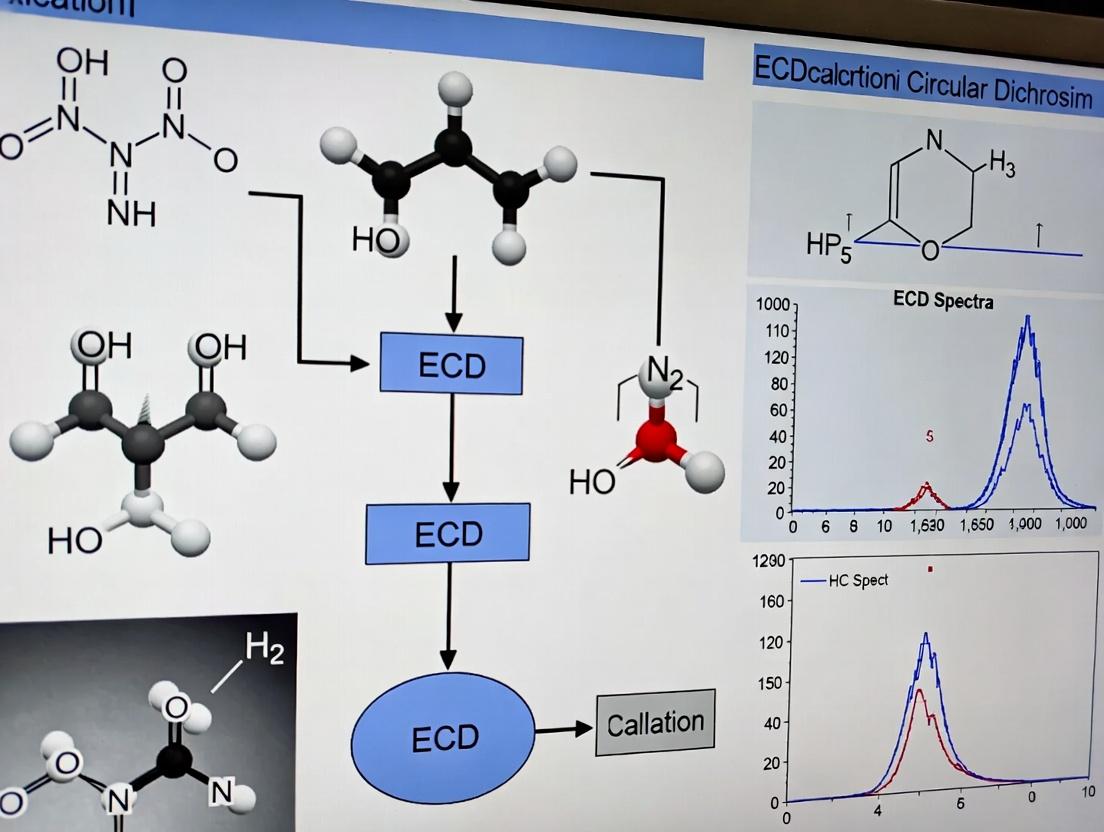
This comprehensive guide explores the critical role of Electronic Circular Dichroism (ECD) calculations in the structural elucidation of natural products.
Mastering ECD Calculations: The Definitive Guide to Determining Natural Product Absolute Configuration
Abstract
This comprehensive guide explores the critical role of Electronic Circular Dichroism (ECD) calculations in the structural elucidation of natural products. It provides researchers, scientists, and drug development professionals with a complete workflow, from foundational quantum chemistry principles and state-of-the-art computational methodologies (TD-DFT, exciton model) to practical application protocols, common troubleshooting strategies, and robust validation against complementary techniques like VCD and ORD. The article synthesizes current best practices for achieving reliable absolute configuration assignments, which are fundamental for understanding bioactivity and advancing drug discovery from natural sources.
Understanding ECD Spectroscopy: The Quantum Chemical Foundation for Stereochemistry
What is ECD and Why is it Indispensable for Natural Products?
Thesis Context: Within the broader research on the application of Electronic Circular Dichroism (ECD) calculations for the structural elucidation of chiral natural products, this document provides essential application notes and detailed protocols. ECD serves as a critical tool for determining absolute configuration, a fundamental step in understanding the bioactivity and structure-activity relationships of natural compounds in drug discovery pipelines.
Electronic Circular Dichroism (ECD) is a spectroscopic technique that measures the difference in absorption of left- and right-handed circularly polarized light by chiral molecules. For natural products, which are overwhelmingly chiral, ECD provides indispensable stereochemical information that other techniques (like NMR and MS) cannot fully deliver. The absolute configuration (AC) of a molecule directly influences its three-dimensional shape and, consequently, its biological interaction with targets such as enzymes and receptors.
The standard workflow involves comparing the experimentally measured ECD spectrum of an isolated compound with in silico calculated spectra for its possible stereoisomers. A successful match allows unambiguous assignment of the AC.
Table 1: Comparison of Common Methods for Absolute Configuration Determination
| Method | Key Principle | Typical Sample Requirement | Throughput | Approximate Cost per Sample | Key Limitation |
|---|---|---|---|---|---|
| ECD Spectroscopy | Differential absorption of polarized light. | 0.1-0.5 mg | Medium | $100-$500 (calc. included) | Requires a strong chromophore; sensitive to conformation. |
| Vibrational CD (VCD) | Differential absorption in IR region. | 0.5-2 mg | Low | $500-$1000 | Requires heavier computation; sample must be IR-active. |
| X-ray Crystallography | Direct imaging of crystal structure. | Single crystal (~0.001 mg) | Very Low | >$1000 | Requires a high-quality, pure crystal. |
| Chemical Derivatization | Synthesis of diastereomers & NMR comparison. | 1-5 mg per derivative | Very Low | Varies widely | Destructive; requires derivatization knowledge and time. |
| NMR with Chiral Shift Reagents | Complexation and chemical shift anisotropy. | 1-10 mg | Medium | $200-$600 | Can be ambiguous; reagent-dependent. |
Table 2: Common Chromophores in Natural Products and Their ECD Transition Ranges
| Chromophore | Typical Compound Class | ECD Transition Region (nm) | Key Transitions |
|---|---|---|---|
| Carbonyl (n→π*) | Lactones, Ketones | 270-350 | n→π* |
| Benzene / Aromatic | Flavonoids, Lignans | 250-280 (B-band) | π→π* (¹L*b) |
| Conjugated Diene | Terpenoids | 220-260 | π→π* |
| α,β-Unsaturated Carbonyl | Chalcones, Steroids | 300-400 (n→π), 220-260 (π→π) | n→π, π→π |
| Amide (n→π*) | Peptides, Depsipeptides | 210-230 | n→π* (amide) |
Detailed Experimental Protocols
Protocol 1: Experimental ECD Measurement for Natural Products
Objective: To obtain a high-fidelity experimental ECD spectrum of a purified chiral natural product.
Materials:
- Purified natural product sample (>95% purity, 0.1-0.5 mg).
- High-quality, UV-transparent solvent (e.g., spectroscopic grade MeCN, MeOH, H₂O).
- Quartz cuvette with a path length appropriate for concentration (typically 0.1 or 1.0 cm).
- Nitrogen gas supply for purging.
- Modern CD spectropolarimeter (e.g., JASCO J-1500/1700 series).
Procedure:
- Sample Preparation: Accurately weigh the sample. Dissolve it in the chosen solvent to achieve an absorbance of <1.5 (ideally ~0.5-1.0) in the region of interest for the target chromophore. Filter through a 0.45 μm PTFE syringe filter if necessary.
- Instrument Setup: Purge the spectropolarimeter with nitrogen for at least 20 minutes to minimize ozone generation and reduce UV absorption by oxygen. Set the temperature (typically 25°C).
- Parameter Settings:
- Wavelength Range: Typically 190-400 nm (limited by solvent cut-off).
- Bandwidth: 1 nm.
- Step Size: 0.5 nm or 1 nm.
- Scan Speed: 50-100 nm/min.
- Response Time: 1-4 seconds.
- Accumulations: 3-8 scans to improve signal-to-noise ratio.
- Baseline Correction: Fill the cuvette with pure solvent and run a blank scan using the same parameters. Save this as the baseline.
- Sample Measurement: Replace the solvent with the sample solution. Run the measurement with the same parameters. The instrument software will typically subtract the baseline automatically.
- Data Processing: Smooth the data (if necessary, using a Savitzky-Golay filter). Express the final spectrum in terms of molar ellipticity [θ] (deg·cm²·dmol⁻¹) using the formula: [θ] = (θobs × MRW) / (c × l), where θobs is the measured ellipticity (mdeg), MRW is the mean residue weight (or molecular weight for small molecules), c is concentration (g/mL), and l is pathlength (cm).
Protocol 2:In SilicoECD Calculation Workflow (TDDFT-Based)
Objective: To calculate the theoretical ECD spectrum for a proposed absolute configuration of a natural product.
Materials:
- Chemical structure file (e.g., .mol, .sdf) of the proposed stereoisomer.
- Computational software: Gaussian, ORCA, or Turbomole for quantum calculations; Confab or RDKit for conformation search; SpecDis or Multiwfn for spectrum processing.
- High-performance computing (HPC) cluster or workstation.
Procedure:
- Conformational Search: Perform a systematic or random conformational search using molecular mechanics (MMFF94 or MM2) to identify all low-energy conformers within a specified energy window (e.g., 5-7 kcal/mol above the global minimum). Retain conformers for quantum mechanical (QM) treatment.
- Geometry Optimization & Frequency Calculation: Optimize each retained conformer using Density Functional Theory (DFT) with a functional like B3LYP or ωB97XD and a basis set such as 6-31G(d). Perform a frequency calculation at the same level to confirm a true energy minimum (no imaginary frequencies) and to obtain Boltzmann populations at the experimental temperature.
- ECD Calculation (TDDFT): For each optimized conformer, perform a Time-Dependent DFT (TDDFT) calculation to obtain excitation energies, oscillator strengths, and rotational strengths. Use a functional like CAM-B3LYP (better for charge-transfer transitions) with a basis set such as TZVP or 6-311++G(2d,p). Include an implicit solvent model (e.g., IEFPCM for MeOH) consistent with the experiment.
- Spectrum Generation: Extract the rotational strengths (in cgs units, 10⁻⁴⁰ esu² cm²) for each excited state. Generate a theoretical spectrum by summing Gaussian- or Lorentzian-shaped bands for each transition, weighted by the Boltzmann population of its parent conformer. Use a half-bandwidth (σ) of 0.2-0.4 eV. Process with software like SpecDis to align, scale, and compare with the experimental spectrum.
- Comparison & Assignment: Visually and statistically (using the similarity factor g or the Compare tool in SpecDis) compare the calculated spectra of all possible stereoisomers with the experimental one. The correct AC is assigned to the isomer whose calculated spectrum best matches the sign sequence and band positions of the experimental spectrum.
Visualization
Title: ECD Computational Workflow for Absolute Configuration Assignment
The Scientist's Toolkit: Research Reagent Solutions
Table 3: Essential Materials for ECD-Based Structural Analysis
| Item / Reagent | Function & Importance | Example / Specification |
|---|---|---|
| Spectroscopic Grade Solvents | Minimize UV absorption background noise, ensuring clean baseline. Essential for short-wavelength data. | HPLC/spectro grade Acetonitrile, Methanol, Water (e.g., Sigma-Aldrich 34851, 439193). |
| Quartz Cuvettes | Provide UV transparency down to ~190 nm. Pathlength choice (0.1 mm-1 cm) allows adjustment for sample concentration. | Hellma Analytics Suprasil quartz cuvettes (e.g., Type 110-QS). |
| Chiral Shift Reagents (for NMR) | Used to independently validate ECD assignment or to determine enantiomeric purity before ECD measurement. | Tris[3-(heptafluoropropylhydroxymethylene)-d-camphorato]europium(III) [Eu(hfc)₃]. |
| Computational Software Licenses | Enable quantum mechanical calculations (TDDFT) and spectrum processing. | Gaussian 16 (Gaussian, Inc.), ORCA (free academic), SpecDis (free for academic use). |
| Reference Standard (of known AC) | Positive control for instrument alignment and method validation. | (1R)-(-)- or (1S)-(+)-Camphorsulfonic Acid ammonium salts - provide specific, known ECD cotton effects. |
| Syringe Filters (PTFE) | Remove particulate matter from sample solutions to prevent light scattering artifacts. | 0.45 μm pore size, PTFE membrane, non-sterile. |
| High-Performance Computing Resources | Necessary for timely completion of TDDFT calculations, which are computationally intensive. | Access to cluster with multiple CPU cores and >64 GB RAM per job. |
Within a thesis focused on Electronic Circular Dichroism (ECD) calculations for natural product structural analysis, understanding the Cotton Effect is fundamental. It describes the differential absorption of left and right circularly polarized light by chiral chromophores, providing absolute configuration and conformational data critical for drug development.
Core Physical Principles & Quantitative Data
The observed ECD signal, ΔA (AL – AR), arises from the interaction between the electric transition dipole moment ( μ ) and the magnetic transition dipole moment ( m ) of a chromophore in a chiral environment. The rotational strength R, a quantitative measure of the Cotton Effect, is given by: R = Im( μ · m )
The sign and magnitude of the Cotton Effect are dictated by the chiral arrangement of chromophores, described by coupled oscillator and exciton chirality models.
Table 1: Key Quantitative Parameters in ECD Spectroscopy & Calculations
| Parameter | Symbol | Typical Units | Significance in Natural Product Analysis |
|---|---|---|---|
| Delta Absorbance | ΔA (or Δε) | mAU (or M-1cm-1) | Direct experimental readout; Δε = εL - εR. |
| Rotational Strength | R | 10-40 esu2cm2 (Debye-Bohr Magneton) | Theoretical strength of a CD band; integral of Δε over band. |
| Dissymmetry Factor | g | Unitless | g = Δε/ε; normalized intensity for comparing chromophores. |
| Excitation Energy | E | eV or nm | Position of Cotton band; correlates with chromophore type. |
| Bandwidth (FWHM) | Γ | nm | Related to conformational flexibility and solvent effects. |
| Coupling Energy | V | eV | Strength of interaction between two chromophores in exciton model. |
Table 2: Common Chromophores in Natural Products & Their ECD Signatures
| Chromophore Type | Typical λ_max (nm) | Key Transition | Utility in Structural Analysis |
|---|---|---|---|
| Carbonyl (n→π*) | 280 - 320 | n → π* | Octant rule for rigid cyclohexanones. |
| Conjugated Diene | 230 - 260 | π → π* | Helicity rules for diene chirality. |
| Aromatic (Lb) | 250 - 280 | π → π* | Sense of twist in chiral aromatic systems. |
| Amide (n→π*) | 210 - 230 | n → π* | Peptide/protein secondary structure (e.g., α-helix +/+/-). |
| Extended π-system (e.g., porphyrin) | Varies (e.g., Soret ~400) | π → π* | Aggregate and supramolecular chirality. |
Application Notes: From Measurement to Calculation
Note 1: Linking Experiment to Computation for Absolute Configuration (AC) Assignment The definitive AC assignment requires matching the sign and relative magnitude of key Cotton bands between experimental and in silico spectra. TD-DFT (Time-Dependent Density Functional Theory) is the standard for calculating ECD spectra of flexible molecules, requiring systematic conformational analysis.
Note 2: Solvent & Environment Effects The chiral environment extends beyond the molecule itself. Solvent polarity can shift band positions and intensities. Explicit solvent molecules in calculations or matrix methods (e.g., PCM) are often necessary for accurate reproduction of experimental spectra.
Note 3: The Excitron Chirality Method For natural products with two or more identical chromophores (e.g., bis-porphyrins, diterpenes with dienes), the exciton coupling model is powerful. The sign of the coupled ECD band (bisignate curve) directly reflects the absolute twist between the transition moments.
Experimental Protocols
Protocol 1: Standard ECD Measurement for Natural Product Solution Objective: Obtain a high-fidelity ECD spectrum of a chiral natural product in solution. Materials: See "Scientist's Toolkit" below. Procedure:
- Sample Preparation: Accurately weigh sample to achieve an absorbance of 0.5-1.2 at the λmax of interest in the chosen cell pathlength (typically 0.1-1.0 cm). Dissolve in high-purity, UV-transparent solvent (e.g., spectroscopic grade MeCN, hexane). Filter through a 0.22 μm PTFE syringe filter if necessary.
- Instrument Calibration: Perform baseline correction with matched cells containing pure solvent. Calibrate instrument intensity and wavelength using a standard (e.g., aqueous (1S)-(+)-10-camphorsulfonic acid, CSA). For CSA (0.06% w/v), verify a Δε of +2.37 at 290.5 nm and -4.85 at 192.5 nm.
- Acquisition Parameters: Set temperature (controlled by Peltier). Typical settings: wavelength range 190-400 nm (dependent on solvent cut-off), step size 0.5-1 nm, bandwidth 1 nm, scanning speed 50-100 nm/min, 3-5 accumulations per scan to improve S/N.
- Data Processing: Average accumulations. Subtract solvent baseline. Smooth data minimally (e.g., Savitzky-Golay). Convert from millidegrees (θ) to Δε using the formula: Δε = θ / (32980 * c * l), where c is concentration in mol/L and l is pathlength in cm.
- Validation: Measure sample at two different concentrations to confirm linearity and absence of aggregation artifacts.
Protocol 2: Computational ECD Workflow for AC Assignment Objective: Generate a theoretical ECD spectrum to compare with experiment. Procedure:
- Conformational Search: Using molecular mechanics (MMFF94, GAFF), perform a systematic or stochastic (e.g., Monte Carlo, Molecular Dynamics) search for all low-energy conformers (within ~3 kcal/mol of global minimum).
- Geometry Optimization & Boltzmann Weights: Optimize all relevant conformers at a higher level (e.g., DFT: B3LYP/6-31G(d)). Calculate their Gibbs free energies. Compute Boltzmann populations at the measurement temperature.
- ECD Calculation: Perform excited-state calculations (TD-DFT) on each populated conformer using a functional and basis set suitable for excited states (e.g., CAM-B3LYP/def2-TZVP). Include implicit solvation (e.g., IEF-PCM model for solvent).
- Spectrum Generation: Combine individual conformer spectra using their Boltzmann weights. Apply a Gaussian or Lorentzian band shape (bandwidth ~0.3-0.4 eV) to each transition to generate a continuous spectrum.
- Comparison & Assignment: Compare the sign sequence and relative intensities of key bands between calculated and experimental spectra. A positive match confirms the proposed AC.
Diagram Title: Computational ECD Workflow for AC Assignment
The Scientist's Toolkit: Research Reagent Solutions
Table 3: Essential Materials for ECD Experiments & Calculations
| Item | Function & Application Notes |
|---|---|
| Spectroscopic Grade Solvents (e.g., MeCN, Hexane, MeOH) | Minimize UV absorption background; essential for low-wavelength data (<220 nm). |
| Quartz Suprasil Cuvettes (0.1 mm to 10 cm pathlength) | UV-transparent down to ~190 nm; selection depends on sample concentration and volume. |
| (1S)-(+)-10-Camphorsulfonic Acid (CSA) | Primary ECD standard for instrument calibration and validation of intensity & wavelength. |
| Chiral Natural Product Standard (e.g., (-)-Menthone) | Secondary standard for method validation in specific solvent systems. |
| 0.22 μm PTFE Syringe Filters | For clarifying sample solutions, removing dust & aggregates that cause light scattering. |
| Software: Conformational Search (e.g., CONFLEX, MacroModel, CREST) | Generates ensemble of likely 3D structures for flexible molecules. |
| Software: Quantum Chemistry (e.g., Gaussian, ORCA, Turbomole) | Performs DFT/TD-DFT calculations for geometry optimization and ECD prediction. |
| Software: Spectrum Processing (e.g., SpecDis, BioTools) | Processes, compares, and aligns experimental and calculated ECD spectra; crucial for similarity analysis. |
Diagram Title: Physics of the Cotton Effect: Key Interactions
Application Notes: Quantum Concepts in Natural Product ECD Analysis
The accurate calculation of Electronic Circular Dichroism (ECD) spectra for natural product structural elucidation rests upon a foundational understanding of core quantum chemistry concepts. These concepts bridge the gap between molecular chiral structure and the experimentally observed differential absorption of left- and right-circularly polarized light. Within the thesis context of using computational ECD for stereochemical assignment, these principles dictate protocol design and data interpretation.
Excited States in Chiral Molecules
For a typical chiral organic natural product, electronic excited states are calculated to simulate the UV-vis and ECD spectra. The energy, wavefunction, and transition probability of these states are paramount. Time-Dependent Density Functional Theory (TD-DFT) is the current standard for molecules of pharmaceutical relevance, providing a balance of accuracy and computational cost. The choice of functional (e.g., CAM-B3LYP, ωB97XD) and basis set (e.g., TZVP, def2-TZVP) is critical for correctly describing charge-transfer and Rydberg states.
Electric and Magnetic Transition Moments
The interaction of light with a molecule is governed by transition moments. The electric dipole transition moment ( \vec{\mu}{0m} = \langle \Psi0 | \hat{\mu} | \Psim \rangle ) determines the intensity of UV absorption. The magnetic dipole transition moment ( \vec{m}{0m} = \langle \Psi0 | \hat{m} | \Psim \rangle ) is crucial for optical activity. For ECD to be non-zero, these two vectors for a given transition from the ground state (0) to an excited state (m) must have a non-vanishing scalar product.
Rotational Strength: The Key ECD Metric
The signed intensity of an ECD band is quantified by the rotational strength ( R{0m} ), a pseudo-scalar quantity given by: [ R{0m} = \text{Im}( \langle \Psi0 | \hat{\mu} | \Psim \rangle \cdot \langle \Psim | \hat{m} | \Psi0 \rangle ) ] It is proportional to the area under the ECD curve for that transition. A positive ( R ) yields a positive Cotton effect (ECD band). The sign is exquisitely sensitive to absolute configuration and conformational dynamics. The total theoretical ECD spectrum is generated by summing Gaussian- or Lorentzian-broadened rotational strengths across all calculated excited states.
Table 1: Comparative Performance of DFT Functionals for Chiroptical Properties
| Functional | Type | Description | Best For | Rotational Strength Error* |
|---|---|---|---|---|
| CAM-B3LYP | Range-Separated Hybrid | Corrects long-range charge transfer issues | General natural products, charge-transfer states | ± 5-10% |
| ωB97XD | Range-Separated Hybrid w/ Dispersion | Includes empirical dispersion corrections | Flexible molecules, weak intermolecular interactions | ± 5-10% |
| PBE0 | Global Hybrid | 25% exact exchange | Rigid chromophores, lower computational cost | ± 10-15% |
| B3LYP | Global Hybrid | Standard hybrid functional | Initial screening, may fail for charge-transfer | ± 15-25% |
*Error is estimated relative to high-level ab initio (e.g., RI-CC2) or experimental benchmarks for rigid test cases.
Experimental Protocols for Computational ECD Analysis
The following protocol outlines a robust workflow for the computational determination of absolute configuration using ECD, as featured in contemporary natural product research.
Protocol: TD-DFT ECD Calculation for Absolute Configuration Assignment
Objective: To determine the absolute configuration of a newly isolated chiral natural product by comparing calculated and experimental ECD spectra.
I. Materials & Computational Setup
- Software Suite: Gaussian 16, ORCA 5.0, or similar quantum chemistry package.
- Conformational Search Software: CREST (using GFN-FF/GFN2-xTB), MacroModel, or CONFLEX.
- Visualization/Analysis: Avogadro, GaussView, VMD, or PyMOL for structure manipulation; Multiwfn or SpecDis for spectrum plotting and Boltzmann averaging.
- Hardware: High-Performance Computing (HPC) cluster with multicore nodes (≥ 24 cores) and sufficient memory (≥ 128 GB RAM recommended).
II. Stepwise Procedure
Step 1: Initial Geometry Preparation and Conformational Search
- Build a 3D model of the proposed stereoisomer using a chemical builder.
- Perform a preliminary geometry optimization at the semi-empirical level (e.g., GFN-xTB or PM6) to remove severe clashes.
- Execute a comprehensive conformational search in the gas phase using CREST (or equivalent) with appropriate settings for rotational barriers and molecular flexibility. Use an energy window of 6-8 kcal/mol relative to the global minimum.
- Collect all unique conformers (RMSD threshold typically 0.5 Å).
Step 2: Quantum Chemical Geometry Optimization & Boltzmann Population
- Optimize each unique conformer's geometry using Density Functional Theory (DFT). Recommended: B3LYP functional with the 6-31G(d) basis set in the gas phase.
- Calculate the harmonic vibrational frequencies at the same level of theory to confirm true minima (no imaginary frequencies) and obtain Gibbs free energy at the desired temperature (e.g., 298 K).
- Calculate the Boltzmann population ( pi ) for each conformer *i* using: [ pi = \frac{\exp(-\Delta Gi / RT)}{\sumj \exp(-\Delta G_j / RT)} ] Discard conformers contributing < 1% to the total population to reduce computational cost.
Step 3: Excited State and Rotational Strength Calculation
- For each populated conformer, perform a TD-DFT excited state calculation.
- Method: Use a range-separated hybrid functional (e.g., CAM-B3LYP, ωB97XD).
- Basis Set: Use a polarized triple-zeta basis set (e.g., def2-TZVP, 6-311+G(d,p)).
- Solvent Model: Employ a polarizable continuum model (e.g., IEFPCM, SMD) for the experimental solvent (e.g., methanol, acetonitrile).
- Number of States: Calculate at least the first 30-50 excited states.
- Key Output: Excitation energies (wavelengths), oscillator strengths (f, for UV), and rotational strengths (R, in cgs units: ( 10^{-40} ) esu(^2) cm(^2)) for each transition.
Step 4: Spectrum Generation and Comparison
- For each conformer, generate a simulated ECD spectrum by broadening each calculated transition with a Gaussian or Lorentzian function (half-width at half-maximum, HWHM, typically 0.2-0.4 eV).
- Produce the final Boltzmann-weighted spectrum by summing the individual conformer spectra weighted by their population ( p_i ).
- Plot the calculated spectrum against the experimental ECD trace. Overlay the corresponding calculated UV spectrum with the experimental UV for validation.
- Critical Analysis: Compare not just band positions, but more importantly, the sign sequence (positive/negative) and relative intensities of the Cotton effects. A convincing match supports the assigned absolute configuration. Compare calculations for the enantiomer to confirm the opposite spectrum is obtained.
III. Troubleshooting & Validation
- Poor UV Match: Indicates incorrect excitation energies. Try a different functional (e.g., switch to ωB97XD) or increase basis set size.
- ECD Sign Inversion with Minor Conformers: Re-check conformational search parameters and energy ordering. Consider implicit/explicit solvent effects on conformation.
- Overall Poor Match: Re-evaluate the proposed stereochemistry or consider the presence of multiple chiral chromophores interacting (exciton coupling).
Visualization: ECD Assignment Workflow and Key Quantum Relationships
Title: Computational ECD Workflow for Absolute Configuration
Title: Quantum Properties Link to Spectra
Table 2: Key Research Reagent Solutions for ECD-Based Structural Analysis
| Item | Category | Function & Relevance |
|---|---|---|
| Polarimetric Solvents (HPLC Grade) | Chemical Reagent | High-purity, UV-transparent solvents (e.g., MeOH, MeCN, CH₂Cl₂) for preparing samples for experimental ECD measurement, matching computational solvent models. |
| Chiral Derivatization Agents | Chemical Reagent | (e.g., Mosher's acid chloride) Used to establish absolute configuration via NMR if ECD is inconclusive, providing orthogonal validation. |
| DFT/TD-DFT Software (Gaussian, ORCA) | Computational Resource | Core quantum chemistry engines for performing geometry optimizations, frequency, and excited state calculations. |
| Conformational Search Software (CREST, CONFLEX) | Computational Resource | Automates the identification of all low-energy conformers, a critical step for flexible molecules. |
| Spectrum Processing & Boltzmann Averaging (SpecDis, Multiwfn) | Computational Resource | Software to process raw quantum output, apply broadening, weight by conformer population, and generate publication-quality spectra for comparison. |
| Polarizable Continuum Model (PCM) | Computational Model | Implicit solvation model within quantum software to simulate solvent effects on electronic states, crucial for accurate excitation energies. |
| High-Performance Computing Cluster | Hardware | Essential infrastructure to complete the computationally intensive TD-DFT calculations for multiple conformers within a reasonable timeframe. |
| Reference ECD Spectra Databases | Data Resource | (e.g., SpecInfo, TD-DFT benchmarks) Used for method validation and comparison with known compounds of similar chromophores. |
Application Notes: Chromophores in ECD-Based Structural Analysis
The application of Electronic Circular Dichroism (ECD) to natural product structure elucidation hinges on the accurate identification and computational modeling of key chromophores. These light-absorbing units—enones, aromatic systems, and extended π-conjugates—dictate the chiroptical properties used for stereochemical assignment.
- Enones (α,β-unsaturated carbonyls): The n→π* and π→π* transitions of the conjugated system are highly sensitive to spatial orientation. Substituents on the enone and its conformational rigidity (e.g., in ring systems) are critical for reliable ECD simulation. Calculated spectra for different stereoisomers often show dramatic sign differences in the 300-400 nm region.
- Aromatic Chromophores (e.g., Phenols, Indoles): Benzene and its derivatives exhibit characteristic π→π* transitions. Substituted aromatics, particularly those with electron-donating groups, introduce perturbed (^{1}La) and (^{1}Lb) bands. Their ECD is exquisitely sensitive to the helicity of adjacent chiral elements, making them powerful probes for absolute configuration, especially when combined with quantum chemical calculations (TDDFT).
- Extended π-Systems (Polyenes, Polyacetylenes, Expanded Aromatics): These systems exhibit intense, often complex ECD spectra due to multiple overlapping transitions. Their conformational flexibility can be a challenge, necessitating thorough conformational searching and averaging. They are vital for studying macrocyclic and fused polycyclic natural products.
Table 1: Characteristic ECD Transitions of Key Chromophores
| Chromophore Type | Key Transition(s) | Typical Spectral Range (nm) | Sensitivity to Stereochemistry | Common in Natural Product Classes |
|---|---|---|---|---|
| Enone | n→π, π→π | 300 - 400 | Very High | Flavonoids, Steroids, Terpenoids |
| Simple Aromatic (e.g., Benzene) | (^{1}Lb), (^{1}La) | 250 - 280 | Moderate to High | Lignans, Aromatic Alkaloids |
| Substituted Aromatic (e.g., Phenol) | Perturbed (^{1}La), (^{1}Lb) | 270 - 320 | High | Flavonoids, Coumarins, Stilbenoids |
| Extended Polyene | π→π* (multiple) | 300 - 500+ | Extreme (helical sense) | Carotenoids, Polyene Macrolides |
| Extended Aromatic (e.g., Naphthalene) | π→π* (multiple) | 280 - 350 | High | Naphthoquinones, Anthracyclines |
Experimental Protocols
Protocol 1: ECD Measurement for Natural Product Solutions
Objective: Acquire high-quality ECD data for computational comparison.
- Sample Preparation: Precisely weigh compound (typically 0.1-1.0 mg) and dissolve in appropriate spectroscopic-grade solvent (e.g., MeCN, MeOH, Hexane) in a volumetric flask to achieve an absorbance of 0.5-1.5 in the region of interest for the 1 cm pathlength cell.
- Instrument Setup: Purge ECD spectrometer with nitrogen (≥5 min). Set parameters: bandwidth 1 nm, step size 0.5 nm, scan speed 100 nm/min, accumulation 3-5 scans. Temperature control is recommended (e.g., 25°C).
- Baseline Correction: Record spectrum of pure solvent in the same cell. This baseline is automatically subtracted from sample spectra.
- Data Acquisition: Fill cell with sample solution, ensuring no bubbles. Record ECD spectrum from a wavelength ~50 nm above the highest absorption to ~50 nm below the lowest. Save data as XY pairs (λ in nm, ΔA in mdeg).
Protocol 2: Computational ECD Workflow Using TDDFT
Objective: Calculate the theoretical ECD spectrum for a proposed stereoisomer.
- Conformational Search: Using molecular mechanics (e.g., MMFF94, OPLS4), perform an exhaustive search on the candidate structure. Apply energy window (typically 5-7 kcal/mol above global minimum).
- Geometry Optimization & Boltzmann Population: Optimize all unique conformers at a lower level DFT method (e.g., B3LYP/6-31G(d) in gas phase or PCM). Calculate their relative Gibbs free energies. Determine Boltzmann population distribution at 298 K.
- Excited-State Calculation: Perform Time-Dependent DFT (TDDFT) calculations on the populated conformers (sum ≥95% population). Use a functional and basis set suitable for chromophores (e.g., CAM-B3LYP/def2-TZVP, including PCM solvent model). Request sufficient excited states (e.g., 30) to cover the spectral range.
- Spectrum Generation: Using a dedicated tool (e.g., SpecDis), sum the individual conformer spectra weighted by their Boltzmann factors. Apply a Gaussian band shape (half-width ~0.3 eV). Shift the calculated wavelength axis by a small, consistent factor (e.g., +5 to +10 nm) to align with experimental UV maximum if necessary.
- Comparison: Overlay the Boltzmann-averaged theoretical ECD spectrum with the experimental spectrum. The sign agreement across all Cotton effects confirms the absolute configuration.
Diagram Title: TDDFT-ECD Computational Workflow for Configurational Assignment
The Scientist's Toolkit: Key Research Reagent Solutions
Table 2: Essential Materials for ECD-Based Structural Analysis
| Item | Function & Application Notes |
|---|---|
| Spectroscopic-Grade Solvents (e.g., Acetonitrile, Methanol, n-Hexane) | Minimize UV absorption interference; essential for accurate baseline correction. Must be anhydrous and in sealed ampules. |
| Quartz SUPRASIL Cuvettes (e.g., 1 mm, 1 cm pathlength) | High UV transmission down to ~190 nm; required for short-wavelength transitions of aromatics/enones. |
| Microbalance (1 µg sensitivity) | Accurate weighing of sub-milligram natural product samples for precise molar concentration determination. |
| Quantum Chemistry Software (e.g., Gaussian, ORCA, Turbomole) | Performs DFT optimization and TDDFT calculations; core platform for theoretical spectrum generation. |
| Conformational Search Software (e.g., CONFLEX, MacroModel, CREST) | Systematically explores rotameric and ring-conformational space to identify all low-energy conformers. |
| Spectrum Processing Tool (e.g., SpecDis, BioTools Spectra Manager) | Processes, averages, and compares experimental spectra; generates Boltzmann-weighted theoretical spectra from TDDFT output. |
| PCM Solvent Model Parameters | Integral part of TDDFT calculation; models solute-solvent interactions critical for accurate transition energy prediction. |
| Reference Compounds (e.g., (R)- and (S)- enantiomers of simple chromophoric models) | Used for method validation and to establish empirical rules or sense of helicity for common chromophores. |
Within the broader thesis on Electronic Circular Dichroism (ECD) calculations for natural product structural analysis, establishing the correct molecular conformation is paramount. The experimentally measured ECD spectrum of a chiral molecule is the Boltzmann-weighted average of the spectra of all its accessible conformations. Therefore, accurate conformational analysis and subsequent Boltzmann weighting are non-negotiable prerequisites for any successful computational ECD study aimed at determining absolute configuration or elucidating solution-state structure.
Foundational Concepts
The Conformational Ensemble
A flexible molecule exists in solution as an ensemble of interconverting conformers. Each conformer has a distinct geometry and, consequently, a distinct computed ECD spectrum. The population of each conformer at a given temperature is governed by its Gibbs free energy relative to the global minimum.
Boltzmann Weighting Principle
The contribution of each conformer to the final theoretical spectrum is weighted by its Boltzmann population factor: [ Pi = \frac{e^{(-\Delta Gi / RT)}}{\sum{j=1}^{n} e^{(-\Delta Gj / RT)}} ] where (Pi) is the population, (\Delta Gi) is the relative free energy, (R) is the gas constant, and (T) is the temperature.
Table 1: Comparison of Conformational Search Methods
| Method | Typical Number of Conformers Generated | Relative Computational Cost | Best Suited For |
|---|---|---|---|
| Systematic Rotor Search | 100 - 10,000+ | Low to Medium | Small molecules (<10 rotatable bonds), exhaustive sampling |
| Molecular Dynamics (MD) | 1,000 - 100,000+ | High | Larger, flexible molecules, implicit/explicit solvation |
| Monte Carlo (MC) | 1,000 - 50,000 | Medium to High | Medium-sized molecules, drug-like compounds |
| Genetic Algorithm (GA) | 100 - 5,000 | Medium | Complex natural products with multiple chiral centers |
Table 2: Typical Parameters for DFT Optimization and Frequency Calculations
| Parameter | Recommended Setting | Purpose/Rationale |
|---|---|---|
| Functional | B3LYP, ωB97XD, PBE0 | Good accuracy for geometry and energy |
| Basis Set (Geometry) | 6-31G(d) | Standard for organic molecules, cost-effective |
| Basis Set (Single Point) | def2-TZVP, aug-cc-pVDZ | Higher accuracy for energy differences |
| Solvation Model | IEFPCM, SMD (e.g., methanol) | Mimics experimental solution conditions |
| Temperature | 298.15 K | Standard for Boltzmann weighting |
| Energy Cut-off | 2-3 kcal/mol | Conformers within this range contribute significantly |
Detailed Experimental Protocols
Protocol 4.1: Conformational Search and Pre-optimization
Objective: Generate a comprehensive set of initial conformers.
- Input Preparation: Generate a 3D model of the molecule with correct stereochemistry using a builder (e.g., Maestro, Avogadro).
- Method Selection: For natural products with moderate flexibility (<15 rotatable bonds), use a systematic search with MacroModel or CREST.
Execution (using CREST):
This performs a fast GFN2-xTB level search in implicit methanol.
- Output Handling: Collect all unique conformer geometries (e.g.,
crest_conformers.xyz). Apply an initial energy window (e.g., 6 kcal/mol) to discard very high-energy structures.
Protocol 4.2: DFT Geometry Optimization and Frequency Calculation
Objective: Refine geometries and obtain accurate Gibbs free energies.
- Software Setup: Use Gaussian, ORCA, or similar. The following is an ORCA 5.0 input example for a single conformer.
- Input File:
- Batch Execution: Submit all conformers from Protocol 4.1. Ensure all jobs complete normally (no imaginary frequencies for minima).
- Data Extraction: Parse output files to extract the final Gibbs free energy (G) for each optimized conformer.
Protocol 4.3: Boltzmann Weighting and Spectrum Generation
Objective: Calculate populations and generate the final weighted theoretical ECD spectrum.
- Energy Alignment: Identify the conformer with the lowest G (Gmin). Calculate relative free energies: ΔGi = Gi - Gmin.
Population Calculation: Apply the Boltzmann formula at T=298.15 K (R = 0.00198588 kcal/mol·K). Example in Python:
ECD Calculation & Weighting: Perform TD-DFT ECD calculation (e.g., at CAM-B3LYP/def2-TZVP level) for each conformer. Apply a Gaussian broadening (σ ~ 0.2-0.3 eV) to each individual spectrum. Sum the broadened spectra, weighted by their Boltzmann populations.
- Final Output: The result is a single, Boltzmann-weighted theoretical ECD spectrum ready for comparison with experiment.
Visual Workflows
Title: Workflow for Conformational Analysis and Boltzmann-Weighted ECD
Title: Boltzmann Weighting of Conformer ECD Spectra
The Scientist's Toolkit
Table 3: Essential Research Reagents & Software Solutions
| Item Name | Category | Function / Purpose |
|---|---|---|
| CREST (Conformer-Rotamer Ensemble Sampling Tool) | Software | Automated, semi-empirical (GFN-xTB) based conformational search and clustering. Essential for generating initial ensembles. |
| Gaussian 16 / ORCA 5.0+ | Software | Industry-standard quantum chemistry packages for performing DFT geometry optimizations, frequency calculations, and TD-DFT ECD computations. |
| IEFPCM / SMD Solvation Models | Computational Model | Implicit solvation models integrated into QM software to simulate the effect of solvent (e.g., methanol, acetonitrile) on conformer energies and spectra. |
| GoodVibes | Software Tool | Python script for processing quantum chemistry output, automating thermochemistry analysis, and handling Boltzmann averaging. |
| SpecDis | Software | Specialized software for processing, plotting, and comparing experimental and calculated ECD/UV spectra, including application of broadening and scaling. |
| Merck Molecular Force Field (MMFF94) | Force Field | Commonly used for initial conformational searching and energy filtering in molecular mechanics-based protocols. |
| Python (NumPy, SciPy, Matplotlib) | Programming Environment | Custom scripting for data parsing, population calculations, spectrum weighting, and automated workflow management. |
Step-by-Step Computational Protocol: From Molecule to Reliable ECD Spectrum
Thesis Context: This protocol details the computational workflow for the prediction of Electronic Circular Dichroism (ECD) spectra, a critical component of the broader thesis research on the stereochemical elucidation of chiral natural products. Accurate ECD calculation is indispensable for assigning absolute configuration, a common challenge in natural product structural analysis with direct implications for understanding bioactivity and guiding drug development.
Experimental Protocol: The Conformer-ECD Workflow
Step 1: Conformational Search Objective: To comprehensively sample the accessible low-energy three-dimensional conformations of the chiral molecule of interest. Methodology:
- Input Preparation: Generate a reasonable 3D starting structure from a 2D representation using tools like CORINA or directly within molecular modeling suites (e.g., Maestro, Spartan).
- Search Algorithm: Employ a robust conformational search method.
- Preferred: Molecular Dynamics (MD) or Metadynamics simulations in implicit solvent (e.g., Generalized Born model) at elevated temperatures (e.g., 500-700 K) for 10-50 ns, followed by geometric clustering.
- Alternative: Stochastic search (e.g., MacroModel's MCMM) or systematic torsional sampling for smaller, less flexible molecules.
- Initial Filtering: Conformers are initially minimized using a molecular mechanics force field (e.g., OPLS4, MMFF94s) and duplicate structures (RMSD cutoff typically < 0.5 Å for heavy atoms) are removed. Key Parameters: Search method, simulation length/temperature (for MD), energy window cutoff (typically 5-10 kcal/mol above the global minimum), clustering RMSD threshold.
Step 2: Quantum Mechanical Geometry Optimization & Selection Objective: To refine conformer geometries and their relative energies at a high level of theory for subsequent spectroscopic property calculation. Methodology:
- Pre-optimization: Perform initial geometry optimization of all MMFF-minimized conformers using a cost-effective Density Functional Theory (DFT) method (e.g., B3LYP-D3BJ/6-31G(d)).
- Frequency Calculation: A single-point vibrational frequency calculation at the same level of theory is mandatory to confirm the structure is a true minimum (no imaginary frequencies) and to obtain thermal corrections (Gibbs free energy at 298 K).
- Final Energy Evaluation: Re-optimize the geometry and calculate the final electronic energy using a higher-level basis set (e.g., def2-TZVP or aug-cc-pVDZ) with the same or a more robust functional (e.g., ωB97X-D, PBE0).
- Conformer Selection: Calculate the Boltzmann population (Pᵢ) for each conformer i based on its computed Gibbs free energy (Gᵢ) at the target temperature (typically 298 K). Conformers contributing cumulatively > 99% of the total population are selected for ECD calculation.
Key Parameters: DFT functional, basis set, solvation model (implicit, e.g., SMD, PCM), energy cutoff for Boltzmann population (typically 99%).
Step 3: Excitation Calculation & Spectrum Generation Objective: To compute the excited states, their energies, rotational strengths, and simulate the continuous ECD spectrum. Methodology:
- Excited State Calculation: Perform Time-Dependent DFT (TD-DFT) calculations on each selected, optimized conformer. The functional/basis set combination is critical (e.g., CAM-B3LYP/def2-TZVP, PBE0/aug-cc-pVDZ). An implicit solvation model matching the experimental conditions must be applied.
- Data Extraction: For each conformer, extract the excitation energies (λ, in nm) and the velocity- or length-form rotational strength (R, in 10⁻⁴⁰ cgs) for a sufficient number of excited states (e.g., 30-50).
- Spectrum Simulation: Generate a Boltzmann-weighted, summed spectrum by applying a Gaussian (or Lorentzian) lineshape function to each transition. The bandwidth (σ, half-width at half-maximum) is an adjustable parameter to match experimental resolution.
- Comparison: The simulated spectrum is directly compared to the experimental trace. Agreement in the sign sequence and band positions is used to assign the absolute configuration.
Key Parameters: TD-DFT functional/basis set, number of excited states, lineshape function and width (σ, typically 0.2-0.4 eV), wavelength scaling factor (if applicable).
Table 1: Common DFT/TD-DFT Methodologies for ECD Workflows
| Computational Stage | Recommended Method | Typical Basis Set | Key Purpose | Approx. Time per Conformer* |
|---|---|---|---|---|
| Pre-optimization | B3LYP-D3BJ | 6-31G(d) | Initial geometry refinement | Low (Minutes) |
| Final Optimization | ωB97X-D | def2-SVP / def2-TZVP | Accurate geometry & energy | Medium (Tens of Minutes) |
| TD-DFT (ECD) | CAM-B3LYP | def2-TZVP / aug-cc-pVDZ | Excitation energy & rot. strength | High (Hours) |
| Time estimates are for a molecule with ~50 atoms, using a modern multi-core workstation. |
Table 2: Conformer Population Analysis for a Hypothetical Natural Product
| Conformer ID | Relative ΔG (kcal/mol) | Boltzmann Population (%) | Cumulative Population (%) | Included in Final ECD? |
|---|---|---|---|---|
| Conf_01 | 0.00 | 45.2 | 45.2 | Yes |
| Conf_02 | 0.15 | 40.1 | 85.3 | Yes |
| Conf_03 | 1.82 | 8.5 | 93.8 | Yes |
| Conf_04 | 2.50 | 4.1 | 97.9 | Yes |
| Conf_05 | 3.10 | 1.6 | 99.5 | Yes (Threshold: 99%) |
| Conf_06 | 5.01 | 0.2 | 99.7 | No |
Workflow Visualization
Title: ECD Prediction Computational Workflow
The Scientist's Toolkit: Essential Research Reagents & Software
Table 3: Key Computational Tools and Resources
| Item Name | Category | Function / Purpose |
|---|---|---|
| Gaussian 16 | Software Suite | Industry-standard for QM calculations (optimization, TD-DFT, frequencies). |
| ORCA | Software Suite | Powerful, efficient open-source QM package for DFT/TD-DFT and spectroscopy. |
| Spartan | Software Suite | Integrated molecular modeling with GUI, strong conformational search & spectroscopy tools. |
| CREST (GFN-FF/GFN2-xTB) | Software | Robust, fast conformer search via metadynamics using semiempirical methods. |
| SpecDis | Software | Specialized for processing, plotting, and comparing calculated vs. experimental ECD/UV spectra. |
| SMD Solvation Model | Algorithm | Implicit solvation model for accurate treatment of solvent effects in QM calculations. |
| def2-TZVP Basis Set | Basis Set | High-quality triple-zeta basis set for accurate property calculations in TD-DFT. |
| CAM-B3LYP Functional | DFT Functional | Long-range corrected functional essential for accurate charge-transfer excitations in ECD. |
| High-Performance Computing (HPC) Cluster | Hardware | Essential for processing conformational ensembles and TD-DFT calculations in parallel. |
Within the framework of a thesis focused on employing Electronic Circular Dichroism (ECD) calculations for the structural elucidation of complex natural products, the selection of an appropriate Density Functional Theory (DFT) functional and basis set is paramount. This choice directly dictates the accuracy of the calculated excited-state properties, which are then compared to experimental ECD spectra to assign absolute configurations. This guide provides application notes and protocols for key functionals like CAM-B3LYP and PBE0, extended to modern alternatives, ensuring robust and reliable computational analysis.
Core Functional Comparison & Quantitative Data
The performance of a functional is often benchmarked against higher-level theoretical methods or experimental data for properties like vertical excitation energies.
Table 1: Benchmarking of Common DFT Functionals for Excitation Energies (Typical Mean Absolute Error, eV)
| Functional | Type | Range-Separated? | Typical MAE for Valence Excitations | Suitability for ECD (Natural Products) |
|---|---|---|---|---|
| CAM-B3LYP | Hybrid-GGA | Yes (~65% HF at LR) | 0.3 - 0.4 | Excellent. Good for charge-transfer states common in chiral molecules. |
| PBE0 | Hybrid-GGA | No (25% HF) | 0.2 - 0.3 | Very Good. Robust for general purpose TD-DFT; may fail for strong CT. |
| ωB97XD | Hybrid-GGA | Yes (100% HF at LR) | 0.2 - 0.3 | Excellent. Includes dispersion correction; strong performer for diverse states. |
| M06-2X | Hybrid-Meta-GGA | No (54% HF) | ~0.2 | Very Good. High accuracy for main-group thermochemistry; good for ECD. |
| B3LYP | Hybrid-GGA | No (20% HF) | 0.3 - 0.5 | Good/Caution. Widely used but can underestimate CT excitation energies. |
| LC-ωPBE | Hybrid-GGA | Yes (100% HF at LR) | 0.2 - 0.3 | Excellent. Tuned for charge-transfer but can be system-dependent. |
Table 2: Recommended Basis Sets for ECD Calculations
| Basis Set | Type | Description | Use Case in ECD |
|---|---|---|---|
| 6-31G(d) | Pople Double-Zeta | Standard for geometry optimization. | Baseline; often sufficient for initial conformational search. |
| 6-311+G(d,p) | Pople Triple-Zeta | Adds diffuse and polarization functions. | Recommended standard for TD-DFT calculation of ECD spectra on pre-optimized geometries. |
| def2-SVP | Ahlrichs Double-Zeta | Efficient for geometry optimization. | Comparable to 6-31G(d). |
| def2-TZVP | Ahlrichs Triple-Zeta | High-quality for property calculations. | Excellent choice for final ECD spectra, balancing accuracy and cost. |
| aug-cc-pVDZ | Dunning Correlation-Consistent | Includes diffuse functions. | For high-accuracy requirements, especially for anions or Rydberg states. |
Experimental Protocols for ECD Computational Analysis
Protocol 3.1: Conformational Search and Geometry Optimization
- Input Preparation: Generate a 3D structure of the candidate stereoisomer using a molecular builder (e.g., Avogadro, GaussView).
- Conformational Search: Employ a molecular mechanics (MM) or semi-empirical method (e.g., MMFF94, PM7) via software like CONFLEX, CREST, or MacroModel to generate an ensemble of low-energy conformers. Set energy window to ~5-10 kcal/mol above the global minimum.
- Geometry Optimization: Optimize all unique conformers (typically population >1%) using DFT.
- Software: Gaussian, ORCA, GAMESS.
- Functional: PBE0 or B3LYP.
- Basis Set: 6-31G(d) or def2-SVP.
- Solvation Model: Include an implicit solvation model (e.g., IEFPCM, SMD) relevant to the experimental conditions (e.g., methanol, acetonitrile).
- Frequency Calculation: Perform a harmonic frequency calculation at the same level of theory to confirm a true minimum (no imaginary frequencies) and to obtain Gibbs free energies at 298 K.
- Boltzmann Population: Calculate the Boltzmann population weight for each conformer based on its relative Gibbs free energy.
Protocol 3.2: Excited-State Calculation & ECD Spectrum Generation
- Input: Use the optimized geometries and populations from Protocol 3.1.
- TD-DFT Calculation: Perform time-dependent DFT (TD-DFT) calculations to obtain excitation energies, rotatory strengths, and excited-state eigenvectors.
- Software: Gaussian, ORCA, DALTON.
- Functional: CAM-B3LYP or ωB97XD (recommended for broad accuracy).
- Basis Set: 6-311+G(d,p) or def2-TZVP.
- Solvation Model: Use the same implicit model as in optimization.
- Number of States: Calculate at least the first 30-50 excited states.
- Spectrum Simulation: Convolute the calculated stick spectra (excitation energy and rotatory strength for each transition) into a continuous curve.
- Tool: Use SpecDis, Multiwfn, or a custom script.
- Parameters: Apply a Gaussian or Lorentzian broadening function. Half-bandwidth (σ) of 0.2-0.4 eV is typical. Shift the entire spectrum by a constant value (ΔE) if necessary for comparison with experiment (common practice).
- Weighted Spectrum: Generate the final Boltzmann-weighted ECD spectrum by summing the individual conformer spectra multiplied by their population weights.
- Comparison: Overlay the calculated spectrum with the experimental one. A good match in sign and magnitude of Cotton effects across the spectral window supports the proposed absolute configuration.
Visualization of Computational Workflow
Title: Computational ECD Workflow for Absolute Configuration Assignment
The Scientist's Toolkit: Essential Research Reagents & Software
Table 3: Essential Computational Toolkit for ECD Studies
| Item / Solution | Function / Purpose | Example (Not Exhaustive) |
|---|---|---|
| Quantum Chemistry Software | Performs DFT geometry optimizations and TD-DFT calculations. | Gaussian, ORCA, GAMESS, DALTON, TURBOMOLE. |
| Conformational Search Software | Systematically explores low-energy molecular conformations. | CONFLEX, CREST (xtb), MacroModel (Schrödinger), Spartan. |
| Spectrum Processing & Plotting Tool | Convolutes TD-DFT outputs, applies shifts, and compares spectra. | SpecDis, Multiwfn, VMD (with plugins), Python/Matplotlib scripts. |
| Molecular Visualization & Builder | Prepares input structures and visualizes results. | GaussView, Avogadro, PyMOL, CYLview. |
| Implicit Solvation Model | Accounts for solvent effects in calculations. | IEFPCM, SMD, COSMO (as implemented in major packages). |
| High-Performance Computing (HPC) Cluster | Provides the necessary computational power for TD-DFT on medium/large molecules. | Local university clusters, cloud computing resources (AWS, Azure). |
This application note is developed within the framework of a doctoral thesis focused on employing Electronic Circular Dichroism (ECD) calculations for the unambiguous structural elucidation of chiral natural products. A critical, and often decisive, factor in the accuracy of these in silico ECD spectra is the treatment of solvation effects. Natural products are almost invariably studied in solution (e.g., methanol, acetonitrile, water), and solute-solvent interactions can profoundly influence conformational populations, electronic transitions, and spectral line shapes. Therefore, selecting and correctly implementing a solvent model is paramount for successful correlation between computed and experimental ECD data, ultimately determining absolute configuration.
Core Solvent Modeling Methodologies
Explicit Solvent Modeling
Explicit modeling involves simulating individual solvent molecules around the solute. This is typically achieved through Molecular Dynamics (MD) or Monte Carlo simulations, followed by QM calculations on snapshots.
Key Protocol: Explicit Solvent Sampling for ECD Conformational Analysis
- System Preparation: Use a molecular builder (e.g., Maestro, GaussView) to create the 3D structure of the chiral natural product.
- Solvation: Place the solute in a pre-equilibrated box of solvent molecules (e.g., TIP3P water, methanol). Ensure a minimum cutoff distance (e.g., 10 Å) from the solute to the box edge.
- Energy Minimization: Relax the system using a steepest descent/ conjugate gradient algorithm (force field: GAFF2/OPLS4) to remove steric clashes.
- Equilibration:
- Perform a 100 ps NVT simulation at 300 K using a Langevin thermostat.
- Follow with a 100 ps NPT simulation at 1 bar using a Berendsen barostat to achieve correct density.
- Production MD: Run an unrestrained MD simulation (1-10 ns) at 300 K and 1 bar to sample the solute's conformational space in explicit solvent.
- Snapshot Extraction: Extract 100-500 evenly spaced snapshots from the trajectory.
- QM Geometry Optimization & ECD Calculation: For each snapshot:
- Perform a constrained optimization at a lower QM level (e.g., B3LYP/6-31G(d)) keeping the solute in the solvent "cage."
- Subsequently, calculate excitation energies and rotatory strengths at a higher level (e.g., CAM-B3LYP/TZVP) for ECD spectrum generation. Note: The solvent cage is often replaced by an implicit model for this final TD-DFT step due to cost.
Implicit Solvent Modeling (PCM, SMD)
Implicit models represent the solvent as a continuous dielectric medium characterized by its dielectric constant (ε) and other bulk properties. They are computationally efficient and standard in TD-DFT calculations.
Key Protocol: Implicit Solvent ECD Spectrum Calculation (Gaussian/GAMESS)
- Conformer Search: Perform a conformational search in vacuum using molecular mechanics (MMFF94).
- Geometry Optimization: Optimize all low-energy conformers (e.g., within 3 kcal/mol) using DFT (e.g., B3LYP/6-31G(d)) with the chosen implicit solvation model (PCM or SMD) active.
- Thermochemical Analysis: Calculate the Boltzmann population (at 298.15 K) based on the free energies (G) from the optimization output.
- ECD Calculation: For each populated conformer, perform a Time-Dependent DFT (TD-DFT) calculation (e.g., CAM-B3LYP/TZVP, 30 excited states) with the same implicit solvation model active.
- Spectrum Averaging & Broadening: Weight the ECD spectra of each conformer by their Boltzmann population. Sum the spectra and apply a Gaussian broadening function (σ ~ 0.2-0.3 eV).
Table 1: Quantitative Comparison of Solvent Modeling Methods for ECD Calculations
| Feature | Explicit Solvent | Polarizable Continuum Model (PCM) | Solvation Model based on Density (SMD) |
|---|---|---|---|
| Computational Cost | Very High | Low-Moderate | Low-Moderate |
| Physical Fidelity | High (atomistic, includes specific interactions) | Moderate (bulk electrostatics) | High (includes bulk electrostatics + non-electrostatic terms) |
| Key Solute-Solvent Effects Modeled | Hydrogen bonding, van der Waals, explicit cavity formation, dielectric screening | Dielectric screening (via apparent surface charge) | Dielectric screening + non-electrostatic cavity-dispersion-solvent structure terms |
| Dependence on Solute Cavity | None | High (sensitive to atomic radii) | High (based on electron density isosurface) |
| Typical Use Case in ECD Workflow | Initial conformational sampling under realistic solvation; benchmarking. | Routine TD-DFT ECD calculation for polar protic/aprotic solvents. | Routine TD-DFT ECD calculation, especially for solvents with complex properties or charged species. |
| Accuracy for H-bond Donors/Acceptors | Excellent | Can be fair to poor without state-specific correction | Generally better than PCM due to parameterization |
Visualization of Method Selection and Workflow
Solvent Model Decision Workflow for ECD
Implicit Solvent Model Principle
The Scientist's Toolkit: Research Reagent Solutions
Table 2: Essential Software & Computational Tools for Solvent Modeling in ECD
| Item (Software/Package) | Category | Primary Function in ECD Workflow |
|---|---|---|
| Gaussian 16/ORCA | Quantum Chemistry | Performs DFT geometry optimizations and TD-DFT ECD calculations with integrated PCM/SMD implicit solvent models. |
| GAMESS | Quantum Chemistry | Open-source alternative for QM calculations with solvation models. |
| CROMOS/GAFF Force Fields | Molecular Mechanics | Provides parameters for explicit solvent (e.g., SPC, TIP3P) and solute molecules during MD simulations. |
| GROMACS/AMBER | Molecular Dynamics | Simulates explicit solvation for conformational sampling and benchmarking of solvent effects. |
| Multiwfn | Wavefunction Analysis | Processes TD-DFT output to generate, plot, and analyze ECD spectra. |
| SpecDis | Spectrum Processing | Used for Boltzmann averaging, broadening, and similarity analysis (similarity index) of computed vs. experimental ECD spectra. |
| ANTECHAMBER (ACPYPE) | Parameterization | Generates molecular mechanics parameters for organic molecules for use in explicit solvent MD simulations. |
| MEAD (or other PB Solvers) | Continuum Electrostatics | Can be used for advanced, non-uniform implicit modeling if required. |
Within the broader thesis on using Electronic Circular Dichroism (ECD) calculations for the structural analysis of complex natural products, the accurate computation of excited states is paramount. Time-Dependent Density Functional Theory (TD-DFT) is the predominant quantum chemical method for predicting low-lying excited states, which are essential for simulating UV-Vis and ECD spectra. This protocol details the critical parameters and considerations for performing robust TD-DFT calculations, focusing on applications in natural product and drug development research.
Key TD-DFT Parameters and Their Optimization
The accuracy of a TD-DFT calculation is governed by several interdependent parameters. Incorrect settings can lead to unrealistic spectra or missed critical transitions.
Table 1: Core TD-DFT Calculation Parameters
| Parameter | Typical Setting / Choice | Rationale & Impact on Calculation |
|---|---|---|
| Functional | B3LYP, CAM-B3LYP, ωB97XD, PBE0 | Hybrid/GGA functionals (B3LYP) are standard; long-range corrected (CAM-B3LYP, ωB97XD) are crucial for charge-transfer states common in extended chromophores. |
| Basis Set | 6-31+G(d), 6-311+G(2d,p), def2-TZVP, aug-cc-pVDZ | Must include diffuse functions (+); essential for modeling excited state electron densities. Larger sets increase accuracy and cost. |
| Solvent Model | IEFPCM, SMD, COSMO | Implicit models like SMD are mandatory to simulate experimental conditions (e.g., methanol, acetonitrile). Dramatically affects state ordering and energies. |
| Number of States (N) | 10-50 (UV-Vis), 30-100+ (ECD) | Must be sufficient to cover the spectral range of interest (e.g., 200-400 nm). ECD requires more states as sign changes depend on coupling of multiple transitions. |
| Convergence Criterion | 10^-8 to 10^-9 (tight) |
Ensures SCF and TD-DFT eigenvalue stability. Loose criteria can cause "ghost" states or inaccurate oscillator strengths. |
| Integration Grid | Ultrafine (e.g., Grid=4 in Gaussian) | A fine numerical integration grid is critical for stable TD-DFT results, especially with modern functionals. |
Protocol: TD-DFT Setup for Natural Product ECD Simulation
This protocol outlines a standard workflow for calculating excited states to generate an ECD spectrum for a chiral natural product.
Step 1: Ground-State Geometry Optimization
- Structure Preparation: Generate a reasonable 3D structure of the target molecule with correct stereochemistry.
- Method Selection: Optimize using a functional (e.g., B3LYP) and a medium basis set (e.g., 6-31G(d)).
- Solvation: Employ an implicit solvent model (IEFPCM) relevant to the planned ECD experiment.
- Frequency Calculation: Run a harmonic frequency calculation at the same level of theory on the optimized geometry.
- Verification: Confirm the absence of imaginary frequencies (all real, positive), ensuring a true local minimum.
Step 2: Excited State Calculation (TD-DFT)
- Method Upgrade: Use the optimized geometry. Select a higher-level functional (e.g., CAM-B3LYP) and a basis set with diffuse functions (e.g., 6-311+G(2d,p)).
- Set Solvent Model: Use the same solvent model as in Step 1.
- Define Number of States: Determine
N. A practical rule is to calculate enough states to reach an excitation energy ~1.0 eV above your spectral window of interest. For ECD up to 200 nm (~6.2 eV), calculate states up to ~7.2 eV. - Set Technical Parameters: Specify a tight SCF convergence and an ultra-fine integration grid.
- Execution: Run the TD-DFT calculation. The output will contain excitation energies (eV, nm), oscillator strengths (f, for UV-Vis), and rotational strengths (R, for ECD).
Step 3: Spectrum Generation
- Data Extraction: Compile excitation energies, oscillator strengths, and rotational strengths (usually in velocity or length representation) from the output.
- Broadening: Apply a broadening function (typically Gaussian) to the discrete transitions to simulate a continuous experimental spectrum. A half-width at half-maximum (HWHM) of 0.2-0.4 eV is common.
- Plotting: Generate the UV-Vis spectrum from f values and the ECD spectrum from R values. Compare the calculated ECD spectrum to the experimental one for structural assignment.
Visualization of the TD-DFT-ECD Workflow
Diagram Title: TD-DFT ECD Calculation and Validation Workflow
The Scientist's Toolkit: Essential Research Reagents & Computational Materials
Table 2: Key Computational "Reagents" for TD-DFT/ECD Studies
| Item/Software | Function/Brief Explanation |
|---|---|
| Gaussian, ORCA, Q-Chem, GAMESS | Quantum chemistry software packages capable of performing DFT and TD-DFT calculations. ORCA is popular for its cost-effectiveness and robust TD-DFT. |
| Conformational Search Software (Spartan, CONFLEX, CREST) | Generates an ensemble of low-energy conformers. Crucial step, as the final spectrum is a Boltzmann-weighted average of all populated conformer spectra. |
| Visualization & Analysis (GaussView, Avogadro, VMD, Multiwfn) | Used to build molecules, visualize orbitals, analyze results (e.g., transition density matrices), and extract spectral data. |
| Spectrum Plotting Scripts (Homebrew Python/R, SpecDis) | Custom or dedicated software (SpecDis) for applying broadening, weighting conformers, scaling energies, and generating publication-quality spectra. |
| Implicit Solvent Parameters (IEFPCM, SMD databases) | Libraries within software defining dielectric constants, surface tensions, etc., for accurate solvation modeling of common solvents (water, methanol, CHCl₃). |
| High-Performance Computing (HPC) Cluster | Essential computational resource. TD-DFT on medium-sized natural products (50+ atoms) with good basis sets is computationally intensive. |
Within the broader thesis on employing Electronic Circular Dichroism (ECD) calculations for the structural elucidation of complex natural products, this protocol details the critical post-calculation steps. The accurate prediction of a solution-phase ECD spectrum from ab initio computed data requires rigorous statistical averaging over conformers and the application of realistic band shapes. This document provides application notes and detailed protocols for transforming raw computational outputs into a final, comparable theoretical spectrum.
Core Theoretical Workflow
The transformation from calculated data to a publishable spectrum follows a defined sequence.
Diagram Title: Workflow: Computed Data to Final ECD Spectrum
Detailed Protocols
Protocol: Conformer Search and Optimization
Objective: Generate a representative ensemble of low-energy conformers for the chiral molecule of interest.
- Input Preparation: Generate a 3D structure using molecular modeling software (e.g., Avogadro, Maestro). Ensure correct stereochemistry.
- Conformational Sampling: Use a molecular mechanics (MM) or semi-empirical method (e.g., GFN2-xTB) for a systematic or stochastic search.
- Software: CONFAB, CREST, Conformers module in Gaussian.
- Key Parameter: Set energy window cutoff (typically 10-12 kcal/mol above global minimum).
- Geometry Optimization: Re-optimize all unique conformers from Step 2 using a Density Functional Theory (DFT) method.
- Recommended Level: B3LYP/6-31G(d) or ωB97XD/def2-SVP.
- Solvent Model: Include an implicit solvent model (e.g., IEFPCM for methanol).
- Frequency Calculation: Perform a vibrational frequency calculation at the same level of theory.
- Purpose: Confirm true minima (no imaginary frequencies) and obtain Gibbs free energy at specified temperature (G(T)).
Protocol: Boltzmann Averaging of ECD Spectra
Objective: Calculate the population-weighted average ECD spectrum from the conformer ensemble.
- Data Extraction: For each conformer i, extract the Gibbs free energy G_i(T) (in Hartree) and the computed ECD data (wavelength λ, rotatory strength R).
- Calculate Boltzmann Population:
- Compute relative energy: ΔGi = Gi - Gmin (where Gmin is the lowest energy).
- Calculate partition function: Q = Σi exp(-ΔGi / (kB * T)).
- kB = 3.166811563e-6 Eh/K (Boltzmann constant in Hartree/Kelvin).
- T = Temperature in Kelvin (typically 298.15 K).
- Population: pi = exp(-ΔGi / (k_B * T)) / Q.
- Generate Weighted Spectrum:
- For each conformer's ECD curve (a list of λ, R pairs), multiply each rotatory strength value R(λ) by its population p_i.
- Sum the weighted curves across all conformers to produce the averaged spectrum: Ravg(λ) = Σi [pi * Ri(λ)].
- Tabulate Results:
Table 1: Example Conformer Population Analysis (Hypothetical Data)
| Conformer ID | Relative ΔG (kcal/mol) | Boltzmann Population (298 K) | Contribution to Key ECD Band (~300 nm) |
|---|---|---|---|
| Conf_1 | 0.00 | 0.65 | Positive (+) |
| Conf_2 | 0.75 | 0.28 | Negative (-) |
| Conf_3 | 2.10 | 0.07 | Weak Positive |
Protocol: Band Broadening and Visualization
Objective: Convert the averaged, discrete rotatory strengths into a continuous, instrument-like spectrum.
- Choose Line Shape Function: Typically a Gaussian or a sum of Gaussian/Lorentzian functions.
- Gaussian: G(λ) = (1/(σ√(2π))) * exp(-(λ - λ_i)^2 / (2σ^2))
- Half-width at half-maximum (HWHM) relates to σ.
- Set Broadening Width: A width (σ or HWHM) of 0.10 - 0.35 eV is common, often translating to ~15-30 nm at 300 nm. This must be optimized based on experimental comparison.
- Convolute the Spectrum: For each calculated transition i at wavelength λi with rotatory strength Ri, center the broadening function. The final intensity at any wavelength λ is:
- I(λ) = Σi [ Ri * G(λ, λ_i, σ) ]
- Generate Final Plot:
- X-axis: Wavelength (nm), typically 180-400 nm.
- Y-axis: Δε (molar ellipticity) in L·mol⁻¹·cm⁻¹. Convert from rotatory strength R (in cgs units, 10⁻⁴⁰ esu²·cm²) using the approximate relationship: Δε ≈ (100.28 * R) / (λ * fwhm), where fwhm is the full width at half maximum.
- Plotting Tool: Use Python (Matplotlib), Origin, or SigmaPlot.
Diagram Title: Band Broadening Process
The Scientist's Toolkit: Key Research Reagent Solutions
Table 2: Essential Computational Tools for ECD Spectrum Generation
| Item/Category | Specific Examples (Software/Package) | Function in Workflow |
|---|---|---|
| Conformer Generator | CREST (GFN-xTB), CONFAB, MacroModel, RDKit | Performs exhaustive search of molecular conformational space. |
| Quantum Chemistry Engine | Gaussian 16, ORCA, Turbomole, NWChem | Optimizes geometries, calculates electronic energies & excited states (ECD). |
| ECD Calculation Method | TD-DFT (Time-Dependent DFT), RI-CC2 | Calculates rotatory strengths for electronic transitions at specific wavelengths. |
| Solvation Model | IEFPCM, COSMO, SMD | Models the effect of solvent (e.g., methanol, acetonitrile) on structure & spectrum. |
| Spectrum Processing Script | Multiwfn, SpecDis, in-house Python scripts (NumPy, SciPy) | Performs Boltzmann averaging, applies band broadening, and formats data. |
| Visualization Software | GaussView, PyMOL, VMD, Matplotlib, OriginLab | Visualizes molecular structures and plots final theoretical vs. experimental spectra. |
Data Presentation & Critical Comparison
Table 3: Impact of Parameters on Final ECD Spectrum
| Parameter | Typical Value/Range | Effect on Spectrum | Recommendation for Natural Products |
|---|---|---|---|
| Energy Cutoff | 2-4 kcal/mol above global min | Excludes high-energy, irrelevant conformers; reduces computational cost. | Use 2-3 kcal/mol for flexible macrocycles. |
| DFT Functional for ECD | CAM-B3LYP, ωB97XD, PBE0 | Affects excitation energy accuracy. CAM-type functionals improve charge-transfer. | Benchmark on known compounds if possible. |
| Broadening Width (HWHM) | 0.15 - 0.30 eV | Determines band sharpness. Too narrow looks artificial; too broad obscures features. | Start at 0.20 eV (~18 nm at 250 nm). Adjust to match experimental resolution. |
| Temperature | 298.15 K | Impacts Boltzmann populations. Higher T increases population of higher-energy conformers. | Match experimental measurement temperature. |
Solving Common ECD Calculation Challenges: Accuracy, Artifacts, and Interpretation
Diagnosing and Fixing Discrepancies Between Calculated and Experimental Spectra
1. Introduction In the structural elucidation of natural products via Electronic Circular Dichroism (ECD), the comparison between calculated and experimental spectra is paramount. Discrepancies, however, are common and can stem from computational, experimental, or molecular conformational sources. This protocol, framed within a thesis on advanced ECD calculations for natural product analysis, provides a systematic workflow for diagnosing and resolving these mismatches to ensure robust configurational assignment.
2. The Diagnostic Workflow: A Systematic Approach
Title: Diagnostic Decision Tree for ECD Spectral Mismatches
3. Key Sources of Discrepancy & Quantitative Benchmarks
Table 1: Common Sources of Error and Their Impact on ECD Spectra
| Source Category | Specific Error | Typical Spectral Manifestation | Quantitative Benchmark for Correction |
|---|---|---|---|
| Conformational | Incomplete ensemble sampling | Incorrect bandshape, missing peaks | Boltzmann population >1% should be included. RMSD >0.3 Å can alter spectra. |
| Computational | Low DFT functional/basis set | Incorrect excitation energies, band intensity | Use at least TD-CAM-B3LYP/def2-TZVP level. Δλ >5 nm vs. exp requires re-evaluation. |
| Solvent Effects | Neglected or incorrect model | Band shift, intensity scaling | Implicit model (e.g., IEFPCM) is mandatory. Explicit H-bonding can shift λ by 3-10 nm. |
| Experimental | Sample concentration/impurity | Scaling mismatch, extra bands | Absorbance <0.8 in CD region. Optical purity must be >99%. |
| Scaling | Improper wavelength scaling | Systematic shift across spectrum | Apply a scaling factor (0.96-0.99) to calculated λ to match 0-0 transition. |
4. Detailed Experimental & Computational Protocols
Protocol 4.1: Comprehensive Conformational Search and Boltzmann Weighting Objective: Generate a complete, energetically ranked set of low-energy conformers.
- Input Preparation: Generate a 3D model using molecular mechanics (MMFF94 or GAFF2 force field).
- Systematic Search: Perform a thorough conformational search using:
- Software: CREST (GFN2-xTB), MacroModel, or CONFLEX.
- Parameters: Rotational barriers > 5 kcal/mol; energy window for saving conformers = 10 kcal/mol.
- Solvent: Include a continuum solvent model (e.g., GBSA for water) during the search.
- Geometry Optimization & Re-ranking: Optimize all saved conformers at a higher level (e.g., B3LYP-D3/def2-SVP) with an implicit solvent model (PCM).
- Frequency Calculation: Perform harmonic frequency calculations at the same level to confirm minima (no imaginary frequencies) and obtain Gibbs free energies at 298 K.
- Boltzmann Population: Calculate populations using: Pᵢ = exp(-ΔGᵢ/RT) / Σ exp(-ΔGⱼ/RT). Discard conformers with Pᵢ < 1%.
Protocol 4.2: High-Fidelity ECD Spectrum Calculation Objective: Compute the UV and ECD spectra for the weighted conformational ensemble.
- Functional/Basis Selection: Use a range-separated hybrid functional (e.g., CAM-B3LYP, ωB97X-D) with a polarized triple-zeta basis set (e.g., def2-TZVP).
- Excited States Calculation: Perform Time-Dependent DFT (TD-DFT) calculations.
- Number of States: Calculate at least the first 30-50 excited states.
- Solvent: Use the same implicit solvent model as in Protocol 4.1, step 3.
- Spectrum Generation: Convert discrete transitions to a continuous spectrum using a Gaussian function: Δε(E) = (1 / (σ√(2π))) Σ Δεᵢ exp[-(E - Eᵢ)²/(2σ²)]
- Parameters: Use a half-bandwidth (σ) of 0.20-0.28 eV (typically 0.25 eV).
- Ensemble Averaging: Generate the final spectrum as the Boltzmann-weighted sum of all conformer spectra.
Protocol 4.3: Critical Experimental Re-measurement Objective: Verify the integrity of the experimental spectrum.
- Sample Purity: Re-analyze compound by HPLC-UV/ELSD/HRMS. Ensure optical purity by chiral HPLC or specific optical rotation.
- Spectrophotometric Measurement:
- Concentration: Accurately dilute to absorbance < 0.8 in the CD cuvette pathlength (typically 0.1 cm).
- Parameters: Use a 0.1 cm quartz cuvette. Set instrument bandwidth to 1 nm, step size to 0.5 nm, scan speed to 50 nm/min, and perform 3-5 accumulations.
- Solvent: Use spectro-grade solvent. Record and subtract a matched solvent baseline.
- Control: Measure a standard (e.g., ammonium d-10-camphorsulfonate) to calibrate instrument magnitude and wavelength.
5. The Scientist's Toolkit: Essential Research Reagents & Solutions
Table 2: Key Reagents and Computational Resources for ECD Analysis
| Item Name | Category | Function/Benefit |
|---|---|---|
| Ammonium d-10-Camphorsulfonate | Experimental Calibrant | Provides a standardized ECD spectrum for absolute instrument calibration (peak at 290.5 nm). |
| Spectro-Grade Solvents (e.g., Acetonitrile, Methanol) | Experimental Reagent | Minimizes UV absorption artifacts and ensures sample stability during CD measurement. |
| CREST (Conformer-Rotamer Ensemble Sampling Tool) | Computational Software | Efficient, quantum-mechanics-based conformational searching using GFN-xTB methods. |
| Turbomole / Gaussian / ORCA | Computational Software | High-level quantum chemistry packages for performing TD-DFT ECD calculations. |
| PCM (Polarizable Continuum Model) / SMD | Computational Solvent Model | Models bulk electrostatic solvent effects implicitly, crucial for accurate excitation energies. |
| SpecDis / DrawSpectra | Computational Analysis | Software for processing, Boltzmann-averaging, and plotting calculated ECD/UV spectra. |
6. Integrated Resolution Workflow
Title: Iterative Workflow for Resolving ECD Discrepancies
Introduction and Thesis Context Within the broader thesis on advancing Electron Capture Dissociation (ECD) calculations for the structural elucidation of complex natural products, a paramount challenge is the computational treatment of molecular flexibility. The biological activity and spectroscopic signatures of these molecules are inherently linked to their three-dimensional conformation. Therefore, inadequate sampling of the conformational landscape can lead to erroneous matches between calculated and experimental ECD spectra, resulting in misassignment of absolute configuration. This application note details protocols and strategies to ensure robust conformational coverage for flexible molecules in computational ECD workflows.
Protocol 1: Systematic Conformational Search and Pre-Optimization
Objective: To generate a comprehensive, energy-refined set of starting conformers for subsequent quantum mechanical (QM) calculation.
Materials & Reworkflow:
- Input: 2D or 3D molecular structure (e.g., SDF, MOL file).
- Software: Molecular mechanics (MM) based conformational search tool (e.g., Open Babel, RDKit, ConfGen, MacroModel).
- Methodology:
- Preparation: Remove any existing conformational bias by generating a rough 3D structure if starting from 2D.
- Parameterization: Select an appropriate MM force field (e.g., MMFF94s, MM2, OPLS4) suitable for the molecule's chemical space (organic, metal complexes, etc.).
- Search Algorithm: Employ a systematic search for molecules with fewer than 8 rotatable bonds. For larger, more flexible molecules, use a stochastic method (e.g., Monte Carlo Multiple Minimum) or genetic algorithm.
- Settings: Set energy window cutoff to 10-15 kcal/mol above the global minimum to capture relevant conformers. Adjust rotational step size (typically 10-15°) for torsional sampling.
- Minimization: Geometrically optimize all generated conformers using the selected MM force field to a gradient convergence criterion (e.g., 0.01 kcal/mol/Å).
- Clustering: Apply a root-mean-square deviation (RMSD) clustering algorithm (cutoff ~0.5 Å for heavy atoms) to remove redundant conformers.
- Output: Save the unique, energy-minimized conformers for QM processing.
Protocol 2: Quantum Mechanical Geometry Optimization and Boltzmann Population Analysis
Objective: To refine MM-derived conformers at a higher level of theory and rank them by relative Gibbs free energy for spectral weighting.
Materials & Reagents:
- Input: Cluster of MM-optimized conformers from Protocol 1.
- Software: Quantum chemical package (e.g., Gaussian, ORCA, Turbomole).
- Methodology:
- Level of Theory Selection: Optimize all conformers using a density functional theory (DFT) method. A recommended baseline is B3LYP with the 6-31G(d) basis set. For molecules with diffuse electrons or steric crowding, consider adding polarization/p diffuse functions (e.g., 6-31+G(d,p)).
- Solvent Model: Incorporate solvent effects implicitly using a model such as IEFPCM or SMD, specifying the appropriate solvent (e.g., methanol, acetonitrile) to match experimental conditions.
- Frequency Calculation: Perform a frequency calculation on each optimized structure at the same level of theory to confirm it is a true minimum (no imaginary frequencies) and to obtain its thermodynamic corrections (Gibbs free energy, G).
- Boltzmann Population: Calculate the relative population (Pᵢ) of each conformer at the experimental temperature (typically 298.15 K) using the formula:
Pᵢ = exp(-ΔGᵢ/RT) / Σ exp(-ΔGⱼ/RT)where ΔGᵢ is the relative free energy of conformer i. - Selection for ECD Calculation: Select all conformers above a population threshold (e.g., >1%) for the final ECD calculation. Alternatively, use a cumulative population threshold (e.g., >95%).
Data Presentation: Conformational Analysis Summary Table
Table 1: Example Conformational Analysis for Cyclic Peptide Natural Product (Simulated Data).
| Conformer ID | Relative Gibbs Free Energy (ΔG, kcal/mol) | Boltzmann Population (%) | Dihedral Angle (Key Bond) | RMSD from Global Min (Å) |
|---|---|---|---|---|
| Conf_01 | 0.00 | 45.2 | 175° | 0.00 |
| Conf_02 | 0.32 | 22.1 | -65° | 0.48 |
| Conf_03 | 0.85 | 9.8 | 55° | 1.12 |
| Conf_04 | 1.50 | 3.5 | -175° | 0.87 |
| Cumulative (Conf_01-04) | - | 80.6% | - | - |
Visualization: Workflow for Conformational Coverage in ECD Analysis
Diagram Title: ECD Computational Workflow with Conformational Sampling
The Scientist's Toolkit: Key Research Reagent Solutions
Table 2: Essential Computational Tools and Resources.
| Item/Software | Category | Function in Conformational Analysis |
|---|---|---|
| Open Babel / RDKit | Open-Cheminformatics Library | Performs rapid rule-based or stochastic conformational search and format conversion. |
| Schrödinger ConfGen | Commercial Conformer Generator | Implements a knowledge-based and torsion-driven search with advanced scoring. |
| GFN-FF/GFN2-xTB | Semiempirical QM Method | Provides fast, reasonably accurate pre-optimization and screening of large conformer sets. |
| Gaussian 16/ORCA | Quantum Chemistry Package | Executes high-level DFT geometry optimization, frequency, and subsequent TD-DFT ECD calculations. |
| IEFPCM/SMD Model | Implicit Solvation Model | Accounts for solvent effects on conformational stability and electronic transitions. |
| Boltzmann Population Script | Custom Script (Python/Perl) | Calculates relative populations from QM output energies for spectral weighting. |
| SpecDis | Spectrum Processing Software | Handles the Boltzmann-averaging of individual conformer ECD spectra and comparison to experiment. |
Dealing with Low-Energy Charge-Transfer States and Functional Failures
In the broader thesis on computational analysis of natural products, the accurate prediction of Electronic Circular Dichroism (ECD) spectra is paramount for determining absolute configurations. A significant functional failure in time-dependent density functional theory (TD-DFT) calculations arises from the improper description of low-energy charge-transfer (CT) states. These states, when miscalculated, lead to spurious ECD bands, erroneous rotational strength, and ultimately, incorrect stereochemical assignments. This application note details protocols to diagnose, manage, and correct for these failures.
Data Presentation: Key Functional Failures and Diagnostic Parameters
Table 1: Quantitative Indicators of CT-State Related Failures in TD-DFT/ECD
| Diagnostic Parameter | Acceptable Range | Problematic Indication | Implication for ECD |
|---|---|---|---|
| Λ (Spatial Overlap Index) | > 0.3 | < 0.1 | High probability of CT-state error. |
| Excited State Dipole Moment (Δμ) | Similar to ground state | Sudden large increase (> 15 D) | Suggests artificial CT to diffuse states. |
| Orbital Overlap (Hole-Electron) | High, localized | Low, spatially separated | Poor description of local excitation. |
| Band Position Error (Δλ) | < 10 nm vs. expt. | > 30 nm redshift | Typical sign of CT failure with standard functionals. |
| Rotational Strength Magnitude | Consistent scaling | Exaggerated positive/negative bands | Unreliable configuration assignment. |
Table 2: Recommended Functional & Basis Set Combinations
| System Type | Recommended Functional | Basis Set | CT-State Handling | Typical Use Case |
|---|---|---|---|---|
| Conjugated, Rigid | CAM-B3LYP, ωB97XD | aug-cc-pVDZ | Excellent | Flavonoids, Aromatics |
| Flexible, with Heteroatoms | PBE0, B3LYP-D3 | def2-TZVP / 6-311+G(d,p) | Good with dispersion | Alkaloids, Macrolides |
| Large, Diffuse Systems | LC-ωPBE | 6-311++G(2d,p) | Best for long-range | Porphyrin-like NPs |
| Screening & Validation | B3LYP, PBE0 | 6-31G(d) | Poor (diagnostic only) | Preliminary geometry opt. |
Experimental Protocols
Protocol 1: Diagnosing CT-State Contamination in ECD Calculations
Objective: To identify if low-energy excited states suffer from charge-transfer artifacts.
- Geometry Optimization: Optimize the ground-state structure using a functional like B3LYP-D3 and a medium basis set (e.g., 6-31G(d)) in implicit solvent (e.g., IEFPCM for methanol).
- Excited State Calculation: Perform a TD-DFT calculation (nstates=15-20) using a range-separated hybrid functional (RSH) like CAM-B3LYP and a polarized basis set like TZVP. Use the same solvent model.
- Wavefunction Analysis:
- Extract the excited state wavefunction for states of interest (typically the first 3-5).
- Calculate the Λ index using tools like
MultiwfnorTheoDORE. Λ = ∫ ρhole(r) * ρelectron(r) dr, where ρ is the density. - Visualize the hole and electron distributions for each state.
- Diagnosis: A state with Λ < 0.1 and spatially separated hole/electron distributions indicates a pathological CT state. Compare its predicted ECD band position and rotational strength with those from a pure local excitation.
Protocol 2: Corrected Workflow for Robust ECD Prediction
Objective: To compute a reliable ECD spectrum for absolute configuration assignment.
- Conformational Search: Use molecular dynamics (MD) or a systematic search (e.g., CREST) with GFN2-xTB to identify all low-energy conformers (within 3 kcal/mol).
- Geometry Optimization & Boltzmann Population: Re-optimize each conformer at the PBE0/def2-SVP level with implicit solvent. Calculate Boltzmann populations based on free energies.
- ECD Calculation with CT-Safe Functional:
- For each populated conformer (>2%), perform a TD-DFT ECD calculation using an RSH functional (CAM-B3LYP or ωB97XD) and a basis set of at least aug-cc-pVDZ quality.
- Request a sufficient number of states (e.g., 30) to cover the spectral range of interest (often 190-400 nm).
- Use the same solvent model as the experiment.
- Spectrum Generation & Averaging:
- Generate a Gaussian-broadened spectrum for each conformer (σ = 0.2-0.3 eV).
- Produce the final Boltzmann-weighted spectrum: Spectrum(final) = Σ (Populationi * Spectrumi).
- Validation: Compare the weighted theoretical spectrum to the experimental one. Use similarity indices (e.g., UV similarity, ECD difference). The correct absolute configuration should yield a significantly higher similarity index than its enantiomer.
Protocol 3: Benchmarking and Functional Selection
Objective: To select the optimal functional for a new class of natural products.
- Select a Training Set: Choose 2-3 compounds from the target class with known, unambiguous absolute configurations and high-quality experimental ECD data.
- Systematic Single-Point ECD Calculation: Using the same optimized geometry and basis set, compute ECD spectra with a panel of functionals:
- Global Hybrid (e.g., B3LYP, PBE0)
- Range-Separated Hybrid (e.g., CAM-B3LYP, ωB97XD, LC-ωPBE)
- Double-Hybrid (e.g., ωB2PLYP) – if computationally feasible.
- Quantitative Comparison: Calculate the root-mean-square deviation (RMSD) of the rotational strength and the position of key Cotton effects between calculated and experimental spectra.
- Selection: Choose the functional that minimizes RMSD while correctly reproducing the sign sequence of the experimental ECD bands.
Visualizations
Title: ECD Calculation Workflow with CT-State Check
Title: Functional Impact on CT States & ECD
The Scientist's Toolkit: Research Reagent Solutions
Table 3: Essential Computational Tools for Managing CT States
| Tool / Software | Category | Primary Function in CT/ECD Workflow |
|---|---|---|
| Gaussian 16 / ORCA | Quantum Chemistry Suite | Perform TD-DFT calculations with various functionals and solvent models. |
| Multiwfn / TheoDORE | Wavefunction Analysis | Critical for calculating Λ index, hole-electron distributions, and analyzing CT character. |
| CREST (xtb) | Conformational Sampling | Efficiently explores conformational space to ensure a representative ensemble for Boltzmann averaging. |
| SpecDis / PyECD | Spectrum Processing | Processes, broadens, and compares calculated vs. experimental ECD/UV spectra; calculates similarity indices. |
| Avogadro / GaussView | Molecular Visualization | Visualizes molecular orbitals, hole-electron densities, and conformational differences. |
| Python (NumPy, SciPy) | Scripting & Custom Analysis | Enables automation of workflows, data parsing, and implementation of custom diagnostics. |
Within the broader thesis on advancing Electron Circular Dichroism (ECD) calculations for the structural elucidation of complex natural products, a central challenge emerges: the prohibitive computational cost of high-accuracy quantum mechanical methods for large, flexible molecules. This application note details practical strategies to navigate the trade-off between computational expense and predictive accuracy, enabling reliable application of computational ECD to drug discovery-relevant natural products.
Strategy Framework: Tiered Approaches
A multi-tiered strategy allows researchers to match the method's complexity to the structural question.
Diagram Title: Tiered Computational Strategy for ECD
Quantitative Method Comparison & Data
Table 1: Computational Cost vs. Accuracy of Common Methods for ECD Prediction
| Method Class | Specific Method/Functional | Approx. Time for 50-Atom System* | Relative Cost | Typical Use Case in ECD Workflow | Key Limitation for Large Molecules |
|---|---|---|---|---|---|
| Molecular Mechanics | MMFF94, GAFF | Minutes-Hours | 1x (Baseline) | Conformational search, ensemble generation | Cannot calculate ECD directly; no electronic transitions. |
| Semi-empirical | PM6, RM1, ZINDO | 1-2 Hours | 10-50x | Pre-screening of conformer ECD; very large systems. | Low accuracy; unreliable for absolute configuration. |
| Time-Dependent DFT (TDDFT) | B3LYP/6-31G(d) | 10-24 Hours | 100-500x | Primary workhorse for final spectrum. | Cost scales poorly with size (>100 atoms). |
| TDDFT (Hybrid) | ωB97XD/6-311+G(d,p) | 1-3 Days | 500-2000x | High-accuracy reference for key conformers. | Prohibitively expensive for full ensembles. |
| TDDFT (Double-Hybrid) | PWPB95/def2-TZVP | 4-10 Days | 2000-5000x | Benchmarking for method validation. | Only feasible for small model fragments. |
| Fragment-Based | Molecular Fractionation | Hours | 20-100x | Systems >200 atoms; protein-ligand complexes. | May miss long-range chiral interactions. |
*Time estimated on a modern 24-core CPU node.
Table 2: Impact of Basis Set Choice on ECD Calculation (TDDFT/B3LYP)
| Basis Set | Number of Basis Functions (C₃₀H₅₀O₁₀) | Approx. RAM Required | Relative CPU Time | Typical Use in Tiered Strategy |
|---|---|---|---|---|
| 3-21G | ~500 | 4 GB | 1x | Initial conformer pre-screening (Tier 2). |
| 6-31G(d) | ~900 | 12 GB | 5x | Standard optimization & single-point ECD (Tier 2/3). |
| 6-311+G(d,p) | ~1300 | 35 GB | 15x | Final, high-quality spectrum (Tier 3). |
| aug-cc-pVDZ | ~1600 | 60 GB | 30x | Benchmarking critical conformers. |
Detailed Experimental Protocols
Protocol 4.1: Conformational Ensemble Generation for Macrocyclic Natural Products
Objective: Generate a comprehensive, Boltzmann-weighted conformational ensemble using low-cost methods.
- Input Preparation: Generate a 3D model of the target molecule using a graphical builder (e.g., Avogadro, Maestro). Ensure correct stereochemistry.
- Systematic/Stochastic Search: Use Confab (Open Babel) or OMEGA (OpenEye) to perform a systematic torsional search. For macrocycles (>12 members), use MacroModel (Schrödinger) with MCMM (Monte Carlo Multiple Minimum) algorithm.
- Key Parameters: Energy cutoff: 50 kJ/mol, Max iterations: 10,000, Solvent model: GB/SA (CHCl₃ or water).
- Geometry Optimization: Optimize all generated conformers using the GFN2-xTB semi-empirical method (xtb program).
- Command:
xtb structure.xyz --opt --gbsa --chcl3
- Command:
- Energy Ranking & Clustering: Calculate GFN2-xTB energies. Cluster conformers using a RMSD threshold of 0.5 Å. Select the lowest-energy conformer from each cluster for subsequent quantum mechanical (QM) treatment.
- Boltzmann Weighting: Calculate the relative population (Pᵢ) at 298 K using the GFN2-xTB energies: Pᵢ = exp(-ΔEᵢ/RT) / Σ exp(-ΔEⱼ/RT).
Protocol 4.2: Tiered TDDFT Calculation for Final ECD Spectrum
Objective: Calculate an accurate, ensemble-averaged ECD spectrum at manageable cost.
- QM Geometry Refinement: Take the 10-20 lowest-energy GFN2-xTB conformers. Re-optimize their geometry using TDDFT at a lower level (e.g., B3LYP/6-31G(d) in vacuum or with implicit solvent like PCM).
- Software: Gaussian 16, ORCA, or Turbomole.
- Vibrational Frequency Check: Perform a frequency calculation on the optimized structures to confirm they are true minima (no imaginary frequencies) and to obtain thermochemical corrections for refined Boltzmann weights.
- High-Level Single-Point ECD: On the top 5-10 conformers (representing >95% population), perform a single-point energy and ECD calculation at a higher level of theory.
- Recommended Level: ωB97XD/6-311+G(d,p) with PCM solvent model.
- ORCA Input Example:
- Spectrum Averaging & Broadening: Combine the individual conformer spectra using their Boltzmann weights. Apply a Gaussian broadening function (σ = 0.2-0.3 eV) to simulate the experimental spectrum.
The Scientist's Toolkit: Research Reagent Solutions
Table 3: Essential Computational Tools for ECD of Large Molecules
| Tool/Solution | Category | Function in Workflow | Key Consideration |
|---|---|---|---|
| xtb (GFN2-xTB) | Semi-empirical QM Package | Fast geometry optimization, conformational energy ranking, and pre-screening. | Excellent cost/accuracy for organic molecules; includes solvation. |
| Gaussian 16 | Ab initio/QM Software | High-accuracy TDDFT calculations for final ECD spectra and geometry refinements. | Industry standard; requires license. Efficient handling of solvent models. |
| ORCA | Ab initio/QM Software | Powerful, free alternative for TDDFT. Excellent performance for ECD and large-scale calculations. | Steeper learning curve; strong community support. |
| CENSO | Workflow Manager | Automates the multi-level conformational search, ranking, and spectroscopy workflow. | Dramatically reduces user effort and error risk in setting up multi-step protocols. |
| Multiwfn | Wavefunction Analyzer | Analyzes TDDFT results, plots spectra, assigns spectral features to electronic transitions. | Essential for interpreting and visualizing the origin of the ECD signal. |
| PyMol / VMD | Molecular Visualization | Visualizes conformers, molecular orbitals involved in transitions, and chiral arrangements. | Critical for intuitive understanding of structure-spectrum relationships. |
Diagram Title: ECD Calculation & Validation Workflow
Within the broader thesis of using Electronic Circular Dichroism (ECD) calculations for the absolute configuration determination of natural products, a significant challenge arises when experimental spectra exhibit weak or complex signatures. A clear, strong Cotton effect is the ideal, but many chiral molecules—particularly those with multiple, remote, or flexibly coupled chromophores—produce ambiguous spectra. This document provides application notes and protocols for systematically addressing such ambiguous cases, ensuring reliable structural analysis crucial for drug development research.
Ambiguous ECD spectra typically manifest in several ways. The following table summarizes the quantitative descriptors and their implications for structural analysis.
Table 1: Characteristics and Implications of Ambiguous ECD Spectra
| Spectral Characteristic | Quantitative Descriptor | Common Structural Cause | Impact on Configuration Assignment |
|---|---|---|---|
| Low Signal-to-Noise Ratio | Δε_max < 5 (at standard concentrations) | Weak chromophore, low extinction coefficient | High uncertainty in peak position and sign. |
| Multiple Overlapping Bands | >3 peak/inflection points within a 50 nm range | Multiple or coupled chromophores, charge-transfer transitions | Difficult to correlate specific transitions to chiral centers. |
| Solvent-Dependent Sign Inversion | Δε sign reversal across solvents (e.g., MeOH vs. CHCl₃) | Conformational flexibility; solvent-solute interactions | Raises doubt about the dominant solution conformation. |
| Temperature-Dependent Variability | ΔΔε/ΔT > 0.5 per 10°C | Population of multiple conformers | Indicates Boltzmann averaging over many states. |
| Weak or Abspected CE in Critical Region |
Experimental Protocols for Resolving Ambiguity
Protocol 3.1: Systematic Solvent and Perturbation Screening Objective: To probe conformational sensitivity and enhance spectral features. Materials: High-purity, anhydrous solvents (MeOH, CH₃CN, DMSO, CHCl₃, n-hexane); quartz cuvette (0.1 mm path length); temperature-controlled ECD spectrometer.
- Prepare a 1-5 mM stock solution of the natural product in a moderately polar solvent (e.g., MeOH).
- Dilute aliquots to a standard concentration (e.g., 0.5 mM) in a series of solvents spanning a wide polarity range.
- Acquire ECD spectra from 190-350 nm at 20°C, ensuring consistent instrument parameters (bandwidth, scan speed, accumulations).
- Introduce a perturbation agent:
- Ion Binding: Add incremental equivalents (0-10 eq.) of a salt (e.g., Ca(OTf)₂) to a solution in dry MeOH or CH₃CN.
- pH Adjustment: For pH-sensitive compounds, acquire spectra in buffers at pH 4, 7, and 10.
- Record spectra after each addition. Plot Δε at key wavelengths vs. equivalent or pH to identify trends.
Protocol 3.2: Temperature-Gradient ECD for Conformational Analysis Objective: To extract thermodynamic parameters and identify the presence of multiple conformers. Materials: Temperature-controlled cuvette holder with Peltier unit; degassed solvent.
- Using a sealed cuvette, acquire a baseline ECD spectrum of pure solvent across the desired temperature range (e.g., 5-65°C).
- Acquire sample spectra at 5-10°C intervals, allowing for thorough thermal equilibration at each point (≥5 minutes).
- For a specific wavelength (λ) showing strong temperature dependence, plot Δε(λ) vs. 1/T (in Kelvin).
- Fit the data to a two-state model if linear, or more complex models as needed, to estimate ΔH° and ΔS° for the conformational equilibrium.
Protocol 3.3: Integrated ECD-TDDFT Workflow for Complex Cases Objective: To compare experimental ambiguous spectra with an ensemble of calculated spectra.
- Conformational Search: Perform a comprehensive molecular mechanics (MMFF94, OPLS4) search in gas phase and implicit solvent. Apply an energy window of 5-7 kcal/mol.
- Quantum Chemical Optimization & Boltzmann Population: Re-optimize all unique conformers (>1% population) at the B3LYP/6-31G(d) level in implicit solvent (e.g., IEFPCM for MeOH). Calculate harmonic frequencies to confirm minima. Calculate Boltzmann populations at the experimental temperature.
- ECD Calculation: Perform TDDFT calculations (e.g., at CAM-B3LYP/TZVP level) on the populated conformers. Apply a consistent Gaussian band shape (σ = 0.2-0.3 eV).
- Spectrum Averaging & Scaling: Generate the final Boltzmann-weighted, UV-shifted calculated spectrum. Compare to the full panel of experimental spectra from Protocols 3.1 & 3.2, not just a single trace.
Visualization of Key Workflows and Relationships
Title: Integrated Strategy for Interpreting Ambiguous ECD Spectra
Title: Structural Causes of Ambiguous Cotton Effects
The Scientist's Toolkit: Research Reagent Solutions
Table 2: Essential Materials for Advanced ECD Analysis
| Item/Category | Function & Rationale |
|---|---|
| Anhydrous, Spectroscopic-Grade Solvents (MeOH, CH₃CN, CHCl₃, n-hexane) | Eliminates solvent artifacts (e.g., water bands below 200 nm) and allows probing of intrinsic solute-solvent interactions. |
| Chiral Shift Reagents (e.g., Eu(hfc)₃, DIP-Chloride) | Used in NMR to independently verify absolute configuration, providing orthogonal data to support ECD assignment. |
| Quartz Micro Cuvettes (0.1 mm, 1 mm path lengths) | Allows use of higher sample concentrations without dilution for weak chromophores, improving S/N. |
| Peltier Temperature Controller | Enables precise temperature-gradient studies (Protocol 3.2) for thermodynamic conformational analysis. |
| TDDFT Software Suite (Gaussian, ORCA, Turbomole) | Performs ab initio calculation of ECD spectra from molecular structures for direct comparison to experiment. |
| Conformational Search Software (Conflex, MacroModel, CREST) | Systematically generates an ensemble of likely 3D structures for flexible molecules, critical for accurate averaging. |
| High-Purity Salts for Perturbation (e.g., Ca(OTf)₂, Zn(ClO₄)₂) | Triflate and perchlorate anions are minimally coordinating, allowing study of cation binding effects on ECD. |
| Deoxygenation Kit (Schlenk line or freeze-pump-thaw apparatus) | Prevents oxidative degradation of sensitive natural products during prolonged or high-temperature measurements. |
Ensuring Reliability: Cross-Validation with VCD, ORD, and X-ray Crystallography
Within the field of natural product structural elucidation, the assignment of absolute configuration (AC) is a pivotal yet challenging step. Electronic Circular Dichroism (ECD) spectroscopy, often coupled with time-dependent density functional theory (TDDFT) calculations, has become a standard computational tool for this purpose. Its appeal lies in its relative speed, low sample consumption, and the direct correlation between molecular chirality and spectroscopic response. However, reliance on ECD calculations alone is fraught with pitfalls that can lead to erroneous structural assignments, potentially derailing downstream drug discovery efforts. This application note, framed within a thesis on computational ECD for natural products, argues for the mandatory integration of ECD into a multi-method validation framework, detailing complementary protocols to ensure robust and reliable AC determination.
The Limitations of Standalone ECD Calculations
ECD predictions are highly sensitive to multiple variables. Small errors in conformational analysis, solvent effects, or theoretical level can lead to significant deviations between calculated and experimental spectra, resulting in misinterpretation.
Table 1: Common Sources of Error in ECD-Based AC Assignment
| Error Source | Impact on Calculated Spectrum | Potential Consequence |
|---|---|---|
| Incorrect Conformer Population | Alters weighting of spectra from individual conformers. | Inversion of Cotton effect signs, leading to wrong AC. |
| Improper Solvent Model | Fails to capture solute-solvent interactions (e.g., H-bonding). | Band shape and intensity discrepancies, misalignment of spectral peaks. |
| Inadequate DFT/TDDFT Functional/Basis Set | Poor description of excited states and transition moments. | Incorrect prediction of excitation energies and rotational strengths. |
| Neglect of Vibrational Fine Structure | Spectrum appears as a smooth curve, missing shoulders. | Loss of diagnostic features for comparison with experiment. |
A Multi-Method Validation Toolkit: Protocols & Applications
A definitive AC assignment requires orthogonal methods that probe chirality through different physical principles.
Protocol 1: Vibrational Circular Dichroism (VCD) with DFT
VCD measures the differential absorption of left- and right-circularly polarized infrared light by molecular vibrations. It is highly sensitive to AC and provides a rich spectroscopic signature.
Experimental Workflow:
- Sample Preparation: Dissolve 0.5-4 mg of chiral natural product in a suitable deuterated solvent (e.g., DMSO-d6, CDCl3) to achieve an optimal absorbance of 0.2-0.8 in the IR region of interest (typically 1800-800 cm⁻¹).
- Data Acquisition: Acquire Fourier-transform IR (FTIR) and VCD spectra using a dedicated VCD spectrometer (e.g., from Bruker, BioTools). Typical settings: 4 cm⁻¹ resolution, 6-12 hour collection time per sample to improve signal-to-noise ratio via co-addition of scans.
- Computational Protocol: a. Conformational Search: Perform a thorough search (e.g., using Confab, CREST, or molecular dynamics) to identify all low-energy conformers within ~3 kcal/mol. b. Geometry Optimization & Frequency Calculation: Optimize each conformer using a hybrid DFT functional (e.g., B3LYP, ωB97XD) with a polarized double- or triple-zeta basis set (e.g., 6-31G(d), TZVP). Ensure harmonic frequency calculations confirm true minima (no imaginary frequencies). Apply appropriate scaling factor (e.g., 0.97). c. Boltzmann Averaging: Weight the IR and VCD spectra of each conformer by its Boltzmann population. d. Comparison: Directly overlay the Boltzmann-averaged, Lorentzian-broadened calculated spectra with the experimental data. Use similarity metrics (e.g., CompareVOA, confidence level).
Protocol 2: NMR-Based Methods: DP4+ Probability and J-Based Coupling Analysis
NMR-derived parameters provide independent, quantitative checks on stereochemical assignments.
DP4+ Analysis Protocol:
- NMR Calculation: For each candidate diastereomer, generate an ensemble of conformers. Calculate isotropic shielding constants (NMR chemical shifts) for all relevant nuclei (¹³C, ¹H) using GIAO-DFT methods (e.g., mPW1PW91/6-31G(d) in PCM solvent model). Boltzmann-average the shielding constants.
- Experimental Data: Obtain high-field (≥400 MHz) ¹H and ¹³C NMR spectra. Assign all signals unambiguously. Correct experimental chemical shifts with respect to the same standard used in calculations (e.g., TMS at 0 ppm).
- Statistical Evaluation: Input the paired sets of calculated and experimental shifts into a DP4+ software or script. The output provides a Bayesian probability for each candidate structure. A probability >95% offers strong support.
J-Based Configuration Analysis (JBCA) Protocol:
- Measurement: Accurately measure proton-proton coupling constants (³JHH) from experimental 1D or 2D NMR spectra (e.g., DQF-COSY, E.COSY).
- Conformer-Specific Calculation: For the proposed AC, calculate the dihedral angles for relevant H-C-C-H fragments in each populated conformer.
- Prediction & Comparison: Apply the Karplus equation (with appropriate parameterization) to convert calculated dihedral angles into predicted ³JHH values. Compare the Boltzmann-averaged predicted values with experimental measurements.
Protocol 3: X-ray Crystallography of Heavy-Atom Derivatives
This remains the "gold standard" for AC determination when a suitable crystal can be obtained.
Experimental Workflow:
- Derivatization: If the natural product lacks a strong chromophore for anomalous scattering, prepare a heavy-atom derivative (e.g., bromobenzoate, Mosher's ester, salt with a heavy metal).
- Crystallization: Screen for crystals using vapor diffusion or other standard techniques.
- Data Collection: Collect high-resolution X-ray diffraction data using Cu Kα or Mo Kα radiation on a modern diffractometer.
- Structure Solution & Refinement: Solve the structure using direct methods. The Flack or Hooft parameter provides a direct measure of the absolute structure, with values near 0.0 confirming the AC.
Data Synthesis: The Power of Concordance
Table 2: Comparative Strengths of AC Assignment Methods
| Method | Principle | Sample Required | Key Advantage | Primary Limitation |
|---|---|---|---|---|
| Computational ECD | Electronic transitions | < 1 mg | Fast, sensitive to chromophore environment. | Highly sensitive to computational parameters. |
| VCD | Vibrational transitions | 0.5-4 mg | Highly stereosensitive, entire molecule probed. | Requires higher sample amount, longer acquisition. |
| DP4+ NMR | Chemical shift prediction | ~1 mg | Uses standard NMR data; high statistical confidence. | Dependent on accurate shift prediction and assignment. |
| X-ray Crystallography | Anomalous scattering | Single crystal | Definitive, direct 3D structure. | Requires a crystalline sample; may need derivatization. |
Visualizing the Multi-Method Workflow
Title: Multi-Method Validation Workflow for Absolute Configuration
The Scientist's Toolkit: Key Research Reagent Solutions
Table 3: Essential Materials for Multi-Method AC Validation
| Item / Reagent | Function in Validation | Example / Notes |
|---|---|---|
| Deuterated Solvents (DMSO-d6, CDCl3) | Solvent for NMR and VCD sample preparation. | Must be anhydrous for VCD; high isotopic purity for NMR. |
| (R)- and (S)-MTPA Chloride | Mosher's reagent for NMR-based AC determination via ester derivatization. | Used to prepare diastereomeric esters for ¹H NMR analysis. |
| Chiral Shift Reagents (e.g., Eu(hfc)3) | Induce diastereomeric shifts in NMR for enantiopurity check. | Useful to confirm sample is enantiopure before AC assignment. |
| Anhydrous Pyridine | Catalyst/base for derivatization reactions (e.g., Mosher's ester formation). | Ensures high yield of derivative for NMR or crystallization. |
| Silica Gel (TLC & Flash Grade) | Monitoring reaction progress and purification of derivatives. | Essential for verifying derivative purity prior to analysis. |
| Software: Gaussian, ORCA | Quantum chemistry packages for DFT/TDDFT (ECD/VCD) and NMR calculations. | Industry standards for predicting spectroscopic properties. |
| Software: CONFLEX, CREST | Advanced conformational search software. | Critical for generating accurate conformational ensembles. |
| Crystallization Screening Kits | High-throughput identification of crystal growth conditions. | Essential for enabling X-ray crystallography. |
Within the broader thesis on employing Electronic Circular Dichroism (ECD) calculations for the structural elucidation of chiral natural products, Vibrational Circular Dichroism (VCD) emerges as a powerful synergistic partner. While ECD probes the electronic transitions of chromophores in the UV-Vis range, VCD measures the differential absorption of left- and right-circularly polarized infrared light by vibrational transitions. This provides a direct fingerprint of the three-dimensional arrangement of all chiral centers in the molecule, not just those near a chromophore. The synergy lies in their complementary nature: ECD is sensitive to the global conformation and configuration but can be ambiguous for flexible molecules or those lacking strong chromophores. VCD is highly sensitive to local stereogenic centers and absolute configuration, offering robustness, but at the cost of significantly greater computational demand for accurate theoretical spectrum prediction.
Application Notes: Comparative Advantages and Quantitative Benchmarks
Table 1: Comparative Analysis of ECD vs. VCD for Natural Product Analysis
| Feature | Electronic CD (ECD) | Vibrational CD (VCD) |
|---|---|---|
| Physical Probe | Electronic transitions (UV-Vis) | Vibrational transitions (IR) |
| Spectral Range | Typically 180-400 nm | Typically 800-2000 cm⁻¹ (mid-IR) |
| Key Sensitivity | Global conformation, chromophore environment | Local stereogenic centers, absolute configuration |
| Chromophore Requirement | Essential (π→π, n→π) | Not required; probes all chiral bonds |
| Computational Level (Typical) | Time-Dependent DFT (TD-DFT) | Density Functional Theory (DFT) |
| Typical Calculation Time (for a medium-sized molecule) | Hours to a few days | Days to weeks |
| Primary Outcome | Absolute configuration, conformation | Absolute configuration with high confidence |
| Major Challenge | Solvent/Conformational ambiguity, no chromophore | Computational cost, anharmonicity, solvent modeling |
Table 2: Representative Performance Metrics for VCD-Based Assignment (Recent Benchmarks)
| Natural Product Class | Number of Chiral Centers | DFT Functional/Basis Set | Conformers Sampled | CPU Time (Core-Hours) | Confidence Level (ΔΔν) |
|---|---|---|---|---|---|
| Terpenoid | 5 | B3LYP/DGDZVP | 15 | ~1,200 | >99% |
| Alkaloid | 4 | ωB97X-D/cc-pVTZ | 25 | ~3,500 | >99% |
| Macrolide | 10 | B3LYP-D3/6-31G(d) + IEFPCM (CHCl₃) | 50 | ~10,000 | >98% |
| Flavonoid | 2 | CAM-B3LYP/6-311++G(2d,p) | 5 | ~400 | >95% |
Experimental Protocols
Protocol 3.1: Integrated ECD/VCD Workflow for Absolute Configuration Determination
Objective: To unambiguously assign the absolute configuration of a novel, chiral natural product isolate.
Materials: See "The Scientist's Toolkit" below.
Procedure:
- Sample Preparation:
- For VCD: Dissolve 2-5 mg of sample in 100-150 µL of deuterated solvent (e.g., CDCl₃, DMSO-d₆). Filter through a 0.45 µm PTFE syringe filter into a BaF₂ or CaF₂ liquid cell with a pathlength of 50-100 µm.
- For ECD: Dissolve sample in a suitable UV-grade solvent (e.g., MeCN, MeOH) to an absorbance of <1.5 in the region of interest. Use a quartz cuvette with a 0.1-1 cm pathlength.
Instrumental Data Acquisition:
- VCD: Acquire spectra on a FT-IR spectrometer equipped with a VCD module. Collect 4,000-10,000 scans at 4-8 cm⁻¹ resolution. Acquire a parallel baseline spectrum of the pure solvent under identical conditions. Subtract baseline from sample spectrum.
- ECD: Acquire spectra on a dedicated CD spectropolarimeter. Set bandwidth to 1 nm, step size to 0.5 nm, and integration time to 1 second. Average 3-5 scans. Subtract solvent baseline.
Computational Analysis (VCD-Focused):
- Conformational Search: Perform a comprehensive molecular mechanics (MMFF94 or MMFF94S) search in gas phase and implicit solvent. Apply an energy window of 5-10 kcal/mol relative to the global minimum.
- Geometry Optimization & Frequency Calculation: Optimize all unique conformers above the Boltzmann population threshold (typically >1%) using DFT (e.g., ωB97X-D/6-31G(d) level). Follow with a harmonic frequency calculation at the same level to obtain IR and VCD intensities. Critical: Verify the absence of imaginary frequencies (all > 0).
- Spectrum Boltzmann Averaging: Weight the calculated VCD spectra of each conformer by its Boltzmann population (derived from free energy). Apply a Lorentzian bandshape (half-width at half-height of 4-8 cm⁻¹).
- ECD Calculation: For the same set of conformers, perform TD-DFT calculations (e.g., CAM-B3LYP/TZVP level with IEFPCM solvent model) to generate the UV and ECD spectra. Apply Boltzmann averaging.
Spectral Comparison & Assignment:
- Compare the experimental and calculated VCD spectra. A positive similarity measure (e.g., CompareVOA software output, high confidence level) confirms the absolute configuration.
- Use the ECD comparison as supportive, conformational evidence. The final assignment is made primarily on the robust VCD result.
Protocol 3.2: Optimizing DFT Calculations for Large Natural Products
Objective: To manage computational cost while maintaining accuracy for VCD prediction of molecules with >10 heavy atoms.
Procedure:
- Initial Conformer Screening: Use a low-cost method (e.g., GFN2-xTB) for the initial broad conformational search.
- Tiered DFT Optimization: Optimize resulting conformers in a tiered approach:
- Tier 1: B3LYP-D3BJ/6-31G(d) with implicit solvent. Prune high-energy conformers.
- Tier 2: Re-optimize remaining conformers with a larger basis set (e.g., def2-TZVP) and more specific functional (e.g., ωB97X-D).
- Focal Point VCD Calculation: Perform the final, expensive frequency/VCD calculation only on conformers contributing to >90% of the total population.
- Utilize Hybrid Functional/Basis Sets: For very large systems (>50 atoms), consider using a less demanding functional (e.g., B3PW91) with a polarized double-zeta basis set for the final step, acknowledging a slight trade-off in accuracy.
Visualizations
Title: Integrated ECD/VCD Analysis Workflow for Absolute Configuration
Title: The ECD/VCD Synergy Resolving Structural Ambiguity
The Scientist's Toolkit: Essential Research Reagent Solutions
Table 3: Key Materials for VCD/ECD Synergistic Analysis
| Item | Function & Specification | Example Vendor/Product |
|---|---|---|
| FT-IR Spectrometer with VCD Module | Core instrument for acquiring differential IR absorption. Requires high sensitivity and stability. | Bruker INVENIO-R with PMA 50, BioTools ChiralIR-2X. |
| CD Spectropolarimeter | Core instrument for acquiring ECD spectra in the UV-Vis range. | Jasco J-1500, Applied Photophysics Chirascan. |
| BaF₂ or CaF₂ Liquid Cells | Windows transparent in the IR region for VCD sample containment. Pathlengths 50-100 µm. | International Crystal Laboratories, Pike Technologies. |
| UV-Grade Quartz Cuvettes | For ECD sample measurement, with pathlengths 0.1-1 cm. | Hellma Analytics, Starna Cells. |
| Deuterated Solvents (HPLC Grade) | For VCD to minimize strong solvent IR absorption bands. | Eurisotop, Sigma-Aldrich. |
| Computational Chemistry Software | For conformational search, DFT optimization, and spectral calculation. | Gaussian 16, ORCA, ADF, CONFLEX. |
| Spectral Processing & Comparison Software | For processing raw data, Boltzmann averaging, and calculating similarity indices. | CompareVOA, SpecDis, BioTools ACD/Labs. |
| High-Performance Computing (HPC) Cluster | Essential for running DFT and TD-DFT calculations within a reasonable timeframe. | Local institutional cluster or cloud computing services (AWS, Azure). |
Complementary Role of Optical Rotatory Dispersion (ORD) Calculations
Application Notes
Within a research thesis focused on Electronic Circular Dichroism (ECD) calculations for the stereochemical analysis of natural products, Optical Rotatory Dispersion (ORD) provides critical complementary validation. While modern ECD is the dominant chiroptical method, ORD spectra contain richer harmonic content and can be more sensitive to subtle conformational changes and multiple chiral centers. The integration of both techniques significantly enhances the robustness of absolute configuration assignment.
Table 1: Comparison of Key Chiroptical Techniques for Natural Product Analysis
| Feature | Electronic Circular Dichroism (ECD) | Optical Rotatory Dispersion (ORD) |
|---|---|---|
| Measured Quantity | Differential absorption of left- and right-circularly polarized light (ΔA) | Rotation of plane-polarized light angle (α) vs. wavelength |
| Primary Output | Δε (or ΔA) spectrum | Specific rotation [α] or molar rotation [Φ] spectrum |
| Information Content | Directly probes excited states; sign correlates with absolute configuration. | Contains contributions from all transitions; richer in fine structure. |
| Sensitivity | High for strong, isolated chromophores. | Can be more sensitive to weak and multiple chiral centers. |
| Kramers-Kronig Relation | Δε and optical rotation are mathematically interconvertible. | ORD is the integral transform of the ECD spectrum. |
| Typical Use Case | Primary assignment of absolute configuration for chiral chromophores. | Complementary validation, studying flexible molecules, and solvent effects. |
Experimental Protocols
Protocol 1: Integrated ORD/ECD Measurement and Computational Workflow This protocol details the steps for concurrent experimental and theoretical analysis.
- Sample Preparation: Dissolve the purified natural product analyte in a suitable spectroscopic-grade solvent (e.g., MeOH, ACN, CHCl₃) at an accurate concentration (typically 0.1-1.0 mg/mL). Filter through a 0.45 μm PTFE syringe filter to remove particulate matter.
- Experimental Data Acquisition:
- ORD: Using a polarimeter, measure the optical rotation at multiple wavelengths across the UV-Vis range (e.g., 589, 578, 546, 436, 365 nm) to generate a dispersive curve. Modern instruments can provide continuous spectra.
- ECD: Record the ECD spectrum using a spectropolarimeter (typical range 180-400 nm). Use matched quartz cuvettes (pathlength 0.1-1.0 mm). Average multiple scans and subtract the solvent baseline.
- Computational Analysis:
- Conformational Search: Perform a thorough conformational search (e.g., using Molecular Mechanics with GAFF/MMFF94) to identify all low-energy conformers (within ~3 kcal/mol of the global minimum).
- Quantum Chemical Optimization: Optimize the geometries of all relevant conformers at the DFT level (e.g., B3LYP/6-31G(d)) in the gas phase.
- Solvation Modeling: Re-optimize or perform single-point energy calculations using a polarizable continuum model (e.g., IEFPCM, SMD) for the experimental solvent.
- Spectra Calculation:
- ECD: Calculate excitation energies and rotatory strengths using TD-DFT (e.g., CAM-B3LYP/def2-TZVP). Apply a Gaussian band shape (σ = 0.2-0.3 eV) to generate the Boltzmann-averaged spectrum.
- ORD: Calculate the specific rotation at the same wavelengths as experiment using time-dependent DFT methods (e.g., B3LYP/aug-cc-pVDZ). Alternatively, generate the full ORD curve from the calculated ECD spectrum via the Kramers-Kronig transform.
- Comparison and Assignment: Compare the sign, magnitude, and curve shape of both the experimental and calculated ORD and ECD spectra. A match across both techniques provides a higher confidence assignment than either method alone.
Visualization
Integrated ORD/ECD Experimental-Computational Workflow
The Scientist's Toolkit
Table 2: Key Research Reagent Solutions & Materials
| Item | Function & Specification |
|---|---|
| Spectroscopic-Grade Solvents (MeOH, ACN, CHCl₃) | High-purity, UV-transparent solvents for sample preparation to minimize background absorbance and artifact signals. |
| Quartz Micro Cuvettes (e.g., 0.1 mm pathlength) | For ECD measurement in the UV range. Stoppered versions prevent solvent evaporation. |
| PTFE Syringe Filters (0.45 μm, hydrophobic) | For degassing and particulate removal from sample solutions to prevent light scattering. |
| Polarimeter / Spectropolarimeter | Instrument capable of measuring optical rotation at multiple discrete wavelengths or full ORD/ECD spectra. |
| Quantum Chemistry Software (e.g., Gaussian, ORCA, Amsterdam Modeling Suite) | For performing conformational searches, DFT geometry optimizations, and TD-DFT calculations of ECD/ORD. |
| Polarizable Continuum Model (PCM) | A computational solvation model (e.g., IEFPCM, SMD) to simulate the effect of the experimental solvent on the molecule's electronic structure. |
| Spectra Processing Software (e.g., SpecDis, GaussView) | For applying Boltzmann averaging, bandshape convolution, and generating comparative plots between experimental and calculated spectra. |
Within a thesis focused on enhancing the predictive accuracy of Electron Capture Dissociation (ECD) calculations for complex natural product structural elucidation, benchmarking against empirical gold standards is paramount. This document details protocols for validating and refining computational ECD spectra against X-ray crystallography and chemical derivatization data.
I. Quantitative Data Comparison of Structural Elucidation Methods
Table 1: Comparative Metrics of Gold-Standard Experimental Techniques for ECD Calibration
| Technique | Primary Information | Typical Sample Requirement | Resolution/Accuracy | Key Limitation for NPs |
|---|---|---|---|---|
| X-ray Crystallography | Absolute 3D atomic coordinates, bond lengths/angles | Single crystal (>0.1 mm dimension) | ~0.8-1.5 Å resolution | Crystallization of flexible or amorphous natural products |
| Chemical Derivatization | Functional group identity & stereochemical context | ~0.1-1.0 mg of pure compound | Functional group-specific | Requires prior partial structure, can be destructive |
| Computational ECD | Predicted chiroptical spectrum for a given 3D conformation | In silico molecular model | Dependent on conformational sampling & theory level | Cannot provide absolute config. without empirical reference |
II. Detailed Experimental Protocols
Protocol A: X-ray Crystallographic Structure Determination for ECD Benchmarking
Objective: Obtain an absolute stereochemical model to serve as the conformational basis for ab initio ECD calculation.
- Crystallization: Dissolve purified natural product (~0.5-2.0 mg) in a minimal volume of suitable solvent (e.g., methanol, ethyl acetate). Slowly diffuse a non-solvent (e.g., hexane, water) via vapor diffusion or layering. Monitor for crystal growth over days/weeks.
- Data Collection: Mount a single crystal on a cryo-loop under a stream of N₂ at 100 K. Collect a full dataset of diffraction intensities on a modern microfocus source or synchrotron.
- Structure Solution & Refinement: Solve the phase problem using direct methods (small molecules) or SHELXT. Refine the model (atomic coordinates, displacement parameters) using SHELXL or Olex2. Validate the final model with the Crystallographic Information File (CIF).
- Conformational Input for ECD: Extract the crystallographic coordinates (including hydrogen atoms) into a computational chemistry format (e.g., .mol2, .pdb). Use this exact geometry as the starting point for Time-Dependent Density Functional Theory (TD-DFT) ECD calculations.
Protocol B: Chemical Derivatization via Mosher's Ester Analysis
Objective: Empirically determine the absolute configuration of a secondary alcohol chiral center to validate ECD-predicted stereochemistry.
- Reagent Preparation: Prepare separate 1.0 mL solutions of (R)- and (S)-MTPA-Cl (α-methoxy-α-(trifluoromethyl)phenylacetyl chloride) in anhydrous dichloromethane (DCM) at 0.1 M concentration under inert atmosphere.
- Derivatization: To two separate vials containing the natural product alcohol (0.01-0.05 mg), add anhydrous pyridine (10 µL) and the respective (R)- or (S)-MTPA-Cl solution (100 µL). Seal and react at room temperature for 8-12 hours.
- Work-up & Purification: Quench reactions with methanol (10 µL). Dilute with DCM (1 mL) and wash sequentially with 1M HCl, saturated NaHCO₃, and brine. Dry the organic layer over anhydrous Na₂SO₄, filter, and concentrate.
- NMR Analysis: Acquire high-resolution ¹H NMR spectra (500 MHz or higher) for both diastereomeric esters in deuterated chloroform. Identify the chemical shift differences (Δδ = δₛ - δᵣ) for protons adjacent to the chiral center. A consistent positive/negative Δδ pattern is interpreted using the Mosher model to assign absolute configuration.
- ECD Correlation: Use the assigned configuration to select the correct enantiomeric ECD spectrum from the TD-DFT calculations for direct comparison with experimental CD/ECD data.
III. The Scientist's Toolkit: Essential Reagents & Materials
Table 2: Key Research Reagent Solutions for Benchmarking Experiments
| Item | Function / Application |
|---|---|
| Anhydrous Pyridine | Base catalyst for Mosher ester derivatization reactions. |
| (R)- & (S)- MTPA-Cl | Chiral derivatizing agents for determining absolute configuration of alcohols/amines. |
| SHELXTL / Olex2 Software | Industry-standard suites for solving and refining X-ray crystallographic structures. |
| Gaussian 16/ORCA Software | Quantum chemistry packages for performing TD-DFT ECD calculations. |
| Deuterated Chloroform (CDCl₃) | Standard NMR solvent for analyzing Mosher ester derivatives. |
| Cryogenic Nitrogen Stream | Maintains crystal integrity at 100K during X-ray data collection. |
IV. Visualized Workflows and Relationships
Title: Benchmarking Workflow for ECD Calculations
Title: ECD Calculation Pipeline with Empirical Inputs
Within the broader thesis on Electronic Circular Dichroism (ECD) calculations for natural product structural analysis, the determination of absolute configuration remains a paramount challenge. While computational ECD provides powerful predictions, ambiguous or contradictory results are common with complex, flexible molecules. This document presents application notes and protocols for integrating ECD with orthogonal spectroscopic and chemical methods to build a convergent evidence framework, resolving contentious stereochemistry in natural products.
Case Study 1: Resolving the C-7 Stereochemistry of Spiromeroterpenoid (±)-Incarvidione
Background: The complex fused-ring system and conformational flexibility of (±)-incarvidione led to ambiguous assignment of its seven stereocenters, particularly C-7, via isolated NMR and ECD analysis. Convergent Strategy: A combination of modified Mosher’s ester analysis, DP4+ probability calculations on NMR data, and comparison of experimental ECD with TDDFT calculations across multiple solvent models was employed.
Application Note & Protocol 1: Integrated ECD-NMR Workflow
Protocol: Advanced TDDFT-ECD Calculation with Solvent Dependency
- Conformational Search: Perform a systematic Monte Carlo search using Molecular Mechanics (MMFF94s force field) in gas phase. Apply an energy window of 10 kcal/mol relative to the global minimum.
- Geometry Optimization & Boltzmann Population: Optimize all conformers (>1% population) at the B3LYP/6-31G(d) level in gas phase. Calculate harmonic vibrational frequencies to confirm minima and derive thermal corrections (298.15 K, 1 atm). Re-optimize and calculate single-point energies for all major conformers (>2% population) at the higher B3LYP/6-311++G(2d,p) level in implicit solvent (PCM model for methanol and acetonitrile).
- ECD Spectrum Calculation: Calculate excitation energies and rotatory strengths for the first 30 excited states using Time-Dependent DFT (TDDFT) at the CAM-B3LYP/6-311++G(2d,p) level for each populated conformer in both methanol and acetonitrile PCM models.
- Spectrum Generation: Generate the final Boltzmann-weighted ECD spectrum by applying a Gaussian band shape with a half-width of 0.3 eV. Compare the simulated spectra in both solvents directly to the experimental traces.
Key Data Integration (Table 1): Table 1: Convergent Data for (±)-Incarvidione C-7 Configuration Assignment
| Method | Key Output/Data | Support for 7R | Support for 7S | Confidence Metric |
|---|---|---|---|---|
| TDDFT-ECD (MeOH) | Δε values at 238 nm, 265 nm | Strong match | Poor match | Similarity Factor: 0.92 |
| TDDFT-ECD (CH₃CN) | Δε values at 242 nm, 270 nm | Strong match | Mismatched sign | Similarity Factor: 0.89 |
| DP4+ NMR Analysis | Probability from GIAO ({}^{13})C shifts | 98.2% | 1.8% | Probability: 98.2% |
| Modified Mosher’s Ester | Δδ^(RS) (SR - RR) values | Consistent pattern | Inconsistent pattern | Δδ sign rule obeyed |
Conclusion: The 7R configuration was unequivocally assigned. The ECD similarity was high only for the 7R isomer across different solvent models, corroborated by the near-definitive DP4+ probability and classical chemical derivatization.
Case Study 2: Absolute Configuration of Flexible Macrocyclic Lactam Trichodermamide B
Background: The remote stereocenters and multiple rotatable bonds in Trichodermamide B resulted in low confidence from standard ECD calculations due to excessive conformational freedom and solvent effects. Convergent Strategy: Synthesis of stereoisomer model fragments, vibrational circular dichroism (VCD), and long-range NMR coupling constant (J) analysis were combined with ensemble-averaged ECD.
Application Note & Protocol 2: Fragment Synthesis & VCD Corroboration
Protocol: Stereoisomer Fragment Synthesis for Direct Spectral Comparison
- Target Fragment Design: Chemically synthesize the acyclic key fragment (C-8 to C-15) encompassing the controversial stereocenters, producing all four possible diastereomers via asymmetric synthesis.
- Experimental VCD Measurement: Prepare 15 mM solutions of each synthetic fragment and the natural product in deuterated dimethyl sulfoxide (DMSO-d₆). Acquire VCD spectra using a dedicated VCD spectrometer with a 6-hour accumulation time for sufficient signal-to-noise ratio.
- Computational VCD for Fragment: Perform conformational search for each fragment diastereomer. Optimize at B3LYP/6-31G(d) level and calculate VCD spectra at B3PW91/6-311+G(d,p) level using PCM (DMSO). Compare experimental fragment VCD directly to calculations to validate the method's accuracy for the local stereocluster.
- J-Based Configuration Analysis: Measure experimental ({}^{3})J_(H-H) coupling constants in C₆D₆ for the natural product. Perform Karplus equation modeling (Haasnoot-de Leeuw-Altona) for proposed configurations using DFT-optimized geometries (B3LYP/6-31G(d)/PCM(C₆D₆)).
Key Data Integration (Table 2): Table 2: Convergent Data for Trichodermamide B C-10/C-11 Configuration
| Method | Key Output/Data | (10R,11S) | (10S,11R) | (10R,11R) | (10S,11S) |
|---|---|---|---|---|---|
| Ensemble ECD | Boltzmann-weighted Δε | Good match | Poor match | Poor match | Poor match |
| Fragment VCD Match | Similarity Index | Match to synth. | No match | No match | No match |
| J-Coupling Fit (RMSD) | RMSD of ({}^{3})J_(H-H) | 1.2 Hz | 4.8 Hz | 5.1 Hz | 3.9 Hz |
| DP4+ on Fragment | Probability from ({}^{13})C | 99.7% | 0.3% | 0.0% | 0.0% |
Conclusion: The 10R,11S configuration was confirmed. The synthesis of fragment stereoisomers provided an empirical anchor, validating the computational VCD/ECD models and allowing definitive assignment through J-coupling analysis.
The Scientist's Toolkit: Research Reagent Solutions
Table 3: Essential Reagents and Materials for Stereochemical Analysis
| Item / Reagent | Function / Application |
|---|---|
| (R)- and (S)-MTPA Chloride (Mosher’s Reagents) | Chiral derivatizing agents for ({}^{1})H NMR-based determination of absolute configuration of secondary alcohols and amines via the Δδ^(RS) method. |
| Chiral Shift Reagents (e.g., Eu(hfc)₃) | Lanthanide complexes for inducing diastereotopic NMR chemical shifts in enantiomeric mixtures, aiding in enantiopurity assessment. |
| Deuterated Solvents for VCD/ECD (Optical Grade) | High-purity DMSO-d₆, CDCl₃, MeOD with minimal absorption in UV/VCD spectral regions for accurate baseline measurements. |
| TDDFT Software (e.g., Gaussian, ORCA) | Quantum chemistry packages for performing conformational searches, geometry optimizations, and calculating ECD/VCD spectra. |
| NMR Processing Software with DP4+ Script | Software (e.g., MestReNova) equipped with or capable of running DP4+ probability analysis scripts for automated NMR-based configurational prediction. |
| Anisotropic NMR Solvent (C₆D₆) | Benzene-d₆ induces aromatic solvent-induced shifts (ASIS), providing additional dispersion in NMR spectra for complex molecules. |
Mandatory Visualizations
Diagram 1: Convergent Evidence Workflow for Stereochemical Assignment
Diagram 2: Protocol for Advanced Solvent-Dependent ECD Calculations
Conclusion
Electronic Circular Dichroism calculations have evolved into a powerful, accessible, and often decisive tool for assigning the absolute configuration of chiral natural products. Mastery requires navigating a complete pipeline—from solid quantum mechanical foundations and meticulous computational protocols to adept troubleshooting and, crucially, cross-validation with other chiroptical and crystallographic methods. This multi-pronged approach is non-negotiable for establishing unequivocal stereochemistry, which is the cornerstone for understanding structure-activity relationships, mechanism of action, and for the rational design of analogues. Future directions point towards increased automation, machine-learning-assisted functional selection and spectrum prediction, and the routine application of high-level wavefunction methods to challenging cases, further cementing ECD's role in accelerating natural product-based drug discovery and development.