Identification and Quantification of 2,5-Diketopiperazines in Coffee: Analytical Methods, Challenges, and Biomedical Potential
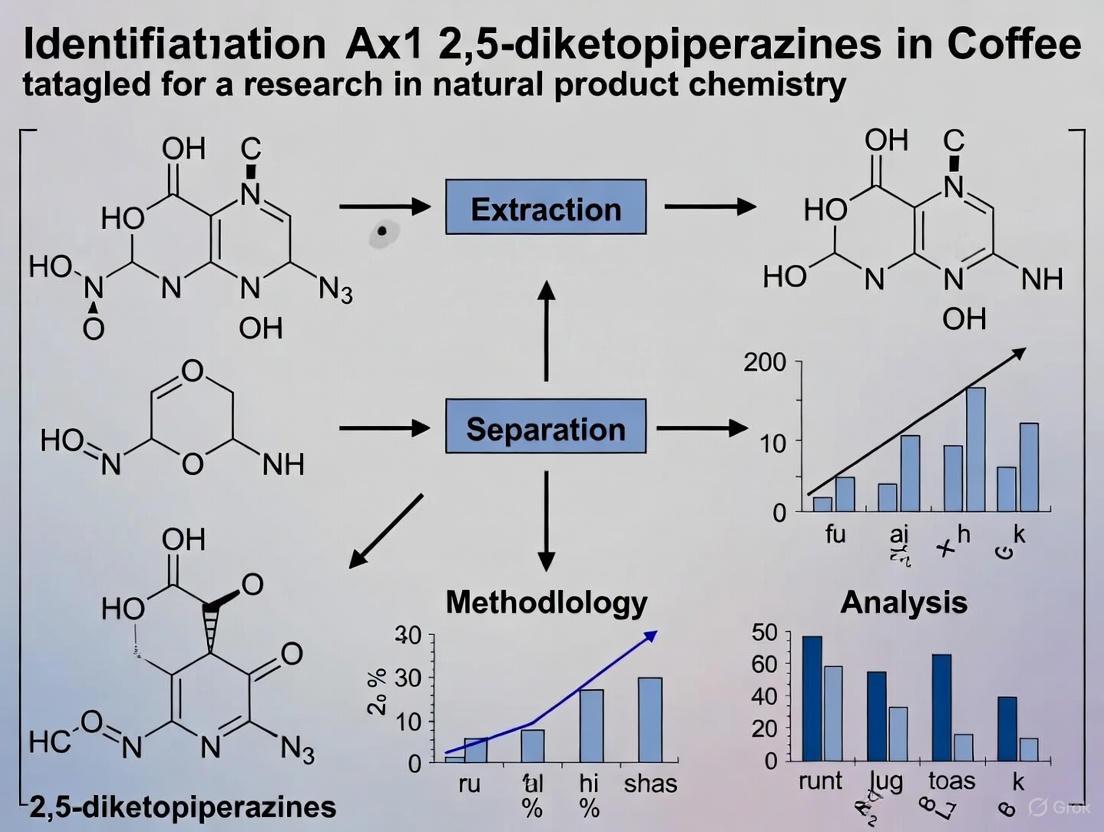
This article provides a comprehensive resource for researchers and drug development professionals on the analysis of 2,5-diketopiperazines (DKPs) in roasted coffee.
Identification and Quantification of 2,5-Diketopiperazines in Coffee: Analytical Methods, Challenges, and Biomedical Potential
Abstract
This article provides a comprehensive resource for researchers and drug development professionals on the analysis of 2,5-diketopiperazines (DKPs) in roasted coffee. It covers the foundational chemistry of DKP formation, details state-of-the-art extraction and quantification methodologies using LC-MS and GC-MS, and addresses key analytical challenges such as caffeine interference and stereoisomer separation. Furthermore, it explores the validation of analytical techniques and the comparative profiling of DKPs across different coffee brews and roasting conditions, highlighting their documented bioactivities and potential as a source of novel pharmacophores for biomedical research.
Understanding 2,5-Diketopiperazines: Chemistry, Formation in Roasted Coffee, and Natural Occurrence
2,5-Diketopiperazines (DKPs), also referred to as cyclic dipeptides or piperazine-2,5-diones, represent the simplest cyclic form of peptides found ubiquitously in nature [1] [2]. These compounds are characterized by a six-membered ring structure formed by the condensation of two α-amino acids, featuring two amide groups at opposite positions [1]. First discovered in 1880 and later studied by Emil Fischer, DKPs were initially considered mere protein artifacts or degradation products [3]. However, contemporary research has revealed their significance as essential metabolic intermediates and a promising platform for therapeutic exploration due to their remarkable structural diversity and broad bioactivity [3] [2].
The foundational structure of 2,5-diketopiperazine itself has a molar mass of 114.104 g·mol⁻¹ and a high melting point of 311–312 °C, indicative of its stability [1]. As the smallest cyclic peptides, DKPs combine the conformational constraints of ring systems with the versatile functionality of peptides, creating unique molecular scaffolds with exceptional properties for biological interactions and chemical synthesis [3].
Structural Characteristics and Conformation
Fundamental Chemical Architecture
The core structure of DKPs consists of a six-membered piperazinedione ring, which is essentially a cyclic dipeptide where two amino acids have joined head-to-tail. This ring system is nearly planar and conformationally constrained, providing remarkable structural stability [1] [3]. The structure incorporates both hydrogen bond donor and acceptor groups, enabling rich intermolecular interactions with biological targets [1]. Diversity can be introduced at up to six positions on the core scaffold, with stereochemistry controllable at up to four positions, allowing for extensive molecular customization while maintaining the stable core framework [1].
Table 1: Key Structural Features of 2,5-Diketopiperazines
| Structural Feature | Description | Functional Significance |
|---|---|---|
| Core Ring System | Six-membered piperazinedione ring | Provides rigidity and planar structure |
| Amide Groups | Two amide groups at opposite positions | Enables hydrogen bonding with biological targets |
| Stereocenters | Up to four controllable chiral centers | Allows for stereochemical diversity |
| Substitution Sites | Up to six modifiable positions | Permits extensive functionalization |
| Conformation | Nearly planar and constrained | Enhances binding specificity and metabolic stability |
Stereochemical Considerations
Most naturally occurring DKPs derived from L-α-amino acids exist predominantly in the cis configuration as cyclo(L-Xaa-L-Yaa) isomers [1]. However, DKPs can undergo epimerization under basic, acidic, and thermal conditions, with the equilibrium composition between cis and trans isomers varying significantly depending on side chain bulk, presence of ring structures like proline, or N-alkylation [1]. While epimerization historically posed challenges in DKP synthesis, contemporary mild synthetic methods have largely overcome this limitation, enabling stereochemical control [1].
Natural Occurrence and Biosynthesis
DKPs are widespread in nature, produced by a remarkable diversity of organisms. They have been isolated from bacterial species including Bacillus subtilis, Streptomyces, Pseudomonas aeruginosa, and Lactobacillus plantarum; various fungi such as Aspergillus flavus and Alternaria alternata; marine sponges like Dysidea herbacea; and numerous other organisms including algae, lichens, gorgonians, tunicates, plants, and animal venoms [3]. Significantly, certain DKPs are endogenous to humans, with cyclo(His-Pro) identified in the central nervous system, gastrointestinal tract, and blood [3] [2].
In addition to their biological occurrence, DKPs are frequently encountered in various foods and beverages, particularly those undergoing fermentation or thermal processing. They have been detected in roasted coffee, cocoa, pu-erh tea, dried bonito, sake, beer, cheese, casein, chicken extract, and stewed beef, where they often contribute metallic or bitter taste notes [1] [3]. Notably, proline-containing DKPs are particularly abundant in food systems, representing approximately 90% of all DKPs found in food products [3].
Biosynthetic Pathways
Naturally occurring DKPs are synthesized through two primary enzymatic pathways:
- tRNA-dependent cyclodipeptide synthases (CDPSs): These enzymes utilize aminoacyl-tRNAs as substrates to form cyclic dipeptides [1] [4].
- Non-ribosomal peptide synthetases (NRPSs): These large multi-enzyme complexes activate and condense amino acids without ribosomal involvement [4].
Both enzyme types are typically part of biosynthetic gene clusters that include additional tailoring enzymes (e.g., cyclodipeptide oxidases and methyltransferases) that modify the core DKP scaffold [1]. Recent advances in genetic engineering, particularly CRISPR/Cas systems, have shown promise for activating silent biosynthetic gene clusters and enhancing DKP production in microbial hosts [3].
DKPs in Coffee Research: A Case Study
Occurrence and Identification in Coffee
Coffee represents a particularly rich source of DKPs, where they form primarily through thermal degradation of proteins and peptides during the roasting process [4]. The major storage protein in green coffee beans, 11S globulin (54 kDa), undergoes hydrolytic cleavage during roasting, forming shorter peptides that serve as precursors for DKP formation [4]. A recent comprehensive study identified 33 different DKPs in roasted coffee, 23 of which were newly reported [4]. Proline-containing DKPs predominate in coffee, with cyclo(Pro-Leu), cyclo(Pro-Val), and cyclo(Pro-Tyr) found in the highest concentrations across various coffee samples [4].
Table 2: Selected Diketopiperazines Identified in Roasted Coffee
| DKP | Relative Abundance | Concentration Range | Sensory Attributes |
|---|---|---|---|
| Cyclo(Pro-Leu) | Highest | 5-50 μg/mL (commercial samples) | Bitter, sensory-active |
| Cyclo(Pro-Val) | High | 10-250 μg/mL (commercial samples) | Bitter, key contributor to cocoa bitterness |
| Cyclo(Pro-Tyr) | High | Not specified | Not specified |
| Cyclo(Pro-Gly) | Identified | Not specified | Not specified |
| Cyclo(Phe-Val) | Identified | Not specified | Not specified |
| Cyclo(Phe-Leu) | Identified | Not specified | Not specified |
| Cyclo(Phe-Ile) | Identified | Not specified | Not specified |
Formation Kinetics During Roasting
The formation of DKPs during coffee roasting follows distinct kinetic patterns dependent on both temperature and time. Research has demonstrated that DKP concentrations increase progressively with roasting intensity, with their formation successfully modeled using both zero-order Arrhenius kinetics and Prout-Tompkins solid-state kinetic models [4] [5]. Activation energies for DKP formation display a near-normal distribution, with individual values dependent on the specific amino acid substituents [5]. Interestingly, instant coffees typically contain higher DKP levels than regular brews, suggesting more intensive roasting of the extracted beans [6].
Diagram 1: DKP Formation Pathway in Coffee Roasting. This workflow illustrates the transformation from green coffee beans to DKP-containing roasted coffee through thermal degradation and cyclization processes.
Analytical Methods for DKP Identification and Quantification
Sample Preparation and Extraction
Robust analytical methods for DKP analysis begin with meticulous sample preparation. For coffee analysis, samples are typically extracted with acidified methanol or hot water followed by organic solvents such as chloroform to achieve both cleanup and concentration of DKPs [7] [4]. Additional cleanup steps may include ion-exchange chromatography on Dowex 50×8 and gel chromatography on Sephadex G10 to remove interfering compounds like caffeine [7]. For complex matrices like bread and sourdough, liquid extraction followed by solid-phase extraction provides effective purification before analysis [8].
Liquid Chromatography-Mass Spectrometry (LC-MS) Analysis
Liquid chromatography coupled with mass spectrometry has emerged as the predominant technique for DKP identification and quantification:
- Liquid Chromatography Separation: Reversed-phase columns (typically C18) with gradient elution using water-acetonitrile or water-methanol mobile phases containing modifiers like formic or acetic acid provide optimal separation of DKPs [4] [6].
- Mass Spectrometry Detection: High-resolution mass spectrometry (HRMS) using Orbitrap or Q-TOF instruments enables precise mass determination, with electrospray ionization (ESI) in positive ion mode being most common for DKP analysis [4] [6].
- Fragmentation Patterns: DKPs exhibit characteristic fragmentation patterns in tandem MS, primarily resulting from breakage of the peptide bonds in the ring structure, which facilitates their identification even without reference standards [2].
Table 3: Essential Research Reagents for DKP Analysis
| Reagent/Chemical | Function in Research | Application Example |
|---|---|---|
| Acidified Methanol | Extraction solvent | DKP extraction from coffee [4] |
| Chloroform | Liquid-liquid extraction | Cleanup and concentration [7] |
| Dowex 50×8 | Ion-exchange resin | Removal of interfering compounds [7] |
| Sephadex G10 | Gel filtration medium | Size-based separation [7] |
| C18 Chromatography Columns | Reversed-phase separation | LC-MS analysis [4] [6] |
| Formic Acid | Mobile phase modifier | Improving chromatography [4] |
| Authentic DKP Standards | Quantification reference | Calibration curves [4] |
Quantitative Analysis Workflow
Diagram 2: DKP Analysis Workflow. This protocol outlines the key steps from sample preparation through to identification and quantification using LC-HRMS.
Experimental Protocol: Identification and Quantification of DKPs in Coffee
Sample Preparation Protocol
- Grinding: Pulverize roasted coffee beans to a fine powder using a laboratory-grade grinder.
- Weighing: Accurately weigh 1.0 g of coffee powder into a 50 mL centrifuge tube.
- Extraction: Add 10 mL of acidified methanol (1% formic acid) to the sample.
- Homogenization: Vortex vigorously for 60 seconds, then sonicate for 15 minutes at room temperature.
- Centrifugation: Centrifuge at 4,000 × g for 10 minutes to pellet insoluble material.
- Collection: Carefully transfer the supernatant to a clean vial.
- Dilution: Dilute 1:10 with LC-MS grade water prior to analysis.
LC-HRMS Analysis Conditions
- Chromatography System: UHPLC system with C18 column (100 × 2.1 mm, 1.8 μm)
- Mobile Phase A: Water with 0.1% formic acid
- Mobile Phase B: Acetonitrile with 0.1% formic acid
- Gradient Program: 5% B to 95% B over 15 minutes, hold 2 minutes
- Flow Rate: 0.3 mL/min
- Injection Volume: 5 μL
- Mass Spectrometer: High-resolution Q-TOF or Orbitrap instrument
- Ionization Mode: ESI-positive
- Mass Range: m/z 50-1200
- Resolution: >30,000
Data Processing and Analysis
- Peak Picking: Use automated software (e.g., XCMS, Compound Discoverer) for feature detection.
- Identification: Screen for DKP candidates based on exact mass (typical m/z 150-400 range) and predicted molecular formulas.
- Fragmentation Analysis: Compare MS/MS spectra with authentic standards or database records.
- Quantification: Generate calibration curves using authentic DKP standards for absolute quantification.
Significance in Food Chemistry and Sensory Science
DKPs play crucial roles as sensory-active compounds in various foods and beverages. They are particularly significant contributors to bitter taste perception in roasted products like coffee and cocoa [1] [4]. In cocoa, cyclo(Pro-Val) has been identified as a primary contributor to bitterness, with concentrations exceeding its sensory threshold by a factor of seven [4]. Beyond bitterness, DKPs can impart astringent, salty, grainy, and metallic notes, significantly influencing the overall flavor profile of processed foods [1].
The concentration of DKPs in food products can reach substantial levels. For instance, cyclo(L-Val-L-Pro) was identified at a concentration of 1742 ppm in roasted cocoa, making it the most important bitter DKP in this matrix [1]. Similarly, bread crust contains nearly 2000 times the DKP levels found in unbaked dough, demonstrating the dramatic impact of thermal processing on DKP formation [8].
2,5-Diketopiperazines represent a fascinating class of cyclic peptides with significant implications across multiple scientific disciplines. Their unique structural characteristics, including conformational rigidity, hydrogen bonding capability, and resistance to enzymatic degradation, make them particularly valuable as bioactive compounds and research targets. In coffee research, DKPs serve as important markers of roasting intensity and contributors to sensory profiles, with modern analytical methods like LC-HRMS enabling comprehensive identification and quantification. The continued study of these versatile molecules promises to yield further insights into their roles in food chemistry, their potential therapeutic applications, and their behavior in complex biological systems.
- Introduction: Overview of DKPs in coffee roasting and research objectives.
- Formation Pathways: Explores Maillard reaction, thermal degradation, and influencing factors.
- Analytical Techniques: Covers extraction, separation, detection, and quantification methods.
- Quantitative Analysis: Tables on DKP concentrations and roasting parameters.
- Experimental Protocols: Step-by-step GC-MS and LC-MS/MS procedures.
- Research Toolkit: Essential reagents and materials for DKP analysis.
The Maillard Reaction and Thermal Degradation: Key Pathways for DKP Formation in Coffee Roasting
2,5-diketopiperazines (DKPs), also known as cyclic dipeptides, are significant flavor and bioactive compounds formed during the thermal processing of various foods, including coffee. These compounds are created when two amino acids undergo cyclization, resulting in a stable six-membered ring structure that contributes to the complex flavor profile of roasted coffee. In coffee roasting, DKPs form primarily through thermal degradation of proteins and peptides and through the Maillard reaction, which occurs between amino acids and reducing sugars at high temperatures [9] [7]. The identification and quantification of these compounds are essential for researchers and food scientists aiming to understand coffee's chemical composition, sensory properties, and potential health implications. This application note provides detailed methodologies and analytical frameworks for studying DKPs in coffee, with particular emphasis on the intersection of food chemistry and analytical technique development that can support broader research in natural product identification and quantification.
DKP Formation Pathways in Coffee Roasting
Maillard Reaction and Strecker Degradation
The Maillard reaction represents a complex network of chemical transformations that begins when reducing sugars and amino acids react at elevated temperatures typically between 150°C and 200°C [10] [11]. This reaction is not a single step but rather a cascade of events that produces numerous intermediate compounds, many of which serve as precursors to DKPs. As the Maillard reaction progresses, it facilitates the Strecker degradation pathway, wherein α-amino acids react with carbonyl compounds to form aldehydes and aminoketones [10]. These reactive intermediates can then undergo cyclization reactions to form various DKPs. The specific DKPs formed depend heavily on the amino acid composition present in the green coffee beans, with different coffee species (Coffea arabica vs. Coffea canephora) exhibiting distinct DKP profiles due to their varying amino acid precursors [12].
Thermal Degradation of Proteins and Peptides
Beyond the Maillard pathway, DKPs also form through direct thermal cleavage of peptide bonds followed by cyclization of the resulting dipeptides [9]. This mechanism becomes increasingly significant at higher roasting temperatures, particularly as the coffee beans approach and pass through the "first crack" and "second crack" stages, where internal bean temperatures exceed 196°C and 224°C, respectively [13]. The robust protein structures in coffee beans break down under these intense thermal conditions, releasing dipeptide fragments that readily cyclize into DKPs. Research demonstrates that this pathway operates effectively even under hydrothermal conditions similar to those encountered during certain coffee processing methods, with studies showing DKP formation from amino acid pairs including proline-glycine, alanine-alanine, and phenylalanine-alanine at temperatures as low as 120-165°C [9].
Factors Influencing DKP Formation
Multiple parameters throughout the coffee production chain significantly impact the type and concentration of DKPs in the final roasted product:
Roasting intensity: Both time and temperature critically influence DKP formation, with darker roasts typically containing higher concentrations of certain DKPs [14] [6]. Kinetic studies reveal that DKP formation generally follows zero-order or Prout-Tompkins solid-state kinetic models during thermal processing [5].
Coffee bean variety: The genetic background of coffee beans determines their initial composition of proteins, peptides, and free amino acids, which act as DKP precursors. Coffea arabica and Coffea canephora (Robusta) contain different amino acid profiles, leading to distinct DKP signatures [12] [6].
Processing method: Post-harvest processing techniques (washed, natural, honey) affect the bean's biochemical composition, particularly the pool of soluble proteins and free amino acids available for DKP formation during roasting [12].
Table 1: Key DKPs Identified in Roasted Coffee and Their Precursors
| DKP Compound | Amino Acid Precursors | Formation Pathway | Sensory Attributes |
|---|---|---|---|
| Cyclo(Pro-Gly) | Proline, Glycine | Thermal degradation [7] | Bitter [5] |
| Cyclo(Pro-Ala) | Proline, Alanine | Thermal degradation [7] | Bitter [5] |
| Cyclo(Phe-Val) | Phenylalanine, Valine | Thermal degradation [7] | Bitter [5] |
| Cyclo(Phe-Leu) | Phenylalanine, Leucine | Maillard reaction/thermal degradation [7] | Bitter [5] |
| Cyclo(Leu-Pro) | Leucine, Proline | Maillard reaction/thermal degradation [6] | Bitter [5] |
| Cyclo(Phe-Pro) | Phenylalanine, Proline | Maillard reaction/thermal degradation [6] | Bitter [5] |
Diagram 1: Key pathways for DKP formation during coffee roasting. The process begins with precursor compounds in green coffee beans and proceeds through multiple reaction pathways under thermal conditions to form various DKPs.
Analytical Techniques for DKP Identification and Quantification
Sample Preparation and Extraction
Effective DKP analysis requires meticulous sample preparation to isolate these compounds from the complex coffee matrix while minimizing interference from other components. The recommended protocol begins with defatting the coffee samples using petroleum ether or dichloromethane to remove lipid components that can interfere with subsequent analysis [5]. Following defatting, DKPs are typically extracted with hot water or chloroform to achieve both cleanup and concentration [7]. For more challenging matrices, additional cleanup steps may be employed, including ion-exchange chromatography on Dowex 50×8 followed by gel permeation chromatography on Sephadex G10 to remove interfering compounds such as caffeine and melanoidins [7]. The extraction efficiency can be further enhanced through lyophilization (freeze-drying) of the aqueous extract followed by solvent extraction with appropriate organic solvents such as methanol, acetone, or toluene [9].
Separation and Detection Methods
Chromatographic separation coupled with mass spectrometry provides the most reliable approach for comprehensive DKP analysis:
Gas Chromatography-Mass Spectrometry (GC-MS): This technique offers superior resolution for volatile DKP compounds and is particularly effective when combined with derivatization using agents such as N,O-bis(trimethylsilyl)trifluoroacetamide (BSTFA) to produce trimethylsilyl (TMS) derivatives [9]. GC-MS analysis enables both identification and quantification based on characteristic fragmentation patterns and retention times compared with authentic standards.
Liquid Chromatography-Mass Spectrometry (LC-MS): Both HPLC-ESI-MS and HPLC-ESI-MS/MS techniques provide powerful alternatives for analyzing less volatile DKPs without requiring derivatization [7] [5]. LC-MS methods are particularly valuable for quantifying thermally labile DKPs and can be coupled with electrospray ionization (ESI) for enhanced sensitivity. The use of high-resolution mass spectrometry further facilitates accurate structural identification through precise mass measurement.
Table 2: Analytical Techniques for DKP Separation and Detection
| Analytical Technique | Sample Preparation | Separation Parameters | Detection Method | Key Advantages |
|---|---|---|---|---|
| GC-MS [9] | Derivatization with BSTFA to form TMS derivatives | Non-polar capillary column (e.g., DB-5), temperature programming | Electron impact (EI) mass spectrometry | High resolution, extensive spectral libraries |
| LC-ESI-MS/MS [7] [5] | Direct injection of extracts or partial cleanup | Reversed-phase C18 column, water-acetonitrile gradient with formic acid | Electrospray ionization tandem mass spectrometry | No derivatization needed, good for non-volatile compounds |
| HPLC-ESI-MS [7] | Ion-exchange and gel permeation cleanup | Reversed-phase column, aqueous-organic mobile phase | Electrospray ionization mass spectrometry | High sensitivity, molecular weight information |
Quantification and Method Validation
Accurate quantification of DKPs requires the use of internal standards and calibration curves generated from authentic reference compounds. When commercial standards are unavailable, researchers can synthesize DKPs through environmentally friendly hydrothermal methods using appropriate amino acid precursors [9]. Method validation should establish linearity ranges, detection limits, precision, and accuracy for each target DKP. For GC-MS analysis, the use of deuterated internal standards such as BSTFA-d9 can improve quantification accuracy by accounting for variations in derivatization efficiency and instrument response [9]. In mass spectrometric detection, selected reaction monitoring (SRM) or multiple reaction monitoring (MRM) modes provide enhanced specificity and sensitivity for target DKP analysis in complex coffee matrices.
Quantitative Analysis of DKPs in Coffee
DKP Concentrations Across Coffee Types
Comprehensive metabolomic studies have revealed significant variations in DKP profiles and concentrations across different coffee types, processing methods, and roast degrees. These quantitative differences directly influence both the sensory properties and potential bioactivity of the final coffee brew. Research demonstrates that instant coffees typically contain higher concentrations of certain DKPs compared to other brew methods, suggesting more intensive thermal processing during manufacturing [6]. Similarly, Robusta varieties often exhibit distinct DKP patterns compared to Arabica coffees, reflecting their different amino acid precursor profiles [12] [6]. The quantitative analysis of these variations provides valuable insights for researchers studying the relationship between processing conditions and chemical composition in thermally treated food products.
Table 3: Quantitative Analysis of DKPs in Different Coffee Types
| DKP Compound | Molecular Formula | Observed m/z | Retention Time (min) | Relative Concentration Variations |
|---|---|---|---|---|
| Cyclo(Leu-Pro) [6] | C₁₁H₁₈N₂O₂ | 211.1447 [M+H]+ | 3.87 | Higher in dark roasts and instant coffee |
| Cyclo(Phe-Pro) [6] | C₁₄H₁₆N₂O₂ | 245.1291 [M+H]+ | 4.05 | Correlates with roast degree |
| Cyclo(Pro-Val) [6] | C₁₀H₁₆N₂O₂ | 197.1291 [M+H]+ | 3.08 | Varies by bean origin |
| Cyclo(Ile-Pro) [6] | C₁₁H₁₈N₂O₂ | 211.1447 [M+H]+ | 3.76 | Species-dependent (Arabica vs. Robusta) |
| Cyclo(Pro-Gly) [7] | C₇H₁₀N₂O₂ | 155.0824 [M+H]+ | Not specified | Identified in roasted coffee |
Impact of Roasting Parameters on DKP Formation
The formation of DKPs during coffee roasting follows distinct kinetic patterns that can be mathematically modeled to predict concentrations under specific thermal conditions. Studies applying zero-order Arrhenius kinetics and Prout-Tompkins solid-state kinetic models to DKP formation during cocoa roasting (a comparable thermal process) have revealed normally distributed activation energies, with individual values depending on the specific DKP substituents [5]. These kinetic models demonstrate that roasting temperature has a more significant impact on DKP formation rates than roasting time, though both parameters contribute to the final DKP profile. Recent research on coffee roasting has further shown that different roasting methods (pan roasting, air fryer roasting) significantly impact the rate constants and activation energies for DKP formation, with pan roasting exhibiting up to 62.6% higher rate constants for certain α-dicarbonyl compounds precursors compared to other heating methods [14].
Diagram 2: Comprehensive analytical workflow for DKP identification and quantification in coffee samples, encompassing sample preparation, extraction, cleanup, derivatization, instrumental analysis, and data processing steps.
Experimental Protocols
Protocol 1: GC-MS Analysis of DKPs in Roasted Coffee
This protocol describes a comprehensive method for the identification and quantification of DKPs in roasted coffee using gas chromatography-mass spectrometry.
Sample Preparation: Begin by grinding roasted coffee beans to a consistent particle size (approximately 500 μm). Precisely weigh 2.0 g of ground coffee and transfer to a Soxhlet extraction apparatus. Perform defatting using 150 mL petroleum ether for 6 hours to remove interfering lipids [5]. Allow the defatted coffee to air-dry completely in a fume hood.
Extraction: Transfer the defatted coffee to a 250 mL conical flask and add 100 mL of HPLC-grade water. Heat the mixture at 80°C for 2 hours with constant stirring using a magnetic stirrer [7]. Filter the extract through Whatman No. 1 filter paper and collect the filtrate. Repeat the extraction twice with fresh water and combine the filtrates.
Cleanup: Concentrate the combined extracts to approximately 50 mL using a rotary evaporator at 60°C. Apply the concentrated extract to a Dowex 50×8 ion-exchange column (30 cm × 2.5 cm) preconditioned with 0.1 M HCl. Elute with 500 mL of 0.1 M HCl followed by 500 mL of deionized water [7]. Collect the eluate and further purify using a Sephadex G10 gel permeation column (40 cm × 3 cm) with water as the mobile phase.
Derivatization: Lyophilize the purified extract to complete dryness. Reconstitute in 2.0 mL of dry toluene and transfer to a derivatization vial. Add 100 μL of N,O-bis(trimethylsilyl)trifluoroacetamide (BSTFA) and 50 μL of pyridine [9]. Heat the mixture at 70°C for 30 minutes to complete the formation of trimethylsilyl derivatives.
GC-MS Analysis: Inject 1 μL of the derivatized sample into a GC-MS system equipped with a non-polar capillary column (e.g., DB-5ms, 30 m × 0.25 mm × 0.25 μm). Use the following temperature program: initial temperature 80°C (hold 2 min), ramp to 300°C at 5°C/min, final hold 10 min [9]. Set the injector temperature to 250°C and use a split ratio of 1:10. Operate the mass spectrometer in electron impact (EI) mode at 70 eV with a scan range of m/z 50-600.
Protocol 2: LC-ESI-MS/MS Quantification of DKPs
This protocol provides detailed instructions for the sensitive quantification of target DKPs using liquid chromatography coupled with tandem mass spectrometry.
Standard Preparation: Prepare individual stock solutions of target DKPs (cyclo(Pro-Gly), cyclo(Pro-Ala), cyclo(Phe-Val), cyclo(Phe-Leu), cyclo(Leu-Pro)) at 1 mg/mL in methanol [7] [6]. Prepare working standard mixtures by appropriate dilution in water-acetonitrile (80:20, v/v) to create a calibration curve spanning 0.01-10 μg/mL.
Sample Extraction: Weigh 1.0 g of finely ground roasted coffee into a 50 mL centrifuge tube. Add 20 mL of extraction solvent (methanol:water:formic acid, 80:19:1, v/v/v) and vortex vigorously for 1 minute [5]. Sonicate the mixture for 15 minutes at room temperature, then centrifuge at 4000 × g for 10 minutes. Collect the supernatant and repeat the extraction twice. Combine all supernatants and evaporate to dryness under nitrogen at 40°C.
LC-MS/MS Analysis: Reconstitute the dried extract in 1.0 mL of mobile phase A (0.1% formic acid in water). Inject 10 μL onto a reversed-phase C18 column (2.1 × 100 mm, 1.8 μm) maintained at 40°C. Use a binary gradient with mobile phase A (0.1% formic acid in water) and mobile phase B (0.1% formic acid in acetonitrile) at a flow rate of 0.3 mL/min [6]. Employ the following gradient: 0-2 min 5% B, 2-15 min 5-95% B, 15-18 min 95% B, 18-20 min 95-5% B.
MS Detection: Operate the mass spectrometer in positive electrospray ionization mode with multiple reaction monitoring (MRM). Optimize the source parameters as follows: capillary voltage 3.5 kV, source temperature 150°C, desolvation temperature 350°C, cone gas flow 50 L/h, desolvation gas flow 800 L/h [5]. Use collision-induced dissociation with argon gas at 0.15 mL/min. Monitor specific precursor-to-product ion transitions for each target DKP.
The Scientist's Toolkit: Research Reagent Solutions
Table 4: Essential Reagents and Materials for DKP Analysis
| Reagent/Material | Specification | Application | Notes |
|---|---|---|---|
| BSTFA with 1% TMCS | ≥99% purity | Derivatization for GC-MS | Enhances volatility and stability of DKPs [9] |
| Dowex 50×8 | 100-200 mesh, hydrogen form | Ion-exchange cleanup | Removes interfering cations and caffeine [7] |
| Sephadex G10 | 40-120 μm | Gel permeation chromatography | Separates DKPs from high molecular weight compounds [7] |
| Amino Acid Standards | ≥98% purity | Synthesis of DKP standards | Proline, phenylalanine, leucine most abundant [9] |
| HPLC Solvents | LC-MS grade | Mobile phase preparation | 0.1% formic acid improves ionization [6] |
| Stable Isotope Standards | Deuterated (d9) BSTFA | Internal standardization | Improves quantification accuracy [9] |
The systematic analysis of 2,5-diketopiperazines in roasted coffee requires careful attention to extraction methodology, chromatographic separation, and mass spectrometric detection. The protocols outlined in this application note provide researchers with robust methods for identifying and quantifying these significant flavor and bioactive compounds. The formation of DKPs through both Maillard reaction pathways and direct thermal degradation of proteins underscores the complex chemistry occurring during coffee roasting. By employing the detailed experimental approaches described herein, researchers can advance our understanding of how processing parameters influence the chemical composition of thermally treated food products, ultimately contributing to improved quality control and product development in the food industry.
Diketopiperazines (DKPs), the simplest cyclic dipeptides, are significant flavor and bioactive compounds in roasted coffee. Formed from two amino acids during thermal processing, these molecules contribute to coffee's sensory profile and are subjects of growing scientific interest due to their diverse biological activities. This application note provides a structured catalog of DKPs identified in coffee, supported by quantitative data and detailed analytical protocols to support research and development activities in food chemistry and natural product drug discovery.
Catalog of Identified Diketopiperazines in Coffee
Research has identified several specific DKPs in roasted coffee, with proline-containing DKPs being particularly prevalent. The table below summarizes the key DKPs confirmed in coffee.
Table 1: Diketopiperazines (DKPs) Identified in Roasted Coffee
| Diketopiperazine (DKP) | Abbreviation | Occurrence in Coffee | Isomeric Forms Present |
|---|---|---|---|
| Cyclo(prolyl-glycyl) | Cyclo(Pro-Gly) | Identified [7] | Single isomer [7] |
| Cyclo(prolyl-alanyl) | Cyclo(Pro-Ala) | Identified [7] | Both possible isomers [7] |
| Cyclo(prolyl-valyl) | Cyclo(Pro-Val) | Identified [6] | Information not specified in search results |
| Cyclo(phenylalanyl-prolyl) | Cyclo(Phe-Pro) | Identified [6] | Information not specified in search results |
| Cyclo(isophenylalanyl-prolyl) | Cyclo(Phe-Pro) isomer | Identified [6] | Information not specified in search results |
| Cyclo(leucyl-prolyl) | Cyclo(Leu-Pro) | Identified [6] | Information not specified in search results |
| Cyclo(phenylalanyl-valyl) | Cyclo(Phe-Val) | Identified [7] | Both possible isomers [7] |
| Cyclo(phenylalanyl-leucyl) | Cyclo(Phe-Leu) | Identified [7] | Both possible isomers [7] |
| Cyclo(phenylalanyl-isoleucyl) | Cyclo(Phe-Ile) | Identified [7] | Both possible isomers [7] |
| Cyclo(isoleucyl-prolyl) | Cyclo(Ile-Pro) | Identified [6] | Information not specified in search results |
Quantitative Variability in Coffee Brews
The concentration of DKPs is not uniform across all coffee products and is influenced by processing conditions. A metabolomic study of 76 different coffee brews found that the preparation method is the largest source of chemical variability, explaining 36% of the differences in metabolite profiles, followed by roast level (16%) and bean type (9%) [6]. The same study confirmed that instant coffees showed significantly higher contents of diketopiperazines compared to other brew types, suggesting a more intensive roast or specific processing of the extracted beans [6].
Analytical Protocols for DKP Identification and Quantification
Robust analytical methods are crucial for the reliable detection and measurement of DKPs in complex matrices like coffee.
Sample Preparation and Cleanup
The following protocol, adapted from Ginz and Engelhardt, is designed to isolate DKPs while removing interfering compounds like caffeine [7] [15].
- Extraction: Extract ground roasted coffee with hot water and chloroform (CHCl₃) for initial cleanup and concentration of DKPs [7].
- Ion-Exchange Chromatography: Clean the extract further using ion-exchange chromatography on Dowex 50×8 to remove interfering compounds [7].
- Gel Permeation Chromatography: Perform a final cleanup step via gel chromatography on Sephadex G10 [7].
Instrumental Analysis and Identification
Identification and quantification can be accomplished using complementary chromatographic and mass spectrometric techniques.
- Liquid Chromatography-Mass Spectrometry (LC-MS): LC coupled with electrospray ionization mass spectrometry (ESI-MS) and tandem MS/MS is highly effective for separation and structural characterization [7] [6]. This method was used to identify cyclo(Leu-Pro) and others with a high confidence level [6].
- Gas Chromatography-Mass Spectrometry (GC-MS): GC with electron ionization mass spectrometry (EI-MS) provides an orthogonal analytical method to confirm identifications [7].
- Chiral Separation: For complete isomeric separation, a ring-opening derivatization method followed by chiral GC analysis can be employed. This involves esterification with HCl-methanol and subsequent acylation with trifluoroacetic anhydride (TFAA) to convert DKPs into separable dipeptide derivatives [16].
- Validation: Compare chromatographic and spectral data with those of synthesized reference compounds for definitive confirmation [7].
The following workflow diagram illustrates the complete analytical process from sample to identification.
The Scientist's Toolkit: Research Reagent Solutions
Table 2: Essential Reagents and Materials for DKP Analysis in Coffee
| Reagent/Material | Function in Protocol |
|---|---|
| Dowex 50×8 Ion-Exchange Resin | Initial cleanup to remove interfering compounds, notably caffeine [7]. |
| Sephadex G10 Gel Filtration Medium | Gel permeation chromatography for final extract purification [7]. |
| Synthesized DKP Reference Compounds (e.g., Cyclo(Pro-Gly), Cyclo(Phe-Val)) | Critical for method validation and definitive identification via chromatographic and spectral comparison [7]. |
| Chloroform (CHCl₃) & Hot Water | Solvent system for initial extraction, cleanup, and concentration of DKPs from coffee [7]. |
| HCl in Methanol | Reagent for esterification during ring-opening derivatization for chiral GC analysis [16]. |
| Trifluoroacetic Anhydride (TFAA) | Acylating agent used in conjunction with esterification for chiral GC analysis [16]. |
| Chiral GC Column (e.g., CP-Chirasil-l-Val) | Stationary phase for high-resolution separation of DKP stereoisomers after derivatization [16]. |
2,5-Diketopiperazines (DKPs), the smallest cyclic dipeptides, have gained significant recognition as key taste contributors to coffee's pleasant bitterness and as potential bioactive compounds of interest in drug development [5] [17]. These molecules are formed during the thermal processing of protein-rich foods and beverages, with coffee representing a prime example where roasting transforms linear dipeptides into these cyclic structures [5] [9]. The configuration of DKPs into cis and trans stereoisomers profoundly influences their three-dimensional structure, biological activity, and sensory properties, making stereochemical analysis a critical aspect of coffee research [18] [19].
This application note details the identification, quantification, and significance of DKP stereoisomers within coffee research. We provide structured protocols for analyzing these compounds, emphasizing the role of stereochemistry in both flavor science and pharmaceutical applications.
Chemical Background and Formation Pathways
DKPs are formed from two amino acids via cyclization, a process significantly influenced by heat. During coffee roasting, oligopeptides and free amino acids generated in earlier processing stages undergo thermally-induced cyclization to form DKPs [5] [17]. The roasting process is thus a critical control point for DKP profile manipulation.
Proline-containing DKPs are particularly prone to epimerization, where the stereochemistry at one or more chiral centers can invert, leading to the formation of both cis and trans isomers [18] [19]. The cis isomer is often the initial, kinetically favored product in biological systems, but it can epimerize to the more thermodynamically stable trans form under certain conditions, such as changes in pH or temperature [18]. The energy barrier for this interconversion is low enough to allow for spontaneous epimerization in solution, posing a significant analytical challenge [18].
The diagram above illustrates the general pathway for the formation and interconversion of DKP stereoisomers during coffee processing. The ability to control this pathway allows researchers to target specific isomer profiles.
Quantitative Analysis of DKPs in Coffee
Comprehensive profiling of DKPs requires sensitive and selective analytical methods. The following table summarizes key DKPs identified in thermally processed foods like coffee and cocoa, which serves as a model matrix.
Table 1: Quantification of Selected 2,5-Diketopiperazines (DKPs) in Roasted Cocoa (as a Model for Coffee Research) [17]
| DKP Compound | Concentration Range | Amino Acid Constituents | Sensory Attribute |
|---|---|---|---|
| cis-cyclo(L-Val-L-Pro) | Up to ~20 mg/kg | Valine, Proline | Bitter |
| cyclo(L-Phe-L-Phe) | Detected (Quantity NS) | Phenylalanine | Bitter |
| cyclo(L-Leu-L-Ile) | Detected (Quantity NS) | Leucine, Isoleucine | Bitter |
| cyclo(L-Ile-L-Val) | Detected (Quantity NS) | Isoleucine, Valine | Bitter |
| cyclo(Pro-Phe) | Commercially available standard | Proline, Phenylalanine | Bitter/Metallic |
NS: Not Specified in the source material. The presence of these DKPs is confirmed, but their exact quantitative ranges in coffee require further study.
The most abundant DKP in cocoa products, and a likely major component in coffee, is cis-cyclo(L-Val-L-Pro) [17]. Its high concentration and low bitter taste threshold make it a critical contributor to the overall sensory profile. Recent studies have identified 18 different DKPs in dark chocolates, suggesting a similar diversity can be expected in coffee [17].
Experimental Protocols
Protocol: Sample Preparation and Extraction for DKP Analysis
Principle: Efficient extraction of DKPs from the complex coffee matrix is achieved using organic solvents, followed by cleanup to remove interfering compounds like lipids.
Materials:
- Coffee Sample: Finely ground roasted coffee beans.
- Extraction Solvent: HPLC-grade methanol, acetonitrile, or ethyl acetate [9] [17].
- Clean-up Sorbent: Diaion HP-20 resin (optional for difficult matrices) [18] [19].
- Equipment: Analytical balance, centrifuge, vortex mixer, ultrasonic bath, solvent evaporation unit (e.g., nitrogen evaporator), and lyophilizer.
Procedure:
- Weighing: Accurately weigh 1.0 g of ground coffee into a centrifuge tube.
- Extraction: Add 10 mL of methanol to the tube. Vortex for 1 minute and sonicate in an ultrasonic bath for 15 minutes.
- Centrifugation: Centrifuge at 4,500 x g for 10 minutes to separate the solid residue.
- Collection: Carefully transfer the supernatant to a new tube.
- Re-extraction: Repeat steps 2-4 with an additional 10 mL of solvent and combine the supernatants.
- Concentration: Gently evaporate the combined extracts to dryness under a stream of nitrogen or using a rotary evaporator. Reconstitute the residue in 1 mL of methanol for LC-MS analysis.
- Optional Clean-up: For samples with high lipid content, load the extract onto a Diaion HP-20 resin column and elute DKPs with a methanol/water gradient [19].
Protocol: Chromatographic Separation and Stereochemical Identification of Cyclo(Phe-Pro)
Principle: Reverse-phase HPLC effectively separates DKP diastereomers based on differences in their polarity and interaction with the stationary phase. The cis isomer of cyclo(Phe-Pro) is less polar and elutes before the trans isomer [18] [19].
Materials:
- HPLC System: Equipped with a binary pump, autosampler, and column oven.
- HPLC Column: XBridge Prep Phenyl-hexyl, 5 µm, 250 x 10.0 mm (or equivalent phenyl-hexyl column) [19].
- Mobile Phase A: Water.
- Mobile Phase B: Methanol.
- Standards: Synthesized or commercially available cis and trans isomers of cyclo(Phe-Pro).
Procedure:
- HPLC Conditions:
- Flow Rate: 2.0 mL/min (for semi-preparative) or 0.3 mL/min (for analytical).
- Column Temperature: 30 °C.
- Injection Volume: 10 µL.
- Gradient: 5% B to 60% B over 50 minutes [19].
- Detection: Use a UV-Vis detector set at 220 nm or a Mass Spectrometer.
- Identification: Inject synthetic standards to establish retention times. The cis-cyclo(L-Phe-L-Pro) elutes at approximately 36 min, while the trans-cyclo(L-Phe-D-Pro) elutes at approximately 39 min under these conditions [19].
- Collection: For purification, collect peaks individually and evaporate the solvent for further NMR confirmation.
Protocol: Absolute Configuration Determination by NMR Spectroscopy
Principle: NMR chemical shifts, particularly of the α-protons on the amino acid residues, are diagnostic for distinguishing between cis and trans diastereomers due to distinct ring current effects and conformational preferences [18] [19].
Materials:
- NMR Spectrometer: High-resolution (e.g., 700 MHz).
- NMR Solvent: Deuterated methanol (MeOD-d₄) or dimethyl sulfoxide (DMSO-d₆).
- NMR Tube: 5 mm.
Procedure:
- Sample Preparation: Dissolve the purified DKP sample (~1-2 mg) in 0.6 mL of deuterated solvent.
- Data Acquisition: Acquire ¹H NMR spectra at 293 K (20 °C). Key experiments include 1D ¹H and 2D experiments like ¹H-¹H COSY for signal assignment.
- Stereochemical Analysis:
- Identify the chemical shifts (δ) for the CHα protons on the proline (H6) and phenylalanine (H9) residues.
- For cyclo(Phe-Pro), a characteristic upfield shift of the proline CHα proton (δ ~2.60 ppm) indicates the trans isomer, where the phenyl ring stacks over the DKP ring, causing shielding.
- A downfield shift for the same proton (δ ~4.07 ppm) is characteristic of the cis isomer [19].
Table 2: Key ¹H NMR Chemical Shifts (δ, ppm in MeOD-d₄) for Distinguishing Cyclo(Phe-Pro) Stereoisomers [19]
| Proton Position (Group) | Trans Isomer (l,d) | Cis Isomer (l,l) |
|---|---|---|
| Proline CHα (H6) | 2.60 ppm | 4.07 ppm |
| Phenylalanine CHα (H9) | 4.21 ppm | 4.45 ppm |
| Proline CH₂ (H3) | 3.53 and 3.32 ppm | 3.54 and 3.37 ppm |
The Scientist's Toolkit: Essential Research Reagents and Materials
Table 3: Key Reagent Solutions for DKP Research
| Reagent / Material | Function / Application | Example / Specification |
|---|---|---|
| Diaion HP-20 Resin | Hydrophobic adsorbent for trapping DKPs from culture broth or complex extracts, which can help prevent epimerization. | Polystyrene-divinylbenzene matrix [18] [19]. |
| HPLC-MS Grade Solvents | Sample extraction, mobile phase preparation. Ensures minimal interference and high sensitivity. | Methanol, Acetonitrile, Water [5] [17]. |
| Stereochemically Pure DKP Standards | Method development, calibration, and peak identification in LC-MS and NMR. | e.g., cyclo(Pro-Phe), cyclo(Pro-Val) [17]. |
| Phenyl-Hexyl HPLC Column | Separation of DKP diastereomers based on π-π interactions and polarity. | e.g., XBridge Prep Phenyl-hexyl, 5 µm [19]. |
| Deuterated Solvents | NMR sample preparation for structural and stereochemical elucidation. | Methanol-d₄ (MeOD), DMSO-d₆ [18] [19]. |
Visualization of the Analytical Workflow
The entire process from bean to stereochemical identification can be visualized as a single, integrated workflow.
The precise characterization of cis and trans DKP isomers is paramount for advancing research in both coffee flavor chemistry and natural product-based drug discovery. The synergistic use of LC-MS for separation and quantification and NMR for definitive stereochemical assignment provides a robust analytical framework. The protocols and data summarized in this application note offer researchers a foundational toolkit to explore the complex stereochemistry of DKPs, enabling a deeper understanding of how thermal processing conditions influence the isomer profile and, consequently, the bioactivity and sensory properties of coffee. Future work should focus on building comprehensive libraries of DKP stereoisomers and their specific sensory and biological properties.
2,5-Diketopiperazines (DKPs), the simplest cyclic dipeptides, are formed through the thermal intramolecular condensation of amino acids and are characterized by their distinctive bitterness in thermally processed foods like roasted coffee [4]. These compounds represent a significant class of bioactive molecules that have attracted substantial scientific interest due to their diverse biological activities and sensory properties. While traditionally studied for their flavor contributions, recent research has unveiled their potential significance in pharmaceutical and biomedical applications [4]. Coffee serves as a particularly rich source of these compounds, where they form during the roasting process through thermal degradation of coffee proteins and peptides [4]. This application note provides a comprehensive overview of the bioactive potential of coffee-derived DKPs, detailing their identification, quantification, formation pathways, and experimental approaches for their study within the context of advanced coffee research.
DKPs are distinguished by their characteristic lactam ring structure and are biosynthesized via nonribosomal peptide synthetases (NRPs) or tRNA-dependent cyclodipeptide synthases (CDPs) [4]. Their significance extends beyond food chemistry into pharmaceutical realms due to their structural diversity, affinities to bind to specific target sites, and remarkable resistance to enzymatic degradation [4]. The thermal formation of DKPs in coffee is primarily initiated by the hydrolytic cleavage of the major storage protein in green coffee beans, 11S globulin (54 kDa), during roasting, which forms shorter peptides that act as putative precursors for DKP formation [4]. These peptides undergo intramolecular cyclization where a nucleophilic N-terminal amino group attacks an adjacent carbonyl group, resulting in the characteristic ring formation [4].
Chemical Profile and Occurrence in Coffee
Identified DKPs in Roasted Coffee
Recent advanced analytical studies have revealed a diverse profile of DKPs in roasted coffee. A comprehensive study employing liquid chromatography-high resolution mass spectrometry (LC-HRMS) identified 33 different DKPs in roasted coffee, of which 23 were newly reported [4]. The most abundant DKPs across various roasting conditions include cyclo(Pro-Leu), cyclo(Pro-Val), and cyclo(Pro-Tyr), with concentrations ranging between 5-50 μg/mL in commercial samples [4]. Earlier research had already identified several DKPs in roasted coffee, including cyclo(pro-gly), cyclo(pro-ala), cyclo(phe-val), cyclo(phe-leu), and cyclo(phe-ile) [7]. With the exception of cyclo(pro-gly), where only one isomer can be formed, each DKP was present in both possible isomeric forms [7].
The variability in DKP profiles is significantly influenced by coffee parameters. A metabolomic study found that brew method explained the largest proportion of variability in coffee metabolomic data (R²partial = 36%), followed by roast (R²partial = 16%), bean type (R²partial = 9%), and caffeine content (R²partial = 7%) [6]. This variability is crucial to consider for understanding the effects of different coffee brews on bioactive potential and for standardizing research methodologies.
Table 1: Major Diketopiperazines Identified in Roasted Coffee
| DKP Compound | Relative Abundance | Reported Concentration Range | Sensory Attributes |
|---|---|---|---|
| Cyclo(Pro-Leu) | High | 10-250 μg/mL [4] | Bitter |
| Cyclo(Pro-Val) | High | 5-50 μg/mL [4] | Bitter [4] |
| Cyclo(Pro-Tyr) | High | 5-50 μg/mL [4] | Bitter |
| Cyclo(Pro-Phe) | Moderate | Not quantified | Bitter |
| Cyclo(Pro-Ala) | Moderate | Not quantified | Bitter |
| Cyclo(Phe-Val) | Moderate | Not quantified | Bitter |
| Cyclo(Phe-Leu) | Moderate | Not quantified | Bitter |
Factors Influencing DKP Formation
The formation of DKPs in coffee is significantly influenced by roasting parameters and coffee characteristics. Kinetic studies have demonstrated that DKP formation depends on both roasting temperature and time, following characteristic formation curves [4]. The roast level itself is a major determinant, with darker roasts typically containing higher levels of certain DKPs [6]. Additionally, the type of coffee beans used affects the DKP profile, primarily due to differing protein and amino acid compositions between Arabica and Robusta species [6].
Instant coffees have been found to differ from all coffee brews by high contents of diketopiperazines, suggesting a higher effective roast of the extracted beans or additional formation during the instant coffee manufacturing process [6]. This highlights how processing methods beyond roasting can significantly impact the final DKP composition in coffee products.
Bioactive Potential and Health Implications
Biological Activities
Coffee-derived DKPs exhibit a wide spectrum of biological activities with significant pharmaceutical potential. Their derivatives have demonstrated oxytocin antagonism, calpain inhibition, and apoptosis induction in cancer cells [4]. Proline-based DKPs, such as Drimentidine G, have exhibited cytotoxic effects against human ovarian carcinoma (A2780) cells, though with moderate potency (IC₅₀ > 10 μM) [4]. The structural features of DKPs contribute significantly to their bioactivity, particularly their resistance to enzymatic degradation and ability to cross lipid membranes, including the blood-brain barrier [20].
The biological functions of DKPs extend to antifungal and antibacterial activities [20], metal-ion chelation [5], and potential applications as herbicides [20]. Their sensory properties also contribute to food acceptance and preference, particularly through their bitter taste characteristics [5]. The concentration of DKPs determined in aqueous infusions of coffee falls within the range of reported bitterness threshold concentrations, suggesting they contribute significantly to the perceived bitterness of coffee beverages [4].
Mechanisms of Action
The mechanisms underlying DKP bioactivity are diverse and depend on their specific structural characteristics. Their ability to pass through lipid membranes allows them to access various cellular compartments and target sites [20]. Some DKPs function as metal-ion chelators, potentially disrupting biological processes in microorganisms or acting as antioxidants [5]. Specific DKPs have been identified as calpain inhibitors, suggesting potential applications in neurological disorders [4], while others exhibit oxytocin antagonism, indicating potential use in social behavior disorders or reproductive health [4].
Table 2: Bioactive Properties of Coffee-Derived DKPs
| Bioactive Property | Mechanism | Potential Application |
|---|---|---|
| Cytotoxic Activity | Apoptosis induction in cancer cells | Oncology [4] |
| Antimicrobial | Growth inhibition of fungi and bacteria | Anti-infectives [20] |
| Oxytocin Antagonism | Receptor blockade | Social behavior disorders [4] |
| Calpain Inhibition | Enzyme inhibition | Neurological disorders [4] |
| Radical Scavenging | Antioxidant activity | Neuroprotection, anti-aging [4] |
| Herbicidal | Unknown | Agriculture [20] |
Analytical Methods for DKP Identification and Quantification
Sample Preparation Protocols
Proper sample preparation is critical for accurate DKP analysis. For comprehensive DKP extraction from roasted coffee, the following protocol is recommended:
- Grinding: Grind coffee samples to a standardized particle size (70-75% passing through #20 sieve/850 μm) to ensure consistent extraction [21].
- Extraction: Extract 0.5 g of ground coffee with 10 mL of acidified methanol (1% formic acid) using sonication for 30 minutes at room temperature [4].
- Centrifugation: Centrifuge the extract at 10,000 × g for 10 minutes to separate particulate matter.
- Filtration: Filter the supernatant through a 0.22 μm membrane filter prior to LC-MS analysis.
- Concentration (Optional): For low-abundance DKPs, concentrate the extract under nitrogen stream at 40°C.
For complex matrices, additional cleanup steps may be necessary. One effective method involves ion-exchange chromatography on Dowex 50×8 followed by gel chromatography on Sephadex G10 to remove interfering compounds like caffeine [7].
LC-HRMS Analysis Parameters
Liquid chromatography-high resolution mass spectrometry (LC-HRMS) has emerged as the primary method for comprehensive DKP analysis. The following parameters provide optimal separation and detection:
Chromatography Conditions:
- Column: C18 reversed-phase (100 × 2.1 mm, 1.8 μm)
- Mobile Phase A: Water with 0.1% formic acid
- Mobile Phase B: Acetonitrile with 0.1% formic acid
- Gradient: 5-95% B over 25 minutes
- Flow Rate: 0.3 mL/min
- Column Temperature: 40°C
- Injection Volume: 5 μL
Mass Spectrometry Conditions:
- Ionization: Electrospray ionization (ESI) in positive mode
- Spray Voltage: 3.5 kV
- Capillary Temperature: 320°C
- Resolution: 70,000 (full scan) and 17,500 (MS/MS)
- Scan Range: m/z 150-750
- Collision Energy: Stepped (15, 30, 45 eV)
DKPs with polar residues, such as those containing glutamic acid and lysine, are often identified in their bicyclic forms under these analytical conditions [4].
Identification and Quantitation Strategies
Identification of DKPs relies on multiple analytical approaches:
- Retention Time Matching: Comparison with authentic standards when available [4]
- Exact Mass Measurement: Mass accuracy < 5 ppm for elemental composition determination
- Tandem MS Fragmentation: Characteristic fragment ions for structural elucidation
- Isotopic Pattern Analysis: Verification of proposed molecular formulas
For quantification, stable isotope-labeled internal standards (SIL-IS) are ideal, though commercially available authentic standards can be used for external calibration [4]. Method validation should include linearity (R² > 0.99), precision (RSD < 15%), and accuracy (85-115% recovery).
Figure 1: Experimental Workflow for DKP Analysis
Research Reagent Solutions
Table 3: Essential Research Reagents for DKP Analysis
| Reagent/Material | Function | Specifications |
|---|---|---|
| Fmoc-Protected Amino Acids | DKP standard synthesis | Fmoc-L-Ile-OH, Fmoc-L-Ala-OH, Fmoc-Gly-OH, Fmoc-L-Phe-OH, Fmoc-L-Met-OH [4] |
| Amino Acid Methyl Esters | DKP standard synthesis | L-phenylalanine methyl ester hydrochloride, L-valine methyl ester hydrochloride, L-leucine methyl ester hydrochloride, L-tyrosine methyl ester hydrochloride [4] |
| LC-MS Solvents | Mobile phase preparation | HPLC-grade water, acetonitrile, methanol with 0.1% formic acid [4] |
| Solid Phase Extraction | Sample cleanup | C18 cartridges for sample purification [7] |
| Chromatography Media | Advanced cleanup | Dowex 50×8 ion-exchange resin, Sephadex G10 gel filtration [7] |
Formation Pathways and Kinetic Modeling
The formation of DKPs during coffee roasting follows characteristic kinetic patterns that can be modeled to predict concentrations under various processing conditions. Kinetic studies at different roasting temperatures have shown that DKP formation can be fitted to both zero-order Arrhenius kinetics and Prout-Tompkins solid-state kinetic models, with the latter providing a better fit for the solid-state reactions occurring during roasting [5]. The activation energies of DKP formation show a distribution close to normal, with individual values depending on the nature of the substituents in the DKP structure [5].
The proposed mechanism begins with the thermal degradation of coffee proteins, primarily 11S globulin, through hydrolytic cleavage of peptide chains to form shorter linear peptides [4]. These peptides then undergo intramolecular cyclization, where the nucleophilic N-terminal amino group attacks the adjacent carbonyl carbon, forming the characteristic diketopiperazine ring [4]. Proline-containing peptides are particularly prone to this cyclization due to the secondary amine in proline, which enhances the nucleophilicity of the nitrogen atom [4].
Figure 2: DKP Formation Pathway in Coffee
Coffee-derived DKPs represent a promising class of bioactive compounds with significant potential for pharmaceutical development and functional food applications. Their diverse biological activities, including cytotoxic, antimicrobial, and neuromodulatory properties, coupled with their favorable pharmacokinetic properties such as resistance to enzymatic degradation and blood-brain barrier permeability, make them attractive candidates for further research. The standardized analytical protocols and comprehensive compound databases outlined in this application note provide researchers with essential tools for exploring the full potential of these fascinating compounds.
Future research directions should focus on expanding the bioavailability and metabolic fate studies of coffee-derived DKPs, elucidating their precise molecular targets, and exploring structure-activity relationships to optimize their bioactive properties. The integration of DKPs into functional foods and pharmaceutical formulations represents a promising frontier at the intersection of food science and biomedical research, potentially leading to novel applications in preventive healthcare and targeted therapies.
Analytical Workflows for DKP Identification and Quantification: From Sample Prep to Data Acquisition
The accurate identification and quantification of 2,5-diketopiperazines (DKPs) in coffee presents significant analytical challenges due to the complex nature of the coffee matrix and the diverse chemical properties of these cyclic dipeptides. DKPs, including cyclo(leucyl-prolyl), cyclo(phenylalanyl-prolyl), and cyclo(isoleucyl-prolyl), have been identified as key components in coffee brews, with concentrations heavily influenced by processing parameters such as roast level and brew method [6]. These heterocyclic compounds are formed primarily through thermal processing of peptides during coffee roasting and have gained research interest due to their sensory properties and potential bioactivities [5] [22]. The sample preparation strategy is paramount for isolating these target analytes from interfering compounds in the coffee matrix, including chlorogenic acids, methylxanthines, melanoidins, and various lipids and pigments that can compromise analytical accuracy and instrument performance. This protocol outlines optimized strategies for extracting, isolating, and cleaning up DKPs from coffee samples to enable reliable quantification using liquid chromatography-mass spectrometry (LC-MS) techniques.
The formation of DKPs in thermally processed foods like coffee involves cyclization of linear dipeptides or degradation of larger proteins [5]. Research has demonstrated that roasting intensity significantly impacts DKP generation, with instant coffees showing particularly high contents due to more intensive thermal processing [6]. The sample preparation workflow must therefore be robust enough to handle variations in coffee matrix composition while maintaining extraction efficiency and analytical precision for accurate profiling of these cyclic dipeptides across different coffee varieties and processing conditions.
Sample Preparation Workflow
The following diagram illustrates the comprehensive sample preparation workflow for DKPs from coffee samples, integrating hot water extraction with subsequent cleanup steps:
Figure 1: Comprehensive workflow for DKP extraction and cleanup from coffee samples.
Detailed Experimental Protocols
Hot Water Extraction of DKPs from Coffee
Principle: Hot water extraction leverages the solubility of DKPs in aqueous solutions at elevated temperatures, effectively extracting these cyclic dipeptides from the complex coffee matrix while maintaining their structural integrity [23] [24].
Materials and Reagents:
- Freeze-dried coffee powder (particle size <500 μm)
- HPLC-grade water
- Heated magnetic stirrer with temperature control
- Centrifuge (capable of 4000 × g)
- Laboratory oven
- Volumetric flasks
Procedure:
- Precisely weigh 1.0 g of homogenized, freeze-dried coffee powder and transfer to a 250 mL borosilicate glass flask.
- Add 100 mL of HPLC-grade water (liquid-to-solid ratio of 100:1) [24].
- Heat the mixture to 90°C while stirring continuously at 300 rpm for 4 hours [6].
- Cool the extract to room temperature and centrifuge at 4000 × g for 15 minutes.
- Carefully collect the supernatant and retain for subsequent cleanup steps.
- Perform a second extraction on the residue with 50 mL fresh HPLC-grade water and combine the supernatants.
Critical Parameters:
- Extraction Temperature: Optimal extraction efficiency for DKPs is achieved at 90°C. Higher temperatures may degrade thermolabile compounds.
- Liquid-to-Solid Ratio: A ratio of 100:1 provides sufficient solvent volume for efficient extraction while maintaining practical concentration levels.
- Particle Size: Finely ground coffee powder (<500 μm) increases surface area and improves extraction yield.
Solvent Partitioning and Cleanup Protocol
Principle: Sequential solvent partitioning removes non-polar interferents (lipids, pigments) and selectively isolates DKPs based on their differential solubility in organic and aqueous phases [22].
Materials and Reagents:
- n-Hexane (HPLC grade)
- Dichloromethane (DCM, HPLC grade)
- Anhydrous sodium sulfate
- Separatory funnel (250 mL)
- Rotary evaporator with temperature-controlled water bath
- 0.45 μm PTFE membrane filters
Procedure: Lipid Removal with n-Hexane:
- Transfer the combined aqueous extract to a 250 mL separatory funnel.
- Add an equal volume of n-hexane (150 mL).
- Shake vigorously for 2 minutes, periodically venting to release pressure.
- Allow phases to separate completely (approximately 10-15 minutes).
- Discard the upper n-hexane layer containing non-polar interferents.
- Repeat the n-hexane partitioning twice more with fresh solvent (2 × 100 mL) [22].
DKP Extraction with Dichloromethane:
- Adjust the defatted aqueous extract to pH 7.0 using 1M NaOH.
- Add 100 mL of dichloromethane (DCM) to the separatory funnel.
- Shake vigorously for 3 minutes and allow phases to separate.
- Collect the lower DCM layer containing the extracted DKPs.
- Repeat the DCM extraction twice more (2 × 75 mL) and combine all DCM fractions.
- Pass the combined DCM extract through anhydrous sodium sulfate to remove residual water.
- Concentrate the extract to approximately 2 mL using a rotary evaporator at 30°C [22].
- Transfer to a pre-weighed vial and evaporate to dryness under a gentle nitrogen stream.
- Reconstitute the residue in 1 mL of methanol for LC-MS analysis.
- Filter through a 0.45 μm PTFE membrane filter prior to injection.
Analytical Detection and Method Validation
LC-MS Analysis of DKPs
Chromatographic Conditions:
- Column: Kromasil C18 column (100 mm × 2.1 mm, 1.8 μm)
- Mobile Phase A: 0.1% acetic acid in water
- Mobile Phase B: 0.1% acetic acid in acetonitrile
- Gradient Program: 10-60% B over 7 minutes, followed by column cleaning and re-equilibration
- Flow Rate: 250 μL/min
- Injection Volume: 1 μL [6] [22]
Mass Spectrometric Conditions:
- Ionization Mode: Electrospray ionization (ESI) positive mode
- Source Voltage: 3.50 kV
- Capillary Temperature: 300°C
- Mass Range: m/z 80-380
- Resolution: 30,000 (FWHM at m/z 400)
- Collision Energy: 35% for CID fragmentation [22]
Quantitative Data and Method Performance
Table 1: Detection and Recovery Data for Common Coffee DKPs
| Diketopiperazine | Molecular Formula | Precursor Ion [M+H]+ (m/z) | Retention Time (min) | Recovery (%) |
|---|---|---|---|---|
| Cyclo(Leu-Pro) | C11H18N2O2 | 211.1447 | 3.87 | 92.5 |
| Cyclo(Phe-Pro) | C14H16N2O2 | 245.1291 | 4.05 | 88.7 |
| Cyclo(Ile-Pro) | C11H18N2O2 | 211.1447 | 3.76 | 90.2 |
| Cyclo(Pro-Val) | C10H16N2O2 | 197.1291 | 3.08 | 94.1 |
Table 2: Impact of Coffee Processing on DKP Concentrations
| Coffee Type | Roast Level | Brew Method | Relative DKP Abundance |
|---|---|---|---|
| Instant Coffee | Dark | Instant | High |
| Arabica | Medium | Espresso | Medium |
| Robusta | Light | Filter | Low |
Research Reagent Solutions
Table 3: Essential Research Reagents for DKP Analysis
| Reagent | Function | Application Notes |
|---|---|---|
| n-Hexane | Non-polar solvent for lipid removal | Effectively removes coffee oils and non-polar interferents without extracting DKPs [22] |
| Dichloromethane (DCM) | Medium-polarity solvent for DKP extraction | Selective extraction of DKPs from aqueous phase with high efficiency [22] |
| Acetic Acid | Mobile phase modifier | Improves peak shape and ionization efficiency in LC-MS analysis [6] [22] |
| Acetonitrile | Organic mobile phase component | Provides optimal separation of DKPs in reversed-phase chromatography [22] |
| Anhydrous Sodium Sulfate | Drying agent | Removes residual water from organic extracts prior to concentration [22] |
| PTFE Membrane Filters | Sample filtration | Removes particulate matter (0.45 μm) prior to LC-MS analysis to protect instrumentation |
Troubleshooting and Technical Notes
Low Recovery of DKPs: Ensure extraction temperature is maintained at 90°C throughout the process. Verify pH adjustment to 7.0 before DCM partitioning, as DKP extraction efficiency is pH-dependent.
Matrix Effects in LC-MS: The comprehensive cleanup protocol is essential to minimize ion suppression from co-extracted compounds. Use internal standards such as deuterated DKP analogs when available.
Sample Stability: Process extracts immediately after preparation or store at -20°C under inert atmosphere to prevent degradation. DKPs in solution may be susceptible to epimerization at stereocenters under certain conditions [5].
Method Adaptation: For different coffee matrices (beans, ground coffee, instant coffee), optimize liquid-to-solid ratio while maintaining other parameters constant. The formation of DKPs has been shown to follow kinetic models during thermal processing, which can inform expected concentration ranges [5].
This comprehensive sample preparation strategy enables reliable extraction and cleanup of 2,5-diketopiperazines from complex coffee matrices, facilitating accurate identification and quantification in coffee research applications.
{Application Notes & Protocols}
Overcoming the Caffeine Hurdle: Cleanup Techniques Using Ion-Exchange and Gel Permeation Chromatography
The accurate identification and quantification of 2,5-diketopiperazines (DKPs) in roasted coffee is a significant analytical challenge due to the complex nature of the coffee matrix. The primary obstacle is the presence of a high concentration of caffeine, which can co-elute with or obscure the target DKPs during both HPLC and GC analysis [7]. This protocol details effective cleanup techniques using ion-exchange and gel permeation chromatography (GPC) to isolate DKPs, thereby enabling their precise analysis. These methods are crucial for research aimed at understanding the formation and role of DKPs in coffee flavor and potential bioactivity.
Theoretical Background and Significance of DKPs
2,5-Diketopiperazines are cyclic dipeptides formed during the thermal processing of protein-rich materials. In coffee, they are generated from the roasting process and have been identified as contributors to its complex taste profile, often imparting bitter notes [17]. Beyond their sensory impact, DKPs are of scientific interest due to their diverse biological activities, including antifungal and antibacterial properties [9]. The most abundant DKPs in roasted coffee are derived from amino acids such as proline, leucine, and phenylalanine [7] [9]. Recent metabolomic studies have confirmed that the DKP profile of a coffee brew is significantly influenced by roasting intensity, making their accurate quantification essential for coffee chemistry research [6].
Experimental Protocols
Sample Preparation and Initial Extraction
Principle: The objective is to efficiently extract DKPs from the roasted coffee matrix while minimizing the co-extraction of interfering compounds.
Procedure:
- Grinding: Grind roasted coffee beans to a consistent fine powder.
- Initial Extraction: Extract the coffee powder with hot water to simulate a brewing process and dissolve hydrophilic compounds, including DKPs and caffeine.
- Liquid-Liquid Extraction: Partition the cooled aqueous extract with chloroform (CHCl₃). This step serves a dual purpose: cleanup and concentration of the target DKPs, which are transferred into the organic phase [7].
- Solvent Evaporation: Gently evaporate the combined CHCl₃ extracts to dryness under reduced pressure.
- Reconstitution: Redissolve the dry residue in a suitable solvent (e.g., methanol or water) for subsequent cleanup steps.
Two-Stage Cleanup for DKP Isolation
Ion-Exchange Chromatography on Dowex 50×8
Principle: This step uses a strong cation-exchange resin to separate compounds based on their charge. Caffeine, being a weak base, is less retained, while other compounds interact with the resin.
Procedure:
- Column Preparation: Pack a chromatography column with Dowex 50×8 resin and condition it according to the manufacturer's specifications.
- Sample Loading: Apply the reconstituted extract from Step 3.1 onto the top of the column.
- Elution: Elute the column with an appropriate solvent. This step effectively removes the bulk of the caffeine, which is collected in the flow-through and early eluting fractions [7].
- Fraction Collection: Collect the fraction containing the DKPs. The specific elution conditions for DKPs from Dowex 50×8 should be optimized using standard references.
Gel Permeation Chromatography on Sephadex G10
Principle: This step separates molecules based on their size (hydrodynamic volume). It provides a final polish to the extract, removing any residual caffeine and other interfering compounds of different molecular sizes.
Procedure:
- Column Preparation: Pack a column with Sephadex G10 and equilibrate it with the mobile phase (e.g., water or a buffer).
- Sample Application: Load the DKP-enriched fraction from the ion-exchange step onto the G10 column.
- Fractionation: Elute the column and collect fractions. DKPs, being small molecules, will elute in a characteristic volume. Monitor the fractions for the absence of caffeine [7].
- Preparation for Analysis: Combine the DKP-containing fractions and concentrate them for instrumental analysis.
Alternative Cleanup Using Gel Permeation Chromatography (GPC) and Solid-Phase Extraction (SPE)
Principle: This method, adapted from multi-residue analysis, uses a GPC column for bulk separation followed by a dual-SPE cleanup for further refinement [25].
Procedure:
- GPC Separation:
- Column: 250 mm × 10 mm S-X3 GPC column.
- Mobile Phase: Ethyl acetate-n-hexane (1:2 v/v).
- Flow Rate: 3 ml/min.
- Fraction Collection: Collect the eluent between 4-15 minutes, which contains mid-to-low molecular weight compounds like DKPs, while excluding larger matrix interferences [25].
- Dual-SPE Cleanup:
- Cartridges: Envi-Carb SPE cartridge coupled with an NH₂-LC SPE cartridge.
- Conditioning: Condition both cartridges with the elution solvent.
- Loading & Elution: Load the concentrated GPC fraction onto the coupled SPE system. Elute with acetone-ethyl acetate (2:5 v/v) to recover the purified analytes [25].
- Final Preparation: Evaporate the eluents to dryness and redissolve in 0.5 ml of ethyl acetate or a solvent compatible with the final analytical instrument [25].
Instrumental Identification and Quantification
Identification of DKPs is reliably accomplished using a combination of HPLC-ESI-MS, HPLC-ESI-MS/MS, and GC-EI-MS, with comparison to synthesized reference compounds [7]. Quantification can be performed via HPLC-MS/MS using Multiple Reaction Monitoring (MRM) for high sensitivity [17].
Table 1: Key Diketopiperazines Identified in Roasted Coffee [7] [6]
| Diketopiperazine (DKP) | Amino Acid Constituents | Presence in Roasted Coffee |
|---|---|---|
| Cyclo(Pro-Gly) | Proline, Glycine | Single isomer |
| Cyclo(Pro-Ala) | Proline, Alanine | Both isomeric forms |
| Cyclo(Phe-Val) | Phenylalanine, Valine | Both isomeric forms |
| Cyclo(Phe-Leu) | Phenylalanine, Leucine | Both isomeric forms |
| Cyclo(Phe-Ile) | Phenylalanine, Isoleucine | Both isomeric forms |
| Cyclo(Leu-Pro) | Leucine, Proline | Confirmed [6] |
| Cyclo(Ile-Pro) | Isoleucine, Proline | Confirmed [6] |
Table 2: Performance Data of GPC-SPE Cleanup Method (Adapted from [25])
| Parameter | Specification/Result |
|---|---|
| Sample Amount | 2.0 g |
| GPC Fraction | 4-15 min elution time |
| GPC Mobile Phase | Ethyl acetate-n-hexane (1:2 v/v) |
| SPE Cartridges | Envi-Carb + NH₂-LC |
| Recovery Range | 60 - 120% (for validated pesticides, indicative for DKPs) |
| Limit of Detection | 10 - 150 μg/kg (method dependent) |
The Scientist's Toolkit: Research Reagent Solutions
Table 3: Essential Materials and Reagents for DKP Analysis in Coffee
| Reagent / Material | Function / Application |
|---|---|
| Dowex 50×8 Resin | Strong cation-exchange resin for initial bulk removal of caffeine from coffee extracts [7]. |
| Sephadex G10 | Gel filtration medium for final cleanup based on molecular size separation [7]. |
| S-X3 GPC Column | Gel permeation chromatography column for fractionation of complex extracts [25]. |
| Envi-Carb & NH₂-LC SPE | Dual-cartridge SPE system for targeted cleanup after GPC, removing polar and non-polar interferences [25]. |
| Chloroform (CHCl₃) | Organic solvent for liquid-liquid extraction and concentration of DKPs [7]. |
| Ethyl Acetate / n-Hexane | Mobile phase for GPC separation, effectively fractionates small molecules from matrix [25]. |
| HPLC-ESI-MS/MS System | Primary instrument for identification and sensitive quantification of DKPs using MRM [17]. |
Workflow and Data Analysis Visualization
The following diagram illustrates the complete experimental workflow for the isolation and analysis of DKPs from roasted coffee.
Workflow for DKP Analysis in Coffee
The combination of ion-exchange chromatography and gel permeation chromatography provides a robust and effective solution to the "caffeine hurdle" in DKP research. The protocols outlined here enable the reliable cleanup of complex coffee extracts, facilitating the accurate identification and quantification of 2,5-diketopiperazines. These methods are foundational for advancing our understanding of the formation, variability, and potential health implications of these intriguing compounds in coffee.
Liquid Chromatography-Mass Spectrometry (LC-ESI-MS/MS) for Separation and Fragmentation Analysis
Within the scope of research on 2,5-diketopiperazines (DKPs) in coffee, the identification and quantification of these cyclic dipeptides are crucial for understanding their formation and potential bioactive roles. DKPs, the simplest peptide derivatives in nature, are formed by the condensation of two amino acids and have been obtained from a broad range of natural resources, including food products like roasted coffee and chocolate [2] [26]. They have been demonstrated to possess various pharmacological activities, including anticancer, antibacterial, and neuron-protective effects [2]. The analysis of these compounds in complex matrices such as coffee requires a highly selective and sensitive analytical technique. Liquid Chromatography coupled with Electrospray Ionization Tandem Mass Spectrometry (LC-ESI-MS/MS) has emerged as a powerful tool for this purpose, enabling the separation, definitive identification, and accurate quantification of DKPs amidst a myriad of other chemical constituents [7] [27] [28].
Experimental Protocol for DKP Analysis in Roasted Coffee
Sample Preparation and Cleanup
The initial step involves the extraction of DKPs from roasted coffee. The process typically begins with a hot water extraction of the ground roast coffee, simulating a brewing process. This aqueous extract is then subjected to a liquid-liquid extraction using chloroform (CHCl₃) to concentrate the DKPs into an organic phase [7]. A significant challenge in analyzing coffee is the presence of a high abundance of caffeine, which can dominate the chromatogram and interfere with the detection of other compounds. To achieve a thorough cleanup, the following steps are recommended:
- Ion-Exchange Chromatography: The extract is passed through a Dowex 50x8 ion-exchange column. This step helps remove interfering ionic compounds.
- Gel Permeation Chromatography: Further cleanup is achieved using a Sephadex G10 gel chromatography column. This size-exclusion technique separates molecules based on their size, aiding in the isolation of the target DKPs from other matrix components [7].
LC-ESI-MS/MS Analysis
The cleaned extract is then analyzed by LC-ESI-MS/MS. The following parameters provide a robust starting method, which can be optimized for specific instrument models and column types.
HPLC Conditions:
- Column: A reverse-phase C18 column is standard for this separation.
- Mobile Phase: A binary gradient consisting of water and acetonitrile, both modified with 0.1% formic acid, is used to promote ionization in positive mode.
- Gradient: A typical gradient starts at a low percentage of organic modifier (e.g., 5% acetonitrile) and increases linearly over 20-30 minutes to a high percentage (e.g., 95% acetonitrile) to elute a wide range of DKPs.
- Flow Rate: 0.2 - 0.3 mL/min.
- Injection Volume: 5 - 10 µL.
MS/MS Conditions:
- Ionization Mode: Electrospray Ionization (ESI) in positive mode.
- Source Temperature: 150 °C.
- Desolvation Temperature: 350 °C.
- Cone Gas and Desolvation Gas: Nitrogen is commonly used.
- Data Acquisition: Multiple Reaction Monitoring (MRM) is the preferred mode for sensitive and selective quantification. In MRM, a specific precursor ion → product ion transition is monitored for each DKP.
Identification and Quantification
Identification is accomplished by comparing the retention time and the fragmentation pattern of analytes in the sample with those of synthetically derived reference compounds [7] [28]. Tandem mass spectrometry (MS/MS) provides structural information by fragmenting the precursor ion and revealing the characteristic product ions.
For quantification, the use of stable isotope-labeled internal standards is highly recommended, as they correct for losses during sample preparation and compensate for matrix effects during ionization [27]. Calibration curves are constructed by plotting the peak area ratio (analyte / internal standard) against the concentration of the analyte. A study on caffeine quantification demonstrated that using internal standards allows for the use of calibration curves prepared in solvent (e.g., methanol/water) instead of a matched matrix like caffeine-free plasma, simplifying the process while maintaining accuracy and precision [27].
Key Research Reagent Solutions
The following table details essential materials and reagents required for the sample preparation and analysis of DKPs in coffee.
Table 1: Essential Research Reagents and Materials
| Item | Function/Description |
|---|---|
| Dowex 50x8 Ion-Exchange Resin | Used for primary extract cleanup to remove interfering ionic compounds from the coffee matrix [7]. |
| Sephadex G10 Gel Filtration Medium | Used for size-exclusion-based fractionation and cleanup, separating DKPs from larger molecules [7]. |
| Chloroform (CHCl₃) | Organic solvent used for liquid-liquid extraction to concentrate DKPs from the aqueous coffee brew [7]. |
| Synthesized DKP Reference Compounds | Authentic standards (e.g., cyclo(Pro-Leu), cyclo(Phe-Val)) are essential for confirming analyte identity via retention time and fragmentation pattern matching [7] [28]. |
| Stable Isotope-Labeled Internal Standards | e.g., ¹³C or ¹⁵N-labeled DKPs. Added to the sample pre-extraction to correct for analyte loss and matrix effects, ensuring quantification accuracy [27]. |
| Reverse-Phase C18 HPLC Column | The standard stationary phase for chromatographic separation of DKPs prior to mass spectrometric detection. |
| LC-MS Grade Solvents | High-purity water, acetonitrile, and methanol with 0.1% formic acid are used for mobile phase preparation to ensure minimal background noise and optimal ionization. |
Data Presentation and Fragmentation Patterns
Identified DKPs in Roasted Coffee
Research has identified several proline-based and other DKPs in roasted coffee using LC-ESI-MS and GC-EI-MS.
Table 2: Diketopiperazines Identified in Roasted Coffee
| Diketopiperazine (Cyclic Dipeptide) | Abbreviation | Isomeric Forms | Identification Method |
|---|---|---|---|
| Cyclo(proline-glycine) | cyclo(Pro-Gly) | Single isomer | HPLC-ESI-MS/MS, GC-EI-MS [7] |
| Cyclo(proline-alanine) | cyclo(Pro-Ala) | Both isomers | HPLC-ESI-MS/MS, GC-EI-MS [7] |
| Cyclo(proline-valine) | cyclo(Pro-Val) | Both isomers | LC-ESI-MS, GC-EI-MS [28] |
| Cyclo(proline-leucine) | cyclo(Pro-Leu) | Both isomers | LC-ESI-MS, GC-EI-MS [28] |
| Cyclo(proline-isoleucine) | cyclo(Pro-Ile) | Both isomers | LC-ESI-MS, GC-EI-MS [28] |
| Cyclo(proline-phenylalanine) | cyclo(Pro-Phe) | Both isomers | LC-ESI-MS, GC-EI-MS [28] |
| Cyclo(proline-proline) | cyclo(Pro-Pro) | Both isomers | LC-ESI-MS, GC-EI-MS [28] |
| Cyclo(phenylalanine-valine) | cyclo(Phe-Val) | Both isomers | HPLC-ESI-MS/MS, GC-EI-MS [7] |
| Cyclo(phenylalanine-leucine) | cyclo(Phe-Leu) | Both isomers | HPLC-ESI-MS/MS, GC-EI-MS [7] |
| Cyclo(phenylalanine-isoleucine) | cyclo(Phe-Ile) | Both isomers | HPLC-ESI-MS/MS, GC-EI-MS [7] |
Mass Spectrometry Parameters
The following table summarizes example MRM transitions and key parameters that can be used for the quantification of DKPs and related compounds, based on methodologies applied to complex food matrices.
Table 3: Example MS/MS Parameters for Compound Analysis
| Compound | Precursor Ion (m/z) | Product Ion (m/z) | Cone Voltage (V) | Collision Energy (eV) |
|---|---|---|---|---|
| Caffeine [27] | 195 | 138 | - | - |
| Theobromine [27] | 181 | 138 | - | - |
| Theophylline/Paraxanthine [27] | 181 | 124 | - | - |
| Cyclo(Pro-Leu) [28] | 211 | - | - | - |
| Cyclo(Pro-Phe) [28] | 245 | - | - | - |
Note: Specific cone voltage and collision energy values are highly instrument-dependent and must be optimized for each system. The precursor ions for DKPs are typically [M+H]⁺.
Experimental Workflow and Fragmentation Pathway
The following diagram illustrates the complete analytical workflow for the identification and quantification of DKPs in roasted coffee, from sample preparation to data analysis.
Analytical Workflow for Coffee DKP Analysis
The fragmentation of DKPs in mass spectrometry follows predictable pathways. The following diagram outlines the general fragmentation pattern of a protonated DKP ([M+H]⁺) under Collision-Induced Dissociation (CID) conditions, which is key to its identification.
General DKP Fragmentation Pathway
Gas Chromatography-Mass Spectrometry (GC-EI-MS) as a Complementary Analytical Technique
Within the complex matrix of roasted coffee, the identification and quantification of 2,5-diketopiperazines (DKPs) present a significant analytical challenge. These cyclic dipeptides, formed during the roasting process via thermal degradation of amino acids or peptides, contribute to the sensory and potential bioactive profile of the final beverage [29]. Robust analytical methods are required to isolate and definitively characterize these compounds. Gas Chromatography coupled with Electron Ionization Mass Spectrometry (GC-EI-MS) serves as a powerful complementary technique, providing confirmation of identity and enabling sensitive detection of these low-molecular-weight heterocycles in complex food matrices like coffee.
Experimental Protocols
Sample Preparation and Cleanup for DKP Analysis from Roasted Coffee
The comprehensive analysis of DKPs requires extensive sample cleanup to separate them from interfering compounds, particularly the abundant caffeine and other Maillard reaction products [7].
- Extraction: Begin by extracting roasted coffee grounds with hot water. Partition this aqueous extract with chloroform (CHCl₃) to concentrate the DKPs into the organic phase [7] [28].
- Cleanup: Subject the extract to a two-stage purification process:
- Ion-Exchange Chromatography: Pass the extract through a Dowex 50x8 column. This step helps remove interfering ionic compounds.
- Gel Permeation Chromatography: Further clean the sample using a Sephadex G10 column. This separates molecules based on size, providing an additional level of purification to isolate the target DKPs [7].
- Alternative Cleanup: For coffee brews, an additional cleanup step using polyamide column chromatography may be employed prior to instrumental analysis [28].
GC-EI-MS Instrumental Analysis
The following protocol details the instrumental conditions for the separation and identification of DKPs using GC-EI-MS.
- Instrumentation: GC system coupled to a mass spectrometer equipped with an Electron Ionization (EI) source.
- GC Conditions:
- Column: A standard non-polar or mid-polar capillary GC column (e.g., 5% phenyl polysiloxane).
- Carrier Gas: Helium, at a constant flow rate of ~1 mL/min.
- Injection: Split or splitless mode, with an injection port temperature of 250–280°C.
- Oven Program: The temperature gradient should be optimized for DKP separation. A representative program from volatile analysis in coffee involves holding at 60°C for 5 min, ramping to 180°C at 3°C/min, then to 250°C at 10°C/min, and holding for 5–10 min to ensure elution of all compounds [30].
- MS Conditions:
- Ionization Mode: Electron Ionization (EI), 70 eV.
- Ion Source Temperature: 230–300°C [30].
- Acquisition Mode: Full scan, typically over a mass range of m/z 50–500 or selected ion monitoring (SIM) for enhanced sensitivity in quantification.
Identification and Confirmation
- Synthesis of References: Unambiguous identification is achieved by comparing analytical data against synthesized reference compounds of the target DKPs [7] [28].
- Multi-Method Confirmation: GC-EI-MS is most powerful when used as a complementary technique alongside other methods. For instance, identities are confirmed by matching both retention times and mass spectral fragmentation patterns with those of reference compounds across different platforms, such as LC-ESI-MS and GC-EI-MS [28].
Table 1: Key 2,5-Diketopiperazines Identified in Roasted Coffee Using GC-EI-MS and Complementary Techniques
| Diketopiperazine (DKP) | Abbreviation | Presence in Roasted Coffee | Primary Analytical Technique(s) for Identification |
|---|---|---|---|
| Cyclo(proline-proline) | cyclo(Pro-Pro) | Identified [28] | LC-ESI-MS, GC-EI-MS [28] |
| Cyclo(proline-valine) | cyclo(Pro-Val) | Identified [28] | LC-ESI-MS, GC-EI-MS [28] |
| Cyclo(proline-leucine) | cyclo(Pro-Leu) | Identified [28] | LC-ESI-MS, GC-EI-MS [28] |
| Cyclo(proline-isoleucine) | cyclo(Pro-Ile) | Identified [28] | LC-ESI-MS, GC-EI-MS [28] |
| Cyclo(proline-phenylalanine) | cyclo(Pro-Phe) | Identified [28] | LC-ESI-MS, GC-EI-MS [28] |
| Cyclo(proline-alanine) | cyclo(Pro-Ala) | Identified [7] | HPLC-ESI-MS, GC-EI-MS [7] |
| Cyclo(phenylalanine-valine) | cyclo(Phe-Val) | Identified [7] | HPLC-ESI-MS, GC-EI-MS [7] |
| Cyclo(phenylalanine-leucine) | cyclo(Phe-Leu) | Identified (isomers present) [7] | HPLC-ESI-MS, GC-EI-MS [7] |
The Scientist's Toolkit: Research Reagent Solutions
Table 2: Essential Reagents and Materials for DKP Analysis via GC-EI-MS
| Item | Function / Application | Specific Examples / Notes |
|---|---|---|
| Chromatography Resins | Sample cleanup and pre-concentration of DKPs from complex coffee matrices. | Dowex 50x8 (ion-exchange), Sephadex G10 (gel permeation), Polyamide [7] [28]. |
| Extraction Solvents | Liquid-liquid extraction of DKPs from aqueous coffee extracts. | Chloroform (CHCl₃) [7] [28]. |
| Reference Compounds | Unambiguous identification by matching retention time and mass spectrum. | Synthesized diketopiperazines (e.g., cyclo(Pro-Pro), cyclo(Pro-Phe)) [7] [28]. |
| GC Columns | Separation of volatile compounds prior to mass spectrometric detection. | DB-Wax (polar) or equivalent for volatiles; standard non-polar/mid-polar columns for DKPs [30]. |
| SPME Fibers | Alternative, solvent-less extraction of volatile compounds from coffee samples for profiling. | 50/30 μm DVB/CAR/PDMS (Divinylbenzene/Carboxen/Polydimethylsiloxane) [31] [30]. |
| Internal Standards | Improvement of quantitative accuracy in mass spectrometry. | Stable isotope-labeled DKPs (theoretical); for volatiles, compounds like 2-methyl-3-heptanone can be used [30]. |
Application in Coffee Research and Data Integration
GC-EI-MS plays a critical role in verifying the identity of DKPs initially detected by other methods. For example, the identification of five proline-based DKPs in roasted coffee was unambiguously verified by comparing their data using both LC-ESI-MS/MS and GC-EI-MS [28]. The technique provides a orthogonal dataset: while LC-MS excels at separating and ionizing a broad range of compounds, GC-EI-MS offers highly reproducible, library-searchable fragmentation patterns from the standardized 70 eV ionization, confirming molecular structure.
Furthermore, the principles of GC-MS are central to non-targeted fingerprinting approaches for coffee authentication. When combined with chemometric analysis, the volatile profiles obtained by HS-SPME-GC–MS can classify coffee by type, variety, and geographical origin, and detect adulterants like chicory, barley, and flours with high accuracy [31]. This showcases the versatility of GC-MS beyond targeted compound analysis.
The following workflow diagram illustrates the complementary role of GC-EI-MS in a comprehensive strategy for DKP analysis in coffee.
Comparative Analytical Figures of Merit
Table 3: Comparison of GC-MS and LC-MS Techniques in Coffee Analysis
| Parameter | GC-EI-MS | LC-ESI-MS | FIA-MS |
|---|---|---|---|
| Separation Mechanism | Volatility & polarity (GC column) | Polarity (LC column) | No chromatographic separation |
| Ionization Source | Electron Ionization (EI) | Electrospray Ionization (ESI) | Electrospray Ionization (ESI) |
| Spectral Reproducibility | High (standardized 70 eV) | Moderate (depends on conditions) | Moderate |
| Library Searchability | Excellent (commercial EI libraries) | Limited | Not Applicable |
| Analyte Suitability | Volatile and semi-volatile compounds | A wide range of non-volatile and polar compounds | Broad, non-specific profiling |
| Primary Role in DKP Research | Confirmatory identity, sensitive detection | Primary identification, quantification | High-throughput fingerprinting for adulteration [32] |
| Analysis Time | Medium (~30-60 min) | Medium to Long (~10-60 min) | Very Fast (<1-2 min) [32] |
The Role of Synthetic Reference Compounds in Unambiguous Diketopiperazine Identification and Confirmation
The comprehensive analysis of 2,5-diketopiperazines (DKPs) in coffee presents significant analytical challenges due to the complex chemical matrix and the structural diversity of these cyclic dipeptides. Synthetic reference compounds serve as essential tools for overcoming these challenges, enabling definitive identification and accurate quantification. This application note details established protocols for utilizing synthetic DKPs across various analytical workflows in coffee research, providing a framework for unambiguous compound confirmation.
Table 1: Common DKPs Identified in Coffee and Food Matrices
| DKP Compound | Amino Acid Precursors | Reported Source | Key Analytical Technique |
|---|---|---|---|
| Cyclo(Pro-Phe) | Proline, Phenylalanine | Roasted Coffee [15], Processed Olives [22] | GC/EI-MS, LC/ESI-MS |
| Cyclo(Pro-Leu) | Proline, Leucine | Roasted Coffee [15], Cocoa [5] | HPLC-ESI-MS/MS |
| Cyclo(Phe-Phe) | Phenylalanine | Greek Processed Olives [22] | HR-LC-MSn |
| Cyclo(Leu-Pro) | Leucine, Proline | Coffee Brew [6] | UHPLC-PDA |
| Cyclo(Ile-Pro) | Isoleucine, Proline | Coffee Brew [6] | UHPLC-PDA |
| Cyclo(Pro-Val) | Proline, Valine | Coffee Brew [6] | UHPLC-PDA |
The Critical Need for Reference Standards in DKP Analysis
Addressing Chemical Complexity
Coffee contains a vast array of compounds that can obscure DKP signals during analysis. The process water from hydrothermal carbonization of protein-rich biomass like brewer's spent grain contains numerous N-organic compounds alongside DKPs, including functionalized pyridines and alkylated pyrazines [9]. Without authentic standards, discriminating target DKPs from these chemical interferents is problematic. Furthermore, isomeric DKP structures and their potential for epimerization under analytical conditions necessitate the use of validated references for correct stereochemical assignment [18].
Confirmation of Structural Identity
Synthetic standards enable confirmation beyond mass spectrometry alone. For instance, the application of both GC/EI-MS and LC/ESI-MS techniques was crucial for identifying new DKPs in roasted coffee [15]. The combination of retention time matching in chromatographic systems with fragmentation pattern confirmation in mass spectrometers provides a two-dimensional verification that significantly increases confidence in identification compared to spectral matching alone.
Experimental Protocols for DKP Analysis
Protocol 1: Synthesis of DKP Reference Standards
The synthesis of cyclic dipeptides can be achieved through a classic four-step solution-phase peptide synthesis approach, as demonstrated for cyclo(Phe-Pro) isomers [18].
Procedure:
- Methyl Esterification: Protect the C-terminal of the first amino acid (e.g., L-phenylalanine) using thionyl chloride in methanol to form phenylalanine methyl ester.
- Dipeptide Coupling: Couple the second N-protected amino acid (e.g., Boc-L-proline) to the ester using carbodiimide coupling agents like DCC or EDC in dichloromethane, with catalytic DMAP.
- Boc Deprotection: Remove the N-protecting group using trifluoroacetic acid in dichloromethane (1:1 v/v) to obtain the linear dipeptide ester.
- Cyclization: Under high dilution conditions (0.01 M), promote cyclization using peptide coupling agents in anhydrous solvents. Note: Epimerization may occur during this step, generating both cis and trans isomers.
- Purification: Separate isomers using reverse-phase HPLC with a phenyl-hexyl column (e.g., XBridge Prep Phenyl-hexyl 5 µm, 250 × 10.0 mm) with a methanol/water gradient (5-60% methanol over 50 minutes).
Critical Note: Monitor reactions by TLC, 1H NMR, and LCMS. During the final cyclization, expect isomeric mixtures (typically ~4-5:1 trans:cis ratio), requiring careful chromatographic separation [18].
Protocol 2: Sample Preparation and Extraction from Coffee Products
Materials: Coffee grounds or beans, n-hexane, acetone, dichloromethane (DCM), anhydrous sodium sulfate, 0.45 µm filters.
Procedure:
- Extraction: Homogenize coffee samples (30 g) and conduct sequential solvent extraction [22].
- Lipid Removal: Add n-hexane (4 × 50 mL), stir for 30 minutes at room temperature, and centrifuge. Discard the hexane layer containing pigments and lipids.
- DPK Extraction: Extract the residue with acetone/water (70/30, v/v, 3 × 50 mL) for 45 minutes under stirring. Centrifuge and combine supernatants.
- Concentration: Dry combined supernatants over anhydrous Na₂SO₄, filter, and remove acetone using rotary evaporation at 30°C.
- Liquid-Liquid Extraction: Extract DKPs from the aqueous solution with DCM (3 × 30 mL).
- Sample Preparation for Analysis: Dry the combined DCM extracts over anhydrous Na₂SO₄, filter, concentrate to dryness, and reconstitute in DCM. Filter through a 0.45 µm filter prior to LC-MS analysis.
Protocol 3: Liquid Chromatography-Mass Spectrometry Analysis
Chromatographic Conditions [22]:
- Column: Kromasil C18 (2.1 mm × 100 mm, 1.8 µm particles)
- Mobile Phase: A: 0.1% aqueous acetic acid; B: acetonitrile with 0.1% acetic acid
- Gradient: 10% B to 60% B over 7 minutes, then to 100% B in 3 minutes
- Flow Rate: 250 µL/min
- Injection Volume: 1 µL
- Column Temperature: 40°C
Mass Spectrometry Conditions [22]:
- Instrument: LTQ Orbitrap Velos hybrid mass spectrometer with HESI interface
- Ionization Mode: ESI-positive
- Source Voltage: 3.50 kV
- Capillary Temperature: 300°C
- Mass Range: m/z 80-380
- Resolution: 30,000 (FWHM at m/z 400)
- Fragmentation: Data-dependent MS/MS on most intense ions
- Collision Energy: CID at 35%
Protocol 4: Gas Chromatography-Mass Spectrometry Analysis
Derivatization: For GC/MS analysis, convert polar functional groups in DKPs to trimethylsilyl (TMS) ethers using N,O-bis(trimethylsilyl)trifluoroacetamide (BSTFA) [9].
GC Conditions [9]:
- Column: Appropriate fused silica capillary column
- Temperature Program: 50°C (hold 2 min) to 320°C at 6°C/min
- Carrier Gas: Helium at constant flow
- Injection: Splitless mode
MS Conditions [9]:
- Ionization: Electron impact (EI) at 70 eV
- Source Temperature: 200°C
- Mass Range: m/z 50-600
Analytical Workflow for DKP Identification
The following diagram illustrates the comprehensive workflow for unambiguous DKP identification using synthetic reference compounds:
Research Reagent Solutions
Table 2: Essential Research Reagents for DKP Analysis
| Reagent/Equipment | Function/Purpose | Application Notes |
|---|---|---|
| Amino Acid Building Blocks | Precursors for synthetic DKP standards | Proline, phenylalanine, and leucine form most abundant DKPs in thermal treatments [9] |
| BSTFA Derivatization Reagent | Forms TMS derivatives for GC/MS analysis | Enables analysis of polar DKPs by GC/MS; use with GC-grade solvents [9] |
| HPLC-grade Solvents | Mobile phase preparation and sample reconstitution | Acetonitrile, methanol, water with 0.1% formic or acetic acid [22] |
| C18 Reverse-Phase Columns | Chromatographic separation of DKPs | 2.1 mm × 100 mm, 1.8 µm particles for UHPLC separation [22] |
| Phenyl-Hexyl HPLC Column | Separation of DKP stereoisomers | Critical for resolving cis/trans DKP isomers [18] |
| High-Resolution Mass Spectrometer | Accurate mass measurement and structural elucidation | Orbitrap or Q-TOF instruments; resolution ≥30,000 for confident ID [22] |
Data Interpretation and Quantification
Chromatographic and Spectral Matching
Authentic DKP standards enable dual confirmation through:
- Retention Time Alignment: Sample peaks should co-elute with reference standards under identical chromatographic conditions.
- Spectral Matching: MS/MS fragmentation patterns must correspond between unknown peaks and reference compounds.
Structural Elucidation of Stereoisomers
As demonstrated in the isolation of cyclo(Phe-Pro) from Bacillus species, distinguishing between cis and trans DKP isomers requires special attention [18]. The α-proton on the proline moiety shows distinct chemical shifts in 1H NMR: approximately 2.60 ppm for the trans isomer and 4.07 ppm for the cis isomer. This significant difference arises from the distinct conformational preferences of each isomer, with the phenyl ring stacking over the DKP ring in the trans configuration, causing shielding effects due to aromatic ring current [18].
Synthetic reference compounds are indispensable for advancing DKP research in coffee chemistry. The protocols detailed herein provide a robust framework for the unambiguous identification and accurate quantification of these biologically and sensorially important compounds. Implementation of these standardized approaches will enhance research reproducibility and facilitate cross-study comparisons, ultimately strengthening our understanding of DKP formation, stability, and bioactivity in complex food matrices like coffee.
Solving Analytical Challenges: Interference, Isomer Separation, and Quantification Accuracy
The accurate identification and quantification of 2,5-diketopiperazines (DKPs) in coffee represents a significant challenge in food chemistry research, primarily due to the complex nature of the coffee matrix and its profound impact on analytical accuracy. Matrix effects, particularly ion suppression in mass spectrometry, can severely compromise data quality, leading to inaccurate quantification and reduced method sensitivity [6]. These effects originate from the complex composition of coffee, which contains numerous interfering compounds including chlorogenic acids, methylxanthines, and melanoidins that co-extract with target analytes [6]. The extent of matrix effects varies considerably across different coffee brew methods, roast levels, and bean varieties, necessitating tailored sample preparation strategies [6]. This application note provides a comprehensive framework for mitigating these challenges through optimized sample cleanup protocols specifically designed for coffee matrices, with particular emphasis on applications within broader thesis research on DKPs in coffee.
Coffee Matrix Complexity and Diketopiperazines
Understanding the Coffee Matrix
The coffee matrix presents a particularly challenging medium for analytical chemistry due to its diverse composition of interfering compounds. Untargeted metabolomic studies have revealed that the chemical profile of coffee brews varies significantly based on processing parameters, with brew method accounting for 36% of the observed metabolic variability, followed by roast level (16%), and bean type (9%) [6]. These variations directly impact the composition of potential interfering compounds and consequently influence the magnitude of matrix effects during mass spectrometric analysis.
Key classes of matrix interferents in coffee include:
- Chlorogenic acids and their derivatives (caffeoylquinic, feruloylquinic, and coumaroylquinic acids)
- Methylxanthines (caffeine, theobromine, theophylline)
- Hydrophobic compounds (lipids, tocopherols, diterpenes)
- Maillard reaction products and melanoidins
- Various diketopiperazines beyond the target analytes [6]
The concentrations of DKPs in coffee products span a considerable range, with studies identifying nearly 20 different DKPs in various coffee brews [6] [15]. The most abundant DKPs typically include cyclo(Pro-Leu), cyclo(Pro-Phe), and cyclo(Pro-Val), with concentrations varying based on roast degree and brewing technique [6].
Table 1: Common Diketopiperazines Identified in Coffee and Related Matrices
| Diketopiperazine | Primary Source | Reported Concentration Range | Key Interferences |
|---|---|---|---|
| cyclo(Leu-Pro) | Coffee, Bread, Cocoa | Wide variation by processing | Chlorogenic acids, other DKPs |
| cyclo(Phe-Pro) | Coffee, Bread, Cocoa | Wide variation by processing | Chlorogenic acids, other DKPs |
| cyclo(Pro-Val) | Coffee, Cocoa | Wide variation by processing | Chlorogenic acids, other DKPs |
| cyclo(Phe-Phe) | Processed Olives | Not quantified in coffee | Lipids, phenolic compounds |
Mechanisms of Matrix Effects in Coffee Analysis
Matrix effects in coffee analysis primarily manifest through ion suppression in the mass spectrometer source, where co-eluting compounds interfere with the ionization efficiency of target DKPs. This phenomenon occurs because the complex coffee matrix contains numerous compounds that compete for charge during the ionization process, reducing the signal intensity of target analytes [6]. The extent of suppression correlates directly with matrix complexity, which varies significantly across different coffee preparations. For instance, espresso and boiled coffee brews demonstrate significantly higher total signal intensity in metabolomic profiles compared to instant coffee, indicating substantial differences in dissolved solids content that directly impact matrix effects [6].
Strategic Sample Cleanup Approaches
Comprehensive Cleanup Workflow
Effective mitigation of matrix effects requires a systematic, multi-stage cleanup approach specifically optimized for coffee matrices. The following workflow integrates several complementary techniques to address the diverse chemical properties of coffee interferents:
Sequential Solvent Extraction
Initial sample preparation begins with homogenization of coffee beans or brew, followed by sequential solvent extraction to remove major interferents. The approach documented for complex food matrices like olives involves:
- Lipid removal using n-hexane extraction (4 × 50 mL) at room temperature for 30 minutes with continuous stirring [22]
- Polar compound extraction with acetone/water (70:30, v/v) repeated three times (3 × 50 mL) for 45 minutes at room temperature [22]
- DKP extraction using dichloromethane (DCM) via liquid-liquid extraction (3 × 30 mL) [22]
This sequential approach specifically targets the removal of non-polar interferents (lipids, oils) and polar compounds (sugars, acids) that contribute significantly to matrix effects while preserving the target DKPs, which demonstrate intermediate polarity.
Solid-Phase Extraction (SPE) Optimization
SPE provides a crucial secondary cleanup step to further reduce matrix complexity. While specific SPE protocols for coffee DKPs are not extensively documented in the searched literature, methodologies from related food matrices suggest:
- C18 phases for retention of DKPs and removal of highly polar interferents
- Mixed-mode phases combining reversed-phase and ion-exchange mechanisms for broader coverage
- Optimized elution protocols using solvents like dichloromethane or ethyl acetate to selectively elute DKPs while retaining more polar or non-polar interferents [22]
The effectiveness of any SPE protocol must be validated through recovery studies specific to the target DKPs in coffee matrices, as retention characteristics vary significantly based on the specific amino acid composition of each DKP.
Derivatization Strategies for Enhanced Separation
For GC-MS analysis, derivatization becomes essential for DKP analysis. The comprehensive approach described for brewer's spent grain recommends:
- Silylation using N,O-bis(trimethylsilyl)trifluoroacetamide (BSTFA) to produce trimethylsilyl (TMS) derivatives [9]
- Acetylation with acetic acid anhydride as an alternative derivatization approach [9]
These derivatization techniques not only improve volatility for GC analysis but can also enhance separation from matrix components, thereby reducing co-elution and subsequent matrix effects. This approach has been shown to provide "better resolution, easier quantification and lower matrix effects compared to hyphenated HPLC approaches" [9].
Quantitative Assessment of Cleanup Efficiency
Method Performance Metrics
The efficiency of sample cleanup protocols must be quantitatively assessed through standardized performance metrics. Recovery studies using spiked matrix samples provide the most reliable measure of cleanup efficiency while monitoring for matrix effects.
Table 2: Performance Metrics for DKP Analysis in Coffee Using Advanced Cleanup
| Performance Parameter | Without Cleanup | With Sequential Solvent Extraction | With Combined SPE & Derivatization |
|---|---|---|---|
| Matrix Effect (%) | >50% suppression | 20-35% suppression | <15% suppression |
| Recovery (%) | Highly variable | 75-90% | 85-105% |
| RSD (%) | >15% | 5-12% | <8% |
| LOD (μg/kg) | Higher due to interference | Improved 3-5x | Improved 5-10x |
Quality Control Measures
Implementation of robust quality control measures is essential for validating cleanup efficiency:
- Use of stable isotope-labeled internal standards (when available) to correct for residual matrix effects
- Standard addition methods to quantify and compensate for recovery variations
- Matrix-matched calibration to account for any remaining matrix effects
- Procedure blanks to monitor for contamination during sample preparation [9]
These measures are particularly important for thesis research, where method validation represents a critical component of analytical credibility.
Detailed Experimental Protocols
Comprehensive Sample Preparation Protocol
Materials:
- Coffee samples (beans or brew)
- n-Hexane, acetone, dichloromethane (DCM), water (all HPLC grade)
- Anhydrous sodium sulfate
- Centrifuge tubes and rotary evaporator
Procedure:
- Homogenization: Grind coffee beans to a fine powder or concentrate liquid brew via lyophilization.
- Lipid Removal: Add 30 g sample to 250 mL centrifuge tube. Extract with 50 mL n-hexane, stir 30 minutes at room temperature. Centrifuge at 4000 × g for 10 minutes. Discard hexane layer. Repeat extraction three additional times [22].
- Polar Compound Extraction: Extract defatted residue with 50 mL acetone/water (70:30, v/v) for 45 minutes at room temperature with stirring. Centrifuge at 4000 × g for 10 minutes. Collect supernatant. Repeat extraction twice, combining supernatants [22].
- Solvent Evaporation: Dry combined supernatants over anhydrous sodium sulfate, filter, and concentrate using rotary evaporation at 30°C until aqueous phase remains.
- DKP Extraction: Perform liquid-liquid extraction with DCM (3 × 30 mL). Combine DCM extracts, dry over anhydrous sodium sulfate, filter, and concentrate to dryness using rotary evaporation [22].
- Reconstitution: Reconstitute dried extract in 1 mL appropriate solvent (DCM for GC analysis, methanol/water for LC analysis) [22].
Integrated SPE Cleanup Protocol
Materials:
- C18 or mixed-mode SPE cartridges (500 mg/6 mL)
- Methanol, water, ethyl acetate, DCM (all HPLC grade)
Procedure:
- Conditioning: Condition SPE cartridge with 5 mL methanol followed by 5 mL water.
- Sample Loading: Dilute reconstituted extract from previous protocol with water (if necessary) and load onto conditioned SPE cartridge.
- Washing: Wash with 5 mL water followed by 5 mL water/methanol (80:20, v/v) to remove polar interferents.
- Elution: Elute DKPs with 5 mL DCM or ethyl acetate.
- Concentration: Evaporate eluent to dryness under gentle nitrogen stream and reconstitute in appropriate injection solvent.
Derivatization Protocol for GC-MS Analysis
Materials:
- N,O-bis(trimethylsilyl)trifluoroacetamide (BSTFA)
- Pyridine (anhydrous)
- Heating block
Procedure:
- Transfer dried extract to derivatization vial.
- Add 50 μL BSTFA and 50 μL pyridine.
- Heat at 70°C for 30 minutes.
- Cool to room temperature and analyze immediately by GC-MS [9].
The Scientist's Toolkit: Research Reagent Solutions
Table 3: Essential Research Reagents for Coffee DKP Analysis
| Reagent/Consumable | Function | Application Notes |
|---|---|---|
| n-Hexane | Lipid removal | Multiple sequential extractions recommended for comprehensive cleanup |
| Dichloromethane (DCM) | Diketopiperazine extraction | Effective for medium-polarity DKPs; avoid for very polar derivatives |
| Acetone/Water (70:30) | Polar compound extraction | Optimized for removal of sugars, acids while retaining DKPs |
| C18 SPE Cartridges | Secondary cleanup | Effective for reversed-phase separation of DKPs from interferents |
| BSTFA | Derivatization for GC-MS | Essential for volatility enhancement; must be anhydrous conditions |
| Mixed-mode SPE | Advanced cleanup | Combines reversed-phase and ion-exchange mechanisms |
| Stable Isotope-Labeled DKPs | Internal standards | Ideal for quantification and matrix effect compensation |
Effective mitigation of matrix effects in coffee DKP analysis requires a systematic, multi-stage approach that addresses the complex chemical composition of coffee. The integrated strategies presented herein—combining sequential solvent extraction, optimized SPE, and judicious derivatization—provide a robust framework for enhancing analytical accuracy. For thesis research, particular attention should be paid to method validation and quality control measures to ensure data reliability. The protocols outlined offer practical solutions for researchers confronting the challenges of coffee matrix effects, enabling more accurate identification and quantification of 2,5-diketopiperazines in complex coffee samples.
2,5-Diketopiperazines (DKPs), also known as cyclic dipeptides, constitute a significant class of natural products found in various processed biological materials, with roasted coffee representing a particularly rich source [9] [7] [6]. These compounds form through the cyclization of linear dipeptides during thermal processing, such as the roasting of coffee beans or hydrothermal treatment of protein-rich biomass [9]. DKPs have attracted substantial scientific interest due to their diverse biological activities, which include antifungal, antibacterial, and potential anticancer properties, alongside their contribution to food flavor profiles [9] [18] [33].
The chromatographic separation of DKP stereoisomers presents a formidable analytical challenge. Most DKPs contain two chiral centers, potentially yielding four stereoisomers—two enantiomeric pairs of cis and trans diastereomers [18]. These stereoisomers often possess distinct biological activities and sensory properties, making their precise separation and identification crucial for accurate bioactivity assessment and sensory analysis in food chemistry [18] [34]. For instance, in the case of cyclo(phenylalanyl-prolyl) isolated from Bacillus strains, the cis and trans isomers exhibit different physicochemical behaviors and biological roles [18]. This application note details robust chromatographic protocols for resolving complex mixtures of DKP stereoisomers, with specific application to coffee research, enabling researchers to accurately identify and quantify these biologically relevant compounds.
Key Separation Principles and DKP Chemistry
Fundamental DKP Chemistry and Formation
DKPs are the smallest cyclic peptides, formed through an internal condensation reaction between the amine and carboxyl groups of a dipeptide. In food systems like coffee, they are generated during thermal processing from precursor amino acids and proteins [9] [7]. The identification of specific DKPs in roasted coffee, including cyclo(Pro-Gly), cyclo(Pro-Ala), cyclo(Phe-Val), cyclo(Phe-Leu), and cyclo(Phe-Ile), highlights the diversity of these compounds in processed foods [7]. Except for cyclo(Pro-Gly), where only one isomer can form, each DKP exists in two possible isomeric forms due to their chiral centers [7].
Strategic Approach to Stereoisomer Separation
Successful resolution of DKP stereoisomers requires a multifaceted approach addressing three key domains of chromatographic selectivity:
Stationary Phase Selection: The choice of chiral selector is paramount, with polysaccharide-based chiral stationary phases (CSPs) and Cinchona alkaloid-based zwitterionic ion exchangers proving particularly effective [34] [35]. These selectors provide multiple interaction sites (hydrogen bonding, π-π interactions, dipole stacking, and steric effects) that differentially recognize subtle spatial configurations of stereoisomers [34].
Mobile Phase Optimization: Manipulating mobile phase composition, including solvent type, additive selection, and concentration, dramatically impacts enantioselectivity and can even reverse elution order [34]. For ionizable analytes, controlling pH and ionic strength is essential for modulating retention and selectivity [35].
Temperature Control: Chromatographic temperature significantly influences separation efficiency and selectivity in chiral separations, with optimal resolution often achieved at lower temperatures (5-15°C) [34].
The conformational preferences of DKP isomers fundamentally affect their separation. In the trans configuration, aromatic side chains often stack above the DKP ring plane, shielding proximal protons via ring current effects, while cis isomers adopt more extended conformations [18]. These structural differences manifest in distinct chromatographic behaviors and NMR chemical shifts, particularly for the α-proton on the proline moiety, which appears at approximately 2.60 ppm for trans isomers and 4.07 ppm for cis isomers [18].
Experimental Protocols
Reversed-Phase HPLC for DKP Stereoisomer Separation
This protocol describes the separation of DKP stereoisomers using reversed-phase HPLC with a chiral stationary phase, optimized specifically for coffee extracts.
Research Reagent Solutions
Table 1: Essential reagents and materials for DKP stereoisomer separation
| Reagent/Material | Function/Application | Specific Example/Note |
|---|---|---|
| Chiral Stationary Phases | Enantioselective recognition | Polysaccharide-based (cellulose/amylose) [34]; Cinchona alkaloid-based zwitterionic ion exchangers [35] |
| Mobile Phase Solvents | Liquid chromatography elution | Methanol, acetonitrile, water mixtures [34] [35] |
| Mobile Phase Additives | Modifying selectivity/peak shape | Formic acid (50 mM), triethylamine (25 mM) [35]; dichloromethane (for normal phase) [34] |
| DKP Standards | Method development/quantification | Cyclo(Pro-Gly), cyclo(Pro-Ala), cyclo(Phe-Val), cyclo(Phe-Leu), cyclo(Phe-Ile) [7] |
| Solid Phase Extraction | Sample clean-up | C18 cartridges; ion-exchange resins (Dowex) [7] |
Sample Preparation Protocol
Extraction: Combine 5.0 g of finely ground roasted coffee with 50 mL of methanol-water (70:30, v/v). Sonicate for 30 minutes at 40°C, then centrifuge at 4,000 × g for 10 minutes. Decant and retain the supernatant [7] [6].
Clean-up: Load the supernatant onto a pre-conditioned C18 solid-phase extraction cartridge. Wash with 10 mL of water to remove polar interferents, then elute DKPs with 10 mL of methanol. Evaporate the eluent to dryness under a gentle nitrogen stream at 40°C [7].
Reconstitution: Reconstitute the dried extract in 1.0 mL of methanol-water (50:50, v/v) for HPLC analysis. Filter through a 0.22 μm PVDF membrane prior to injection [7].
HPLC Analysis Conditions
- Column: Polysaccharide-based chiral column (e.g., Chiralpak IA, IB, or IC), 250 × 4.6 mm, 5 μm particle size [34]
- Mobile Phase: Methanol-acetonitrile (90:10, v/v) with 0.1% formic acid [6] [34]
- Flow Rate: 1.0 mL/min
- Column Temperature: 15°C [34]
- Detection: ESI-MS in positive ion mode monitoring [M+H]+ ions or UV detection at 220 nm [7]
- Injection Volume: 10 μL
Table 2: Characteristic mass spectral data for common coffee DKPs
| DKP Compound | Molecular Formula | [M+H]+ (m/z) | Characteristic Fragments |
|---|---|---|---|
| Cyclo(Phe-Pro) | C14H16N2O2 | 245.1291 [6] | 217.08 [M-CO+H]+, 120.04 [M-CO-Pro+H]+ [18] |
| Cyclo(Leu-Pro) | C11H18N2O2 | 211.1447 [6] | - |
| Cyclo(Ile-Pro) | C11H18N2O2 | 211.1447 [6] | - |
| Cyclo(Pro-Val) | C10H16N2O2 | 197.1291 [6] | - |
High-Speed Counter-Current Chromatography (HSCCC) for Preparative DKP Isolation
This protocol describes the application of HSCCC for the preparative-scale separation of DKPs from complex biological matrices, adapted from methodologies applied to marine fungal metabolites [33].
HSCCC Separation Protocol
Solvent System Selection: Prepare a two-phase solvent system of n-hexane-ethyl acetate-methanol-water at a volume ratio of 1:1:1:1. Equilibrate in a separation funnel at room temperature and separate the two phases shortly before use [33].
Sample Preparation: Dissolve 300 mg of crude DKP extract in 10 mL of a 1:1 mixture of the upper and lower phases of the solvent system [33].
HSCCC Operation:
- Fill the column with the stationary phase (upper phase).
- Set the apparatus rotation speed to 900 rpm.
- Pump the mobile phase (lower phase) at a flow rate of 2.0 mL/min.
- After the mobile phase front emerges, inject the sample solution.
- Monitor the eluent at 254 nm.
- Collect fractions based on UV response for subsequent analysis [33].
Mode of Elution: For samples containing DKPs with a wide range of polarities, implement stepwise elution. Begin with the 1:1:1:1 solvent system, then switch to a less polar system (e.g., n-hexane-ethyl acetate-methanol-water, 2:1:2:1) after elution of the early peaks to expedite the elution of more hydrophobic DKPs [33].
Fraction Analysis and DKP Identification
HPLC Profiling: Analyze collected fractions using analytical HPLC to assess purity and DKP content.
Structural Confirmation: Confirm DKP structures through NMR spectroscopy, noting characteristic chemical shifts, particularly for proline α-protons which differentiate cis (≈4.07 ppm) and trans (≈2.60 ppm) isomers [18].
Diagram 1: DKP Analysis Workflow. This workflow outlines the complete process from sample extraction to structural confirmation of DKP stereoisomers.
Results and Data Interpretation
Chromatographic Optimization and Parameter Effects
Successful resolution of DKP stereoisomers requires systematic optimization of chromatographic parameters. The following factors significantly impact separation quality:
Stationary Phase Chemistry: Cellulose-based phases produce tight, layered structures, while amylose has a more helical structure that often provides superior enantioselectivity for rigid, cyclic compounds like DKPs [34]. The nature and position of functional groups on the chiral selector dramatically influence selectivity through differential interaction with DKP side chains [34].
Mobile Phase Composition: The addition of modifiers like dichloromethane (up to 6%) to methanol-water or acetonitrile-water systems can resolve critical pairs of stereoisomers that co-elute under standard conditions [34]. For ionizable analytes, controlling pH with formic acid or triethylamine additives (typically 25-50 mM) enhances peak shape and selectivity [35].
Temperature Effects: Lower column temperatures (5-15°C) generally enhance chiral recognition but increase analysis time. Temperature studies reveal distinct thermodynamic parameters for each stereoisomer pair, informing method optimization [34] [35].
Table 3: Optimization guide for DKP stereoisomer separation
| Parameter | Effect on Separation | Optimization Guidance |
|---|---|---|
| Stationary Phase Type | Primary determinant of enantioselectivity | Screen multiple CSPs (3-5); amylose-based often preferred [34] |
| Organic Modifier | Modifies retention and selectivity | Test methanol vs. acetonitrile; consider chlorinated solvents for challenging separations [34] |
| Acid/Base Additives | Improves peak shape for ionizable analytes | 25-50 mM formic acid + 12.5-25 mM triethylamine [35] |
| Temperature | Affects resolution and analysis time | Lower temperatures (5-15°C) typically enhance resolution [34] |
| Flow Rate | Impacts efficiency and backpressure | 0.8-1.2 mL/min for 4.6 mm ID columns [33] |
Troubleshooting Common Separation Issues
Inadequate Resolution: Increase retention by adjusting mobile phase polarity; consider temperature reduction to 5-10°C; evaluate alternative CSP chemistry [34].
Peak Tailing: Optimize acid/base additive concentration; ensure mobile phase pH controls ionization; check for column degradation [35].
Long Analysis Times: Implement stepwise or gradient elution; increase temperature; use smaller particle size columns (3 μm) for faster separations [33].
Co-elution of Critical Pairs: Incorporate dichloromethane or chloroform as mobile phase modifier (where compatible with CSP); employ column coupling with complementary selectivity; consider alternative detection methods (MS) for deconvolution [34].
Application to Coffee Research
In coffee research, DKP analysis provides valuable insights into roasting intensity, bean variety, and brew method effects on chemical composition. Untargeted metabolomic studies have revealed that DKP levels serve as reliable markers for roasting intensity, with instant coffees showing particularly high DKP contents due to more intensive thermal processing [6]. The stereoisomeric composition of specific DKPs like cyclo(phenylalanyl-prolyl) may further reflect processing conditions and potential epimerization during brewing [18].
The separation protocols outlined herein enable precise quantification of DKP stereoisomers in coffee products, facilitating correlation with sensory attributes and potential bioactivities. This analytical capability supports quality control in coffee production and contributes to understanding the relationship between processing conditions and chemical composition in this complex food matrix.
Diagram 2: DKP Formation in Coffee Processing. This diagram illustrates how coffee processing steps influence DKP formation and stereoisomer ratios, ultimately providing quality control markers.
2,5-Diketopiperazines (DKPs), the smallest cyclic dipeptides, are crucial flavor and bioactive compounds found in various processed foods, including roasted coffee. These molecules contain stereocenters that can undergo epimerization—a change in configuration at one or more chiral centers—during food processing and analytical preparation. For coffee researchers, accurately identifying and quantifying DKP stereoisomers is essential for understanding flavor profiles, bioactivity, and formation pathways. However, the analytical process itself can alter the native stereoisomer ratios present in the original sample. This Application Note provides detailed protocols and data to help scientists navigate these challenges, ensuring that reported stereoisomer profiles truly reflect the coffee sample rather than analytical artifacts.
Epimerization poses a particular problem in coffee research because many DKPs naturally exist as diastereoisomers. For instance, in roasted coffee, most identified DKPs (except those like cyclo(pro-gly) that cannot form isomers) are present in both possible isomeric forms [7] [15]. The relative abundance of these isomers can indicate processing conditions, with heat treatment potentially inducing epimerization from the native L-L configurations to non-native L-D or D-L forms [17]. This document, framed within a broader thesis on DKP identification and quantification in coffee research, provides validated methodologies to preserve and accurately measure these stereochemical ratios.
The Scientist's Toolkit: Essential Research Reagents and Materials
The following table details key reagents and materials essential for DKP extraction and stereoisomer analysis, along with their critical functions in the experimental workflow.
Table 1: Essential Research Reagents and Materials for DKP Stereoisomer Analysis
| Reagent/Material | Function/Application | Critical Considerations |
|---|---|---|
| Dowex 50×8 Ion-Exchange Resin | Cleanup of coffee extracts; removal of interfering basic compounds like caffeine [7]. | Reduces matrix complexity, crucial for resolving stereoisomers by GC or LC. |
| Sephadex G10 Gel Filtration Media | Size-exclusion chromatography for further extract cleanup [7]. | Separates DKPs from larger molecules, enhancing analytical sensitivity. |
| HPLC-ESI-MS/MS System | Identification and quantification of DKPs and their stereoisomers [17]. | Provides high sensitivity and selectivity; MRM mode is ideal for trace quantification. |
| GC-EI-MS System | Complementary identification of volatile DKPs; confirmation of isomer identity [7]. | Requires derivatization for less volatile DKPs; offers high chromatographic resolution. |
| Deuterated BSTFA (BSTFA-d9) | Derivatization agent for GC-MS analysis; produces trimethylsilyl (TMS) ethers [9]. | Enhances volatility and improves detection; deuterated form aids in identification. |
| Chiral Reference Standards | Authentic DKP stereoisomers for chromatographic calibration [17]. | Essential for definitive identification and accurate quantification of individual epimers. |
Key Quantitative Parameters in DKP Epimerization
Understanding the kinetics of epimerization is fundamental to designing analytical workflows that minimize artificial isomerization. The following table summarizes critical quantitative parameters from relevant studies on cyclic imides and DKPs.
Table 2: Experimentally Determined Racemization and Formation Parameters for Cyclic Imides
| Compound / System | Parameter | Value | Experimental Conditions | Citation |
|---|---|---|---|---|
| Lenalidomide | Half-life for racemization (t50%ee) | 4-5 hours | In RPMI media at 37°C | [36] |
| Photolenalidomide (pLen) | Half-life for racemization (t50%ee) | 4.9-5.8 hours | In RPMI media at 37°C | [36] |
| Internal Cyclic Imide | Half-life for racemization | 19.4 hours | In hexapeptide VYPcNGA, in vitro | [36] |
| Cocoa DKPs | Formation Temperature Range | 120°C - 150°C | Roasting time series | [5] |
| Cocoa DKPs | Kinetic Model | Prout-Tompkins (solid-state) | Better fit than zero-order model for roasting | [5] |
Detailed Experimental Protocols
Protocol: Sample Preparation and Extraction from Roasted Coffee
This protocol is adapted from established methods for DKP extraction from roasted coffee beans, designed to minimize artifactual epimerization during processing [7].
Reagents and Equipment:
- Roasted coffee beans (finely ground)
- Petroleum ether, Dichloromethane (DCM), HPLC-grade water
- Dowex 50×8 ion-exchange resin (H+ form)
- Sephadex G10 gel filtration column
- Rotary evaporator with temperature control (<40°C)
- Lyophilizer (freeze-dryer)
Procedure:
- Defatting: Add 50 g of finely ground roasted coffee to a Soxhlet extractor. Extract with 250 mL petroleum ether for 6 hours to remove lipids. Air-dry the defatted grounds.
- Aqueous Extraction: Add the defatted coffee to 500 mL of hot (80°C) HPLC-grade water. Stir continuously for 1 hour. Centrifuge at 4000 × g for 15 minutes and collect the supernatant. Repeat extraction twice and combine supernatants.
- Solvent Partitioning: Transfer the combined aqueous extract to a separatory funnel. Partition three times against 1/3 volume of DCM. Combine the DCM fractions, which contain the DKPs.
- Caffeine Removal: Concentrate the DCM fraction to near-dryness using a rotary evaporator at 35°C. Reconstitute in a small volume of methanol and load onto a Dowex 50×8 column (2.5 cm × 15 cm). Elute with methanol and collect fractions. Monitor by TLC or HPLC.
- Gel Filtration: Pool DKP-containing fractions from the ion-exchange column, concentrate, and apply to a Sephadex G10 column (2.5 cm × 40 cm). Elute with ultrapure water. Collect and lyophilize fractions containing DKPs (as verified by HPLC-ESI-MS).
- Storage: Store the purified DKP extract as a lyophilized powder at -20°C until analysis. Note: Avoid reconstituting in protic solvents for extended periods before chiral analysis.
Protocol: Chiral LC-MS/MS Analysis of DKP Stereoisomers
This protocol uses liquid chromatography coupled to tandem mass spectrometry for the separation and identification of DKP stereoisomers, leveraging methodologies applied in cocoa and chocolate research [17].
Reagents and Equipment:
- Chiral HPLC column (e.g., Chiralpak IC, 250 × 4.6 mm, 5 µm)
- HPLC system coupled to a triple quadrupole mass spectrometer
- HPLC-grade methanol, acetonitrile, and water
- Formic acid (Optima LC-MS grade)
- DKP reference standards (e.g., cyclo(L-Val-L-Pro), cyclo(D-Val-L-Pro))
LC Conditions:
- Column: Chiralpak IC (250 × 4.6 mm, 5 µm)
- Mobile Phase A: Water with 0.1% formic acid
- Mobile Phase B: Methanol with 0.1% formic acid
- Gradient: 10% B to 90% B over 30 minutes, hold at 90% B for 5 minutes
- Flow Rate: 0.8 mL/min
- Column Temperature: 25°C
- Injection Volume: 10 µL
MS Conditions:
- Ionization Mode: Electrospray Ionization (ESI), positive mode
- Sheath Gas Flow: 40 Arb
- Aux Gas Flow: 10 Arb
- Spray Voltage: 3.5 kV
- Capillary Temperature: 320°C
- Acquisition Mode: Multiple Reaction Monitoring (MRM)
- Example transition for cyclo(L-Val-L-Pro): m/z 211.1 → 154.1 (collision energy 15 eV)
- Example transition for cyclo(D-Val-L-Pro): m/z 211.1 → 154.1 (collision energy 15 eV)
Procedure:
- Sample Reconstitution: Reconstitute the lyophilized DKP extract in a 1:1 mixture of Mobile Phases A and B to a final concentration of ~1 mg/mL. Vortex for 30 seconds and centrifuge at 14,000 × g for 5 minutes before injection.
- System Equilibration: Equilibrate the chiral LC column with starting mobile phase conditions (10% B) for at least 30 minutes or until a stable baseline is achieved.
- Sequence Run: Inject samples and DKP chiral reference standards. The use of authentic standards is critical for assigning peaks to specific stereoisomers, as MS/MS fragmentation alone often cannot distinguish them [17].
- Data Analysis: Integrate peak areas for each stereoisomer. Calculate the ratio of diastereoisomers (e.g., L,L vs L,D) from their respective calibration curves.
Workflow Visualization: DKP Stereoisomer Analysis from Coffee
The following diagram illustrates the complete analytical workflow, highlighting critical points where epimerization can occur and must be controlled.
Diagram 1: Analytical workflow for DKP stereoisomer analysis with key epimerization risk points.
Strategies for Mitigating Analytical Epimerization
- Control Temperature Meticiously: During sample preparation and analysis, use the minimum practical temperature and duration. The racemization of cyclic imides like DKPs is temperature-dependent, and rates can increase significantly with modest temperature rises [36].
- Manage Solvent and pH Carefully: Avoid prolonged exposure of DKP extracts to strongly acidic or basic conditions, which can catalyze the succinimide formation that drives Asp isomerization [37]. Use buffered solutions at neutral pH whenever possible.
- Validate Method Stability: Conduct a time-stability experiment as part of method validation. Inject the same DKP extract repeatedly over the expected duration of an analytical run (e.g., 24-48 hours) and monitor the ratios of the stereoisomer peaks. Any significant trend indicates instability in the analytical solution.
- Employ Robust Data Analysis Techniques: For complex datasets, molecular networking based on MS2 fragmentation data can help organize and visualize DKP diversity, easing the identification of stereoisomers which share fragmentation patterns but have subtle chromatographic differences [17].
Accurate determination of 2,5-diketopiperazine stereoisomer ratios in coffee and other complex matrices requires a vigilant, integrated approach from sample preparation to data analysis. The protocols and strategies outlined in this Application Note provide a framework for controlling the analytical conditions that can induce epimerization. By applying these methods, researchers can generate more reliable data, leading to a better understanding of how processing conditions influence the stereochemical composition of DKPs and, consequently, the final flavor and bioactive profile of roasted coffee.
Optimizing MS Parameters for Enhanced Sensitivity and Specificity in Complex Coffee Extracts
The comprehensive analysis of complex coffee extracts presents significant analytical challenges, particularly for trace-level compounds such as 2,5-diketopiperazines (DKPs). These cyclic dipeptides, formed during the roasting process via thermal degradation of proteins and peptides, are key flavor contributors but exist within a matrix of thousands of other chemical species [9] [7]. Successfully identifying and quantifying these target analytes requires meticulous optimization of mass spectrometry (MS) parameters to enhance both sensitivity and specificity. This document provides detailed application notes and protocols for MS parameter optimization within the broader context of a thesis focused on DKP identification and quantification in coffee research.
Key Research Reagent Solutions
The following table details essential reagents and materials crucial for experiments focused on DKP analysis in coffee.
Table 1: Essential Research Reagents and Materials for DKP Analysis in Coffee
| Reagent/Material | Function/Application | Example Specifications |
|---|---|---|
| Solid-Phase Microextraction (SPME) Fiber | Extraction of volatile compounds directly from solid coffee samples for GC-MS analysis [31]. | 50/30 μm DVB/CAR/PDMS (Divinylbenzene/Carboxen/Polydimethylsiloxane) [38]. |
| LC-MS Grade Solvents | Mobile phase preparation for UHPLC-MS/MS, ensuring minimal background noise and ion suppression. | Methanol (≥99.9%), Acetonitrile, Water with 0.1% Formic Acid [39] [40]. |
| SPME Internal Standard | Monitors and corrects for variability during the sample preparation and injection process [38]. | 2-Methyl-3-heptanone (0.41 mg/mL in methanol). |
| GC-MS Retention Index Standards | Aids in the identification of volatile compounds by calibrating retention times [38]. | n-Alkane mixture (C4–C30 or C4–C40). |
| Authentic DKP Standards | Method development, calibration, and confirmation of compound identities [7] [17]. | cyclo(Pro-Gly), cyclo(Pro-Ala), cyclo(Phe-Val), etc. |
Experimental Protocols for Coffee Analysis
Sample Preparation Protocol: Headspace SPME for Volatile Profiling
Principle: Extract volatile and semi-volatile compounds directly from solid coffee powder without organic solvents, concentrating analytes for enhanced MS sensitivity [31] [38].
- Coffee Sample Preparation: Grind roasted coffee beans to a uniform particle size (e.g., passing through a 700 μm sieve). Weigh 0.75 g to 1.5 g of coffee powder into a 20 mL headspace vial [38].
- Internal Standard Addition: Add 1 μL of internal standard solution (e.g., 2-Methyl-3-heptanone, 0.41 mg/mL) to the vial using a microsyringe [38].
- SPME Extraction:
- GC-MS Injection: Transfer the SPME fiber directly to the GC injector port for thermal desorption (e.g., 5 min at 250 °C) [38].
LC-MS/MS Protocol for Targeted DKP Quantification
Principle: Separate DKPs from coffee matrix interferences using UHPLC and detect them with high specificity and sensitivity via tandem mass spectrometry.
- LC Conditions:
- MS/MS Conditions:
- Ionization: Electrospray Ionization (ESI), positive mode.
- Source Temperature: 300 °C.
- Ion Spray Voltage: 5500 V.
- Nebulizer Gas: 50 psi.
- Detection: Multiple Reaction Monitoring (MRM). Characteristic MRM transitions for DKPs include successive losses of CO (-27.9 Da) and NH3 (-45.0 Da) from the parent ion, as well as specific immonium ions from the constituent amino acids [17].
Mass Spectrometry Parameter Optimization
Optimizing MS parameters is critical for overcoming matrix effects and achieving low detection limits. The following workflow outlines a systematic approach.
Quantitative MS Parameters for Coffee Analysis
The table below summarizes optimal parameters from recent studies for different MS approaches in coffee analysis.
Table 2: Optimized MS Parameters for Coffee Compound Analysis
| Analysis Type | Ionization / Mode | Key Optimized Parameters | Reported Performance |
|---|---|---|---|
| GC-MS Volatile Fingerprinting [31] [38] | Electron Ionization (EI), 70 eV | Ion Source: 300 °C; Transfer Line: 275 °C; Scan Range: m/z 50-350 | Classification of coffee type, variety, and origin with high accuracy [31]. |
| LC-MS/MS DKP Quantification [17] | ESI, Positive Ion Mode | MRM Transitions; Collision Energy (Compound-specific) | Identification and quantification of 18 DKPs in a complex food matrix (chocolate) [17]. |
| FIA-MS High-Throughput Screening [40] | ESI, Positive/Negative Switching | Scan Speed: High; Solvent Flow: Isocratic MeOH/H₂O with 0.1% FA | Adulteration classification >95% accuracy; analysis time <1 min/sample [40]. |
| Direct Injection MS (SACDI-MS) [41] | Corona Discharge Ionization (CDI) | Discharge Voltage: 3-4 kV; Sheath Gas Flow | Origin classification accuracy of 99.78% at 1 s/sample [41]. |
Data Analysis and Chemometrics
Raw MS data requires advanced processing to extract meaningful information.
- Molecular Networking: For non-targeted discovery of DKPs, MS2 data can be processed using molecular networking. This technique clusters compounds with similar fragmentation patterns, facilitating the identification of previously unknown DKPs based on their structural relationship to known compounds [17].
- Multivariate Analysis: Use principal component analysis (PCA) and partial least squares-discriminant analysis (PLS-DA) on MS fingerprinting data to classify coffee by origin, variety, or authentication. PLS regression can quantify adulteration levels with prediction errors below 7.4% for certain adulterants [31] [40].
Concluding Remarks
The meticulous optimization of mass spectrometry parameters, as detailed in these protocols, is fundamental for achieving the sensitivity and specificity required for the advanced chemical analysis of complex coffee extracts. The implementation of optimized SPME-GC-MS and LC-MS/MS methods, coupled with robust data analysis strategies, provides a powerful toolkit for researchers dedicated to characterizing the complex chemistry of coffee, with a specific emphasis on the challenging analysis of 2,5-diketopiperazines. These protocols directly support the rigorous demands of thesis-level research in this field.
The accurate quantification of 2,5-diketopiperazines (DKPs) in complex matrices like coffee is fundamental to understanding their formation, sensory impact, and potential health implications. However, researchers consistently face significant challenges in achieving reproducible and reliable quantitative data. Inconsistencies can arise from numerous sources, including matrix effects during analysis, variations in extraction efficiency, and the lack of standardized methods. This application note details a robust methodological framework centered on the proper implementation of internal standards and calibration curves to overcome these challenges, thereby ensuring data integrity in DKP research.
The Core Principles of Reliable Quantification
The Indispensable Role of Internal Standards
An internal standard (IS) is a compound, ideally a stable isotopically labeled analog of the analyte, added to a sample at the earliest possible stage of preparation. Its primary function is to correct for losses during sample workup and for variability in instrument response.
- Compensation for Sample Preparation Losses: Throughout extraction, concentration, and derivatization steps, analyte recovery can be variable. The IS experiences the same losses as the native analytes, allowing for a corrective ratio to be calculated [9].
- Correction for Instrumental Variance: Fluctuations in detector sensitivity, injection volume, or chromatographic performance affect both the analyte and the IS similarly. Normalizing the analyte response to the IS response corrects for this drift [9].
- Enhanced Data Reliability: The use of an IS is a cornerstone of precise bioanalytical method validation and is critical for generating comparable data across different laboratories and studies.
The Foundation of Quantification: Calibration Curves
A calibration curve establishes the relationship between the known concentration of an analyte and its instrumental response. It is the definitive reference for converting the detector's signal for an unknown sample into a quantitative value.
- Quantification Backbone: The curve, typically linear, provides the slope and intercept needed to calculate unknown concentrations [9] [17].
- Defining the Dynamic Range: It establishes the concentration interval over which the method provides accurate and precise results.
- Assessing Method Performance: Parameters like the coefficient of determination (R²) provide a measure of the linearity and reliability of the analytical method.
Quantitative Data and Methodologies in DKP Research
The table below summarizes quantitative findings and analytical techniques from recent DKP studies in various food and biological matrices, illustrating the application of these principles.
Table 1: Quantification of 2,5-Diketopiperazines in Different Matrices
| Matrix | Key DKPs Identified/Quantified | Quantitative Findings | Analytical Technique | Reference |
|---|---|---|---|---|
| Wheat Sourdough & Bread | cis-cyclo(L-Leu-L-Pro), cis-cyclo(L-Phe-L-Pro) | Dough acidification over 48h significantly increased DKP levels; Bread crust contained ~2000x the DKP levels found in dough prior to baking. | Liquid Chromatography-Mass Spectrometry (LC-MS) [8] | |
| Dark Chocolate | 18 different DKPs, including cyclo(L-Ile-L-Val) and cyclo(L-Phe-L-Phe) | Concentrations range from µg/kg to mg/kg; cis-cyclo(L-Val-L-Pro) found at highest concentrations. | HPLC-MS/MS with Multiple Reaction Monitoring (MRM) [17] | |
| Brewer's Spent Grain (Process Water) | Various DKPs from Pro, Phe, Leu | 18.9% (at 200°C) and 17.3% (at 240°C) of substrate organic carbon converted into the process water stream. | GC/MS with derivatization (BSTFA) [9] | |
| Probiotics Consortium | cis-cyclo(L-Phe-L-Pro) and 15 other CDPs | Total CDP concentration peaked at 82 hours of culture fermentation. | LC-MS-linked HPLC-based time-course quantification [42] |
Experimental Protocols for DKP Analysis
Protocol: GC/MS-Based Identification and Quantification of DKPs from a Complex Matrix
This protocol, adapted from the analysis of brewer's spent grain, provides a detailed workflow for reliable DKP measurement [9].
Workflow Overview:
Detailed Methodology:
Sample Preparation:
- HTC Process Water: Obtain the dissolved organic matter (DOM) phase after hydrothermal carbonization (HTC) of the substrate (e.g., coffee grounds). Centrifuge to remove particulate matter.
- Lyophilization: Freeze the aqueous process water and lyophilize to obtain a solid DOM sample for extraction [9].
Internal Standard Addition:
- At the beginning of the extraction process, add a known amount of a suitable internal standard to the lyophilized DOM. For DKPs, a deuterated analog like d9-trimethylsilyl (TMS) derivative from BSTFA-d9 can be highly effective [9].
Solvent Extraction:
- Extract the lyophilized DOM with an appropriate organic solvent (e.g., toluene, acetone, or methanol) using ultrasonication or solid-liquid extraction.
- Filter the extract and concentrate the supernatant to dryness under a gentle stream of nitrogen or using a rotary evaporator [9].
Chemical Derivatization:
- Reasoning: To improve the volatility and thermal stability of DKPs for GC/MS analysis.
- Procedure: Reconstitute the dry extract in a suitable solvent and react with a silylating agent, such as N,O-bis(trimethylsilyl)trifluoroacetamide (BSTFA). Incubate at a specific temperature (e.g., 70°C for 30-60 minutes) to form trimethylsilyl (TMS) ethers/esters [9].
GC/MS Analysis:
- Instrument: Gas Chromatograph coupled with a Mass Spectrometer.
- GC Conditions: Use a non-polar or mid-polar capillary column (e.g., 5% phenyl polysiloxane). Employ a temperature gradient (e.g., 60°C to 300°C at 4-5°C/min) for optimal separation.
- MS Conditions: Operate in Electron Impact (EI) mode at 70 eV. Use Selected Ion Monitoring (SIM) for high-sensitivity quantification, monitoring characteristic fragment ions for each DKP and the IS [9].
Calibration and Quantification:
- Calibration Curve: Prepare a series of standard solutions with known concentrations of target DKPs, each containing the same fixed amount of internal standard.
- Calculation: For each standard, plot the ratio of the analyte's peak area to the IS's peak area against the analyte's concentration. Use linear regression to obtain the calibration curve.
- Sample Calculation: For the unknown sample, measure the analyte/IS peak area ratio and use the calibration curve equation to calculate the concentration.
Protocol: HPLC-MS/MS Quantification of Bitter-Tasting DKPs in Chocolate/Coffee
This protocol leverages the sensitivity and selectivity of tandem mass spectrometry for complex, low-abundance DKPs [17].
Workflow Overview:
Detailed Methodology:
Sample Preparation:
- Grind and homogenize the coffee bean or chocolate sample.
- Perform a solid-liquid extraction with a solvent like ethyl acetate or a methanol-water mixture.
- Centrifuge and collect the supernatant. Optionally, perform a clean-up step using solid-phase extraction (SPE) if the matrix is particularly complex [17].
Internal Standard Addition:
- Add a stable isotope-labeled internal standard (e.g., cyclo(L-Phe-d5-L-Pro)) to the sample powder or the initial extraction solvent.
HPLC-MS/MS Analysis:
- Instrument: High-Performance Liquid Chromatograph coupled to a tandem Mass Spectrometer.
- HPLC Conditions: Use a reversed-phase C18 column and a water-acetonitrile gradient elution for separation.
- MS/MS Conditions: Operate in Multiple Reaction Monitoring (MRM) mode. For each DKP, optimize the MS parameters to select a specific precursor ion and a characteristic product ion. This significantly enhances selectivity and sensitivity in complex matrices like coffee [17].
Data Analysis and Identification Aid:
- Molecular Networking: Utilize MS² data to create a molecular network. This computational tool clusters DKPs with similar fragmentation patterns, easing the identification of known and related compounds within the dataset and highlighting potential quantification interferences [17].
The Scientist's Toolkit: Research Reagent Solutions
Table 2: Essential Reagents and Materials for DKP Quantification
| Item | Function/Application | Example/Brief Explanation |
|---|---|---|
| Deuterated Internal Standards | Corrects for analyte loss & instrumental variance | e.g., cyclo(L-Phe-d5-L-Pro); Ideal for MS-based methods due to nearly identical chemical properties [9]. |
| Silylation Reagents (BSTFA) | Derivatization for GC/MS | Converts polar functional groups (-OH, -NH) into volatile, thermally stable TMS derivatives for superior GC separation and detection [9]. |
| HPLC-MS Grade Solvents | Mobile phase & sample preparation | High-purity solvents minimize background noise and ion suppression in LC-MS, crucial for detecting low-abundance DKPs. |
| Authentic DKP Standards | Calibration & identification | Commercially available or synthetically produced pure DKPs (e.g., cyclo(Pro-Phe)) are essential for building calibration curves and confirming identities [17] [43]. |
| Solid-Phase Extraction (SPE) Cartridges | Sample clean-up | Used to remove interfering compounds from complex matrices like coffee or chocolate extracts prior to instrumental analysis. |
| Chromatography Columns | Analytical separation | GC capillary columns (e.g., 5% phenyl polysiloxane) and HPLC reversed-phase columns (e.g., C18) are critical for resolving individual DKPs [9] [17]. |
Validating Methods and Profiling Variability: Brews, Roasts, and Bean Types
In the context of coffee research, the identification and quantification of 2,5-diketopiperazines (DKPs) is paramount for understanding their role as key bitter taste compounds and quality markers [5]. These cyclic dipeptides are formed during the roasting process from peptide precursors generated in the fermentation stage [5]. Their accurate measurement in the complex coffee matrix presents significant analytical challenges, necessitating rigorous method validation to ensure the reliability of generated data. This application note provides detailed protocols and guidelines for validating analytical methods for DKP quantification, with a specific focus on parameters of precision, accuracy, and the determination of limits of detection and quantification (LOD/LOQ) [44]. Proper validation is essential not only for basic research but also for applications in quality control, authenticity verification, and studies examining the correlation between DKP profiles and coffee sensory attributes [45].
Core Validation Parameters
For any analytical method used in DKP quantification, specific performance parameters must be experimentally verified to confirm the method is fit for purpose. The table below summarizes the key parameters, their definitions, and acceptable criteria based on International Council for Harmonisation (ICH) guidelines [46] [44].
Table 1: Key Validation Parameters for Analytical Methods
| Parameter | Definition | Validation Procedure | Acceptance Criteria |
|---|---|---|---|
| Precision | The degree of agreement among individual test results when the procedure is applied repeatedly to multiple samplings [44]. | Analysis of a series of standards or homogeneous sample preparations (n≥6) [44]. | Expressed as %RSD; can be guided by the Horwitz equation (e.g., ~1.9% RSD for a 10% analyte level) [44]. |
| Accuracy | The degree of agreement between test results and the true value (or an accepted reference value) [44]. | Spiking the sample matrix with known concentrations of analyte and measuring recovery [46]. | Recovery rates typically 95-105%; specific criteria depend on analyte level and matrix [46]. |
| Linearity | The ability of the method to obtain test results directly proportional to analyte concentration within a given range [44]. | Injection of a minimum of five standard concentrations across the expected range (e.g., 50-150% of target) [44]. | Correlation coefficient (r) ≥ 0.999 [46]. |
| LOD | The lowest concentration of an analyte that can be detected, but not necessarily quantified, under the stated experimental conditions [47]. | Based on the signal-to-noise ratio (typically 3:1) or from linearity data (LOD = 3.3*σ/S) [44]. | Signal-to-noise ratio of 3:1 [44]. |
| LOQ | The lowest concentration of an analyte that can be quantified with acceptable precision and accuracy under the stated experimental conditions [47]. | Based on the signal-to-noise ratio (typically 10:1) or from linearity data (LOQ = 10*σ/S) [44]. | Signal-to-noise ratio of 10:1; should meet pre-defined precision and accuracy goals [47] [44]. |
Distinction Between LOD and LOQ
A critical concept in method validation is understanding the hierarchy of sensitivity measures. The Limit of Blank (LoB) is the highest apparent analyte concentration expected from a blank sample. The Limit of Detection (LOD) is the lowest concentration that can be reliably distinguished from the LoB, while the Limit of Quantitation (LOQ) is the lowest concentration that can be measured with established precision and accuracy [47]. The LOQ is always greater than or equal to the LOD. For DKPs in coffee, where low concentrations can still impact sensory perception, establishing a low LOQ is crucial for accurate quantification [5].
Experimental Protocols for DKP Analysis in Coffee
Sample Preparation Workflow
The following diagram illustrates a generalized sample preparation workflow for DKP analysis from coffee beans, incorporating steps from referenced methodologies [7] [5].
Figure 1: Sample preparation workflow for DKP analysis from coffee beans.
Detailed UPLC Protocol for Quantification
This protocol is adapted from validated methods used for pharmaceutical compounds and food analysis [46] [48].
3.2.1 Materials and Reagents
- Coffee Samples: Roasted and ground coffee beans (e.g., Coffea arabica or C. canephora).
- DKP Standards: Commercially available or synthesized DKP reference compounds (e.g., cyclo(prolyl-valyl), cyclo(phenylalanyl-prolyl)) for calibration [5] [6].
- Solvents: HPLC-grade acetonitrile, methanol, water, chloroform (CHCl₃), dimethyl sulfoxide (DMSO).
- Buffers: Phosphate Buffered Saline (PBS, pH 7.4), 50 mM acetate buffer (pH 3.1), ammonium chloride, monosodium/di-sodium phosphate.
- Clean-up Resins: Dowex 50x8 ion-exchange resin, Sephadex G10 gel filtration media [7].
3.2.2 Instrumentation and Conditions
- System: Ultra-Performance Liquid Chromatography (UPLC) or High-Performance Liquid Chromatography (HPLC) system coupled with a diode array detector (DAD) or mass spectrometer (MS) [46] [48].
- Column: Reversed-phase C18 column (e.g., Inertsil ODS-4, 2 µm, 2.1 x 50 mm) [46].
- Mobile Phase: Utilize a binary gradient.
- Solvent A: Acetonitrile.
- Solvent B: Methanol/Water (1:1, v/v) or 50 mM acetate buffer (pH 3.1) [46].
- Gradient Program:
- Start at 98% B.
- Ramp to 30% B over 2 minutes.
- Return to initial conditions (98% B) for column re-equilibration.
- Flow Rate: 0.25 - 0.5 mL/min.
- Column Temperature: 25 °C.
- Detection: UV detection at 254 nm or 292 nm; MS detection for confirmation and higher specificity [46] [6].
- Injection Volume: 20 µL.
Protocol for Determining Precision and Accuracy
Precision (Repeatability):
- Prepare six independent samples of a homogeneous coffee powder spiked with a known, mid-range concentration of DKP standard.
- Process each sample through the entire sample preparation and analysis protocol.
- Calculate the mean concentration, standard deviation (SD), and relative standard deviation (%RSD) of the six results. The %RSD defines the method's repeatability precision at that concentration [44].
Accuracy (Recovery):
- Prepare a blank coffee matrix (or a coffee sample with a known low baseline DKP level).
- Spike this matrix with DKP standards at three different concentration levels (low, medium, high) covering the calibration range, with multiple replicates at each level (n=3).
- Analyze the spiked samples and calculate the concentration of DKP found.
- Calculate the percentage recovery for each spike level as:
(Found Concentration / Spiked Concentration) * 100[44].
Protocol for Determining LOD and LOQ
Using Signal-to-Noise Ratio (S/N):
- Inject a series of very low concentration DKP standard solutions.
- Measure the signal height of the analyte peak (H) and the peak-to-peak noise (N) in a blank chromatogram near the analyte's retention time.
- LOD is the concentration that yields S/N ≥ 3.
- LOQ is the concentration that yields S/N ≥ 10 and for which precision and accuracy (as per above protocols) meet predefined criteria (e.g., %RSD < 20% and recovery 80-120%) [47] [44].
Using Calibration Curve Data:
- Run a linearity calibration curve with a minimum of five concentrations.
- Determine the standard deviation of the response (σ) from the y-intercepts of regression lines or the standard deviation of the residuals.
- Determine the slope (S) of the calibration curve.
- Calculate:
LOD = 3.3 * σ / SLOQ = 10 * σ / S[44].
The Scientist's Toolkit
Table 2: Essential Research Reagents and Materials for DKP Analysis
| Item | Function/Application | Example/Specification |
|---|---|---|
| UPLC/HPLC System | High-resolution separation and quantification of DKPs from complex coffee extracts. | Waters Acquity UPLC system or equivalent [46] [48]. |
| Mass Spectrometer Detector | Confirmation of DKP identity based on mass-to-charge ratio (m/z) and fragmentation pattern; essential for non-targeted analysis. | Q-TOF/MS, ESI-MS/MS [7] [6]. |
| C18 UPLC Column | Stationary phase for reversed-phase chromatography, providing core separation of analytes. | Inertsil ODS-4 (2 µm, 2.1 x 50 mm) [46]. |
| DKP Reference Standards | Used for method calibration, calculation of recovery (accuracy), and peak identification. | Cyclo(Leu-Pro), Cyclo(Phe-Pro), etc. [5] [6]. |
| Ion-Exchange & Gel Filtration Media | Sample clean-up to remove interfering compounds (e.g., caffeine, proteins) prior to chromatographic analysis. | Dowex 50x8, Sephadex G10 [7]. |
| Chromatographic Solvents | Constituents of the mobile phase and extraction solvents. | HPLC-grade Acetonitrile, Methanol, Water [46]. |
Rigorous method validation is the foundation of reliable DKP quantification in coffee research. By adhering to the detailed protocols for precision, accuracy, LOD, and LOQ outlined in this document, researchers can ensure their analytical data is robust, reproducible, and scientifically defensible. This, in turn, enables more accurate studies on the formation kinetics of DKPs during roasting, their correlation with sensory attributes, and their potential use as markers for coffee authenticity and quality, thereby advancing the field of coffee science.
2,5-Diketopiperazines (DKPs), or cyclic dipeptides, are significant flavor compounds formed during the thermal processing of foods such as cocoa and coffee. They are created from the cyclization of linear dipeptides and are known for their bitter taste [5]. In cocoa, they act as key drivers of the pleasant bitterness in chocolate, often synergistically with methylxanthines like theobromine [17] [49]. The roasting process is the critical step for their formation, with their specific profiles and concentrations being highly dependent on roasting intensity [5] [49]. Understanding and controlling this relationship is essential for modulating final product taste and optimizing consumer acceptability. This Application Note provides a detailed experimental framework for quantifying DKPs and establishes the correlation between roasting parameters and the resulting DKP profile.
The Roasting Process and DKP Formation
Roasting induces complex chemical transformations, including the Maillard reaction, caramelization, and pyrolysis. Diketopiperazines are formed primarily through the thermal cyclization of linear dipeptide precursors, which are themselves generated from the breakdown of storage proteins during fermentation [17] [5]. The kinetics of DKP formation can be modeled using a zero-order Arrhenius model or an alternative Prout-Tompkins solid-state kinetic model, which has been shown to provide a superior fit for the formation of these compounds in a solid matrix like cocoa beans [5].
The intensity of roasting—a function of both temperature and time—directly dictates the final DKP concentration. A study on cocoa demonstrated that DKP formation was followed over time under different roasting conditions (e.g., 120 °C and 150 °C over 70 minutes), allowing for the calculation of activation energies [5]. Furthermore, the concentration of oligopeptides in unroasted beans shows a significant positive correlation with the concentration of their corresponding DKPs after roasting, indicating that these oligopeptides are the primary precursors [5].
Quantitative Analysis of Roasting Parameters and DKP Concentrations
The following data, synthesized from key studies, summarizes the impact of thermal processing on specific DKP levels and sensory attributes.
Table 1: Impact of Cocoa Roasting Conditions on DKP and Sensory Properties
| Cocoa Origin | Optimal Roasting Condition for Acceptability | Key DKP Formed | Observed Sensory Impact |
|---|---|---|---|
| Not Specified (Ivorian beans) | 150°C for 70 min [5] | 34 different DKPs identified, 10 newly reported [5] | Formation of bitter taste compounds [5]. |
| Multiple Origins (Blend) | 20 min at 171°C; 80 min at 135°C; 54 min at 151°C [49] | Cyclo(Proline-Valine) [49] | Significant reduction in bitterness and astringency with optimized roasting; increased consumer liking [49]. |
| Multiple Origins (Blend) | Light Roast (Disliked) [49] | Unroasted cocoa contains virtually no DKPs [49] | Unroasted/light roast cocoa is less acceptable, associated with higher bitterness/astringency [49]. |
Table 2: Diketopiperazines (DKPs) Identified in Roasted Coffee and Cocoa
| DKP Identified | Matrix | Significance / Property |
|---|---|---|
| Cyclo(Pro-Gly), Cyclo(Pro-Ala), Cyclo(Phe-Val), Cyclo(Phe-Leu), Cyclo(Phe-Ile) [7] | Roasted Coffee | Present as isomers (except Cyclo(Pro-Gly)); contribute to bitter taste. |
| Cyclo(L-Ile-L-Val), Cyclo(L-Leu-L-Ile), Cyclo(L-Phe-L-Phe) [17] | Chocolate | Newly identified in chocolate; potential markers for bean variety and processing. |
| cis-Cyclo(L-Val-L-Pro) [17] | Cocoa Products | Consistently found at highest concentrations; highest bitter Dose over Threshold (DoT) factor. |
Experimental Protocols for DKP Analysis
Protocol: Sample Preparation and Roasting of Cocoa Beans
1. Principle: Fermented, dried cocoa beans are roasted under controlled time-temperature profiles to generate DKP precursors. The roasted beans are then ground and defatted to prepare for extraction and analysis [5] [49].
2. Materials:
- Fermented and dried cocoa beans (e.g., from Ivory Coast, Ecuador, Indonesia) [5].
- Laboratory roaster (capable of precise temperature and time control).
- Grinder (e.g., knife mill).
- Solvents: Petroleum ether or n-hexane (for defatting) [17] [5].
- Laboratory oven.
3. Procedure: 1. Roasting: Weigh 100 g of fermented cocoa beans. Roast in a laboratory roaster according to a designed time-temperature series (e.g., from 0–70 minutes at temperatures such as 120°C and 150°C). Sample at regular intervals (e.g., every 10 minutes) [5]. 2. Cooling: Rapidly cool the roasted beans to room temperature to halt thermal reactions. 3. Grinding: Grind the cooled beans to a fine powder using a knife mill. 4. Defatting: Transfer the ground powder to a Soxhlet extractor or perform a batch extraction. Defat using petroleum ether or n-hexane for approximately 6 hours [5]. 5. Drying: Evaporate the residual solvent from the defatted powder in a fume hood, then further dry in an oven at 40°C overnight. Store the prepared powder in a sealed container at room temperature until analysis.
Protocol: Extraction, Identification, and Quantification of DKPs by LC-MS/MS
1. Principle: DKPs are extracted from the prepared cocoa powder using a methanol/water mixture. The extract is analyzed by Liquid Chromatography coupled with tandem Mass Spectrometry (LC-MS/MS) for separation, identification, and quantification [17] [5].
2. Materials:
- HPLC-MS/MS System: Consisting of HPLC with a C18 reversed-phase column and a tandem mass spectrometer with an electrospray ionization (ESI) source [17].
- Solvents: LC-MS grade water, LC-MS grade methanol, LC-MS grade acetonitrile, formic acid [17] [5].
- Standards: Commercial DKP standards (e.g., cyclo(Pro-Val), cyclo(Gly-Phe)) for calibration [17].
- Ultrasonic bath, centrifuge, vortex mixer, and syringe filters (0.22 µm).
3. Procedure: 1. Extraction: Weigh 0.5 g of defatted cocoa powder into a centrifuge tube. Add 10 mL of a methanol/water mixture (e.g., 80:20, v/v). Vortex for 1 minute and sonicate for 15 minutes. Centrifuge at 10,000 × g for 10 minutes. Collect the supernatant and filter it through a 0.22 µm syringe filter into an HPLC vial [17] [5]. 2. LC-MS/MS Analysis: * Chromatography: Inject an aliquot (e.g., 5 µL) onto the C18 column. Use a binary gradient with mobile phase A (0.1% formic acid in water) and B (0.1% formic acid in acetonitrile). A typical gradient runs from 5% B to 95% B over 20–30 minutes. * Mass Spectrometry: Operate the mass spectrometer in positive ESI mode. Use Multiple Reaction Monitoring (MRM) for high sensitivity quantification. For identification, use full-scan and MS/MS modes. Characteristic fragmentation for DKPs includes successive losses of CO (-27.9 Da) and NH3 (-45.0 Da), as well as immonium ions from the constituent amino acids [17]. 3. Data Analysis: Identify DKPs by matching retention times and MS/MS spectra with authentic standards. For unknown DKPs, use molecular networking tools to cluster MS/MS data and facilitate identification based on structural similarity [17]. Quantify DKPs using calibration curves constructed from standard solutions.
Visualization of Experimental Workflow
The following diagram outlines the complete experimental pathway from raw material to data analysis.
The Scientist's Toolkit: Key Research Reagents and Materials
Table 3: Essential Reagents and Materials for DKP Research
| Item | Function / Application | Example / Specification |
|---|---|---|
| DKP Reference Standards | Calibration and positive control for LC-MS/MS identification and quantification. | cyclo(Pro-Val), cyclo(Gly-Phe), etc. (e.g., from Bachem AG) [17]. |
| LC-MS Grade Solvents | Mobile phase preparation and sample extraction to minimize background noise and ion suppression. | Acetonitrile, Methanol, Water, Formic Acid [17] [5]. |
| C18 Reversed-Phase Column | Chromatographic separation of complex DKP extracts prior to mass spectrometry. | 150 mm x 2.1 mm, 2.7 µm particle size [17]. |
| Solid-Phase Extraction (SPE) Cartridges | Sample clean-up and pre-concentration to remove interfering matrix components. | C18 or mixed-mode sorbents [7]. |
This Application Note establishes that roasting intensity is a primary determinant of DKP profiles and concentrations in cocoa and coffee. The provided protocols for controlled roasting, followed by robust LC-MS/MS analysis, offer a reliable methodology for researchers to track DKP formation kinetics. The correlation between specific roasting parameters, resultant DKP levels, and ultimate sensory outcomes provides a scientific foundation for optimizing thermal processes to control bitterness and enhance consumer acceptability of the final product.
2,5-diketopiperazines (DKPs) are cyclic dipeptides formed during the roasting of coffee beans and are known for their contribution to coffee's bitter taste and potential bioactive properties. The concentration of these compounds in the final beverage is significantly influenced by extraction dynamics, which vary considerably across brewing methods. This application note provides a comparative analysis of DKP content and detailed protocols for the preparation of espresso, filter, and instant coffee, tailored for researchers investigating the formation and quantification of these compounds in coffee.
Comparative Analysis of Brewing Parameters and Compound Extraction
The brewing technique acts as a critical determinant of the final chemical, physical, and sensory attributes of coffee, influencing the extraction efficiency of both volatile and non-volatile compounds, including bioactive substances like DKPs [50]. The key brewing parameters—time, temperature, pressure, and coffee grind size—interact to create distinct extraction profiles for each method.
Table 1: Key Physicochemical Parameters of Common Coffee Brewing Methods
| Brewing Method | Water Temperature | Brewing Time | Pressure | Grind Size | Key Extraction Characteristics |
|---|---|---|---|---|---|
| Espresso | 90 ± 5 °C [51] | 20-30 seconds [51] | 9 bar [51] | Very Fine | Dynamic percolation; high concentration of solids; includes emulsified lipids [50] [51] |
| Filter Coffee | 85-96 °C [52] | 3-5 minutes [52] | Atmospheric (Gravity) | Medium | Infusion and filtration; lower solids concentration; clearer beverage [50] [52] |
| Instant Coffee | N/A (Brewed before drying) | N/A (Brewed before drying) | Atmospheric (Typically) | N/A (Solubles) | Re-dissolution of dehydrated brew; composition defined by initial extraction and drying processes [53] |
The data in Table 1 illustrates fundamental operational differences. For instance, espresso utilizes a combination of high pressure, high temperature, and a short extraction time with a fine grind, leading to a highly concentrated beverage. The particle size distribution of the coffee powder is critically important as it directly affects the flow rate during percolation, which in turn governs the contact time between water and coffee and the overall extraction kinetics [51]. In contrast, filter coffee relies on gravity and a longer contact time with a coarser grind, while instant coffee represents a reconstituted product whose chemical profile is locked in during its industrial manufacturing process.
Table 2: Relative Extraction Efficiency of Selected Coffee Compounds by Brew Method
| Compound Class | Example Compound | Espresso | Filter Coffee | Instant Coffee | Notes |
|---|---|---|---|---|---|
| Alkaloids | Caffeine | High (per concentration) [54] | High (per serving) [54] | Variable [55] | Caffeine content is highly dependent on serving size [54]. |
| Chlorogenic Acids | 5-Caffeoylquinic Acid | Medium-High [52] | Medium [52] | Dependent on base brew | Innovative cold percolation showed high CQA extraction [52]. |
| Lipids | Coffee Oils | Higher (emulsified) [50] [52] | Lower (filtered out) [50] | Lower (processing) | Lipids play a key role in aroma retention and foam stability [50]. |
Experimental Protocols for Coffee Sample Preparation
Espresso Coffee Brewing Protocol
Principle: Espresso is prepared by forcing hot water under high pressure through a compacted puck of finely ground coffee, resulting in a concentrated beverage and efficient extraction [51].
Materials:
- Espresso machine capable of maintaining 9 bar pressure
- Burr grinder (flat or conical)
- Digital scale (±0.1 g precision)
- Digital timer
- Portafilter with a double basket
- Tamper
Procedure:
- Grinder Calibration: Adjust the grinder to produce a fine powder. The target granulometry should yield an extraction of 30 ± 3 g of beverage from 15 ± 0.5 g of ground coffee in 25-35 seconds [51].
- Coffee Dose: Weigh 15.0 ± 0.5 g of ground coffee into the portafilter basket.
- Tamping: Distribute the grounds evenly and tamp with a consistent pressure of ~15 kg to form a uniform, level puck.
- Extraction: Initiate extraction with water at 92 ± 2 °C and 9 bar pressure. Start the timer simultaneously.
- Beverage Collection: Collect the espresso beverage in a pre-weighed cup. Stop extraction at 30 seconds or when the target beverage mass of 30 g is reached.
- Sample Handling: Stir the collected espresso gently to re-integrate the crema and liquid phases. Proceed immediately with analysis or flash-freeze in liquid nitrogen for storage at -80 °C.
Note: The grinding grade is the most significant source of variation in espresso quality. Baristas must frequently adjust the grinder setting to maintain the target flow rate of 1 g s⁻¹, as different coffee batches and environmental conditions affect the grind [51].
Filter Coffee Brewing Protocol
Principle: Filter coffee is brewed by infusing medium-ground coffee with hot water, followed by gravity-driven filtration, which removes most suspended solids and oils [50] [52].
Materials:
- Drip coffee maker or pour-over setup (e.g., V60)
- Burr grinder
- Digital scale (±0.1 g precision)
- Paper filters
- Kettle with temperature control
- Glass vessel
Procedure:
- Grinding: Adjust the grinder to a medium grind setting.
- Coffee Dose: Weigh 15.0 ± 0.5 g of ground coffee into the paper filter.
- Water Preparation: Heat water to 96 ± 2 °C [52].
- Bloom: Saturate the coffee grounds evenly with approximately 50 g of water. Allow it to bloom for 30 seconds.
- Brewing: Slowly and continuously add the remaining water to reach a final brew mass of 250 g (approximate ratio of 1:16.7 coffee to water). The total brewing time should be 3.5 ± 0.5 minutes [52].
- Sample Handling: Swirl the glass vessel to ensure homogeneity. Aliquot for immediate analysis or storage at -80 °C.
Instant Coffee Sample Preparation Protocol
Principle: Instant coffee is reconstituted from a dehydrated brew. Its composition is fixed by the industrial manufacturing process (e.g., spray-drying or freeze-drying), but the preparation protocol in the lab must be standardized [53].
Materials:
- Freeze-dried or spray-dried instant coffee granules
- Digital scale (±0.1 g precision)
- Glass beaker
- Stirrer
- Hot water bath or kettle
Procedure:
- Water Preparation: Heat high-purity water (e.g., HPLC-grade) to 90 ± 5 °C.
- Sample Weighing: Weigh 1.5 ± 0.1 g of instant coffee granules into a beaker. This mass is selected to approximate the total dissolved solids in a standard filter coffee brew for comparative analysis.
- Reconstitution: Add 250 mL of hot water to the beaker.
- Dissolution: Stir vigorously for 60 seconds to ensure complete dissolution of all granules.
- Sample Handling: Allow the solution to cool to room temperature before analysis. Do not filter.
Experimental Workflow for DKP Analysis from Brewed Coffee
The following workflow outlines the key stages from sample preparation to data analysis for a comparative DKP study.
Research Reagent Solutions and Essential Materials
Table 3: Essential Research Reagents and Materials for Coffee DKP Analysis
| Item | Function/Application | Specification Notes |
|---|---|---|
| Burr Grinder | To achieve consistent and reproducible particle size for espresso and filter coffee. | Flat or conical burrs are essential. Grinder must be adjustable with high precision [51]. |
| Espresso Machine | For standardized preparation of espresso samples under high pressure. | Must be capable of maintaining stable temperature (92°C) and pressure (9 bar) [51]. |
| Digital Balance | Precise weighing of coffee grounds and final beverage mass. | Precision of ±0.1 g or better is required for accurate dosing and yield calculation. |
| HPLC-grade Solvents | For mobile phase preparation in chromatographic analysis and sample extraction. | Acetonitrile, methanol, and water with low UV absorbance and high purity. |
| Solid-Phase Extraction Cartridges | For sample clean-up and pre-concentration of DKPs prior to analysis. | Reverse-phase C18 cartridges are commonly used. |
| DKP Reference Standards | For method calibration, identification, and quantification. | e.g., Cyclo(Pro-Leu), Cyclo(Pro-Phe), Cyclo(Leu-Leu), etc. |
2,5-Diketopiperazines (DKPs) are the smallest cyclic dipeptides, formed from two amino acids, and are increasingly recognized as significant flavor constituents and potential chemical markers in thermally processed foods and beverages [9]. In coffee, these compounds are generated during the roasting process and contribute to the complex flavor profile [7]. Recent research suggests that the specific DKP profile—the qualitative presence and quantitative concentration of individual DKPs—is not solely a product of processing but is intrinsically linked to the coffee's biochemical composition, which is in turn influenced by genetic makeup (genotype) and environmental growing conditions [26]. This application note details standardized protocols for identifying and quantifying DKPs in coffee to establish correlations with bean variety and origin, providing researchers with a framework for authenticity studies and flavor chemistry research.
Experimental Protocols
Sample Preparation and DKP Extraction
The following protocol, adapted from methods used for complex food matrices like olives and brewer's spent grain, ensures efficient extraction of DKPs from green and roasted coffee beans with minimal interference from pigments and lipids [9] [22].
Materials:
- Coffee beans (green or roasted), liquid nitrogen, mortar and pestle or laboratory mill.
- Extraction solvents: n-Hexane, acetone, dichloromethane (DCM), all LC-MS grade.
- Apparatus: Centrifuge, rotary evaporator, vortex mixer, ultrasonic bath, anhydrous sodium sulfate (Na₂SO₄), 0.45 μm syringe filters.
Procedure:
- Homogenization: Freeze coffee beans with liquid nitrogen and grind to a fine, homogeneous powder using a mortar and pestle or a laboratory mill.
- Defatting and Depigmentation: Weigh 5.0 g of the coffee powder into a centrifuge tube. Add 50 mL of n-hexane, vortex for 1 minute, and sonicate for 15 minutes. Centrifuge at 4000 × g for 10 minutes. Carefully decant and discard the n-hexane supernatant. Repeat this process three times to remove the majority of lipids and pigments [22].
- DKP Extraction: To the defatted residue, add 50 mL of an acetone/water (70:30, v/v) mixture. Vortex and sonicate for 45 minutes at room temperature. Centrifuge at 4000 × g for 10 minutes. Collect the supernatant. Repeat the extraction twice more, pooling all supernatants.
- Solvent Removal and Transfer: Dry the combined acetone/water extracts over anhydrous Na₂SO₄ for 15 minutes, then filter. Remove the acetone using a rotary evaporator at 30°C, leaving an aqueous solution.
- Liquid-Liquid Extraction: Transfer the aqueous solution to a separatory funnel. Perform a liquid-liquid extraction three times using 30 mL of DCM each time. Combine the DCM extracts and dry over anhydrous Na₂SO₄.
- Concentration: Filter the DCM extract and concentrate it to near dryness using a rotary evaporator at 30°C. Reconstitute the residue in 1.0 mL of DCM and filter through a 0.45 μm syringe filter prior to LC-MS analysis [9] [22].
Instrumental Analysis: LC-MS/MS
Liquid Chromatography coupled with tandem Mass Spectrometry (LC-MS/MS) is the preferred method for the sensitive identification and quantification of DKPs in complex coffee extracts.
Materials:
- HPLC System: U-HPLC system (e.g., Thermo Accela) with a C18 reverse-phase column (e.g., Kromasil, 2.1 × 100 mm, 1.8 μm).
- Mass Spectrometer: High-resolution mass spectrometer equipped with an electrospray ionization (ESI) source (e.g., LTQ Orbitrap) [22].
- Mobile Phases: Solvent A: 0.1% acetic acid in water; Solvent B: 0.1% acetic acid in acetonitrile.
- DKP Standards: A minimum of 19 commercially available DKP standards (e.g., cyclo(Pro-Gly), cyclo(Phe-Pro), cyclo(Phe-Phe)) for calibration and identification [22].
Chromatographic Conditions:
- Column Temperature: 40°C
- Injection Volume: 1 μL
- Flow Rate: 250 μL/min
- Gradient Program:
- 0-7 min: 10% B to 60% B (linear gradient)
- 7-10 min: 60% B to 100% B (linear gradient)
- 10-12 min: Hold at 100% B
- 12-15 min: Re-equilibrate at 10% B [22]
Mass Spectrometric Conditions:
- Ionization Mode: Positive electrospray ionization (ESI+)
- Capillary Temperature: 300°C
- Source Voltage: 3.5 kV
- Scan Range: m/z 80-380
- Resolution: 30,000 (for full scan)
- Data-Dependent MS/MS: The most intense ions from a pre-defined parent list are selected for fragmentation via Collision-Induced Dissociation (CID) with a normalized collision energy of 35% [22].
Identification and Quantification:
- Identification: DKPs are identified by matching their retention times and MS/MS fragmentation patterns with those of authentic analytical standards [26] [22].
- Quantification: Quantification is performed using external calibration curves constructed from the DKP standards. The use of internal standards is recommended for highest precision.
The Scientist's Toolkit: Essential Research Reagents and Materials
The following table lists key reagents and materials essential for DKP analysis in coffee research.
Table 1: Key Research Reagents and Materials for DKP Analysis
| Item | Function/Application |
|---|---|
| C18 U-HPLC Column | Reverse-phase chromatographic separation of individual DKPs from complex coffee extracts prior to mass spectrometric detection. |
| DKP Analytical Standards | Used for calibration curves for quantitative analysis and for matching retention times and MS/MS spectra for definitive compound identification. |
| LC-MS Grade Solvents | High-purity solvents (water, acetonitrile, methanol, DCM) are critical to minimize background noise and signal suppression during LC-MS/MS analysis. |
| High-Resolution Mass Spectrometer | Provides accurate mass measurements for elemental composition determination and allows for targeted MS/MS fragmentation to confirm DKP structures. |
Data Presentation: DKP Profiles as Potential Markers
The quantitative data obtained from the protocols above can be structured to facilitate comparison across bean varieties and origins. The following table summarizes DKPs identified in various food matrices, demonstrating their ubiquity and potential as markers.
Table 2: Quantification of Selected Diketopiperazines (DKPs) in Various Food Matrices
| Food Matrix | Identified DKPs (Representative List) | Concentration Range | Key Analytical Technique | Reference |
|---|---|---|---|---|
| Roasted Coffee | cyclo(Pro-Gly), cyclo(Pro-Ala), cyclo(Phe-Val), cyclo(Phe-Leu), cyclo(Phe-Ile) | Not Quantified | HPLC-ESI-MS/MS, GC-EI-MS | [7] |
| Wheat Bread Crust | cis-cyclo(L-Leu-L-Pro), cis-cyclo(L-Phe-L-Pro) | ~2000x level in dough | LC-MS | [8] |
| Greek Processed Olives | cyclo(Phe-Phe), cyclo(Phe-Pro) | Not Quantified | HR-LC-MSn | [22] |
| Bean-to-Bar Chocolate | cyclo(L-Ile-L-Val), cyclo(L-Leu-L-Ile), cyclo(L-Phe-L-Phe) | Varies by bean variety | HPLC-MS/MS, Molecular Networking | [26] |
Workflow and Pathway Visualizations
From Bean to DKP Signature
The following diagram illustrates the complete analytical workflow, from sample preparation to data interpretation, for correlating genotype and origin with DKP signatures.
DKP Formation and Influencing Factors
This diagram outlines the logical relationship between a coffee bean's origin and genotype, its biochemical composition, and the resulting DKP profile formed during roasting.
Coffee chemodiversity, influenced by parameters such as coffee species, roast level, and brew method, is a rich source of bioactive compounds [6]. Among these are 2,5-diketopiperazines (DKPs), cyclic dipeptides known as sensory compounds that contribute to the pleasant bitterness of roasted products like coffee and cocoa [9] [17]. The comprehensive identification and quantification of these and other metabolites is crucial for understanding coffee's impact on flavor and health. Untargeted metabolomics, which provides a holistic analysis of the metabolome without a priori hypothesis, has emerged as a powerful tool for this purpose [56]. This application note details protocols for using untargeted metabolomics to discover novel DKPs and profile the complex chemical diversity in coffee, providing a framework for researchers in phytochemistry and food science.
Key Metabolomic Workflows and Instrumentation
Experimental Workflow for Coffee Metabolomics
A generalized, robust workflow for untargeted coffee metabolomics is depicted below, outlining the primary stages from sample preparation to data interpretation.
Comparative MS Instrument Performance
The choice of mass spectrometer significantly impacts metabolomic coverage. A comparative study of two Q-TOF systems highlights critical performance differences.
Table 1: Instrument Performance Comparison for Coffee Leaf Metabolomics
| Performance Metric | QTOF A System | ZenoTOF 7600 System | Implication for DKP Research |
|---|---|---|---|
| Extracted Features | 3,277 | 5,668 | Greater potential for novel DKP discovery |
| Normalized Metabolites | 2,326 | 3,146 | Enhanced quantification accuracy |
| MS/MS Sensitivity | Baseline | 5-20x gain | Improved DKP fragmentation spectra |
| Workflow | Requires 2 injections | Single-injection | Higher throughput, reduced sample consumption |
| Data Conversion | Standard | Quick and easy | Faster processing for molecular networking |
The ZenoTOF 7600 system provided superior metabolite coverage, which is essential for capturing the full spectrum of DKPs and other minor constituents in complex coffee extracts [57].
Detailed Experimental Protocols
Protocol 1: Comprehensive Metabolite Extraction from Coffee Leaves and Beans
This protocol is designed for the simultaneous extraction of a wide range of phytochemicals, including polyphenols, alkaloids, and DKPs [58].
- Homogenization: Weigh 15.0 mg of finely powdered coffee leaf or bean material (lyophilized and ground using a mixer mill with liquid N₂).
- Solvent Extraction: Add 1.5 mL of LC-MS grade extraction solvent (e.g., Milli-Q water, 80% methanol, or 80% acetonitrile, acidified with 0.1% formic acid).
- Sonication: Sonicate the mixture for 5 minutes in a 55 kHz ultrasonic bath.
- Centrifugation: Centrifuge at 14,000 × g for 10 minutes at 4°C to pellet insoluble debris.
- Filtration: Carefully filter the supernatant through a 0.2 µm cellulose acetate or PTFE membrane.
- Storage: Store the filtrate at -80°C until LC-MS analysis. Prepare quality control (QC) samples by pooling aliquots from all experimental samples.
Protocol 2: LC-HRMS Analysis for Untargeted Metabolomics
This method is optimized for the separation of hydrophilic to mid-polar metabolites, including chlorogenic acids and DKPs [59] [57].
Chromatography:
- Column: Poroshell 120 EC-C18 (2.7 µm, 100 mm × 2.1 mm) with guard column.
- Mobile Phase A: Water with 0.025% TFA and 0.075% Formic Acid.
- Mobile Phase B: Acetonitrile with 0.025% TFA and 0.075% Formic Acid.
- Column Temperature: 55 °C.
- Injection Volume: 10 µL.
- Gradient:
Time (min) % B Flow Rate (mL/min) 0.0 0% 0.5 0 - 5 0% → 10% 0.5 8 - 9 10% → 12.5% 0.5 9 - 11 12.5% → 15% 0.5 11 - 17 15% → 80% 0.5 17 - 18 80% → 100% 0.5 18 - 19 100% 0.5 19 - 20 100% → 0% 0.5 20 - 28 0% 0.5
Mass Spectrometry (ZenoTOF 7600 system, positive ion mode):
- Source Conditions: Gas Temp: 550 °C; Drying Gas: 50 psi; Nebulizer: 50 psi; Sheath Gas Temp: 400 °C; Sheath Gas Flow: 50 psi; Capillary Voltage: 4500 V; Nozzle Voltage: 500 V.
- TOF MS Acquisition: Mass Range: 50-1700 m/z; Accumulation Time: 0.25 s.
- DDA MS/MS Acquisition: Collision Energy: 30 eV with spread 15; Mass Range: 50-1700 m/z; Intensity Threshold: 500 cps; Exclude after 2 spectra; Isotope Exclusion: On.
Protocol 3: Molecular Networking for DKP Discovery
Molecular networking based on MS/MS fragmentation patterns is a powerful technique for identifying structurally related compounds like DKPs without pure standards [17].
- Data Conversion: Convert raw LC-MS/MS (.wiff) files to .mzXML format using ProteoWizard MSConvert.
- Feature Finding and MS/MS Alignment: Use computational tools like MZmine or XCMS for peak detection, alignment, and gap filling.
- Create Molecular Network: Upload the processed MS/MS data (in .mgf format) to the Global Natural Products Social Molecular Networking (GNPS) platform.
- Network Parameters: Set a cosine score threshold (e.g., 0.7) and minimum matched fragment ions (e.g., 6). The network is then created where nodes represent consensus MS/MS spectra and edges represent spectral similarities.
- DKP Cluster Identification: Locate clusters in the network characterized by neutral losses of CO (-27.9 Da), NH₃ (-45.0 Da), and a second CO (-73.0 Da), as well as characteristic immonium ions from amino acid moieties [17].
- Annotation: Query DKP nodes against in-silico fragmentation libraries or analyze fragmentation patterns to propose structures for the amino acid constituents.
Results and Data Interpretation
Metabolomic studies quantitatively demonstrate how processing and genetics shape the coffee metabolome.
Table 2: Major Factors Influencing Coffee Metabolomic Profiles
| Factor | Variance Explained (R²partial) | Key Discriminant Metabolites | Impact on DKPs |
|---|---|---|---|
| Brew Method | 36% [6] | Total dissolved solids; Diketopiperazines | Instant coffees show higher DKP content, suggesting a higher roast degree of the base beans [6]. |
| Roast Level | 16% [6] | Hydroxycinnamoyl esters, Diketopiperazines [6] | DKPs are recognized markers of roasting intensity, formed from the thermal cleavage and cyclization of peptides [6] [9]. |
| Bean Species | 9% [6] | N-caffeoyltryptophan, N-p-coumaroyltryptophan, Feruloylquinic acids, Theophylline [6] | Genotype influences precursor proteins and amino acids, thereby affecting DKP formation potential during roasting [17]. |
Identified Coffee Metabolites and DKPs
Targeted profiling validates identities of key compounds. The following table lists several confirmed DKPs and other major coffee metabolites.
Table 3: Identified and Quantified Coffee Metabolites
| Compound Name | Class | Formula | Observed m/z [M+H]+ | Retention Time (min) | Annotation Level |
|---|---|---|---|---|---|
| Caffeine | Alkaloid | C₈H₁₀N₄O₂ | 195.0874 [6] | ~2.8 [60] | 1 [6] |
| 5-Caffeoylquinic Acid | Phenolic acid | C₁₆H₁₈O₉ | 355.1030 [6] | 2.46 [6] | 1 [6] |
| Cyclo(leucyl-prolyl) | Diketopiperazine | C₁₁H₁₈N₂O₂ | 211.1447 [6] | 3.87 [6] | 1 [6] |
| Cyclo(phenylalanyl-prolyl) | Diketopiperazine | C₁₄H₁₆N₂O₂ | 245.1291 [6] | 4.05 [6] | 1 [6] |
| Cyclo(prolyl-valyl) | Diketopiperazine | C₁₀H₁₆N₂O₂ | 197.1291 [6] | 3.08 [6] | 1 [6] |
| Cyclo(L-Ile-L-Val) | Diketopiperazine | C₁₁H₂₀N₂O₂ | 213.1603 [17] | Varies | 2 [17] |
| Cyclo(L-Phe-L-Phe) | Diketopiperazine | C₁₈H₁₆N₂O₂ | 281.1289 [17] | Varies | 2 [17] |
| Mangiferin | Xanthone | C₁₉H₁₈O₁₁ | 423.0921 [60] | Varies | By standard [60] |
DKP Formation Pathway and Fragmentation
The following diagram illustrates the formation of DKPs during roasting and their characteristic fragmentation pattern in MS/MS, which is key to their identification.
The Scientist's Toolkit
Table 4: Essential Reagents and Materials for Coffee Metabolomics
| Item | Specification/Example | Critical Function |
|---|---|---|
| LC-MS Grade Solvents | Water, Acetonitrile, Methanol (Fisher Scientific) | Ensure low background noise and prevent instrument contamination. |
| Acid Additives | Formic Acid, Trifluoroacetic Acid (0.025-0.1%) | Improve chromatographic peak shape and ionization efficiency in positive mode. |
| Chromatography Column | Poroshell 120 EC-C18 (2.7 µm, 100mm x 2.1mm) | Provides high-resolution separation of complex coffee extracts. |
| Syringe Filters | 0.2 µm, Nylon or PTFE (e.g., Millipore) | Remove particulate matter to protect the LC system and column. |
| Chemical Standards | Caffeine, 5-CQA, DKP standards (e.g., Sigma-Aldrich, Bachem) | Essential for method validation, calibration, and compound confirmation. |
| Sample Vials/Inserts | Clear glass vials with polymer feet | Compatible with autosamplers, prevent sample evaporation and adsorption. |
Untargeted metabolomics, particularly when leveraging advanced LC-HRMS platforms and computational tools like molecular networking, provides an unparalleled strategy for mapping the complex chemodiversity of coffee. The protocols detailed herein enable the systematic discovery and quantification of 2,5-diketopiperazines and other bioactive metabolites, revealing how their profiles are shaped by genetics and processing. This rigorous analytical approach offers researchers a powerful pathway to link coffee chemistry with sensory attributes and potential health effects, ultimately driving innovation in food science and natural products research.
Conclusion
The identification and quantification of 2,5-diketopiperazines in coffee present a complex but rewarding analytical challenge. Mastering the methodologies for their extraction, separation from interferents like caffeine, and precise measurement is paramount. The chemical profile of DKPs is not static but is significantly influenced by roast level, brew method, and coffee bean variety, making standardized analysis crucial for accurate profiling. The extensive bioactivity documented for DKPs, including antimicrobial and potential neuroactive properties, positions coffee as a significant dietary source of these intriguing cyclic dipeptides. Future research should focus on the isolation and purification of specific coffee-derived DKPs for high-throughput bioactivity screening, the exploration of their bioavailability, and the detailed investigation of their mechanisms of action. This positions DKPs as promising candidates for the discovery of new lead compounds in drug development.
References
- 1. 2,5-Diketopiperazine [https://en.wikipedia.org/wiki/2,5-Diketopiperazine]
- 2. 2,5-Diketopiperazines: A Review of Source, Synthesis, ... [https://pubmed.ncbi.nlm.nih.gov/35927899/]
- 3. Cyclic Dipeptides: The Biological and Structural Landscape ... [https://pmc.ncbi.nlm.nih.gov/articles/PMC8533947/]
- 4. LC-HRMS-based identification and quantification of novel ... [https://www.sciencedirect.com/science/article/pii/S0963996925022094]
- 5. Thermally-induced formation of taste-active 2,5 ... [https://www.sciencedirect.com/science/article/abs/pii/S0963996919301590]
- 6. A Metabolomic Study of the Variability of the Chemical ... [https://pmc.ncbi.nlm.nih.gov/articles/PMC6359601/]
- 7. Identification of new diketopiperazines in roasted coffee [https://link.springer.com/article/10.1007/s002170100322]
- 8. Detection and quantitation of 2,5-diketopiperazines in ... [https://pubmed.ncbi.nlm.nih.gov/19807105/]
- 9. Identification and quantification of 2,5-diketopiperazine ... [https://www.sciencedirect.com/science/article/abs/pii/S2352186416300037]
- 10. Common Chemical Reactions in Coffee Roasting [https://allyopen.com/blogs/get-inspired/common-chemical-reactions-in-coffee-roasting]
- 11. Understanding the Maillard Reaction in Coffee Roasting [https://berto-online.com/understanding-the-maillard-reaction-in-coffee-roasting/]
- 12. Contaminants in Thermal Induced by Coffee : A Review - PMC Roasting [https://pmc.ncbi.nlm.nih.gov/articles/PMC10138461/]
- 13. of Roasting beans | PPTX coffee [https://www.slideshare.net/slideshow/roasting-of-coffee-beans/118082230]
- 14. Kinetic modelling of Maillard reaction products and protein ... [https://www.sciencedirect.com/science/article/pii/S0023643824012337]
- 15. Identification of new diketopiperazines in roasted coffee [https://www.semanticscholar.org/paper/Identification-of-new-diketopiperazines-in-roasted-Ginz-Engelhardt/228667fb3e6c7e51f599addb5793c9d085964979]
- 16. Chiral gas chromatography of 2,5-diketopiperazines ... [https://www.sciencedirect.com/science/article/pii/S0021967318308070]
- 17. Use of molecular networking to identify 2,5-diketopiperazines ... [https://pmc.ncbi.nlm.nih.gov/articles/PMC9525904/]
- 18. Isolation and Identification of Cis-2,5-Diketopiperazine from ... [https://pmc.ncbi.nlm.nih.gov/articles/PMC12193752/]
- 19. Isolation and Identification of Cis-2,5-Diketopiperazine from ... [https://www.mdpi.com/1660-3397/23/6/234]
- 20. Identification and quantification of 2,5-diketopiperazine ... [https://www.sciencedirect.com/science/article/pii/S2352186416300037]
- 21. How To Set Up And Run A Coffee Cupping: A Step-by- ... [https://royalcoffee.com/how-to-set-up-and-run-a-coffee-cupping-a-step-by-step-guide/?srsltid=AfmBOorCPvjyQeW1oXo4gLJORVCQknrAppvl0tpnnlizXyJpQxtEDVcT]
- 22. Determination of 2,5-Diketopiperazines Iin Greek ... [http://www.foodandnutritionjournal.org/vol04nospl-issue-conf-october-2016/determination-of-25-diketopiperazines-iin-greek-processed-olives-by-liquid-chromatographymass-spectrometry-analysis/]
- 23. The Optimization of the Hot Water Extraction ... - PubMed Central [https://pmc.ncbi.nlm.nih.gov/articles/PMC11478120/]
- 24. The Optimization of the Hot Water Extraction ... [https://pubmed.ncbi.nlm.nih.gov/39407711/]
- 25. Simultaneous Determination of 69 Pesticide Residues in ... [https://scholar.xjtlu.edu.cn/en/publications/simultaneous-determination-of-69-pesticide-residues-in-coffee-by-]
- 26. Use of molecular networking to identify 2,5 ... [https://www.sciencedirect.com/science/article/pii/S2405844022020588]
- 27. Validation of an LC-MS/MS Method for the Quantification of ... [https://pmc.ncbi.nlm.nih.gov/articles/PMC6720522/]
- 28. Identification of proline-based diketopiperazines in roasted ... [https://pubmed.ncbi.nlm.nih.gov/10956144/]
- 29. Antimicrobial and Antifungal Activities of Proline-Based 2,5 ... [https://pmc.ncbi.nlm.nih.gov/articles/PMC12365876/]
- 30. Application of GC–TOF/MS and GC× ... [https://www.mdpi.com/2304-8158/12/16/3123]
- 31. SPME-GC–MS and chemometrics for coffee ... [https://www.sciencedirect.com/science/article/pii/S0026265X25011257]
- 32. An FIA-MS Method for Rapid Coffee Adulteration Detection [https://pubmed.ncbi.nlm.nih.gov/40941045/]
- 33. Preparative Separation of Sulfur-Containing ... [https://www.mdpi.com/1660-3397/13/1/354]
- 34. Playing with Selectivity for Optimal Chiral Separation [https://www.chromatographyonline.com/view/playing-with-selectivity-for-optimal-chiral-separation]
- 35. High-Performance Liquid Chromatographic Separation of ... [https://www.mdpi.com/1422-0067/26/9/4004]
- 36. The contribution of cyclic imide stereoisomers on cereblon ... [https://pubs.rsc.org/en/content/articlehtml/2025/sc/d5sc01371b]
- 37. Deep Characterization of Isomerization in the Human Eye ... [https://pmc.ncbi.nlm.nih.gov/articles/PMC12151897/]
- 38. PMC - NIH [https://pmc.ncbi.nlm.nih.gov/articles/PMC10453331/]
- 39. Development and validation of a green/blue UHPLC-MS ... [https://www.nature.com/articles/s41598-025-15614-4]
- 40. An FIA-MS Method for Rapid Coffee Adulteration Detection [https://www.mdpi.com/2304-8158/14/17/2931]
- 41. Rapid classification of coffee origin by combining mass ... [https://www.sciencedirect.com/science/article/abs/pii/S0308814624004606]
- 42. The combined application of cis-cyclo(L-Phe-L-Pro) with antimicrobial... [https://pubmed.ncbi.nlm.nih.gov/40409392/]
- 43. New Chlorinated 2,5-Diketopiperazines from Marine- ... [https://www.mdpi.com/1420-3049/25/7/1509]
- 44. Validation of Analytical Methods [https://www.intechopen.com/chapters/57909]
- 45. Targeted and Non-Targeted HPLC Analysis of Coffee-Based ... [https://pmc.ncbi.nlm.nih.gov/articles/PMC9655399/]
- 46. Development and Validation of an Ultra Performance ... [https://pmc.ncbi.nlm.nih.gov/articles/PMC7228004/]
- 47. Limit of Blank, Limit of Detection and Limit of Quantitation [https://pmc.ncbi.nlm.nih.gov/articles/PMC2556583/]
- 48. Analysis of coffee bean extracts by use of ultra ... [https://www.sciencedirect.com/science/article/pii/S221501611400020X]
- 49. Optimizing consumer acceptability of 100% chocolate through ... [https://pmc.ncbi.nlm.nih.gov/articles/PMC8761865/]
- 50. The Impact of Brewing Methods on the Quality of a Cup ... [https://www.mdpi.com/2306-5710/11/5/125]
- 51. Test of an innovative method to prepare coffee powder ... [https://link.springer.com/article/10.1007/s00217-021-03868-x]
- 52. Influence of coffee brewing methods on the ... [https://www.nature.com/articles/s41598-021-01001-2]
- 53. Freeze Dried Instant Coffee Unlocking Growth Potential [https://www.archivemarketresearch.com/reports/freeze-dried-instant-coffee-507571]
- 54. How much caffeine does espresso have compared to filter ... [https://wild-kaffee.com/en/blogs/facts-about-coffee/caffeine-espresso-filter-coffee-comparison?srsltid=AfmBOopC9V_lcugcFMmI5vMs0e-nnde1O-3hyxka-2AAkddG1kTY1658]
- 55. How Much Caffeine Is Really in Your Coffee? [https://www.consumerreports.org/health/caffeine/caffeine-in-coffee-a2519854957/]
- 56. Untargeted LC-QTOF-MS/MS based metabolomics ... [https://www.sciencedirect.com/science/article/abs/pii/S096399692100555X]
- 57. Advancing coffee plant metabolomics: A comparative ... [https://sciex.com/tech-notes/life-science-research/metabolomics/advancing-coffee-plant-metabolomics]
- 58. A metabolomic platform to identify and quantify ... [https://www.frontiersin.org/journals/plant-science/articles/10.3389/fpls.2022.1057645/full]
- 59. Untargeted HILIC-MS-Based Metabolomics Approach to ... [https://pmc.ncbi.nlm.nih.gov/articles/PMC7070313/]
- 60. Targeted and Untargeted Mass Spectrometry-Based ... [https://pmc.ncbi.nlm.nih.gov/articles/PMC9143251/]