GNPS Molecular Networking: A Comprehensive Guide to Metabolite Identification and Discovery
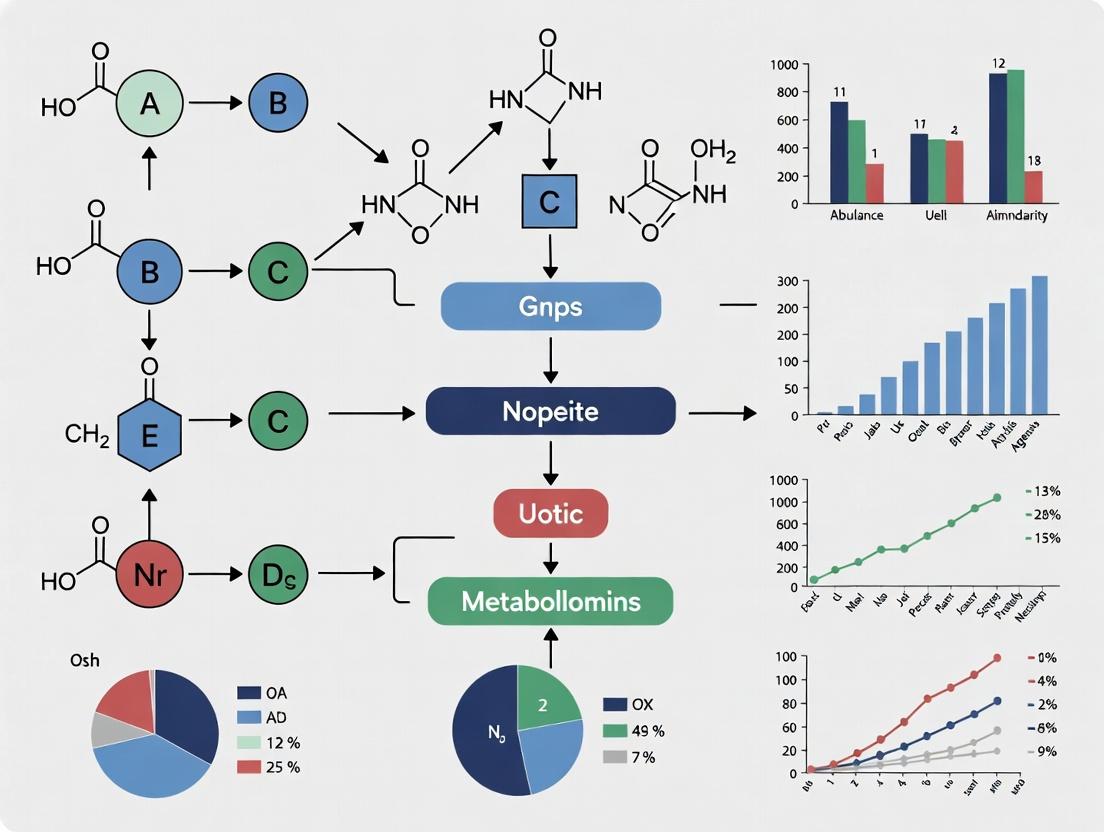
This article provides a thorough overview of GNPS (Global Natural Products Social Molecular Networking) for metabolite identification, tailored for researchers and drug development professionals.
GNPS Molecular Networking: A Comprehensive Guide to Metabolite Identification and Discovery
Abstract
This article provides a thorough overview of GNPS (Global Natural Products Social Molecular Networking) for metabolite identification, tailored for researchers and drug development professionals. It covers foundational concepts of mass spectrometry-based metabolomics and molecular networking, details the step-by-step workflow from data acquisition to network interpretation, addresses common challenges and optimization strategies, and validates the approach through comparisons with traditional methods. The content serves as a practical guide for leveraging GNPS to accelerate natural product discovery, drug candidate screening, and biomarker identification.
What is GNPS Molecular Networking? Foundational Principles for Metabolomics
Within the broader thesis research on GNPS molecular networking for metabolite identification, mass spectrometry (MS)-based metabolomics serves as the foundational analytical engine. It provides the high-resolution spectral data required to construct molecular networks that visualize chemical relationships between metabolites across complex samples. However, the path from raw spectral data to confident metabolite annotation via GNPS is fraught with analytical and bioinformatic challenges that must be meticulously addressed.
Core Principles and Workflow
MS-based metabolomics involves the systematic identification and quantification of small molecules (<1500 Da) in biological systems. The typical workflow encompasses sample collection, metabolite extraction, chromatographic separation (LC/GC), MS or tandem MS (MS/MS) analysis, data processing, and statistical/network-based analysis.
Diagram Title: MS Metabolomics to GNPS Network Workflow
Key Experimental Protocols
Protocol 3.1: Comprehensive Metabolite Extraction from Mammalian Cells (Dual Solvent)
Objective: To quench metabolism and extract a broad range of polar and non-polar intracellular metabolites for LC-MS analysis.
- Preparation: Pre-chill methanol (80% in water, v/v) and acetonitrile:isopropanol (7:3, v/v) to -20°C. Pre-cool centrifuge to 4°C.
- Quenching & Washing: Aspirate culture medium. Rapidly add 1 mL ice-cold PBS to the monolayer, swirl, and aspirate immediately.
- Extraction: Add 500 µL cold methanol to the plate. Scrape cells on dry ice. Transfer suspension to a pre-cooled microtube.
- Phase Separation: Add 500 µL cold acetonitrile:isopropanol. Vortex for 30 sec. Sonicate in ice bath for 5 min.
- Clearing: Centrifuge at 21,000 x g, 20 min, 4°C.
- Drying: Transfer supernatant (clear) to a new tube. Dry in a vacuum concentrator (~2 hrs).
- Reconstitution: Store dried extract at -80°C. For analysis, reconstitute in 100 µL LC-MS compatible solvent (e.g., water:acetonitrile, 98:2), vortex, centrifuge, and transfer to MS vial.
Protocol 3.2: Data-Dependent Acquisition (DDA) for MS/MS Library Generation
Objective: To acquire fragmentation spectra for as many detected metabolites as possible to feed into GNPS.
- LC-MS Setup: Use a reversed-phase C18 column (e.g., 2.1 x 100 mm, 1.7 µm) with a gradient from water to acetonitrile (both with 0.1% formic acid). Flow rate: 0.4 mL/min.
- Full MS Survey Scan: Set resolution to 70,000 (at m/z 200), scan range 70-1050 m/z, AGC target 1e6, max injection time 100 ms.
- DDA Settings: Isolate top 10 most intense ions per cycle using a 1.2 m/z isolation window. Fragment using stepped normalized collision energy (20, 40, 60 eV).
- MS/MS Scan: Set resolution to 17,500, AGC target 5e4, max injection time 50 ms.
- Dynamic Exclusion: Exclude fragmented ions for 15 sec to increase coverage.
Major Challenges and Quantitative Considerations
Key challenges are summarized with associated metrics that impact downstream GNPS network quality.
Table 1: Key Analytical Challenges in MS-Based Metabolomics
| Challenge Category | Specific Issue | Typical Impact/Value | Consequence for GNPS Networking |
|---|---|---|---|
| Chemical Complexity | Dynamic Range | >9 orders of magnitude in biofluids | Low-abundance metabolites missed in MS/MS |
| Metabolite Structural Diversity | >200,000 possible plant metabolites | Incomplete spectral library coverage | |
| Analytical Variability | Retention Time Drift | 0.1-0.3 min shift over batch | Misalignment of peaks across samples |
| Ion Suppression | Signal modulation up to +/- 30% | Quantification inaccuracy | |
| Identification | Lack of MS/MS Spectra | ~80% of detected features lack MS/MS in DDA | Sparse network connections |
| Isomer Discrimination | Multiple compounds with same m/z | Incorrect node annotation in network | |
| Data Handling | False Positives | Up to 30% in peak picking from complex samples | Noisy, unreliable network edges |
| File Size | ~2-4 GB per LC-MS/MS run | Computational burden for processing |
The Scientist's Toolkit: Research Reagent Solutions
Table 2: Essential Reagents and Materials for MS Metabolomics
| Item | Function/Benefit | Example/Note |
|---|---|---|
| Cold Methanol (80%) | Quenches metabolism, denatures enzymes, high polarity extraction. | Must be HPLC-grade, kept at -20°C for quenching. |
| Acetonitrile:Isopropanol (7:3) | Efficient for lipid and non-polar metabolite co-extraction. | Enhances metabolite coverage for untargeted work. |
| Internal Standard Mix | Corrects for ion suppression and extraction losses. | Includes stable isotope-labeled amino acids, fatty acids, etc. |
| Quality Control (QC) Pool | Monitors instrument stability and data quality. | Prepared by pooling equal aliquots from all study samples. |
| LC-MS Grade Solvents | Minimizes background noise and ion source contamination. | Water, methanol, acetonitrile with 0.1% formic acid. |
| Mass Calibration Solution | Ensures high mass accuracy critical for formula prediction. | Vendor-specific (e.g., Pierce Positive/Negative Ion Calibrants). |
| Derivatization Reagents | For GC-MS; increases volatility/ detectability of polar metabolites. | MSTFA (N-Methyl-N-(trimethylsilyl)trifluoroacetamide). |
| Solid Phase Extraction (SPE) Cartridges | Clean-up and fractionation to reduce matrix effects. | C18 for lipids, polymeric for acids, HLB for broad range. |
Integrating with GNPS Molecular Networking
The pre-processed MS/MS data (.mzML or .mzXML format) is uploaded to the GNPS platform. The critical parameters set for network creation directly address metabolomics challenges:
Diagram Title: MS Data to GNPS Network Pipeline
Critical GNPS Parameters from Metabolomics Data:
- Precursor Ion Mass Tolerance: Set to 0.02 Da (for high-res Q-TOF data) to manage mass accuracy drift.
- MS/MS Fragment Ion Tolerance: 0.02 Da.
- Minimum Cosine Score: 0.7 to balance sensitivity/specificity against false-positive edges.
- Minimum Matched Peaks: 4–6 to ensure spectral quality.
- Library Search: Performed against public repositories (e.g., MassBank, HMDB) and in-house user-curated libraries.
The molecular network output groups structurally related metabolites (e.g., glycosylated variants, same core scaffold) into clusters, allowing for analogue-informed annotation—a powerful solution to the library coverage challenge.
Molecular networking, as implemented by the Global Natural Products Social Molecular Networking (GNPS) platform, is a computational metabolomics strategy that organizes complex mass spectrometry (MS) data based on spectral similarity. Within the broader thesis of accelerating metabolite identification and elucidating chemical diversity in drug discovery, molecular networking transforms raw, disparate spectral data into structured, interpretable visual maps. These maps reveal molecular families and analog relationships, guiding researchers toward novel bioactive compounds and biosynthetic pathways.
Core Principles: From Spectral Data to Network Nodes and Edges
The foundation of molecular networking is the pairwise comparison of fragmentation spectra (MS/MS). Each spectrum is represented as a node in the network. A connection (edge) is drawn between two nodes if their spectral similarity score exceeds a defined threshold.
Table 1: Key Spectral Similarity Metrics Used in GNPS Molecular Networking
| Metric | Formula/Principle | Typical Threshold (Cosine Score) | Purpose in Networking |
|---|---|---|---|
| Cosine Similarity | ∑(Ia * Ib) / √(∑Ia² * ∑Ib²) | 0.6 - 0.8 | Measures the angular similarity between two spectrum intensity vectors. Primary score for edge creation. |
| Modified Cosine | Cosine similarity with parent mass tolerance shift. | 0.6 - 0.8 | Accounts for small mass differences from modifications (e.g., methylation, glycosylation). |
| MS-Cluster | Precursor mass tolerance & spectral averaging. | N/A | Groups near-identical spectra to deplicate data before networking. |
| Maximum Common Substructure (MCS) | Spectral alignment to find shared fragments. | Complementary | Used post-networking to annotate shared structural backbones within a cluster. |
Experimental Protocol: Creating a Molecular Network with GNPS
This protocol details the steps to process liquid chromatography-tandem mass spectrometry (LC-MS/MS) data and generate a molecular network via the GNPS platform.
Protocol 3.1: Data Preparation and Upload
- Instrumentation: Acquire LC-MS/MS data in data-dependent acquisition (DDA) mode. High-resolution mass spectrometers (e.g., Q-TOF, Orbitrap) are preferred.
- File Conversion: Convert raw instrument files (.d, .raw) to open mzML or mzXML format using tools like MSConvert (ProteoWizard).
- Metadata: Prepare a sample metadata table (.tsv) detailing sample names, group classifications (e.g., control vs. treated), and optional LC-MS parameters.
- Upload: Navigate to the GNPS website, create a project, and upload the mzXML/mzML files and metadata table.
Protocol 3.2: Molecular Networking Job Parameters
- Job Setup: From the "Workflows" page, select "Molecular Networking."
- Critical Parameters (Table 2):
Table 2: Essential GNPS Molecular Networking Parameters and Typical Settings
Parameter Typical Setting Function Precursor Ion Mass Tolerance 0.02 Da (for Orbitrap) Groups MS1 peaks for MS/MS selection. Fragment Ion Mass Tolerance 0.02 Da Tolerance for aligning MS/MS fragment peaks. Min Pairs Cos 0.7 Minimum cosine score to create an edge. Network TopK 10 Each node connects only to its top 10 most similar nodes. Minimum Matched Fragment Ions 6 Minimum shared peaks to consider similarity. Advanced > Library Search Enabled Annotates nodes with known spectra from libraries. Advanced > Analog Search Enabled Searches for structural analogs of library hits. - Submit Job: Launch the analysis. Processing time varies with dataset size.
Protocol 3.3: Network Visualization and Interpretation
- Access Results: After job completion, access the network via the "View All Graphs" link.
- Visualization Tool: The network loads in Cytoscape (via Cytoscape.js in-browser). Nodes are clustered by spectral similarity.
- Interpretation: Large, tight clusters typically represent groups of structurally related molecules (e.g., same glycoside family). Singletons may be unique compounds.
- Annotation: Nodes with a star icon have matched library spectra. Click nodes to view putative identifications.
GNPS Molecular Networking Workflow
The Scientist's Toolkit: Essential Reagents & Materials
Table 3: Key Research Reagent Solutions for Molecular Networking Studies
| Item | Function in Molecular Networking Context |
|---|---|
| LC-MS Grade Solvents (Acetonitrile, Methanol, Water) | Ensure minimal background noise and ion suppression for high-quality MS data generation. |
| Volatile Buffers/Additives (Formic Acid, Ammonium Acetate) | Aid in LC separation and ionization efficiency in positive or negative ESI mode. |
| Standard Reference Compounds (e.g., pharmacokinetic standards) | Used to check instrument performance, retention time stability, and for potential within-network calibration. |
| Solid Phase Extraction (SPE) Cartridges (C18, HILIC) | For sample clean-up and fractionation to reduce complexity and enrich metabolites prior to LC-MS/MS. |
| Database & Software Licenses (Cytoscape, commercial spectral libraries) | Critical for network visualization and enhanced annotation beyond public libraries. |
| Internal Standard Mix (Stable isotope-labeled metabolites) | For quality control of sample preparation and MS signal stability across batches. |
Advanced Applications: Integrating Quantitative Data and Pathway Mapping
Molecular networks can be layered with quantitative data (e.g., peak areas from MZMine 3) to create "quantitative networks," highlighting compounds that change significantly between experimental conditions.
Integrating Quantitative Data into Networks
Protocol for Annotation Propagation and Putative Identification
A powerful feature of molecular networking is the ability to propagate annotations from known library spectra to unknown, structurally similar neighbors in the network.
Protocol 6.1: Library Search and Analog Propagation
- Within the GNPS job setup, ensure both "Library Search" and "Analog Search" are enabled.
- Post-analysis, in the network visualization, select a library-annotated node (star icon).
- Examine its connected neighbors. The cosine score on each edge indicates the degree of spectral (and thus structural) similarity.
- Use the "Maximum Common Substructure (MCS)" tool (where available) to predict the shared core structure between the library hit and its analog neighbors.
- Prioritize unknown nodes with high cosine similarity to potent bioactive library hits for downstream isolation and characterization.
Table 4: Example of Annotation Propagation within a Single Network Cluster
| Node ID | Parent m/z | Cosine to Node A | Library Match (Node A) | Putative Annotation for Unknown Node |
|---|---|---|---|---|
| Node A | 457.1554 | N/A | Genistein-7-O-glucoside (Score: 0.95) | Known Standard |
| Node B | 441.1605 | 0.82 | No direct match | Genistein aglycone or methylated analog |
| Node C | 609.1460 | 0.78 | No direct match | Genistein-di-O-glucoside (biosynthetic precursor) |
Application Notes on GNPS Ecosystem Components
Public Data Repositories
The GNPS ecosystem is built upon a foundation of open, accessible mass spectrometry data. The primary repository, the Mass Spectrometry Interactive Virtual Environment (MassIVE), serves as the core data warehouse.
Table 1: Core Public Data Repositories within GNPS (2024)
| Repository Name | Primary Data Type | Approximate Public Datasets (as of 2024) | Key Accession Prefix | Direct GNPS Integration |
|---|---|---|---|---|
| MassIVE | MS/MS Spectral Data | 15,000+ | MSV0000xxxx | Full (Native) |
| ProteomeXchange | Proteomics & Metabolomics | 40,000+ (Aggregate) | PXDxxxxxx | Via Reanalysis |
| Metabolomics Workbench | Metabolomics | 2,500+ | STxxxxxx | Partial (Export/Import) |
| MetaboLights | Metabolomics | 8,000+ | MTBLSxxxx | Partial (Export/Import) |
| GNPS Public Spectral Libraries | Reference MS/MS Spectra | 1.2+ Million Spectra | CCMSLIBxxxxxx | Full (Native) |
Community-Driven Spectral Libraries
Community-curated spectral libraries are critical for metabolite annotation. The GNPS platform hosts several tiered libraries.
Table 2: GNPS Spectral Library Tiers and Statistics
| Library Tier | Curatorial Standard | Example Libraries | Approx. Unique Compounds (2024) | Use Case |
|---|---|---|---|---|
| Tier 1 | Publicly available, experimentally acquired reference standards | GNPS, NIST20, MassBank, HMDB | ~350,000 | Confident annotation (Level 1-2) |
| Tier 2 | In silico predicted or derivative spectra | MiBig, NPF, DEREPLICATOR+ outputs | ~1,000,000 | Putative annotation (Level 3) |
| Tier 3 | Public but unreviewed user-contributed spectra | User-contributed GNPS libraries | ~500,000 | Discovery & hypothesis generation |
Quantitative Analysis of Molecular Networking Output
Molecular networking via GNPS creates a structured output of spectral relationships.
Table 3: Typical Molecular Network Metrics from a Public GNPS Job (Averaged)
| Network Metric | Range in Mature Dataset | Interpretation |
|---|---|---|
| Number of Molecular Families (Clusters) | 500 - 50,000 | Reflects chemical diversity |
| Nodes per Cluster (Average) | 2 - 15 | Indicates spectral similarity density |
| Annotation Rate (via Library Match) | 5% - 30% | Dependent on library coverage |
| Singletons (Unconnected Spectra) | 30% - 70% | Unique or low-abundance metabolites |
Detailed Experimental Protocols
Protocol: Creating a Molecular Network from Public Data on GNPS
Objective: To reanalyze a public dataset via the GNPS molecular networking workflow. Duration: 1-3 hours of setup; 2-48 hours for processing (cloud-dependent).
Materials & Software:
- Computer with internet access.
- Web browser (Chrome/Firefox recommended).
- Public dataset accession number (e.g., MSV000084205).
- GNPS user account (free).
Procedure:
- Data Location & Selection: Navigate to the GNPS website (gnps.ucsd.edu). Under "Data," select "Browse Public Data." Use the search function to find a dataset of interest by accession or keyword.
- Job Submission: Click "Analyze with Molecular Networking" on the dataset page. This pre-populates the job submission page.
- Parameter Configuration:
- Spectrum Processing: Set
Precursor Ion Mass Toleranceto 0.02 Da andFragment Ion Mass Toleranceto 0.02 Da for high-resolution LC-MS/MS data. - Molecular Networking: Set
Min Pairs Cos(minimum cosine score) to 0.7 andMinimum Matched Fragment Ionsto 6. - Advanced Network Options: Enable
Run MS Clusterand setMinimum Cluster Sizeto 2. - Library Search: Enable
Search Analogueswith a maximum mass difference of 100 Da.
- Spectrum Processing: Set
- Job Launch: Click "Submit" to send the job to the GNPS cloud. Note the generated job task ID (e.g.,
8d8bc5b35e0446c3a4066c68b8cbd5a8). - Results Monitoring: Monitor job status under "Your Jobs" on GNPS. Upon completion, explore results via the interactive Cytoscape web interface or download the network files (
graphml) and cluster information (csv).
Protocol: Contributing Data to the GNPS Public Repository
Objective: To deposit raw MS/MS data and associated metadata for community reuse. Duration: 2-4 hours.
Pre-Submission Requirements:
- Data must be in open format (
.mzML,.mzXML,.mgf). - Metadata must be prepared following ISA (Investigation-Study-Assay) standards.
- A validated MassIVE account.
Procedure:
- Data Conversion: Convert proprietary raw files (e.g.,
.raw,.d) to.mzMLusing MSConvert (ProteoWizard), with peak picking enabled for centroid data. - Metadata Preparation: Create three tab-separated value (TSV) files:
m_metadata.txt: Sample-to-biological context mapping.s_metadata.txt: Sample-to-data file mapping.f_metadata.txt: Data file-specific parameters (e.g., ionization mode).
- FTP Upload: Use an FTP client (e.g., FileZilla) to connect to
massive.ucsd.edu. Upload all.mzML/.mzXMLfiles and metadata TSV files to your private user directory. - Metadata Validation & Submission: Use the
metadata_validatortool on the MassIVE website to validate your TSV files. Once valid, complete the web submission form to finalize the deposit and obtain the MSV accession number.
Protocol: Feature-Based Molecular Networking (FBMN) with MZmine3 and GNPS
Objective: To perform advanced networking that integrates quantitative feature detection from LC-MS data. Duration: 4-8 hours.
Procedure:
- Feature Detection in MZmine3:
- Import
.mzMLfiles. - Run
Mass Detection(ADAP chromatogram builder recommended). - Execute
Chromatographic Deconvolution(Local Minimum Search algorithm). - Perform
Isotopic Peak GroupingandAlignment(Join Aligner). - Run
Gap Fillingon the aligned peak list. - Export the feature table and MS/MS spectra via
Export → GNPS FBMN.
- Import
- GNPS FBMN Submission:
- On GNPS, select "Feature-Based Molecular Networking" workflow.
- Upload the
quantification_table.csvandMS2_spectra.mgffiles from MZmine3. - Set FBMN-specific parameters:
Ion Mobility(if applicable),Min Feature Overlap(0.7), andRun Ion Identity Networking. - Submit the job.
- Results Interpretation: The resulting network nodes are quantified features, allowing for the visualization of abundance patterns across samples directly within the network layout (e.g., in Cytoscape with the
EnhancedGraphicsplugin).
Visualizations
Workflow of a Standard GNPS Molecular Networking Analysis
Data & Tool Flow in the GNPS Ecosystem
Annotation Confidence Levels in GNPS
The Scientist's Toolkit: Essential Research Reagents & Solutions
Table 4: Key Reagents and Materials for GNPS-Compatible Metabolite Identification Research
| Item | Function/Description | Example Product/Brand (for Protocol Compatibility) |
|---|---|---|
| LC-MS Grade Solvents (Acetonitrile, Methanol, Water) | Mobile phase preparation for LC-MS/MS; minimizes ion suppression and background noise. | Fisher Chemical Optima LC/MS, Honeywell CHROMASOLV LC-MS |
| Formic Acid / Ammonium Acetate (LC-MS Grade) | Mobile phase additives for pH adjustment and ionization enhancement in positive or negative ESI modes. | Fluka LC-MS LiChropur Formic Acid |
| Analytical Reference Standards | Essential for generating Tier 1 library spectra and validating Level 1 identifications. | Sigma-Aldroid Certified Reference Materials (CRMs) |
| Solid Phase Extraction (SPE) Cartridges (C18, HILIC) | Sample clean-up and metabolite fractionation to reduce complexity and ion suppression. | Waters Oasis HLB, Phenomenex Strata-X |
| Derivatization Reagents (e.g., MSTFA for GC-MS) | For volatile derivative formation in complementary GC-MS based metabolomics workflows. | Pierce MSTFA (N-Methyl-N-(trimethylsilyl)trifluoroacetamide) |
| Internal Standard Mix (Stable Isotope Labeled) | For data normalization and quality control during sample preparation and LC-MS run. | Cambridge Isotope Laboratories (CIL) MSK-CUS-100 |
| Quality Control (QC) Pool Sample | Created by combining equal aliquots of all study samples; used for system equilibration and monitoring instrument performance. | N/A (Prepared in-lab) |
| m/z Calibration Solution | For accurate mass calibration of the mass spectrometer before data acquisition. | Thermo Scientific Pierce LTQ Velos ESI Positive Ion Calibration Solution |
| Data Conversion Software | Converts proprietary instrument files to open, GNPS-compatible formats (.mzML). | ProteoWizard MSConvert (Open-Source) |
| Feature Detection Software | For quantitative feature extraction prior to Feature-Based Molecular Networking (FBMN). | MZmine3 (Open-Source) |
Application Notes
The Role of MS/MS Spectra in Molecular Networking
MS/MS (tandem mass spectrometry) spectra are the foundational data for GNPS (Global Natural Products Social Molecular Networking). An MS/MS spectrum is generated by isolating a precursor ion, fragmenting it, and measuring the mass-to-charge (m/z) ratios and intensities of the resultant product ions. This fragmentation pattern is a chemical fingerprint, highly specific to the molecular structure. In GNPS, these spectra are compared computationally to identify similar molecules and cluster them into molecular families, enabling the dereplication of known compounds and the discovery of novel analogs.
Cosine Scores: Quantifying Spectral Similarity
The cosine score is the primary metric used in GNPS to compare two MS/MS spectra. It calculates the cosine of the angle between two spectral vectors (where peaks are vector dimensions), providing a value between 0 and 1. A higher score indicates greater similarity.
Table 1: Interpretation of Cosine Score Ranges in GNPS
| Cosine Score Range | Typical Interpretation | Implication for Molecular Family |
|---|---|---|
| 0.7 - 1.0 | High similarity | Likely same compound or very close structural analog (e.g., isomer). |
| 0.5 - 0.7 | Moderate similarity | Probable structural relatedness within a molecular family (shared core scaffold). |
| 0.2 - 0.5 | Low similarity | Possible weak relationship; may be noise or distant analog. |
| 0.0 - 0.2 | Very low similarity | Unrelated compounds. |
Molecular Families: From Clusters to Discovery
Molecular families are clusters of MS/MS spectra (and thus, the compounds they represent) that share significant spectral similarity. The clustering is performed based on pairwise cosine scores above a user-defined threshold (often 0.7). Within a thesis on GNPS, the analysis of these families allows a researcher to: 1) Dereplicate: Quickly identify known compounds by matching against reference libraries. 2) Prioritize: Focus on network regions (families) with no library matches for novel metabolite discovery. 3) Hypothesize Biosynthetic Pathways: Related compounds often originate from the same or similar biosynthetic gene clusters.
Experimental Protocols
Protocol: Generating a Molecular Network on GNPS
This protocol details the steps to create a molecular network from LC-MS/MS data.
Materials: See The Scientist's Toolkit below. Procedure:
- Data Preparation: Convert raw LC-MS/MS data (.d, .raw) to open mzML or mzXML format using MSConvert (ProteoWizard). Ensure centroiding for MS2 spectra.
- File Submission: Navigate to the GNPS website (gnps.ucsd.edu). Use the "Molecular Networking" job interface.
- Parameter Selection:
- Precursor Ion Mass Tolerance: Set to 0.02 Da (for high-res Q-TOF/Thermo Orbitrap data).
- Fragment Ion Mass Tolerance: Set to 0.02 Da.
- Minimum Cosine Score: Set to 0.7 for stringent clustering, or 0.6 for broader relationships.
- Minimum Matched Fragment Ions (Peaks): Set to 6.
- Network TopK: Set to 10 (each node connects only to its 10 best matches).
- Library Search: Enable "Search Analog" with a maximum mass difference of 100 Da.
- Job Submission & Monitoring: Upload your mzXML files and a metadata file describing samples. Submit the job and monitor via the provided link.
- Results Analysis: Use Cytoscape to visualize the network (.graphml file). Nodes represent consensus MS/MS spectra; edges represent cosine scores. Annotate nodes using library match results.
Protocol: Calculating and Validating Cosine Scores Offline
For targeted analysis or method development, cosine scores can be calculated using the ms2score Python package or the Spec2Vec model.
Procedure:
- Environment Setup: Install Python packages:
matchms,numpy,ms2deepscore. - Data Loading: Load two or more MS/MS spectra from msp or mgf files.
- Spectrum Processing: Clean spectra using
matchmsfilters: normalize intensities, remove peaks below a threshold, select top-N most intense peaks. - Score Calculation:
- For classical cosine: Use
Scores(similarity_function=cosine_similarity())in matchms. - For advanced scoring: Use
MS2DeepScoremodel for machine learning-based similarity.
- For classical cosine: Use
- Validation: Manually inspect high-scoring pairs (>0.8) by aligning their fragment peaks to confirm plausible structural relationships.
Diagrams
GNPS Molecular Networking Workflow
Molecular Family Clustering by Cosine Score
The Scientist's Toolkit
Table 2: Essential Research Reagents & Tools for GNPS Molecular Networking
| Item | Function/Benefit |
|---|---|
| High-Resolution LC-MS/MS System (e.g., Q-TOF, Orbitrap) | Generates high-quality MS/MS spectra with accurate mass measurements for precise cosine scoring. |
| Data Conversion Software (MSConvert, ProteoWizard) | Converts proprietary instrument data to open mzML/mzXML formats compatible with GNPS. |
| GNPS Web Platform (gnps.ucsd.edu) | The central, cloud-based ecosystem for performing molecular networking, library search, and data analysis. |
| Reference Spectral Libraries (e.g., NIST20, GNPS built-in, MassBank) | Essential for dereplication via spectral matching against known compounds. |
| Cytoscape Software | Open-source platform for visualizing, analyzing, and annotating molecular networks generated by GNPS. |
Python Environment with matchms/ms2deepscore |
Enables offline, customizable processing and similarity scoring of MS/MS spectra for advanced analysis. |
| Sample-Specific Metadata Table (.txt or .csv) | Crucial for contextualizing results; links samples to experimental conditions (e.g., strain, treatment). |
| Solid Phase Extraction (SPE) Cartridges | Used for pre-fractionation of complex natural product extracts to reduce ion suppression and complexity. |
The Role of GNPS in Modern Natural Product Discovery and Drug Development
The Global Natural Products Social Molecular Networking (GNPS) platform represents a paradigm shift in metabolite identification, central to a thesis on molecular networking. It enables the de-replication of known compounds and the prioritization of novel chemical entities within complex biological extracts. By transforming tandem mass spectrometry (MS/MS) data into a visual network of related spectra, GNPS facilitates hypothesis-driven discovery, accelerating the translation of natural product chemistry into viable drug leads.
Application Notes and Quantitative Data
GNPS application in drug discovery pipelines yields significant efficiency gains. Key quantitative metrics from recent studies (2023-2024) are summarized below.
Table 1: Quantitative Impact of GNPS in Recent Natural Product Studies
| Study Focus | Extracts/Strains Screened | MS/MS Spectra Processed | Known Compounds Dereplicated (%) | Novel Clusters Prioritized | Time Savings vs. Traditional Methods | Reference Type |
|---|---|---|---|---|---|---|
| Marine Microbiome Drug Discovery | 500+ microbial strains | ~1.2 million | 85-92% | 15 significant clusters | ~6-8 months | Research Article |
| Plant Endophyte Metabolomics | 120 plant extracts | ~450,000 | 78% | 8 novel families | ~4-5 months | Application Note |
| Clinical Metabolite Annotation | 1000+ patient samples | ~5 million | 65% (microbiome-derived) | N/A | High-throughput scale | Benchmarking Study |
Detailed Experimental Protocols
Protocol 1: GNPS Molecular Networking for Crude Extract Prioritization
- Objective: To rapidly annotate metabolites and identify novel chemical scaffolds in a microbial fermentation extract.
- Materials: LC-MS/MS system (e.g., Q-Exactive series), C18 reversed-phase column, solvents (MeCN, H₂O, Formic acid), GNPS account (gnps.ucsd.edu).
- Procedure:
- Sample Preparation: Reconstitute lyophilized crude extract in 80% MeOH to 1 mg/mL. Centrifuge and transfer supernatant to MS vial.
- LC-MS/MS Analysis:
- Column: Poroshell 120 EC-C18 (2.1 x 150 mm, 2.7 µm).
- Gradient: 5% to 100% MeCN in H₂O (both with 0.1% formic acid) over 20 min.
- MS: Data-Dependent Acquisition (DDA) mode. Full scan (m/z 150-2000), top 10 precursors selected for fragmentation (stepped NCE 20, 40, 60).
- Data Conversion: Convert raw files to .mzML format using MSConvert (ProteoWizard).
- GNPS Job Submission:
- Upload files to MassIVE (dataset ID: MSV00009XXXX).
- Create Molecular Network:
Precursor tolerance: 0.02 Da,Fragment tolerance: 0.02 Da,Min pairs cosine score: 0.7. - Set library search parameters:
Score threshold: 0.7,Min matched peaks: 6.
- Data Analysis: Visualize network in Cytoscape. Clusters without library matches (grey nodes) are prioritized for isolation. Use
feature-based molecular networking(FBMN) via MZmine 3 for quantitative linking.
Protocol 2: Integrated GNPS and Bioinformatics Workflow for Biosynthetic Gene Cluster (BGC) Linking
- Objective: To correlate molecular families with putative BGCs from sequenced microbial genomes.
- Procedure:
- Perform Protocol 1 to generate molecular network and identify a target novel cluster.
- Genome Mining: Assemble genome from Illumina/Nanopore data. Run antiSMASH 7.0 to identify BGCs.
- Metabolite-Genome Linkage: Use the
NPLinkerplatform orBiG-FAManalysis to correlate spectral network patterns (using MS/MS fingerprints) with BGC phylogeny. - Heterologous Expression: Clone the candidate BGC into a suitable host (e.g., Streptomyces coelicolor) for expression and compound validation.
Visualizations
Diagram 1: GNPS Drug Discovery Workflow (Width: 760px)
Diagram 2: GNPS Integration with Multi-Omics (Width: 760px)
The Scientist's Toolkit: Key Research Reagent Solutions
Table 2: Essential Materials and Tools for GNPS-Driven Discovery
| Item/Reagent | Function in GNPS Workflow | Example Product/Software |
|---|---|---|
| LC-MS Grade Solvents | Ensure low background noise and high sensitivity during LC-MS/MS analysis. | Optima LC/MS Grade Acetonitrile, Water with 0.1% Formic Acid. |
| Solid Phase Extraction (SPE) Cartridges | Pre-fractionate crude extracts to reduce complexity prior to GNPS analysis. | Strata C18-E or Polymeric Sorbent cartridges. |
| Mass Spectrometry Instrumentation | Generate high-resolution MS/MS spectra, the primary input data for GNPS. | Thermo Q-Exactive HF, Bruker timsTOF, Sciex TripleTOF. |
| Data Conversion Software | Convert proprietary MS files to open-source formats (.mzML, .mzXML) for GNPS. | ProteoWizard MSConvert, Bruker DataAnalysis. |
| Feature Detection & Alignment Software | Enable quantitative feature-based molecular networking (FBMN). | MZmine 3, MS-DIAL. |
| Cytoscape with GNPS Plugin | Visualize, style, and interactively explore molecular networks from GNPS. | Cytoscape 3.10+ & the clustermaker2 and GNPS apps. |
| Bioinformatics Suites for BGC Analysis | Link GNPS metabolite clusters to biosynthetic gene clusters. | antiSMASH, BiG-SCAPE, NPLinker. |
| Public Spectral Libraries | Annotate known compounds via spectral matching on GNPS. | GNPS Libraries, NIST20, MassBank. |
Step-by-Step GNPS Workflow: From Raw Data to Biological Insights
Application Notes and Protocols
1.0 Introduction and Thesis Context In a research thesis utilizing Global Natural Products Social Molecular Networking (GNPS) for metabolite identification, the initial data preparation is the critical, non-negotiable foundation for success. GNPS workflows require high-quality, standardized LC-MS/MS data in an open, community-supported format. This protocol details the optimal acquisition parameters for data-dependent acquisition (DDA) LC-MS/MS and the subsequent conversion to the mzML file format, ensuring data integrity and compatibility for downstream GNPS analysis, molecular networking, and database spectral matching.
2.0 Critical LC-MS/MS Acquisition Parameters for GNPS Data generation must balance spectral quality with comprehensiveness. The following parameters are optimized for untargeted metabolomics and GNPS compatibility.
Table 1: Recommended LC-MS/MS Data-Dependent Acquisition (DDA) Parameters
| Parameter Category | Specific Parameter | Recommended Setting | Rationale for GNPS |
|---|---|---|---|
| MS1 Survey Scan | Mass Range | 100-1500 m/z | Covers most relevant natural product ions. |
| Resolution | > 60,000 (Q-TOF, Orbitrap) | Enables accurate mass measurement for formula prediction. | |
| Scan Rate | 3-12 Hz | Sufficient for chromatographic peak definition. | |
| AGC Target / Dynamic Range | Standard or 1e6 | Ensures good signal-to-noise without detector saturation. | |
| MS2 Fragmentation | Isolation Window | 1.0-2.0 m/z | Prevents co-fragmentation, yields cleaner MS2 spectra. |
| Fragmentation Mode | CID or HCD (CE: 20-40 eV) | Generates informative, reproducible fragment patterns. | |
| Resolution | > 15,000 (Orbitrap) or unit mass (Q-TOF) | Balances speed and spectral detail. | |
| Top N Ions per Cycle | 5-10 | Maximizes MS2 coverage across eluting peaks. | |
| Intensity Threshold | 5e3 - 1e4 counts | Filters noise, focuses on real analytes. | |
| Dynamic Exclusion | 15-30 seconds | Prevents repetitive sequencing of abundant ions. | |
| Chromatography | Gradient Length | 10-30 minutes | Sufficient for metabolite separation. |
| Column | C18 (2.1 x 100 mm, 1.7-1.9 µm) | Standard for reversed-phase metabolomics. |
3.0 Protocol: Conversion of Raw Data to mzML Format The mzML format is the open, standardized community format required by GNPS. Conversion involves using the MSConvert tool (part of ProteoWizard).
Protocol 3.1: Batch File Conversion Using MSConvert GUI
- Installation: Download and install ProteoWizard (http://proteowizard.sourceforge.net/) for your operating system.
- Source Data: Gather all raw files (.raw, .d, .wiff, etc.) in a single input directory.
- Launch MSConvert: Open the MSConvert GUI application.
- Configure Input/Output:
- Browse: Add your raw files.
- Output format: Select
mzML. - Output directory: Choose a destination folder.
- Set Filter Options (Critical):
- Select the
peakPickingfilter. Setvendor msLevel=1-to apply peak picking to all MS levels, ensuring centroided spectra. - Select the
titleMakerfilter to preserve original metadata in the scan title.
- Select the
- Execute: Click "Start" to begin batch conversion. Monitor the log for errors.
Protocol 3.2: Command-Line Conversion for Automation For scripting and reproducibility, use the command-line interface.
Example for batch conversion of all .raw files in a folder:
4.0 Visualization of the Data Preparation Workflow
Workflow for GNPS Data Preparation
5.0 The Scientist's Toolkit: Essential Research Reagent Solutions
Table 2: Key Software and Tools for Data Preparation
| Item | Function & Relevance |
|---|---|
| Vendor Acquisition Software (Xcalibur, MassHunter, SCIEX OS) | Controls the MS instrument, implements the DDA method from Table 1 to generate raw data. |
| ProteoWizard (MSConvert) | The definitive, cross-platform tool for converting vendor raw files to open mzML/mzXML formats. Essential for GNPS submission. |
| GNPS/MassIVE File Format Validator | Online tool to check mzML file integrity and compliance before uploading to the GNPS platform. |
| Python/R Packages (pyteomics, MSnbase) | For programmatic validation, metadata extraction, or custom preprocessing scripts in automated pipelines. |
| QC Reference Standard Mixture | A defined mix of metabolites (e.g., in positive/negative ion mode) run at the start of a batch to assess LC-MS system performance. |
Within the context of a broader thesis on Global Natural Products Social Molecular Networking (GNPS) for metabolite identification, the evolution from Classical Molecular Networking (MN) to Feature-Based Molecular Networking (FBMN) represents a critical methodological advancement. This shift addresses key limitations in data processing, enabling more accurate annotation of metabolites in complex biological samples for drug discovery and systems biology research.
Comparative Analysis of Workflows
Table 1: Core Quantitative Comparison of Classical MN vs. FBMN
| Parameter | Classical Molecular Networking | Feature-Based Molecular Networking |
|---|---|---|
| Input Data Type | Raw MS/MS spectral files (.mzML, .mzXML) | Feature tables (from MZmine, OpenMS, MS-DIAL) + aligned MS/MS spectra |
| Spectral Alignment | Cosine similarity on peak lists only | Combines feature intensity correlation & spectral similarity |
| Quantitative Integration | No direct integration; separate analysis required | Built-in quantitative feature intensity data from LC-MS |
| Isomer Differentiation | Limited; relies solely on MS/MS spectrum | Enhanced; uses both MS/MS and chromatographic retention time |
| Duplicate Spectra Handling | Prone to redundant nodes from same analyte | Consolidates spectra from same chromatographic feature |
| Downstream Analysis | Network topology & spectral library matches | Enables metabolomics: stats, differential abundance, bioactivity correlation |
Table 2: Performance Metrics for Metabolite Identification
| Metric | Classical MN | FBMN | Notes |
|---|---|---|---|
| Annotation Rate (avg.) | 5-15% | 15-30% | % of network nodes with library matches |
| Feature Reduction | Not Applicable | 40-70% | Reduction of redundant spectra via feature alignment |
| Reproducibility (CV) | Higher variability | <20% CV | For feature intensity across replicates |
| Isomer Resolution | Low | High | Ability to separate e.g., glycosylation isomers |
| Processing Time | Faster initial setup | Longer setup, richer output | Depends on sample complexity |
Experimental Protocols
Protocol 1: Classical GNPS Molecular Networking
Objective: To create a molecular network from raw LC-MS/MS data files for metabolite dereplication.
Materials: LC-MS/MS system (Q-TOF, Orbitrap), computational workstation, GNPS account.
Procedure:
- Data Acquisition: Collect data-dependent (DDA) MS/MS on samples. Convert raw files to open formats (.mzML, .mzXML) using MSConvert (ProteoWizard).
- File Preparation: Ensure each file represents one sample or fraction. No feature detection is performed.
- GNPS Upload & Parameters:
- Go to the GNPS website (gnps.ucsd.edu) and initiate a "Molecular Networking" job.
- Critical Parameters:
- Precursor Ion Mass Tolerance: 0.02 Da
- Fragment Ion Mass Tolerance: 0.02 Da
- Minimum Cosine Score: 0.7
- Minimum Matched Fragment Ions: 6
- Network TopK: 10
- Maximum Connected Component Size: 100
- Job Submission & Visualization: Submit job. View results in Cytoscape (via
clustermaker2plugin) or within the GNPS web interface. - Annotation: Interpret networks by examining library matches (e.g., against GNPS, NIST14, user libraries).
Protocol 2: Feature-Based Molecular Networking (FBMN)
Objective: To integrate quantitative LC-MS feature data with molecular networking for enhanced metabolite identification and comparative analysis.
Materials: As in Protocol 1, plus MZmine 3, OpenMS, or MS-DIAL software.
Procedure:
- Data Acquisition & Conversion: As in Protocol 1, Step 1.
- Feature Detection & Alignment (MZmine 3 Example):
- Import: Load all .mzML files into MZmine.
- Mass Detection: Perform on both MS1 and MS2 scans.
- Chromatogram Building:
ADAPmodule recommended. - Deconvolution: Use
Local Minimum SearchorADAPwaveform. - Isotope Grouping: Group isotopic peaks.
- Alignment: Align features across samples (
Join Aligner). - Gap Filling: Fill in missing peaks (
Peak Finder). - Export: Export (a) Feature Quantification Table (.csv), (b) MS/MS Spectral Summary (.mgf), and (c) Metadata Table (.csv).
- GNPS FBMN Job Submission:
- Select "Feature-Based Molecular Networking" on GNPS.
- Upload the
.mgf(spectra) and.csv(feature table) files. - Set similar parameters as Classical MN, but leverage the
Quantification Tableoption.
- Advanced Analysis in Cytoscape:
- Load network (
graphmlfile from GNPS) and feature table into Cytoscape. - Use
ChemViz2to display molecular structures. - Map feature intensities (abundance) onto node size/color for visual metabolomics.
- Perform statistical analysis (e.g., via
clustermaker2for hierarchical clustering of samples based on feature abundance).
- Load network (
Visualization of Workflows
Title: GNPS Molecular Networking Workflow Comparison
The Scientist's Toolkit: Research Reagent Solutions
| Tool/Resource | Type | Primary Function | Key Benefit |
|---|---|---|---|
| GNPS Platform | Web Ecosystem | Central hub for spectral networking, library search, & workflows. | Community-driven, continually updated reference libraries. |
| MZmine 3 | Open-Source Software | LC-MS data preprocessing: feature detection, alignment, gap filling. | Modular, supports FBMN pipeline, handles large datasets. |
| MS-DIAL | Open-Source Software | Comprehensive MS1 & MS2 data processing, lipidomics-focused. | Powerful for untargeted analysis, includes in-silico MS/MS decoy. |
| Cytoscape | Network Analysis Software | Visualization and exploration of molecular networks. | Plugins (ChemViz2, clustermaker2) enable advanced visualization. |
| ProteoWizard | Software Library | Converts vendor MS files to open formats (.mzML). | Universal compatibility across instrument platforms. |
| SIRIUS 5 | Software Tool | Molecular formula & structure prediction via CSI:FingerID. | Integrates with GNPS/FBMN outputs for orthogonal annotation. |
| Global Natural Products Social (GNPS) Spectral Libraries | Reference Database | Curated MS/MS spectra of natural products & metabolites. | Enables dereplication and putative annotation. |
| QIITA / METABOLOMICS WORKBENCH | Data Repository | Public repository for multi-omics data, including GNPS jobs. | Facilitates reproducible research and data sharing. |
Application Notes on Molecular Network Interpretation
Molecular networking via GNPS (Global Natural Products Social Molecular Networking) is a cornerstone technique for de-replication and novel metabolite identification in natural product research. It visualizes the chemical space of complex mixtures by treating mass spectrometry (MS/MS) data as a relational graph.
Core Network Components
Nodes: Represent consensus MS/MS spectra from the data. Each node corresponds to a distinct (or consensus) molecular ion, characterized by its parent mass-to-charge ratio (m/z) and fragmentation pattern.
Edges: Represent spectral similarities between nodes, calculated using metrics like the cosine score. An edge suggests a shared structural motif or a biogenetic relationship between the two connected molecules.
Clusters: Groups of densely interconnected nodes that typically represent a family of structurally related compounds, such as analogs within a specific natural product class.
Quantitative Metrics for Network Interpretation
The following table summarizes key metrics used to evaluate and interpret network topology and cluster quality.
Table 1: Key Quantitative Metrics for Network & Cluster Analysis
| Metric | Typical Range | Interpretation in GNPS Context |
|---|---|---|
| Cosine Score | 0.0 - 1.0 | Spectral similarity. >0.7 often indicates high structural similarity; 0.2-0.7 suggests shared scaffolds. |
| Matched Peaks | Integer count | Number of fragment ions shared between two spectra. Higher counts support a valid edge. |
| Cluster Size | Number of nodes | Larger clusters may indicate a prominent chemical family in the sample. |
| Network Diameter | Number of edges | Longest shortest path. Indicates the overall connectivity and diversity of the network. |
| Average Clustering Coefficient | 0.0 - 1.0 | Measures how nodes tend to cluster together. High values indicate tight, family-like groupings. |
Experimental Protocols
Protocol 1: Generating a Molecular Network via GNPS
Objective: To transform raw LC-MS/MS data into an interpretable molecular network.
- Data Acquisition: Perform LC-MS/MS on samples in data-dependent acquisition (DDA) mode. Export data in .mzML or .mzXML format.
- File Conversion & Export: Use MSConvert (ProteoWizard) with peak picking activated to convert vendor files.
- GNPS Job Submission: a. Access the GNPS platform (https://gnps.ucsd.edu). b. Create a new "Molecular Networking" job. c. Upload your .mzML files. d. Set Critical Parameters: * Precursor Ion Mass Tolerance: 0.02 Da * Fragment Ion Mass Tolerance: 0.02 Da * Minimum Cosine Score: 0.7 * Minimum Matched Fragment Ions: 6 * Network TopK: 10 (connects each node to its top 10 most similar neighbors) * Maximum Connected Component Size: 100 * Run MS-Cluster and perform spectral library search.
- Result Visualization: Use Cytoscape to open the network file (
graphml) downloaded from GNPS. Apply visual styles based on metadata (e.g., sample origin, parent m/z).
Protocol 2: In-depth Cluster Analysis for Novelty Prioritization
Objective: To analyze a specific cluster to identify potential novel metabolites.
- Cluster Selection: In Cytoscape, identify a cluster of interest (high connectivity, unknown nodes).
- Feature Examination: For nodes within the cluster: a. Note parent m/z and proposed molecular formula. b. Review the MS/MS spectral data for each node. c. Examine library match results. Nodes with no known library match are "unknowns" and are candidates for novelty.
- Analog Search: For an "unknown" node, examine its connected neighbors. Neighbors with known identifications provide immediate structural clues (e.g., "this unknown is a glycosylated analog of compound X").
- MS/MS Fragmentation Logic: Map the fragment ion differences between connected nodes to propose structural modifications (e.g., loss of -CH2, +O, -sugar).
- Isolation & Validation: Use the m/z and retention time to guide targeted isolation of the compound(s) for subsequent NMR-based structural elucidation.
Visualizations
Title: GNPS Molecular Networking Workflow
Title: Cluster Interpretation for Structural Elucidation
The Scientist's Toolkit
Table 2: Essential Research Reagent Solutions & Materials
| Item | Function in GNPS Workflow |
|---|---|
| LC-MS Grade Solvents (Acetonitrile, Methanol, Water with 0.1% Formic Acid) | Essential for reproducible chromatographic separation and efficient electrospray ionization in MS. |
| Standard MS Calibration Mix | Ensures accurate mass measurement across the m/z range, critical for reliable network alignment. |
| Spectral Library Reference Standards | Authentic compounds used to generate reference MS/MS spectra for confident library matching within GNPS. |
| Solid Phase Extraction (SPE) Cartridges (e.g., C18, HLB) | Used for sample clean-up and fractionation to reduce matrix complexity prior to LC-MS/MS analysis. |
| Cytoscape Software | Open-source platform for visualizing, analyzing, and styling the molecular network graphs from GNPS. |
| MS-Convert (ProteoWizard) | Converts vendor-specific mass spec data files into the open .mzML/.mzXML formats required by GNPS. |
| Internal Database (e.g., SQLite) | For managing sample metadata, which is crucial for contextualizing network patterns (e.g., bioactivity per sample). |
Application Notes
Within a thesis on GNPS molecular networking for metabolite identification, annotation is the critical step of assigning chemical structures to mass spectral features. The strategy is tiered, moving from high-confidence matches to putative annotations.
- Library Searches provide the most reliable annotations when a match is found in a reference spectral library. The confidence is high but limited to known compounds already in libraries.
- In-Silico Tools expand annotation possibilities. DEREPLICATOR+ uses genomic and spectral information to predict known peptide and small molecule families, even from novel variants. MolNetEnhancer integrates outputs from multiple in-silico tools (like MS2LDA and Network Annotation Propagation (NAP)) to create a comprehensive chemical class taxonomy for a molecular network, revealing structural relationships.
- Analog Searching bridges the gap when no direct match exists. By searching for spectra with high similarity (cosine score > 0.7) but not identical precursors, it enables the annotation of unknown compounds as analogs or derivatives of known library compounds, guiding isolation efforts.
Table 1: Comparison of GNPS Annotation Strategies
| Strategy | Tool/Approach | Primary Input | Output Type | Confidence Level | Key Limitation |
|---|---|---|---|---|---|
| Library Search | GNPS Library Search | MS/MS Spectrum | Exact Structure | High (Level 1-2) | Limited to known compounds in libraries. |
| In-Silico Tool | DEREPLICATOR+ | MS/MS, Genomic Data | Molecular Family (e.g., Lipopeptide) | Putative (Level 3) | Best for peptides & certain natural products. |
| In-Silico Tool | MolNetEnhancer | MS/MS Molecular Network | Chemical Class Taxonomy | Putative (Level 3-4) | Integrative, but classes are broad. |
| Analog Search | GNPS Analog Search | MS/MS Spectrum | Analog Structure | Tentative (Level 3) | Requires a structurally related library compound. |
Table 2: Typical Spectral Similarity Score Thresholds in GNPS Workflows
| Search Type | Cosine Score Threshold | Minimum Matched Peaks | Comment |
|---|---|---|---|
| Classical Library Search | ≥ 0.7 | 6 | Standard for confident spectral match. |
| Analog Search | ≥ 0.7 | 6 | Must be used with Delta m/z filter (e.g., ± 150 Da). |
| Network Edges | ≥ 0.7 (or user-defined) | 4-6 | Defines connectivity in molecular network. |
Experimental Protocols
Protocol 1: Integrated GNPS Workflow with Advanced Annotation Objective: To annotate metabolites in a complex biological sample using a multi-strategy GNPS workflow.
- Data Acquisition: Acquire LC-MS/MS data in data-dependent acquisition (DDA) mode. Convert raw files to .mzML format using MSConvert (ProteoWizard).
- Molecular Networking: Upload files to GNPS (https://gnps.ucsd.edu). Create a molecular network using the Feature-Based Molecular Networking (FBMN) workflow in MZmine 3, followed by GNPS submission. Parameters: Precursor ion mass tolerance 0.02 Da, MS/MS tolerance 0.02 Da, Min pairs cos 0.7, Minimum matched peaks 6.
- Library Annotation: Run the GNPS Library Search job concurrently. Parameters: Score threshold 0.7, Min matched peaks 6, Library on public GNPS.
- In-Silico Annotation:
- Run the DEREPLICATOR+ job (select as an option during FBMN job setup) to annotate peptide families.
- Run the Network Annotation Propagation (NAP) job on the resulting network to get in-silico annotations.
- Submit the network, NAP results, and MS2LDA results (from a separate run on the MS2LDA website) to MolNetEnhancer to generate a reinforced network with chemical class hierarchies.
- Analog Searching: On the GNPS results page, launch an Analog Search from any unannotated node of interest. Set Delta m/z maximum to 150 Da and apply standard cosine (0.7) and peak match (6) filters.
- Data Integration: Visualize the final MolNetEnhancer-enhanced network in Cytoscape. Annotations will be layered: exact matches (library), molecular families (DEREPLICATOR+), and broad chemical classes (MolNetEnhancer).
Protocol 2: Targeted Analog Search for Derivative Identification Objective: To identify potential structural analogs of a specific compound of interest (e.g., a known drug metabolite).
- Reference Spectrum Selection: Identify the GNPS library spectrum for your parent compound of interest. Note its precursor m/z.
- Job Submission: On the GNPS website, navigate to the Analog Search page. Upload your experimental mzML files.
- Parameter Configuration:
- Analog Search Maximum Delta Mass: Set to 150.0 Da (or a biologically relevant mass difference).
- Precursor Ion Mass Tolerance: 0.02 Da.
- MS/MS Fragment Ion Tolerance: 0.02 Da.
- Score Threshold: 0.7.
- Minimum Matched Peaks: 6.
- Maximum Nearest Neighbors: 10.
- Library to Search: Select "Use Only Analogs of Library Spectra".
- Execution and Analysis: Run the job. Review matches, which will list the library compound and the calculated mass difference. Inspect MS/MS spectra to confirm conserved fragment ions indicative of a shared core structure.
Visualization
GNPS Multi-Strategy Annotation Workflow
Decision Logic for Annotation Strategies
The Scientist's Toolkit
Table 3: Essential Research Reagent Solutions & Materials
| Item | Function in GNPS Annotation Workflow |
|---|---|
| LC-MS Grade Solvents (Acetonitrile, Methanol, Water with 0.1% Formic Acid) | Essential for reproducible chromatography and stable electrospray ionization during MS data acquisition. |
| Standard MS Calibration Solution (e.g., ESI Tuning Mix) | Ensures accurate mass measurement across the instrument's range, critical for formula prediction and database matching. |
| Authenticated Chemical Standards | Used to build in-house spectral libraries, providing Level 1 confidence annotations and seeds for analog searches. |
| MZmine 3 / OpenMS Software | Open-source platforms for feature detection, alignment, and table construction prior to Feature-Based Molecular Networking on GNPS. |
| Cytoscape Software | Network visualization and analysis platform essential for interpreting complex, multi-layered results from MolNetEnhancer. |
| Public Spectral Libraries (GNPS, MassBank, NIST17) | Reference databases for library searching. The GNPS library is the primary public repository for community MS/MS spectra. |
Optimizing GNPS Analysis: Solving Common Problems and Improving Results
Troubleshooting Poor Network Connectivity and Isolated Nodes
Within the framework of a thesis on GNPS (Global Natural Products Social Molecular Networking) for metabolite identification, the construction of a high-quality molecular network is paramount. This network, where nodes represent consensus MS/MS spectra and edges represent spectral similarity, is the scaffold for dereplication and novel compound discovery. Poor network connectivity—manifesting as an overabundance of isolated singleton nodes or small, disconnected clusters—severely hinders hypothesis generation. It can obscure relationships between related metabolites (e.g., derivatives, analogs, or biosynthetic family members), leading to missed identifications and reduced research impact. This document outlines systematic protocols to diagnose and resolve these issues, ensuring robust networks for downstream analysis.
Table 1: Primary Causes of Poor Connectivity in GNPS Molecular Networking
| Cause Category | Specific Factor | Typical Impact | Diagnostic Metric |
|---|---|---|---|
| Data Quality | Low MS/MS signal intensity | Poor-quality spectra hinder cosine score calculation. | Precursor intensity < 1E4 counts; few fragment ions. |
| High background/chromatographic noise | Non-coeluting peaks matched incorrectly, creating noise edges. | Many MS/MS spectra from non-peak regions. | |
| Parameter Selection | Incorrect precursor/fragment ion tolerance | Missed alignments of related ions (e.g., adducts, isotopes). | Network splits by adduct type (M+H, M+Na clusters separate). |
| Cosine score threshold too high | Most common cause. Overly stringent similarity filtering. | High % of singleton nodes (>70% often indicates issue). | |
| Minimum matched peaks too high | Discards valid matches for structurally similar but not identical molecules. | Correlates with high singleton count. | |
| Chemical/Biological | Truly unique metabolites in sample | Some compounds are structurally isolated. | Singletons are high-purity, high-intensity spectra. |
| Extensive post-acquisition filtering | Over-use of "classical" network filtering (e.g., library match removal). | Loss of known connected families. |
Table 2: Recommended GNPS Parameters for Optimizing Connectivity
| Parameter | Default/Strict Value | Optimized Troubleshooting Value | Function |
|---|---|---|---|
| Min Matched Peaks | 6 | 4 | Increases chance of connecting spectra with lower fragmentation. |
| Cosine Score Threshold | 0.7 | 0.5 - 0.65 | Primary lever to increase edges. Start lower, then raise. |
| Network TopK | 10 | 20 | Allows each node to connect to more neighbors. |
| Maximum Connected Component Size | 100 | 500 or 1000 | Prevents artificial splitting of large families (e.g., lipids). |
| Precursor Ion Tolerance | 0.02 Da | 0.05 Da | Better alignment of peaks from less calibrated instruments. |
Experimental Protocols for Diagnosis and Resolution
Protocol 1: Diagnostic Workflow for Isolated Nodes
Objective: To systematically identify the root cause of poor network connectivity. Materials: GNPS job results (network graph, clusterinfo table), raw LC-MS/MS data files, software (MSFragger, MZmine, Cytoscape). Procedure:
- Extract & Categorize Singletons: From the GNPS
clusterinfofile, filter nodes withcomponentindex= -1. Separate into two lists: low-intensity (<1E4) and high-intensity spectra. - Manually Inspect Spectra: Load high-intensity singleton spectra into a viewer (e.g., GNPS Spectrum Viewer). Assess spectral quality: is it noisy, or does it show a clear fragmentation pattern with multiple ions?
- Check for Adduct/Neutral Loss Patterns: In the raw data, examine the chromatographic peak of a high-intensity singleton. Use MZmine to detect related ions (M+Na, M+K, M+NH4, M-H2O). If present, the precursor tolerance or ion recognition may be too narrow.
- Re-process with Relaxed Parameters: Create a new GNPS job focusing on a subset of data. Use parameters from Table 2, particularly a lower Cosine Score (0.55) and lower Min Matched Peaks (4).
- Compare Results: Calculate the percentage change in singleton count and size of the largest connected component. A significant decrease in singletons indicates parametric cause.
Protocol 2: MS/MS Data Pre-processing Optimization for Connectivity
Objective: To enhance spectral quality and alignment before GNPS analysis. Materials: Raw LC-MS/MS data (.raw, .mzML), software (MZmine 3, ProteoWizard, MSFragger). Procedure:
- Convert and Demultiplex: Use ProteoWizard's
msconvertto convert data to open.mzMLformat. For data-dependent acquisition (DDA) with overlapping windows, apply demultiplexing (e.g., usingmsdemuxalgorithm in MZmine). - Chromatographic Deconvolution: In MZmine, run the "ADAP Chromatogram Builder" followed by "Wavelet Chromatographic Deconvolution." This resolves co-eluting isomers and isolates pure MS/MS spectra.
- Alignment with MSFragger (for IM-MS): For ion-mobility data, use the MSFragger+Metabo workflow. Set
precursor_mass_low = -0.5andprecursor_mass_high = 1.0in themetabo.conffile to comprehensively capture adducts and in-source fragments as potential precursors. - Export for GNPS: Export the peak list with aligned spectra as an
.mgffile. Ensure the export includes all deconvoluted MS/MS spectra.
Visualizations
Title: Troubleshooting Workflow for GNPS Network Connectivity
Title: GNPS Connectivity Enhancement Protocol Flow
The Scientist's Toolkit: Research Reagent Solutions
Table 3: Essential Tools for Troubleshooting GNPS Networks
| Item | Function in Troubleshooting |
|---|---|
| MZmine 3 (Open Source) | Critical for pre-processing: chromatographic deconvolution to isolate pure spectra, alignment of features across samples, and detection of adduct/isotope patterns before GNPS submission. |
| Cytoscape with GNPS Plugin | Enables advanced visualization of the network graph. Allows filtering based on node attributes (mass, intensity), manual inspection of clusters, and identification of disconnected sub-networks. |
| MS/MS Spectral Library (e.g., NIST, GNPS) | Used to annotate high-intensity singleton nodes. A confident library match for a singleton confirms it is a truly unique compound, not a connectivity failure. |
| Standard Mixture (e.g., Metlin MRM Kit) | A defined chemical mixture analyzed to benchmark pipeline performance. If standards that are structurally related fail to connect, it precisely indicates a parameter/data quality issue. |
| Ion Identity Networking (IIN) Workflow | A post-GNPS modular strategy within the GNPS ecosystem. It explicitly connects nodes based on chromatographic co-elution and mass differences corresponding to adducts, neutral losses, and common biotransformations, rescuing isolated nodes. |
| MS-DIAL (Alternative Software) | Useful for cross-validation. Its own networking algorithm may connect spectra ignored by GNPS due to different scoring functions, highlighting parameter-specific issues. |
1. Introduction: The Role of Parameter Optimization in GNPS Molecular Networking
Within the broader thesis of advancing metabolite identification via Global Natural Products Social Molecular Networking (GNPS), the optimization of spectral matching parameters is a foundational step. The accuracy, breadth, and biological relevance of a molecular network are directly governed by the thresholds set for precursor/product ion mass tolerance, the minimum cosine score, and the minimum number of matched fragment ions. Suboptimal parameters can lead to networks that are overly sparse (missing true connections) or excessively dense (introducing false positives), compromising downstream biochemical interpretations. These parameters collectively define the stringency for linking Mass Spectrometry (MS) spectra into molecular families, forming the basis for hypothesis generation in drug discovery and natural products research.
2. Core Parameters: Definitions and Quantitative Guidelines
The following table summarizes the core parameters, their function, typical value ranges, and the impact of their adjustment based on current literature and GNPS community guidelines (updated as of 2023-2024).
Table 1: Core Spectral Matching Parameters for GNPS Molecular Networking
| Parameter | Definition | Typical Range | Impact of Increasing Value | Recommended Starting Point (LC-MS/MS, Q-TOF) |
|---|---|---|---|---|
| Precursor Ion Mass Tolerance | Maximum allowed difference (Da or ppm) between precursor m/z values for two spectra to be compared. | 0.01 - 0.05 Da or 10 - 20 ppm | Narrows network: Reduces false links from different precursor ions but may split true molecular families with adducts or isotopes. | 0.02 Da (or 10-15 ppm) |
| Product Ion Mass Tolerance | Maximum allowed difference (Da) between fragment ion m/z values for peak matching. | 0.01 - 0.05 Da | Narrows network: Increases spectral match specificity but may miss true fragments with small mass errors. Critical for high-resolution MS. | 0.02 Da |
| Minimum Cosine Score | Threshold for the spectral similarity score, calculated from the alignment of fragment ion intensities and m/z. | 0.6 - 0.85 | Narrows network: Increases confidence in spectral matches; higher scores (>0.8) favor identical or very similar scaffolds. | 0.7 |
| Minimum Matched Peaks | Minimum number of aligned fragment ions between two spectra required for a valid match. | 4 - 6 | Narrows network: Ensures matches are based on sufficient spectral evidence, filtering low-information spectra. | 4 |
3. Application Notes: Strategic Optimization for Specific Research Goals
Note 1: Dereplication vs. Novelty Discovery. For dereplication (identifying known compounds), use stricter parameters (e.g., Cosine > 0.8, Min Matched Peaks = 6, low mass tolerance). This yields high-confidence matches to libraries. For exploring novel chemical space, milder parameters (e.g., Cosine = 0.65-0.7, Min Matched Peaks = 4) can connect structurally related but distinct analogs, revealing new molecular families.
Note 2: Instrument Resolution Considerations. High-resolution mass spectrometers (FT-MS, Orbitrap) allow for lower mass tolerances (e.g., 0.005-0.01 Da), increasing match fidelity. For unit-mass or lower-resolution data (e.g., ion trap), wider tolerances (0.05 Da) are necessary but require a higher cosine score to compensate.
Note 3: Iterative Networking. A two-pass strategy is powerful: First, run a network with standard parameters (Cosine 0.7, Tol. 0.02 Da) to obtain a global view. Second, extract clusters of interest and re-network with optimized, context-specific parameters for deeper analysis.
4. Experimental Protocol: Systematic Parameter Optimization
Objective: To empirically determine the optimal set of parameters for a specific LC-MS/MS dataset and research question.
Materials: Processed MS/MS spectra (.mgf format), GNPS environment (or standalone tools like MS-Cluster or DEREPLICATOR+), visualization software (Cytoscape).
Procedure:
- Dataset Preparation: Convert raw files to .mgf. Apply consistent peak picking and noise filtration.
- Baseline Network Generation: On GNPS, create a molecular network using the recommended starting points from Table 1.
- Parameter Grid Experiment:
- Define a test matrix. Example: Cosine Score (0.65, 0.70, 0.75, 0.80) x Product Ion Tolerance (0.01, 0.02, 0.05 Da).
- Hold other parameters constant (e.g., Precursor Tol.: 0.02 Da, Min Matched Peaks: 4).
- Submit parallel networking jobs via the GNPS workflow.
- Network Metric Analysis: For each resulting network, calculate:
- Total number of nodes (spectra) and edges (connections).
- Number of singletons (unconnected nodes).
- Average cluster size.
- Annotation rate (if using library).
- Benchmark Validation: Spike a set of known, structurally related standard compounds into your sample. The optimal parameter set should successfully cluster these standards together while separating unrelated compounds.
- Biological Validation: The final parameter set should yield networks where chemically related metabolites (e.g., same biosynthetic pathway) cluster together, as evidenced by literature or genomic context.
5. The Scientist's Toolkit: Essential Research Reagent Solutions
Table 2: Key Materials and Tools for Parameter Optimization Studies
| Item | Function & Rationale |
|---|---|
| Authenticated Standard Compound Mixtures | Contains known analogs for benchmarking clustering performance under different parameters. |
| GNPS Mass Spectrometry Libraries | Provides annotated spectra for ground-truth validation of cosine score and match quality. |
| Internal Standard Spike-in (e.g., deuterated compounds) | Aids in monitoring mass accuracy drift and setting appropriate mass tolerances. |
| QC Reference Sample (pooled from all samples) | Run repeatedly to assess spectral reproducibility, informing minimum matched peak requirements. |
| GNPS Molecular Networking Workflow | The core platform for performing spectral networking with customizable parameters. |
| Cytoscape with ChemViz2 Plugin | Enables visualization of networks colored by chemical properties or biological activity, aiding parameter outcome assessment. |
Python/R Scripts (using matchms or spec2vec) |
For automated extraction and analysis of network metrics across multiple parameter sets. |
6. Visualization of the Parameter Optimization Workflow & Impact
Diagram 1: Parameter Optimization Iterative Workflow
Diagram 2: Parameter Stringency Impact on Network Topology
Within the framework of a thesis on GNPS (Global Natural Products Social) molecular networking for metabolite identification, effective noise handling is paramount. Molecular networking relies on tandem mass spectrometry (MS/MS) data to visualize the chemical space of complex samples, such as microbial extracts or plant metabolomes. Chromatographic and spectral noise from solvents, columns, and instrumentation can generate false-positive nodes and edges in these networks, leading to misinterpretation of biological relevance. This application note details protocols for blank subtraction and quality filtering to ensure network integrity and enhance confidence in downstream metabolite annotation.
Noise in LC-MS/MS data can be categorized as:
- Chemical Noise: Contaminants from solvents, plasticizers, column bleed, and sample preparation materials.
- Instrumental Noise: Electronic noise, detector spikes, and pump pulsations.
- Background Noise: Low-intensity ions consistently present in the system.
Core Protocols
Protocol 3.1: Procedural Blank Acquisition and Subtraction
Objective: To identify and subtract background ions originating from the analytical system and solvents.
Detailed Methodology:
- Blank Preparation: Prepare a procedural blank that undergoes the exact same preparation steps as experimental samples but without the biological material (e.g., use extraction solvent only).
- Data Acquisition: Analyze the procedural blank using the identical LC-MS/MS method as experimental samples. Interleave blanks throughout the acquisition batch (e.g., after every 5-10 samples).
- Data Processing (using MS-DIAL or MZmine): a. Align blank and sample files based on retention time (RT) and m/z. b. Set subtraction parameters (Table 1). c. Execute subtraction: Any feature in the sample with an abundance less than or equal to N times the blank abundance is removed.
- Verification: Inspect extracted ion chromatograms (XICs) of known contaminants (e.g., phthalates, polysiloxanes) to confirm removal.
Table 1: Typical Parameters for Blank Subtraction
| Parameter | Recommended Setting | Explanation |
|---|---|---|
| Blank Ratio | 3-5 | Sample feature intensity must be > this multiple of blank intensity to be retained. |
| Retention Time Tolerance | ±0.1 min | Max RT shift for matching features between sample and blank. |
| m/z Tolerance | ±0.005 Da or 10 ppm | Max mass accuracy shift for matching features. |
| Minimum Sample Intensity | 10,000 | Absolute intensity threshold; features below are considered noise. |
Protocol 3.2: Spectral Quality Filtering for GNPS
Objective: To filter out low-quality MS/MS spectra prior to molecular networking to improve spectral similarity scores.
Detailed Methodology:
- Feature Finding: Process raw data through MZmine 3 or similar to detect chromatographic peaks and associated MS/MS spectra.
- Apply Filters (Pre-GNPS): a. Precursor Purity: Remove MS/MS spectra where the precursor ion accounts for < 50% of the total ion current in the isolation window. b. Minimum Peak Count: Require a minimum number of fragment ions per spectrum (e.g., ≥ 3). c. Remove Single Ions: Discard spectra with only one fragment ion. d. Intensity Threshold: Remove fragment ions with relative intensity < 0.1-1% of base peak. e. Remove Precursor Fragments: Exclude fragment ions within a ±0.5 Da window around the precursor m/z.
- Export for GNPS: Export the filtered peak list and associated MS/MS spectra in the standard
.mzMLor.mgfformat. - Apply GNPS Post-Collection Filters:
a. In the Molecular Networking job parameters, set the
Minimum Matched Fragment Ionsto 4. b. Set theMinimum Cosine Scoreto 0.6 or 0.7 to filter weak spectral relationships.
Table 2: Spectral Quality Filtering Parameters for GNPS
| Processing Stage | Parameter | Typical Value | Purpose |
|---|---|---|---|
| Pre-GNPS (MZmine) | Min fragment ions | 3 | Remove uninformative spectra. |
| Min relative intensity | 0.5% | Filter out noise peaks in MS/MS. | |
| GNPS Networking | Min matched peaks | 4 | Ensure robust spectral similarity. |
| Cosine score threshold | 0.65 | Filter low-similarity edges. |
The Scientist's Toolkit: Research Reagent Solutions
Table 3: Essential Materials for Noise-Reduced Metabolomics
| Item | Function & Importance |
|---|---|
| LC-MS Grade Solvents | Minimize chemical background; essential for low-detection-limit work. |
| Certified Vial/Inserts | Reduce leachable and silicone contaminant introduction. |
| Procedural Blank Matrix | A mimic of your sample without analytes (e.g., sterile culture media for microbial studies). |
| Quality Control (QC) Pooled Sample | Monitors instrument stability; not for subtraction but for system suitability. |
| SPE Cartridges (C18, HLB) | For sample clean-up to remove salts and non-polar contaminants pre-injection. |
| Reference Standard for Contaminants | E.g., Diethylhexyl phthalate, for monitoring and identifying common lab contaminants. |
Workflow Visualization
Title: GNPS Data Preprocessing Workflow with Noise Filters
Title: Noise Impact and Mitigation Pathways in GNPS
Application Notes
These notes detail the synergistic application of Ion Identity Networking (IIN) and MS2LDA within the GNPS ecosystem, a central pillar of modern metabolomics research. This integrated approach directly addresses the core challenge of annotating unknown metabolites, a critical bottleneck in drug discovery and natural product research.
IIN tackles the issue of data complexity by grouping different ion species (e.g., [M+H]⁺, [M+Na]⁺, [M+NH₄]⁺, in-source fragments) arising from the same molecular entity. This consolidation reduces redundancy in molecular networks and clarifies relationships. Concurrently, MS2LDA analyzes fragmentation patterns (MS/MS spectra) to discover recurring substructures or molecular motifs, termed "Mass2Motifs." When combined, these techniques transform molecular networks into substructure-resolved networks, where nodes representing different molecules can be linked not just by spectral similarity, but by shared, chemically meaningful building blocks.
Table 1: Typical Data Metrics from an IIN and MS2LDA Integrated Analysis on GNPS
| Metric | Typical Range/Output | Significance |
|---|---|---|
| MS2 Spectra Processed | 1,000 - 100,000+ | Scale of the dataset. |
| Molecular Families (MFs) Identified | 50 - 500+ | Groups of related metabolites. |
| Ion Identity Networks (IINs) Formed | ~20-40% reduction in redundant nodes | Consolidates adducts & in-source fragments. |
| Mass2Motifs Discovered | 50 - 200+ | Recurrent substructural patterns. |
| Spectra Annotated with Mass2Motifs | 30-70% of spectra | Proportion of data with substructure insight. |
| Links Added from Substructure Sharing | 15-35% new edges in network | Reveals hidden chemical relationships. |
Table 2: Comparison of Standalone vs. Integrated GNPS Analysis
| Feature | Classical Molecular Networking | IIN + MS2LDA Enhanced Networking |
|---|---|---|
| Node Identity | Single ion species (e.g., [M+H]⁺) | Consolidated molecule (all adducts clustered). |
| Edge Basis | Overall spectral similarity (cosine score) | Spectral similarity + shared Mass2Motifs. |
| Annotation Depth | Library match or analog search | Probabilistic substructure assignments. |
| Network Clarity | High redundancy; cluttered | Reduced redundancy; chemically structured. |
| Hypothesis Generation | "These are similar" | "These share a hydroxycinnamoyl moiety". |
Experimental Protocols
Protocol 1: Integrated IIN and MS2LDA Workflow on GNPS
Objective: To create a substructure-aware molecular network from LC-MS/MS data.
Materials:
- LC-MS/MS data file (.mzML, .mzXML, or .mgf format)
- Access to the GNPS platform (https://gnps.ucsd.edu)
- MS2LDA.org web application
Procedure:
Data Preparation:
- Convert raw instrument files to open formats (.mzML preferred) using tools like MSConvert (ProteoWizard).
- Ensure MS/MS data is centroided and properly calibrated.
Molecular Networking with IIN:
- Navigate to GNPS > "Molecular Networking" job submission page.
- Upload your MS/MS data file.
- Critical Parameters for IIN:
Advanced > Ion Identity Networking: Set toYes.IIN: Maximum Ion Charge: Set to2(or higher for your instrument).IIN: Maximum RT Difference: Set to0.2minutes (adjust based on chromatography).IIN: Adducts to Search: Select relevant ones (e.g., [M+H]+, [M+Na]+, [M+K]+, [M+NH4]+).
- Submit the job. Upon completion, download the
networkedges_selfloopandclusterinfosummaryfiles from the IIN-results.
Mass2Motif Discovery with MS2LDA:
- Go to MS2LDA.org. Create a new experiment and upload the same MS/MS data file used in Step 2.
- Set LDA parameters: Number of topics (
n=100-300), α (0.1), β (0.1). Run the model. - Explore and annotate discovered Mass2Motifs using the built-in annotation tools and databases.
Integration and Visualization in Cytoscape:
- Install the
MS2LDA Cytoscape Appfrom the Cytoscape App Store. - Import your GNPS network files into Cytoscape.
- Use the MS2LDA app to import your MS2LDA experiment results.
- Map Mass2Motifs: The app will map motifs onto corresponding network nodes. Nodes can be colored or shaped by the presence of specific motifs.
- Create Motif Networks: Use the app to generate a new network where edges represent shared Mass2Motifs between molecules, revealing substructure-based relationships.
- Install the
Protocol 2: Validating a Mass2Motif Annotation
Objective: To provide orthogonal evidence for a substructure hypothesis generated by MS2LDA.
Materials:
- Putative Mass2Motif annotation (e.g., "Dewar chromophore")
- List of precursor masses (m/z) and fragmentation spectra annotated with this motif
- Pure chemical standard of the hypothesized substructure (if available)
- LC-MS/MS system
Procedure:
In-Silico Validation:
- For each MS2 spectrum annotated with the motif, examine the fragment ions constituting the motif signature. Check if these fragments align with reasonable neutral losses or fragmentation pathways of the hypothesized substructure using tools like CFM-ID or SIRIUS.
- Perform a literature search for known metabolites containing this substructure that are reported in similar biological samples.
Experimental Validation (Standard Comparison):
- If a standard compound containing the putative substructure is available, acquire its MS/MS spectrum under identical instrumental conditions (collision energy, ionization mode) as the experimental data.
- Process the standard's data through the same MS2LDA model. Confirm that the standard's spectrum is assigned the same Mass2Motif.
- Compare the standard's fragment ions directly with the motif's fragmentation pattern in the unknown spectra.
Cross-Platform Validation:
- Utilize the "MotifDB" feature on MS2LDA.org to check if your discovered motif matches any previously published and validated motifs from reference datasets.
Visualizations
Title: IIN & MS2LDA Integrated Workflow for GNPS
Title: IIN Groups Ions, MS2LDA Assigns Substructure
The Scientist's Toolkit
Table 3: Essential Research Reagents & Tools for IIN and MS2LDA Analysis
| Item | Function in Analysis |
|---|---|
| GNPS Platform (gnps.ucsd.edu) | Cloud ecosystem for performing molecular networking, IIN, and accessing related tools. |
| MS2LDA.org Web Server | Dedicated platform for unsupervised discovery of Mass2Motifs from MS/MS data. |
| Cytoscape with MS2LDA App | Network visualization and analysis software; the app integrates GNPS & MS2LDA results. |
| ProteoWizard MSConvert | Converts vendor-specific MS raw files to open .mzML/.mzXML formats for GNPS upload. |
| Authentic Chemical Standards | Crucial for validating the chemical identity of Mass2Motifs inferred by MS2LDA models. |
| MotifDB (within MS2LDA.org) | A growing database of previously annotated Mass2Motifs for cross-referencing and annotation. |
| SIRIUS/CFM-ID Software | Provides in-silico fragmentation predictions to support or refute proposed substructures. |
| Solvent Blanks & QC Pools | Essential for distinguishing sample-derived ions from background and monitoring instrument stability. |
Best Practices for Data Curation and Metadata Integration to Enhance Biological Context
Application Notes: The Critical Role of Curation in GNPS Molecular Networking
Molecular networking via the Global Natural Products Social Molecular Networking (GNPS) platform has revolutionized metabolite annotation. However, the biological interpretability of these networks is wholly dependent on the quality and depth of the integrated metadata. Effective data curation transforms a network of spectral connections into a map of biochemical ecology.
Core Principles:
- Provenance is Paramount: Every sample must be traceable to its biological origin.
- Contextual Metadata Drives Discovery: Environmental, experimental, and clinical metadata enable hypothesis generation directly from network topology.
- Standardized Vocabularies Enable Integration: Use of ontologies (e.g., ChEBI, NCBI Taxonomy, ENVO) allows for cross-study comparison and large-scale meta-analysis.
Table 1: Impact of Metadata Fields on GNPS Network Biological Interpretation
| Metadata Category | Essential Fields | Quantitative Impact on Annotations | Primary Use Case |
|---|---|---|---|
| Biological Source | Species, Tissue, Disease State, Collection Date/Location | Increases putative annotation rate by ~40% (Schorn et al., 2021) | Linking metabolites to host/pathogen interactions or ecological niche. |
| Experimental Design | Dose, Time Point, Replicate Group, Perturbation (e.g., drug treatment) | Enables statistical analysis (e.g., fold-change); critical for feature-based molecular networking. | Drug mechanism of action studies, biomarker discovery for disease progression. |
| Sample Preparation | Extraction Solvent, Instrument, Chromatography Method | Reduces technical variance false positives in networking by >30%. | Reproducibility and cross-laboratory data merging. |
Protocols for Integrated Curation and Metadata Workflow
Protocol 2.1: Pre-ACQUISITION Metadata Schema Design
Objective: To establish a machine-readable metadata template prior to sample extraction, ensuring no contextual information is lost.
- Define Core Requirements: Align metadata fields with the specific biological questions of the study (e.g., for host-microbe studies: host genotype, infection status, microbiome profile).
- Adopt a Standard Schema: Utilize the ISA-Tab format or the GNPS MassIVE.quant experimental design template. These frameworks structure investigation, study, and assay metadata.
- Populate with Ontology Terms: Where possible, use controlled vocabulary. For example, for "tissue type," use terms from UBERON (e.g.,
UBERON:0000948for heart). - Embed in Sample Naming: Use a consistent, informative sample naming convention (e.g.,
Control_Heart_Replicate3_20231027).
Protocol 2.2: Post-ACQUISITION Metadata Integration for GNPS Submission
Objective: To seamlessly link raw mass spectrometry files with their contextual metadata upon submission to public repositories.
- Prepare Data Files: Convert raw files to open formats (.mzML, .mzXML). Ensure consistent naming.
- Map Metadata to Files: Create a sample-to-condition mapping table (.TXT or .CSV). This is mandatory for GNPS Feature-Based Molecular Networking (FBMN).
- Repository Submission:
- Upload data to MassIVE or ProteomeXchange.
- In the
metadata/directory, include: (a) The sample mapping table, (b) The full experimental design file (ISA-Tab), (c) A README file describing the study.
- GNPS Job Launch: When initiating a molecular networking job on GNPS, explicitly link to the metadata table to enable downstream coloring and grouping of networks by biological conditions.
Protocol 2.3: Metadata-Driven Network Annotation & Prioritization
Objective: To leverage integrated metadata to filter and interpret molecular networking results.
- Condition-Specific Networking: Use the GNPS "Group Contribution" or "Metadata Network Annotation" workflows to highlight molecular families that are statistically enriched in specific sample groups (e.g., treated vs. control).
- Cross-Reference Spectral Libraries with Source Metadata: Filter library match results based on the biological source metadata of your samples. A match from a phylogenetically related organism is more reliable.
- Export for Further Analysis: Export the network (e.g., as a
.graphmlfile) and import into Cytoscape. Use the integrated metadata to color nodes and edges, visually revealing biological patterns.
Diagram 1: Metadata-Integrated GNPS Workflow for Biological Context
Diagram 2: Metadata Categories Feeding into Enhanced GNPS Analysis
The Scientist's Toolkit: Research Reagent Solutions
Table 2: Essential Tools for Metadata-Curated GNPS Research
| Tool / Reagent Category | Specific Example | Function in Workflow |
|---|---|---|
| Metadata Standardization | ISAcreator Software, NMDR Metadata Guidelines | Provides framework to create structured, ontology-supported metadata templates, ensuring compliance with journal and repository standards. |
| Sample Tracking & ID | QR Code Labels, Electronic Lab Notebook (ELN) like LabArchives | Links physical sample to digital metadata record from the moment of collection, preventing provenance loss. |
| Controlled Vocabularies & Ontologies | ChEBI, NCBI Taxonomy, Environment Ontology (ENVO) | Provides standardized terms for chemical entities, organisms, and environmental descriptions, enabling global data integration. |
| Mass Spectrometry Data Conversion | MSConvert (ProteoWizard), File Converter (MZmine) | Converts vendor-specific raw files (.raw, .d) to open, community-standard formats (.mzML) required for GNPS and other public tools. |
| GNPS-Integrated Analysis Suite | MZmine 3, QIIME 2 (for microbiome metadata) | Performs feature detection, alignment, and quantification, and exports directly to GNPS FBMN with integrated sample metadata. |
| Network Visualization & Exploration | Cytoscape with GNPS Network Plugin | Allows for advanced visualization of molecular networks, using integrated metadata to color and filter nodes, revealing biological patterns. |
Validating GNPS Findings: Comparison with Traditional Metabolite ID Methods
Application Notes
Within the framework of a thesis on GNPS molecular networking for metabolite identification, establishing confidence in annotations is paramount. The Global Natural Products Social Molecular Networking (GNPS) platform, along with the guiding principles of the Metabolomics Standards Initiative (MSI), provides a structured system for reporting identification confidence. Levels 2 through 4 represent a critical spectrum from putative annotations to unequivocal molecular formula identification, directly impacting the interpretation of networking results in drug discovery and natural products research.
Level 2: Putative Annotation (e.g., via Library Spectrum Match) This level applies when an experimental MS/MS spectrum is matched against a reference spectral library (e.g., GNPS, MassBank) without orthogonal chemical data. While a high-degree of similarity (e.g., Cosine score > 0.7 and matched peaks > 6) suggests a shared core structure, isomeric compounds cannot be distinguished. This level is the primary output of automated GNPS library search workflows, generating hypotheses for downstream testing.
Level 3: Tentative Candidate(s) (e.g., via Molecular Networking & In-Silico Tools) This level is assigned when a compound is characterized by class or via diagnostic spectral fragmentation patterns, often through propagation of annotations within a molecular network (the "network annotation propagation" method). It also includes annotations supported by in-silico fragmentation prediction tools (e.g., CFM-ID, SIRIUS). This level indicates one or more possible structures, requiring further evidence to narrow down candidates.
Level 4: Unequivocal Molecular Formula Confidence Level 4 is achieved when the molecular formula is determined with high confidence, typically via high-resolution mass spectrometry (e.g., FT-MS, Orbitrap) and isotopic pattern analysis (e.g., mzMine 2, XCMS). This level does not imply a specific structure but provides a critical constraint for database searching and is a foundational step prior to isolation and NMR analysis (Level 1).
Table 1: GNPS Identification Levels 2-4: Criteria and Typical Data
| MSI Level | GNPS/Workflow Context | Key Evidence | Typical Spectral Match Metrics (Library) | Limitations |
|---|---|---|---|---|
| Level 2 | Library Spectrum Match | MS/MS match to reference spectrum | Cosine Score: 0.7-1.0Matched Peaks: ≥ 6m/z Error: < 0.02 Da | Cannot resolve isomers; Dependent on library quality/completeness. |
| Level 3 | Molecular Networking, In-silico Prediction | Spectral similarity to annotated node(s),Predicted fragmentation patterns | Cosine Score within network: >0.6Delta m/z (for modified pairs): < 0.02 Da | May propose multiple candidate structures; Requires probabilistic scoring. |
| Level 4 | High-Resolution MS Preprocessing | Accurate mass, Isotopic pattern (({}^{13})C, ({}^{34})S, etc.) | Mass Accuracy: < 5 ppmIsotopic Pattern Fit: < 20% RMS error | Does not differentiate structural isomers or stereochemistry. |
Table 2: Recommended Tools and Reagents for Levels 2-4 Workflows
| Tool / Reagent Category | Specific Example(s) | Primary Function in Identification Workflow |
|---|---|---|
| LC-MS Grade Solvents | Methanol, Acetonitrile, Water (with 0.1% Formic Acid) | Mobile phase for chromatographic separation; Ionization efficiency. |
| MS Calibration Solution | Pierce LTQ Velos ESI Positive/Negative Ion Calibration Solution | Ensures high mass accuracy for molecular formula determination (Level 4). |
| Reference Spectral Libraries | GNPS Public Library, MassBank, NIST20 | Spectral matching for putative annotation (Level 2). |
| Molecular Networking Software | GNPS Feature-Based Molecular Networking (FBMN) | Clusters related molecules by MS/MS similarity for annotation propagation (Level 3). |
| In-silico Prediction Suite | SIRIUS (with CSI:FingerID, CANOPUS) | Predicts molecular formula and structure class from MS/MS data (Levels 3-4). |
| Isotopic Pattern Analysis Tool | MZmine 2 (Isotopic Pattern Grouper module) | Groups adducts/isotopes and confirms molecular formula (Level 4). |
Experimental Protocols
Protocol 1: Level 2 Putative Annotation via GNPS Library Search
Objective: To annotate features in a dataset by matching experimental MS/MS spectra to a reference library.
- Data Preparation: Convert raw LC-MS/MS data (.d, .raw) to open formats (.mzML, .mzXML) using MSConvert (ProteoWizard).
- Upload to GNPS: Create a new GNPS job (https://gnps.ucsd.edu). Upload the mzML files.
- Parameter Setting: In the Molecular Networking job parameters, configure the Library Search section:
- Filter Precursor Ion Window: 0.02 Da
- Filter Analog Library: Off (for direct matching).
- Library Search Min Matched Peaks: 6
- Score Threshold: 0.7 (Cosine Score)
- Execution & Results: Submit the job. Results are accessed via the job page. Annotated spectra are viewable with links to library compounds, providing a Level 2 identification.
Protocol 2: Level 3 Annotation via Feature-Based Molecular Networking (FBMN)
Objective: To extend annotations within a dataset using spectral similarity networks.
- Feature Detection: Process the mzML files in MZmine 2 or similar. Perform chromatogram building, deconvolution, isotopic grouping, and alignment. Export a feature quantification table (.csv) and an MS/MS spectral summary (.mgf).
- GNPS FBMN Job: On GNPS, select the Feature-Based Molecular Networking workflow. Upload the .mgf and .csv files.
- Network Parameters: Set key parameters:
- Min Pairs Cos: 0.6
- Network TopK: 10
- Maximum Connected Component Size: 100
- Library Search: On (with same settings as Protocol 1).
- Analysis: Use Cytoscape with the
gnpsstyle to visualize the network. Annotations from library-matched nodes (Level 2) can be propagated to connected, unmatched nodes based on high spectral similarity, providing a Level 3 tentative candidate for those features.
Protocol 3: Level 4 Molecular Formula Determination using MZmine 2
Objective: To determine the unambiguous molecular formula of a detected ion.
- High-Resolution Data Import: Import high-resolution LC-MS data (e.g., from Orbitrap, FT-ICR) into MZmine 2.
- Chromatogram Building & Deconvolution: Use the ADAP chromatogram builder and Local Minimum resolver algorithms.
- Isotopic Pattern Grouping: Apply the Isotopic Peak Grouper module with parameters:
- m/z tolerance: 5 ppm (or instrument-specific accuracy)
- Retention time tolerance: 0.2 min
- Monotonic shape: Checked.
- Formula Prediction: Run the Formula Prediction module on the isotopic pattern-grouped features.
- Set m/z tolerance to 5 ppm.
- Define elements and limits (e.g., C 0-50, H 0-100, N 0-10, O 0-20, etc.).
- Enable MS/MS scan requirement for additional validation.
- Validation: The module ranks candidate formulas. The top candidate with low mass error (< 3 ppm) and a good isotopic pattern fit (RMS < 10%) provides a Level 4 identification—an unequivocal molecular formula.
Visualizations
Title: GNPS Identification Confidence Levels 2-4 Workflow
Title: Decision Logic for Assigning GNPS Identification Levels
This Application Note provides a comparative analysis of the Global Natural Products Social Molecular Networking (GNPS) platform against traditional dereplication methods. Framed within a broader thesis on GNPS for metabolite identification, this document details the advantages in workflow speed, chemical space coverage, and the capacity for novelty detection, supported by current protocols and data.
Quantitative Comparison
Table 1: Performance Metrics Comparison
| Metric | Traditional Dereplication (LC-MS/MS) | GNPS Molecular Networking |
|---|---|---|
| Typical Analysis Time | 1-3 hours per sample (manual) | 5-30 minutes for 100s of samples (automated) |
| Spectral Library Coverage | ~10,000-100,000 reference spectra (commercial, in-house) | >1,000,000 community spectra (public libraries) |
| Novel Analog Detection | Limited; relies on isolated reference standards | High; via spectral similarity clustering |
| Annotation Confidence | Library match score (e.g., dot product) | Cosine score + network context (e.g., MS/MS similarity) |
| Key Limitation | Cannot identify outside acquired libraries | Requires high-quality MS/MS data input |
Detailed Experimental Protocols
Protocol 1: Traditional Dereplication Workflow
Objective: Identify known metabolites in a crude extract via LC-MS/MS and database search.
- Sample Preparation: Fractionate crude extract via flash chromatography. Dissolve sub-fractions in appropriate LC-MS grade solvent.
- LC-MS/MS Analysis:
- Column: C18 reversed-phase (e.g., 2.1 x 150 mm, 1.9 µm).
- Gradient: 5% to 100% acetonitrile in water (0.1% formic acid) over 25 min.
- Mass Spectrometer: Data-Dependent Acquisition (DDA) mode. Top 10 most intense ions per cycle fragmented.
- Data Processing: Convert raw files to .mzML format. Extract precursor and fragment ion lists.
- Database Query: Search processed spectra against commercial (e.g., Chapman & Hall, NIST) and private spectral libraries using software (e.g., MassHunter, Compound Discoverer). A match score >700/1000 is typically considered a confident annotation.
Protocol 2: GNPS Molecular Networking Workflow
Objective: Rapidly annotate and visualize chemical families in a batch of samples, highlighting novel analogs.
- Data Acquisition: Follow LC-MS/MS steps from Protocol 1 for all samples in a study batch.
- File Conversion: Use MSConvert (ProteoWizard) to convert raw files to .mzXML format.
- Feature Detection & Molecular Networking:
- Upload files to the GNPS platform (https://gnps.ucsd.edu).
- Use the MZmine3 or Feature-Based Molecular Networking (FBMN) workflow.
- Parameters: Precursor ion mass tolerance 2.0 Da, fragment ion tolerance 0.5 Da. Min pairs cosine score: 0.7. Network TopK: 10.
- Library Annotation: Nodes are matched against GNPS libraries (e.g., GNPS, NIST14, MassBank). Annotations propagate within clusters.
- Novelty Detection: Investigate clusters (molecular families) with no library matches or with putative annotations for known core scaffolds but unannotated nodes, indicating potential novel derivatives.
Visualizations
Diagram 1: Workflow Comparison
Diagram 2: GNPS Novelty Detection Logic
The Scientist's Toolkit
Table 2: Key Research Reagent Solutions & Materials
| Item | Function in Dereplication |
|---|---|
| C18 Reversed-Phase LC Column | Core separation component for resolving complex metabolite mixtures prior to MS analysis. |
| LC-MS Grade Solvents (Acetonitrile, Methanol, Water) | High-purity solvents minimize background noise and ion suppression in MS. |
| Formic Acid / Ammonium Acetate | Common volatile buffers for LC-MS to promote ionization in positive or negative mode. |
| Reference Standard Compound Libraries | Essential for traditional workflows to build in-house MS/MS spectral libraries for matching. |
| GNPS Public Spectral Libraries | Crowd-sourced, ever-growing MS/MS library central to GNPS annotation power. |
| Data Conversion Software (MSConvert) | Converts proprietary MS vendor files to open formats (.mzML, .mzXML) for GNPS analysis. |
| MZmine3 / OpenMS Software | Open-source tools for feature detection and alignment, critical for Feature-Based Molecular Networking. |
| Cytoscape | Network visualization software used to explore and interpret molecular networks from GNPS. |
Molecular networking via the Global Natural Products Social Molecular Networking (GNPS) platform has revolutionized dereplication and metabolite identification. However, the structural predictions from tandem mass spectrometry (MS/MS) data alone are often insufficient for definitive annotation. This application note, framed within a thesis on advancing GNPS methodologies, details the integration of two orthogonal approaches: genomics (specifically biosynthetic gene cluster (BGC) analysis via tools like AntiSMASH) and nuclear magnetic resonance (NMR) spectroscopy. This multi-omics convergence transforms molecular networking from a screening tool into a powerful engine for complete structural elucidation and understanding of biosynthetic origins.
Application Notes: A Tripartite Strategy for Confident Metabolite Identification
The synergy between GNMS, genomics, and NMR follows a logical workflow where each technology informs and refines the next.
Phase 1: GNMS Molecular Networking as the Discovery Engine. GNPS analysis of crude or fractionated extracts creates clusters of structurally related molecules. This enables the prioritization of nodes of interest (e.g., unique molecules, high-abundance compounds, or those linked to bioactivity).
Phase 2: Genomics (AntiSMASH) as the Biosynthetic Hypothesis Generator. For the producing organism (if cultivable and sequencable), whole-genome sequencing and AntiSMASH analysis predict the portfolio of possible natural product scaffolds encoded by its BGCs. This genomic map provides a constrained set of plausible structural blueprints.
Phase 3: NMR as the Definitive Structural Arbiter. Targeted isolation of the metabolite(s) corresponding to the prioritized GNPS node is guided by MS traces. Subsequently, 1D and 2D NMR experiments deliver atomic-resolution structural data, confirming or refuting the hypotheses generated by MS and genomics.
Key Insight: A match between the molecular family suggested by GNPS, the scaffold predicted by AntiSMASH BGC analysis, and the final NMR structure represents the highest confidence level in metabolite identification. Discrepancies can reveal novel enzymology or the activation of silent gene clusters.
Experimental Protocols
Protocol 3.1: Integrated GNMS & AntiSMASH Workflow for Microbial Isolates
Objective: To link MS/MS spectral networks to biosynthetic potential in a bacterial strain.
Materials: Pure bacterial culture, DNA extraction kit, LC-MS/MS system, computational resources.
Procedure:
- Culture & Extract: Grow the bacterium in appropriate media. Perform metabolite extraction (e.g., using 1:1:1 ethyl acetate:methanol:dichloromethane).
- GNMS Data Acquisition: Analyze the extract via RP-LC-MS/MS in data-dependent acquisition (DDA) mode. Positive and negative ionization modes are recommended.
- Molecular Networking: Upload the .mzML file to the GNPS platform (https://gnps.ucsd.edu). Create a molecular network using standard parameters (Precursor ion mass tolerance: 0.02 Da, Fragment ion tolerance: 0.02 Da, Min pairs cos score: 0.7, Network TopK: 10).
- Genomic DNA Extraction & Sequencing: In parallel, extract high-molecular-weight genomic DNA from the same bacterial biomass. Perform whole-genome sequencing (Illumina/PacBio).
- Genome Assembly & Annotation: Assemble reads into contigs. Annotate the genome using PROKKA or RAST.
- BGC Mining with AntiSMASH: Submit the assembled genome to the AntiSMASH server (https://antismash.secondarymetabolites.org). Use default settings for bacterial genomes.
- Data Integration:
- Identify key molecular families in the GNPS network.
- Examine the AntiSMASH output for known BGC types (e.g., non-ribosomal peptide synthetase (NRPS), type I polyketide synthase (PKS)) that could produce such scaffolds.
- Use the m/z of the parent ion to calculate potential molecular formulas. Compare these to the predicted molecular weights of core structures from the identified BGCs.
Protocol 3.2: NMR-Guided Isolation from a Prioritized Molecular Network Node
Objective: To isolate a target compound from a complex extract based on GNMS guidance for NMR analysis.
Materials: Bulk extract, HPLC-MS system, preparative HPLC system, NMR spectrometer, deuterated solvents.
Procedure:
- Node Prioritization: From the GNPS network, select a target node (e.g., a novel scaffold or the putative parent ion of a cluster).
- Analytical LC-MS Method Translation: Develop a reproducible analytical LC-MS method that clearly separates the target ion ([M+H]+ or [M-H]-). Note its retention time (RT).
- Preparative Fractionation: Scale up the extraction. Perform initial fractionation (e.g., vacuum liquid chromatography or flash chromatography).
- MS-Based Fraction Screening: Analyze all fractions by the analytical LC-MS method. Pool fractions containing the target ion.
- Preparative HPLC Purification: Inject the pooled material onto a preparative HPLC column. Use the scaled analytical method as a starting point. Collect peaks based on UV and/or triggered MS.
- Purity Assessment: Analyze each collected peak by analytical LC-MS. The target peak should show a single dominant UV trace and a single major ion in the MS.
- NMR Data Acquisition: Dry the pure compound. Dissolve in an appropriate deuterated solvent (e.g., CD3OD, DMSO-d6). Acquire a suite of NMR spectra: 1H, 13C, COSY, HSQC, HMBC. 1D-Selective NOESY or ROESY may be required for stereochemistry.
- Structure Elucidation & Validation: Use NMR data to determine the planar structure and relative configuration. Cross-reference the final structure with the original MS/MS fragmentation pattern in the GNPS network and the predicted BGC product from AntiSMASH.
Data Presentation
Table 1: Comparison of Key Features in Multi-Omic Metabolite Identification
| Technology | Primary Data Output | Key Metric for Comparison | Typely Instrument/Platform | Confidence Level for ID | Throughput |
|---|---|---|---|---|---|
| GNMS / GNPS | MS/MS spectra, molecular network | Cosine similarity score (0-1), parent m/z | LC-QTOF, LC-Orbitrap | Level 2-3 (Probable structure) | High |
| Genomics (AntiSMASH) | Annotated BGCs, predicted core structures | % similarity to known BGCs, BGC type | Sequencing platform, AntiSMASH server | Level 4 (Molecular family) | Medium |
| NMR Spectroscopy | 1D/2D spectra (chemical shifts, couplings) | Chemical shift (δ, ppm), J-coupling (Hz) | 400-800 MHz NMR spectrometer | Level 1 (Confirmed structure) | Low |
The Scientist's Toolkit: Essential Research Reagents & Materials
Table 2: Key Reagents and Solutions for Integrated Workflows
| Item | Function / Application |
|---|---|
| LC-MS Grade Solvents (MeOH, ACN, H2O, FA) | Ensures low background noise and optimal ionization during LC-MS/MS data acquisition for GNPS. |
| Deuterated NMR Solvents (CD3OD, DMSO-d6, CDCl3) | Provides a field-frequency lock and prevents large solvent signals from obscuring analyte signals in NMR. |
| DNA Extraction Kit (for microbial/fungal cells) | High-quality, high-molecular-weight genomic DNA is essential for successful genome sequencing and BGC analysis. |
| Solid Phase Extraction (SPE) Cartridges (C18, DIAION) | Initial clean-up and fractionation of crude extracts to reduce complexity prior to LC-MS and preparative HPLC. |
| Sephadex LH-20 | Size-exclusion chromatography medium for gentle fractionation based on molecular size, often used in natural products isolation. |
| Internal Standard for MS Calibration (e.g., ESI-L Low Concentration Tuning Mix) | Ensures mass accuracy and reproducibility across MS data acquisition sessions, critical for GNPS library matching. |
| NMR Chemical Shift Reference (e.g., TMS, DSS) | Provides a reference point (0 ppm) for calibrating chemical shifts in NMR spectra, enabling universal comparison. |
Visualization: Multi-Omic Integration Workflow
Diagram Title: Integrated GNMS, Genomics & NMR Workflow for Metabolite ID
Diagram Title: Convergent Evidence from Multi-Omic Data
Application Notes: The Reproducibility Crisis and FDR in GNPS Workflows
Molecular networking via the Global Natural Products Social Molecular Networking (GNPS) platform has revolutionized metabolite annotation. However, benchmarking studies consistently reveal critical challenges in reproducibility and false discovery rates (FDRs) that impact downstream drug discovery pipelines. Key findings from recent literature are summarized below.
Table 1: Key Benchmarking Findings in GNPS Molecular Networking
| Benchmarking Focus | Key Metric Reported | Typical Range/Value | Impact on Metabolite ID | Primary Influencing Factor |
|---|---|---|---|---|
| Inter-laboratory Reproducibility | Percentage of Consensus Spectra Matched | 30-70% | High variability in network topology between labs | Sample prep, LC conditions, instrument calibration |
| False Discovery Rate (FDR) for MS/MS Spectral Matches | Incorrect Annotations at 1% FDR | 5-15% of library matches may be incorrect at stated threshold | Overconfidence in putative IDs | Library quality, scoring algorithm (e.g., Cosine Score) thresholds |
| Feature Detection Reproducibility | Coefficient of Variation (CV) for Peak Area | 15-40% CV in complex samples | Quantification and differential analysis reliability | Chromatographic alignment, noise filtering parameters |
| Network Propagation Error | Error Rate in Analog Searches (e.g., MODIFICATIONS) | Propagates errors from a single node to connected clusters | Cascade of incorrect annotations | Molecular family rules, mass tolerance settings |
| Reference Spectral Library Quality | Percentage of "Curated" vs. "Community" Spectra | Varies by library; <50% for many specialized collections | Directly correlates with FDR | Level of experimental validation for reference spectra |
Detailed Experimental Protocols
Protocol 1: Assessing Inter-Laboratory Reproducibility
Aim: To quantify the reproducibility of molecular network topology when the same biological sample is processed in different laboratories.
- Sample Preparation & Distribution: Prepare a large, homogeneous batch of a complex natural extract (e.g., Streptomyces fermentation). Aliquot and distribute identical samples to ≥3 participating laboratories.
- Decentralized Data Acquisition: Each lab processes the sample using their standard LC-MS/MS methods (data-dependent acquisition) but following a minimal set of core parameters (e.g., same collision energy ramping, specified column chemistry).
- Centralized GNPS Analysis: All .mzML files are uploaded to GNPS. A molecular network is created for each lab's dataset individually using identical parameters: Precursor mass tolerance: 2.0 Da, Fragment ion tolerance: 0.5 Da, Min pairs cosine score: 0.7, Minimum matched peaks: 6.
- Consensus Network Generation: Use the
CREATE CONSENSUS NETWORKworkflow on the GNPS website, uploading all individual network files (.graphml). - Reproducibility Metric Calculation:
- Extract the list of consensus Molecular Families (MFs) from the consensus network.
- For each lab's individual network, note which MFs are detected.
- Calculate the Jaccard Index for pairwise lab comparisons: J = (MFs in Lab A ∩ MFs in Lab B) / (MFs in Lab A ∪ MFs in Lab B).
- Report the mean and standard deviation of all pairwise Jaccard indices.
Protocol 2: Empirical False Discovery Rate (FDR) Estimation via Decoy Approach
Aim: To estimate the rate of incorrect spectral library matches in a GNPS job.
- Decoy Library Creation: Generate a decoy spectral library by shuffling the fragment ion m/z values of all spectra in the target library (e.g., NIST, GNPS curated) by a random, non-integer offset (e.g., +5.1 Da). Concatenate this decoy library with the target library.
- GNPS Analysis with Combined Library: Process the experimental dataset through the GNPS Library Search workflow against the combined target-decoy library. Use standard parameters: Cosine score > 0.7, Matched peaks ≥ 6.
- FDR Calculation: After results are obtained, separate matches to target (correct) and decoy (false) libraries.
- Count the number of spectra matching to the decoy library (D).
- Count the number of spectra matching to the target library (T).
- Calculate the empirical FDR at the chosen cosine score threshold: FDR = (D / T) * 100%.
- Note: This estimates the FDR for spectral matches, not for the biological annotation (which requires further validation).
The Scientist's Toolkit: Key Research Reagent Solutions
| Item | Function in Molecular Networking Benchmarking |
|---|---|
| Standardized Reference Material (e.g., NIST SRM 1950) | Complex, well-characterized human plasma used as a process control to benchmark LC-MS/MS system performance and inter-lab reproducibility. |
| Internal Standard Mix (e.g., ISF-1 from Biocrates) | A set of stable isotope-labeled compounds spanning multiple chemical classes, spiked into all samples to monitor extraction efficiency, ionization suppression, and instrument sensitivity. |
| Authentic Chemical Standards | Pure compounds corresponding to expected metabolites; essential for validating library matches by confirming retention time and fragmentation pattern. |
| QC Pool Sample | A pooled aliquot of all experimental samples, injected repeatedly throughout the analytical sequence to monitor instrument drift and assess feature detection reproducibility (via CV). |
| Curated Spectral Libraries (e.g., GNPS-Curated, MassBank) | High-quality, experimentally validated MS/MS reference spectra. The primary tool for annotation, whose quality directly dictates FDR. |
| Decoy Spectral Libraries | Computer-generated false libraries used exclusively in FDR estimation protocols (see Protocol 2). |
Workflow and Pathway Diagrams
Title: Inter-Lab Reproducibility Assessment Workflow
Title: Empirical FDR Estimation Using Decoy Libraries
Within the evolving landscape of metabolite identification, the Global Natural Products Social Molecular Networking (GNPS) platform has emerged as a cornerstone. The broader thesis herein posits that the integration of automated validation workflows with quantitative network analysis represents a paradigm shift, moving from descriptive, qualitative annotation towards statistically robust, quantitative metabolite identification and validation. This is critical for accelerating discovery in natural product-based drug development.
Application Notes
Automated Validation in GNPS Workflows
Traditional GNPS analysis requires manual inspection of spectral matches, network topology, and literature data. Automated validation introduces rule-based and machine-learning-driven steps to assess match quality, propagate annotations, and flag potential false positives.
Key Automated Validation Criteria:
- Spectral Match Scoring: Beyond cosine score, incorporating metrics like matched peak intensity ratios and fragmentation tree consistency.
- Network Context Validation: Assessing if a putative annotation is consistent with the chemical relationships inferred from its network neighborhood (e.g., analog series, biotransformations).
- Metadata Integration: Automated cross-referencing of associated sample metadata (e.g., biological source, treatment) to assess biological plausibility.
Quantitative Network Analysis (QNA)
QNA transforms molecular networks from qualitative maps to quantitative frameworks. It involves the integration of peak intensities or ion abundances across samples into the network structure, enabling differential analysis and activity-weighted prioritization.
Core Applications of QNA:
- Differential Analysis: Statistically comparing feature abundances between experimental conditions directly within the network context.
- Activity-Molecular Network Correlation: Overlaying bioactivity data onto networks to prioritize molecular families correlated with an observed effect.
- Quantitative Stability Metrics: Assessing the reproducibility of network topology and feature quantification across technical and biological replicates.
Table 1: Comparison of GNPS Analysis Modalities
| Aspect | Traditional GNPS | GNPS with Automated Validation | GNPS with QNA |
|---|---|---|---|
| Primary Output | Qualitative molecular network | Annotated network with confidence flags | Quantitative, sample-resolved network |
| Annotation Basis | Spectral similarity (Cosine Score) | Spectral similarity + automated rule checks | Spectral similarity + quantitative profiles |
| Data Integration | Limited, often manual | Automated metadata checks | Integrated abundance & bioactivity data |
| Key Metric | Cosine Score | Composite Validation Score (e.g., DDA Score*) | p-value, fold-change, correlation coefficient |
| Throughput | Moderate | High | High (post-processing intensive) |
| Objective | Dereplication & annotation | High-confidence annotation | Discovery of significant/active metabolites |
Note: DDA Score: A composite score used in tools like DEREPLICATOR+ that combines spectral matching with analysis of peptide sequence tags.
Table 2: Typical Statistical Outputs from a QNA Workflow
| Analysis Type | Input Data | Statistical Test | Key Output | Interpretation |
|---|---|---|---|---|
| Differential Abundance | Peak areas across two conditions (n≥5) | Welch's t-test or Mann-Whitney U | Fold-change, p-value, q-value | Metabolite significantly upregulated in Condition A vs. B |
| Bioactivity Correlation | Feature abundance vs. bioactivity %inhibition across samples | Pearson/Spearman correlation | Correlation coefficient (r), p-value | Metabolite abundance strongly correlates with activity |
| Network Stability | Feature presence/abundance in replicate networks | Jaccard Index, Procrustes analysis | Similarity coefficient (0-1) | High coefficient indicates reproducible network generation |
Experimental Protocols
Protocol: Quantitative Molecular Networking on GNPS
This protocol details creating a quantitative network from LC-MS/MS data.
I. Materials & Data Preparation
- Sample Set: Minimum of 6 biological replicates per condition.
- LC-MS/MS Data: Data-dependent acquisition (DDA) files in .mzML format.
- Software: MZmine 3, GNPS-Cyberduck/FTP, R or Python environment.
II. Procedure
- Feature Detection & Quantification (MZmine 3): a. Import all .mzML files. b. Perform mass detection, chromatogram building, and deconvolution (ADAP or LOCAL_MINIMUM). c. Align features across all samples (Join Aligner). d. Perform gap filling (peak integrator). e. Annotate isotopes and adducts. f. Export (a) Feature Quantification Table (.CSV of peak areas) and (b) MS/MS Spectral Summary (.MGF file).
Molecular Networking (GNPS): a. Upload the .MGF file to GNPS. b. Create a molecular network job with standard parameters: Precursor Ion Mass Tolerance 0.02 Da, Fragment Ion Tolerance 0.02 Da, Min Pairs Cos Score 0.7. c. Critical for QNA: In the "Quantification" table option, upload the feature quantification table. d. Set "Advanced Network Options" to create a quantitative network.
Differential Analysis & Visualization: a. After job completion, access the Network Visualization (e.g., Cytoscape file provided). b. Use the Quantification Table overlayed on the network to color nodes by abundance or fold-change. c. For advanced stats, export node and quantification data for analysis in R (using
metabolomicsRorggplot2).
Protocol: Automated Validation via Feature-Based Molecular Networking (FBMN)
This protocol uses FBMN, which is more amenable to quantification and validation.
- Preprocess with MZmine 3 (as in Protocol 4.1, Step 1).
- FBMN on GNPS: a. From MZmine, directly export for FBMN via the GNPS export module. b. On GNPS, launch an FBMN job. This inherently links features to MS/MS spectra. c. Enable DEREPLICATOR+ and NAP (Network Annotation Propagation) for automated annotation with validation scores. d. Enable QSAR features if bioactivity data is available for correlation.
- Review Validation Dashboard: a. Inspect the results dashboard for each annotation, reviewing the composite score breakdown. b. Use the "Mirror Plot" tool to manually verify top-scoring automated annotations.
Diagrams
Quantitative Network Analysis Workflow
(Title: Quantitative Network Analysis from LC-MS to Hits)
Automated Validation Decision Logic
(Title: Automated Validation Decision Tree for GNPS)
The Scientist's Toolkit: Research Reagent Solutions
Table 3: Essential Tools for Automated GNPS & QNA
| Tool / Resource | Type | Primary Function in Workflow |
|---|---|---|
| MZmine 3 | Open-Source Software | Feature detection, chromatographic alignment, and quantification from raw LC-MS data; precursor to FBMN. |
| GNPS Platform | Web Ecosystem | Core molecular networking, spectral library matching, and hosted analysis tools (FBMN, DEREPLICATOR+, NAP). |
| Cytoscape | Desktop Application | Advanced visualization and analysis of quantitative molecular networks exported from GNPS. |
| R Studio with MetaboAnalystR/metabolomicsR | Programming Environment | Performing robust statistical analysis (t-tests, PCA, correlation) on quantitative data exported from networks. |
| Commercial Spectral Library (e.g., mzCloud) | Database | Augmenting public libraries for higher-confidence spectral matching, crucial for validation. |
| Internal Standard Mixtures (e.g., SPLASH LIPIDOMIX) | Chemical Standard | Ensuring quantification accuracy and monitoring LC-MS performance during acquisition. |
| Blank Samples & Pooled QC Samples | Sample Preparation | Essential for identifying background artifacts and monitoring instrumental drift in quantitative studies. |
Conclusion
GNPS molecular networking has fundamentally transformed the landscape of metabolite identification by providing a visual, community-driven framework that connects experimental data with public knowledge. By understanding its foundations, mastering its methodological workflow, optimizing parameters to overcome analytical challenges, and critically validating results against established techniques, researchers can unlock unprecedented insights into complex metabolomes. For biomedical and clinical research, this translates to accelerated discovery of novel therapeutics, more robust biomarker identification, and a deeper systems-level understanding of disease mechanisms. Future directions point towards deeper integration with genomic context, real-time analysis capabilities, and the application of machine learning to predict bioactive compound structures directly from network topology, promising to further streamline the path from raw spectral data to functional biological discovery.