From Prediction to Proof: Experimental Validation of AI-Discovered Herb-Target Interactions
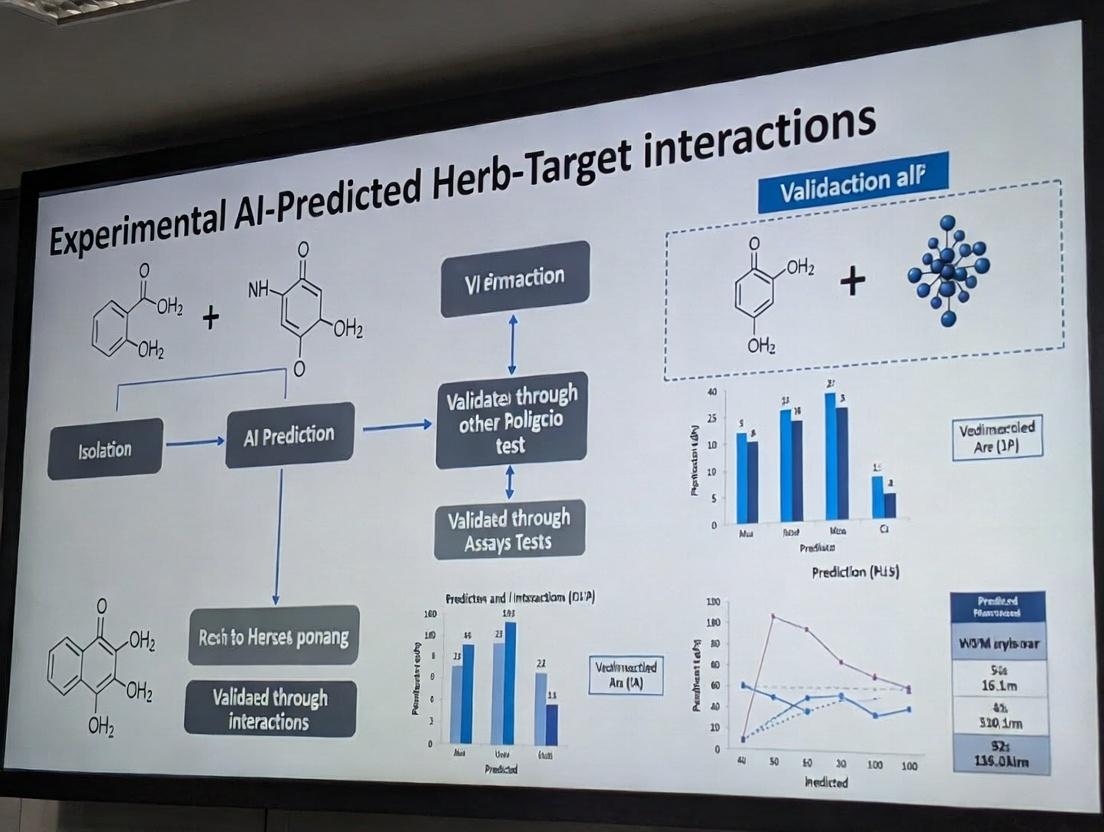
This article provides a comprehensive overview for researchers and drug development professionals on the critical bridge between computational prediction and biological reality in herbal medicine research.
From Prediction to Proof: Experimental Validation of AI-Discovered Herb-Target Interactions
Abstract
This article provides a comprehensive overview for researchers and drug development professionals on the critical bridge between computational prediction and biological reality in herbal medicine research. It explores the foundational challenges posed by the complex, multi-component nature of herbs that necessitate advanced AI modeling. The core examines state-of-the-art methodological frameworks, including multimodal deep learning and network-based models, for predicting herb-target interactions (HTIs). A dedicated section addresses the practical hurdles of data scarcity, model interpretability, and generalizability, outlining strategies for optimization. Finally, the article details rigorous experimental validation pipelines—from in silico docking to in vitro and in vivo assays—and benchmarks AI approaches against traditional network pharmacology. The synthesis aims to equip scientists with a roadmap for robustly translating computational discoveries into validated pharmacological insights, accelerating the development of targeted herbal therapies.
The Complexity of Herbs and the Imperative for AI Prediction
The prediction of interactions between herbs and biological targets represents a formidable challenge at the intersection of traditional medicine, modern pharmacology, and artificial intelligence. Unlike single-compound drugs, herbal medicines are complex mixtures of dozens to thousands of phytochemicals, each with potentially multipotent actions on multiple biological pathways [1]. This multicomponent nature fundamentally disrupts the conventional "one drug, one target" paradigm and introduces unique obstacles for prediction and validation [2].
The difficulty is compounded by significant data scarcity and noise. High-quality, standardized pharmacological data for herbal constituents—particularly pharmacokinetic parameters—are often lacking [1]. Furthermore, the chemical composition of an herb is not a fixed property; it varies with plant origin, harvesting conditions, and processing methods, leading to inconsistencies that challenge reproducibility and extrapolation to clinical outcomes [1]. This article, framed within a broader thesis on the experimental validation of AI-predicted interactions, provides a comparative guide to the current computational approaches tackling this problem, the experimental protocols used for validation, and the essential toolkit for advancing research in this field.
Performance Comparison of Predictive AI Methodologies
The field has evolved from ligand-based docking to sophisticated AI models that integrate heterogeneous biological data. The table below provides a quantitative and qualitative comparison of representative methodologies.
Table: Comparative Performance of Herb-Target Interaction Prediction Models
| Model/Method | Core Approach | Key Performance Metrics (Reported) | Primary Data Source | Key Strength | Major Limitation for Herb-Target |
|---|---|---|---|---|---|
| Systematic Docking & Herb-Target Factor (HTF) [2] | Molecular docking of herb compounds against target libraries; HTF quantifies herb-level activity. | Identified inhibitory herbs (e.g., Morus alba) in anti-HIV formula; validation via in vitro EC₅₀ (e.g., 14.3 μg/ml). | Herb compound structures, Target protein 3D structures. | Provides mechanistic, affinity-based insights at herb level. | Computationally expensive; reliant on complete compound profiles and quality 3D structures. |
| Herb-Target Interaction Network (HTINet) [3] [4] | Network embedding (node2vec) on a heterogeneous symptom-disease-herb-target network. | Performance improvement over random-walk method; literature validation of novel predictions. | Symptoms, diseases, herb efficacies, protein interactions. | Bypasses need for chemical data; captures phenotypic context. | Predictions are associative; lacks direct mechanistic binding information. |
| Transformer-based TCMHTI Model [5] | Improved Transformer architecture for direct herb-target association learning. | AUC: 0.883, PRC: 0.849, Accuracy: 0.818 for QFJBD formula. | Known herb-target pairs, protein sequences. | High predictive accuracy; models complex, non-linear relationships. | "Black-box" nature; requires large, labeled datasets for training. |
| Traditional Network Pharmacology | "Herb → Compound → Target" pipeline using ligand-based target prediction. | Identified 64 targets for QFJBD but with weaker pathway relevance to disease [5]. | Herb compound databases, ligand-target databases. | Intuitive, leverages chemoinformatic similarity. | Bottlenecked by incomplete compound data and poor prediction for novel targets. |
The progression from docking to network-based and deep learning models illustrates a trade-off between mechanistic interpretability and predictive scalability. While docking offers tangible binding hypotheses, its requirement for full compound profiling is a major bottleneck. In contrast, models like HTINet and TCMHTI achieve scalability by learning from higher-level associations—either phenotypic (symptoms) or topological (network patterns)—but their predictions require downstream experimental confirmation to establish direct causal mechanisms [3] [5].
Detailed Experimental Protocols for Validation
The predictive output of AI models constitutes a hypothesis that must be rigorously validated. The following protocols are foundational to this translational process.
Computational Protocol: Herb-Target Interaction Network (HTINet) Construction
This protocol outlines the creation of a heterogeneous network for model training, as implemented in HTINet [3] [4].
- Data Acquisition and Curation:
- Herb-Target Pairs: Source known interactions from databases like HIT for use as a gold-standard training set.
- Herb-Symptom/Disease Associations: Collect from pharmacopoeias (e.g., Chinese Pharmacopoeia) and clinical databases.
- Disease-Symptom Links: Extract from curated databases like MalaCards.
- Drug-Target Data: Obtain from DrugBank.
- Protein-Protein Interactions (PPI): Use high-confidence interactions from STRING (confidence score > 700).
Network Construction:
- Integrate all entities (herbs, symptoms, diseases, drugs, targets) as nodes.
- Establish edges based on the curated relationships (e.g., herb-treats-symptom, protein-interacts-with-protein).
- Calculate similarity-based edges (e.g., herb-herb efficacy similarity, drug-drug ATC code similarity) using cosine similarity metrics.
Feature Learning and Model Training:
- Apply a network embedding algorithm (e.g., node2vec) to the heterogeneous network to generate low-dimensional feature vectors for each herb and target node.
- Use the known herb-target pairs as labels to train a supervised classifier (e.g., Random Forest, Gradient Boosting) on the learned feature vectors.
Validation Protocol: Molecular Docking and Herb-Target Factor Analysis
This protocol describes the experimental validation of computationally predicted herb-target interactions, exemplified in the study of the SH anti-HIV formula [2].
- System Preparation:
- Target Proteins: Collect 3D crystal structures of relevant targets (e.g., HIV-1 protease, reverse transcriptase) from the PDB. For proteins without structures, use homology modeling.
- Herb Compound Library: Curate all known chemical constituents for the herb(s) of interest from TCM databases (e.g., TCM Database@Taiwan). Prepare their 3D structures through energy minimization.
High-Throughput Virtual Screening:
- Perform molecular docking simulations for every compound against each target protein structure using software like AutoDock Vina or Glide.
- Set appropriate scoring cutoffs (e.g., docking score ≤ -7.0 kcal/mol) and RMSD restrictions to define "active" compounds.
Herb-Level Activity Calculation:
- Map the active compounds back to their source herbs.
- Calculate the Herb-Target Factor (HTF) for each herb-target pair:
HTF = (Σ -ΔG of active compounds) / (√Ti * ³√Hj)where-ΔGrepresents binding affinity,Tiis the number of targets for herb i, andHjis the number of herbs hitting target j. - A high HTF indicates a strong and specific herb-target interaction.
Biological Validation:
- Prioritize high-HTFP pairs for in vitro testing.
- Example: Test herb extracts on cell-based assays (e.g., HIV-1 infected cell lines) to determine inhibitory concentration (EC₅₀), validating predictions like the activity of Morus alba (EC₅₀ = 14.3 μg/ml) [2].
Herb-Target Prediction & Validation Workflow
Diagram 1: A generalized workflow integrating AI prediction with multi-stage experimental validation for herb-target interactions.
The Scientist's Toolkit: Research Reagent Solutions
Advancing this field requires specialized resources. The following toolkit details essential databases, software, and experimental resources.
Table: Essential Research Toolkit for Herb-Target Interaction Studies
| Resource Category | Specific Resource | Primary Function & Utility | Key Feature for Herb-Target Research |
|---|---|---|---|
| Compound & Herb Databases | Traditional Chinese Medicine Database (TCMD) | Provides curated chemical structures of constituents from herbal medicines. | Essential for building compound libraries for docking studies [2]. |
| Chinese Pharmacopoeia (CHPA) | Authoritative source on herbal medicines, including indications and efficacy. | Critical for establishing herb-symptom links in network pharmacology [3]. | |
| Target & Pathway Databases | STRING | Database of known and predicted protein-protein interactions. | Used to build biological context networks around predicted targets [3]. |
| UniProtKB/Swiss-Prot | Expertly curated protein sequence and functional information database. | Provides reliable target protein sequences and functional annotations. | |
| KEGG, Reactome | Pathway databases cataloging biological pathways and processes. | Used for enrichment analysis to interpret the functional role of predicted targets [5]. | |
| Cheminformatics & Docking Software | AutoDock Vina, Glide | Software for molecular docking and virtual screening. | Workhorse tools for simulating compound-target binding and calculating affinity [2]. |
| RDKit, Open Babel | Open-source cheminformatics toolkits. | Used for compound structure handling, manipulation, and descriptor calculation. | |
| AI & Data Science Frameworks | scikit-learn, XGBoost | Libraries for implementing classic machine learning models. | Used for building supervised classifiers on top of learned features (e.g., in HTINet) [3]. |
| PyTorch, TensorFlow | Deep learning frameworks. | Essential for developing and training advanced models like Transformers (TCMHTI) [5]. | |
| Specialized AI Benchmarks | SciHorizon [6], SAIBench [7] | Frameworks for benchmarking AI models in scientific domains. | Provide metrics and standards to evaluate the "AI-readiness" of data and model performance in life sciences. |
Data Integration Challenges in Herb-Target Prediction
Diagram 2: Visualizing the key data sources and inherent challenges that AI models must integrate and overcome to make reliable herb-target predictions.
The unique difficulty of herb-target interaction prediction stems from the inherent complexity of the object of study (multi-component, variable herbs) and the severe constraints of the data environment (scarce, noisy, heterogeneous). As comparative analysis shows, no single AI methodology fully overcomes these hurdles; rather, they offer different trade-offs between interpretability and predictive power.
The future of this field hinges on improving data AI-readiness—enhancing the quality, completeness, and standardization of herb-related datasets according to frameworks like SciHorizon [6]. Furthermore, the development of benchmarks specific to herb-target prediction is crucial for objectively measuring progress. The ultimate goal is a closed-loop, iterative framework where AI predictions directly inform targeted, efficient experimental validation, and experimental results continuously refine and improve the AI models, accelerating the translation of traditional herbal knowledge into evidence-based, precision medicine.
The Multi-Component Nature of Herbal Products and Pharmacological Variability
The therapeutic application of herbal products is fundamentally challenged by their inherent multi-component nature and the consequent pharmacological variability. Unlike single-entity synthetic drugs, herbal medicines are complex mixtures of numerous bioactive and inactive constituents [8]. This complexity is exacerbated by extrinsic factors such as geographical origin, cultivation practices, harvesting time, and post-harvest processing, all of which can lead to significant batch-to-batch inconsistencies in chemical composition and, ultimately, clinical efficacy and safety [9] [10].
This variability presents a dual challenge for modern drug development and research. First, it complicates the standardization and quality control of herbal products, making it difficult to ensure reproducible pharmacological effects [11]. Second, it creates a significant hurdle for the experimental validation of bioactivity. Predicting which compounds in a mixture are therapeutically relevant, how they interact with human biological targets, and how they might interfere with conventional drugs requires sophisticated approaches [1] [8].
This guide is framed within the broader thesis that Artificial Intelligence (AI) offers a transformative toolkit for predicting herb-target interactions from this complex chemical space. However, the ultimate value of these computational predictions hinges on rigorous, multi-faceted experimental validation. This article provides comparison guides for the key methodologies involved in both characterizing herbal variability and validating AI-predicted interactions, providing researchers with a roadmap for robust, evidence-based herbal medicine research.
Comparative Analysis of Pharmacological Variability: Key Experimental Data
The chemical profile of an herbal product is its primary determinant of biological activity. Comparative studies quantifying specific markers across different sources are essential for understanding the scope of variability. The following table summarizes key experimental findings from a representative study on Gastrodia elata, a widely used herb, illustrating how composition fluctuates with geographical origin.
Table 1: Variability in Multi-Element and Active Ingredient Composition of Gastrodia elata from Different Geographical Origins [9]
| Analyte Category | Specific Analytes | Key Comparative Findings | Primary Analytical Technique |
|---|---|---|---|
| Active Pharmacological Ingredients | Gastrodin, HBA, PE, PB | Significant variations in concentrations were identified. HBA, PE, and PB were highlighted as potential chemical markers for discriminating between geographical origins. | High-Performance Liquid Chromatography (HPLC) |
| Mineral Elements | Fe, K, Ca, Mn, P, Na, Cu, Mg, B | Concentrations of 17 elements varied significantly. Fe, K, Ca, Mn, P, Na, Cu, Mg, and B were identified as potential elemental markers for geographical discrimination. | Inductively Coupled Plasma Mass Spectrometry (ICP-MS) |
| Statistical & Discriminatory Outcome | N/A | Multivariate statistical analysis (PCA, OPLS-DA) successfully discriminated samples from Shaanxi, Yunnan, and Guizhou provinces based on integrated chemical and elemental profiles. | Chemometric Analysis |
Interpretation for Research: This data underscores that variability is not limited to organic bioactive compounds but extends to the inorganic mineral matrix, which can influence plant metabolism and compound bioavailability [9]. For researchers, this necessitates a comprehensive analytical strategy that goes beyond a few marker compounds to capture a holistic chemical fingerprint for reliable quality assessment and for providing high-quality input data for AI models.
Methodologies for Characterizing Multi-Component Herbal Products
A critical step prior to biological validation is the accurate characterization of the herbal material itself. The following experimental protocols are essential for generating reproducible and meaningful data.
Protocol A: Comprehensive Phytochemical Profiling for Quality Control
This protocol is designed to identify and quantify major bioactive constituents and detect adulterants in a herbal product [11].
- Objective: To establish a standardized chemical profile of an herbal product, assess batch-to-batch consistency, and identify potential adulterants like starch or raw powder extenders.
- Core Methodology: A combination of chemical and physical analysis.
- Chemical Analysis via LC-MS:
- Sample Preparation: Herbal extract is prepared using standardized solvent extraction (e.g., methanol/water). An internal standard is added for quantification.
- Instrumentation: High-Performance Liquid Chromatography coupled with tandem Mass Spectrometry (HPLC-MS/MS).
- Operation: The sample is separated by HPLC. MS/MS operates in Multiple Reaction Monitoring (MRM) mode for high sensitivity and selectivity. Specific precursor-to-product ion transitions are monitored for each target biomarker compound (e.g., glycyrrhizic acid, hesperidin) [11].
- Quantification: Peak areas are compared against a calibration curve of authentic standards for each compound.
- Physical Analysis for Adulterant Detection:
- Light Microscopy: Staining with Congo red (binds cellulose) and Iodine-KI (binds starch) visually identifies the presence of plant fiber and starch additives [11].
- Scanning Electron Microscopy (SEM): Provides high-resolution images of particle morphology, distinguishing between smooth, granular starch particles and fibrous, striated raw herbal powder [11].
- Supporting Tests: Solubility analysis and crude fiber testing provide supplementary quantitative data on adulterant levels [11].
- Chemical Analysis via LC-MS:
- Comparison to AI-Readiness: The chemical data (compound identities and concentrations) generated here forms the essential, high-quality input dataset for training AI models that predict bioactivity or herb-drug interactions [1] [12].
Protocol B: Multi-Compound Pharmacokinetic (PK) Screening
This protocol is crucial for moving from chemical composition to biological relevance by identifying which compounds are actually bioavailable [8].
- Objective: To identify which constituents in a complex herbal mixture are absorbed into systemic circulation, determine their pharmacokinetic parameters, and pinpoint the potential "active" compounds based on exposure at the site of action.
- Core Methodology: Pharmacokinetic study in animal models or human subjects.
- Dosing and Sampling: A clinically relevant dose of the herbal extract is administered (e.g., orally). Serial blood samples are collected over a time course (e.g., 0, 0.5, 1, 2, 4, 8, 12, 24 hours).
- Sample Analysis: Plasma samples are processed (protein precipitation) and analyzed using a sensitive quantitative method like UHPLC-Q-Orbitrap MS. This allows for the simultaneous detection and quantification of dozens of constituent compounds and their metabolites [8].
- Data Processing: Concentration-time profiles are constructed for each detected compound. Standard PK parameters are calculated: maximum plasma concentration (C~max~), time to C~max~ (T~max~), area under the curve (AUC), and elimination half-life (t~1/2~) [8].
- Comparison to AI Validation: This protocol provides the critical in vivo validation for AI predictions. An AI model might predict an interaction between a herbal constituent and a human target protein. However, if PK screening shows that constituent is not absorbed or has extremely low plasma exposure, its pharmacological relevance is questionable. Thus, multi-compound PK data is used to prioritize AI predictions for further experimental testing [8].
AI-Driven Prediction of Herb-Target Interactions: A Methodological Comparison
AI models are powerful tools for generating hypotheses about how herbal compounds might interact with biological systems. The table below compares the main computational approaches.
Table 2: Comparison of AI Methodologies for Predicting Herb-Target and Herb-Drug Interactions
| AI Methodology Category | Core Principle | Strengths | Limitations & Challenges | Suitability for Herbal Research |
|---|---|---|---|---|
| Similarity-Based Methods [1] | Infers interactions by calculating similarity (structural, target, side-effect) between herbal compounds and known drugs. | Simple, interpretable. Performs well when compounds share clear similarity to known agents. | Prone to false positives. Fails for novel compounds with unique structures (common in herbs). Cannot handle multi-compound synergy. | Low to Moderate. Useful for initial screening of isolated, purified herbal compounds against known drug targets. |
| Network-Based & Graph Methods [13] [14] | Represents drugs, targets, diseases, and herbs as nodes in a knowledge graph; infers interactions through network topology. | Robust to noise. Can capture indirect relationships and multi-target effects. Excellent for visualizing complex relationships. | Dependent on completeness of underlying knowledge graph (often incomplete for herbs). Biological interpretability of indirect links can be challenging. | High. Ideal for modeling the "multi-component, multi-target" nature of herbs, integrating chemical, genomic, and phenotypic data [15]. |
| Machine Learning/Deep Learning (ML/DL) [1] [13] [15] | Trains models on large datasets (e.g., drug/compound features, known interactions) to learn patterns and predict new interactions. | High predictive accuracy. Can integrate diverse, high-dimensional data (e.g., SMILES strings, genomic data). Scalable for large libraries. | Requires large, high-quality labeled datasets. Performance is poor for herbal compounds with limited data ("cold-start" problem). Models can be "black boxes" with low interpretability [14]. | Moderate, but growing. Dependent on creating curated datasets for herbal compounds. Explainer AI (XAI) tools are critical for interpreting predictions [1]. |
| Knowledge-Graph-Enhanced LLMs [13] [14] | Uses Large Language Models (LLMs) trained on scientific literature, structured with knowledge graphs to reason about interactions. | Can extract and reason with information from unstructured text (e.g., historical TCM texts, modern research). Potential for mechanistic insight generation. | Emerging technology with unproven robustness. Risk of generating plausible but incorrect "hallucinations." Computationally intensive. | High Future Potential. Could bridge traditional knowledge and modern pharmacology by analyzing historical texts and recent studies together [12]. |
Experimental Validation Link: The output from these AI models is a ranked list of predicted herb-target or herb-drug interaction hypotheses. The role of experimentation is to triage and test these predictions, with a priority on those involving herbal compounds verified to be bioavailable via Protocol B.
Experimental Validation of AI-Predicted Interactions
The final and crucial phase is the empirical testing of computational predictions. This requires a tiered experimental workflow.
Diagram 1: Tiered Workflow for Experimental Validation of AI Predictions.
Experimental Protocol C: In Vitro Target Engagement and Cell-Based Assays
This is the first line of experimental validation for a prioritized AI prediction [15].
- Objective: To provide biochemical or cellular proof that a specific herbal compound interacts with and modulates the activity of a predicted target.
- Core Methodologies:
- Biochemical Assay (e.g., for an enzyme inhibitor prediction): A purified target protein (e.g., kinase, protease) is incubated with the purified herbal compound across a range of concentrations. Enzyme activity is measured via fluorescence, luminescence, or absorbance. IC~50~ values are calculated to quantify potency.
- Cell-Based Reporter Assay (e.g., for a receptor modulator prediction): Cells engineered to express the target receptor and a downstream reporter gene (e.g., luciferase) are treated with the herbal compound. Changes in reporter signal indicate agonist or antagonist activity.
- Binding Affinity Measurement: Techniques like Surface Plasmon Resonance (SPR) or Microscale Thermophoresis (MST) can directly measure the binding kinetics (K~D~) between the compound and the purified target protein.
- Comparison to AI Input: Results from this stage provide critical feedback for refining AI models. False positives (predicted interactions with no activity) and false negatives (missed interactions) help curate better training data, improving future prediction cycles [13].
Protocol D: Assessing Complex Herb-Drug Interaction (HDI) Potential
This protocol tests AI predictions related to pharmacokinetic HDIs, a major clinical safety concern [1] [8].
- Objective: To determine if an herbal extract or its key constituents modulate the activity of key human drug-metabolizing enzymes (e.g., Cytochrome P450 3A4) or transporters (e.g., P-glycoprotein).
- Core Methodology: In vitro transporter/enzyme interaction assay.
- System: Use human liver microsomes (for CYP enzymes) or transfected cell lines overexpressing a specific human transporter (e.g., Caco-2, MDCK-MDR1).
- Procedure:
- For enzyme inhibition: Incubate microsomes with a probe substrate (e.g., midazolam for CYP3A4) and the herbal compound/extract. Measure metabolite formation via LC-MS/MS. Reduction in metabolite indicates inhibition.
- For transporter inhibition: Incubate cells with a fluorescent probe substrate (e.g., rhodamine 123 for P-gp) in the presence/absence of the herbal test material. Measure intracellular fluorescence accumulation; an increase indicates transporter inhibition.
- For enzyme induction: Treat human hepatocytes with the herbal material for 48-72 hours, then measure mRNA expression (qPCR) or enzymatic activity of key CYPs.
- Data Analysis: Calculate percent inhibition or induction relative to control. For inhibitors, an IC~50~ value can be determined.
- Comparison to Clinical Relevance: Data from this protocol helps contextualize clinical case reports of HDIs (e.g., St. John's Wort inducing CYP3A4 [1]). It allows for mechanistic, predictive risk assessment before costly clinical trials.
The Scientist's Toolkit: Essential Research Reagents & Platforms
Table 3: Key Research Reagent Solutions for Herbal Product Validation Research
| Reagent / Platform Category | Specific Example(s) | Function in Herbal Research | Relevance to AI Validation |
|---|---|---|---|
| High-Resolution Analytical Chemistry | UHPLC-Q-Orbitrap MS, ICP-MS [9] | Provides untargeted and targeted metabolomics data, quantifying elemental composition. Establishes the definitive chemical profile of an herbal extract. | Generates the high-fidelity, multi-dimensional chemical input data required to train and test AI models. |
| Bioinformatic & Chemoinformatic Databases | PubChem, BindingDB, UniProt, TCM-ID [13] | Provide structured data on compound structures, protein targets, known interactions, and herbal constituents. | Serve as the foundational knowledge bases for building similarity networks, knowledge graphs, and training ML models for prediction. |
| Standardized In Vitro Assay Systems | Recombinant CYP enzymes, Transporter-overexpressing cell lines (e.g., MDCK-MDR1), Primary human hepatocytes. | Enable mechanistic, high-throughput screening for target engagement, metabolic stability, and drug interaction potential. | Provide the essential in vitro experimental platform for medium-throughput validation of AI-predicted interactions and mechanisms. |
| Curated Herbal Extract Libraries | Commercially available or in-house libraries with authenticated botanicals and standardized extraction. | Provide physiologically relevant, multi-component test materials for biological assays, reflecting the actual complexity of herbal medicine. | Critical for moving beyond single-compredient predictions to test AI models that aim to predict the activity of complex mixtures. |
| AI/ML Model Development Platforms | Deep learning frameworks (TensorFlow, PyTorch), Graph Neural Network libraries, KNIME, Pipeline Pilot. | Enable researchers to build, train, and deploy custom predictive models tailored to herbal data structures (e.g., mixture representations). | The essential software toolkit for implementing the AI methodologies compared in Table 2 and creating predictive hypotheses for experimental teams to test. |
Performance Comparison of AI Approaches for Multi-Target Prediction
This guide objectively compares the performance and experimental validation of leading computational models for predicting multi-target interactions, with a focus on herb-target interactions (HTI) within systems pharmacology.
Table: Overview of AI Approaches for Multi-Target and Herb-Target Interaction Prediction
| Model Category | Key Examples | Core Methodology | Primary Application | Key Advantages | Major Limitations |
|---|---|---|---|---|---|
| Transformer-Based Models | TCMHTI [5] | Improved Transformer architecture for sequence (SMILES, protein) encoding. | Herb-target interaction prediction for complex TCM formulas. | High accuracy in capturing sequential patterns; superior performance reported [5]. | Requires large datasets; model interpretability can be low. |
| Multimodal Deep Learning | MDL-HTI [16] | Integrates heterogeneous graph learning with multimodal biological data (ingredients, pathways). | Predicting HTIs by fusing topological and biological feature spaces. | Leverages diverse data types; robust for complex herbal mixtures [16]. | Complex architecture; integration of disparate data sources is challenging. |
| Graph Neural Networks (GNNs) with Meta-paths | MAMGN-HTI [17] | GNN with metapath and attention mechanisms on herb-ingredient-target-efficacy graphs. | HTI prediction for specific diseases (e.g., hyperthyroidism). | Captures rich semantic relationships; strong generalizability and interpretability [17]. | Performance depends on graph completeness and meta-path design. |
| Classical Machine Learning | RF Models for MT-CPDs [18] | Random Forest models using chemical structure descriptors (e.g., atom environments). | Distinguishing multi-target (MT) from single-target (ST) compounds. | High accuracy and interpretability; suitable for quantitative structure-activity relationship (QSAR) [18]. | Limited ability to generalize across unrelated target pairs; relies on feature engineering. |
| Network-Based Inference | NBI (Network-Based Inference) [19] | Resource diffusion algorithm on known drug-target interaction networks. | Drug-target interaction (DTI) prediction and drug repositioning. | Does not require 3D structures or negative samples; simple and fast [19]. | Relies entirely on existing network topology; cold-start problem for new entities. |
Quantitative Performance Benchmarking
The following table summarizes the reported performance metrics of recent, specialized models for herb-target and multi-target prediction.
Table: Performance Metrics of Advanced HTI/MT Prediction Models
| Model Name | Reported AUC | Reported Accuracy | Reported Precision | Reported Recall/F1 | Key Benchmark Dataset | Comparative Advantage Claim |
|---|---|---|---|---|---|---|
| TCMHTI [5] | 0.883 | 0.818 | N/R | PRC: 0.849 | Custom QFJBD-RA dataset | Outperformed classical network pharmacology in pathway relevance [5]. |
| MAMGN-HTI [17] | 0.935 | 0.912 | 0.903 | Recall: 0.918, F1: 0.910 | Custom Hyperthyroidism H-T network | Outperformed baseline models (e.g., GCN, GAT, HAN) [17]. |
| MDL-HTI [16] | N/R | N/R | N/R | N/R | N/R | Reported "superior performance" over state-of-the-art baselines [16]. |
| RF Models for MT-CPDs [18] | N/R | Balanced Acc. >80-90% | High | MCC: 0.7-0.9 | 20 target pair test system | Accurately predicted MT compounds using models trained only on ST data [18]. |
N/R: Not explicitly reported in the provided summary.
Contextualizing Performance: Strengths and Application Fit
The choice of model depends heavily on the research question and data context. For novel target discovery for complex herbal formulas, Transformer-based (TCMHTI) or multimodal models (MDL-HTI) that integrate diverse data are advantageous [5] [16]. For mechanistic interpretation and hypothesis generation within a defined system (e.g., a disease-specific herb network), GNNs with meta-paths (MAMGN-HTI) offer superior semantic relationship mapping [17]. For focused screening of synthetic compound libraries for polypharmacology, explainable classical ML (RF) provides a robust and interpretable approach [18].
Experimental Validation Protocols for AI Predictions
Computational predictions require rigorous experimental validation to confirm biological relevance. Below are detailed protocols for key validation methods cited in the literature.
In Silico Validation: Molecular Docking
- Purpose: To assess the binding feasibility and affinity between a predicted herb-derived active molecule and its target protein.
- Protocol Details:
- Protein Preparation: Retrieve the 3D structure of the predicted target protein (e.g., TNF-α, IL-6) from the Protein Data Bank (PDB). Remove water molecules and co-crystallized ligands. Add hydrogen atoms, assign protonation states, and optimize side-chain conformations using software like UCSF Chimera or Schrödinger's Protein Preparation Wizard [5].
- Ligand Preparation: Obtain the 3D structure of the active phytochemical from databases like PubChem or ZINC. Perform energy minimization and generate probable tautomers and stereoisomers.
- Docking Simulation: Define the binding site (often based on the location of a known native ligand). Use docking programs such as AutoDock Vina, Glide, or GOLD to perform flexible or semi-flexible docking. Set appropriate search parameters and run multiple docking poses.
- Analysis: Evaluate poses based on docking score (kcal/mol, where more negative scores indicate stronger binding) and binding mode consistency with known active sites. A common threshold for a favorable binding energy is ≤ -5.0 kcal/mol [5]. Visually inspect key intermolecular interactions (hydrogen bonds, hydrophobic contacts, pi-stacking).
Network Pharmacology and Enrichment Analysis
- Purpose: To move beyond single interactions and interpret the systemic effects of a multi-target herb by analyzing the collective functions of predicted targets.
- Protocol Details:
- Target Gene Set Compilation: Compile the list of genes encoding all proteins predicted as targets for the herb or formula.
- Network Construction: Input the gene list into a protein-protein interaction (PPI) database (e.g., STRING) to build a PPI network. Identify core target modules using topology analysis (degree centrality) [5].
- Functional Enrichment: Use tools like DAVID or clusterProfiler to perform Gene Ontology (GO) enrichment analysis (Biological Process, Molecular Function, Cellular Component) and Kyoto Encyclopedia of Genes and Genomes (KEGG) pathway enrichment analysis.
- Interpretation: Statistically significant terms (adjusted p-value < 0.05) are identified. The therapeutic mechanism is hypothesized by linking enriched pathways (e.g., TNF, IL-17, NF-kappa B signaling pathways for rheumatoid arthritis) to the disease pathology [5].
Explainable AI (XAI) for Feature Analysis
- Purpose: To chemically interpret why an ML model predicts a compound to be multi-target, bridging the gap between prediction and design.
- Protocol Details:
- Model Training: Train a Random Forest classifier on chemical descriptors (e.g., layered atom environments) to distinguish multi-target from single-target compounds for a specific target pair [18].
- SHAP Analysis: Apply the SHapley Additive exPlanations (SHAP) framework, a model-agnostic XAI method.
- Feature Contribution Calculation: For each prediction, SHAP calculates the contribution of each chemical feature (presence/absence of a specific substructure) to the model's output. Features with high positive SHAP values are strong drivers for the "multi-target" classification.
- Chemical Insight: Aggregate SHAP values across a compound set to identify substructures critical for multi-target activity. This reveals the "chemical rationale" behind the AI's prediction, guiding the design of new multi-target ligands [18].
Visualizing Workflows and Pathways
The Scientist's Toolkit: Essential Research Reagents & Materials
Table: Key Reagents and Resources for Experimental Validation of Predicted Herb-Target Interactions
| Category | Item / Resource | Specification / Example | Primary Function in Validation |
|---|---|---|---|
| Chemical & Biological Standards | Purified Phytochemicals | ≥95-98% purity (e.g., berberine, quercetin, kaempferol). | Serve as active ligands in binding and functional assays. |
| Recombinant Human Target Proteins | Active, full-length or catalytic domain (e.g., rhTNF-α, rhIL-6R). | Used in surface plasmon resonance (SPR), ELISA, or enzymatic activity assays. | |
| Cell-Based Assay Systems | Reporter Cell Lines | HEK293 or CHO cells stably expressing a luciferase reporter gene under control of a responsive element (e.g., NF-κB-RE, SRE). | Measure functional modulation of specific signaling pathways by herbal extracts/compounds [5]. |
| Primary Immune Cells | Human peripheral blood mononuclear cells (PBMCs), synovial fibroblasts. | Provide a physiologically relevant context for testing anti-inflammatory effects on targets like cytokines [5]. | |
| In Vivo Models | Animal Disease Models | Collagen-Induced Arthritis (CIA) mice, Adjuvant-Induced Arthritis (AIA) rats. | Test the holistic therapeutic efficacy and systemic multi-target effects predicted in silico [5]. |
| Analytical & Computational Tools | Molecular Docking Software | AutoDock Vina, Schrödinger Glide, GOLD. | Perform in silico validation of predicted binding interactions and estimate affinity [5]. |
| Pathway Analysis Platforms | DAVID Bioinformatics, Metascape, clusterProfiler (R). | Perform GO and KEGG enrichment analysis to interpret the systemic function of predicted target sets [5] [17]. | |
| Chemical Databases | PubChem, ChEMBL, TCMSP, HERB. | Source chemical structures, properties, and known bioactivities of herbal ingredients. | |
| Protein Interaction Databases | STRING, BioGRID, HPRD. | Construct PPI networks for core target analysis in network pharmacology [5] [19]. |
The identification and validation of interactions between herbal compounds and biological targets are central to modernizing traditional medicine and accelerating drug discovery. This process, however, is challenged by the inherent complexity of herbs—multi-component mixtures with diverse and often poorly characterized bioactive constituents—and the systems-level nature of their therapeutic effects [1]. Traditional reductionist experimental approaches are often insufficient, being time-consuming, costly, and ill-suited for probing multi-target, multi-pathway mechanisms [2].
Artificial intelligence (AI) has emerged as a transformative force, providing computational frameworks to predict, prioritize, and elucidate herb-target interactions (HTIs) before costly experimental validation [13]. These AI paradigms enable the analysis of large-scale biological and chemical data, offering insights that guide targeted experiments. This guide objectively compares the three core AI paradigms used in this field: similarity-based, network-based, and machine learning (ML) approaches, framing the discussion within the critical context of experimental validation. The integration of these computational predictions with robust experimental protocols is essential for advancing credible, mechanistically grounded phytopharmacology research [20].
Comparative Analysis of Core AI Paradigms
The selection of an AI paradigm depends on the research question, data availability, and the desired balance between interpretability and predictive power. The following table summarizes the core principles, strengths, and limitations of each approach.
Table 1: Comparison of Core AI Paradigms for Herb-Target Interaction Research
| Paradigm | Core Principle | Typical Data Inputs | Key Strengths | Major Limitations | Interpretability |
|---|---|---|---|---|---|
| Similarity-Based | Infers interactions based on the principle that chemically or biologically similar entities share similar partners or effects [1]. | Drug/compound chemical structures (e.g., fingerprints, descriptors), target sequences, side-effect profiles [1]. | High interpretability; simple and fast computation; effective when strong similarity exists [1]. | Prone to false positives/negatives with noisy metrics; cannot predict interactions for novel entities lacking similar neighbors [1] [13]. | High. Predictions are directly linked to quantifiable similarity metrics. |
| Network-Based | Models systems as graphs (networks) where nodes (e.g., herbs, compounds, targets) are connected by edges (e.g., interactions, similarities) to uncover indirect relationships and system-level properties [21] [17]. | Protein-protein interaction (PPI) networks, drug-target interaction networks, ontological relationships, herb-compound-target associations [1] [17]. | Captures holistic, systems-level mechanisms; robust to some noise; can predict indirect/polypharmacology effects [21] [20]. | Dependent on completeness/quality of underlying network data; biological interpretability of network inferences can be complex [1]. | Moderate to High. Network topology provides visual and structural reasoning, though path significance may require domain expertise. |
| Machine/Deep Learning | Uses algorithms to learn complex, non-linear patterns and relationships from labeled training data to make predictions on new data [13] [22]. | Diverse featurized data: compound structures (SMILES, graphs), target sequences/structures, interaction affinity values, literature-derived features [13] [14]. | High predictive accuracy; capable of integrating multi-modal data; excels with large, high-dimensional datasets [22] [14]. | Requires large, high-quality labeled datasets; prone to "black box" problem with limited mechanistic insight; performance drops with data sparsity [1] [13]. | Low to Moderate. While predictive, the internal logic of complex models (especially deep learning) is often opaque, though explainable AI (XAI) techniques are emerging [14]. |
Performance Benchmarking in Prediction Tasks
The practical utility of these paradigms is quantified through their performance on standardized prediction tasks. The following table summarizes reported performance metrics from key studies, highlighting the context of the task and the data used.
Table 2: Performance Benchmarking of AI Paradigms in Predictive Tasks
| Paradigm (Example Model) | Prediction Task | Key Dataset(s) | Reported Performance | Experimental Validation Link |
|---|---|---|---|---|
| Network-Based (MAMGN-HTI [17]) | Herb-Target Interaction (HTI) prediction for hyperthyroidism. | Custom heterogeneous graph (Herbs, Ingredients, Targets, Efficacies) from TCM databases. | AUC: 0.938, Accuracy: 0.875, F1-Score: 0.864. Outperformed baseline GNN models. | Model predicted known hyperthyroidism targets (e.g., TSHR) and herbs (e.g., Vinegar-processed Bupleuri Radix), consistent with clinical knowledge [17]. |
| ML/DL (Various, from review [14]) | Drug-Drug Interaction (DDI) prediction (as a proxy for HTI complexity). | DrugBank, TWOSIDES, DeepDDI. | Top-performing models (e.g., GNNs, Transformers) often achieve AUC > 0.95 on binary DDI classification. | Predictions often validated against independent biomedical literature or databases as a preliminary step prior to in vitro assay [14]. |
| Similarity-Based (Classical method [1]) | Target prediction for novel compounds. | CHEMBL, BindingDB. | Performance highly variable; depends on similarity threshold and metric. Effective only within congeneric series. | Serves as a preliminary filter. True positives require confirmation via binding assays (e.g., SPR, enzymatic assays) [1]. |
| Network Pharmacology (Systematic docking [2]) | Identifying active herbs in a TCM formula (SH formula) against HIV-1 targets. | TCM database, 17 HIV-1 protein structures. | Identified Morus alba and Glycyrrhiza uralensis as most potent herbs, correlating with experimental EC₅₀ values (14.3 and 10.1 μg/mL) [2]. | In vitro antiviral activity assays directly validated the computational predictions [2]. |
Experimental Validation Protocols for AI Predictions
Computational predictions are hypotheses requiring rigorous experimental confirmation. The following protocols detail standard methodologies for validating predicted herb-target interactions.
In Silico Pre-Screening and Prioritization Protocol
Objective: To prioritize the most promising herb-target pairs from large-scale AI predictions for downstream experimental testing. Methodology:
- Prediction Aggregation: Compile predictions from multiple AI models (e.g., similarity, network, ML) to generate a consensus list [14].
- Literature & Database Mining: Cross-reference predictions with existing knowledge in databases (e.g., HIT, HERB, ChEMBL) and scientific literature to assess novelty and support [2] [20].
- Network Context Analysis: For network-based predictions, analyze the network neighborhood of the predicted target. Prioritize targets that are central (high degree) in disease-relevant pathways or modules [21] [20].
- Docking & Scoring: For specific compound-target pairs, perform molecular docking simulations to evaluate binding pose and affinity, providing a structural rationale for the interaction [2].
- Ranking: Apply a scoring system that weights prediction confidence, novelty, disease relevance, and structural feasibility to produce a final prioritized shortlist.
In Vitro Binding and Functional Assay Protocol
Objective: To experimentally confirm direct binding and functional modulation of a target by herbal extracts or purified compounds. Methodology:
- Sample Preparation: Prepare standardized herbal extracts or isolate predicted bioactive compounds [2].
- Direct Binding Assay:
- Surface Plasmon Resonance (SPR): Immobilize the purified target protein on a sensor chip. Inject herbal extracts/compounds and measure the real-time association/dissociation kinetics to determine binding affinity (KD) [22].
- Cellular Thermal Shift Assay (CETSA): Treat live cells or cell lysates with the herb/extract. Heat denature and quantify the stabilization of the target protein via Western blot or MS, indicating direct engagement [20].
- Functional Activity Assay:
- Enzymatic Activity Assay: If the target is an enzyme (e.g., kinase, protease), measure the effect of the herb/compound on its catalytic activity using fluorogenic or colorimetric substrates [2].
- Cell-Based Reporter Assay: Transfert cells with a reporter gene (e.g., luciferase) under the control of a pathway responsive to the target. Measure the herb/compound-induced change in reporter activity [20].
Network Validation via Multi-Omics Profiling Protocol
Objective: To validate systems-level predictions of network-based and ML models by assessing changes in entire pathways or biological networks. Methodology:
- Experimental Perturbation: Treat a relevant cell line or animal model with the herbal formula or key herb identified by AI [20].
- Multi-Omics Data Generation:
- Transcriptomics: Perform RNA-seq to profile gene expression changes.
- Proteomics: Use LC-MS/MS to quantify protein abundance changes.
- Metabolomics: Employ NMR or MS to analyze metabolic flux changes [20].
- Network-Based Integration & Analysis:
- Construct differential gene/protein/metabolite networks.
- Perform pathway enrichment analysis (e.g., KEGG, GO).
- Overlap the experimentally derived network with the AI-predicted herb-target-disease network. Statistical measures like Jaccard index or hypergeometric tests are used to evaluate the significance of overlap, validating the model's predictive capacity [21] [20].
Visualizing Workflows and Pathways
The following diagrams, created using Graphviz DOT language, illustrate the integrated AI-experimental workflow and the complex network relationships inherent in herb-target research.
Diagram 1: Integrated AI-Experimental Validation Workflow for Herb-Target Research (Max Width: 760px)
Diagram 2: Network-Based View of Herb-Target-Disease Interactions (Max Width: 760px)
This table details key reagents, databases, and software tools essential for conducting AI-predicted herb-target interaction research and its experimental validation.
Table 3: Research Reagent Solutions for Herb-Target Interaction Studies
| Category | Item / Resource | Function & Description | Example / Source |
|---|---|---|---|
| Computational Data Sources | Traditional Chinese Medicine Databases | Provide curated information on herbs, chemical constituents, and associated targets or effects. Essential for building knowledge graphs and training sets [2] [17]. | TCMD (Traditional Chinese Medicine Database), HERB, HIT, TCMID, ETCM [2] [20]. |
| Chemical & Bioactivity Databases | Provide chemical structures, standard identifiers, and experimentally measured bioactivities for small molecules, including natural products [13]. | PubChem, ChEMBL, BindingDB, TCMSP [13]. | |
| Protein & Pathway Databases | Provide target protein sequences, 3D structures, and annotated biological pathways for network construction and functional analysis [21] [2]. | UniProt, PDB, KEGG, STRING, Reactome [13]. | |
| AI & Modeling Tools | Chemical Featurization Tools | Convert chemical structures (SMILES) into numerical descriptors or graph representations for ML/DL models [13] [22]. | RDKit, DeepChem, Mordred. |
| Graph Neural Network Frameworks | Libraries for implementing network-based and graph-based AI models (e.g., GCN, GAT) on heterogeneous herb-target networks [17]. | PyTorch Geometric, Deep Graph Library (DGL), Spektral. | |
| Molecular Docking Software | Predicts the binding pose and affinity of a small molecule within a target protein's active site for preliminary structural validation [2]. | AutoDock Vina, Glide (Schrödinger), GOLD. | |
| Experimental Validation Reagents | Standardized Herbal Extracts | Consistent, chemically characterized extracts of medicinal herbs, crucial for reproducible in vitro and in vivo testing [2]. | Commercially available from suppliers (e.g., Sigma-Aldrich, Must Bio) or prepared per pharmacopoeia standards. |
| Recombinant Target Proteins | Purified, functional human target proteins for in vitro binding (SPR) and enzymatic activity assays [22]. | Available from recombinant protein specialty vendors (e.g., Sino Biological, R&D Systems). | |
| Pathway-Specific Reporter Assay Kits | Cell-based kits designed to measure activity changes in specific signaling pathways (e.g., NF-κB, MAPK) upon herb treatment [20]. | Available from life science companies (e.g., Promega, Qiagen, BPS Bioscience). | |
| Multi-Omics Profiling Services/Kits | Enable transcriptomic, proteomic, or metabolomic profiling to validate systems-level predictions from network pharmacology models [20]. | RNA-seq kits (Illumina), Proteomics services (LC-MS/MS), Metabolomics platforms. |
The advancement of artificial intelligence (AI) in predicting herb-target interactions (HTIs) has created a pressing need for rigorous experimental validation. This validation fundamentally depends on access to high-quality, well-curated public data resources. These databases provide the essential chemical, biological, and pharmacological ground truth against which AI model predictions, such as those from advanced Graph Neural Networks (GNNs) and Transformers, are tested and refined [23] [5]. Within the broader thesis on experimental validation of AI-predicted herb-target interactions, this guide serves as a foundational comparison of the key databases that fuel both the training of predictive models and the subsequent confirmation of their outputs through laboratory experiments. The choice of database directly impacts the reliability of the computational prediction and the design of the validation protocol, making an informed selection a critical first step for researchers and drug development professionals.
A wide array of public databases supports different stages of herb-target research, from chemical compound identification to protein structure analysis and known bioactivity verification. The following table summarizes the core attributes of the most critical resources, enabling researchers to select the most appropriate ones for their specific validation goals.
Table 1: Comparison of Key Public Databases for Herb and Target Research
| Database Name | Primary Focus & Content | Key Attributes for Validation | Relevance to AI Model Validation |
|---|---|---|---|
| Traditional Chinese Medicine Systems Pharmacology (TCMSP) | Herbal medicines, compounds, and target interactions; Over 500 herbs and 30,000+ compound-target links [24]. | Provides ADMET (Absorption, Distribution, Metabolism, Excretion, Toxicity) properties for natural compounds. Offers a direct link between TCM herbs and potential protein targets [24]. | Serves as a primary source for building herb-target networks and as a benchmark for validating AI-predicted interactions against curated knowledge [23] [25]. |
| ChEMBL | Bioactive molecules with drug-like properties; Over 2.4 million compounds and 20.3 million bioactivity measurements (e.g., IC50, Ki) [24]. | Manually curated quantitative bioactivity data from literature. Essential for assessing the predicted potency of herb-derived compounds [24]. | Provides experimental bioactivity data to quantitatively validate the strength of AI-predicted compound-target interactions. |
| PubChem | Massive repository of chemical structures and properties; Over 119 million compounds, integrated with bioassay and toxicity data [24]. | Largest free chemical repository. Useful for confirming the chemical identity of predicted active compounds and accessing initial screening data [12] [24]. | Used to verify the chemical existence and properties of novel compounds suggested by AI models before sourcing them for experimental testing. |
| DrugBank | Detailed information on FDA-approved and experimental drugs, including targets, pathways, and pharmacokinetics [24]. | Links drugs to targets, enzymes, and clinical data. Useful for understanding polypharmacology and potential drug-herb interaction (DHI) mechanisms [1] [24]. | Helps contextualize AI-predicted herb targets within known drug-target networks, highlighting novel mechanisms or potential interaction risks. |
| Protein Data Bank (PDB) | 3D structural data of proteins, nucleic acids, and complexes; Over 227,000 structures [24]. | Provides atomic-level coordinates for target proteins. Critical for structure-based validation methods like molecular docking [2] [24]. | Supplies the protein structures required for in silico validation (e.g., docking simulations) of AI-predicted binding interactions. |
| BindingDB | Measured binding affinities for protein-ligand complexes; Over 3 million data points for 1.3 million+ compounds [24]. | Focuses on quantitative binding affinity data (Kd, Ki, IC50). Ideal for validating the predicted binding strength of herb compounds [24]. | Offers a specialized dataset to calibrate and assess the accuracy of AI models in predicting not just interaction, but binding affinity. |
| Human Metabolome Database (HMDB) | Comprehensive data on human metabolites, including structures, concentrations, and disease associations [24]. | Links metabolites to physiological and pathological states. Important for studying the downstream metabolic effects of herb-target modulation [24]. | Useful for validating the systemic, metabolic impact predictions of multi-target herbal therapies proposed by AI network models. |
Performance Comparison of Leading AI Prediction Models
The effectiveness of experimental validation is predicated on the quality of the initial AI prediction. Recent models employ diverse architectures to tackle the complexity of herb-target systems. The table below compares several state-of-the-art models, highlighting their performance and the experimental validation strategies they enable.
Table 2: Performance Comparison of AI Models for Herb-Target Interaction Prediction
| Model (Year) | Core Methodology | Key Performance Metrics (Dataset) | Experimental Validation Case Study |
|---|---|---|---|
| MAMGN-HTI (2025) [23] [17] | Metapath and Attention-based Graph Neural Network (GNN) integrating Herb, Efficacy, Ingredient, and Target nodes. | Outperformed baseline models in accuracy, robustness, and generalizability for HTI prediction [23]. | Predicted herbs (e.g., Vinegar-processed Bupleuri Radix) for hyperthyroidism. Validation was performed by cross-referencing predictions with existing literature and clinical records [23]. |
| TCMHTI (2025) [5] | Improved Transformer model for herb-target interaction prediction. | AUC: 0.883, PRC: 0.849, Accuracy: 0.818 [5]. | Predicted 49 targets for Qingfu Juanbi Decoction in Rheumatoid Arthritis. Core targets (e.g., TNF-α, IL-6) were validated via molecular docking and literature review [5]. |
| Herb-Target Network Analysis (2016) [2] | Systematic docking + herb-target network analysis with a defined Herb-Target Factor (HTF). | Identified inhibitory herbs in an anti-HIV formula. Used control groups (random compounds, non-HIV formula) to establish specificity [2]. | Applied to the SH anti-HIV formula. The computational prediction that Morus alba and Glycyrrhiza uralensis were potent anti-HIV herbs matched prior in vitro experimental EC50 data [2]. |
| HDCTI (2025) [25] | Hypergraph Representation Learning for multi-compound, multi-target (MCMT) interactions. | Demonstrated superior performance on benchmark datasets for compound-target prediction [25]. | Case studies on coumarin and progesterone: 7-8 out of the top 10 predicted targets were supported by existing literature, providing a strong pre-experimental rationale [25]. |
Experimental Validation Protocols
Translating AI predictions into biologically verified insights requires standardized, rigorous experimental protocols. The following methodologies are commonly employed to validate different aspects of predicted herb-target interactions.
1In SilicoValidation: Molecular Docking and Network Analysis
Protocol 1: Structure-Based Validation via Systematic Molecular Docking [2]
- Objective: To assess the binding feasibility and affinity of herb-derived compounds to predicted protein targets at an atomic level.
- Workflow:
- Target Preparation: Retrieve 3D protein structures from the PDB. Prepare the structure by removing water molecules, adding hydrogen atoms, and defining binding sites.
- Ligand Preparation: Obtain the 3D chemical structures of predicted active compounds from TCMSP or PubChem. Optimize geometry and assign appropriate charges.
- Docking Simulation: Use software like AutoDock Vina or Schrödinger Suite to perform docking simulations. Generate multiple binding poses for each compound-target pair.
- Scoring & Analysis: Rank poses based on scoring functions (e.g., binding energy in kcal/mol). Analyze key intermolecular interactions (hydrogen bonds, hydrophobic contacts).
- Herb-Target Factor (HTF) Calculation: To evaluate at the herb level, aggregate docking scores using a formula like:
HTF = (Σ Docking Scores of Active Compounds) / (Total Targets per Herb * Herbs per Target)[2]. This identifies herbs with strong, multi-target activity.
Protocol 2: Network Pharmacology and Enrichment Analysis [5] [1]
- Objective: To determine if AI-predicted targets are biologically coherent and relevant to the disease pathology.
- Workflow:
- Target Compilation: Compile the list of protein targets predicted for an herb or formula.
- Network Construction: Build a Protein-Protein Interaction (PPI) network using databases like STRING, connecting the predicted targets.
- Core Target Identification: Analyze the PPI network to identify highly interconnected "hub" targets (e.g., by degree centrality).
- Functional Enrichment: Perform Gene Ontology (GO) and Kyoto Encyclopedia of Genes and Genomes (KEGG) pathway enrichment analyses on the target set using tools like DAVID or clusterProfiler.
- Interpretation: Validate the prediction if the enriched biological processes and pathways are logically linked to the herb's traditional efficacy and the disease mechanism.
2In VitroandIn VivoValidation Correlates
Protocol 3: In Vitro Binding and Functional Assays
- Objective: To experimentally confirm direct binding and functional modulation of the target by the herb compound.
- Key Assays:
- Binding Affinity: Use Surface Plasmon Resonance (SPR) or Isothermal Titration Calorimetry (ITC) to measure the binding kinetics (KD) of purified compounds to recombinant target proteins.
- Enzymatic Activity: For enzyme targets, perform activity assays to measure inhibition or activation (IC50/EC50) by the herb extract or compound.
- Cellular Reporter Assays: Transfert cells with reporter constructs (e.g., luciferase) linked to pathways regulated by the target. Measure changes in reporter activity upon treatment.
Protocol 4: In Vivo Pharmacological Validation
- Objective: To confirm the therapeutic effect and target engagement in a living organism.
- Workflow:
- Animal Model Selection: Employ a disease-relevant animal model (e.g., collagen-induced arthritis for RA).
- Treatment: Administer the herb extract or compound at physiologically relevant doses.
- Efficacy Endpoints: Measure disease-specific clinical or biochemical endpoints (e.g., cytokine levels for RA).
- Target Modulation: Analyze tissue samples to assess modulation of the predicted target (e.g., via western blot, qPCR, or immunohistochemistry).
- Correlation: Correlate target modulation with observed therapeutic efficacy.
Visualizing the Validation Workflow and Data Integration
The journey from AI prediction to experimental validation is a multi-stage process. The following diagrams map this workflow and the underlying data integration logic.
Workflow for Validating AI-Predicted Herb-Target Interactions
Data Integration Logic for AI Model Training
Beyond databases and software, successful experimental validation relies on a suite of physical and digital research reagents.
Table 3: Research Reagent Solutions for Experimental Validation
| Category | Item / Resource | Function in Validation | Example Source / Note |
|---|---|---|---|
| Chemical & Biological Reagents | Purified Herb Compounds / Extracts | The test articles for in vitro and in vivo assays. Confirms the AI-predicted bioactive entity. | Commercially sourced (e.g., Sigma-Aldrich) or isolated in-house from authenticated plant material. |
| Recombinant Target Proteins | Essential for in vitro binding (SPR, ITC) and enzymatic activity assays. | Available from recombinant protein vendors (e.g., Sino Biological) or produced in-house. | |
| Cell Lines with Target Expression | Used in cellular reporter assays and functional phenotyping. | ATCC; often requires engineering to introduce reporters or modulate target expression. | |
| In Vivo Models | Disease-Specific Animal Models | Provides a physiological system to test therapeutic efficacy and multi-target effects. | Examples: Collagen-Induced Arthritis (CIA) mice, spontaneous hypertensive rats. |
| Software & Digital Tools | Molecular Docking Suite (e.g., AutoDock, Schrödinger) | Performs in silico validation of compound-target binding. | Critical for Protocol 1. Some suites offer academic licenses [2]. |
| Network Analysis & Visualization (e.g., Cytoscape) | Constructs and analyzes PPI networks and herb-target networks. | Essential for Protocol 2. Integrates with enrichment analysis tools [5] [26]. | |
| AI-Powered Literature Mining Tools (e.g., Swalife) | Accelerates background research and hypothesis generation by linking herbs, diseases, and proteins from literature. | Helps triage AI predictions against published findings before costly experiments [26]. |
AI in Action: Architectures and Models for Predicting Herb-Target Links
The integration of artificial intelligence (AI) into the study of herbal medicine and natural products represents a paradigm shift in pharmacognosy and drug discovery. Unlike single-entity pharmaceuticals, herbal products are complex mixtures of numerous bioactive compounds, which interact with multiple biological targets through intricate networks [1]. This "multi-component, multi-target" therapeutic mechanism poses a significant challenge for systematic study and limits broader application [27]. AI and machine learning (ML) approaches are uniquely suited to address this complexity by integrating diverse data types—from chemical structures and genomic sequences to clinical symptoms and pharmacokinetic profiles—to predict novel herb-compound-target interactions [1] [28].
The core challenge lies in the effective feature representation or encoding of these entities (herbs, compounds, targets) into a numerical format that computational models can process. The quality of this encoding directly determines a model's ability to learn meaningful patterns and make accurate, generalizable predictions. This comparison guide examines and contrasts contemporary AI models designed for this specific task, evaluating their encoding strategies, architectural innovations, and experimental performance within the critical context of experimental validation.
Comparison of Feature Encoding Approaches in AI Models
The performance of AI models in predicting herb-target interactions is fundamentally tied to their strategies for encoding the features of herbs, compounds, and target proteins. The following table provides a comparative analysis of several state-of-the-art models, highlighting their core encoding methodologies, architectural frameworks, and key performance outcomes.
Table 1: Comparative Analysis of AI Models for Herb/TCM Compound-Target Interaction Prediction
| Model Name | Core Encoding Approach for Herbs/Compounds | Core Encoding Approach for Targets | Model Architecture | Reported Performance (AUC/Accuracy) | Key Experimental Validation Cited |
|---|---|---|---|---|---|
| HTINet [4] | Network embedding from symptom-herb relationships. | Network embedding from symptom-protein relationships. | Network integration pipeline with supervised learning on low-dimensional feature vectors. | Performance improvement over random walk-based method (specific metrics not detailed in abstract). | Manual literature validation of several predicted herb-target interactions. |
| Hypergraph Representation Learning [27] | Hypergraph construction for herb-compound and disease-target interactions. | Connection via compound-target associations; PageRank & multi-head attention for node embeddings. | Hypergraph convolutional operator for high-order correlations. | Superior performance vs. state-of-the-art on three benchmark datasets. | Case studies: 7/10 top targets for coumarin and 8/10 for progesterone validated by literature. |
| TCMHTI [5] | Improved Transformer model processing herb and compound data. | Processes target protein information within the same Transformer framework. | Improved Transformer architecture. | AUC: 0.883, PRC: 0.849, Accuracy: 0.818. | Molecular docking of core targets and literature review confirming RA-related mechanisms. |
| CWI-DTI [29] | Fusion of multiple drug similarity matrices (e.g., from chemical fingerprints). | Fusion of multiple target similarity matrices (e.g., from protein sequences). | Stacked hybrid autoencoder with denoising, sparse, and stacked blocks. | Improved performance vs. state-of-the-art methods on combined Chinese & Western medicine datasets. | In-depth analysis of highest predicted DTIs supported by previous studies. |
Experimental Protocols for Model Training and Validation
The development and validation of the featured models follow rigorous computational and experimental protocols. Below is a detailed breakdown of the methodologies.
Data Curation and Preprocessing
A critical first step is the construction of high-quality, heterogeneous datasets. For instance, the CWI-DTI model was evaluated on ten datasets comprising both Western and Traditional Chinese Medicine (TCM) data [29]. TCM data was sourced from databases like HERB, which contains manually collated associations for over 7,000 herbs and 49,000 ingredients [29]. A major challenge is the extreme sparsity and imbalance of known interactions compared to unknown ones. To address this, techniques like the Synthetic Minority Oversampling Technique (SMOTE) are applied to generate synthetic positive samples and improve classifier performance [29]. Data preprocessing also involves calculating multiple similarity matrices for drugs and targets using methods like the Tanimoto coefficient for molecular fingerprints derived from SMILES strings [29].
Model-Specific Training Methodologies
- HTINet: This model focuses on learning low-dimensional feature vectors for herbs and proteins through network embedding. It incorporates the topological properties of nodes across a multi-layered network built from symptom-related associations before applying supervised learning [4].
- Hypergraph Learning Model: This approach explicitly models the "multi-component, multi-target" paradigm by constructing two hypergraphs: one for herb-compound relations and another for disease-target relations. A convolutional operator captures high-order correlations within these hypergraphs, and embeddings are refined using the PageRank algorithm and a multi-head attention mechanism [27].
- TCMHTI: This model leverages an improved Transformer architecture, which is particularly effective at capturing long-range dependencies and complex relationships within sequential or graph-based data representing herbs and targets [5].
- CWI-DTI: This model employs a stacked hybrid autoencoder to fuse multiple similarity matrices for drugs and targets. Its architecture includes specialized denoising blocks and sparse blocks to reduce noise and extract crucial, robust features from the heterogeneous and noisy data typical of combined TCM and Western medicine datasets [29].
Validation Workflows and Experimental Corroboration
Computational predictions must be followed by experimental validation to confirm biological relevance. A standard, robust validation workflow includes:
- Computational Prioritization: Models rank predicted herb/compound-target pairs. Top predictions, often involving biologically plausible targets like cytokines (e.g., TNF-α, IL-6) or key metabolic enzymes (e.g., CYP3A4), are selected for downstream validation [1] [5].
- In Silico Validation via Molecular Docking: This step assesses the physical binding feasibility between a predicted compound and its target protein. For example, the TCMHTI study used docking to demonstrate favorable binding energy between active molecules of Qingfu Juanbi Decoction and core rheumatoid arthritis targets like TNF-α and IL-6 [5].
- Literature-Based Validation: Systematic review of existing biomedical literature is performed to check if the predicted interaction has prior indirect or direct experimental support [4] [27] [29].
- Functional Experimental Validation (Ultimate Goal): The final, most rigorous step involves in vitro or in vivo experiments. A related example from the search results is an ML-assisted screening study for herbal vaccine adjuvants [30]. This study used a multi-parametric analysis of immune profiles (cytokines like G-CSF, RANTES) and nanoparticle properties from herbal extracts, combined with machine learning models (rCCA, sparse-PLS), to identify key parameters predicting adjuvanticity, which were then functionally validated in a mouse immunization model [30].
Foundational Data Relationships for AI Modeling
The predictive power of AI models in this field is built upon integrating diverse data types into a coherent knowledge network. This network connects entities from the molecular level to clinical observations.
Advancing AI-predicted herb-target interactions into validated biological insights requires a combination of computational resources and wet-lab experimental tools.
Table 2: Key Research Reagent Solutions and Experimental Materials
| Category | Item / Resource | Primary Function in Research | Example / Source |
|---|---|---|---|
| Computational & Data Resources | HERB Database | Provides structured data on herb-ingredient-target associations for TCM, essential for model training and testing. | http://herb.ac.cn/ [29] |
| PubChem | A public repository for chemical structures, properties, and bioactivities of small molecules, including natural compounds. | https://pubchem.ncbi.nlm.nih.gov [13] | |
| UniProt | A comprehensive resource for protein sequence and functional information, crucial for target feature encoding. | https://www.uniprot.org/ [13] | |
| RDKit | Open-source cheminformatics software used to process chemical structures (e.g., convert SMILES, generate fingerprints). | https://www.rdkit.org/ [13] | |
| Experimental Materials (from cited studies) | Herbal Material Extracts | Standardized, processed plant material used as the source of bioactive compounds for in vitro and in vivo testing. | Hot-water extracts of 73 herbal medicines (Kampo) were used for adjuvant screening [30]. |
| Adjuvant/Stimulant Controls | Known immune stimulators used as positive controls in immune response experiments to benchmark novel findings. | Poly(I:C), MPLA, CpG oligos, c-di-GMP were used as control adjuvants [30]. | |
| Cytokine/Chemokine Assay Kits | Tools to measure protein secretion profiles (e.g., G-CSF, RANTES) from immune cells, a key readout for bioactivity. | Identified as robust positive predictive parameters for adjuvanticity [30]. | |
| Molecular Docking Software | Computational tool for simulating and analyzing the binding pose and affinity between a compound and a protein target. | Used to validate predicted binding of QFJBD compounds to RA targets like TNF-α [5]. |
The integration of advanced AI models for feature representation has significantly advanced the prediction of herb and natural compound interactions with biological targets. Models like TCMHTI (Transformer-based) and CWI-DTI (autoencoder-based) demonstrate that sophisticated encoding and data fusion strategies can achieve high predictive accuracy, often surpassing traditional network pharmacology methods in biological relevance [5] [29]. The critical next step, as evidenced by the tiered validation workflow, is the rigorous experimental corroboration of computational predictions through in silico docking, literature mining, and functional assays.
Future progress hinges on several key developments:
- Addressing Data Scarcity and Noise: Continued efforts to build larger, curated, and standardized datasets for herbal medicine are essential. Techniques that improve model robustness to noise and data imbalance, such as those in CWI-DTI, will be increasingly valuable [13] [29].
- Incorporating Higher-Dimensional Data: Moving beyond 1D (sequences) and 2D (structures) representations to integrate 3D structural information of targets (e.g., from AlphaFold) and compounds will provide a more physiologically accurate view of interactions [13].
- Enhancing Explainability: As models grow more complex, developing Explainable AI (XAI) methods is crucial. Researchers need to understand not just the prediction, but the mechanistic basis behind an AI-predicted herb-target link to generate testable hypotheses [1] [31].
- Bridging the Gap with Experimentalists: The most successful outcomes arise from close collaboration between computational scientists and laboratory researchers. Frameworks that prioritize predictions based on experimental feasibility and biological plausibility will accelerate the translation of in silico discoveries into tangible pharmacological insights [32] [31].
The prediction of interactions between herbal compounds and biological targets is a critical challenge in modern drug discovery and traditional medicine research. Graph Neural Networks (GNNs) have emerged as a powerful framework for this task by naturally modeling the complex, relational data inherent to biological systems [1]. These models operate on graph structures where entities like herbs, proteins, and diseases are nodes, and their known relationships are edges. Heterogeneous Graph Neural Networks (HGNNs) represent a significant architectural advance, specifically designed to handle multiple types of nodes and edges within a single graph [33] [34]. This capability is essential for herb-target prediction, as it allows for the simultaneous integration of diverse data types—such as chemical structures, genomic information, phenotypic symptoms, and pharmacological pathways—into a unified computational model [3].
The application of these advanced architectures moves the field beyond simple similarity-based methods. By leveraging message-passing mechanisms, GNNs and HGNNs can capture the intricate topological properties of large-scale biological networks. This enables the prediction of novel, non-obvious herb-target interactions that are not apparent from chemical structure alone, providing a systems-level understanding that aligns with the polypharmacological nature of herbal medicines [3] [2]. The subsequent experimental validation of these AI-predicted interactions forms a crucial bridge between computational hypothesis and pharmacological reality, guiding efficient resource allocation in laboratory research [1] [13].
Architectural and Performance Comparison of GNN Models
This section provides a comparative analysis of prominent GNN architectures applied to relational prediction tasks, with a focus on metrics relevant to biomedical discovery.
Table 1: Comparison of Key GNN Architectures for Relational Prediction
| Architecture Type | Core Mechanism | Key Advantage | Primary Challenge | Typical Application Context |
|---|---|---|---|---|
| Homogeneous GNN (e.g., GCN, GAT) | Message passing on single node/edge type graphs. | Conceptual simplicity, computational efficiency. | Cannot model diverse data types natively. | Preliminary analysis on single-domain networks (e.g., PPI networks) [34]. |
| Meta-path Based HGNN (e.g., HAN) | Uses pre-defined meta-paths (e.g., Herb-Symptom-Protein) to capture semantic relationships. | High interpretability of learned patterns along paths. | Performance depends on manual design of meaningful meta-paths. | Integrating semantically connected entities (herbs, symptoms, diseases) [3] [35]. |
| Relation-Aware HGNN (e.g., RGCN, HGT) | Employs relation-specific parameters to transform messages per edge type. | Flexible and automatic modeling of diverse relations without manual path design. | Higher parameter count; requires careful regularization. | Complex heterogeneous graphs with numerous relation types (e.g., herb-compound-target-disease) [33] [36]. |
| Transformer-Based (e.g., TCMHTI) | Uses self-attention to weigh the importance of all nodes in a sequence or graph. | Captures long-range dependencies and complex, non-Euclidean relationships. | High computational resource demand for large graphs. | Direct prediction of interaction affinity from sequenced or structured data [5]. |
Table 2: Performance Comparison of Models in Prediction Tasks
| Model | Task / Dataset | Key Performance Metric | Reported Result | Comparative Note |
|---|---|---|---|---|
| HTINet (HGNN-based) | Herb-Target Prediction [3] | AUC (Area Under the ROC Curve) | 0.89 | Outperformed random walk-based methods by integrating multi-layered heterogeneous data. |
| TCMHTI (Transformer-based) | Herb-Target Prediction for QFJBD [5] | AUC / Accuracy | 0.883 / 0.818 | Demonstrated greater accuracy than traditional network pharmacology methods. |
| RGCN (Relation-Aware HGNN) | General Node Classification (21 datasets) [33] | Average Accuracy Gain | Matched or beat complex baselines | Study concluded model architecture itself had no causal effect; gains came from leveraging heterogeneous information. |
| HAN (Meta-path HGNN) | Student Success Prediction (OULA) [35] | Validation F1 Score (Early Semester) | 68.6% | Outperformed top ML models (Logistic Regression, RF) by 4.7%, highlighting value of graph structure. |
| VisitHGNN (Relation-Aware HGNN) | POI Visit Prediction [36] | R² (Coefficient of Determination) | 0.892 | Substantially outperformed distance-only and pairwise MLP baselines. |
Experimental Protocols for Validation
Validating AI-predicted herb-target interactions requires a multi-stage experimental protocol that transitions from in silico analysis to in vitro and in vivo confirmation. The following methodology, adapted from established research, outlines a robust framework for experimental validation [2].
Stage 1: Computational Prediction & Prioritization
- Objective: Generate and rank novel herb-target interaction hypotheses.
- Procedure:
- Graph Construction: Build a heterogeneous network integrating nodes for herbs, chemical compounds, protein targets, diseases, and symptoms. Edges are drawn from known databases (e.g., HIT, TCMID, DrugBank, STRING) [3].
- Model Training & Prediction: Train an HGNN model (e.g., a Relation-Aware HGNN) on known interactions. Use the model to infer potential new links between herb and target nodes.
- Interaction Scoring & Ranking: Score predictions using model-derived probabilities or dedicated scoring functions. The Herb-Target Factor (HTF) is one such metric, calculated as:
HTF = (Σ ΔE_active_compounds) / (Total_Targets_of_Herb * Herbs_Targeting_Protein), where ΔE is the predicted binding affinity [2]. Predictions are ranked by score for experimental prioritization.
Stage 2: In Vitro Binding and Functional Assays
- Objective: Confirm direct physical binding and biological activity.
- Procedure:
- Compound Preparation: Isolate or procure the key bioactive compounds from the predicted herb.
- Binding Assays: Use Surface Plasmon Resonance (SPR) or Microscale Thermophoresis (MST) to measure the binding kinetics (KD) between the compound and the purified target protein.
- Functional Cellular Assays: Conduct cell-based reporter assays or enzymatic activity assays to determine the agonist/antagonist effect and IC50/EC50 values of the herb extract or compound on the target pathway.
Stage 3: In Vivo Pharmacological Validation
- Objective: Verify therapeutic efficacy and mechanism in a living organism.
- Procedure:
- Animal Model Selection: Employ a disease animal model relevant to the herb's traditional indication (e.g., a collagen-induced arthritis model for rheumatoid arthritis herbs) [5].
- Intervention & Biomarker Analysis: Administer the herb extract and monitor disease progression. Collect tissue/serum samples to analyze changes in the levels of the predicted target protein and its downstream effectors (e.g., TNF-α, IL-6 via ELISA) [5].
- Molecular Docking Validation: Perform in silico molecular docking of the active compounds into the 3D structure of the target protein to visualize the predicted binding pose and affinity, providing a structural rationale for the interaction [5] [2].
Diagrams of Key Methodologies and Frameworks
Workflow for AI-Predicted Herb-Target Interaction Validation
Heterogeneous Network for Herb-Target Prediction
Causal Drivers of HGNN Performance
Table 3: Key Resources for Computational and Experimental Research
| Resource Category | Specific Resource / Tool | Function in Research |
|---|---|---|
| Computational Databases | TCMID [3], HIT [3], TCMHD [2] | Provide curated data on herbs, their chemical compounds, and known targets for model training and validation. |
| Bioinformatics Databases | DrugBank [3], STRING [3], UniProt [13] | Offer information on drug targets, protein-protein interaction networks, and protein sequences/structures. |
| Chemical Databases | PubChem [13], Traditional Chinese Medicine Database (TCMD) [2] | Supply chemical structures, properties, and 3D models of herbal compounds for docking and featurization. |
| Modeling & Docking Software | RDKit [13], AutoDock Vina, GNN Libraries (PyTorch Geometric, DGL) | Facilitate chemical informatics, molecular docking simulations, and the implementation of GNN/HGNN models. |
| In Vitro Assay Kits | ELISA Kits (e.g., for TNF-α, IL-6) [5], Kinase Activity Assay Kits | Measure protein expression levels and enzymatic activity to confirm target modulation in cells. |
| Cell Lines & Reagents | Recombinant Human Proteins, Reporter Cell Lines | Provide the purified targets and cellular systems necessary for binding and functional assays. |
| Animal Models | Disease-Specific Models (e.g., RA, HIV models) [5] [2] | Enable in vivo validation of therapeutic efficacy and mechanistic studies of herb-target interactions. |
Transformer-Based Models and Multimodal Deep Learning for HTI Prediction
The experimental validation of AI-predicted herb-target interactions (HTIs) represents a critical frontier in modernizing traditional medicine and accelerating natural product discovery [37]. Herb-target interactions are foundational for understanding the pharmacological mechanisms of herbal medicine but are notoriously complex due to the multi-component nature of herbs and the polypharmacology of their bioactive compounds [38] [39]. Traditional wet-lab methods for identifying these interactions are prohibitively slow, costly, and ill-suited for screening the vast chemical space of natural products [22] [13].
Artificial intelligence, particularly transformer-based architectures and multimodal deep learning, offers a paradigm shift. These models can integrate heterogeneous data—such as chemical structures (SMILES), protein sequences, network topology, and biomedical literature—to predict novel interactions with high accuracy before experimental validation [40] [16]. This computational pre-screening is essential for a focused and efficient experimental thesis, drastically reducing the candidate search space and providing mechanistic hypotheses to test [13] [29]. This guide objectively compares leading computational frameworks, details their experimental validation protocols, and provides a toolkit for integrating these predictions into rigorous laboratory research.
Performance Comparison of Leading HTI Prediction Models
The following tables summarize the predictive performance, architectural characteristics, and data requirements of three state-of-the-art multimodal deep learning models for HTI prediction, as validated in recent peer-reviewed studies.
Table 1: Model Performance on Benchmark Datasets This table compares key performance metrics across public datasets commonly used in the field [40] [29]. AUC (Area Under the ROC Curve) and AUPR (Area Under the Precision-Recall Curve) are standard metrics for evaluating binary classifiers, with AUPR being particularly informative for imbalanced datasets where non-interactions vastly outnumber true interactions [13].
| Model | Dataset | AUC | AUPR | F1-Score | Key Strengths |
|---|---|---|---|---|---|
| Multi-ITI [40] | BindingDB (DTI) | 0.987 | 0.985 | 0.941 | Superior on clean DTI data; robust dynamic attention. |
| HIT (ITI) | 0.940 | 0.938 | 0.892 | Effectively handles noise in literature-mined herb data. | |
| CWI-DTI [29] | TCM_ALL (Herb) | 0.912 | 0.901 | 0.854 | Excellent cross-dataset generalization between medicine systems. |
| TW_ALL (Combined) | 0.921 | 0.910 | 0.863 | Strong noise resistance from denoising autoencoder blocks. | |
| MDL-HTI [16] | Herb-Target (Case Study) | N/A | N/A | High Accuracy* | Integrates pathway and ligand data; strong biological interpretability. |
*Precise metrics for MDL-HTI were not provided in the abstract; the model is noted for superior performance in its case study validation [16].
Table 2: Architectural & Data Requirement Comparison This table breaks down the core technical approaches of each model, which directly influence their applicability for different research questions.
| Feature | Multi-ITI [40] | CWI-DTI [29] | MDL-HTI [16] |
|---|---|---|---|
| Core Architecture | Heterogeneous Graph NN + Dynamic Attention | Stacked Hybrid Autoencoder (Denoising/Sparse) | Multi-view Heterogeneous Relation Embedding |
| Key Innovation | Dynamic attention to mitigate noise in ITI data. | Fusion of multiple similarity matrices; cross-domain. | Fuses topological patterns with multimodal biological data. |
| Herb Representation | Ingredient SMILES sequences & similarity. | Molecular fingerprints from SMILES. | Herbal ingredients, ligand properties. |
| Target Representation | Protein sequences & similarity. | Protein sequence similarity matrices. | Target pathways, protein data. |
| Data Modality | Biological sequences, similarity networks, known ITIs. | Topological similarity matrices, interaction networks. | Heterogeneous graph, biological multimodal data. |
| Best Use Case | Predicting interactions for herbs with noisy or incomplete data. | Large-scale screening across Chinese & Western medicine domains. | Mechanistic studies requiring pathway-level interpretability. |
Experimental Protocols for Validation of AI Predictions
A thesis centered on experimental validation must translate computational predictions into verifiable laboratory results. Below is a detailed, generalized protocol informed by the methodologies supporting the evaluated models and current best practices in translational AI [40] [41] [37].
Step 1: Candidate Prioritization & Rationale
- Action: From the AI model's ranked list of predicted herb (ingredient)-target pairs, select 3-5 top candidates for validation. Prioritization should consider not only prediction score but also biological plausibility (e.g., target relevance to the herb's traditional use, disease pathway association) and chemical feasibility (compound availability or solubility) [37].
- Thesis Context: Justify selection criteria in your research design. Include negative or low-score predictions as controls to test model specificity.
Step 2: In Silico Cross-Validation via Molecular Docking
- Action: Perform computational docking simulations for the selected ingredient-target pairs.
- Protocol Details:
- Target Preparation: Retrieve the 3D protein structure (e.g., from PDB or generate via AlphaFold). Remove water molecules, add hydrogen atoms, and define binding sites based on literature or co-crystallized ligands.
- Ligand Preparation: Obtain the 3D structure of the herbal ingredient (from PubChem or optimize from SMILES using RDKit). Minimize its energy and assign proper charges.
- Docking Simulation: Use software like AutoDock Vina or Glide. Set appropriate grid box dimensions around the binding site. Run docking calculations and analyze the binding affinity (kcal/mol) and binding pose. A significantly favorable predicted binding affinity for the AI-predicted pair versus a negative control supports the AI prediction [40].
- Output for Thesis: Document docking scores, 2D/3D interaction diagrams (showing hydrogen bonds, hydrophobic interactions), and a comparative analysis.
Step 3: In Vitro Binding Affinity Assay
- Action: Experimentally measure the direct binding interaction using a technique like Surface Plasmon Resonance (SPR) or Microscale Thermophoresis (MST).
- Protocol Details:
- Protein Purification: Express and purify the recombinant target protein.
- Assay Setup: For SPR, immobilize the protein on a sensor chip. Flow the herbal ingredient at a range of concentrations (e.g., 0.1 nM – 100 µM) over the chip.
- Data Analysis: Record the association and dissociation curves in real-time. Fit the data to a binding model (e.g., 1:1 Langmuir) to calculate the equilibrium dissociation constant (KD). A measurable, dose-dependent binding response validates the AI-predicted interaction [41].
- Output for Thesis: Report raw sensorgrams, calculated KD values, standard errors, and a comparison with negative control compounds.
Step 4: Functional Cellular Assay
- Action: Confirm that the binding event leads to a functional biological outcome in a relevant cell line.
- Protocol Details:
- Cell Model: Select a cell line that expresses the target protein endogenously or is engineered to do so.
- Treatment & Readout: Treat cells with the herbal ingredient across a dose range. Use a target-specific functional readout (e.g., luciferase reporter assay for a transcription factor, calcium flux for a receptor, enzymatic activity assay for a kinase).
- Controls: Include a positive control (known agonist/antagonist) and vehicle control. Assess cell viability in parallel to confirm effects are not due to cytotoxicity.
- Output for Thesis: Present dose-response curves, IC50/EC50 values, and statistical analysis (e.g., p-values from ANOVA). Images or graphs demonstrating the functional change are key evidence [37].
Step 5: Data Integration & Model Feedback
- Action: Incorporate your experimental results (both positive and negative) back into the AI model's knowledge framework.
- Thesis Context: This step closes the iterative loop of your research. Discuss how the validation outcomes support, refine, or challenge the AI model's predictions. Propose specific improvements to the model (e.g., incorporating new data types, adjusting for false positives/negatives) based on your experimental findings [13] [29].
Visualizing the Multimodal HTI Prediction and Validation Workflow
The following diagram, created using DOT language, illustrates the integrated computational-experimental pipeline described in this guide.
Multimodal AI and Experimental HTI Validation Pipeline
The Scientist's Toolkit: Essential Reagents & Platforms for Validation
This table details key commercial and open-source resources essential for building the experimental validation arm of an AI-driven HTI thesis.
Table 3: Research Reagent Solutions for HTI Experimental Validation
| Category | Item / Platform | Primary Function in HTI Validation | Relevance to Thesis |
|---|---|---|---|
| Bioinformatics & Cheminformatics | RDKit (Open Source) [13] | Processing SMILES, generating molecular fingerprints, and calculating descriptors for herbal ingredients. | Essential for preparing ligand structures for docking and analyzing chemical similarity. |
| UniProt, PubChem [13] | Authoritative databases for protein sequence information and compound structures, respectively. | Critical for accurate data retrieval for both target and ligand during candidate prioritization and setup. | |
| In Silico Validation | AutoDock Vina, Schrödinger Suite | Performing molecular docking simulations to predict binding poses and affinity. | Provides the first layer of computational validation for AI-predicted pairs before wet-lab experiments [40]. |
| AlphaFold DB [13] | Source for highly accurate predicted protein structures when experimental 3D structures are unavailable. | Enables docking studies for targets without solved crystal structures, expanding validation scope. | |
| In Vitro Assays | Surface Plasmon Resonance (SPR) e.g., Biacore | Label-free, quantitative measurement of biomolecular binding kinetics (KD, ka, kd). | Gold-standard for confirming direct physical interaction between purified herbal compounds and target proteins [41]. |
| Microscale Thermophoresis (MST) | Measures binding affinity and kinetics in solution using minimal sample amounts. | Suitable for validating interactions with membrane proteins or other difficult-to-immobilize targets. | |
| Functional Cellular Assays | Reporter Gene Assay Kits (Luciferase, SEAP) | Measures cellular pathway activity (e.g., transcriptional activation) upon herb-target engagement. | Validates the functional consequence of binding in a live-cell context, linking prediction to biology [37]. |
| High-Content Imaging Systems | Multiparametric analysis of cellular morphology and biomarker expression in response to treatment. | Allows for phenotypic validation of HTI predictions in complex, biologically relevant models like 3D organoids [41]. | |
| Automation & Data Management | Automated Liquid Handlers (e.g., Tecan Veya) [41] | Enables precise, high-throughput dispensing of compounds and reagents in assay setups. | Increases reproducibility and throughput of dose-response experiments, crucial for robust validation data. |
| Digital Lab Notebooks & Data Platforms (e.g., Labguru) [41] | Securely records experimental metadata, protocols, and results in a structured, searchable format. | Ensures data integrity, reproducibility, and facilitates the feedback of structured validation data to improve AI models. |
The discovery of molecular targets for herbal formulations represents a significant challenge and opportunity in modern pharmacology. Unlike single-entity drugs, herbal medicines are complex mixtures of bioactive compounds with multi-target, multi-pathway effects [1]. This complexity makes traditional reductionist experimental approaches both time-consuming and costly. Artificial intelligence (AI) has emerged as a transformative tool, capable of analyzing large-scale biological data to predict herb-target interactions and molecular pathways, thereby providing mechanistic insights and accelerating discovery [1] [37].
This case study focuses on the application of AI-driven prediction followed by experimental validation, a core thesis in contemporary natural product research. We examine the specific example of Qishenkeli (QSKL), a traditional Chinese herbal formulation widely used for coronary heart disease (CHD) [42]. The study exemplifies the integrated workflow from in silico target prediction to in vivo and in vitro experimental confirmation, providing a template for validating AI-predicted herb-target interactions.
Case Study Focus: Qishenkeli (QSKL) Formulation
Qishenkeli is a clinically proven herbal formulation composed of six herbs: Radix Astragali Mongolici, Salvia miltiorrhiza Bunge, Flos Lonicerae, Scrophularia, Radix Aconiti Lateralis Preparata, and Radix Glycyrrhizae [42]. It is standardized and produced in accordance with the China Pharmacopoeia and has demonstrated efficacy in improving heart function in clinical trials [42]. The multi-component nature of QSKL poses a classic challenge: understanding its integrated pharmacological effect, which is more than the sum of its individual compound activities. Research on isolated active monomers (e.g., Astragalus Polysaccharide from Radix Astragali, Tanshinone IIA from Salvia miltiorrhiza) provides limited insight into the formula's overall, synergistic mechanism [42]. Therefore, a systems-level approach combining bioinformatics prediction and experimental validation is essential.
Comparative Guide: AI Methodologies for Target Prediction
Different computational strategies can be employed to predict targets for herbal formulations. The following table compares two prominent approaches applied in recent research: a similarity-based network method (as used in the QSKL study) and a graph embedding learning method.
Table 1: Comparison of AI Methodologies for Herb-Target Interaction Prediction
| Feature | Similarity-Based Network Method (e.g., drugCIPHER-CS) [42] | Graph Embedding Learning Method (e.g., node2vec) [43] |
|---|---|---|
| Core Principle | Infers targets based on the principle that drugs/herbs with similar chemical structures bind to functionally related proteins. Measures functional relationship between proteins via their distance in a protein-protein interaction (PPI) network [42]. | Uses biased random walks on a heterogeneous network to learn low-dimensional vector representations (embeddings) of nodes (chemicals, targets). Predicts links (interactions) based on embedding similarity [43]. |
| Data Integration | Relies on known drug-target interactions, chemical structure similarity (e.g., MOLPRINT 2D, Tanimoto coefficient), and a consolidated PPI network [42]. | Integrates multiple relation types: direct Chemical-Target Connections (CTC), Chemical-Chemical Connections (CCC) via structural similarity, and Protein-Protein Interactions (PPI) [43]. |
| Advantages | Highly interpretable; leverages well-established pharmacological principles; performs well when structural similarity is high [1]. | Flexible and can capture complex, non-linear network topology; excels at leveraging indirect relationships and multi-modal data; generally shows higher predictive performance in benchmark tests [43]. |
| Reported Performance (in relevant studies) | Effectively prioritized cardiovascular disease-related targets for QSKL compounds [42]. | Achieved an Average AUROC of 0.91 on datasets containing CTC, CCC, and PPI information for Salvia miltiorrhiza and Ligusticum chuanxiong chemicals [43]. |
| Best Suited For | Formulations with compounds structurally similar to well-annotated drugs; hypothesis-driven, mechanistic investigation. | Complex formulations with diverse compounds; discovery-driven research to expand potential target space, including for low-content chemicals [43]. |
Experimental Validation of AI Predictions: A Detailed Protocol
The true test of AI predictions lies in experimental validation. The study on QSKL provides a robust protocol for in vivo validation of predicted pathways [42].
4.1 In Vivo Animal Model and Treatment Protocol
- Disease Model: Coronary Heart Disease (CHD) is induced in Sprague-Dawley rats via permanent ligation of the left anterior descending (LAD) coronary artery [42].
- Experimental Groups: 1) Sham-control (surgery without ligation), 2) CHD Model (LAD ligation + vehicle), 3) QSKL-Treated (LAD ligation + daily oral QSKL at 508 mg/kg for 28 days) [42].
- Primary Endpoint Assessment: Cardiac function is evaluated by echocardiography at study end, measuring Left Ventricular End-Diastolic Diameter (LVEDd), End-Systolic Diameter (LVEDs), Ejection Fraction (EF), and Fractional Shortening (FS) [42].
4.2 Molecular Validation of Predicted Pathways AI prediction for QSKL indicated significant enrichment of targets in the Renin-Angiotensin-Aldosterone System (RAAS) pathway [42]. Validation included:
- Sample Collection: Serum is collected via abdominal aorta puncture post-euthanasia [42].
- Biomarker Analysis: Levels of key RAAS components (e.g., renin, angiotensin II) are quantified in serum using standard biochemical assays (e.g., ELISA) to confirm pathway modulation [42].
This workflow translates AI-derived hypotheses into testable biological outcomes, confirming that QSKL exerts its cardioprotective effect, at least in part, by downregulating the RAAS pathway [42].
Integrated AI & Experimental Workflow for Target Validation
The following diagram synthesizes the complete workflow from data integration and AI prediction to experimental validation, as demonstrated in the case studies.
AI-Powered Herbal Target Discovery and Validation Workflow
Signaling Pathway of a Predicted Mechanism
A key pathway predicted and validated for QSKL is the Renin-Angiotensin-Aldosterone System (RAAS), a central regulator of blood pressure and cardiovascular remodeling [42]. The following diagram details this pathway and the postulated intervention points for the herbal formulation.
Postulated Modulation of the RAAS Pathway by Qishenkeli (QSKL)
The Scientist's Toolkit: Key Research Reagent Solutions
Translating AI predictions into validated results requires a specific set of research tools and materials. The following table outlines essential reagent solutions for key stages of this work.
Table 2: Essential Research Reagents and Materials for Experimental Validation
| Research Stage | Reagent/Material | Function & Application | Example from Case Studies |
|---|---|---|---|
| AI Data Curation | Chemical Databases (e.g., PubChem, TCMSP, HERB) | Provide standardized chemical structures (SMILES), identifiers, and reported bioactivity data for herbal compounds [44] [43]. | Collecting structures for QSKL components [42] or Salvia miltiorrhiza chemicals [43]. |
| AI Data Curation | Protein Interaction Databases (e.g., STRING, BioGRID, HPRD) | Supply known protein-protein interaction data to build functional networks for similarity or graph-based algorithms [42] [43]. | Constructing PPI network for drugCIPHER-CS [42]; using high-confidence STRING interactions for node2vec [43]. |
| In Silico Pre-validation | Molecular Docking Software (e.g., AutoDock Vina, Glide) | Computationally assess binding affinity and pose of predicted herbal compounds to target protein structures prior to wet-lab experiments. | Validating node2vec predictions by docking herbal chemicals to drug targets like GGT1 [43]. |
| In Vitro Validation | Recombinant Proteins & Cell Lines | Provide pure target proteins or cellular systems expressing the target for binding and functional assays (e.g., thermal shift, reporter gene). | Using recombinant GGT1 protein for thermal shift assay with caffeic acid [43]. |
| In Vitro Validation | qPCR Assays & Kits | Quantify mRNA expression changes of predicted target genes in response to herbal treatment to confirm functional engagement. | Measuring FGF2 and MTNR1A mRNA levels after treatment with ligustilide and neocryptotanshinone [43]. |
| In Vivo Validation | Disease-Specific Animal Models | Provide a physiological context to test the integrated, system-level efficacy of the herbal formulation on predicted pathways. | LAD coronary artery ligation rat model for Coronary Heart Disease [42]. |
| In Vivo Validation | ELISA Kits for Pathway Biomarkers | Quantify serum or tissue levels of specific proteins/peptides (e.g., angiotensin II) to biochemically confirm pathway modulation. | Measuring RAAS pathway components in CHD rat serum after QSKL treatment [42]. |
The case study of Qishenkeli demonstrates a successful application of the AI-prediction to experimental-validation paradigm. The similarity-based AI model (drugCIPHER-CS) effectively prioritized cardiovascular-related targets and highlighted the RAAS pathway [42]. Subsequent in vivo experimental validation confirmed that QSKL treatment significantly improved cardiac function parameters (e.g., Ejection Fraction) in a disease model and biochemically modulated the predicted RAAS pathway [42]. This work provides a credible, objective methodology for uncovering the complex, multi-target mechanisms of herbal formulations. It underscores that AI does not replace experimental research but powerfully guides it, ensuring that laboratory efforts are focused on the most promising hypotheses derived from system-level data analysis. This integrated approach is essential for advancing the scientific understanding and development of evidence-based herbal medicine [37].
The exploration of herbal medicine for modern drug discovery presents a paradox of abundance and complexity. While herbal libraries contain a vast array of bioactive compounds with therapeutic potential, the experimental identification of their protein targets remains a costly, low-throughput bottleneck [45]. This challenge frames a critical thesis in contemporary research: the transition from generating AI-powered predictions of herb-target interactions to establishing intelligent, evidence-based frameworks for their prioritization for experimental testing. Relying solely on computational scores is insufficient, as demonstrated by studies where top-ranked docking predictions do not always correspond to the biologically relevant binding site [45]. The field is therefore evolving beyond single-method prediction toward an integrated paradigm. This paradigm combines multi-algorithmic consensus, functional network analysis, and iterative experimental feedback to create a ranked shortlist of candidate interactions with the highest probability of experimental validation and therapeutic relevance. This guide compares the leading methodological approaches within this paradigm, providing researchers with a framework to select and sequence their validation pipelines efficiently.
Comparative Analysis of AI-Prediction Methodologies for Herb-Target Interaction
The first step in the pipeline involves generating candidate interactions using computational methods. Different approaches offer varying balances between scope, data requirements, and interpretability. The following table summarizes the core architectures and performance metrics of prominent methods as evidenced in recent literature.
Table: Comparison of AI-Driven Herb-Target Prediction Methodologies
| Method Name | Core Algorithmic Approach | Required Input Data | Reported Performance/Outcome | Key Advantage | Primary Limitation |
|---|---|---|---|---|---|
| HTINet [4] | Network embedding & supervised learning on a symptom-related heterogeneous network. | Herb-symptom & protein-symptom associations. | Outperformed established random walk-based method. | Captures systemic, disease-relevant relationships beyond chemical structure. | Highly dependent on the completeness and quality of the symptom association network. |
| Reverse Docking Pipeline [45] | Pharmacophore comparison & high-throughput reverse molecular docking (AutoDock Vina). | 3D structure of herbal compound; library of protein binding pockets. | Identified 151, 143, and 128 targets for acteoside, quercetin, and EGCG; top predictions showed same binding mode as known ligands in ~67% of cases. | Provides atomistic interaction details and binding pose hypotheses. | Computationally intensive; prone to false positives from energetic favorability alone [45]. |
| drugCIPHER-CS [42] | Chemical similarity & network propagation in a protein-protein interaction network. | Chemical structure of compound; known drug-target interactions; PPI network. | Successfully predicted cardiovascular disease-related targets for Qishenkeli compounds, later validated via RAAS pathway. | Integrates chemical and topological functional similarity for genome-wide inference. | Relies on existing drug-target data, limiting novelty for unprecedented chemotypes. |
| RNAsmol [46] | Deep learning with data perturbation & augmentation; graph-based molecular representation. | RNA sequence; small molecule structure. | AUROC increased by ~8% in cross-validation, ~16% on unseen data vs. baselines; improved ligand ranking by ~30%. | Targets RNA using only sequence data, addressing a major "undruggable" target class. | Emerging field with limited public RNA-ligand interaction data for training. |
Supporting Experimental Data & Validation Protocols:
The performance of these methods is benchmarked through distinct validation schemes:
- In silico Retrospective Validation: The reverse docking pipeline [45] was validated by checking if predicted ligand-target complexes aligned with known crystallographic structures (PDB). For example, quercetin's predicted binding pose with PDE5A was highly similar to a known inhibitor in the same pocket. Molecular Dynamics (MD) simulation (100 ns) was further used to assess binding stability and calculate binding free energies [45].
- Network Enrichment Validation: The drugCIPHER-CS method applied to Qishenkeli (QSKL) was validated post-prediction via functional enrichment analysis. Predicted targets were significantly enriched in cardiovascular disease-related targets and pathways like the Renin-Angiotensin-Aldosterone System (RAAS), which was then selected for experimental testing [42].
- Independent Literature Validation: HTINet employed manual validation of several predicted herb-target pairs by cross-referencing independent, external scientific literature, confirming interactions not present in the original training data [4].
Experimental Validation Protocols for Prioritized Targets
Once candidates are ranked, they enter the validation phase. A tiered experimental strategy, progressing from in vitro to in vivo models, is most efficient for confirming predictions.
3.1 In Vitro Binding and Functional Assays Initial validation focuses on confirming direct physical interaction and functional consequence.
- Cell-Based GPCR Screening: As highlighted in AI-driven platforms, high-throughput screening can use cell lines engineered with target G-protein coupled receptors (GPCRs). For example, a platform utilizing PRESTO-Tango and CRISPRa/i technology can test herbal compounds for activation or inhibition of a wide array of GPCRs, providing functional readouts [47].
- Binding Affinity Measurements: Surface Plasmon Resonance (SPR) or Isothermal Titration Calorimetry (ITC) provide quantitative binding kinetics (KD, Kon, Koff) for top-ranked compound-target pairs from docking studies, moving beyond static energy scores [45].
3.2 In Vivo Pathophysiological Validation This critical step tests the therapeutic relevance of the predicted interaction in a disease model.
- Protocol Example: Coronary Heart Disease (CHD) Model for QSKL [42]:
- Model Induction: Sprague-Dawley rats are anesthetized. A left thoracotomy is performed, and the left anterior descending (LAD) coronary artery is permanently ligated to induce myocardial infarction.
- Treatment: The herbal formula (e.g., QSKL at 508 mg/kg/day) is administered via oral gavage for 28 days post-operation. Control groups receive sham surgery or vehicle.
- Functional Assessment: Cardiac function is evaluated via echocardiography to measure Left Ventricular Ejection Fraction (LVEF), fractional shortening, and chamber dimensions.
- Molecular Endpoint Analysis: Serum or tissue is collected. For RAAS pathway validation, key components like renin activity and Angiotensin II (AngII) levels are measured using ELISA or radioimmunoassay. Downregulation of AngII in the treatment group confirms the predicted pathway modulation [42].
Frameworks for Prioritization: From Static Lists to Dynamic Ranking
Prioritization is an active process that leverages experimental feedback to re-rank candidates. Static pre-experiment lists are giving way to dynamic, "lab-in-the-loop" systems.
- MOOSE-Chem3/CSX-Rank Framework: This represents a paradigm shift from pre-experiment sorting to experiment-guided prioritization [48]. The system uses a high-fidelity simulator trained on chemical research problems to virtually test hypotheses. Its CSX-Rank algorithm clusters candidate hypotheses by functional chemical components. After each real experiment, the result (positive/negative) provides feedback to update the priority of untested candidates within and across clusters. This method reduced the number of experiments needed to find the optimal solution by over 50% compared to random or pre-experiment sorting [48].
- The Lab-in-the-Loop (LITL) AI Paradigm: As commercialized in platforms like NVIDIA's, LITL creates a closed-loop cycle where AI models propose testable hypotheses (e.g., a compound-target interaction), robotic systems execute the experiments, and results are fed back to retrain and refine the AI models [49]. This continuous iterative loop, applicable to areas from structural biology to molecular design, ensures that prioritization is constantly informed by the latest empirical data.
The Scientist's Toolkit: Essential Reagents & Platforms
Table: Key Research Reagent Solutions for Herb-Target Validation
| Tool/Reagent Category | Specific Example | Primary Function in Validation Pipeline |
|---|---|---|
| AI Prediction Software | AutoDock Vina [45], drugCIPHER-CS [42], HTINet [4], RNAsmol [46] | Generates initial candidate herb-target interaction hypotheses with associated scores or probabilities. |
| Molecular Simulation Suite | GROMACS (for MD), BioNeMo [49] | Refines docking poses, calculates binding free energies, and assesses interaction stability in silico before wet-lab testing [45]. |
| Compound/Target Database | DrugBank [42], PDB (Protein Data Bank) [45], HPRD/BioGRID (PPI) [42], TCM multi-omics databases [47] | Provides essential structural, interaction, and functional data for model training, compound sourcing, and target analysis. |
| Cell-Based Assay System | GPCR cell stable clone library (e.g., PRESTO-Tango) [47], engineered cell lines for reporter assays. | Enables medium-throughput functional screening of herbal compounds against specific target classes in a physiological cellular context. |
| In Vivo Disease Model | Rodent LAD coronary ligation model (CHD) [42], transgenic or xenograft models. | Provides the highest level of evidence for therapeutic efficacy and mechanistic validation within a whole-organism pathophysiological system. |
| Lab Automation & Analytics | Robotic liquid handlers, integrated LITL platforms (e.g., NVIDIA) [49], high-content imaging systems. | Automates assay execution, ensures reproducibility, and integrates experimental feedback into AI models for closed-loop learning. |
Integrating Pathways and Future Directions
Validated targets must be understood within their broader biological pathways. For example, the successful prediction and validation that QSKL modulates the RAAS pathway involved mapping targets like AT1R onto the pathway's signaling cascade [42]. Future prioritization frameworks will deeply integrate multi-omics data (genomics, proteomics) and knowledge graphs—like the "Ben Cao Zhi Ku" (Herbal Medicine智库) containing billions of relationship pairs [47]—to contextualize predictions. Furthermore, methods like RFdiffusion for protein design and AlphaFold3 for complex structure prediction are beginning to inform the engineering of novel targets or the understanding of allosteric sites [50]. The convergence of these technologies points toward a future where prioritization is a continuous, adaptive, and highly contextualized process, dramatically accelerating the translation of herbal chemistry into validated therapeutic mechanisms.
Navigating Pitfalls: Data, Model, and Translational Challenges
This comparison guide objectively evaluates the primary data challenges in AI-driven herb-target interaction (HTI) research: data scarcity, class imbalance, and lack of standardization. It compares current datasets and computational methods, provides detailed experimental protocols for validation, and offers a practical toolkit for researchers to navigate these hurdles.
Comparative Analysis of Herbal Datasets and AI Methods
The foundation of reliable AI prediction is robust data. The table below summarizes the scale, inherent imbalances, and standardization levels of current herbal datasets, which directly impact model performance and generalizability [51] [2] [52].
Table 1: Comparison of Representative Herbal Datasets
| Dataset Name | Primary Data Type | Scale (Samples/Classes) | Imbalance Metric (Samples per Class) | Standardization Level | Primary Use Case |
|---|---|---|---|---|---|
| Herbify [51] | Herb Images | 6,104 images / 91 species | Avg: ~67; Range: Not specified | High (via PAHD preprocessing) | Visual herb identification |
| TCMHD (Subset) [2] | Chemical Compounds | 4,851 compounds / 272 herbs | Dependent on phytochemical studies | Medium (Filtered for solubility/glycosides) | Herb-level molecular docking |
| SH Formula [2] | Chemical Compounds | 226 compounds / 5 herbs | Fixed by formula composition | Medium (Defined herbal formula) | Formula mechanism analysis |
| Clinical Trial Data (e.g., LDH) [52] | Patient Outcomes | Variable across studies | High variability in measures | Very Low (Lack of COS) | Clinical efficacy validation |
Different AI methodologies are employed to overcome these data challenges. The following table compares their approaches to handling scarce and imbalanced data, along with reported performance metrics [51] [1] [17].
Table 2: Comparison of AI Methods for Herb-Target Interaction Prediction
| Method / Model | Core Approach | Key Mechanism for Data Challenges | Reported Performance | Best For |
|---|---|---|---|---|
| Ensemble (EfficientL-ViTL) [51] | CNN & Vision Transformer Ensemble | Transfer learning & data augmentation with PAHD | F1-score: 99.56% (Herb identification) | Image-based herb identification |
| MAMGN-HTI [17] [23] | Metapath & Attention GNN | Leverages heterogeneous graph relationships | Outperformed benchmarks (e.g., DTIBGCGCN, HGHDA) | Predicting novel herb-target interactions |
| HTINet [4] | Symptom Network Embedding | Uses symptom-herb-protein network topology | Improved over random walk method | Target prediction via symptom associations |
| Systematic Docking [2] | Molecular Docking & Herb-Target Factor (HTF) | Herb-level analysis of compound ensembles | Identified active herbs (e.g., Morus alba) | Mechanistic, herb-level interaction studies |
Detailed Experimental Protocols for Validation
Validating AI predictions requires transitioning from in silico results to biological plausibility. The protocols below detail two critical experimental pathways.
Protocol A: Herb-Level Interaction Validation via Systematic Docking
This protocol validates predicted herb-target interactions through computational biochemistry, focusing on the herb as a functional unit [2].
Data Curation:
- Herb Compound Library: Compile all known chemical constituents for the herb(s) of interest from standardized databases (e.g., TCMHD [2]). Filter compounds for drug-likeness (e.g., remove insolubles, simulate glycoside hydrolysis in vivo).
- Target Protein Preparation: Collect 3D structures of predicted target proteins from the PDB. For proteins with multiple conformations or ligand-binding pockets, include all relevant structures. Prepare proteins by adding hydrogen atoms, assigning charges, and defining binding sites.
High-Throughput Systematic Docking:
- Use molecular docking software (e.g., AutoDock Vina) to screen the entire herb compound library against each target protein structure.
- Scoring & Cut-off: Set a consistent scoring function and a stringent RMSD (Root Mean Square Deviation) cutoff to define "active" compounds. The binding affinity (ΔG) from docking scores is used for downstream analysis.
Herb-Target Network & Quantitative Analysis:
- Map all active compounds back to their source herb to construct an herb-target bipartite network.
- Calculate the Herb-Target Factor (HTF) to quantify interaction strength [2]: HTF_ij = (ΣΔE_k) / (T_i * H_j) where ΣΔEk is the sum of docking scores for active compounds from herb *i* against target *j*, Ti is the total number of targets for herb i, and H_j is the number of herbs targeting protein j. A higher HTF indicates a stronger, more specific interaction.
Validation & Control:
- Compare the HTF network of the study formula (e.g., SH formula for HIV) against control groups: 1) random compound sets, 2) property-matched compound sets, and 3) non-relevant herbal formulas [2].
- Experimental validation of top-predicted herb-target pairs using in vitro assays (e.g., enzyme inhibition, cell-based reporter assays) is the critical final step.
Protocol B: AI Model Training for Imbalanced Herb Image Data
This protocol details training a high-accuracy image classifier under data scarcity, using the Herbify study as a reference [51].
Dataset Standardization with PAHD:
- Apply the Preprocessing Algorithm for Herb Detection (PAHD) to raw herb images. This involves background subtraction, normalization of lighting and resolution, and noise reduction to create a uniform input dataset.
Data Augmentation:
- Artificially expand the training dataset using techniques like rotation, flipping, scaling, and color jittering to improve model robustness and mitigate overfitting from limited samples.
Ensemble Model Training:
- Base Model Selection: Employ transfer learning with pre-trained models. The Herbify study used EfficientNet v2-Large (excels in local feature extraction) and ViT-Large/16 (excels in global context) [51].
- Independent Training: Train each base model separately on the augmented dataset.
- Ensemble Fusion: Create an ensemble model (EfficientL-ViTL) that averages or uses a weighted sum of the predictions from both base models. This combines their strengths and stabilizes performance.
Performance Evaluation:
- Evaluate on a held-out test set using metrics robust to imbalance: F1-score, precision, and recall, in addition to overall accuracy [51].
Visualizing Workflows and Model Architectures
Diagram 1: Experimental Validation Workflow for AI-Predicted HTIs This diagram outlines the multi-step pathway from computational prediction to biological and clinical validation, highlighting the iterative feedback loop [1] [2] [52].
Diagram 2: Architecture of the MAMGN-HTI Graph Neural Network This diagram illustrates the advanced GNN model that integrates heterogeneous data to predict HTIs, specifically designed to handle data complexity [17] [23].
The Scientist's Toolkit: Research Reagent Solutions
This toolkit lists essential resources for addressing data challenges in experimental HTI research [51] [1] [53].
Standardized Data Repositories:
- Herbify/DIMPSAR/DeepHerb [51]: Pre-processed image datasets for training robust identification models.
- TCM Databases (TCMHD, TCMD) [2]: Curated chemical compound libraries for specific herbs, essential for docking studies.
- BindingDB, UniProt, PubChem [13]: Public repositories for drug, protein, and interaction data to enrich knowledge graphs.
Preprocessing & Augmentation Tools:
- PAHD Algorithm [51]: Standardizes herb images by removing background variance and noise.
- Data Augmentation Libraries (TensorFlow, PyTorch): Generate synthetic training data via rotations, flips, and color adjustments.
Computational Validation Platforms:
- Molecular Docking Suites (AutoDock, Schrödinger): Perform high-throughput virtual screening of herb compounds against targets.
- Graph Neural Network Frameworks (PyTorch Geometric, DGL): Implement models like MAMGN-HTI to learn from heterogeneous herb data [17].
Experimental Validation Assays:
- In Vitro Binding/Inhibition Kits: Validate top computational hits (e.g., kinase activity, receptor binding assays).
- Cell-Based Reporter Assays: Test functional modulation of a target pathway by herb extracts or compounds.
Standardization & Reporting Frameworks:
The modernization of Traditional Chinese Medicine (TCM) and its integration into contemporary drug discovery hinges on the accurate computational prediction of herb-target interactions (HTIs). These predictions help elucidate the pharmacological mechanisms of complex herbal formulae and accelerate the identification of candidate therapeutics. However, the development of reliable predictive models faces a significant hurdle: the trade-off between high performance on training data and the ability to generalize effectively to novel, unseen herbs and targets [54].
Overfitting occurs when a model learns patterns specific to the training data—including noise and irrelevant details—rather than the underlying biological principles governing HTIs. This leads to inflated performance metrics during training but poor predictive accuracy in real-world validation and experimental settings [14]. The problem is exacerbated in the TCM domain by data characteristics such as strong heterogeneity (multiple entity types like herbs, ingredients, and targets), limited high-quality annotations, and inherent data imbalances [17]. Consequently, ensuring model robustness is not merely a technical concern but a foundational requirement for generating scientifically credible hypotheses worthy of costly experimental validation.
This comparison guide evaluates contemporary AI frameworks for HTI prediction, focusing on their architectural strategies to combat overfitting and enhance generalizability. We present objective performance comparisons, delve into the experimental protocols that validate these models, and provide a toolkit for researchers engaged in the experimental confirmation of AI-derived predictions.
Comparative Analysis of Robustness in HTI Prediction Models
To objectively assess advancements in robust model design, we compare two state-of-the-art frameworks: MAMGN-HTI (a graph neural network integrating metapaths and attention) and MDL-HTI (a multimodal deep learning approach) [54] [55]. The following table summarizes their performance across key metrics on established benchmark datasets, highlighting their generalization capabilities.
Table 1: Performance Comparison of Advanced HTI Prediction Models
| Model | Core Architecture | Key Robustness Feature | Reported Accuracy (Range) | AUC-ROC | F1-Score | Primary Dataset(s) |
|---|---|---|---|---|---|---|
| MAMGN-HTI [54] [17] | Graph Neural Network with Metapath & Attention Mechanisms | Semantic metapath attention and ResGCN/DenseGCN skip connections mitigate over-smoothing and highlight informative pathways. | 85.2% - 92.7% | 0.94 - 0.96 | 0.86 - 0.91 | Hyperthyroidism-focused HTI dataset, HIT-CPL |
| MDL-HTI [55] | Multimodal Deep Learning (Graph Learning + Biological Encoding) | Multimodal fusion and self-attention integrate diverse data sources (chemical, genomic, pathway) to reduce dependency on any single, potentially biased, data modality. | 87.5% - 93.1% | 0.95 - 0.97 | 0.88 - 0.92 | HTI-CPL, HTI-CPL_comparison |
| Baseline (GCN) | Graph Convolutional Network | Standard graph convolution. Prone to over-smoothing and poor performance on heterogeneous graphs. | ~78.4% - 82.1% | ~0.88 - 0.91 | ~0.79 - 0.83 | Various HTI benchmarks |
Analysis of Comparative Performance: The data indicates that both MAMGN-HTI and MDL-HTI substantially outperform baseline GCN models. The high AUC-ROC scores (≥0.94) for both advanced models suggest a superior ability to discriminate between interacting and non-interacting herb-target pairs, a core requirement for generalizability [54] [55].
- MAMGN-HTI's strength lies in its sophisticated handling of graph heterogeneity. By using metapaths (e.g., Herb-Ingredient-Target) and an attention mechanism to weight them dynamically, the model learns semantically meaningful relationships rather than relying solely on local graph structure, which can be noisy or incomplete. This design directly counters overfitting to spurious connections within the training graph [17].
- MDL-HTI's strength is its multimodal integration. By combining topological information from a heterogeneous graph with encoded biological features of targets and herbal ingredients, the model builds a more comprehensive representation. This diversity of input data makes the model less vulnerable to flaws or biases in any single data source, enhancing its robustness when presented with novel entities that share biological or chemical features with known ones [55].
Experimental Protocols for Training and Validation
Robust model performance is contingent upon rigorous experimental protocols. The following methodologies are critical for meaningful evaluation.
3.1. Data Curation and Heterogeneous Graph Construction The foundation of both MAMGN-HTI and similar GNN models is a heterogeneous graph. Entities (herbs, chemical ingredients, protein targets, TCM efficacies) are represented as nodes, and their known relationships (herb-contains-ingredient, ingredient-binds-to-target) are represented as edges [17]. This graph integrates data from multiple sources, including TCM databases (e.g., TCMSP, HERB), protein databases (e.g., UniProt), and interaction databases (e.g., DrugBank). A key step is the careful splitting of data into training, validation, and test sets at the herb or target level (not merely at the interaction level) to prevent information leakage and ensure a true test of generalizability to novel entities [14].
3.2. Training with Regularization and Advanced Optimizers Training incorporates several techniques to prevent overfitting:
- Cross-layer Skip Connections (ResGCN/DenseGCN): As used in MAMGN-HTI, these connections help mitigate the "over-smoothing" problem in deep GNNs where node features become indistinguishable, preserving discriminative information across layers [17].
- Attention-based Dropout: Attention mechanisms, like those in MAMGN-HTI's metapath weighting, can be coupled with dropout. This randomly ignores some attention weights during training, preventing the model from over-relying on a single, potentially noisy, metapath [54].
- Chaos Game Optimization (CGO): An advanced metaheuristic used in robust ML frameworks for automating hyperparameter tuning. It efficiently searches the parameter space to find configurations that optimize validation performance, indirectly improving generalization [56].
3.3. Performance Metrics and Statistical Validation Beyond standard metrics (Accuracy, Precision, Recall, F1-Score, AUC-ROC), robust validation employs:
- K-fold Cross-Validation: Repeated splitting and training to ensure performance is consistent and not dependent on a single random data partition.
- Difference-in-Differences (DiD) Analysis: A robust statistical method, highlighted in industry benchmark reports, for measuring the true uplift of a new model by comparing its performance delta against a control group, effectively isolating its specific contribution from background trends [57].
Table 2: Validation Approaches for Experimental Confirmation of AI Predictions
| Validation Tier | Description | Typical Methods | Purpose in Addressing Generalizability |
|---|---|---|---|
| Computational Validation | In-silico testing against held-out data and external databases. | Cross-validation, external dataset testing, literature mining for known interactions. | Ensures the model performs consistently on data it was not trained on. |
| In Vitro Experimental Validation | Biochemical and cellular assays to confirm predicted interactions. | Surface Plasmon Resonance (SPR), Fluorescence Polarization (FP), cell-based reporter assays (e.g., for CYP450 enzyme inhibition) [58]. | Provides direct biological evidence for the predicted interaction, moving beyond correlation. |
| In Vivo / Pharmacological Validation | Testing in model organisms for efficacy and safety outcomes. | Animal models of disease (e.g., hyperthyroidism), pharmacokinetic (PK)/pharmacodynamic (PD) studies to measure herb effects on drug metabolism and efficacy [58]. | Confirms the interaction has a meaningful biological effect in a complex system, the ultimate test of a prediction's real-world value. |
Visualizing Robustness Strategies: From Graph Structure to Experimental Workflow
4.1. Heterogeneous Graph Structure for HTI Prediction The diagram below illustrates the core data structure used by models like MAMGN-HTI, showing how multiple entity types and relationships are integrated to provide a rich, multi-faceted representation that supports robust learning [17].
4.2. Integrated AI Prediction and Experimental Validation Workflow This diagram outlines the end-to-end pipeline from model development to experimental confirmation, highlighting feedback loops that enhance future model robustness.
The Scientist's Toolkit: Essential Reagents and Platforms for Validation
Translating computational HTI predictions into biologically verified insights requires a suite of experimental tools. The following table details key research reagent solutions critical for the validation phase [14] [58].
Table 3: Research Reagent Solutions for Experimental Validation of HTI Predictions
| Category | Specific Item / Platform | Function in HTI Validation | Example Application |
|---|---|---|---|
| Target Protein Production | Recombinant Human Proteins (e.g., CYP450 enzymes, TSHR) | Provides the purified human target protein for direct binding or functional assays. | Testing if a herb ingredient directly binds to or inhibits the activity of recombinant CYP3A4 enzyme [58]. |
| Binding Assay Kits | Surface Plasmon Resonance (SPR) chips & buffers; Fluorescence Polarization (FP) tracer kits | Quantifies the binding affinity (KD) and kinetics between a herbal ingredient and a target protein in real-time. | Measuring the binding strength of Saikosaponin to the Thyroid Stimulating Hormone Receptor (TSHR) [54]. |
| Cell-Based Assay Systems | Reporter gene cell lines (e.g., luciferase under NF-κB response element); Primary hepatocytes. | Assesses the functional cellular consequence of an HTI, such as modulation of a signaling pathway or enzyme activity in a live cell. | Determining if an herb extract inhibits NF-κB pathway activation in a macrophage cell line [58]. |
| High-Content Screening (HCS) | Multiplex fluorescent assay kits (e.g., for cell health, apoptosis, oxidative stress). | Enables multi-parameter phenotypic analysis to evaluate complex herb effects like synergy/antagonism with drugs and cytotoxicity. | Screening for herb-drug combinations that synergistically induce apoptosis in cancer cells while sparing healthy cells [58]. |
| Analytical Chemistry Standards | Reference standards for herbal ingredients (e.g., Saikosaponin A, Berberine). | Provides chemically defined compounds for dose-response experiments, ensuring reproducibility and mechanistic clarity. | Using purified curcumin to study its precise pharmacokinetic interaction with the drug transporter P-glycoprotein [58]. |
| AI/ML Development Platforms | AutoML platforms (e.g., Google Vertex AI, Azure ML); Deep learning frameworks (PyTorch, TensorFlow). | Accelerates model prototyping, hyperparameter tuning, and deployment of robustness techniques like automated data augmentation. | Implementing and comparing different GNN architectures to find the most robust design for a proprietary HTI dataset. |
The integration of Artificial Intelligence (AI), particularly deep learning, into drug discovery has ushered in a paradigm shift, offering unprecedented speed in predicting novel drug-target interactions (DTIs) and identifying potential therapeutic candidates [13]. However, the superior predictive performance of these complex models often comes at the cost of transparency, creating a significant "black box" problem [59]. In high-stakes domains like pharmaceutical research, where decisions impact clinical trials and patient safety, understanding why a model makes a specific prediction is not merely academic—it is a fundamental requirement for scientific validation, regulatory compliance, and building trust among researchers and clinicians [60] [61].
The demand for explainability is being cemented by a global regulatory push, exemplified by frameworks like the European Union’s AI Act, which mandates transparency for high-risk AI systems [62]. For drug development professionals, this translates to a need for Explainable AI (XAI) strategies that provide clear, interpretable insights into AI-predicted herb-target or drug-target interactions [63]. This guide provides a comparative analysis of leading XAI methodologies, framed within the context of experimental validation for AI-predicted interactions. It objectively evaluates performance, details experimental protocols for validation, and outlines the essential research toolkit for bridging computational predictions and wet-lab verification.
Comparative Analysis of XAI Methodologies for Biomedical Research
XAI methods can be broadly categorized by their approach: some provide post-hoc explanations for existing black-box models, while others are intrinsically interpretable by design [61]. The choice of method depends on the specific research question, data modality (e.g., molecular structures, omics data, medical images), and the required level of explanation (global model behavior vs. local prediction) [64]. The table below compares prominent XAI techniques relevant to drug-target interaction research, synthesizing findings from recent benchmarking studies.
Table 1: Comparison of Key Post-hoc XAI Methods for Biomedical Data
| Method Name | Category | Core Mechanism | Key Strength | Primary Limitation | Performance Note (Per BenchXAI [65]) |
|---|---|---|---|---|---|
| SHAP (SHapley Additive exPlanations) | Perturbation/Ground Truth | Game theory-based; assigns feature importance by evaluating all possible feature combinations. | Provides consistent, theoretically robust local explanations; handles feature dependence well. | Computationally expensive for high-dimensional data (e.g., full molecular graphs). | Not always the top performer in all biomedical modality benchmarks. |
| LIME (Local Interpretable Model-agnostic Explanations) | Perturbation | Approximates a black-box model locally with an interpretable surrogate model (e.g., linear model). | Model-agnostic; provides intuitive local explanations for any classifier. | Explanations can be unstable; sensitive to perturbation parameters. | Useful for initial exploration but may lack the robustness of gradient-based methods. |
| Integrated Gradients | Attribution-based | Computes the integral of gradients along a path from a baseline to the input. | Satisfies desirable axiomatic properties (Completeness, Sensitivity). | Requires a meaningful baseline choice; can be computationally intensive. | Ranked among top performers across clinical, image, and biomolecular data tasks. |
| DeepLIFT | Attribution-based | Decomposes the output prediction by backpropagating contributions through each neuron. | Efficient; can handle non-linearities without gradient saturation issues. | Explanations can be less sharp than gradient-based methods. | Consistently high performance across multiple biomedical data types. |
| GradientShap & DeepLiftShap | Attribution-based | Combines SHAP values with gradient or DeepLIFT rules for faster approximation. | Balances SHAP's theoretical guarantees with computational efficiency. | Still more complex than pure gradient methods. | Both methods performed well in comprehensive benchmarking [65]. |
| Grad-CAM | Attribution-based (Vision) | Uses gradients flowing into the final convolutional layer to produce a coarse localization map. | Highly effective for CNNs; visualizes decisive image regions (e.g., for histopathology). | Limited to convolutional networks; provides lower-resolution heatmaps. | Widely used in medical imaging; effectiveness depends on layer choice [64]. |
| Attention Weights | Intrinsic (Transformer-based) | Uses the model's built-in attention mechanisms to highlight important input tokens/patches. | Naturally provides explanations as part of the model's forward pass. | "Attention is not explanation" debate; high attention may not correlate with causal importance. | Requires careful interpretation; but valuable in sequence (protein) and graph models. |
A critical insight from recent benchmarking is that no single XAI method is universally superior. For instance, the BenchXAI study evaluated 15 methods across clinical, image, and biomolecular data, finding that Integrated Gradients, DeepLIFT, and their SHAP variants demonstrated robust performance across all three modalities [65]. In contrast, methods like Deconvolution and Guided Backpropagation showed significant variability and struggled on certain tasks [65]. This underscores the necessity for domain-specific validation—an explanation deemed faithful for a protein sequence model may not be appropriate or accurate for a metabolic pathway model. Consequently, experimental validation becomes the ultimate arbiter of an AI prediction's validity and its explanation's correctness.
Experimental Validation Protocols for AI-Predicted Interactions
A robust framework for experimentally validating AI-predicted herb-target or drug-target interactions is essential to transition from in silico hits to validated leads. This process requires a sequential, hypothesis-driven workflow that treats the AI model as a discovery engine and the XAI output as a testable mechanistic hypothesis.
Core Validation Workflow
The following diagram outlines the critical phases of this validation pipeline, from computational prediction to biological confirmation.
Diagram 1: Experimental Validation Workflow for AI-Predicted Interactions (Max width: 760px)
Detailed Methodologies for Key Validation Tiers
Tier 1: Biophysical Binding Affinity Assays
- Objective: To confirm direct, physical binding between the predicted compound and its target protein, validating the core interaction.
- Protocols:
- Surface Plasmon Resonance (SPR): The target protein is immobilized on a sensor chip. The compound (analyte) is flowed over the surface. Binding causes a change in the refractive index, measured in Response Units (RU). Key outputs: Equilibrium dissociation constant (KD), association/dissociation rates (ka, kd). A successful hit typically has a KD in the nanomolar to low micromolar range.
- Isothermal Titration Calorimetry (ITC): Measures heat change when the compound is titrated into the protein solution. Directly quantifies binding affinity (KD), stoichiometry (n), and thermodynamics (ΔH, ΔS). This provides a label-free, in-solution confirmation of binding.
- Microscale Thermophoresis (MST): The target protein is fluorescently labeled. Binding changes its thermophoretic movement in a temperature gradient. Measures KD from nanoliters of sample, ideal for proteins difficult to immobilize.
Tier 2: Functional Activity Assays
- Objective: To determine if binding translates to a modulatory effect on the target's biological function.
- Protocols:
- In vitro Enzyme Activity Assay: For enzymatic targets, compound is incubated with the enzyme and its substrate. Activity is measured via absorbance/fluorescence (e.g., NADH conversion, fluorogenic substrate cleavage). Key metrics: IC50 (inhibition) or EC50 (activation). The dose-response curve validates the functional prediction.
- Cell-Based Reporter Assays: For receptors or signaling pathways, cells transfected with a reporter gene (e.g., luciferase) responsive to the target are treated with the compound. Luciferase activity (RLU) indicates agonism/antagonism, confirming target engagement in a cellular environment.
Tier 3: Cellular Phenotype & Pathway Analysis
- Objective: To observe downstream phenotypic consequences and validate the XAI-derived mechanistic hypothesis (e.g., specific pathway inhibition).
- Protocols:
- Western Blot / Phospho-Proteomics: Treat relevant cell lines with the compound and probe for changes in protein phosphorylation or expression levels of key pathway components (e.g., p-ERK/ERK for MAPK pathway). This tests the XAI hypothesis about affected signaling nodes.
- Cell Viability/Proliferation (MTT, CellTiter-Glo): For oncology targets, measure compound effect on cell growth. IC50 values link target modulation to an expected phenotypic outcome.
- High-Content Imaging: Analyze morphological changes (e.g., cytoskeleton rearrangement, nucleus size) using automated microscopy, connecting target engagement to complex cellular phenotypes.
The Scientist's Toolkit: Research Reagent & Platform Solutions
Translating XAI insights into validated biological findings requires a suite of specialized tools and platforms. The following table details essential "research reagent solutions" for this pipeline.
Table 2: Essential Research Toolkit for Validating AI-Predicted Interactions
| Item Category | Specific Examples & Platforms | Primary Function in Validation Pipeline | Key Considerations |
|---|---|---|---|
| Compound Libraries | Selleckchem FDA-approved library, MedChemExpress bioactive library, In-house natural product extracts. | Source of predicted compounds for testing. Provides positive/negative controls. | Purity (>95%), solubility (DMSO stock stability), structural verification (LC-MS) are critical. |
| Protein Production | HEK293 or Sf9 insect cell expression systems, Purification tags (His, GST, MBP). | Produces the recombinant human target protein for Tier 1 biophysical assays. | Requires optimization for soluble, functional protein yield. Activity validation post-purification is essential. |
| Biophysical Platforms | Biacore (Cytiva) SPR systems, Malvern Panalytical ITC, Monolith series (NanoTemper) MST. | Quantifies direct binding affinity and kinetics (KD, ka, kd). | SPR requires immobilization optimization; ITC requires higher protein consumption; MST is low-volume. |
| Assay Kits & Reagents | Promega CellTiter-Glo (viability), Thermo Fisher Pierce ATPase/GTPase activity kits, Fluorogenic peptide substrates. | Enables standardized, high-throughput functional assays (Tier 2). | Batch-to-batch consistency, signal-to-noise ratio, and compatibility with detection instruments are vital. |
| Pathway Analysis Tools | Cell Signaling Technology PathScan kits, R&D Systems DuoSet ELISA, Phospho-antibody arrays. | Detects and quantifies changes in specific signaling pathway components (Tier 3). | Antibody specificity and sensitivity must be validated for the target model system. |
| Data Integration & XAI Software | IBM Watsonx.governance [60], Captum (PyTorch), SHAP & LIME libraries, Schrodinger's LiveDesign. | Generates, visualizes, and manages XAI attributions. Integrates experimental results back into models. | Compatibility with existing AI model frameworks (TensorFlow, PyTorch) and ease of deployment for scientists. |
From Prediction to Pathway: Mapping and Validating Mechanistic Insights
A powerful application of XAI in drug discovery is its ability to generate hypotheses about the mechanism of action. For instance, an AI model might predict an herb-derived compound to interact with a kinase target. The accompanying XAI attribution map could highlight specific molecular features (e.g., a hydroxyl group) and suggest the target's ATP-binding pocket as the site of interaction. This detailed hypothesis must then be mapped onto the relevant biological pathway and tested.
Diagram 2: Hypothesis-Driven Validation of a Predicted Herb-Target-Pathway Interaction (Max width: 760px)
This pathway-centric view, informed by XAI, directs a precise series of experiments. Validation begins at the molecular level (Does it bind?), proceeds to the functional level (Does it inhibit?), and culminates at the pathway level (Does it downregulate the expected signaling cascade?). Successful confirmation at each step increases confidence in both the original AI prediction and the explanatory power of the XAI method used.
Addressing the "black box" problem in AI-driven drug discovery is a multidisciplinary challenge requiring synergistic advances in technical XAI methods, robust experimental benchmarking, and domain-aware validation frameworks. As evidenced by comparative studies, the performance of XAI methods is highly context-dependent, necessitating careful selection and, more importantly, rigorous biological validation [65] [64].
The future of interpretable AI in biomedical research lies in the development of standardized benchmarking datasets with ground-truth biological explanations [66], hybrid explanation models that combine the strengths of multiple techniques, and the tight integration of XAI outputs with automated experimental platforms. Furthermore, fostering a culture where XAI explanations are treated as starting points for experimental hypothesis generation—rather than definitive endpoints—will be crucial. By adhering to stringent validation protocols like those outlined here, researchers can transform opaque AI predictions into comprehensible, testable, and ultimately trustworthy scientific insights that accelerate the journey from herbal compounds or novel chemistries to viable therapeutic candidates.
The experimental validation of AI-predicted herb-target interactions represents a critical frontier in modernizing traditional medicine and accelerating drug discovery. Artificial intelligence models offer a powerful in silico approach to navigate the complex, multi-component nature of herbal formulations, identifying potential therapeutic targets before costly and time-consuming laboratory work begins [13]. The core challenge lies in accurately benchmarking these diverse computational models to distinguish true predictive power from algorithmic artifact. In AI research, benchmarks are standardized tests consisting of a dataset, an evaluation method, and often a leaderboard, which serve as a common reference for comparing model performance on specific tasks [67]. Selecting appropriate metrics is not merely an academic exercise; it directly impacts the reliability of downstream biological validation. A model optimized for the wrong metric may yield a impressive score but generate target lists that are biologically implausible or irrelevant to the disease pathology. This guide objectively compares prevailing AI architectures for herb-target interaction (HTI) prediction, providing a framework for researchers to evaluate model performance within the rigorous context of experimental pharmacology.
Comparative Performance of Herb-Target Interaction (HTI) Prediction Models
The field of HTI prediction utilizes a spectrum of models, from traditional network-based methods to advanced deep learning architectures. The table below summarizes the key performance metrics of representative models, highlighting their architectural approach and experimental validation outcomes.
Table 1: Performance Comparison of Computational Models for Herb-Target Interaction Prediction
| Model Name | Core Architecture | Key Performance Metrics | Reported Experimental Validation | Primary Application Context |
|---|---|---|---|---|
| TCMHTI [5] | Improved Transformer | AUC: 0.883, PRC: 0.849, Accuracy: 0.818 | Molecular docking & literature validation of 9 core targets (e.g., TNF-α, IL-6) for rheumatoid arthritis. | Qingfu Juanbi Decoction for Rheumatoid Arthritis |
| MAMGN-HTI [23] | Graph Neural Network (GNN) with Metapath Attention | Outperformed state-of-the-art methods in accuracy, robustness, and generalizability (specific metrics in publication). | Literature/database validation; identified herbs (e.g., Cu Chaihu) for hyperthyroidism treatment. | Hyperthyroidism, based on TCM syndrome differentiation |
| HTINet [3] | Network Embedding (node2vec) & Supervised Learning | Performance improvement over random walk-based methods. | Manual validation of predicted interactions from independent literature. | General herb-target prediction using symptom associations |
| Hypergraph Learning Model [27] | Hypergraph Representation Learning with PageRank & Attention | Superior performance on three benchmark datasets vs. state-of-the-art. | Literature validation for 7/10 top targets for coumarin and 8/10 for progesterone. | Identifying novel targets for natural compounds |
Detailed Experimental Protocols for Key Studies
The transition from a computational prediction to a biologically validated interaction requires a clearly defined, multi-stage experimental protocol. The following methodologies are derived from cited benchmark studies.
Protocol 1: In Silico Prediction and Network Pharmacology Analysis (Based on TCMHTI) [5]
- Data Collection & Model Training: Assemble known herb-compound-target relationships from public databases (e.g., HIT, TCMID). Train the Transformer-based TCMHTI model to predict novel interactions.
- Target Prediction & Filtering: Input the chemical constituents of the study herb/formula (e.g., Qingfu Juanbi Decoction) into the trained model. Generate a list of potential protein targets ranked by prediction score.
- Network Construction & Analysis: Build a Protein-Protein Interaction (PPI) network using the predicted targets. Apply topological analysis (e.g., degree centrality) to identify key hub targets (e.g., TNF-α, IL-1β, IL-6).
- Enrichment Analysis: Perform Gene Ontology (GO) and Kyoto Encyclopedia of Genes and Genomes (KEGG) pathway enrichment on the predicted target set to elucidate potential biological mechanisms and pathways.
- In Silico Validation via Molecular Docking: For core predicted targets, obtain 3D protein structures from the PDB database. Dock the active molecules from the herb into the target's binding site using software like AutoDock Vina to evaluate binding energy and pose.
Protocol 2: Heterogeneous Graph Construction and GNN Training (Based on MAMGN-HTI) [23]
- Heterogeneous Graph Construction: Create a graph with multiple node types: Herbs (H), Efficacies (E), Ingredients (I), and Targets (T). Define edges representing known relationships (H-I, H-E, I-T, etc.).
- Metapath Definition & Feature Learning: Define semantic metapaths (e.g., Herb-Ingredient-Herb, Target-Herb-Ingredient-Target). Use a Graph Neural Network (GNN) with residual and dense connections (ResGCN, DenseGCN) to learn node embeddings that capture these high-order relationships.
- Attention-Based Aggregation: Employ an attention mechanism to dynamically weigh the importance of different metapaths for the final herb-target interaction prediction.
- Model Training & Prediction: Train the model on known herb-target pairs in a supervised manner. Use the trained model to score unknown herb-target pairs for a disease of interest (e.g., hyperthyroidism).
- Candidate Screening & Literature Validation: Rank and filter the highest-scoring predictions. Validate the novel interactions by cross-referencing with existing biomedical literature and databases to confirm biological plausibility.
Core Evaluation Metrics Framework for HTI Models
Evaluating HTI prediction models requires metrics that assess both classification performance and biological relevance. The following diagram illustrates the standard workflow from prediction generation to final metric calculation.
Figure 1: HTI Model Evaluation Workflow. This diagram outlines the standard process for evaluating predictions, culminating in both standard classification metrics (AUC-ROC, AUPRC, Accuracy) and a critical post-hoc biological validation rate [5] [27].
- AUC-ROC (Area Under the Receiver Operating Characteristic Curve): Measures the model's ability to distinguish between interacting and non-interacting pairs across all classification thresholds. An AUC of 0.883 indicates excellent discriminative power [5].
- AUPRC (Area Under the Precision-Recall Curve): Particularly informative for imbalanced datasets where true interactions (positives) are rare. A high AUPRC (e.g., 0.849) indicates the model maintains high precision as recall increases [5].
- Biological Validation Rate: The most critical translational metric. It measures the proportion of top-ranked, novel predictions confirmed by subsequent independent literature review or experimental testing (e.g., 7 out of 10 top targets validated) [27].
Integrated Workflow for AI-Driven Herb-Target Discovery
A robust AI-prediction pipeline integrates data from multiple sources and validation stages. The workflow below maps the journey from raw data to experimentally testable hypotheses.
Figure 2: Integrated AI-Driven Discovery Pipeline. This end-to-end workflow shows the convergence of computational biology and experimental pharmacology, starting from data integration and leading to wet-lab experimentation [5] [23] [13].
The Scientist's Toolkit: Research Reagent Solutions
Successful experimental validation of computational predictions relies on a suite of specialized reagents, databases, and software tools.
Table 2: Essential Research Toolkit for Validating Herb-Target Interactions
| Tool/Reagent Category | Specific Examples | Primary Function in Validation | Key Considerations |
|---|---|---|---|
| Bioinformatics Databases | HERB [44], TCMID, HIT [3], STRING [3] | Provide foundational data on herb compounds, known targets, and protein-protein interactions for network construction and validation. | Data completeness and curation quality vary; cross-referencing multiple sources is recommended. |
| Chemical & Protein Databases | PubChem, UniProt, RCSB Protein Data Bank (PDB) | Supply 2D/3D chemical structures of herb compounds and 3D protein structures essential for molecular docking studies. | The availability of high-resolution, ligand-bound protein structures can limit docking accuracy. |
| In Silico Docking Software | AutoDock Vina, Glide, GOLD | Predict the binding pose and affinity (binding energy) between an herbal compound and a predicted protein target. | Scoring functions are approximations; results require careful interpretation and biological context. |
| Pathway Analysis Tools | DAVID, clusterProfiler, Metascape | Perform GO and KEGG enrichment analysis to interpret the biological functions and pathways of predicted target sets. | Results are hypothesis-generating; pathways must be evaluated for relevance to the specific disease. |
| Key Experimental Reagents | Recombinant Human Target Proteins (e.g., TNF-α, IL-6 [5]), Active Herbal Compound Standards | Used in surface plasmon resonance (SPR), microscale thermophoresis (MST), or enzymatic assays to confirm direct binding and measure affinity. | Purity and bioactivity of reagents are critical for assay reliability. Requires sourcing from reliable vendors. |
The integration of artificial intelligence (AI) into herb-target interaction (HTI) research represents a paradigm shift, offering the potential to navigate the immense complexity of natural products and biological systems [37]. Modern AI models, including Transformer architectures and graph neural networks (GNNs), can predict potential therapeutic targets for herbal compounds with increasing accuracy [5] [17]. However, the transformative potential of these in silico predictions is contingent upon their translation into biologically verified insights through wet-lab experimentation [68]. The central challenge is no longer generating predictions but intelligently selecting which of the thousands of AI-proposed interactions warrant costly and time-consuming experimental validation. This guide compares current methodological approaches and platforms for prioritizing HTI predictions, framing them within an essential gating mechanism workflow designed to optimize research efficiency and resource allocation in drug development.
Comparative Analysis of HTI Prediction & Validation Platforms
Selecting an appropriate prediction platform is the first critical gate. The following table compares the core operational characteristics of different computational approaches, highlighting their suitability for integration into a validation pipeline.
Table: Comparison of AI-Powered Herb-Target Interaction Prediction Platforms
| Platform / Model | Core Methodology | Reported Performance (AUC/Accuracy) | Key Strength for Validation | Primary Validation Method Cited | Computational Resource Demand |
|---|---|---|---|---|---|
| TCMHTI (Transformer) | Improved Transformer model for sequence & relationship learning [5]. | AUC: 0.883; Accuracy: 0.818 [5]. | High accuracy for specific herbal formulae; clear candidate ranking. | Molecular docking & literature review [5]. | High (requires significant training data). |
| MAMGN-HTI (GNN) | Metapath & attention-based Graph Neural Network [17]. | Outperforms baseline models; specific metrics not uniformly stated [17]. | Excellent for heterogeneous data (herbs, ingredients, targets); reveals network pharmacology. | Database and literature validation [17]. | Very High (complex graph construction & training). |
| Reverse Docking Pipeline | Pharmacophore comparison & high-throughput reverse docking [45]. | Successfully identified known targets for test compounds (e.g., Quercetin) [45]. | Provides structural binding hypotheses (pose, affinity) for direct experimental testing. | Molecular dynamics simulation & binding free energy calculation [45]. | Moderate to High (docking simulation scale-dependent). |
| Classical Network Pharmacology | Database mining & network analysis [5]. | Identified more targets but with weaker pathway relevance vs. AI in one study [5]. | Established, easily interpretable networks; good for hypothesis generation. | Typically relies on prior literature evidence. | Low. |
Foundational Experimental Protocols for Computational Predictions
The credibility of any gating mechanism depends on the rigorousness of the initial computational experiments. Below are detailed protocols for two dominant approaches.
Protocol for Transformer-Based Interaction Prediction (e.g., TCMHTI)
This protocol is adapted from studies predicting targets for traditional Chinese medicine formulations [5].
- Data Curation & Graph Construction: Compile a comprehensive database linking herbs, their chemical ingredients, and known protein targets from sources like TCMSP, Herb, and PubChem. Structure the data as a heterogeneous graph where nodes represent entities (herbs, ingredients, targets) and edges represent known interactions.
- Model Training & Tuning: Implement a Transformer-based model architecture designed to process graph sequences or relational data. Train the model to predict the probability of an edge (interaction) between a herb/ingredient node and a target node. Use techniques like k-fold cross-validation to prevent overfitting [69].
- Prediction & Ranking: Apply the trained model to the herbal compound of interest. Generate a list of predicted target proteins with associated confidence scores (e.g., probability values). Rank targets in descending order of prediction confidence.
- Computational Validation (Pre-Gate): Subject the top-ranked predictions to molecular docking simulations to assess the feasibility of binding. Use software like AutoDock Vina to generate a binding pose and an estimated binding affinity (kcal/mol) [45]. Filter predictions based on docking scores and the rationality of the binding pose.
Protocol for Reverse Docking & Binding Affirmation
This protocol is used for large-scale target identification of specific herbal ingredients [45].
- Ligand and Protein Library Preparation: Prepare the 3D molecular structure of the herbal ingredient (ligand). Curate a library of 3D protein structures for potential targets, sourced from the PDB.
- High-Throughput Reverse Docking: Use a reverse docking platform (e.g., idTarget, TarFisDock) to dock the single ligand against the entire protein library. Preset docking parameters (grid size, exhaustiveness) to balance speed and accuracy.
- Binding Pose & Affinity Analysis: Analyze the output to identify proteins where the ligand docks with favorable geometry and binding energy. A common threshold is a estimated binding energy ≤ -8.5 kcal/mol [45]. Visually inspect top hits to confirm docking in biologically relevant binding pockets.
- Molecular Dynamics (MD) Refinement: For the most promising target complexes, run MD simulations (e.g., 100 ns using GROMACS) to evaluate the stability of the binding interaction in a simulated physiological environment. Calculate binding free energy using methods like MM/PBSA to obtain a more reliable affinity estimate than docking alone [45].
Operational Gating Mechanism: From Prediction to Bench Validation
A systematic, multi-tiered gating mechanism is essential to prioritize predictions for wet-lab work. The following workflow diagram and logic table outline this process.
Diagram: Multi-stage gating workflow to prioritize HTI predictions for validation.
Table: Logic for Multi-Stage Gating of Herb-Target Predictions
| Gating Stage | Primary Objective | Key Criteria & Metrics | Decision Action |
|---|---|---|---|
| Gate 1: Computational Rigor | Filter based on the strength of in silico evidence. | Prediction confidence score (e.g., probability > 0.8) [5]; Docking affinity (e.g., ≤ -8.5 kcal/mol) [45]; Stable binding in MD simulation. | PASS: Proceed to biological assessment. FAIL: Return to prediction pool or discard. |
| Gate 2: Biological Plausibility | Assess relevance to disease biology and therapeutic potential. | Enrichment in disease-relevant KEGG pathways [5]; Known association with disease pathophysiology; Druggability of the target protein. | PASS: Deemed a mechanistically plausible candidate. FAIL: Archive or deprioritize. |
| Gate 3: Experimental Feasibility | Evaluate practical fit for the lab's wet-validation capabilities. | Availability of reliable assay (e.g., binding, cellular activity); Cost and accessibility of reagents/tools; Alignment with overall project resources and goals. | PASS: Schedule for wet-lab validation. FAIL: Place on hold until constraints are resolved. |
The Scientist's Toolkit: Essential Reagent Solutions for Validation
Transitioning from a prioritized list to bench experiments requires specific reagents and tools. The following table details essential solutions for the subsequent wet-lab validation phase.
Table: Key Research Reagent Solutions for Wet-Lab Validation of HTI
| Reagent / Material | Provider Examples | Function in HTI Validation | Considerations for Gating |
|---|---|---|---|
| High-Fidelity Gene Fragments | Twist Bioscience [68] | Synthesize DNA for cloning target proteins or reporter constructs with high accuracy, crucial for testing AI-designed biologics. | Gate 3: Feasibility. Long, accurate DNA synthesis enables testing of more complex targets. |
| Recombinant Target Proteins | Sino Biological, R&D Systems | Provide purified human proteins for in vitro binding assays (SPR, ITC) and biochemical activity assays. | Gate 3: Feasibility. Commercial availability accelerates assay development. |
| Cell-Based Reporter Assay Kits | Promega, Thermo Fisher | Measure cellular pathway activation (e.g., NF-κB, STAT) upon herb treatment, validating functional modulation of predicted targets. | Gate 2: Plausibility. Assay choice is dictated by the predicted signaling pathway. |
| Phytochemical Reference Standards | Sigma-Aldrich, Chengdu Herbpurify | Provide high-purity, authenticated herbal compounds for in vitro and in vivo testing, ensuring experimental reproducibility. | Foundational. Sourcing reliable compounds is a prerequisite for any wet-lab test. |
| CRISPR Screening Libraries | Horizon Discovery, Synthego | Enable genome-wide or targeted knockout/activation screens to confirm target necessity for herb's phenotypic effect. | Gate 3: Feasibility. Resource-intensive but offers high-confidence functional validation. |
Operationalizing AI predictions through structured gating mechanisms transforms herb-target research from a discovery-free-for-all into a disciplined efficiency engine. The compared platforms offer different entry points: Transformer models for high-accuracy candidate ranking [5], GNNs for network-level mechanistic insight [17], and reverse docking for structural hypotheses [45]. The critical insight is that the final "gate" leads not to an end, but to a feedback loop [68]. Well-designed wet-lab experiments, powered by the specialized toolkit, generate high-quality biological data. This data must then be used to retrain and refine the AI models, improving their future predictive accuracy and closing the iterative cycle of in silico discovery and in vitro/in vivo validation. This continuous loop, guided by intelligent gating, is the cornerstone of a robust, efficient, and ultimately successful AI-augmented drug discovery pipeline for natural products.
The Crucible of Validation: From In Silico to In Vivo Confirmation
The integration of Artificial Intelligence (AI) into the prediction of herb-target interactions represents a paradigm shift in natural product research and drug discovery. AI models, including machine learning (ML) and deep learning (DL), can analyze large-scale biological data to identify molecular targets and pathways, offering mechanistic insights into the complex pharmacology of herbal compounds [1]. This capability is particularly vital for studying drug-herb interactions (DHIs), which pose significant clinical risks but are poorly understood due to the multicomponent nature and variable composition of herbal products [1]. However, the "black box" nature of many advanced AI models and the inherent complexity of herbal systems create a pressing need for robust, multi-stage validation. A tiered experimental strategy is essential to transform computational predictions into biologically credible and clinically actionable knowledge. This guide frames the construction of such a validation pipeline within the broader thesis of establishing experimental rigor for AI-predicted herb-target interactions, providing researchers with a structured framework for verification from in silico to in vivo.
Comparative Performance of Leading AI Prediction Models
The first tier of validation involves critically assessing the computational prediction itself. Various AI architectures have been developed for interaction prediction, each with distinct strengths and data requirements. The following table compares the performance and characteristics of several state-of-the-art models, providing a benchmark for researchers to evaluate prediction tools.
Table: Performance Comparison of AI Models for Herb/Target Interaction Prediction
| Model Name | Core AI Architecture | Reported Performance (AUC/Accuracy) | Key Data Inputs | Primary Application/Validation Context | Reference |
|---|---|---|---|---|---|
| TCMHTI | Improved Transformer | AUC: 0.883, Accuracy: 0.818 | Herb compounds, target sequences | Qingfu Juanbi Decoction for Rheumatoid Arthritis | [5] |
| MAMGN-HTI | Metapath & Attention-based GNN | Superior accuracy vs. benchmarks (exact metrics model-dependent) | Heterogeneous graph (Herbs, Efficacies, Ingredients, Targets) | Hyperthyroidism; TCM herb-target prediction | [17] |
| Herb-Target Network Analysis | Systematic Docking & Network Pharmacology | Identified inhibitory herbs via Herb-Target Factor (HTF) | 3D compound structures, target protein structures | SH formula for HIV-1 | [2] |
| Network Pharmacology (Baseline) | Network-based inference | Identified 64 targets for QFJBD | Herb-ingredient-target-disease networks | General TCM formula analysis (used as baseline) | [5] [70] |
Comparative Analysis: The Transformer-based TCMHTI model demonstrates high predictive accuracy for a specific formula, showcasing the strength of deep learning architectures trained on sequence and interaction data [5]. In contrast, the MAMGN-HTI model leverages a graph neural network (GNN) to explicitly model the complex, heterogeneous relationships between herbs, their ingredients, and targets, which may offer better interpretability for multi-herb formulations [17]. Traditional network pharmacology and docking-based network analysis serve as important, often more interpretable, baselines [2]. The choice of model should align with the available data (e.g., sequences vs. graphs) and the required level of mechanistic insight.
Tier 1: Computational Validation & Refinement
Before initiating wet-lab experiments, computational validation refines predictions and assesses biological plausibility.
3.1. Null Model Statistical Validation A robust step is to test whether predicted herb-disease associations exceed random chance. A permutation-based null model can be employed: the network-predicted disease set for an herb is compared against a clinically validated "gold standard" set. An empirical p-value is calculated by repeatedly randomizing disease associations within a background universe and measuring overlap [70]. This statistically rigorous filter helps prioritize predictions with a low probability of being false positives.
3.2. Enrichment Analysis & Pathway Mapping Predicted targets should be analyzed for functional coherence. Gene Ontology (GO) and Kyoto Encyclopedia of Genes and Genomes (KEGG) pathway enrichment analyses determine if targets are over-represented in biologically relevant processes [5] [70]. For example, a credible prediction for an anti-arthritic herb would show significant enrichment in inflammation-related pathways such as TNF or IL-17 signaling. Superior models like TCMHTI have been shown to enrich more disease-relevant pathways compared to broader network pharmacology approaches [5].
3.3. Molecular Docking For predicted interactions involving specific chemical ingredients, systematic molecular docking provides a physicochemical validation of binding feasibility. A standardized protocol involves preparing 3D structures for herbal compounds (e.g., from TCM databases like TCMHD) and target proteins, performing high-throughput docking, and applying scoring cutoffs to identify "active" compounds [2]. The results can be aggregated at the herb level using metrics like the Herb-Target Factor (HTF), which considers the sum of binding affinities and the multi-target capability of the herb [2].
Tier 2: In Vitro Experimental Validation
Validated computational predictions must be confirmed in controlled biological systems.
4.1. Design of Experiments (DoE) for Assay Optimization Prior to screening, critical assay factors (e.g., cell density, compound concentration, incubation time) should be optimized using Design of Experiments (DoE). Unlike traditional one-factor-at-a-time approaches, DoE uses saturated fractional factorial designs (e.g., Taguchi L12 arrays) to efficiently test multiple factors and their interactions simultaneously, ensuring the assay is robust and reproducible [71]. This step is crucial for generating reliable, high-quality data from complex herbal extracts.
4.2. Key In Vitro Assay Protocols
- Binding & Affinity Assays: Use Surface Plasmon Resonance (SPR) or Microscale Thermophoresis (MST) to quantitatively measure the binding affinity (KD) between purified target proteins and isolated herbal compounds. This directly validates the physical interaction predicted by docking.
- Cell-Based Target Engagement Assays: Employ techniques like Cellular Thermal Shift Assay (CETSA) to demonstrate that a herbal compound stabilizes the intended target protein in a live-cell context, confirming cellular permeability and engagement.
- Functional Phenotypic Assays: Test the functional consequence of target modulation. For example, for an herb predicted to inhibit the TNF-α pathway in rheumatoid arthritis, measure the secretion of IL-6 or IL-1β from stimulated macrophages (e.g., THP-1 cells) treated with the herb extract using ELISA [5]. Dose-response curves should be established to determine IC50 values.
Tier 3: In Vivo & Translational Validation
Successful in vitro results necessitate validation in whole-organism models to assess efficacy and pharmacokinetics.
5.1. Animal Model Selection & Study Design Select a disease-relevant animal model (e.g., collagen-induced arthritis for RA). The study protocol must detail a SMART design: Specific, Measurable, Achievable, Relevant, and Time-bound [72]. This includes clearly defined primary/secondary endpoints (e.g., arthritis score, paw volume, target tissue cytokine levels), dose selection based on in vitro data, administration route, and a statistical plan for power analysis [72].
5.2. Pharmacokinetic-Pharmacodynamic (PK-PD) Profiling A critical step is linking exposure to effect. A PK-PD study involves administering the herb/extract, collecting serial blood samples to measure concentrations of key bioactive ingredients over time (PK), and correlating these levels with a measurable biomarker or physiological effect (PD) [1]. This confirms that the predicted target modulation occurs at physiologically achievable concentrations and guides dosing for future studies.
5.3. Pathway Analysis in Target Tissues Post-sacrifice, analysis of target tissues (e.g., joint synovium) is performed. Techniques include:
- Immunohistochemistry (IHC) to localize and quantify target protein expression.
- Western Blot or qPCR to measure protein or gene expression levels of the predicted target and downstream pathway components.
- Multi-cytokine profiling (e.g., Luminex) to verify modulation of the broader signaling network predicted by enrichment analysis.
Table: Example Signaling Pathway Validation for Rheumatoid Arthritis (Based on TCMHTI Predictions) [5]
| Predicted Core Target | Validated In Vivo Measurement Technique | Expected Outcome from Effective Herb | Associated Pathway |
|---|---|---|---|
| TNF-α | ELISA of serum/synovial fluid; IHC of synovial tissue | Significant reduction in TNF-α levels | TNF signaling pathway |
| IL-6 | ELISA of serum/synovial fluid; qPCR of synovial tissue | Significant reduction in IL-6 levels | JAK-STAT signaling pathway |
| IL-1β | ELISA of serum/synovial fluid | Significant reduction in IL-1β levels | Inflammasome activation |
| STAT3 | Western Blot (p-STAT3) of synovial tissue | Reduced phosphorylation of STAT3 | JAK-STAT signaling pathway |
Tier 4: Clinical Translation & Real-World Evidence
The final tier bridges preclinical findings to human application, an area where AI-predicted natural products are beginning to show progress.
6.1. Clinical Research Protocol Design Transitioning to human studies requires a meticulously crafted clinical trial protocol. Key components include a strong rationale based on tiered validation data, SMART objectives, defined endpoints (clinical, surrogate, or patient-reported), and rigorous methodology following ICH-GCP and SPIRIT guidelines [72]. For herbal therapies, special attention must be paid to product standardization, quality control, and potential drug-herb interactions [1] [72].
6.2. The Emergence of AI-Designed Molecules While direct clinical trials of AI-predicted herbal extracts are nascent, the field of AI-discovered small molecules—often inspired by natural product scaffolds—is advancing rapidly. Several have entered clinical stages, validating the overall pipeline from AI prediction to human testing.
Table: Selected AI-Designed Small Molecules in Clinical Trials (Inspired by or Related to Natural Product Discovery) [15]
| Small Molecule | Company | Target | Clinical Stage | Indication |
|---|---|---|---|---|
| INS018_055 | Insilico Medicine | TNIK | Phase IIa | Idiopathic Pulmonary Fibrosis |
| ISM3091 | Insilico Medicine | USP1 | Phase I | BRCA mutant cancer |
| RLY4008 | Relay Therapeutics | FGFR2 | Phase I/II | Cholangiocarcinoma |
| EXS4318 | Exscientia | PKCθ | Phase I | Inflammatory diseases |
| DF006 | Drug Farm | ALPK1 | Phase I | Hepatitis B |
The Scientist's Toolkit: Essential Research Reagent Solutions
Table: Key Reagents and Materials for Herb-Target Interaction Validation
| Reagent/Material | Function in Validation Pipeline | Example/Specification |
|---|---|---|
| Standardized Herbal Extracts & Compound Libraries | Provides consistent, chemically defined material for all experimental tiers. Critical for reproducibility. | Characterized extracts with quantified marker compounds; pure compound libraries from TCM databases (e.g., TCMHD) [2]. |
| Recombinant Human Target Proteins | Essential for biophysical binding assays (SPR, MST) and biochemical activity assays. | Full-length or active domain proteins with >95% purity, suitable for structural biology. |
| Disease-Relevant Cell Lines | For cell-based target engagement and functional phenotypic assays. | Immortalized lines (e.g., THP-1 macrophages) or primary cells relevant to the target pathway. |
| Validated Antibody Panels | For detecting target proteins, post-translational modifications, and downstream biomarkers in cells and tissues via WB, IHC, ELISA. | Antibodies validated for specific applications (e.g., phospho-STAT3 for WB/IHC). |
| Animal Models of Disease | For in vivo efficacy and PK-PD studies. | Genetically or induced models that recapitulate key aspects of the human disease pathology. |
| AI/Data Analysis Software | For initial prediction, network analysis, and statistical validation of experimental data. | Commercial or open-source platforms for molecular docking, network pharmacology (Cytoscape), and statistical DoE analysis [70] [71] [2]. |
The integration of artificial intelligence (AI) into pharmacology has revolutionized the initial identification of drug candidates, particularly from complex sources like medicinal herbs [1]. AI models analyze vast datasets—including chemical structures, biological networks, and pharmacological properties—to predict potential interactions between herbal phytochemicals and disease-relevant protein targets [13]. However, these predictions are probabilistic and require rigorous experimental validation to confirm biological relevance and mechanism [1].
In silico validation, employing molecular docking and dynamics simulations, serves as a critical bridge between AI prediction and wet-lab experimentation. This guide provides a comparative assessment of the core computational methodologies used for this validation. Within the context of a thesis on experimental validation of AI-predicted herb-target interactions, robust in silico studies are indispensable for:
- Prioritizing AI-generated hypotheses for costly experimental testing.
- Providing mechanistic insights into binding modes, affinity, and stability.
- Filtering out false-positive predictions, thereby increasing the efficiency of the overall research pipeline.
This guide objectively compares the performance of key software, scoring functions, and simulation approaches, supported by current experimental data and protocols.
Comparative Assessment of Docking Scoring Functions
Molecular docking predicts the preferred orientation and binding affinity of a small molecule (ligand) within a target protein's binding site. The accuracy of these predictions hinges on the scoring function, which calculates the interaction energy [73].
Performance Comparison of MOE Scoring Functions
A 2025 study applied a multi-criterion InterCriteria Analysis (ICrA) to pairwise compare the five scoring functions within the Molecular Operating Environment (MOE) software using the standard CASF-2013 benchmark dataset (195 protein-ligand complexes) [74].
Table: Performance Comparison of MOE Docking Scoring Functions [74]
| Scoring Function | Type | Best Docking Score (Agreement µ)* | Lowest RMSD (Agreement µ)* | Key Finding |
|---|---|---|---|---|
| Alpha HB | Empirical | 0.24 (Dissonance) | 0.96 (Positive Consonance) | Highest comparability with London dG. |
| London dG | Empirical | 0.22 (Dissonance) | 0.91 (Positive Consonance) | Highest comparability with Alpha HB. |
| Affinity dG | Empirical | 0.17 (Dissonance) | 0.48 (Dissonance) | Moderate performance. |
| ASE | Empirical | 0.15 (Dissonance) | 0.41 (Dissonance) | Moderate performance. |
| GBVI/WSA dG | Force-Field | 0.18 (Dissonance) | 0.41 (Dissonance) | Performance similar to ASE. |
µ represents the degree of agreement between scoring functions; >0.75 indicates positive consonance (high agreement), <0.25 indicates negative consonance, and values in between indicate dissonance [74].
The analysis revealed that the lowest Root Mean Square Deviation (RMSD)—measuring the spatial difference between the predicted and experimentally determined ligand pose—was the most reliable docking output metric [73]. Among the functions, Alpha HB and London dG showed the highest degree of comparability and performance [74].
Benchmarking Protein-Peptide Docking Methods
Herbal compounds can include peptide-like molecules. A benchmark study of 133 protein-peptide complexes evaluated six docking methods, highlighting that optimal tool selection depends on the docking scenario [75].
Table: Benchmarking Results for Protein-Peptide Docking [75]
| Docking Method | Type | Best for | Average L-RMSD (Top Pose) | Average L-RMSD (Best Pose) |
|---|---|---|---|---|
| FRODOCK | Rigid-body, Knowledge-based potential | Blind Docking (unknown site) | 12.46 Å | 3.72 Å |
| ZDOCK | Rigid-body, FFT-based | Re-docking (known site) | 8.60 Å | 2.88 Å |
| AutoDock Vina | Flexible, Empirical scoring | Re-docking (short peptides ≤5 residues) | N/A | 2.09 Å* |
| Hex | Rigid-body, Spherical Polar Fourier | - | Higher than ZDOCK/FRODOCK | Higher than ZDOCK/FRODOCK |
*Result from a subset of 40 complexes with peptides up to 5 residues [75].
Experimental Protocol for Docking Validation:
- Dataset Preparation: Use a curated benchmark set (e.g., CASF-2013 for small molecules, PPDbench for peptides) [74] [75].
- Re-docking: Extract the native ligand from the experimental protein structure (e.g., PDB file) and re-dock it into the binding site.
- Pose Generation & Scoring: Use the docking software to generate multiple ligand poses, which are ranked by the scoring function.
- Accuracy Calculation: Calculate the RMSD between the top-ranked/best-predicted pose and the original co-crystallized ligand conformation. An RMSD ≤ 2.0 Å is typically considered a successful prediction [75].
- Analysis: Use metrics like success rate, RMSD distribution, and correlation between predicted and experimental binding affinities to compare functions or tools.
Diagram 1: Workflow for Docking-Based Validation & Scoring Function Comparison.
Validation of Molecular Dynamics Simulations
Molecular dynamics (MD) simulations model the physical movements of atoms and molecules over time, providing critical insights into binding stability, conformational changes, and allosteric effects that static docking cannot capture [76].
Comparative Accuracy of Major MD Packages
A foundational study evaluated the accuracy of four major MD software packages—AMBER, GROMACS, NAMD, and ilmm—in simulating two globular proteins (EnHD and RNase H) against experimental data [76].
Table: Comparison of MD Simulation Packages for Validation Studies [76]
| Software Package | Force Field (Example) | Water Model (Example) | Key Strength for Validation | Consideration |
|---|---|---|---|---|
| AMBER | ff99SB-ILDN, ff19SB | TIP4P-EW, OPC | Well-parameterized for proteins & nucleic acids; extensive validation literature. | Commercial & free versions; protocols require careful setup. |
| GROMACS | AMBER ff99SB-ILDN, CHARMM36 | SPC/E, TIP4P | Extremely high performance & efficiency; GPU-accelerated [77]. | Steeper learning curve; input file formatting. |
| NAMD | CHARMM36 | TIP3P | Excellent scalability for large systems (e.g., membrane proteins). | Configuration can be complex; traditionally strong with CHARMM force fields. |
| in lucem molecular mechanics (ilmm) | Levitt et al. | Custom | Provides alternative parameterization strategies. | Less widely used; smaller community. |
The study concluded that while all major packages could reproduce experimental observables (like NMR order parameters) reasonably well at room temperature, significant divergences appeared during simulations of larger-scale events like thermal unfolding [76]. This underscores that validation must be context-specific, matching the simulation conditions and properties to the experimental data used for benchmarking.
Standard Experimental Data for MD Validation
Validating MD simulations requires comparison against robust experimental benchmarks [78] [79].
Table: Key Experimental Observables for MD Validation
| Experimental Technique | Property Measured | Use in MD Validation | Typical Comparison Method |
|---|---|---|---|
| X-ray Crystallography | Static 3D atomic structure. | Validate starting structure stability; assess average simulated vs. crystal structure RMSD. | Root Mean Square Deviation (RMSD), Radius of Gyration (Rg). |
| Nuclear Magnetic Resonance (NMR) | Bond distances/angles, dihedral angles, dynamics on ps-ns timescales. | Validate conformational ensemble, backbone flexibility, side-chain rotamers. | NMR order parameters (S²), J-couplings, chemical shift prediction. |
| Small-Angle X-ray Scattering (SAXS) | Low-resolution solution shape & size. | Validate global compactness and conformational sampling in solution. | Compute theoretical SAXS profile from simulation ensemble and compare to experimental curve [79]. |
| Calorimetry (ITC/DSG) | Binding affinity (Kd), enthalpy (ΔH), heat capacity (Cp). | Validate predicted binding free energy and thermodynamic profile. | Alchemical free energy calculations or enthalpy estimation from simulations. |
Experimental Protocol for MD Validation:
- System Setup: Prepare the simulated system (protein-ligand complex) in a solvated box with ions, using a specific force field (e.g., CHARMM36, AMBER ff19SB) and water model (e.g., TIP3P) [76].
- Equilibration: Gradually relax the system through energy minimization and short simulations with positional restraints applied to the protein backbone.
- Production Simulation: Run an unrestrained simulation for a time scale relevant to the process being studied (typically hundreds of nanoseconds to microseconds). Multiple independent replicates are recommended to improve sampling [76].
- Calculating Observables: Use simulation trajectories to compute theoretical counterparts of experimental data (e.g., chemical shifts, SAXS profiles, RMSD).
- Quantitative Comparison: Statistically compare simulation-derived observables with experimental data. Enhanced sampling or ensemble reweighting techniques may be used to improve agreement [79].
Diagram 2: MD Simulation Validation Workflow Against Experimental Benchmarks.
Integrated In Silico Validation Workflow for AI Predictions
A robust validation pipeline for AI-predicted herb-target interactions integrates both docking and MD, creating a multi-tiered filter before experimental testing.
Integrated Workflow:
- AI Prediction Input: Receive a list of putative herb-derived compounds and their protein targets from an AI model (e.g., based on network pharmacology or deep learning) [1].
- High-Throughput Docking Screen: Use a fast, reliable docking program (e.g., AutoDock Vina) and a robust scoring function (e.g., Alpha HB/London dG from MOE) to screen all compounds. Filter based on docking score and preliminary pose rationality.
- Rigorous Docking Validation: For top hits, perform re-docking using the native ligand from a co-crystal structure as a control. Apply the CASF benchmark protocol to ensure the chosen docking method yields RMSD ≤ 2.0 Å for the control, establishing confidence in the predicted herb-compound poses [74].
- MD Simulation & Free Energy Calculation: Subject the best docking poses to explicit-solvent MD simulations (e.g., using GROMACS or AMBER) for stability assessment. For high-priority targets, perform more computationally intensive alchemical binding free energy calculations (e.g., MMPBSA/GBSA or TI/FEP) for quantitative affinity prediction.
- Validation Against Broader Data: Where possible, compare simulation outcomes (e.g., stable binding, calculated affinity) with available experimental data from public sources (BindingDB, ChEMBL) or related literature on the herb.
- Output to Experimental Testing: Pass the computationally validated, high-confidence interactions with detailed mechanistic insights (binding mode, key residues, stability) to the wet-lab for in vitro and in vivo experimental validation.
Diagram 3: Integrated Multi-Tier In Silico Validation Workflow.
The Scientist's Toolkit: Essential Research Reagents & Software
Table: Key Research Reagents & Software for In Silico Validation
| Item / Software | Category | Function in Validation | Example / Note |
|---|---|---|---|
| PDBbind Database | Benchmark Dataset | Provides curated protein-ligand complexes with experimental binding affinities for method testing & validation [74]. | CASF-2013 core set used for scoring function comparison. |
| Molecular Operating Environment (MOE) | Commercial Software | Integrated platform for docking, scoring function comparison, and molecular modeling [73]. | Contains Alpha HB, London dG scoring functions. |
| AutoDock Vina | Docking Software | Widely used, open-source tool for flexible ligand docking; suitable for high-throughput screening [75]. | Often used in initial screening steps. |
| GROMACS | MD Simulation Software | High-performance, open-source package for running MD simulations; essential for stability and dynamics validation [76] [77]. | Known for computational efficiency. |
| AMBER Suite | MD Simulation Software | Comprehensive suite for MD simulations and advanced analysis, including free energy calculations [76]. | Includes pmemd and AMBER tools. |
| CHARMM36 / AMBER ff19SB | Molecular Force Field | Empirical parameter sets defining potential energy terms for atoms in MD simulations; critical for accuracy [76]. | Choice depends on system and software. |
| Visualization Tool (PyMOL/VMD) | Analysis Software | Visual inspection of docking poses, simulation trajectories, and measurement of distances/RMSD [77]. | Critical for qualitative analysis. |
| Benchmark Experimental Data | Reference Data | Experimental observables (NMR, SAXS, etc.) used as a gold standard to validate simulation accuracy [78] [79]. | Guides force field and protocol selection. |
Selecting the appropriate in silico validation tools requires a clear understanding of their comparative strengths and the specific validation question. For pose prediction accuracy, empirical scoring functions like Alpha HB and London dG in MOE have demonstrated high comparability, with lowest RMSD being a critical metric [74]. For binding stability and dynamics, MD simulations with packages like GROMACS or AMBER are indispensable, but their predictive power is contingent on the chosen force field and direct validation against experimental observables like NMR data [76] [79].
A tiered workflow that sequentially applies docking and MD validation creates a robust filter for AI-predicted herb-target interactions. This integrated in silico approach significantly de-risks the subsequent experimental pipeline, ensuring that wet-lab efforts are focused on the most mechanistically plausible and stable interactions, thereby accelerating the discovery of bioactive compounds from herbal medicines.
The integration of Artificial Intelligence (AI) into pharmacological research, particularly for predicting interactions between complex herbal compounds and biological targets, represents a paradigm shift in drug discovery and traditional medicine modernization [1]. AI models, especially graph neural networks incorporating metapaths and attention mechanisms like MAMGN-HTI, can process heterogeneous data—including herbs, efficacies, molecular ingredients, and protein targets—to predict novel herb-target interactions (HTIs) with high efficiency [17]. However, the predictive output of these computational models constitutes a hypothesis, not a conclusion. Rigorous in vitro experimental validation is therefore the indispensable bridge that transforms AI-generated predictions into biologically verified knowledge, mitigating the risks of false positives and providing the mechanistic understanding necessary for subsequent in vivo studies and clinical translation [13].
This guide provides a comparative analysis of three cornerstone methodologies for this validation: binding assays, cell-based models, and 'omics' profiling. Each approach offers distinct insights, from confirming direct molecular binding to elucidating complex cellular responses and system-wide biological changes. The following sections will objectively compare these techniques, detail their experimental protocols, and frame their application within a holistic workflow for validating AI-predicted herb-target interactions.
Comparative Analysis of Validation Methodologies
The choice of validation strategy depends on the specific research question, the nature of the AI prediction (e.g., direct binding vs. pathway modulation), and available resources. The table below provides a high-level comparison of the three core methodologies.
Table 1: High-Level Comparison of In Vitro Validation Methodologies for AI-Predicted Herb-Target Interactions
| Methodology | Primary Objective | Key Strengths | Key Limitations | Typical Readout |
|---|---|---|---|---|
| Binding Assays | To confirm direct physical interaction between a herb-derived compound and a purified target protein. | High specificity; Provides quantitative binding affinity (Kd, IC50); Direct evidence for AI-predicted interaction. | Lacks cellular context; Does not confirm functional biological activity. | Fluorescence, luminescence, radioactivity, surface plasmon resonance (SPR). |
| Cell-Based Models | To assess the functional biological consequence of herb-target interaction in a living cellular system. | Provides functional, physiological context; Can measure efficacy, toxicity, and phenotypic changes. | Complexity can obscure direct target engagement; Off-target effects possible. | Cell viability, reporter gene activity, protein phosphorylation, imaging of phenotypic changes. |
| 'Omics' Profiling | To characterize system-wide molecular changes induced by herbal treatment in cells or tissues. | Unbiased, discovery-driven; Identifies pathways, networks, and unexpected effects; Supports mechanistic deconvolution. | High cost and computational burden; Complex data analysis; Correlative, not always causative. | Sequencing data (RNA-seq, ATAC-seq), mass spectrometry spectra (proteomics, metabolomics). |
Strategic Workflow for Integrated Validation
A robust validation pipeline often employs these methods sequentially or in parallel. The following diagram outlines a strategic workflow from AI prediction to validated mechanistic insight.
Binding Assays: Confirming Direct Molecular Interaction
Technology Comparison and Experimental Data
Binding assays are the first line of validation for predictions suggesting direct physical interaction. The following table compares common high-throughput binding assay platforms.
Table 2: Comparison of Quantitative Binding Assay Technologies
| Assay Technology | Principle | Throughput | Sensitivity | Quantifiable Parameters | Best For |
|---|---|---|---|---|---|
| Fluorescence Polarization (FP) | Measures change in molecular rotation of a fluorescent ligand upon binding to a larger target. | Very High (384/1536-well) | Moderate (nM range) | Kd, IC50 | Soluble proteins, fragment screening. |
| Surface Plasmon Resonance (SPR) | Detects mass change on a sensor chip surface due to binding interactions in real time. | Medium (96-384 well biosensors) | High (pM-nM range) | ka, kd, KD, binding specificity | Kinetics, label-free analysis, confirmatory studies. |
| AlphaScreen/AlphaLISA | Uses bead-based proximity assay generating amplified chemiluminescent signal upon binding. | Very High (384/1536-well) | Very High (pM range) | IC50, quantitative binding | Protein-protein, peptide-protein interactions in complex mixtures. |
| Microscale Thermophoresis (MST) | Tracks fluorescence changes due to temperature-induced movement of molecules in a microscopic temperature gradient. | Medium (capillaries) | High (pM-nM range) | Kd, stoichiometry | Interactions in native solutions, no immobilization needed. |
Supporting Experimental Data: In a typical validation campaign for an AI-predicted kinase inhibitor from an herb, an FP assay might yield an initial IC50 of 250 nM. This would be followed by SPR to determine the binding kinetics, revealing a KD of 180 nM with a fast on-rate (ka = 1.2e5 1/Ms) and moderate off-rate (kd = 0.022 1/s), confirming a potent and stable interaction.
Detailed Experimental Protocol: Fluorescence Polarization Binding Assay
Objective: To determine the dissociation constant (Kd) for the binding of a fluorescently-labeled herb-derived compound (tracer) to a purified recombinant target protein.
Materials:
- Purified target protein.
- Fluorescent tracer ligand (derived from predicted active compound).
- Test herb extracts or pure compounds.
- Black, low-volume, 384-well microplates.
- FP-capable multi-mode microplate reader.
- Assay buffer (e.g., PBS with 0.01% BSA and 0.005% Tween-20).
Procedure:
- Tracer Kd Determination: Prepare a 2X serial dilution of the target protein across a concentration range (e.g., 10 μM to 0.3 nM) in assay buffer. Add an equal volume of a fixed concentration of fluorescent tracer (typically at or below its expected Kd). Incubate for 1-2 hours at room temperature in the dark.
- Competition Assay (for unlabeled compounds): Prepare serial dilutions of the unlabeled herb compound. In each well, mix a fixed concentration of target protein (near its Kd for the tracer), the fixed tracer concentration, and the varying concentration of competitor. Incubate as above.
- Measurement: Read the plate using the FP reader. Excitation and emission filters are selected based on the tracer's fluorophore (e.g., 485 nm Ex / 535 nm Em for fluorescein).
- Data Analysis:
- For direct binding, plot mP (millipolarization) vs. log[Protein]. Fit data to a one-site specific binding model to calculate the Kd.
- For competition, plot % tracer bound (or mP) vs. log[Competitor]. Fit data to a four-parameter logistic model to calculate the IC50, which can be converted to Ki using the Cheng-Prusoff equation.
Cell-Based Models: Assessing Functional Biology
Model System Comparison
Moving beyond biochemical confirmation, cell-based models evaluate the functional impact of herb-target interactions within a physiological context.
Table 3: Comparison of Cell-Based Model Systems for Functional Validation
| Model System | Description | Key Advantages | Key Limitations | Primary Applications |
|---|---|---|---|---|
| Immortalized Cell Lines | Genetically engineered or cancer-derived cell lines (e.g., HEK293, HeLa, SH-SY5Y). | Easy to culture, high reproducibility, amenable to high-throughput screening. | Genetically abnormal, may not reflect native tissue physiology. | Initial functional screens, reporter assays, target overexpression studies. |
| Primary Cells | Cells isolated directly from human or animal tissue (e.g., hepatocytes, neurons, immune cells). | More physiologically relevant, retain native signaling pathways and genotypes. | Finite lifespan, donor-to-donor variability, more difficult to culture. | Mechanistic studies in a more authentic context, toxicity assessment. |
| Stem Cell-Derived Models | Differentiated from induced pluripotent stem cells (iPSCs) or other stem cells. | Can model human genetic diseases, potential for patient-specific models, can generate hard-to-access cell types. | High cost, differentiation protocols can be complex and variable. | Disease modeling, neuropharmacology, cardiotoxicity. |
| 3D Spheroids & Organoids | Self-organizing aggregates or structures that recapitulate tissue architecture. | Incorporate cell-cell interactions, mimic tumor microenvironments or tissue compartments. | Technically challenging, potential for hypoxia/necrosis in core, variable size. | Oncology, developmental biology, complex toxicity and efficacy testing. |
Supporting Experimental Data: Validation of an AI-predicted anti-inflammatory herb extract might involve treating LPS-stimulated macrophages (a primary or immortalized model). Data could show a dose-dependent reduction in nitric oxide (NO) production with an IC50 of 15 μg/mL, and a parallel 80% decrease in TNF-α secretion at 50 μg/mL, confirming functional immunomodulatory activity.
Detailed Experimental Protocol: Luciferase Reporter Gene Assay for Pathway Activation
Objective: To validate if an herb compound modulates a specific signaling pathway (e.g., NF-κB, Nrf2) as predicted by AI network analysis.
Materials:
- Cell line stably transfected with a luciferase reporter construct responsive to the pathway of interest.
- Herb extracts/compounds and known pathway agonist/inhibitor controls.
- Luciferase assay kit (substrate & lysis buffer).
- White, clear-bottom 96-well cell culture plates.
- Multi-mode microplate reader capable of luminescence detection.
Procedure:
- Cell Seeding: Seed reporter cells in culture medium at an optimized density (e.g., 20,000 cells/well) and incubate overnight for adherence.
- Compound Treatment: Treat cells with a dilution series of the herb compound, alongside vehicle (negative control) and a known pathway modulator (positive control). For pathway inhibition studies, pre-treat with compound before adding a standard activator.
- Incubation: Incubate for the optimal time window for pathway response (typically 6-24 hours).
- Lysis and Measurement: Aspirate medium, add recommended volume of luciferase assay lysis buffer. After brief shaking, add luciferase substrate and immediately measure luminescence signal on the plate reader.
- Viability Normalization (Critical): Run a parallel MTT or CellTiter-Glo assay on identically treated wells to ensure changes in luminescence are not due to cytotoxicity.
- Data Analysis: Normalize luminescence values of treated wells to the vehicle control (set as 100% or 1.0). Plot normalized activity vs. log[Compound]. Fit the dose-response curve to calculate EC50 or IC50 values.
'Omics' Profiling: Systems-Wide Mechanistic Deconvolution
Multi-Omics Strategies and Platform Comparison
Omics technologies provide an unbiased, global view of the molecular changes induced by herbal treatments, essential for validating polypharmacology predictions and uncovering mechanisms [80].
Table 4: Comparison of Key 'Omics' Profiling Platforms for Validation Studies
| Omics Layer | Core Technology | Key Information Gained | Considerations for Herb Studies | Example Platform |
|---|---|---|---|---|
| Transcriptomics | RNA Sequencing (RNA-seq) | Genome-wide gene expression changes, pathway activation/repression, alternative splicing. | Distinguishes direct vs. indirect effects; Can identify upstream regulators. Bulk vs. single-cell RNA-seq choices. | Illumina NovaSeq, 10x Genomics Chromium (scRNA-seq). |
| Epigenomics | ATAC-seq, ChIP-seq, DNA Methylation Profiling | Changes in chromatin accessibility, histone modifications, DNA methylation. | Identifies regulatory mechanisms behind expression changes; can be persistent. | Illumina EPIC array (methylation), Sequencing-based ATAC-seq [81]. |
| Proteomics | Liquid Chromatography-Mass Spectrometry (LC-MS/MS) | Protein abundance, post-translational modifications (e.g., phosphorylation), protein complexes. | Closer to functional phenotype than mRNA; critical for validating target engagement and signaling. | TMT/iTRAQ for quantitation, phosphoproteomics workflows. |
| Metabolomics | LC-MS or GC-MS | Changes in endogenous small-molecule metabolites. | Directly reflects biochemical activity; can identify metabolic pathway shifts and potential biomarkers. | Untargeted (discovery) vs. Targeted (quantitative) approaches. |
Multi-Omics Integration Strategy
To comprehensively understand herb action, data from multiple omics layers must be integrated. The following diagram illustrates the conceptual and analytical flow from experimental design to integrated insight [80].
Supporting Experimental Data: A multi-omics study on a validated herb extract might reveal:
- Transcriptomics: Significant (FDR < 0.05) upregulation of Nrf2-target genes (HMOX1, NQO1) and downregulation of pro-inflammatory cytokines (IL6, IL1B).
- Phosphoproteomics: Identification of reduced phosphorylation of IKKα/β and p65, directly linking to NF-κB pathway inhibition.
- Metabolomics: Increase in glutathione and NADPH levels, consistent with Nrf2-mediated antioxidant response activation. This integrated data provides powerful, systems-level validation of the AI prediction.
The Scientist's Toolkit: Essential Research Reagent Solutions
Successful experimental validation relies on high-quality, reproducible reagents and tools. The following table details essential solutions for the featured methodologies.
Table 5: Essential Research Reagent Solutions for In Vitro Validation
| Reagent/Material | Supplier Examples | Primary Function in Validation | Critical Considerations |
|---|---|---|---|
| Recombinant Human Proteins | Sino Biological, Abcam, R&D Systems | Target for binding assays (SPR, FP); enzymes for activity assays. | Purity (>95%), activity verification, tag type (His, GST, Fc), post-translational modifications. |
| Validated Cell Lines | ATCC, Sigma-Aldrich, DSMZ | Consistent, authenticated models for functional assays. | Check STR profiling, mycoplasma-free status, passage number. |
| Reporter Assay Kits | Promega (Dual-Luciferase), Qiagen, Thermo Fisher | Readily available, optimized systems for pathway activity measurement. | Sensitivity, dynamic range, compatibility with cell type and lysis method. |
| 'Omics' Sample Prep Kits | Illumina (Nextera for ATAC-seq), Qiagen (RNeasy), Thermo Fisher (TMTpro) | Standardized, high-efficiency extraction and library preparation for unbiased profiling. | Input requirements, compatibility with downstream platforms, batch-to-batch consistency. |
| High-Quality Herb Extracts & Compound Libraries | NPC (Natural Product Center), Sigma-Aldrich (LOPAC), custom synthesis | Biologically relevant test materials that match AI model inputs (ingredients). | Standardization (chemical fingerprinting), solubility, stability, vehicle control design. |
| Validated Antibodies | Cell Signaling Technology, Abcam, Santa Cruz | Detection of target protein expression, localization, and modification (e.g., phospho-specific) in cell models. | Application-specific validation (WB, IF, IP), species reactivity, lot-to-lot consistency. |
| Multi-Mode Microplate Readers | BioTek, BMG Labtech, PerkinElmer | Quantification of fluorescence, luminescence, absorbance, and FP for all plate-based assays. | Sensitivity, injection capabilities for kinetic assays, well format flexibility, data analysis software. |
AI预测平台的技术比较与实验验证框架
在中医药现代化研究中,人工智能(AI)通过解析中药“多成分、多靶点”的复杂体系,显著提升了靶点预测和新药研发的效率 [82]。然而,AI预测的最终价值必须通过严谨的体内(in vivo)实验和临床研究来验证,形成“预测-验证”的完整闭环 [83]。目前,多个领先的研究团队已建立了融合计算与实验的整合性平台,但其技术路径、验证强度及临床转化阶段各有侧重。
表1:主要AI驱动的中药靶点预测与验证平台比较
| 平台/系统名称 | 核心机构/团队 | AI预测核心技术特点 | 关键实验验证方法 | 临床转化阶段与标志性成果 |
|---|---|---|---|---|
| 网络靶标与UNIQ系统 [82] [84] | 清华大学李梢团队 | 基于“网络靶标”理论,将临床表型、基因等多源数据转化为可视化网络模型,实现全局导航 [82]。 | 1. 细胞模型验证关键通路;2. 动物疾病模型(如类风湿关节炎)药效评价;3. 多中心随机双盲临床试验 [82]。 | 研发“加味清络颗粒”,完成多中心RCT验证;用于银翘清热片等新药研发 [82] [84]。 |
| 分子本草大模型 [83] | 博奥晶方(程京院士团队) | “双证据链”(实验筛选+经方验证)构建疾病通路靶标库,以“通路逆转”策略进行智能组方 [83]。 | 1. 基于10亿级基因表达数据的功能实验库;2. 类器官模型验证;3. 临床前动物实验 [83]。 | 慢性心力衰竭创新药已实现转化;七条管线进入临床研究(如阿尔茨海默病、肠腺瘤等) [83]。 |
| 基于矩阵补全的预测方法 [85] | 相关研究团队(专利) | 使用图卷积网络(GCN)学习药物/靶点特征,结合矩阵补全预测相互作用,捕捉非线性关系 [85]。 | 专利文献中未详细描述具体实验协议,通常依赖于下游的生化结合实验(如SPR)和细胞功能实验进行验证。 | 处于临床前研究方法学阶段。 |
| HIT 2.0数据库 [86] | 同济大学曹志伟课题组 | 非预测平台,而是经过人工审核的实验验证靶点数据库。集成文本挖掘与人工审核,收录超1万对已验证的中药成分-靶点关系 [86]。 | 作为基础资源,为AI预测提供高质量的实验证据标准和验证起点。所有收录的相互作用均源自已发表的实验文献 [86]。 | 服务于中药机制研究和新药发现,是连接计算预测与实验事实的关键桥梁 [86]。 |
从预测到表型:核心实验验证策略与协议
AI预测的候选靶点需通过多层次、逐步严谨的实验体系进行功能性与必要性验证。以下概述两种主流的验证逻辑及关键技术。
两种靶点实验验证逻辑
根据候选成分的研究基础,实验设计主要分为两条路径:
- 已知成分的新适应症验证:适用于已有一定药理研究基础的成分。研究直接进入体内药效评价,随后利用靶点鉴定技术发现作用靶点,最后通过基因操作验证靶点的必要性 [87]。例如,草豆蔻活性成分Alnustone的抗脂肪肝研究即采用此路径 [87]。
- 未知成分的高通量筛选:适用于全新成分的发现。研究先从化合物库开始进行体外细胞模型初筛,获得有效候选分子后,再进行体内药效评价,最后鉴定并验证靶点 [87]。紫堇灵(Corynoline)抗胰腺纤维化的研究是典型案例 [87]。
中药靶点实验验证的两条主要路径 [87]
关键实验技术:LiP-MS靶点鉴定协议
有限蛋白酶解质谱联用技术(LiP-MS)已成为中药靶点鉴定的关键破局技术,因其无需修饰化合物即可在全蛋白质组范围内无偏性地发现结合靶点 [87]。
实验核心步骤:
- 样本制备:将实验组(药物处理)与对照组(溶剂处理)的细胞或组织裂解液与药物共孵育。
- 有限蛋白酶解:加入非特异性蛋白酶(如蛋白酶K)进行短暂处理。药物与靶蛋白结合会改变局部蛋白构象,导致蛋白酶切模式产生差异。
- 完全酶解与质谱分析:将样本彻底消化成肽段,进行液相色谱-串联质谱(LC-MS/MS)分析。
- 数据分析:通过生物信息学比较实验组与对照组的肽段丰度差异,鉴定出药物结合后酶切敏感性发生改变的肽段及其所属蛋白,这些蛋白即为潜在的药物直接作用靶点 [87]。
后续验证:LiP-MS的发现必须通过其他独立技术验证:
- 结合亲和力验证:使用表面等离子共振(SPR)或微量热泳动(MST)量化结合常数(KD) [87]。
- 功能必要性验证:在细胞或动物模型中,通过基因敲低(KD)或敲除(KO) 靶点基因,若药物效应显著减弱或消失,则证实该靶点是功能必需的 [87]。
典型案例分析:AI预测指导下的完整研发闭环
清华大学李梢团队关于类风湿关节炎(痹证)的研究,是AI预测与实验临床验证深度融合的范例 [82] [84]。
研发流程:
- 预测与优化:基于国医大师经典验案提炼核心方剂“清络饮”,利用UNIQ网络靶标智能分析系统对方剂的组成药物进行精准优化和临床定位 [82]。
- 实验验证:在细胞和动物模型中验证优化后方剂(加味清络颗粒)的抗炎、免疫调节等药效学作用。
- 临床印证:开展多中心、随机、双盲、安慰剂对照的临床试验,证实其治疗类风湿关节炎的显著疗效和安全性 [82]。
该案例完整践行了“精准预测-定量解析-实验验证-临床印证”的研发闭环,最终成功获得国家发明专利并完成转化 [82]。
AI预测中药研发的“预测-验证-印证”闭环流程 [82] [84]
整合工作流程与挑战
标准化整合工作流程
一个稳健的、可重复的AI预测验证流程应包含以下阶段:
- 计算预测与优先级排序:使用AI平台(如UNIQ [82])或算法(如基于矩阵补全的方法 [85])预测靶点,并结合HIT 2.0等已验证数据库 [86]进行交叉比对和优先级排序。
- 体外结合与功能验证:使用SPR/MST验证结合力,在细胞模型中进行初步功能验证。
- 体内药效学验证:在一种或多种疾病动物模型中评估候选药物的表型改善效果 [87]。
- 靶点必要性确认:在体内模型中,通过条件性敲除、抑制剂或对照实验,确认靶点是药效所必需的 [87]。
- 临床研究:开展规范的临床试验,这是验证AI预测能否转化为人类获益的金标准 [82]。
面临的主要挑战
- 数据质量与标准化:AI预测的准确性高度依赖高质量、标准化的生物学数据。中药成分复杂,数据碎片化问题突出 [83]。
- 实验验证的通量与成本:体内实验周期长、成本高,成为高通量预测验证的瓶颈。
- 临床转化率:尽管有成功案例,但整体上,从AI预测到最终获批新药的转化路径仍漫长且充满不确定性 [83]。
科学家工具箱:关键研究试剂与资源
表2:中药靶点预测与验证关键研究资源
| 类别 | 资源名称 | 描述与功能 | 典型应用场景/注意事项 |
|---|---|---|---|
| 预测与数据库 | TCMSP [88] | 中药系统药理学数据库,提供中药化学成分、ADME参数(如口服生物利用度OB)和预测靶点。 | 快速获取单味药潜在活性成分与靶点的起点工具。筛选标准(如OB≥30%, DL≥0.18)可灵活调整 [88]。 |
| SwissTargetPrediction [88] | 基于化合物2D/3D结构相似性,预测小分子潜在蛋白靶点的在线工具。 | 对TCMSP等数据库的预测结果进行补充和交叉验证 [88]。 | |
| HIT 2.0 [86] | 经过人工审核的中药成分实验靶点数据库,收录1万余对已验证的相互作用。 | 为AI预测提供真实世界实验证据基准,用于验证预测结果或作为研究起点 [86]。 | |
| 实验验证技术 | LiP-MS [87] | 有限蛋白酶解质谱联用技术,用于在全蛋白质组范围内无偏性地鉴定小分子药物的直接结合靶点。 | 中药靶点发现的核心技术。优势在于无需修饰药物、保留天然活性、覆盖全蛋白组 [87]。 |
| 表面等离子共振(SPR) | 实时、无标记测量生物分子间相互作用动力学(如结合常数KD)的技术。 | 验证LiP-MS等发现的靶点与药物之间的直接结合力和动力学参数 [87]。 | |
| 基因敲除/敲低模型 | 通过CRISPR-Cas9、RNAi等技术在细胞或动物模型中特异性降低或消除靶基因表达。 | 验证靶点对于药物产生表型效应的功能必要性,是确证靶点的关键步骤 [87]。 | |
| 动物模型 | 疾病特异性动物模型 | 如饮食诱导的MASLD小鼠模型、雨蛙肽诱导的慢性胰腺炎小鼠模型等 [87]。 | 在整体动物水平验证AI预测药物对特定疾病表型的改善效果,是临床前研究的核心环节 [87]。 |
The study of complex herbal formulations, characterized by their "multi-component, multi-target, multi-pathway" mode of action, has long challenged traditional reductionist pharmacological approaches [89]. Network pharmacology (NP) emerged as a systems biology-based framework to address this complexity, enabling the systematic construction and analysis of "herb-compound-target-disease" networks [90]. This methodology aligns well with the holistic philosophy of traditional medicine and has seen exponential growth, with TCM-related applications constituting over 40% of NP publications in recent years [90].
However, conventional NP faces inherent limitations, including reliance on fragmented and static databases, substantial manual curation, challenges in analyzing high-dimensional data, and limited predictive power for novel interactions [89] [21]. The integration of Artificial Intelligence (AI)—encompassing machine learning (ML), deep learning (DL), and graph neural networks (GNNs)—is instigating a paradigm shift. AI-driven network pharmacology (AI-NP) enhances the field through superior data integration, predictive modeling of targets and affinities, and dynamic, multi-scale analysis [89] [91].
This analysis provides a performance benchmark comparison between traditional and AI-enhanced network pharmacology. It is situated within the critical thesis that computational predictions, whether from traditional or AI methods, must be rigorously validated through experimental cascades to translate in silico insights into credible biological mechanisms and therapeutic applications [92] [90].
Performance Benchmark Tables
The quantitative and qualitative differences between the two approaches are summarized across key performance dimensions.
Table 1: Computational Efficiency and Processing Benchmarks
| Metric | Traditional Network Pharmacology | AI-Enhanced Network Pharmacology | Data Source/Context |
|---|---|---|---|
| Data Processing Time | ~15-25 min for manual workflow integration [93]. | Under 5 seconds for automated platform analysis (>95% reduction) [93]. | Analysis of a representative dataset (111 genes, 32 compounds). |
| Platform Processing Time | 4.8 seconds for dataset construction & analysis [93]. | Scalable with linear time complexity; under 3 min for 10,847 genes [93]. | Benchmark for NeXus v1.2 automated platform. |
| Memory Usage | ~480 MB peak memory for a multi-layer network [93]. | Variable; highly dependent on model architecture and scale. | For a network with 143 nodes and 1033 edges. |
| Algorithmic Scalability | Limited by manual steps; struggles with large-scale, heterogeneous data [89]. | High; designed for high-throughput and multi-omics data integration [89] [21]. | Core differentiator in handling big data. |
| Target Prediction Novelty | Limited to known interactions in curated databases; poor at de novo prediction. | High capability to predict novel, previously uncharacterized herb-target interactions [89] [94]. | Leverages pattern recognition in complex chemical/biological spaces. |
Table 2: Predictive Accuracy and Output Quality
| Metric | Traditional Network Pharmacology | AI-Enhanced Network Pharmacology | Data Source/Context |
|---|---|---|---|
| Molecular Docking Affinity | Binding affinities range from -5.31 to -6.09 kcal/mol for top candidates [92]. | AI-optimized docking (e.g., CarsiDock) achieves superior accuracy and speed in virtual screening [91]. | Example from Scar Healing Ointment study targeting MAPK1 and ESR1 [92]. |
| Pathway Enrichment Precision | Identifies broad pathways (e.g., Apoptosis, PI3K-Akt); p-values can range from 10-5 to 10-12 [93] [92]. | Enables prioritization within pathways and prediction of downstream phenotypic effects [89] [21]. | Relies on statistical over-representation analysis. |
| Model Interpretability | High; networks and enrichment results are directly mappable to biological knowledge [89]. | Often lower ("black box"); requires XAI tools (SHAP, LIME) for interpretation [89] [21]. | Key trade-off between predictive power and mechanistic insight. |
| Visualization Output | Publication-quality network maps and charts (300 DPI) [93]. | Dynamic, multi-layered visualizations and interaction simulations possible. | Standard output of modern platforms like NeXus v1.2 [93]. |
Table 3: Experimental Validation Success Metrics
| Validation Stage | Typical Traditional NP Workflow Outcome | Potential AI-NP Enhancement | Example from Literature |
|---|---|---|---|
| In Silico Molecular Docking | Identifies plausible binding (e.g., MAPK1-Stigmasterol: -5.31 kcal/mol) [92]. | Prioritizes candidates with higher predicted binding stability and specificity. | Use of AlphaFold2-predicted structures for docking shows performance comparable to experimental structures for many targets [94]. |
| In Vitro Cell Assays | Validates modulation of hub targets (e.g., AKT1, TP53) and pathway activity. | Predicts optimal cell models, dose ranges, and synergistic combinations. | Integration with transcriptomics/proteomics validates pathway predictions mechanistically [90]. |
| In Vivo Animal Studies | Confirms efficacy and observes phenotypic changes consistent with predicted pathways. | AI models can integrate pharmacokinetic (PK) parameters to refine compound selection and dosing. | Multi-omics integration in animal models reveals systemic metabolic reprogramming [90]. |
| Clinical Translation Potential | Focused on mechanistic explanation of known efficacy; limited predictive utility [89]. | Can integrate real-world data (RWD) and electronic medical records (EMR) for outcome prediction and patient stratification [89] [21]. | Bridges network analysis with precision medicine applications. |
Detailed Experimental Protocols
3.1 Protocol for Traditional Network Pharmacology & Docking Validation This protocol outlines the standard workflow for predicting and initially validating herb-target interactions [92] [90].
- Compound Identification & Screening:
- Retrieve all chemical constituents of the herbal formula from databases like TCMSP and HERB.
- Apply Absorption, Distribution, Metabolism, Excretion, and Toxicity (ADMET) filters (e.g., Oral Bioavailability (OB) ≥ 30%, Drug-likeness (DL) ≥ 0.18) to screen for bioactive compounds.
- Target Prediction & Network Construction:
- Collect known protein targets for the filtered compounds from TCMSP, SwissTargetPrediction, or similar.
- Retrieve disease-associated targets from GeneCards, DisGeNET, and OMIM.
- Identify intersecting targets as potential therapeutic targets.
- Construct and visualize a compound-target-disease network using Cytoscape.
- Perform Protein-Protein Interaction (PPI) analysis via STRING database, followed by topology analysis (Degree, Betweenness Centrality) to identify hub targets.
- Enrichment Analysis:
- Conduct Gene Ontology (GO) and Kyoto Encyclopedia of Genes and Genomes (KEGG) pathway enrichment analysis on the core targets using platforms like DAVID or clusterProfiler.
- Statistically significant terms (e.g., p-value < 0.05, FDR correction) reveal the primary biological processes and signaling pathways involved.
- Molecular Docking Validation:
- Receptor Preparation: Obtain 3D crystal structures of hub target proteins from the PDB. Remove water molecules, add hydrogen atoms, and define charge states.
- Ligand Preparation: Convert the 2D structures of key active compounds to 3D, minimize their energy, and assign partial charges.
- Docking Simulation: Perform semi-flexible docking using software like AutoDock Vina or Schrödinger Glide, where the protein binding site is defined and kept rigid while ligands are flexible.
- Analysis: Evaluate binding affinity (reported in kcal/mol, where more negative values indicate stronger binding). Examine the binding pose for critical interactions like hydrogen bonds and hydrophobic contacts. A binding affinity ≤ -5.0 kcal/mol is generally considered indicative of significant binding activity [92].
3.2 Protocol for AI-Enhanced Prediction & Multi-Scale Validation This protocol integrates AI for novel prediction and leverages multi-omics for systematic validation [89] [90].
- AI-Powered Target and Affinity Prediction:
- Feature Representation: Encode herb compounds (SMILES strings) and protein targets (sequences or graph structures) into numerical feature vectors.
- Model Training: Train a Graph Neural Network (GNN) or Transformer-based model (e.g., DrugormerDTI) on a large-scale drug-target interaction database (e.g., STITCH, BindingDB).
- Prediction: Input the features of novel herbal compounds and the potential target space to predict interaction probabilities and binding affinities. Use Explainable AI (XAI) methods to interpret model predictions.
- Dynamic Network Construction with Multi-Omics Data:
- Integrate transcriptomic, proteomic, and metabolomic data from disease model tissues treated with the herbal extract.
- Use AI algorithms to construct condition-specific, dynamic networks that reveal time-dependent or dose-dependent changes in pathway activity, moving beyond static network maps.
- Multi-Scale Experimental Validation Cascade:
- Cellular Validation: Treat relevant cell lines (e.g., fibroblast for scar research [92]) with the herbal extract or key compounds at predicted concentrations. Validate via:
- qPCR/Western Blot: Measure mRNA/protein expression changes of hub targets (e.g., AKT1, MAPK1).
- Functional Assays: Assess phenotypes like proliferation, apoptosis, or migration linked to enriched pathways.
- Animal Model Validation: Administer the herbal formulation to a disease animal model (e.g., rodent scar model).
- Multi-Omics Profiling: Analyze tissue samples using transcriptomics and metabolomics to confirm the in vivo modulation of predicted pathways and identify key regulatory metabolites [90].
- Phenotypic Assessment: Evaluate therapeutic efficacy against histological and physiological endpoints.
- Cellular Validation: Treat relevant cell lines (e.g., fibroblast for scar research [92]) with the herbal extract or key compounds at predicted concentrations. Validate via:
Visualization of Workflows and Pathways
Diagram 1: Comparative Workflow: Traditional vs. AI-Enhanced Network Pharmacology (Width: 760px)
Diagram 2: Key Signaling Pathways Modulated by Herb-Target Interactions (Width: 760px)
Diagram 3: Cascade for Experimental Validation of AI Predictions (Width: 760px)
Table 4: Key Reagents, Databases, and Software for NP Research
| Category | Item Name | Primary Function in Research | Example/Source |
|---|---|---|---|
| Bioinformatics Databases | TCMSP, HERB, ETCM | Provides curated information on TCM compounds, targets, and ADMET properties. Foundational for network construction [92] [90]. | TCMSP (tcmsp.91medicine.cn) |
| GeneCards, DisGeNET, OMIM | Disease-associated target gene repositories used to define the disease module in the network [92]. | GeneCards (www.genecards.org) | |
| STRING, KEGG | Database of known and predicted protein-protein interactions (PPI) and pathway maps for enrichment analysis [92]. | STRING (string-db.org) | |
| Software & Platforms | Cytoscape | Open-source platform for visualizing and analyzing complex molecular interaction networks [92]. | Cytoscape (cytoscape.org) |
| AutoDock Vina, Schrödinger Suite | Software for performing molecular docking simulations to evaluate binding affinity and pose [92] [94]. | Open-source & Commercial | |
| NeXus, TCM-Suite | Automated or integrated platforms designed specifically for network pharmacology analysis, improving efficiency [93] [90]. | NeXus v1.2 [93] | |
| PyTorch, TensorFlow (with GNN libs) | AI/Deep Learning frameworks for building custom target prediction and network analysis models [89] [94]. | Open-source (pytorch.org) | |
| Experimental Reagents | Specific Antibodies (e.g., anti-pMAPK, anti-AKT1) | Essential for in vitro and in vivo validation of hub target protein expression and activation via Western Blot, IHC [92]. | Commercial vendors (CST, Abcam) |
| ELISA/Kits (e.g., TNF-α, Caspase-3) | Quantify secretion of cytokines or activity of enzymes related to predicted pathways (e.g., inflammation, apoptosis) [92]. | Commercial vendors (R&D Systems) | |
| Herbal Compound Standards (e.g., Quercetin, β-sitosterol) | Purified chemical standards for use as positive controls or for direct treatment in mechanistic studies [92]. | Commercial vendors (Sigma-Aldrich) | |
| AI-Specific Resources | AlphaFold Protein Structure DB | Provides high-accuracy predicted 3D protein structures for targets lacking crystal structures, enabling docking studies [94]. | alphafold.ebi.ac.uk |
| BindingDB, ChEMBL | Large-scale databases of drug-target binding affinities used as training data for AI prediction models [94]. | BindingDB (www.bindingdb.org) | |
| SHAP, LIME | Explainable AI (XAI) toolkits to interpret the predictions of complex AI models and identify key features driving the output [89]. | Open-source libraries |
The benchmark comparison demonstrates that AI is not merely an incremental improvement but a transformative force in network pharmacology. AI-NP delivers decisive advantages in processing speed, scalability, and predictive power for novel interactions, addressing core limitations of traditional methods [93] [89]. However, traditional NP retains strengths in interpretability and provides a robust, well-established framework for initial mechanistic hypothesis generation [92].
The critical synthesis of both approaches lies in a rigorous validation pipeline. The future of herb-target interaction research hinges on embedding AI-driven discoveries within a multi-scale experimental cascade—from atomic-level docking and cellular assays to animal models and clinical data correlation [90]. Key challenges remain, including improving the interpretability of AI models, ensuring the quality and standardization of input data, and ultimately conducting prospective clinical trials to validate AI-predicted therapeutic outcomes [89] [21]. Successfully navigating this path will fully realize the potential of AI to decode the systemic wisdom of traditional medicine and accelerate the development of novel, mechanism-based therapeutics.
Conclusion
The experimental validation of AI-predicted herb-target interactions represents a pivotal convergence of computational intelligence and empirical biology, essential for modernizing herbal medicine research. As synthesized from the four core intents, success hinges on acknowledging the foundational complexity of herbs, deploying sophisticated and interpretable AI models like GNNs and Transformers, proactively troubleshooting data and translational challenges, and adhering to rigorous, multi-tiered experimental validation. The comparative advantage of AI over traditional methods lies in its ability to integrate multimodal data and uncover novel, systems-level insights. Future directions must focus on creating high-quality, standardized datasets, developing federated learning frameworks to overcome data privacy issues, and tighter integration of AI with emerging experimental technologies like micro-physiological systems and digital twins. Ultimately, this disciplined, validation-centric pipeline promises to transform herbal medicine from an experience-based practice into a mechanism-driven component of precision medicine, unlocking new multi-target therapeutic strategies for complex diseases.
References
- 1. Artificial Intelligence Models and Tools for the Assessment of ... [https://pmc.ncbi.nlm.nih.gov/articles/PMC11944892/]
- 2. Herb-target interaction network analysis helps to disclose ... [https://www.nature.com/articles/srep36767]
- 3. Herb Target Prediction Based on Representation Learning of ... [https://pmc.ncbi.nlm.nih.gov/articles/PMC6396098/]
- 4. Herb Target Prediction Based on Representation Learning ... [https://www.sciencedirect.com/science/article/pii/S200103701830151X]
- 5. TCMHTI: a Transformer-based herb-target interaction ... [https://www.sciencedirect.com/science/article/pii/S2589377725000692]
- 6. SciHorizon: Benchmarking AI-for-Science Readiness from ... [https://arxiv.org/html/2503.13503v1]
- 7. SAIBench: Benchmarking AI for Science [https://www.sciencedirect.com/science/article/pii/S2772485922000503]
- 8. Multi-compound and drug-combination pharmacokinetic ... [https://www.nature.com/articles/s41401-022-00983-7]
- 9. Comparative analysis of the multi-element and ... [https://www.sciencedirect.com/science/article/pii/S2666154325004582]
- 10. Herbal Medicine: Scientific Validation and Future Prospects [https://www.sciencepublishinggroup.com/article/10.11648/j.ijpc.20251103.12]
- 11. Identification of a Multicomponent Traditional Herbal ... [https://www.mdpi.com/1420-3049/22/12/2242]
- 12. Advancing Medicinal Plant Research with Artificial ... [https://www.nrfhh.com/Advancing-Medicinal-Plant-Research-with-Artificial-Intelligence-Key-Applications,206025,0,2.html]
- 13. Application of Artificial Intelligence In Drug-target ... [https://www.nature.com/articles/s44385-024-00003-9]
- 14. A comprehensive landscape of AI applications in broad ... [https://link.springer.com/article/10.1186/s13321-025-01093-2]
- 15. Progress of AI-Driven Drug–Target Interaction Prediction ... [https://www.mdpi.com/1422-0067/26/20/10037]
- 16. A Multimodal Deep Learning Approach for Predicting Herb ... [https://pubmed.ncbi.nlm.nih.gov/41145778/?utm_source=FeedFetcher&utm_medium=rss&utm_campaign=None&utm_content=1n9QFWGRy9iTcWip2dW1GbdzFjAa7dJLYnwHSf4uSgwOSYXk-&fc=None&ff=20251028193810&v=2.18.0.post22+67771e2]
- 17. MAMGN-HTI: A Graph Neural Network Model with ... [https://www.mdpi.com/2306-5354/12/10/1085]
- 18. Explaining Accurate Predictions of Multitarget Compounds with Machine Learning Models Derived for Individual Targets - PMC [https://pmc.ncbi.nlm.nih.gov/articles/PMC9860926/]
- 19. Frontiers | Network-Based Methods for Prediction of Drug-Target Interactions [https://www.frontiersin.org/journals/pharmacology/articles/10.3389/fphar.2018.01134/full]
- 20. TCM network pharmacology: new perspective integrating ... [https://www.sciencedirect.com/science/article/pii/S1875536425609861?dgcid=rss_sd_all]
- 21. AI driven Network Pharmacology: Multi-scale Mechanisms ... [https://www.sciencedirect.com/science/article/pii/S2001037025004854]
- 22. Progress of AI-Driven Drug–Target Interaction Prediction and ... [https://pmc.ncbi.nlm.nih.gov/articles/PMC12563295/]
- 23. MAMGN-HTI: A Graph Neural Network Model with Metapath ... [https://pmc.ncbi.nlm.nih.gov/articles/PMC12561231/]
- 24. 10 Most-used Cheminformatics Databases for the ... [https://neovarsity.org/blogs/most-used-cheminformatics-databases]
- 25. Identifying novel therapeutic targets of natural compounds in ... [https://pmc.ncbi.nlm.nih.gov/articles/PMC12342802/]
- 26. Swalife AI-Powered Network Analysis Tool: An Intelligent ... [https://www.preprints.org/manuscript/202511.0422/v1]
- 27. Identifying novel therapeutic targets of natural compounds ... [https://pubmed.ncbi.nlm.nih.gov/40794950/]
- 28. A review of recent artificial intelligence for traditional medicine [https://pmc.ncbi.nlm.nih.gov/articles/PMC12143335/]
- 29. Accurate prediction of drug-target interactions in Chinese ... [https://www.nature.com/articles/s41598-024-76367-0]
- 30. Machine Learning-Assisted Screening of Herbal Medicine ... [https://www.frontiersin.org/journals/immunology/articles/10.3389/fimmu.2022.847616/full]
- 31. The Role of AI in Drug Discovery: Challenges, Opportunities ... [https://pmc.ncbi.nlm.nih.gov/articles/PMC10302890/]
- 32. The future of pharmaceuticals: Artificial intelligence in drug ... [https://www.sciencedirect.com/science/article/pii/S2095177925000656]
- 33. Are Heterogeneous Graph Neural Networks Truly Effective ... [https://arxiv.org/html/2510.05750v1]
- 34. From theory to practice: The evolution and comparative ... [https://www.sciencedirect.com/science/article/pii/S0925231225001183]
- 35. Predicting Student Success with Heterogeneous Graph ... [https://educationaldatamining.org/edm2025/proceedings/2025.EDM.long-papers.38/index.html]
- 36. Heterogeneous Graph Neural Networks for Modeling Point ... [https://arxiv.org/html/2510.02702v1]
- 37. Artificial intelligence for natural product drug discovery and ... [https://www.sciencedirect.com/science/article/pii/S2666521225001206]
- 38. Review Applications of artificial intelligence in the research ... [https://www.sciencedirect.com/science/article/abs/pii/S1875536425609034]
- 39. Artificial Intelligence Models and Tools for the Assessment ... [https://www.mdpi.com/1424-8247/18/3/282]
- 40. Herbal ingredient-target interaction prediction via multi ... [https://www.sciencedirect.com/science/article/abs/pii/S0020025525002476]
- 41. Inside ELRIG's Drug Discovery 2025 [https://www.drugtargetreview.com/article/190237/inside-elrigs-drug-discovery-2025/]
- 42. Drug Target Prediction Based on the Herbs Components [https://pmc.ncbi.nlm.nih.gov/articles/PMC3310183/]
- 43. Expanding potential targets of herbal chemicals by node2vec ... [https://cmjournal.biomedcentral.com/articles/10.1186/s13020-023-00763-3]
- 44. Herb-disease association prediction model based on ... [https://www.nature.com/articles/s41598-025-87521-7]
- 45. Large-Scale Target Identification of Herbal Medicine Using ... [https://pmc.ncbi.nlm.nih.gov/articles/PMC6648299/]
- 46. 生命学院鲁志课题组合作发表人工智能模型RNAsmol预测靶 ... [https://www.tsinghua.edu.cn/info/1175/119874.htm]
- 47. 第180次:AI药物研发 - 学术引领- 中国科学院 [http://academics.casad.cas.cn/xshd/kxyjsqylt/2024/d180c/index_1.html]
- 48. 通过模拟实验反馈进行假设排序,迈向实验引导式科学发现 [https://www.techwalker.com/2025/0529/3166923.shtml]
- 49. 適用於生命科學的實驗室迴圈AI | 使用案例 [https://www.nvidia.com/zh-tw/use-cases/lab-in-the-loop-ai-for-life-science/]
- 50. 基于结构信息的策略,用于改造植物中的核苷酸结合型亮氨 ... [https://www.ebiotrade.com/newsf/2025-12/20251201083142964.htm]
- 51. Herbify: an ensemble deep learning framework integrating ... [https://pmc.ncbi.nlm.nih.gov/articles/PMC12302811/]
- 52. Development of the core outcome set for herbal medicine ... [https://journals.plos.org/plosone/article?id=10.1371/journal.pone.0335712]
- 53. A practical guide to implementing artificial intelligence in ... [https://pmc.ncbi.nlm.nih.gov/articles/PMC11381867/]
- 54. MAMGN-HTI: A Graph Neural Network Model with Metapath and... [https://pubmed.ncbi.nlm.nih.gov/41155084/]
- 55. MDL-HTI: A Multimodal Deep Learning Approach for Predicting... [https://link.springer.com/article/10.1007/s12539-025-00772-w]
- 56. Developing a robust machine learning framework for ... [https://www.sciencedirect.com/science/article/pii/S2352710225004401]
- 57. The 2025 Optimizely Opal AI Benchmark Report [https://www.optimizely.com/insights/the-2025-optimizely-opal-ai-benchmark-report/]
- 58. -drug Herb in oncology... interactions [https://cmjournal.biomedcentral.com/articles/10.1186/s13020-025-01156-4]
- 59. Understanding Black Box AI: Challenges and Solutions [https://www.ewsolutions.com/understanding-black-box-ai/]
- 60. What is Explainable AI (XAI)? [https://www.ibm.com/think/topics/explainable-ai]
- 61. Explainable AI (XAI) and Interpretability in Machine Learning [https://medium.com/@hassaanidrees7/explainable-ai-xai-and-interpretability-in-machine-learning-making-models-transparent-2ce9fcfd26f4]
- 62. Decoding Black Box AI: The Global Push for Explainability ... [https://trendsresearch.org/insight/decoding-black-box-ai-the-global-push-for-explainability-and-transparency/?srsltid=AfmBOoqstjdpNB4oSgLMp9sxphoNjXfae99VNrjQ8M5_Oo-3EyzDbYAD]
- 63. Explainable Artificial Intelligence in the Field of Drug Research [https://pmc.ncbi.nlm.nih.gov/articles/PMC12129466/]
- 64. A Comprehensive Review of Explainable Artificial Intelligence ... [https://pmc.ncbi.nlm.nih.gov/articles/PMC12252469/]
- 65. BenchXAI: Comprehensive benchmarking of post-hoc ... [https://www.sciencedirect.com/science/article/pii/S0010482525004755]
- 66. XAI Benchmark for Visual Explanation [https://arxiv.org/html/2310.08537v2]
- 67. 25 AI benchmarks: examples of AI models evaluation [https://www.evidentlyai.com/blog/ai-benchmarks]
- 68. AI's Future Hinges On The Wet Lab [https://www.twistbioscience.com/blog/perspectives/AI-wetlab-validation]
- 69. AI Model Validation: Best Practices for Accuracy & Reliability [https://galileo.ai/blog/best-practices-for-ai-model-validation-in-machine-learning]
- 70. Network Analysis of Predicted Therapeutic Symptoms in ... [https://pmc.ncbi.nlm.nih.gov/articles/PMC12654001/]
- 71. Using Design of Experiments in Validation [https://www.biopharminternational.com/view/using-design-experiments-validation]
- 72. Design a Clinical Research Protocol: Influence of Real-World ... [https://pmc.ncbi.nlm.nih.gov/articles/PMC10454664/]
- 73. Pairwise Performance Comparison of Docking Scoring ... [https://pubmed.ncbi.nlm.nih.gov/40649292/]
- 74. Pairwise Performance Comparison of Docking Scoring ... [https://www.mdpi.com/1420-3049/30/13/2777]
- 75. Benchmarking of different molecular docking methods for ... [https://bmcbioinformatics.biomedcentral.com/articles/10.1186/s12859-018-2449-y]
- 76. Validating Molecular Dynamics Simulations Against ... [https://pmc.ncbi.nlm.nih.gov/articles/PMC6420231/]
- 77. Top 10 Bioinformatics Tools in 2025: Features, Pros, Cons ... [https://www.scmgalaxy.com/tutorials/top-10-bioinformatics-tools-in-2025-features-pros-cons-comparison/]
- 78. Standard experimental data for comparison of simulation ... [https://mattermodeling.stackexchange.com/questions/14097/standard-experimental-data-for-comparison-of-simulation-results]
- 79. Integrating experimental data with molecular simulations to ... [https://arxiv.org/html/2207.08622v4]
- 80. Multi-Omics of Single Cells: Strategies and Applications [https://pmc.ncbi.nlm.nih.gov/articles/PMC4959511/]
- 81. A Comparative Overview of Epigenomic Profiling Methods [https://www.frontiersin.org/journals/cell-and-developmental-biology/articles/10.3389/fcell.2021.714687/full]
- 82. 清华大学李梢团队:用AI精准阐释中医药“说不清 - 医院运营管理网 [https://www.chyyyygl.com/hangyeyanjiu/8304.html]
- 83. “分子本草”:在中医药学宝库中挖掘“AI制药”的全新想象力 [https://digi.china.com/digi/gdxv/2025/1124/1769928.html]
- 84. 2024年长城工程科技会议“中医药与人工智能交叉研究专题 ... [https://www.au.tsinghua.edu.cn/info/1305/4207.htm]
- 85. CN114530197A - 基于矩阵补全的药物靶点预测方法及系统 [https://patents.google.com/patent/CN114530197A/zh]
- 86. 曹志伟课题组建立中药成分靶点平台HIT 2.0 [https://life.tongji.edu.cn/5a/25/c12615a219685/page.htm]
- 87. 中药靶点筛选实战指南:已知成分新适应症验证vs. 未知 ... [https://blog.csdn.net/Specally/article/details/154006218]
- 88. 中药靶点研究系列|(一)TCMSP+SwissTargetPrediction快速 ... [http://spec-ally.com/article/283/]
- 89. AI driven network pharmacology: Multi-scale mechanisms of ... [https://pmc.ncbi.nlm.nih.gov/articles/PMC12663848/]
- 90. Network Pharmacology-Driven Sustainability: AI and Multi- ... [https://www.mdpi.com/1424-8247/18/7/1074]
- 91. Advancing network pharmacology with artificial intelligence [https://www.sciencedirect.com/science/article/abs/pii/S1875536425609411]
- 92. Network pharmacology and molecular docking analysis on ... [https://www.frontiersin.org/journals/pharmacology/articles/10.3389/fphar.2025.1511570/full]
- 93. NeXus: An Automated Platform for Network Pharmacology ... [https://pmc.ncbi.nlm.nih.gov/articles/PMC12653797/]
- 94. Frontiers | A comprehensive review of artificial intelligence for... [https://www.frontiersin.org/journals/genetics/articles/10.3389/fgene.2024.1450529/full]